FindThatLead Pricing in 2026: Plans, Credits, and Real Costs
A neutral breakdown of FindThatLead pricing in 2026 — what each plan really costs per usable email, where credits disappear faster than you expect, and how it stacks up against Tomba, Hunter, and BookYourData.
TL;DR
- FindThatLead sells credits, not emails. The sticker price is only half the story — what matters is your cost per deliverable address after bounces and duplicates.
- Entry pricing sits around $49/mo for roughly 5,000 credits, with mid and upper tiers near $150/mo and $399/mo. Annual billing knocks off a meaningful chunk.
- Credits get consumed by searches, verifications, and enrichment separately, so a "5,000 credit" plan rarely produces 5,000 contactable leads.
- The sender/campaign module is bundled, which is good value if you have no sending stack — and dead weight if you already run Instantly, Smartlead, or Lemlist.
- If you only need finding and verification, single-purpose tools like Tomba or Hunter usually deliver a lower effective cost per verified contact at the same monthly spend.
What is FindThatLead and who is it actually for?#
FindThatLead is a Spanish-built B2B prospecting suite that bundles four things into one subscription: an email finder, an email verifier, a lead search database, and a cold email sender it calls Scrab.in / Sender. That bundle is the whole pitch. You go from "I know the company" to "I sent the sequence" without buying a second tool.
The buyer it fits best is a solo founder or a two-to-five person agency that has no existing outbound stack. If you're starting from zero, one $49 line item that covers sourcing and sending is genuinely simpler than stitching together a finder, a verifier, and a sequencer.
The buyer it fits worst is a team that already pays for a sending platform. You end up paying for a sender you'll never open, and the credit pool you actually care about — finding and verifying — is smaller than what a dedicated tool would give you for the same money. That's the central tension in every FindThatLead pricing conversation, and it's worth resolving before you look at a single number.

How much does FindThatLead cost in 2026?#
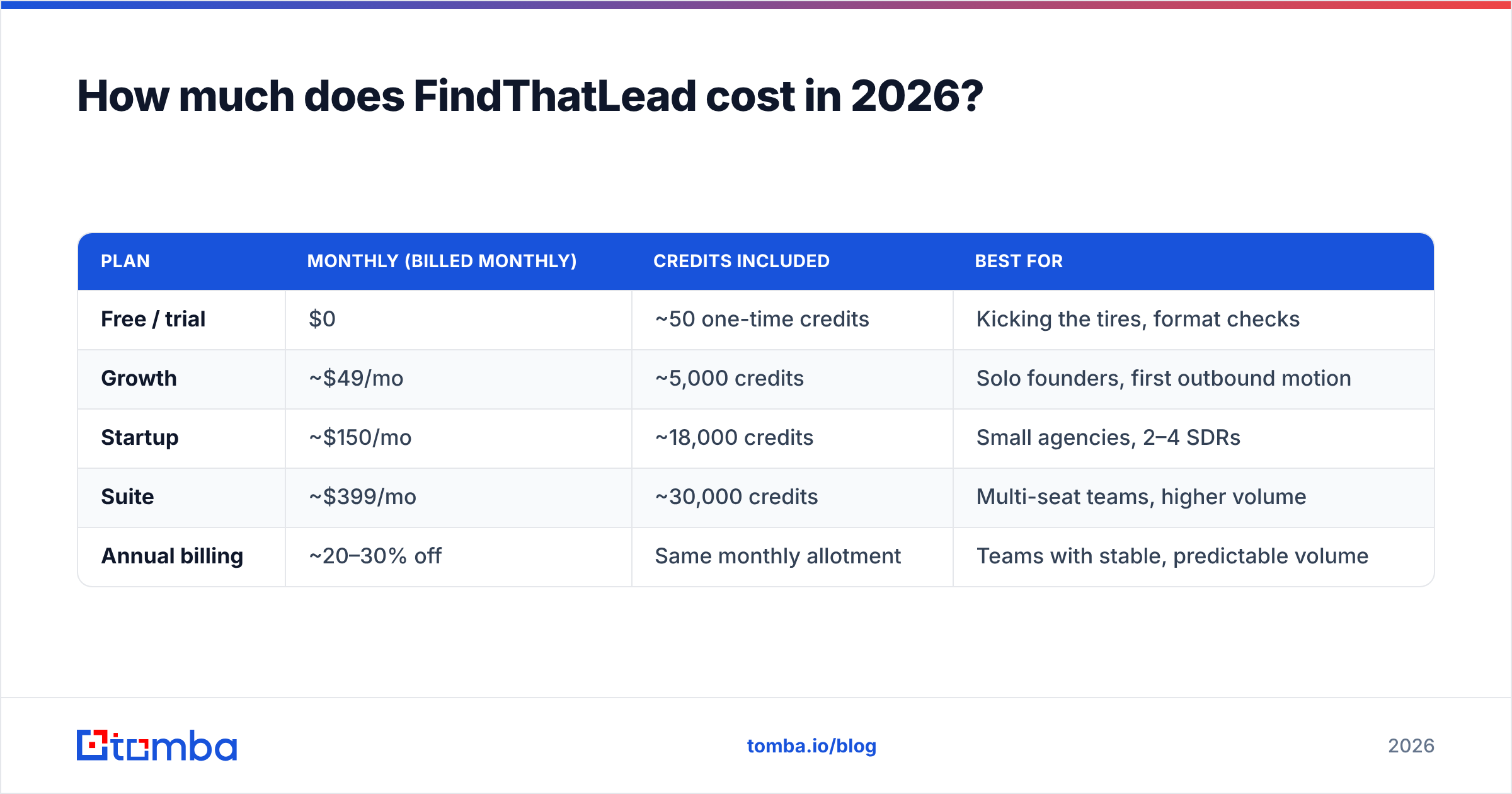
Here's the published structure at the time of writing. Vendors move numbers quietly, so treat this as the shape of the pricing rather than a contract, and confirm on findthatlead.com before you buy.
| Plan | Monthly (billed monthly) | Credits included | Best for |
|---|---|---|---|
| Free / trial | $0 | ~50 one-time credits | Kicking the tires, format checks |
| Growth | ~$49/mo | ~5,000 credits | Solo founders, first outbound motion |
| Startup | ~$150/mo | ~18,000 credits | Small agencies, 2–4 SDRs |
| Suite | ~$399/mo | ~30,000 credits | Multi-seat teams, higher volume |
| Annual billing | ~20–30% off | Same monthly allotment | Teams with stable, predictable volume |
Two things stand out immediately.
First, the jump from Growth to Startup triples your price but roughly 3.6x's your credits — so the per-credit rate improves as you scale, which is normal and fair. At Growth you're paying roughly $0.0098 per credit; at Startup, about $0.0083; at Suite, about $0.0133. That last number is the odd one. The Suite tier costs more per credit than Startup because you're paying for seats and team features, not additional data. If you're buying Suite purely for volume, you're overpaying — that plan exists for collaboration.
Second, credits do not roll over on standard plans. Under-use one month and the balance evaporates. Over-use and you're either topping up or throttled until the reset. That combination punishes lumpy, campaign-driven usage, which is exactly how most small teams actually work.
What consumes a FindThatLead credit?#
This is where the advertised price and the real price separate. Credit accounting varies by action, and most people budget as if 1 credit = 1 usable email. It doesn't.
- A single email search — you supply name + domain, you get a candidate address. Costs a credit whether or not the result is high confidence.
- A domain / company search — pulling a list of contacts at one company. Each returned contact typically draws its own credit, so one search on a 40-person company can cost 40.
- A verification — checking an address you already have. Charged separately from the find, meaning a find-then-verify workflow on the same contact costs you twice.
- A prospecting search from the database — filtered lead pulls charge per revealed contact, and reveals include contacts you'll immediately discard for bad titles or wrong geography.
- An enrichment call — adding company size, industry, or social profiles to an existing row draws additional credits on top of everything above.
- Bulk uploads — a CSV run charges per row processed, including rows that return nothing at all.
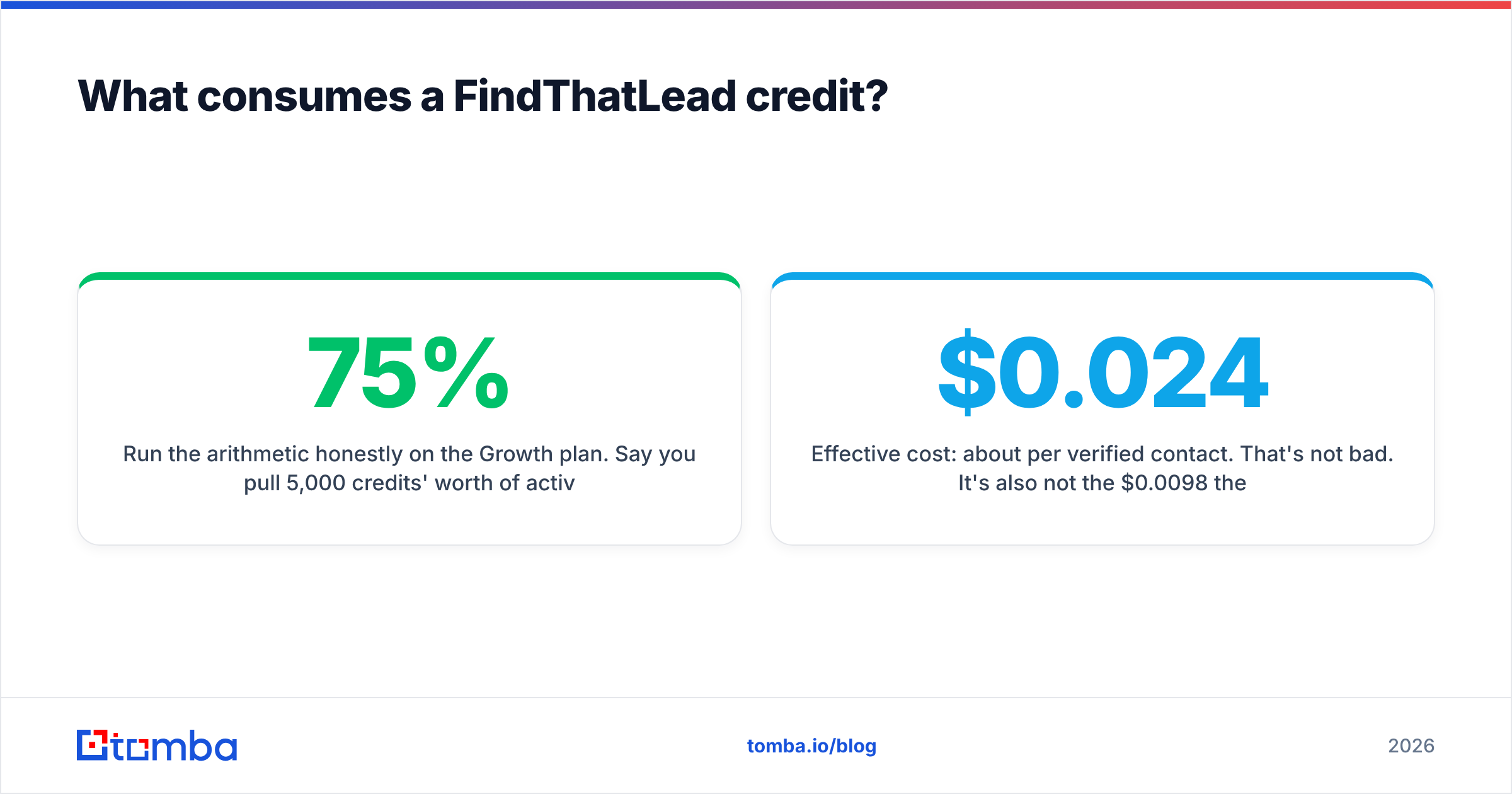
Run the arithmetic honestly on the Growth plan. Say you pull 5,000 credits' worth of activity but split it 60/40 between finding and verifying: that's roughly 3,000 finds. At a realistic 65–75% hit rate for a mixed-quality domain list, you land somewhere around 2,000–2,250 addresses. Verify those and you spend most of your remaining 2,000 credits. You end the month with roughly 2,000 verified contacts from a plan sold as "5,000."
Effective cost: about $0.024 per verified contact. That's not bad. It's also not the $0.0098 the pricing page implies.
Does FindThatLead's accuracy justify the price?#
Cost per credit is meaningless without a hit rate attached to it. A tool that charges half as much but finds half as many valid addresses is exactly the same deal, minus the wasted hours.
Independent review data on G2 puts FindThatLead in respectable-but-not-leading territory: users consistently praise the all-in-one convenience and the Chrome extension, while the most common complaint across reviews is result quality on smaller or non-US companies, plus credits burned on inconclusive lookups. That pattern is typical of tools that lean heavily on pattern-guessing plus a modest verification layer.

The practical implication for your budget: whatever tool you pick, treat the finder's output as a hypothesis and run a real email verifier before anything hits your sequencer. Providers now judge you on complaint and bounce signals well before they judge your copy, and a 6% bounce rate will cost you more in lost domain reputation than any credit pack you'll ever buy. If your finder doesn't bundle solid SMTP-level verification, budget for it separately — that's a real line item, not an optional extra.
Catch-all domains are the specific trap. Roughly a fifth of B2B domains accept everything at the gateway, so a naive verifier marks them "valid" and you find out the truth from your bounce report. A dedicated catch-all verifier is the difference between a clean list and a domain reputation problem you'll spend six weeks unwinding.
How does FindThatLead pricing compare to the alternatives?#
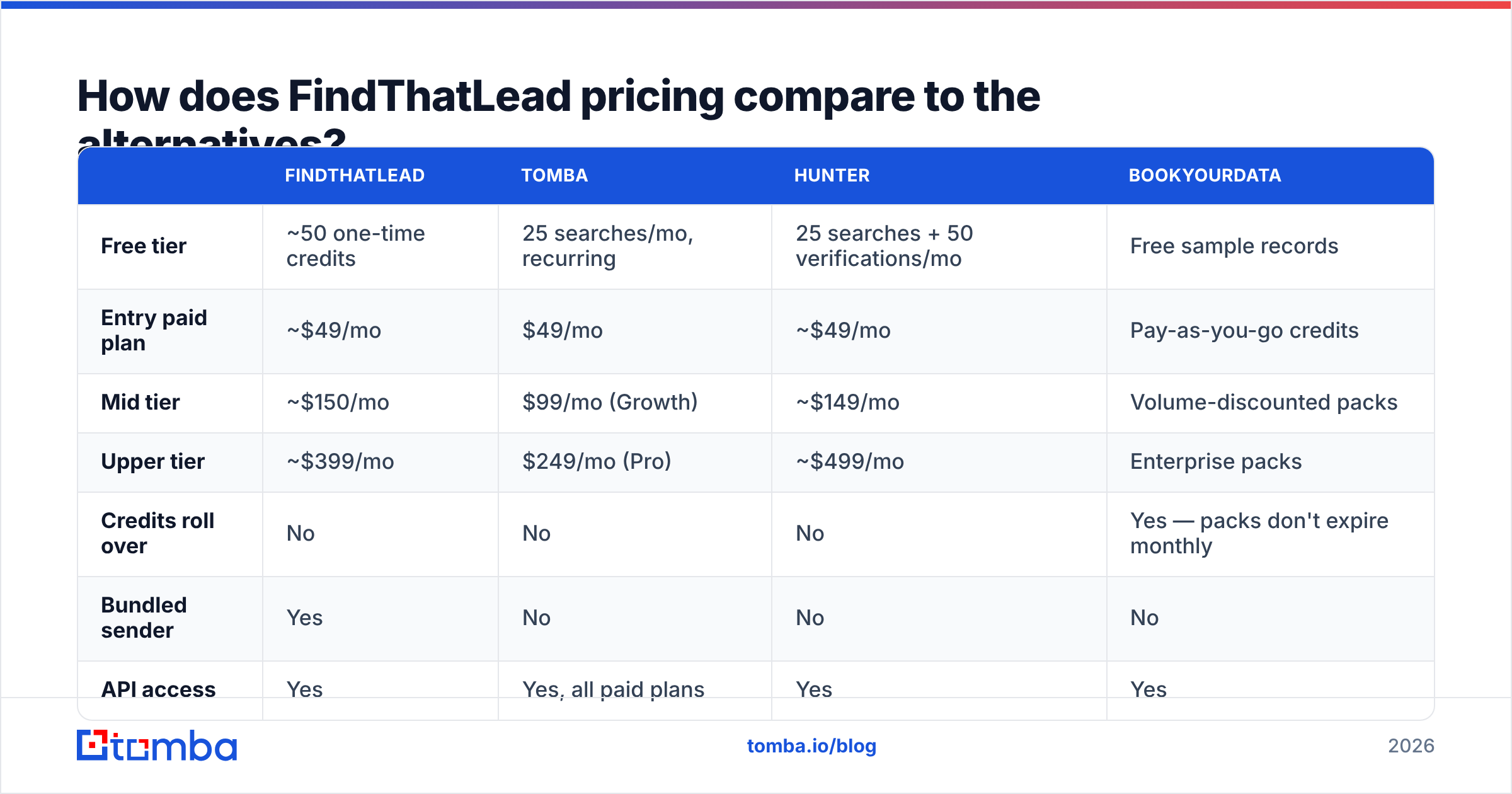
This is the comparison most people actually want. All figures are entry-tier, monthly billing, at time of writing.
| FindThatLead | Tomba | Hunter | BookYourData | |
|---|---|---|---|---|
| Free tier | ~50 one-time credits | 25 searches/mo, recurring | 25 searches + 50 verifications/mo | Free sample records |
| Entry paid plan | ~$49/mo | $49/mo | ~$49/mo | Pay-as-you-go credits |
| Mid tier | ~$150/mo | $99/mo (Growth) | ~$149/mo | Volume-discounted packs |
| Upper tier | ~$399/mo | $249/mo (Pro) | ~$499/mo | Enterprise packs |
| Credits roll over | No | No | No | Yes — packs don't expire monthly |
| Bundled sender | Yes | No | No | No |
| API access | Yes | Yes, all paid plans | Yes | Yes |
| Catch-all handling | Basic | Dedicated catch-all verifier | Partial | Verified-at-source lists |
| Best fit | No existing outbound stack | Finding + verification at volume | Simple domain-level lookups | One-off verified list purchases |

Read that table by intent, not by price.
If you have no sending tool, FindThatLead's bundle is legitimately efficient. Buying a finder plus a sequencer separately starts near $80–100/mo combined, so $49 all-in is a real saving in year one.
If you already send from Instantly, Smartlead, or your own SMTP, you're paying a bundle premium for shelf-ware. At $49/mo Tomba's Starter plan puts the entire budget into finding, verifying, catch-all checking, and enrichment, and the $99/mo Growth tier scales that further without the Suite-tier per-credit penalty. Hunter is the cleanest choice if your workflow is overwhelmingly "give me the pattern for this domain."
If you buy lists in bursts rather than subscribing, BookYourData is worth a serious look. Its pay-as-you-go credits don't reset monthly, which solves the exact problem that kills subscription value for seasonal or campaign-driven teams — you buy 10,000 verified records, use them across four months, and nothing expires. For agencies with unpredictable client onboarding cycles, that model often beats any monthly plan on pure economics.

What are the hidden costs in FindThatLead's plans?#
Four things reliably surprise people after they subscribe.
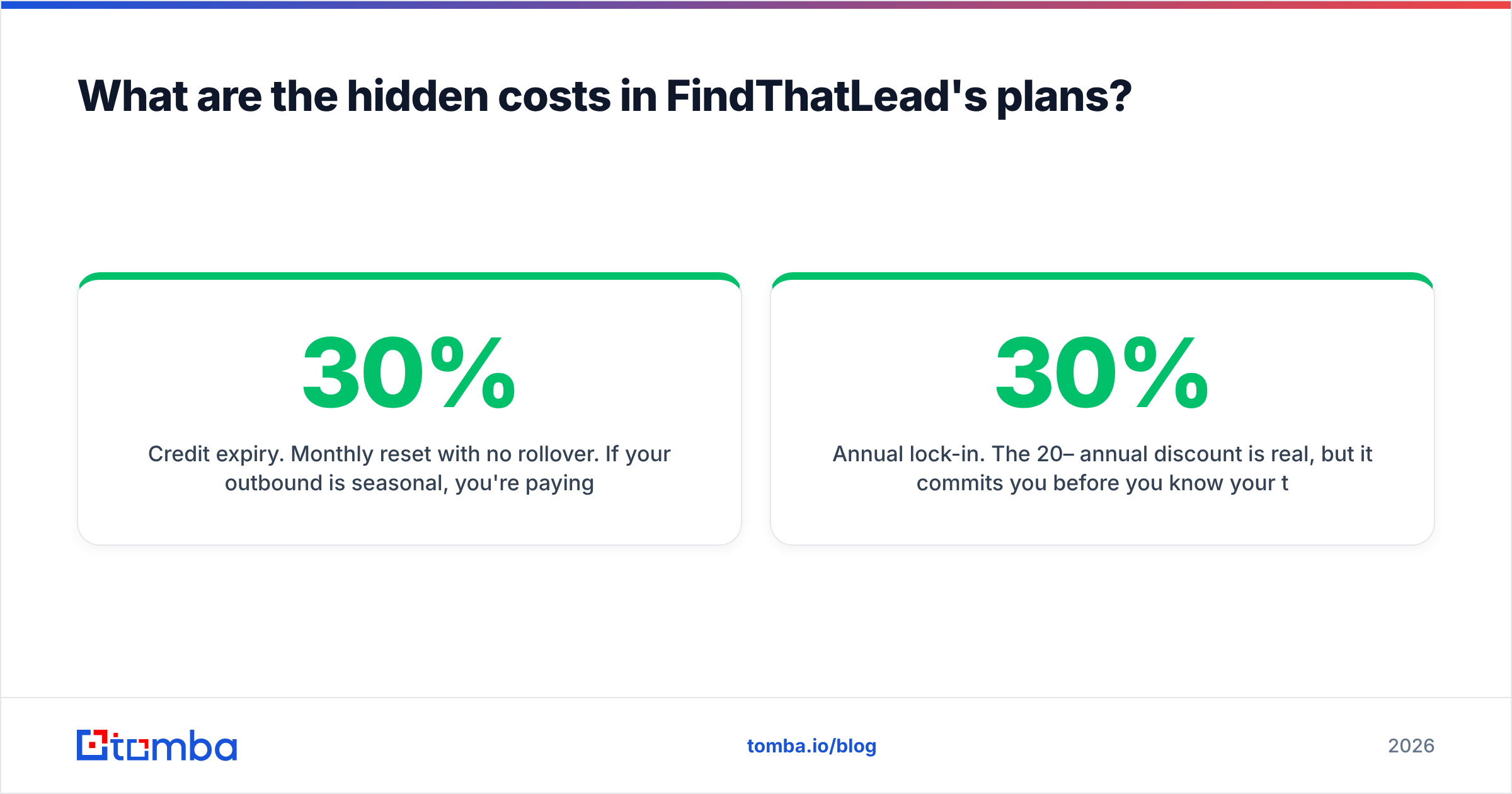
- Credit expiry. Monthly reset with no rollover. If your outbound is seasonal, you're paying full price for months where you use 30% of the allowance. Over a year that's a silent 20–40% overspend.
- Double-charging the same contact. Find and verify are separate deductions. Any workflow that treats verification as mandatory — which it should be — effectively halves your headline credit count.
- Seat costs at the top tier. Suite's worse per-credit rate is really a seat charge in disguise. Confirm how many users you need before assuming the top plan is the volume plan.
- Annual lock-in. The 20–30% annual discount is real, but it commits you before you know your true hit rate on your target market. Run one full month monthly-billed, measure cost per verified contact against your own domain list, then decide.
A useful discipline: before committing to any annual plan, run the same 200 target domains through two or three free tiers and compare not the number of results but the number of results that survive verification. Tomba's free tier gives 25 searches a month on a recurring basis, Hunter's gives 25 searches plus 50 verifications, and most vendors will extend a trial if you ask. That single afternoon of testing is worth more than any review roundup, including this one.
Which FindThatLead plan should you buy?#
- Free tier — only for confirming the tool resolves your specific market. Fifty credits is a sample, not a test.
- Growth (~$49/mo) — correct for a solo founder doing 200–400 outbound contacts a month with no other sending tool. Below that volume, use free tiers and a bulk email finder on demand instead.
- Startup (~$150/mo) — the sweet spot on per-credit economics. If you're going to exceed Growth's allowance two months running, move here rather than topping up.
- Suite (~$399/mo) — buy this for seats and shared workspaces, not for volume. If you need volume without seats, a cheaper plan on a dedicated finder plus a top-up will cost less.
- Skip entirely — if your stack already includes a sequencer and a CRM, and what you're missing is data quality. That's a finder-and-verifier problem, and bundles don't solve it.
How do you cut data spend without ripping out your stack?#
Three moves that work regardless of which vendor you land on.
Dedupe before you search, not after. Every duplicate row in your upload is a credit you set on fire. Running your list through a deduplication pass first routinely cuts 8–15% off a bulk job.
Search at the domain level, then filter. Pulling contacts by domain and filtering by title in your own spreadsheet is usually cheaper than running individual name-plus-domain lookups, especially at companies where you want three or four contacts. A domain search returns the org chart slice in one pass.
Verify once, at the end. Don't verify at import, again after enrichment, and again before send. Pick one point — immediately before the list enters your sequencer — and verify there. You'll cut verification spend by a third and catch decay that earlier checks would have missed anyway.
Is FindThatLead worth it in 2026?#
Conditionally, yes. If you have no outbound stack and want one subscription that covers sourcing through sending, the ~$49 Growth plan is a defensible first purchase, and the Startup tier has the best per-credit economics in the lineup. Reviews on Capterra and G2 back that up: convenience is the consistent win.
But if your problem is data quality rather than tooling breadth — if you already send fine and your bounce rate is the thing keeping you up — a bundle is the wrong shape of purchase. You'd be spreading $49 across four modules when you need it concentrated in one.
Run the honest number on your own list before you commit: total monthly spend divided by contacts that actually survive verification. That figure, not the pricing page, is what you're really buying.
If that math points you toward a dedicated finder, start with the Tomba Email Finder. The free tier gives you 25 searches a month with no card, Starter is $49/mo, Growth is $99/mo, and every paid plan includes API access, catch-all verification, and enrichment in the same credit pool — so the number on the invoice is much closer to the number of contacts you can actually email.
Related guides#
Ready to find emails that actually work?
Join 150,000+ professionals who stopped guessing and started sending. Free credits on signup — no credit card required.
Get the Tomba newsletter
Practical outbound tactics and product updates — once every two weeks.
About the author