FindThatLead Pros and Cons: Honest 2026 Review and Verdict
FindThatLead is fast, cheap to start, and bundles a cold-email sender. It also burns credits on unverified guesses and thins out outside Europe. Here is the honest breakdown before you commit a year.
TL;DR — FindThatLead pros and cons in one minute
- FindThatLead is one login for four jobs: email finder, domain search, a LinkedIn extension, and a cold-email sender.
- The pros: fast hits on European SMB domains, a bundled sender, and a Chrome extension that stays out of your way.
- The cons: credits burn on guesses, coverage thins outside Europe, and verification trails dedicated tools.
- Entry pricing sits near $49 a month for about 5,000 credits. A failed search can still cost you one.
- Already own a sequencer and need clean data? A focused finder like Tomba returns more usable emails per dollar.
What is FindThatLead?#
FindThatLead is a B2B prospecting tool built in Barcelona. It tries to cover the whole top of the funnel in one product. You give it a domain, a name, or a LinkedIn profile. It hands back a business email. You can load those contacts into its own sender and start emailing. No CSV export needed.
Think of a Swiss Army knife next to a chef's knife. The Swiss Army knife does eight things at arm's reach. The chef's knife does one thing better than anything else in the drawer. FindThatLead is the multi-tool. Whether that suits you depends on how much you cook.
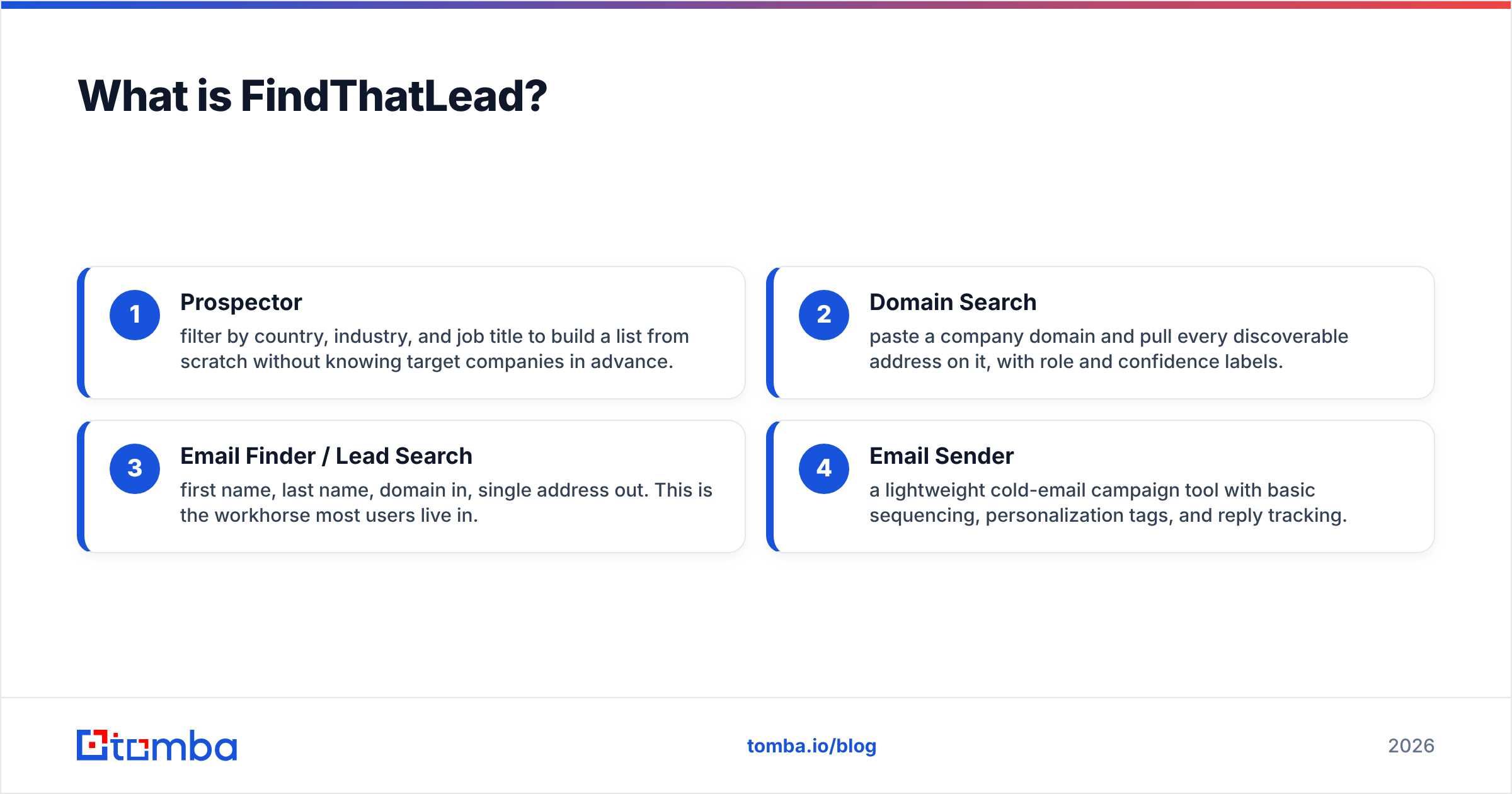
Any FindThatLead pros and cons review starts with the four modules:
- Prospector — filter by country, industry, and job title. You build a list without knowing the target firms first.
- Domain Search — paste a company domain and pull every address on it, with role and confidence labels.
- Email Finder — first name, last name, domain in. One address out. Most users live here.
- Email Sender — a light cold-email tool with basic sequences, merge tags, and reply tracking.
The bundle is the selling point. Most rivals make you buy data from one vendor and sending from another. Plans shift often, so check the official FindThatLead site before you sign.
What are the real FindThatLead pros?#
The upside of FindThatLead pros and cons is short but real. This tool has lasted a decade in a brutal market.
It is fast on European SMB domains. Say you sell to Spanish, French, Italian, or Portuguese firms under 200 staff. The hit rate holds up well against pricier US databases. That regional edge is real and rarely discussed.
The Chrome extension does not fight you. Open a LinkedIn profile, click, get an address. No modal stack. No upsell screen. No forced list step. It is a small win, but you feel it 200 times a day.
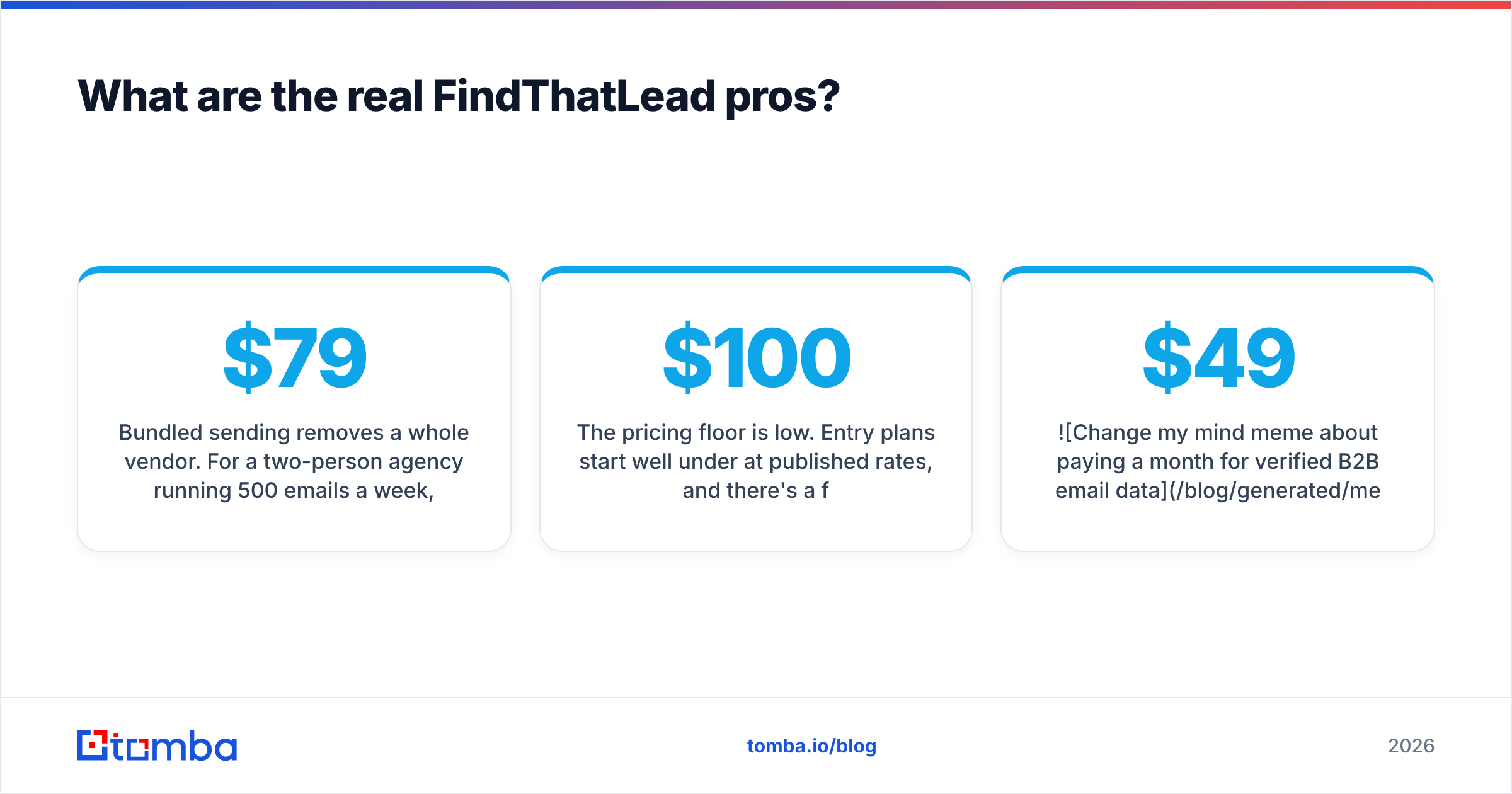
The bundled sender cuts out a vendor. Picture a two-person agency sending 500 emails a week. The built-in sender kills a $79 sequencer, one integration, and a sync bug you would debug on a Friday. At small scale, that is real money.
Prospector solves the blank page. Most finders assume you already have a target list. Prospector builds one from filters alone. It helps at the "we don't know who to call yet" stage, not just the "find this person's email" stage.
The price floor is low. Entry plans start under $100 a month. A free trial lets you test coverage against your own ICP before you spend.

What are the biggest FindThatLead cons?#
Now the part vendor pages skip. The downside of FindThatLead pros and cons runs longer.
Credits vanish on results you did not want. This is the top complaint on review sites. In some modules, a weak guess or a role-based catch-all still draws down your balance. Say you buy 5,000 credits and 1,200 come back unusable. Your real cost per contact almost doubles.
Verification is the weak link. The tool shows confidence scores. The checks behind them are lighter than a dedicated verifier. Users often run exports through a second tool before they send. On a fresh domain, that step is not optional. A 6% bounce rate can wreck your sender name in one campaign. Push anything shaky through an email verifier first.
Catch-all domains are a coin flip. Every finder struggles here. FindThatLead returns catch-all addresses with mid-range scores and leaves the call to you. Most large firms run catch-all mail servers. Without a catch-all verifier, you are guessing on a big slice of them.
Coverage thins outside Europe. US mid-market, US enterprise, and APAC all lag the specialists. Chasing a 3,000-person American SaaS firm? You will see gaps.
The sender is fine, not great. It lacks the inbox rotation, warmup, and delivery reports of a real cold-email platform. Good for low volume. Not what you scale on.
Billing friction shows up in reviews. Cancel and downgrade gripes repeat on G2 and Capterra. Read recent reviews, not the average score. Averages skew old.
How accurate is FindThatLead compared to other email finders?#
Accuracy settles the FindThatLead pros and cons debate. Every other feature rides on whether the address is real.

Three numbers matter. Vendors love to blur them together.
- Hit rate — of 100 lookups, how many return an address. FindThatLead scores well here, partly because it will guess a pattern.
- Accuracy rate — of the addresses returned, how many land. Guessing costs you here.
- Usable yield — hit rate times accuracy, minus the role and catch-all addresses you would never mail. Only this number maps to pipeline.
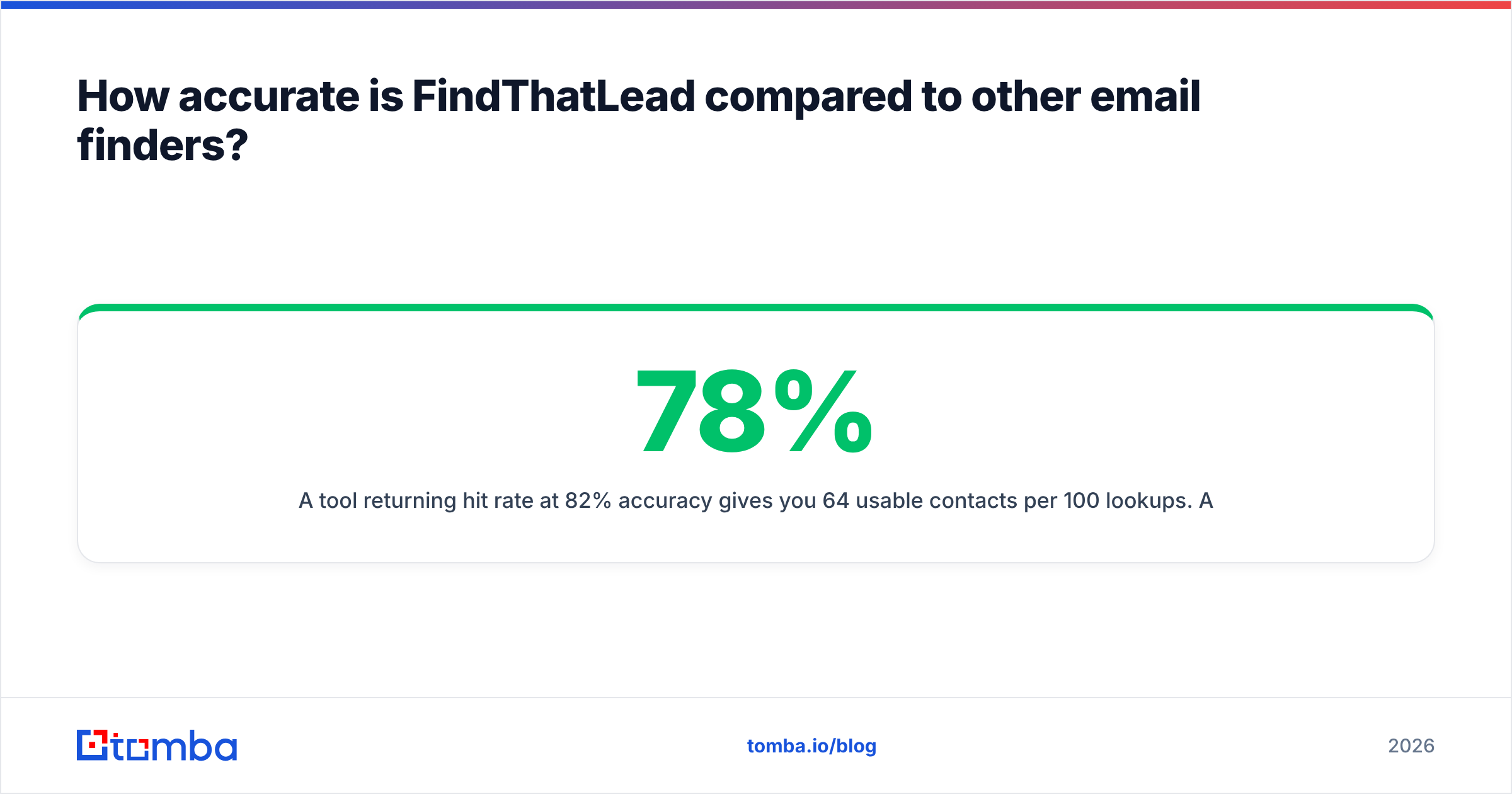
A 78% hit rate at 82% accuracy gives you 64 usable contacts per 100 lookups. A 68% hit rate at 96% accuracy gives you 65. Same yield, far less bounce risk. So compare tools on yield, not on the big number in the hero section.
The test costs one hour. Take 100 contacts whose addresses you already trust. Strip the emails. Run the list through each free trial. Your own ICP is the only benchmark that counts. Tomba lists its data sources so you can check where each result came from.
How does FindThatLead pricing compare in 2026?#
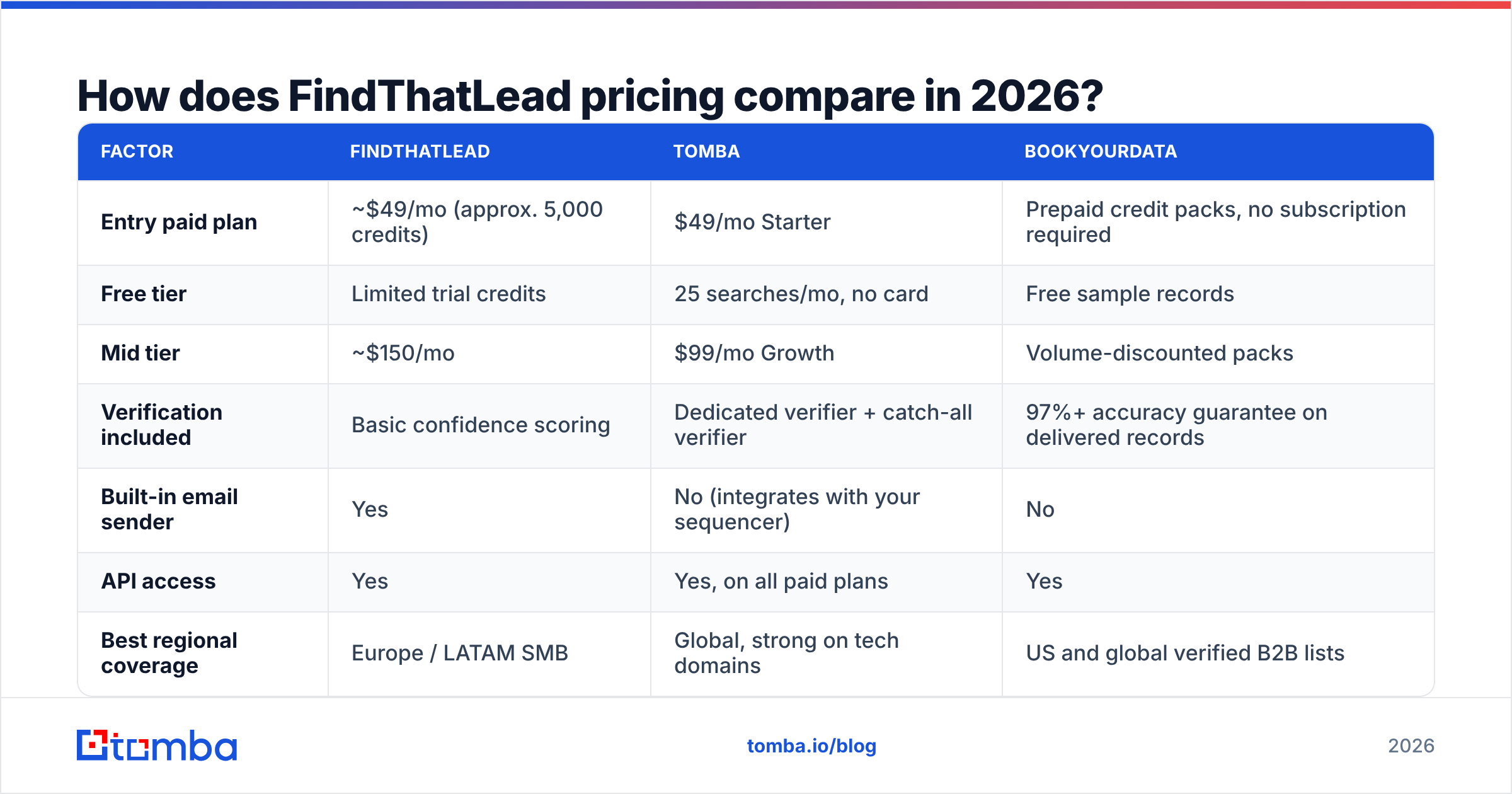
Price is where the FindThatLead pros and cons get personal. Plans move, so treat these numbers as rough and check them at signup. One question never moves: what does one usable, verified contact cost you?
| Factor | FindThatLead | Tomba | BookYourData |
|---|---|---|---|
| Entry paid plan | ~$49/mo (approx. 5,000 credits) | $49/mo Starter | Prepaid credit packs, no subscription required |
| Free tier | Limited trial credits | 25 searches/mo, no card | Free sample records |
| Mid tier | ~$150/mo | $99/mo Growth | Volume-discounted packs |
| Verification included | Basic confidence scoring | Dedicated verifier + catch-all verifier | 97%+ accuracy guarantee on delivered records |
| Built-in email sender | Yes | No (integrates with your sequencer) | No |
| API access | Yes | Yes, on all paid plans | Yes |
| Best regional coverage | Europe / LATAM SMB | Global, strong on tech domains | US and global verified B2B lists |
| Bulk workflow | CSV upload | Bulk finder + verifier | Prebuilt list download |
| Credit charged on failed lookup | Sometimes, module-dependent | No charge for no-result | Pay only for delivered records |

Three honest notes on that table.
FindThatLead and Tomba share the same headline price. The gap is what a credit buys. One returns more results, guesses included. The other returns fewer results with tighter checks, and bills nothing for an empty search. Pick on your bottleneck: volume or delivery.
BookYourData plays a different game. It sells prepaid, pre-verified records instead of a search plan. That suits teams who want a clean list handed over. If you buy one big list per quarter, that model is often cheaper and less fiddly than any subscription.
The bundled sender saves you $50 to $80 a month. That only counts if it is good enough for your volume. Above a few thousand sends a month, you will buy a real sequencer anyway. Then the bundle stops being a discount.
See Tomba pricing for the full tiers, including the Pro plan at $249 a month for high-volume teams.
Who should use FindThatLead, and who should skip it?#
Your setup decides how the FindThatLead pros and cons land.
Good fit if you are:
- A solo founder or two-person agency in Europe. You sell to SMBs, send under 1,000 emails a month, and want one bill instead of three.
- Early in list building. You have no target account list yet, so Prospector's filters beat domain-by-domain lookups.
- Price-sensitive and volume-tolerant. You would rather over-fetch and clean up later than pay more for precision.
Poor fit if you are:
- Selling into US enterprise or APAC. Coverage gaps will cap your pipeline before you spot the cause.
- Running a fresh sending domain. A 5–8% bounce rate costs you more in delivery than you saved on data.
- Scaling with a real sequencer already in place. You are paying for a sending module you will never open.
- Building an automated data pipeline. You need clean API responses, not a bundled UI you never log into.
That last case drives most migrations. Once contact finding lives inside a workflow, you want a focused email finder API that behaves the same way every time.
What are the best FindThatLead alternatives in 2026?#
If the cons in this FindThatLead pros and cons review hit home, the swaps fall into three groups.
Focused finders and verifiers. These tools do one job: return a correct address and prove it lands. Tomba sits here, with domain search, a catch-all verifier, a phone finder, and enrichment around the core finder. You pair it with the sequencer you already trust.
Prepaid list vendors. BookYourData and its peers sell verified records outright. Good when you would rather buy a clean 5,000-contact list once than watch a monthly credit balance. Their accuracy guarantee removes the verify step too.
Full GTM platforms. Apollo, ZoomInfo, and friends bundle data, intent signals, dialers, and sequencing. They do more, cost far more, and are usually overkill under five sales reps.
Pick by bottleneck. If you cannot find enough addresses, a bigger database helps. If your addresses keep bouncing, more volume fixes nothing. You need better verification. Most teams who leave FindThatLead sit in the second group and misread themselves as the first.
What's the verdict on FindThatLead pros and cons?#
The FindThatLead pros and cons balance out like this. It is a fair-priced tool that does four things well enough, rather than one thing brilliantly. For a European SMB seller at modest volume, the bundle is good value and the gripes are survivable. If your revenue rides on delivery — fresh domains, enterprise targets, automated pipelines — the credit burn and the verify gap turn into real costs. They just never show up on the invoice.
Run the 100-contact test on your own ICP before you sign an annual deal. A vendor's score on a generic sample and its score on your market are often different numbers. Only one of them affects your quota.
If precision beats bundling for you, start with the Tomba Email Finder. The free tier gives 25 searches a month with no card. Starter runs $49 a month. No-result lookups cost you nothing. Run your 25 hardest domains through it, compare the yield with your current tool, and let the data pick.
Related guides#
Ready to find emails that actually work?
Join 150,000+ professionals who stopped guessing and started sending. Free credits on signup — no credit card required.
Get the Tomba newsletter
Practical outbound tactics and product updates — once every two weeks.
About the author