FindThatLead vs Getro (2026): Full Comparison and Verdict
FindThatLead finds B2B emails at scale. Getro runs talent networks and job boards for VCs and communities. Here is where they overlap, where they don't, and which one your team actually needs in 2026.
TL;DR
- They are not really competitors. FindThatLead is a B2B email finder and cold outreach platform. Getro is talent-network and job-board software for VC firms, accelerators, and communities. Buying one instead of the other usually means you scoped the problem wrong.
- Pick FindThatLead if the job is "get me verified contact data for people who don't know us yet, then email them."
- Pick Getro if the job is "make my portfolio companies' jobs discoverable to a community that already trusts us, and let members opt in."
- The overlap is thin: both touch company and people data, both can feed a CRM, and both get compared because agencies searching "lead generation for VC portfolios" hit both.
- The real decision is whether your growth motion is outbound interruption or inbound network activation. If it's outbound, contact accuracy is the whole ballgame — and that's where a dedicated email finder beats an all-in-one suite.
What is FindThatLead?#
FindThatLead is a Spanish-built B2B prospecting platform that has been around since 2015. Its core promise: give it a domain, a name, or a LinkedIn profile, and it returns a business email address. Around that core it stacks a lead search database, a Chrome extension, a bulk CSV processor, and a cold email sender called Scrab.in / Cold Email Sender depending on which part of the suite you land on.
The typical FindThatLead user is a solo founder, an agency, or a two-to-five-person SDR team that wants one login for finding and sending. You can read their positioning on the FindThatLead site directly.
What it is good at:
- Domain-to-email lookups. Feed it
stripe.comand get a list of publicly discoverable addresses with confidence scores. - Bulk enrichment from CSV. Upload first name, last name, domain — get emails back. This is the workflow most agencies actually use.
- Built-in sending. You don't need a separate sequencer for small volumes.
- Price accessibility. Entry tiers are cheap enough that a solo consultant can justify them without a procurement conversation.
What is Getro?#
Getro is a completely different animal. It builds talent networks and job boards for organizations that have a community: venture capital firms with portfolios, accelerators, private equity groups, professional associations, and university networks. Their products — GetroJobs and GetroConnect — aggregate open roles across every company in your portfolio and surface them on a branded board, then let candidates opt into a talent pool your member companies can search.
Check Getro's own site and you'll notice the language: "talent network," "portfolio," "members," "job board." Nowhere does it say "cold email." That's not an omission — it's the entire product philosophy. Getro is a permission-based, inbound system. People raise their hand, and companies in your network get access to them.
The buyer is usually a platform lead or talent partner at a VC firm, not a sales rep.

Why does anyone compare FindThatLead vs Getro?#
Three honest reasons, and none of them are "these tools do the same thing":
- Shared search intent. Agencies Googling "how do I reach people at VC-backed startups" get both in the results. One sells you the emails; the other sells the VC firm the board those startups post jobs on.
- Both are sold as "network growth" tools. The category language overlaps even when the mechanics don't.
- Budget competition inside one org. At a small accelerator, the same $300/month might go toward either outbound tooling or a branded job board. That's a real trade-off, even if the products aren't substitutes.
If you came here trying to decide between them, the useful reframe is: which growth motion am I funding this quarter? Everything else follows from that answer.
How do FindThatLead and Getro compare feature by feature?#
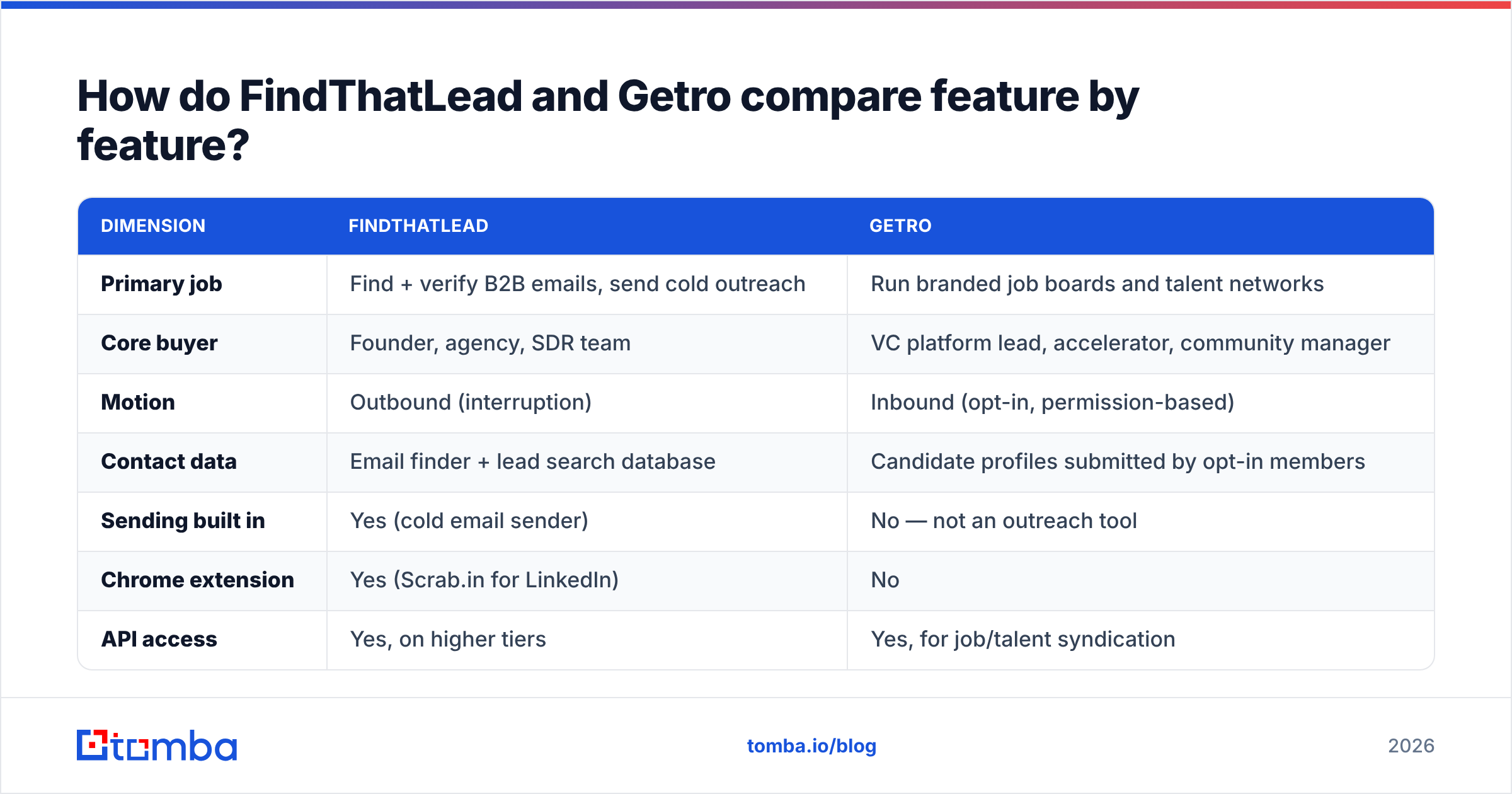
| Dimension | FindThatLead | Getro |
|---|---|---|
| Primary job | Find + verify B2B emails, send cold outreach | Run branded job boards and talent networks |
| Core buyer | Founder, agency, SDR team | VC platform lead, accelerator, community manager |
| Motion | Outbound (interruption) | Inbound (opt-in, permission-based) |
| Contact data | Email finder + lead search database | Candidate profiles submitted by opt-in members |
| Sending built in | Yes (cold email sender) | No — not an outreach tool |
| Chrome extension | Yes (Scrab.in for LinkedIn) | No |
| API access | Yes, on higher tiers | Yes, for job/talent syndication |
| Bulk CSV enrichment | Yes, core workflow | Not applicable |
| Job board hosting | No | Yes — the whole product |
| Typical contract | Monthly self-serve | Annual, quote-based |
| Best fit volume | 1k–50k contacts/month | 10–500 portfolio companies |
Read that table once and the "versus" framing collapses. There is exactly one row where they compete: both can be described as helping you connect with people. Every other row diverges.
What does each one actually cost?#
Pricing moves, so treat these as directional and confirm on each vendor's page before you commit budget.
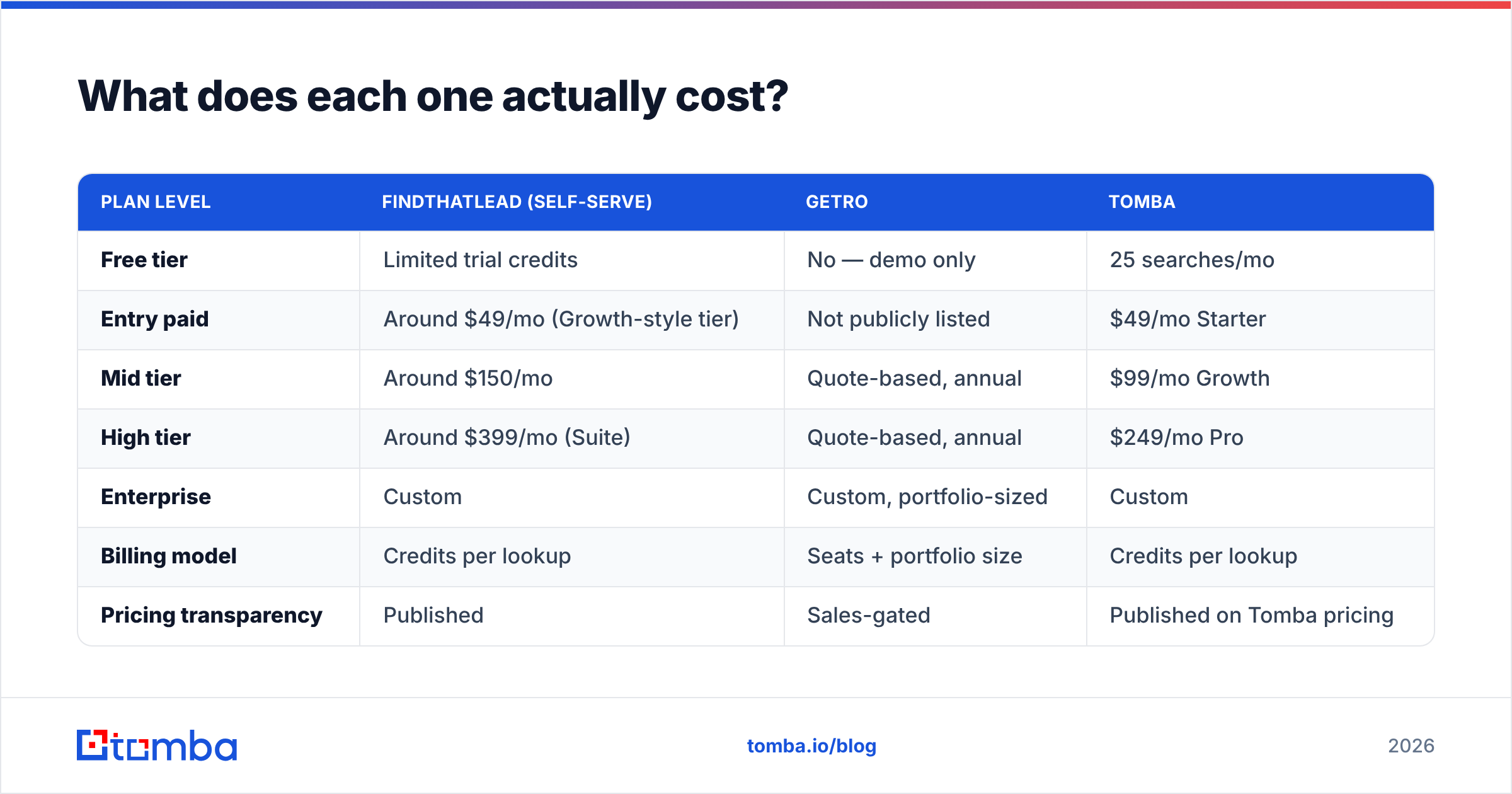
| Plan level | FindThatLead (self-serve) | Getro | Tomba |
|---|---|---|---|
| Free tier | Limited trial credits | No — demo only | 25 searches/mo |
| Entry paid | Around $49/mo (Growth-style tier) | Not publicly listed | $49/mo Starter |
| Mid tier | Around $150/mo | Quote-based, annual | $99/mo Growth |
| High tier | Around $399/mo (Suite) | Quote-based, annual | $249/mo Pro |
| Enterprise | Custom | Custom, portfolio-sized | Custom |
| Billing model | Credits per lookup | Seats + portfolio size | Credits per lookup |
| Pricing transparency | Published | Sales-gated | Published on Tomba pricing |
Two things worth flagging.
First: Getro's sales-gated pricing is not a knock. Talent-network software is genuinely priced against portfolio size and seat count. A 12-company seed fund and a 400-company growth fund are different implementations. Expect a discovery call and an annual contract.
Second: FindThatLead's credit model is where the surprise lives. Credits are typically consumed on attempts, not on successful, verified finds. If a batch returns a lot of low-confidence guesses, you paid for them. That's the mechanic behind most "I burned my monthly credits in four days" complaints you'll find in reviews on G2.

Which one wins for outbound prospecting?#
FindThatLead, uncontested — Getro doesn't play in this category at all. But "wins by default" is a low bar, and if outbound is your motion, the more useful question is whether FindThatLead is the best outbound tool, not whether it beats a job board.
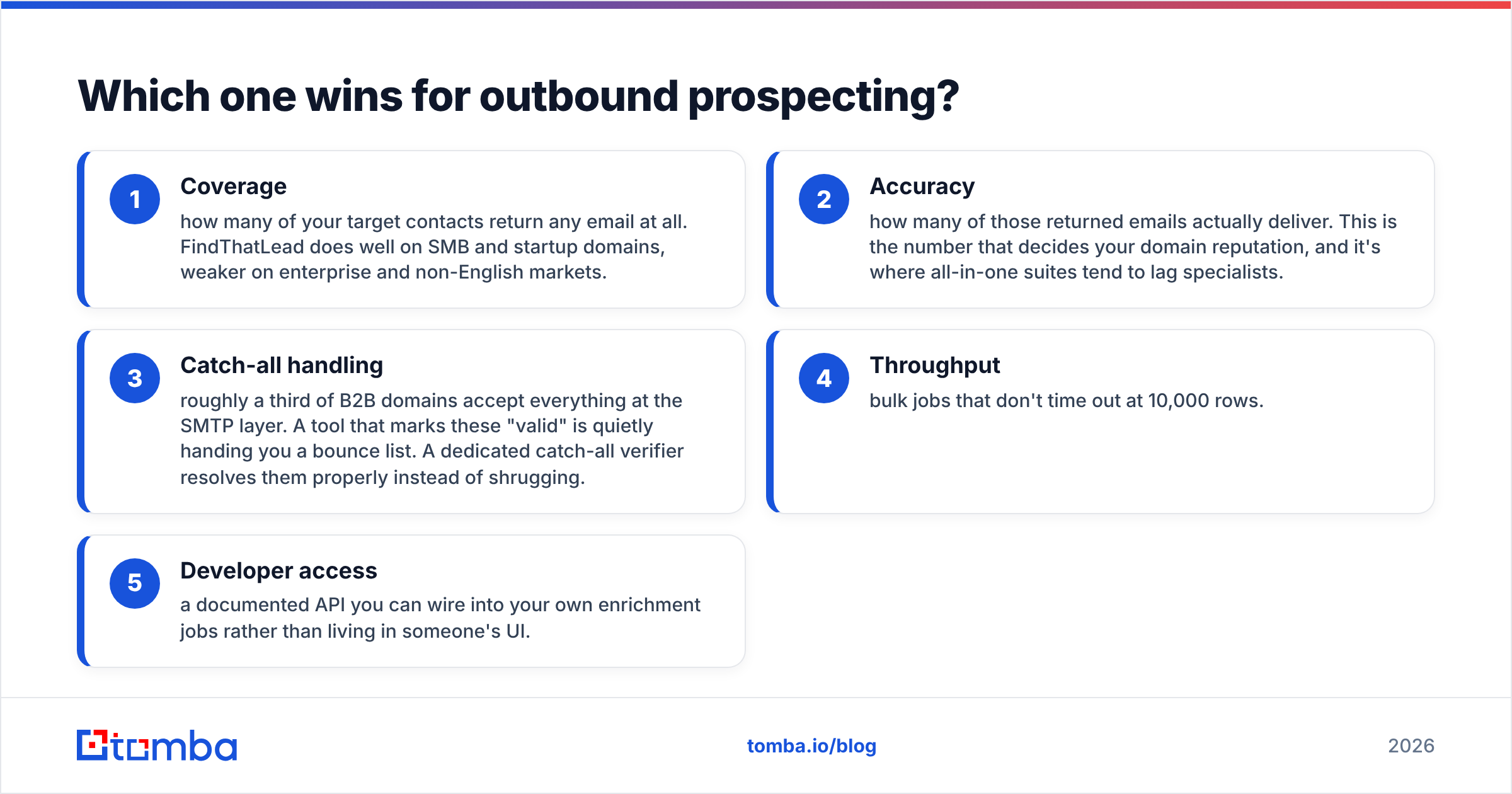
Here's the honest scorecard for outbound work:
- Coverage — how many of your target contacts return any email at all. FindThatLead does well on SMB and startup domains, weaker on enterprise and non-English markets.
- Accuracy — how many of those returned emails actually deliver. This is the number that decides your domain reputation, and it's where all-in-one suites tend to lag specialists.
- Catch-all handling — roughly a third of B2B domains accept everything at the SMTP layer. A tool that marks these "valid" is quietly handing you a bounce list. A dedicated catch-all verifier resolves them properly instead of shrugging.
- Throughput — bulk jobs that don't time out at 10,000 rows.
- Developer access — a documented API you can wire into your own enrichment jobs rather than living in someone's UI.
FindThatLead scores fine on 1 and 4, adequately on 5, and inconsistently on 2 and 3. That inconsistency is the single most expensive thing in cold outreach: a 30% bounce rate doesn't just waste credits, it damages sender reputation in ways that take weeks of warmup to repair.
If you're evaluating FindThatLead specifically for outbound, run a 200-contact bench test against your actual ICP before you buy annual. Split the same list across two tools, send to both, and compare bounce rates. That test costs you an afternoon and settles the argument permanently.
Which one wins for community and talent networks?#
Getro, and it isn't close — FindThatLead has no product in this space.
If you run a fund, an accelerator, or a paid community, Getro solves a specific and annoying operational problem: your portfolio companies post jobs across 30 different ATS instances, and nobody outside the fund can see them in one place. Getro aggregates those feeds, hosts a branded board, and gives candidates a single opt-in path into your network.
The strategic value is compounding. Every candidate who opts in becomes a durable asset for the whole portfolio, not a one-off placement. That's a genuinely different flywheel from outbound, and it's why the two tools rarely appear in the same budget line for long.
Where Getro is not the answer:
- You need to reach people who have never heard of your fund. Getro's pool is opt-in only.
- You're a product company with no community to activate.
- You need contact data for buyers, not candidates.
What are the honest weaknesses of each?#
FindThatLead's weak spots:
- Verification depth. The find-and-verify loop is bundled, which sounds convenient until you realize bundled verification is usually shallower than a dedicated email verifier running full SMTP, MX, and catch-all logic.
- Credit burn on failed lookups. Budget accordingly.
- Support responsiveness is a recurring theme in public reviews, particularly on refund and credit-reset requests.
- Jack-of-all-trades pressure. Finding, verifying, and sending in one product means engineering attention splits three ways. Specialists ship deeper on each layer.
Getro's weak spots:
- Sales-gated onboarding. You cannot try it in an afternoon. Plan for a multi-week cycle.
- Requires a real network. If you don't have 20+ companies and an audience, you're buying infrastructure for traffic you don't have.
- No outbound whatsoever. Do not buy Getro expecting lead generation in the sales sense.
- Annual commitment on a product whose ROI shows up over quarters, not weeks.
Neither of these is a damning list. They're the normal trade-offs of a self-serve suite versus an enterprise vertical SaaS.
How do they fit into the rest of your stack?#
Most teams that seriously evaluate either tool end up running a split stack rather than an all-in-one. The pattern looks like this:
- Data layer — a dedicated finder and verifier that owns accuracy. This is the layer you should never compromise on, because every downstream metric depends on it. Domain search for account-based lists, bulk lookups for CSV imports, verification before anything leaves the building.
- Sequencing layer — Instantly, Smartlead, Lemlist, or whatever your team already knows. Deliverability features here mature fast; you want to be able to swap.
- CRM layer — HubSpot or Salesforce as the system of record. HubSpot's own sales enablement guidance is a reasonable free baseline if you're building the process from scratch.
- Network layer — Getro, if and only if you have a community to activate.
The reason to decouple: when one vendor owns finding, verifying, and sending, a failure in any one of the three is invisible to you until bounces spike. Separate vendors give you separate telemetry.
Which should you choose in 2026?#
Use this as a decision list, in order:
- Do you need to email people who don't know you? → Outbound stack. Getro is irrelevant here.
- Do you run a fund, accelerator, or member community with 20+ companies? → Getro is worth the discovery call, independent of any outbound tooling.
- Are you a small agency or founder who values one login over best-in-class accuracy? → FindThatLead is a defensible choice at entry pricing.
- Is bounce rate already costing you inbox placement? → Split the stack. Put a specialist on the data layer and keep your sequencer.
- Do you need an API, CLI, or spreadsheet workflow rather than a dashboard? → Check developer access before you buy; this is where all-in-one suites are thinnest. Tomba's email finder API, Sheets add-on, and CLI exist precisely for this case.
The uncomfortable truth about the FindThatLead vs Getro comparison is that if you had a clear picture of your own motion, you'd never have run it. Sort the motion first. The tool falls out of that decision almost mechanically.
Where does Tomba fit?#
Only in one of these lanes — the data lane. Tomba doesn't build job boards and doesn't compete with Getro in any meaningful way. What it does is the thing outbound teams most often get wrong: returning email addresses that actually deliver.
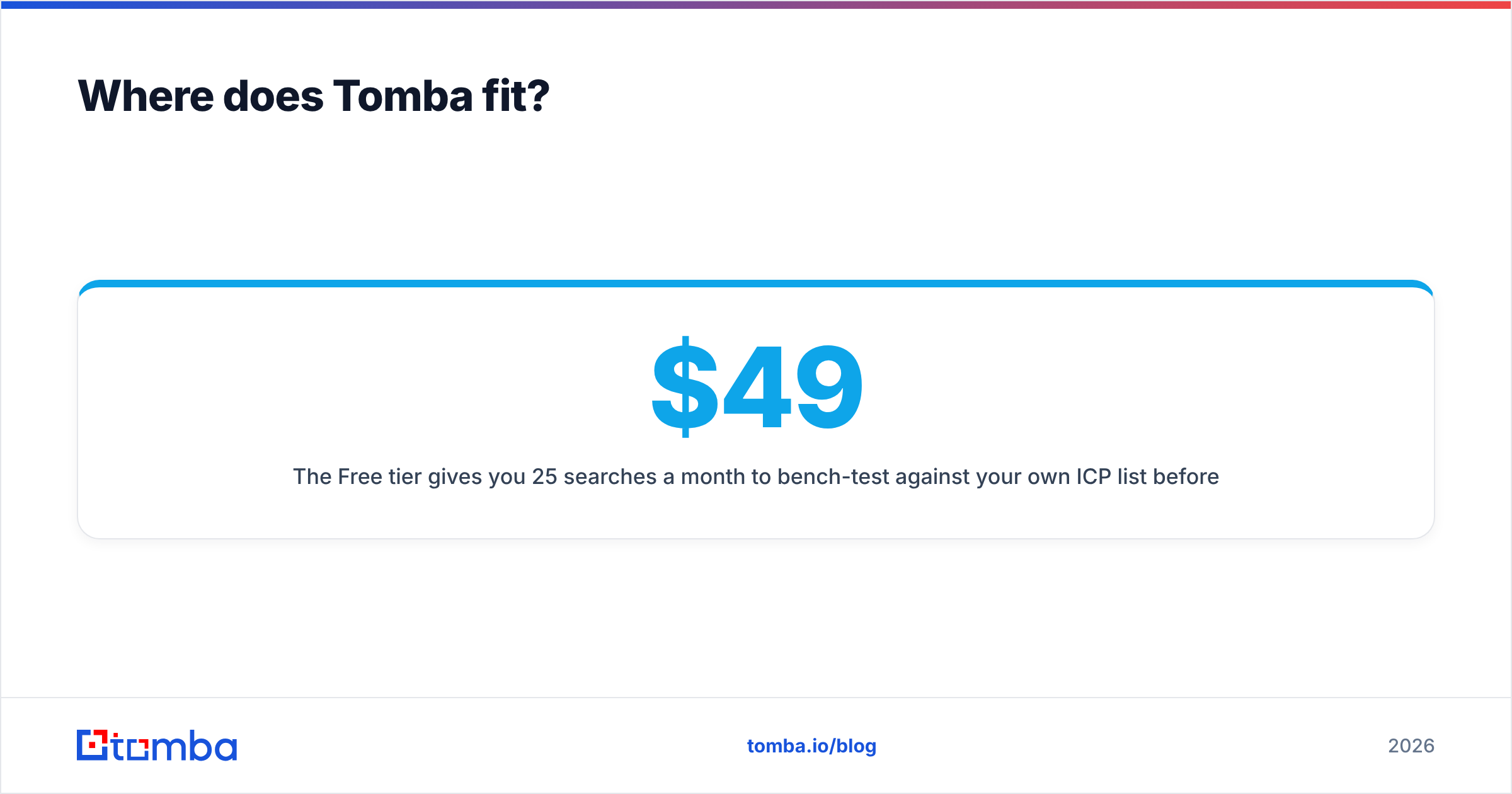
The Free tier gives you 25 searches a month to bench-test against your own ICP list before spending anything. Starter is $49/mo, Growth $99/mo, Pro $249/mo — published, no sales call required. Verification, catch-all resolution, domain search, phone lookup, and enrichment sit alongside the finder rather than being bolted on as an afterthought.
If your next quarter depends on outbound landing in real inboxes, start with the Tomba Email Finder, run the same 200-contact test you'd run on any vendor, and compare bounce rates. That number will tell you more than any comparison post — including this one.
Related guides#
Ready to find emails that actually work?
Join 150,000+ professionals who stopped guessing and started sending. Free credits on signup — no credit card required.
Get the Tomba newsletter
Practical outbound tactics and product updates — once every two weeks.
About the author