FindThatLead vs Goava: Which B2B Prospecting Tool Wins in 2026?
FindThatLead finds emails at volume. Goava scores Nordic accounts before you ever write one. They solve different halves of the same problem — here is which half you actually have.
TL;DR
- FindThatLead and Goava are not really competitors. FindThatLead is a volume email-finding and cold-outreach tool. Goava is a Nordic-focused sales intelligence platform that tells you which companies to call. Comparing them is comparing a drill to a blueprint.
- Pick FindThatLead if you already know your ICM and you need contact data plus a lightweight sender, cheap, self-serve, global.
- Pick Goava if you sell into Sweden, Norway, Denmark or Finland, run a seat-based AE team, and your bottleneck is account prioritisation — not email discovery.
- Pricing transparency splits them. FindThatLead publishes credit-based tiers you can buy with a card. Goava quotes annual contracts per seat and does not publish a price list.
- Most teams end up needing a third thing: a dedicated finder/verifier with an API so contact data stays fresh no matter which intelligence layer sits above it.
What are FindThatLead and Goava, actually?#
They sit at opposite ends of the outbound workflow, and that single fact explains almost every difference below.
FindThatLead launched out of Barcelona in 2015 and has always been a prospecting-first product. You give it a domain, a name, or a LinkedIn URL, and it returns a business email. Around that core it stacked a Prospector (build lists by role, industry, location), a Chrome extension, a bulk CSV processor, and a simple cold-email sender so you can go from list to send without leaving the tab. It is self-serve, credit-metered, and priced for founders and small agencies.
Goava is a different animal. It is a Swedish sales intelligence platform built on Nordic company registry data — financials, employee counts, org structure, tech signals, trigger events like funding rounds or leadership changes. Its pitch is not "find more contacts." It is "stop wasting AE hours on accounts that were never going to buy." Goava Discover scores and recommends accounts; Goava Insights pushes enrichment and signals into your CRM. Deployment is per-seat, contract-based, and usually involves onboarding.
So the honest framing of FindThatLead vs Goava is: one tool answers who is the person and what is their email, the other answers which company deserves your next hour.
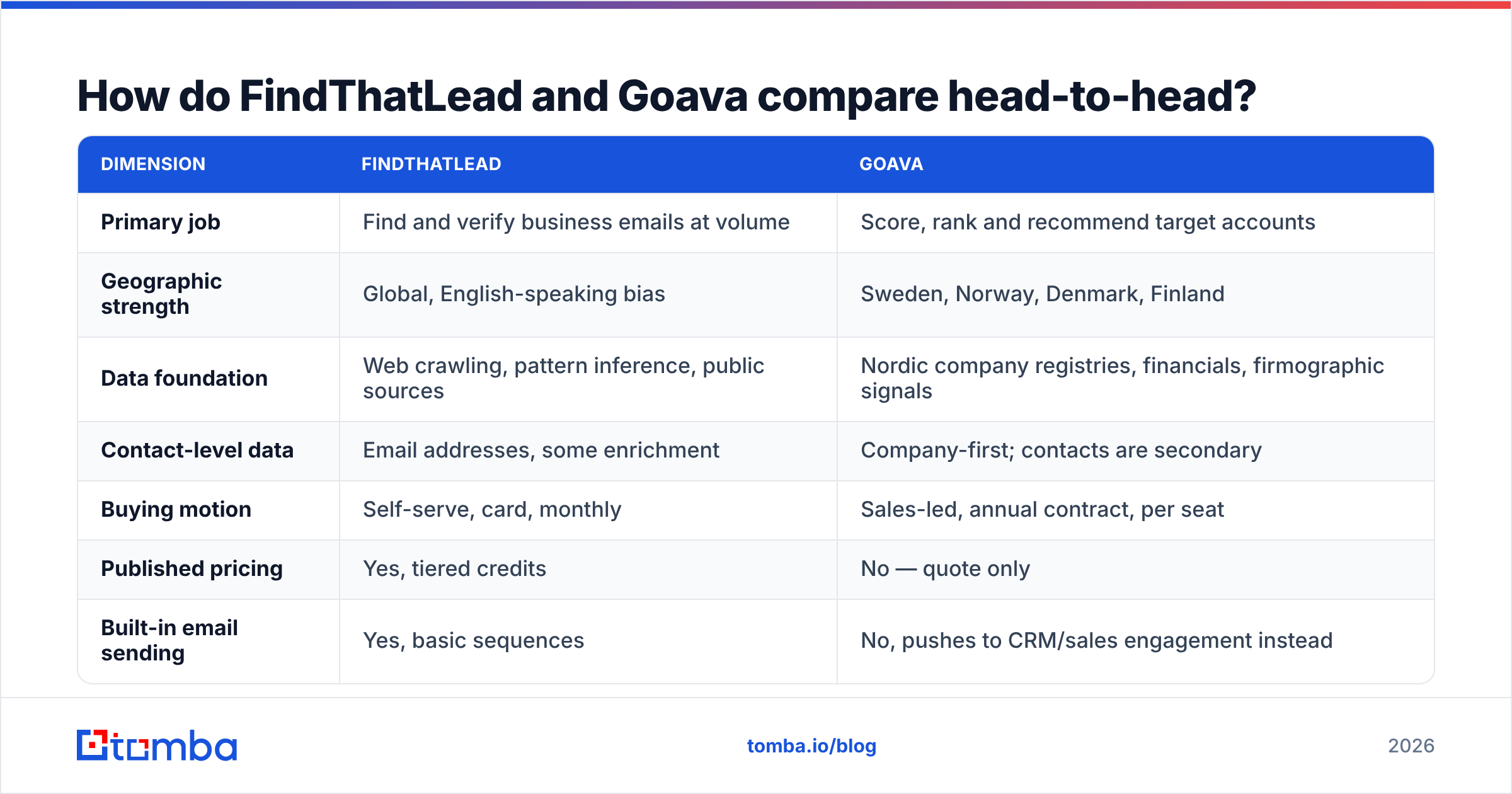
How do FindThatLead and Goava compare head-to-head?#
| Dimension | FindThatLead | Goava |
|---|---|---|
| Primary job | Find and verify business emails at volume | Score, rank and recommend target accounts |
| Geographic strength | Global, English-speaking bias | Sweden, Norway, Denmark, Finland |
| Data foundation | Web crawling, pattern inference, public sources | Nordic company registries, financials, firmographic signals |
| Contact-level data | Email addresses, some enrichment | Company-first; contacts are secondary |
| Buying motion | Self-serve, card, monthly | Sales-led, annual contract, per seat |
| Published pricing | Yes, tiered credits | No — quote only |
| Built-in email sending | Yes, basic sequences | No, pushes to CRM/sales engagement instead |
| CRM depth | Light (export, Zapier-style) | Deep native (HubSpot, Salesforce, Upsales, Lime, SuperOffice) |
| Best-fit team size | 1–20 reps | 10–200 reps with defined territories |
| Learning curve | Under an hour | Onboarding + admin configuration |
The pattern is consistent. FindThatLead optimises for speed to first email sent. Goava optimises for quality of the list before anyone sends anything.
Which one has better data coverage?#
Neither — because they are not measuring the same thing, and that distinction matters more than any hit-rate number you will see in a vendor deck.
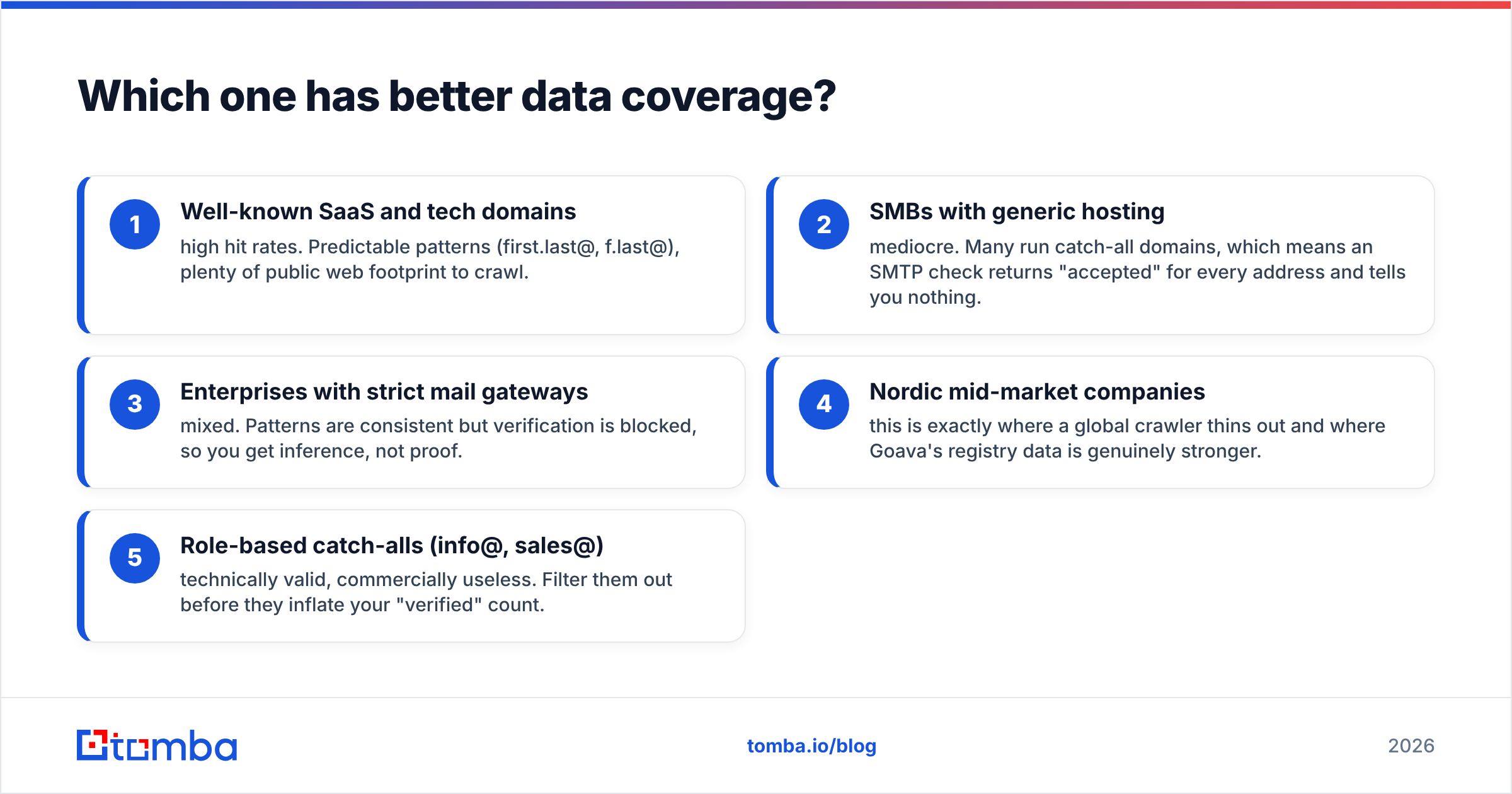
FindThatLead's coverage question is: of the 1,000 first-name/last-name/domain combinations I submit, how many come back with a deliverable email? In practice, expected results for tools in this class:
- Well-known SaaS and tech domains — high hit rates. Predictable patterns (first.last@, f.last@), plenty of public web footprint to crawl.
- SMBs with generic hosting — mediocre. Many run catch-all domains, which means an SMTP check returns "accepted" for every address and tells you nothing.
- Enterprises with strict mail gateways — mixed. Patterns are consistent but verification is blocked, so you get inference, not proof.
- Nordic mid-market companies — this is exactly where a global crawler thins out and where Goava's registry data is genuinely stronger.
- Role-based catch-alls (info@, sales@) — technically valid, commercially useless. Filter them out before they inflate your "verified" count.
Goava's coverage question is completely different: how many Swedish/Nordic companies do you hold, with what depth of financial and firmographic detail, and how current is it? Because it draws on official registry sources rather than crawling, its Nordic company records tend to be more complete and more structured than what any global scraper produces. Revenue bands, employee counts, board changes, and industry codes come from the source of record, not from an About page.
The trade: Goava's registry advantage is regional. Point it at a US mid-market account and you are outside its home turf. Point FindThatLead at a Swedish AB with a rarely-updated website and you will get a pattern guess with weak verification behind it.
If you want to sanity-check any vendor's claims, real reviews on G2 are more useful than the marketing site — filter by company size and region so you are reading users who look like you.
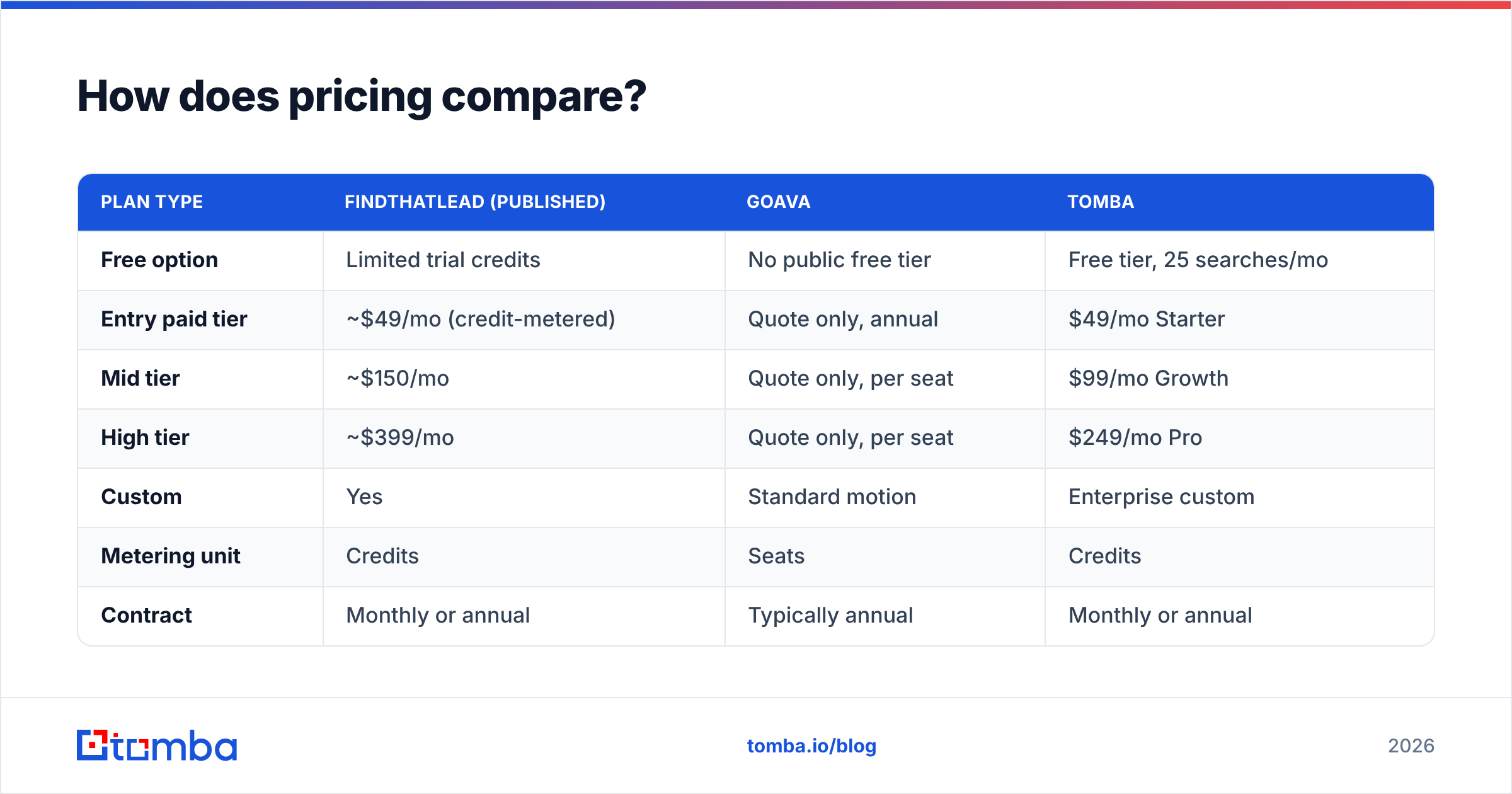
How does pricing compare?#
This is the sharpest practical difference, and it is where most evaluations end.
| Plan type | FindThatLead (published) | Goava | Tomba |
|---|---|---|---|
| Free option | Limited trial credits | No public free tier | Free tier, 25 searches/mo |
| Entry paid tier | ~$49/mo (credit-metered) | Quote only, annual | $49/mo Starter |
| Mid tier | ~$150/mo | Quote only, per seat | $99/mo Growth |
| High tier | ~$399/mo | Quote only, per seat | $249/mo Pro |
| Custom | Yes | Standard motion | Enterprise custom |
| Metering unit | Credits | Seats | Credits |
| Contract | Monthly or annual | Typically annual | Monthly or annual |
Two notes before you budget from this table. First, FindThatLead's published tiers move; check their live pricing page before you commit, and confirm whether a "credit" is consumed on a search, a result, or both — that single definition can double your effective cost. Second, Goava does not publish prices at all. Expect a discovery call, a seat count, and an annual commitment. That is normal for Nordic sales-intelligence vendors, but it means you cannot pilot it on a Tuesday afternoon with a company card.
Seat-based pricing has a specific failure mode worth naming: it punishes you for adding an SDR who only needs occasional lookups, and it charges the same whether a rep runs 10 searches or 10,000. Credit-based pricing has the opposite failure mode — a heavy month spikes your bill. Match the model to how spiky your prospecting actually is. If you want a transparent baseline to benchmark both against, Tomba pricing is published in full with no call required.
Who should choose FindThatLead?#
Choose FindThatLead if most of these are true:
- You already know who to target. Your ICP is defined, your territory list exists, and the missing piece is contact data — not prioritisation.
- You sell globally or outside the Nordics. Goava's core advantage evaporates the moment your target list is mostly US, UK, DACH or APAC.
- You want one tab, not a stack. Finding, listing and sending in one product is genuinely convenient for a two-person team, even if each module is less capable than a specialist.
- You need to start today. Self-serve signup, card payment, first list in under an hour.
- Your budget is under $200/month. At that level, seat-based enterprise intelligence is not on the menu.
Where it disappoints: the built-in sender is basic compared to a dedicated sequencer, deliverability tooling is thin, and verification quality on catch-all domains is a known soft spot across this entire product category — not a FindThatLead-specific flaw.
Who should choose Goava?#
Choose Goava if most of these are true:
- The Nordics are your market. Sweden especially. This is not a marginal edge; registry-grade data on Swedish companies is the whole product.
- Your reps waste time on bad accounts. If pipeline quality — not pipeline quantity — is the complaint in your Monday meeting, an intelligence layer beats a bigger contact list.
- You have a real CRM and real process. Goava's value shows up inside HubSpot, Salesforce, Upsales or Lime. Without a CRM to enrich, you are buying a dashboard.
- You have 10+ reps with defined territories. Account scoring pays off when there are more accounts than hours. Below that, a spreadsheet and judgement do fine.
- You can sign an annual contract. No monthly escape hatch.
Where it disappoints: it will not hand you a clean, verified email for a specific person on demand at scale. That is not what it is for, and treating it as a contact-data source is the most common way teams end up disappointed with an otherwise good platform.

Where does Tomba fit in this comparison?#
Tomba occupies the layer both tools lean on and neither fully owns: verified contact data, delivered through an API, priced transparently.
The realistic 2026 stack for a Nordic-focused team looks like this:
- Account selection — Goava (or your own scoring model) decides which 300 companies matter this quarter.
- Contact discovery — domain search returns every findable address at those 300 domains, with roles and confidence scores attached.
- Verification — an email verifier strips the invalid, the role-based and the risky before a single send. This is the step teams skip and then blame their sequencer for.
- Scale processing — bulk email finder handles the 300-domain job as one upload instead of 300 manual lookups.
- Automation — the Tomba API keeps CRM records fresh on a schedule rather than a quarterly panic-cleanse.
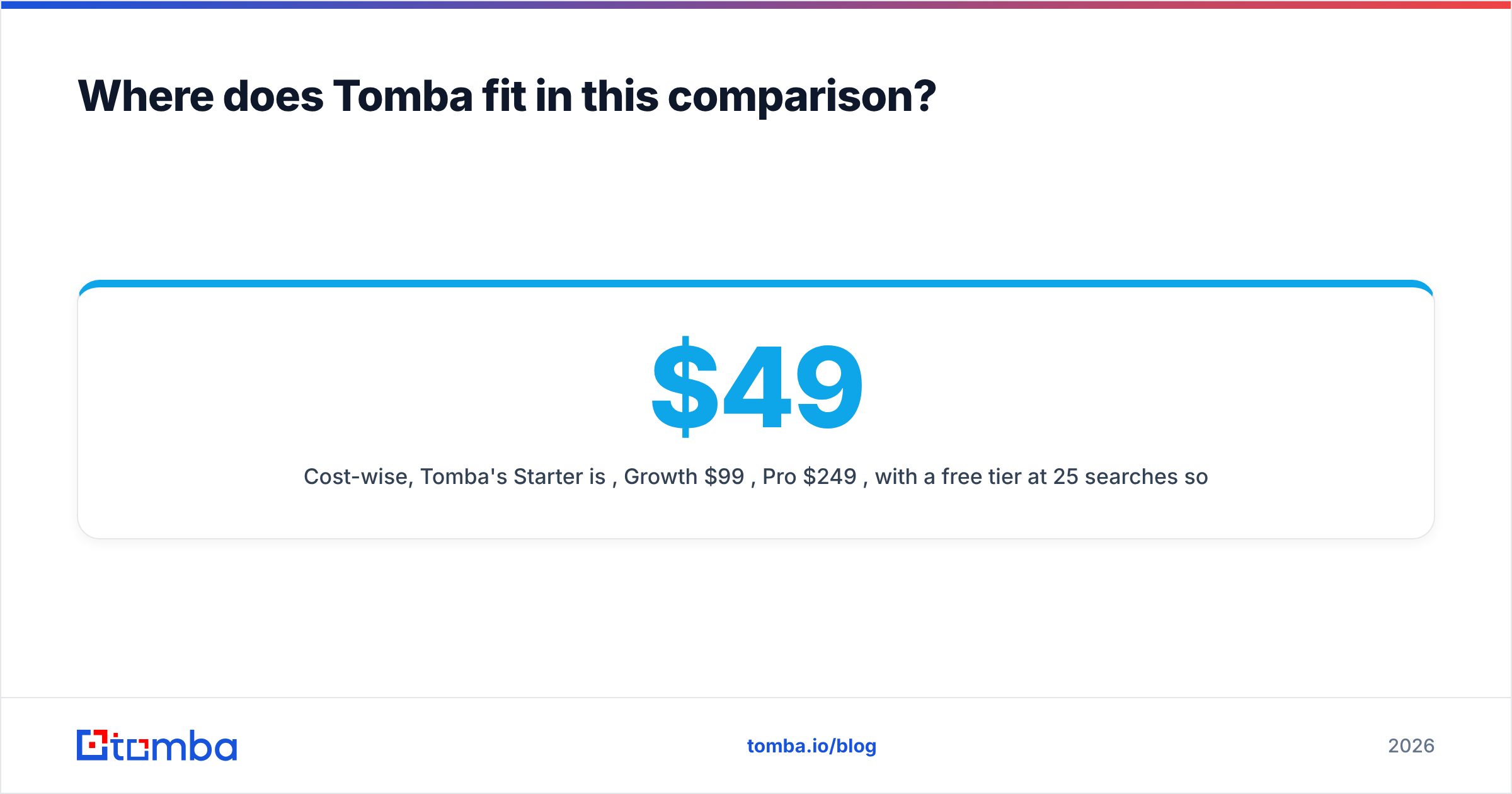
Cost-wise, Tomba's Starter is $49/mo, Growth $99/mo, Pro $249/mo, with a free tier at 25 searches per month so you can test hit rates on your own domain list before paying anything. That last point matters more than any benchmark table: run 100 of your target domains through any tool's free tier and count deliverable results yourself. Vendor-published accuracy numbers are measured on vendor-chosen samples.
Worth being straight about the trade: Tomba does not score Nordic accounts by revenue band or flag a board change in Gothenburg. If that is your bottleneck, Goava earns its contract. And if you want the all-in-one convenience of finding plus sending in a single product, FindThatLead's bundle has real appeal for a small team. Tomba's argument is narrower — it is the contact-data layer done properly, with an API that does not care which tool sits above it.
What should you actually evaluate before buying?#
Run this checklist before either sales call:
- Pull 100 real target domains from your CRM, not a demo list. Test hit rate and deliverability on those.
- Ask how catch-all domains are handled. "Accepted" is not "valid." Any vendor that cannot explain the distinction is guessing on your behalf.
- Clarify credit consumption rules. Does a failed search burn a credit? Does a bulk job charge per row or per result?
- Check bounce guarantees in writing. A stated tolerance is worth more than a marketing percentage.
- Test the export and the API. If getting data out is painful, the data quality barely matters.
- Confirm GDPR posture. Selling into the EU and the Nordics means data provenance is a buyer question, not a legal afterthought.
Two of those checks — catch-all handling and credit rules — will eliminate more shortlisted vendors than any feature grid.
The verdict#
There is no single winner in FindThatLead vs Goava, because they answer different questions. Goava wins on Nordic account intelligence and CRM-native enrichment for seat-based teams with annual budgets. FindThatLead wins on speed, price transparency, global reach and the convenience of finding plus sending in one place. If your reps are drowning in accounts, buy intelligence. If they are drowning in bad email addresses, buy a finder.
Most teams discover their real problem is the second one, and that it persists no matter which intelligence platform sits on top. Start there. Run your own domain list through the Tomba Email Finder free tier — 25 searches, no card — and compare the deliverable-result count against whatever either vendor quotes you. Then negotiate from evidence instead of a demo.
Related guides#
Ready to find emails that actually work?
Join 150,000+ professionals who stopped guessing and started sending. Free credits on signup — no credit card required.
Get the Tomba newsletter
Practical outbound tactics and product updates — once every two weeks.
About the author