FindThatLead vs Winmo: Which B2B Prospecting Tool Wins in 2026?
FindThatLead is a self-serve email finder. Winmo is a sales-led database for ad and media sellers. They barely compete — here is which one actually fits your outbound motion, and what it costs.
FindThatLead vs Winmo is an odd matchup. One is a cheap, self-serve email finder. The other is a curated database built for people who sell ads. Here is how to pick the right one.
TL;DR
- FindThatLead and Winmo solve different problems. FindThatLead is a self-serve email finder with a cold-email sender bolted on. Winmo is a curated intelligence database built for people selling advertising, sponsorship, and media.
- If your buyer is a CMO at a brand with an ad budget, Winmo's spend data and agency-relationship mapping have no equivalent in FindThatLead.
- If your buyer is anyone else — SaaS, agency services, recruiting, e-commerce tooling — Winmo's dataset is the wrong shape and the wrong price.
- Pricing philosophies clash. FindThatLead publishes credit-based monthly plans. Winmo runs sales-led annual contracts with no public list price.
- If what you need is verified work emails at volume, a dedicated finder-plus-verifier stack (Tomba starts free, then $49/mo) usually beats both on cost per usable contact.
What is FindThatLead, exactly?#
FindThatLead is a Barcelona-built prospecting tool that has been around since 2015. Its core job is simple: give it a name and a domain, or just a domain, and it returns business email addresses. Around that core it adds more tools. You get lead search by role and location, a Chrome extension, and a bulk CSV processor. There is also "Scrab.in," a LinkedIn automation companion, plus a basic cold-email sender. So you can go from list to sequence without leaving the tab.
Think of it as a Swiss Army knife sold at a hardware-store price. Nothing in it is best-in-class. But a solo founder can buy it on a credit card at 11pm and have 500 prospects by midnight.
The trade-off is the one every all-in-one makes. The finder is decent but not elite. The verifier is a checkbox, not a discipline. The sender is thinner than a real sequencer. You pay for convenience, not depth.
What is Winmo, exactly?#
Winmo is not an email finder that happens to have extra data. It is a research product with contact details attached. Its dataset is narrow on purpose. It covers brands that spend money on advertising, the agencies that hold those accounts, and the executives on both sides. It also tracks signals: when accounts are in play, when budgets shift, and when a review is coming. That last part is what people actually pay for.
If you sell sponsorship inventory, out-of-home placements, CTV, event booths, or agency retainers, that context is the product. Say a brand just moved its media buying to a new agency of record. That fact is worth more than the email address itself. Winmo's "WinmoEdge" editorial layer exists to surface exactly those moments.
The catch is coverage. Winmo is curated, human-checked, and vertical. Outside advertising and media sales, most of your addressable market is simply not in the database. No amount of budget fixes that.
FindThatLead vs Winmo: how do they compare head-to-head?#
Here is the honest side-by-side. Public pricing reflects list rates at the time of writing. Winmo does not publish rates, so buyer-reported figures are given as ranges, not gospel.
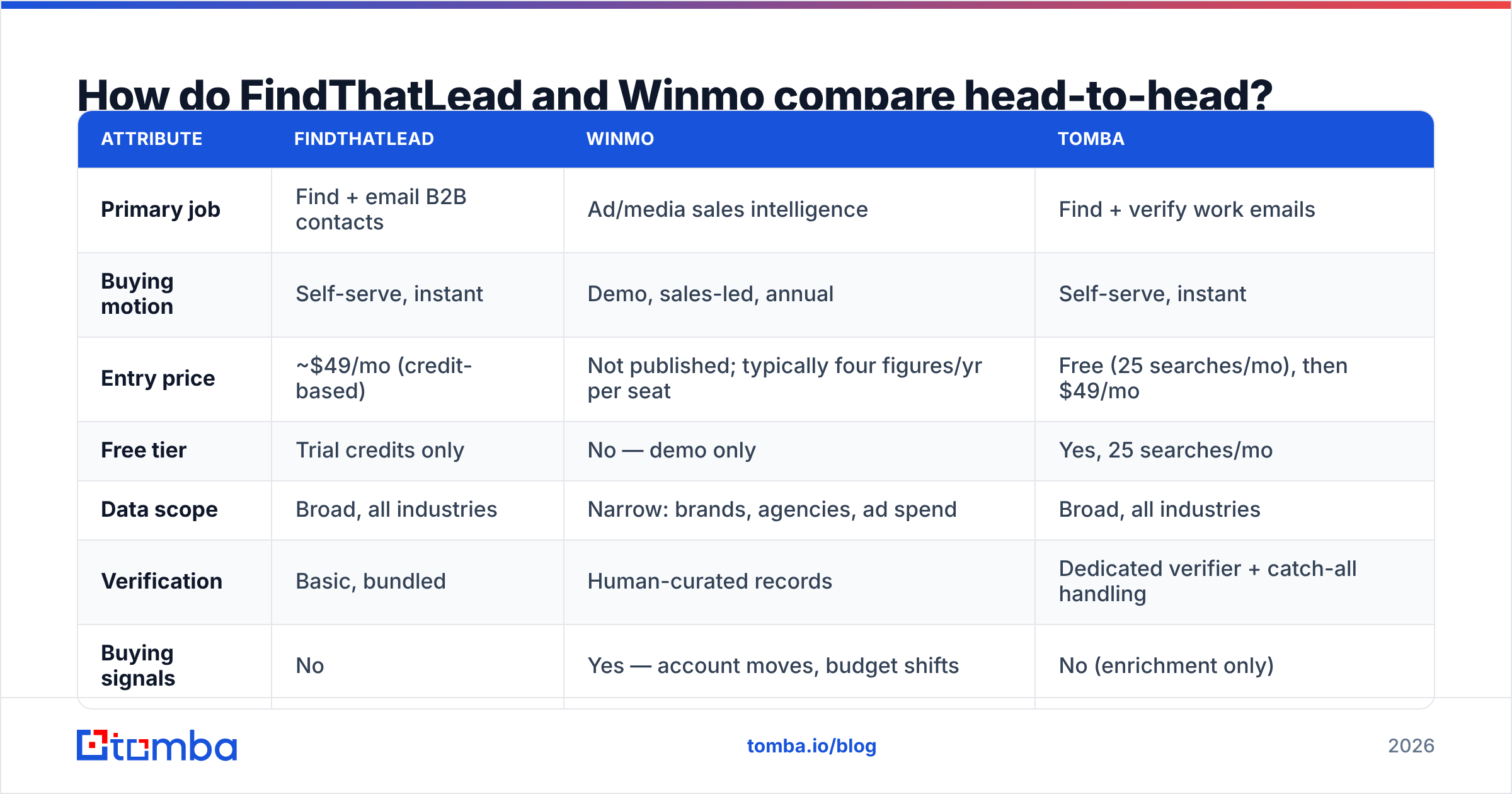
| Attribute | FindThatLead | Winmo | Tomba |
|---|---|---|---|
| Primary job | Find + email B2B contacts | Ad/media sales intelligence | Find + verify work emails |
| Buying motion | Self-serve, instant | Demo, sales-led, annual | Self-serve, instant |
| Entry price | ~$49/mo (credit-based) | Not published; typically four figures/yr per seat | Free (25 searches/mo), then $49/mo |
| Free tier | Trial credits only | No — demo only | Yes, 25 searches/mo |
| Data scope | Broad, all industries | Narrow: brands, agencies, ad spend | Broad, all industries |
| Verification | Basic, bundled | Human-curated records | Dedicated verifier + catch-all handling |
| Buying signals | No | Yes — account moves, budget shifts | No (enrichment only) |
| Sending built in | Yes, basic sequencer | No — data only | No — integrates with your sender |
| API | Yes | Limited / enterprise | Yes, documented, all plans |
| Best for | Solo founders, SMB outbound | Media, sponsorship, agency sellers | Teams that need verified emails at volume |
The table makes the real decision obvious. This is not a feature fight. It is a category mismatch. You are choosing between a general-purpose contact-finding utility and a specialist intelligence subscription. Asking which is better is like asking whether a wrench beats a market report.

Which one has better data accuracy?#
Different accuracy, measured differently. So be careful what you compare.
Winmo's accuracy claim rests on human curation. A research team maintains records, calls to confirm, and retires contacts when people move. Within its niche, that produces high-quality records, and buyers say the contact data holds up. But curation does not scale sideways. Ask for a director of engineering at a mid-market SaaS company and the well runs dry. High precision, narrow reach.
FindThatLead's accuracy is algorithmic. It guesses and checks email patterns across a broad index. Coverage is far wider. But hit rate and bounce rate swing by region, company size, and how obscure the domain is. Users on G2 describe the same pattern across this whole tool class. These tools are strong on US and EU mid-market companies with predictable email formats. They are weak on small local businesses, non-Latin domains, and anyone hiding behind a catch-all server.

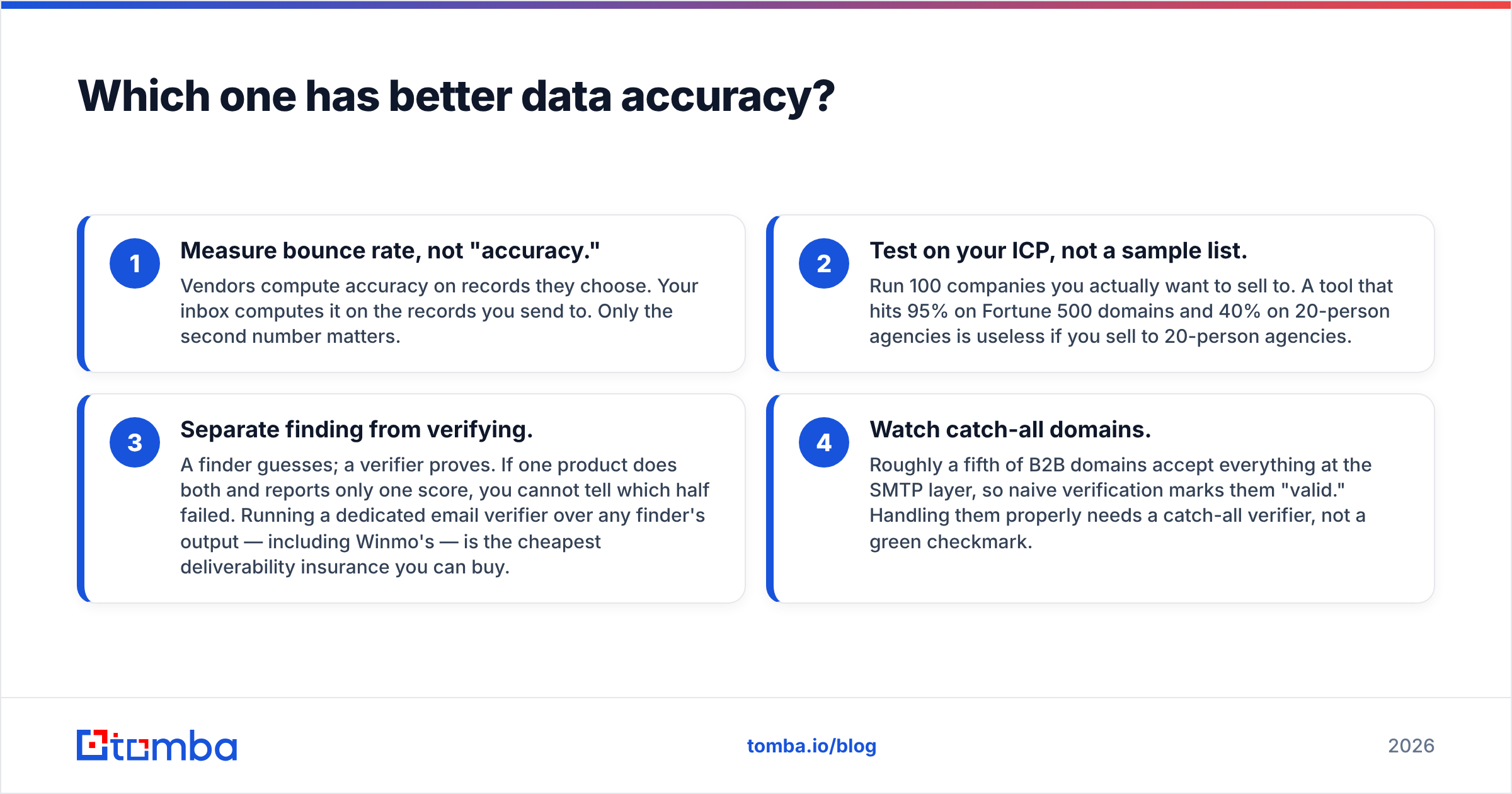
Three things matter more than any vendor's headline percentage:
- Measure bounce rate, not "accuracy." Vendors compute accuracy on records they choose. Your inbox computes it on the records you send to. Only the second number matters.
- Test on your ICP, not a sample list. Run 100 companies you actually want to sell to. A tool that hits 95% on Fortune 500 domains and 40% on 20-person agencies is useless if you sell to 20-person agencies.
- Separate finding from verifying. A finder guesses. A verifier proves. If one product does both and reports one score, you cannot tell which half failed. Run a dedicated email verifier over any finder's output, including Winmo's. It is the cheapest deliverability insurance you can buy.
- Watch catch-all domains. Roughly a fifth of B2B domains accept every address at the SMTP layer. Simple checks then mark them "valid." You need a catch-all verifier, not a green checkmark.
How does pricing actually work for each?#
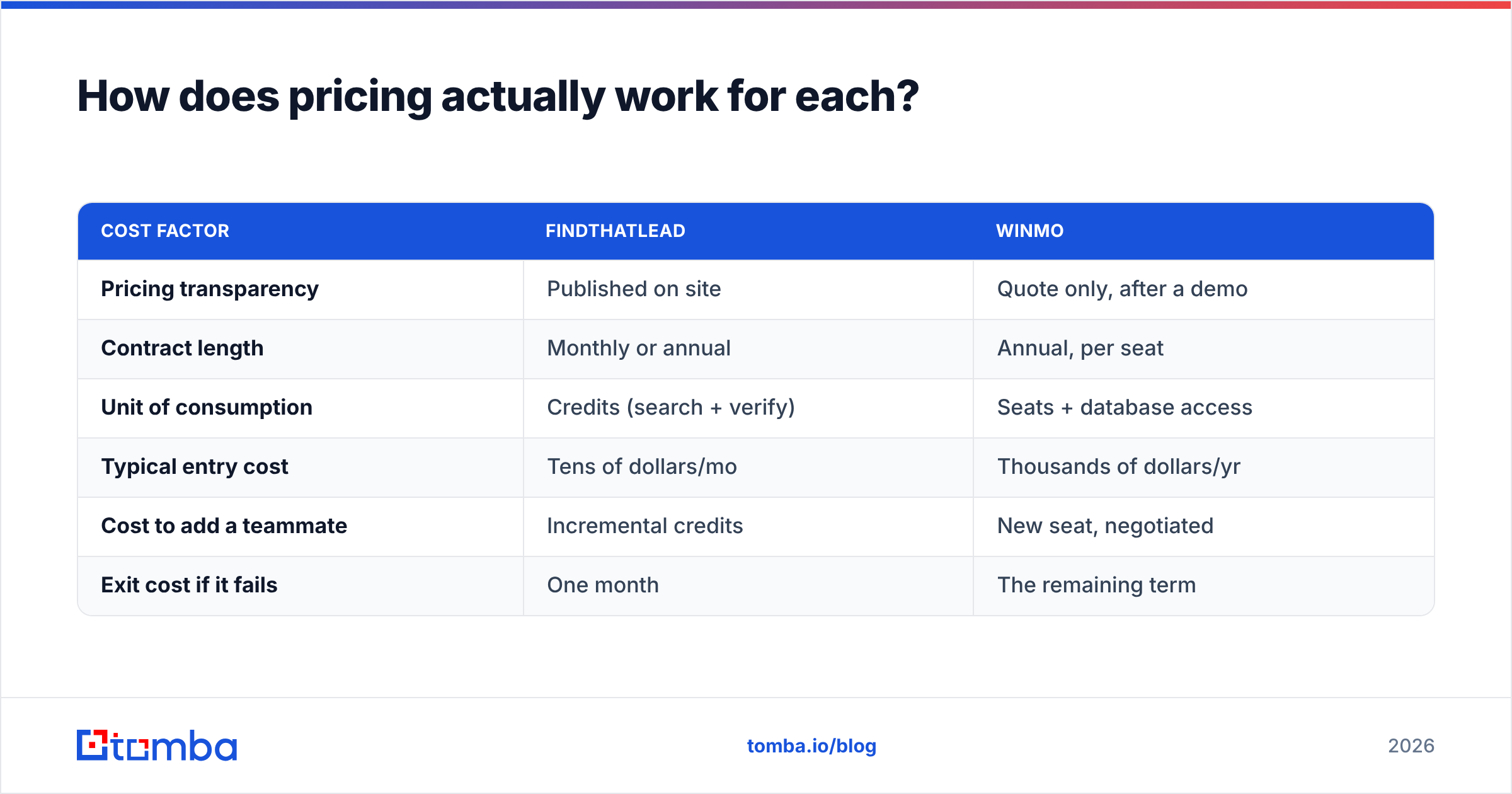
This is where the two products feel like they come from different decades. On cost structure, FindThatLead vs Winmo is not a close call.
| Cost factor | FindThatLead | Winmo |
|---|---|---|
| Pricing transparency | Published on site | Quote only, after a demo |
| Contract length | Monthly or annual | Annual, per seat |
| Unit of consumption | Credits (search + verify) | Seats + database access |
| Typical entry cost | Tens of dollars/mo | Thousands of dollars/yr |
| Cost to add a teammate | Incremental credits | New seat, negotiated |
| Exit cost if it fails | One month | The remaining term |

The gap matters more than the raw numbers. With FindThatLead you can be wrong for $49 and move on. With Winmo you commit before you have run a single campaign against the data. If your ICP is thin in that database, you find out after the paperwork is signed. That is fine when your whole business sells to advertisers. One closed sponsorship deal pays for the year. It is a bad bet when you are testing a new segment.
For reference, Tomba pricing sits in the same self-serve tier as FindThatLead. It is free at 25 searches a month, then $49/mo Starter, $99/mo Growth, $249/mo Pro, and custom Enterprise. The point is not that cheaper is better. It is that reversible decisions should be priced reversibly.
Who should choose FindThatLead?#
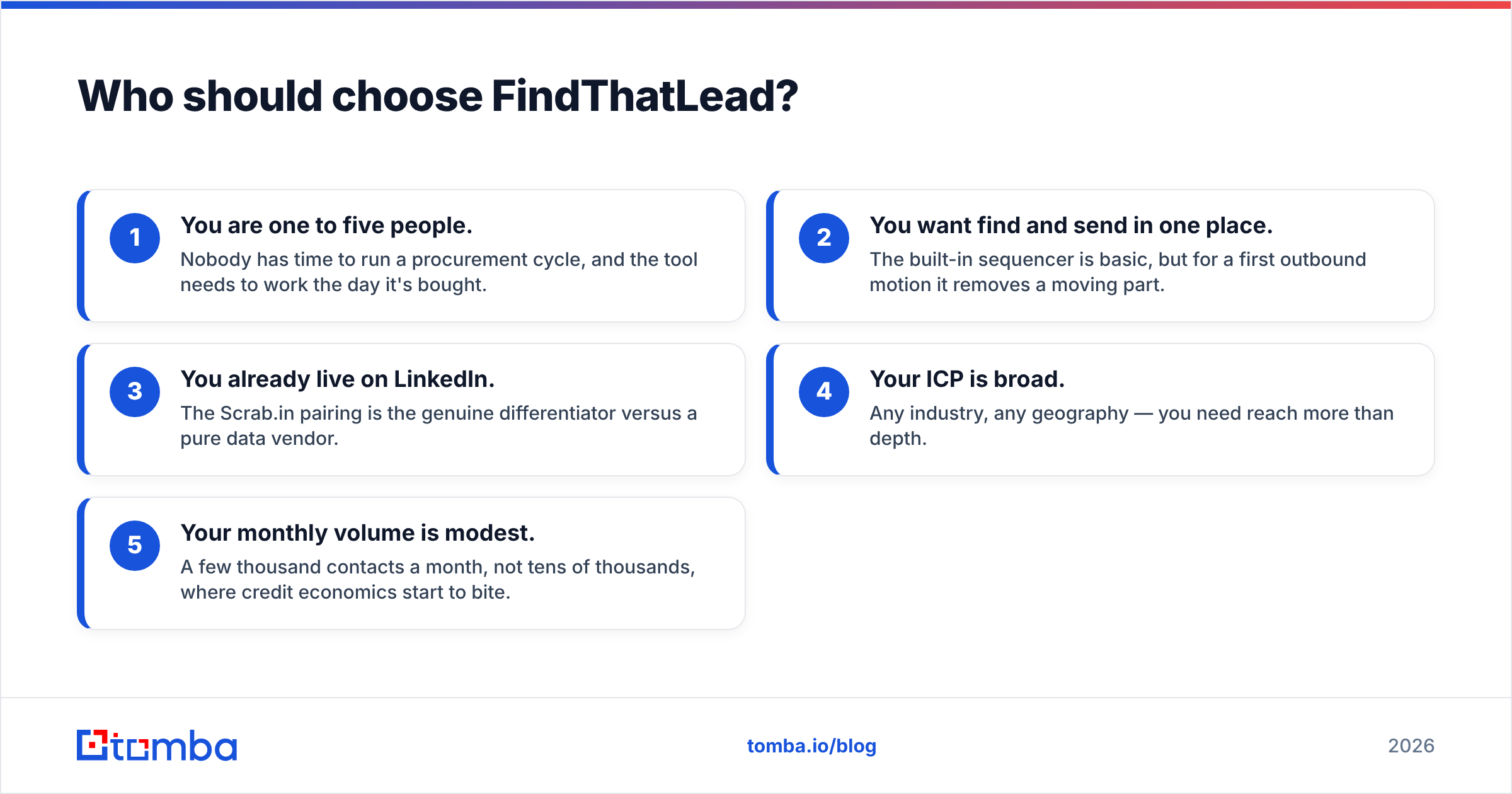
Pick FindThatLead if most of these describe you:
- You are one to five people. Nobody has time to run a procurement cycle. The tool needs to work the day it is bought.
- You want find and send in one place. The built-in sequencer is basic, but for a first outbound motion it removes a moving part.
- You already live on LinkedIn. The Scrab.in pairing is the genuine differentiator versus a pure data vendor.
- Your ICP is broad. Any industry, any geography. You need reach more than depth.
- Your monthly volume is modest. A few thousand contacts a month, not tens of thousands, where credit economics start to bite.
Where it disappoints: teams that need auditable verification, agencies building lists at scale, and anyone whose deliverability is already shaky. The bundled check is not a real verification step. A bounce rate above 3% will damage your sender reputation faster than any tool can rebuild it.
Who should choose Winmo?#
Pick Winmo if your revenue depends on knowing who controls an ad budget:
- You sell media, sponsorship, or ad inventory. Publishers, broadcasters, sports properties, event organizers, ad-tech vendors.
- You are an agency selling to brands. Knowing which agency holds which account, and when that relationship is wobbling, is the whole pitch.
- Timing is your edge. Budget-cycle and account-move alerts are the reason to pay, not the contact records.
- Your deal sizes justify the seat. One won sponsorship covers a year of the subscription. Ten cold emails do not.
Where it disappoints: anyone outside that vertical. Sell developer tools, logistics software, or recruiting services? You will pay a premium for a database built around a market you do not sell into. That is not a knock on Winmo's quality. It is a warning about fit. Fit is the failure mode nobody catches during a demo.
Is there a better option than either?#
Often, yes. Most teams weighing FindThatLead vs Winmo are really asking a narrower question: how do I get verified work emails for a list of companies I already care about?
If that is the question, neither product is the shortest path. A specialist finder-plus-verifier stack gives you:
- Domain-first list building. Feed a list of target companies and pull every relevant contact via domain search, instead of hunting person by person.
- Verification as its own step. Find, then verify, then send. Each stage gets its own score, so you can tell where quality broke.
- Volume without contract drama. Bulk email finder runs, an API for enrichment inside your CRM, and month-to-month billing.
- Honest coverage limits. No vendor covers everything. Test on your own domains before you commit. Then you find the gaps in an afternoon, not a quarter.
To be fair to both incumbents: FindThatLead's LinkedIn tie-in is real. Winmo's ad-spend intelligence is not something a general-purpose email tool can replicate. If you need buying signals about media budgets, buy the specialist. Just do not buy a specialist subscription when what you needed was a reliable way to get 5,000 verified addresses this month.
What is the fastest way to decide?#
Run a 100-row bake-off before you talk to any sales rep.
- Build one list of 100 target companies that genuinely represent your ICP — not household names, real accounts.
- Pull contacts from each tool for the same roles at the same companies.
- Verify everything with the same third-party verifier so the scoring is neutral.
- Count usable contacts, not returned rows. A row with no email, or a risky one, is not a lead.
- Divide monthly cost by usable contacts. That number — cost per usable contact — is the only comparison that survives contact with a quota.
Most buyers hit something awkward at step 5. The expensive tool wins on quality per record but loses badly on coverage. The cheap tool wins on volume but forces a verification step it did not include. That is exactly why the finder-plus-verifier split exists as a category.
The bottom line#
FindThatLead vs Winmo is not a real rivalry. FindThatLead is the low-commitment generalist for small teams that need emails now. Winmo is the high-commitment specialist for people whose buyers control advertising budgets. Buy the one that matches your buyer. Ignore the feature grids that pretend they are interchangeable.
Say your real requirement is verified business email addresses across any industry, without an annual contract or a demo call. Then start with the Tomba Email Finder. The free tier gives you 25 searches a month to test coverage on your own target list. Verification is a first-class step, not a bundled afterthought. Paid plans start at $49/mo with the same API you would use in production. Run your 100-company bake-off, keep whichever tool wins on cost per usable contact, and cancel the rest.
Related guides#
Ready to find emails that actually work?
Join 150,000+ professionals who stopped guessing and started sending. Free credits on signup — no credit card required.
Get the Tomba newsletter
Practical outbound tactics and product updates — once every two weeks.
About the author