Findymail Pricing 2026: Real Costs, Credits & Limits
Findymail charges per verified email, not per lookup — which sounds cheap until you hit the credit rollover rules. Here's what the plans actually cost per usable contact in 2026.
TL;DR
- Findymail's paid plans start around $49/mo for 1,000 verified emails and scale to roughly $249/mo at the 10,000-email tier, with annual billing knocking off about 20%.
- The headline feature is that you only spend a credit when Findymail returns a verified email — no charge for a miss. That is genuinely good, and it changes how you should compare price tags.
- The catch: credits do not roll over on most plans, exports are metered separately from lookups, and phone/mobile data is thin compared to full contact-data platforms.
- Effective cost per usable contact lands near $0.049 at the entry tier and drops toward $0.025 at volume — competitive, but not the cheapest per-contact price on the market.
- If your workflow is domain-first prospecting plus verification at scale, Tomba's $49/mo Starter and $99/mo Growth tiers cover the same jobs with a broader tool surface (domain search, catch-all verification, phone finder, enrichment API).
What is Findymail and who actually buys it?#
Findymail is a B2B email-finding tool built around one promise: you pay for results, not attempts. Feed it a name and a company domain, or a LinkedIn URL, or a CSV of leads, and it returns verified work emails. If it cannot find one, your credit stays in the bank.
That model attracts a specific buyer. Agencies running cold outreach for multiple clients. Solo founders doing 200–500 prospect lookups a month. Small SDR teams who got burned by a "10,000 credits" plan where half the credits evaporated on failed searches and unverifiable catch-alls.
It is not built for the enterprise data buyer who wants firmographics, intent signals, org charts, and mobile numbers in one contract. Findymail is deliberately narrow. Whether that narrowness is a bargain or a limitation depends entirely on what else you already own.

How much does Findymail actually cost in 2026?#
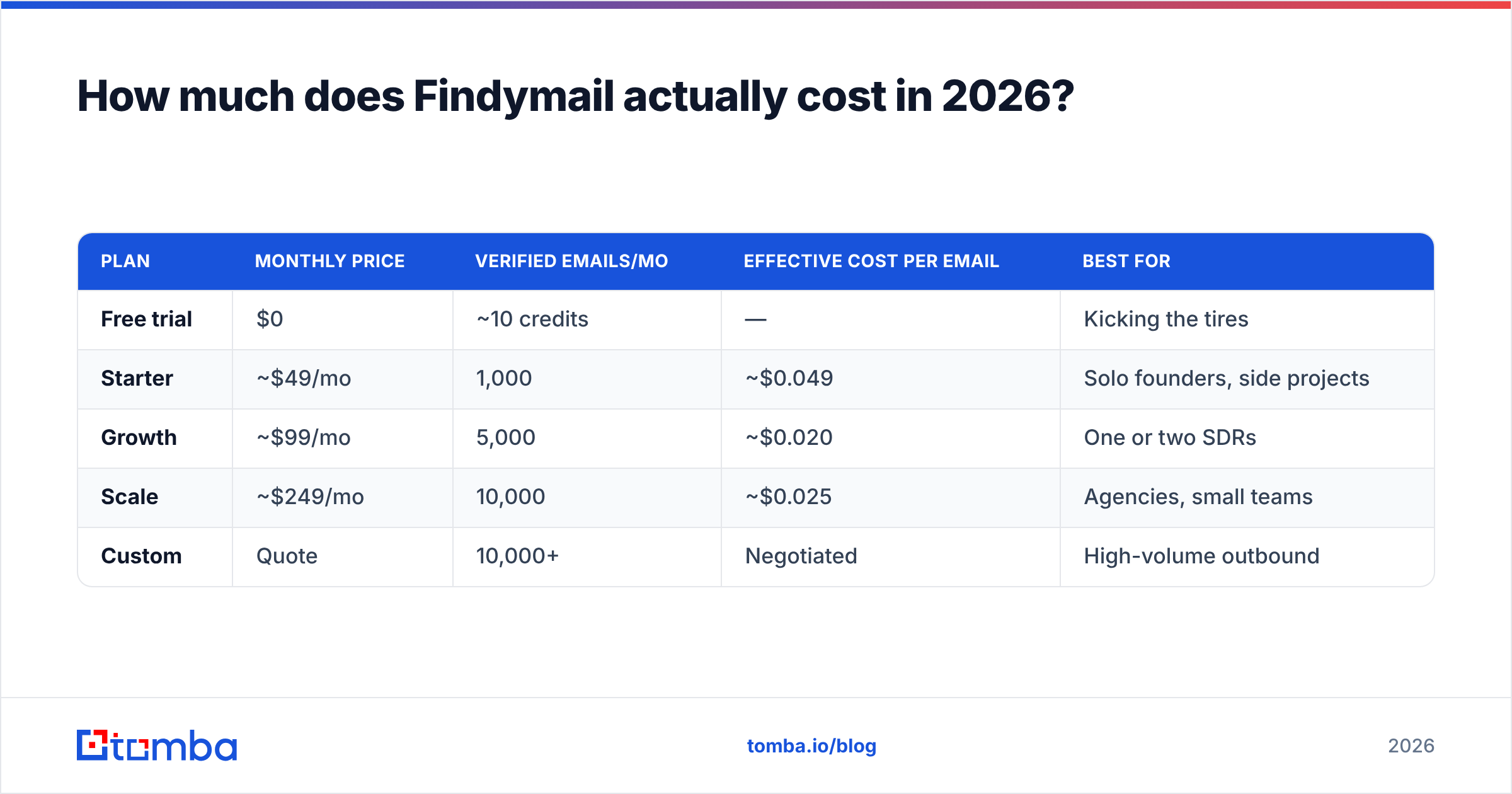
Findymail publishes a straightforward credit ladder. Pricing on the official Findymail site has been stable across the last several cycles, with the usual annual discount for paying up front.
| Plan | Monthly price | Verified emails/mo | Effective cost per email | Best for |
|---|---|---|---|---|
| Free trial | $0 | ~10 credits | — | Kicking the tires |
| Starter | ~$49/mo | 1,000 | ~$0.049 | Solo founders, side projects |
| Growth | ~$99/mo | 5,000 | ~$0.020 | One or two SDRs |
| Scale | ~$249/mo | 10,000 | ~$0.025 | Agencies, small teams |
| Custom | Quote | 10,000+ | Negotiated | High-volume outbound |
Two things jump out.
First, the per-email cost does not decline smoothly. The Growth tier is the sweet spot on paper; the Scale tier costs more per email than Growth in some published configurations because it bundles extra seats and export volume rather than raw lookups. Read the tier you are buying carefully instead of assuming bigger equals cheaper.
Second, the "verified emails" number is a ceiling on successful results, not on API calls. On a tool that charges per attempt, a 60% hit rate on 1,000 attempts leaves you 600 usable emails. On Findymail, 1,000 credits should produce close to 1,000 usable emails. That is the argument for the price, and it is a fair one.
What do you actually get for each credit?#
Here is where the fine print matters. Five things determine whether a Findymail credit is worth $0.049 to you:
- A credit burns only on a verified hit. Failed searches cost nothing. This is the core differentiator and it holds up in practice.
- Catch-all domains are handled conservatively. Findymail leans toward not returning an address it cannot confirm, which protects your bounce rate but lowers your raw coverage on catch-all-heavy industries (agencies, consultancies, mid-market SaaS).
- Credits generally do not roll over. Unused credits expire at the end of the billing cycle on standard plans. If your outbound is lumpy — heavy in Q1, quiet in August — you are paying for capacity you cannot bank.
- Exports and lookups are tracked separately. Bulk CSV enrichment consumes credits per enriched row; re-exporting the same list can consume again depending on how the job is configured.
- Phone numbers are limited. Findymail is an email tool. If you need mobile numbers alongside emails, you are buying a second vendor or accepting gaps.
That fifth point is the most common surprise. Teams building a multi-channel sequence — email plus a cold call plus a LinkedIn touch — end up stacking Findymail with something else, and the combined bill quietly doubles. If phone coverage matters to your motion, price the phone finder side of your stack before you commit to an email-only contract.
Is Findymail's pay-per-verified-email model actually cheaper?#
It depends on your target list quality, and the math is less flattering than the marketing.
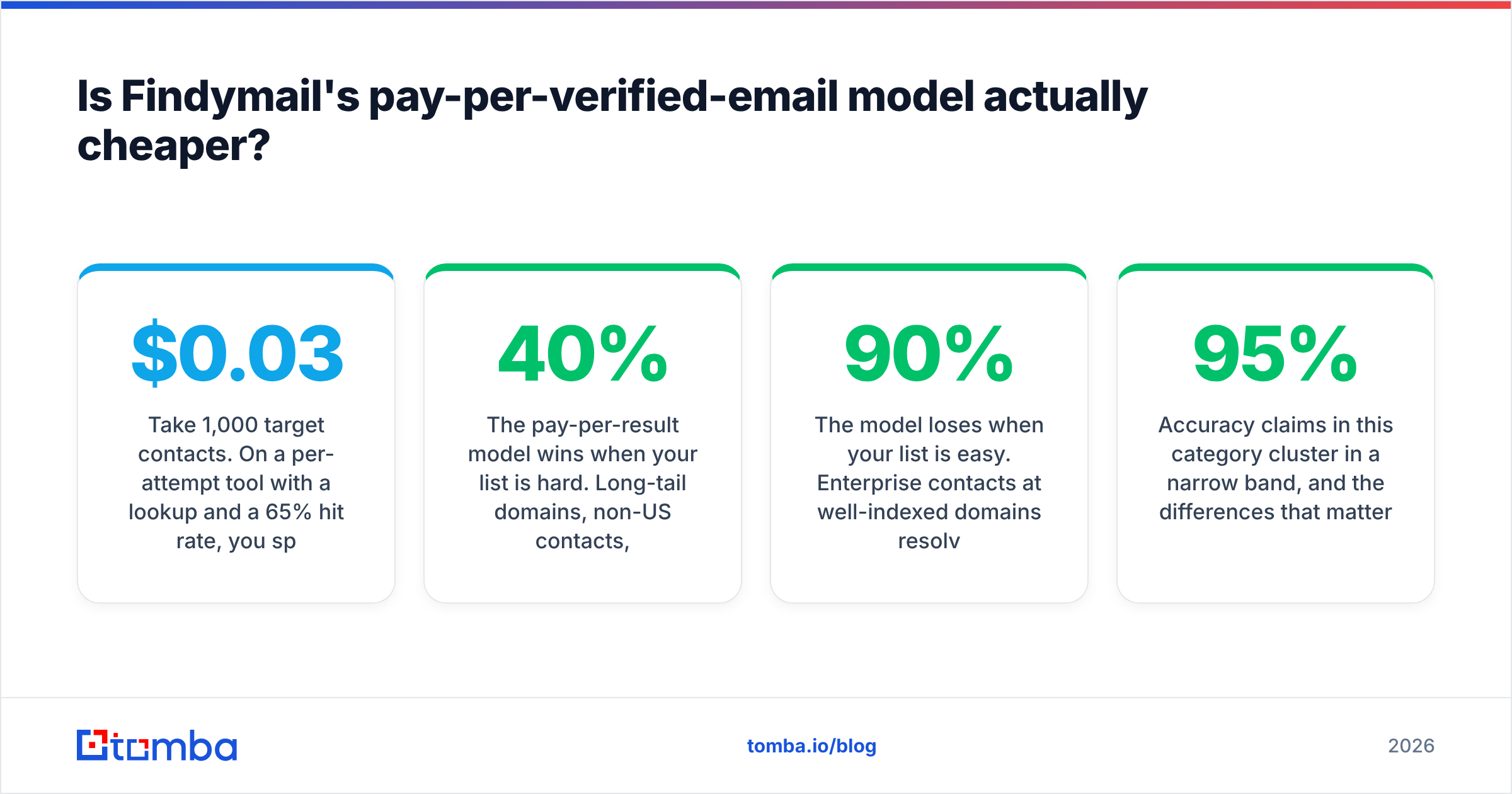
Take 1,000 target contacts. On a per-attempt tool with a $0.03 lookup and a 65% hit rate, you spend $30 and get 650 emails — about $0.046 per usable email. On Findymail at $0.049 per verified email, you spend $49 for 1,000 emails, or $0.049 each. Nearly identical.
The pay-per-result model wins when your list is hard. Long-tail domains, non-US contacts, small companies with no public email footprint — those are exactly the searches that fail, and on a per-attempt tool you pay for every failure. Hit rates on lists like that can drop under 40%, which pushes the per-attempt cost above $0.075 per usable email while Findymail stays flat at $0.049.
The model loses when your list is easy. Enterprise contacts at well-indexed domains resolve at 80–90% on most credible tools, so paying a premium per confirmed result buys you insurance you did not need.
The practical test: run 100 representative prospects through a free tier before you commit. Most vendors, Findymail included, give you enough trial credits to measure your own hit rate rather than trusting anyone's published average — including the numbers in this article.

Accuracy claims in this category cluster in a narrow band, and the differences that matter are usually about which segments a provider covers well, not a global percentage. A tool that is 95% accurate on US tech and 55% accurate on European manufacturing has a lovely average and a useless result for a manufacturing SDR.
How does Findymail pricing compare to the alternatives?#
Findymail sits in a crowded middle. Below it are free and near-free lookup tools with thin coverage. Above it are full contact-data platforms charging four figures a month for firmographics and intent.
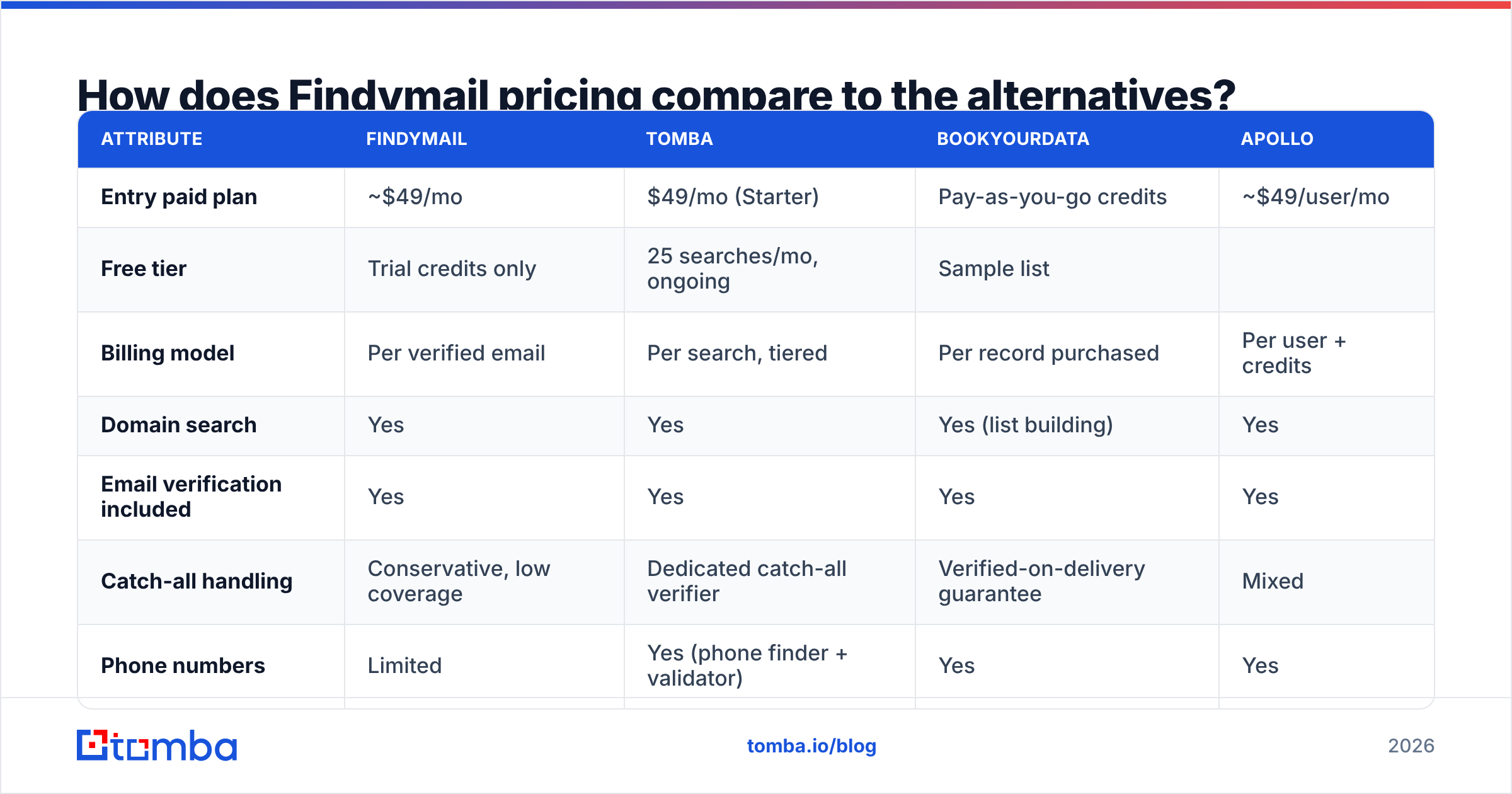
| Attribute | Findymail | Tomba | BookYourData | Apollo |
|---|---|---|---|---|
| Entry paid plan | ~$49/mo | $49/mo (Starter) | Pay-as-you-go credits | ~$49/user/mo |
| Free tier | Trial credits only | 25 searches/mo, ongoing | Sample list | |
| Limited monthly credits | ||||
| Billing model | Per verified email | Per search, tiered | Per record purchased | Per user + credits |
| --- | --- | --- | --- | --- |
| Domain search | Yes | Yes | Yes (list building) | Yes |
| Email verification included | Yes | Yes | Yes | Yes |
| Catch-all handling | Conservative, low coverage | Dedicated catch-all verifier | Verified-on-delivery guarantee | Mixed |
| Phone numbers | Limited | Yes (phone finder + validator) | Yes | Yes |
| Public API | Yes | Yes, full REST API | Yes | Yes |
| Sheets/Excel add-ons | Yes | Yes (Sheets, Excel, Airtable) | CSV export | Limited |
| Mid tier | ~$99/mo (5,000) | $99/mo (Growth) | Volume pricing | ~$79–99/user/mo |

A few honest notes on that table.
BookYourData plays a different game entirely. Instead of looking up contacts one at a time, you build and buy a targeted list up front with a delivery-accuracy guarantee. For teams that want 5,000 verified contacts in one purchase rather than a monthly credit allowance, that model is often cleaner and cheaper per record than any subscription. It is a legitimately different purchasing motion, not a worse one.
Apollo bundles a sequencer and a CRM-ish layer, so the per-seat price covers more than data. If you need those, comparing it to Findymail on cost-per-email is apples to oranges. If you already run Instantly or Smartlead for sending, you are paying twice.
Tomba overlaps Findymail most directly on price, but the tool surface is wider at the same tier. The $49/mo Starter and $99/mo Growth plans include domain search, email verification, catch-all checks, phone lookup, and enrichment through a single email finder API — plus a permanently free 25-search tier rather than a one-time trial. Full Tomba pricing runs Free → Starter $49 → Growth $99 → Pro $249 → Enterprise.

What are the hidden costs in Findymail pricing?#
Four line items that do not appear on the pricing page:
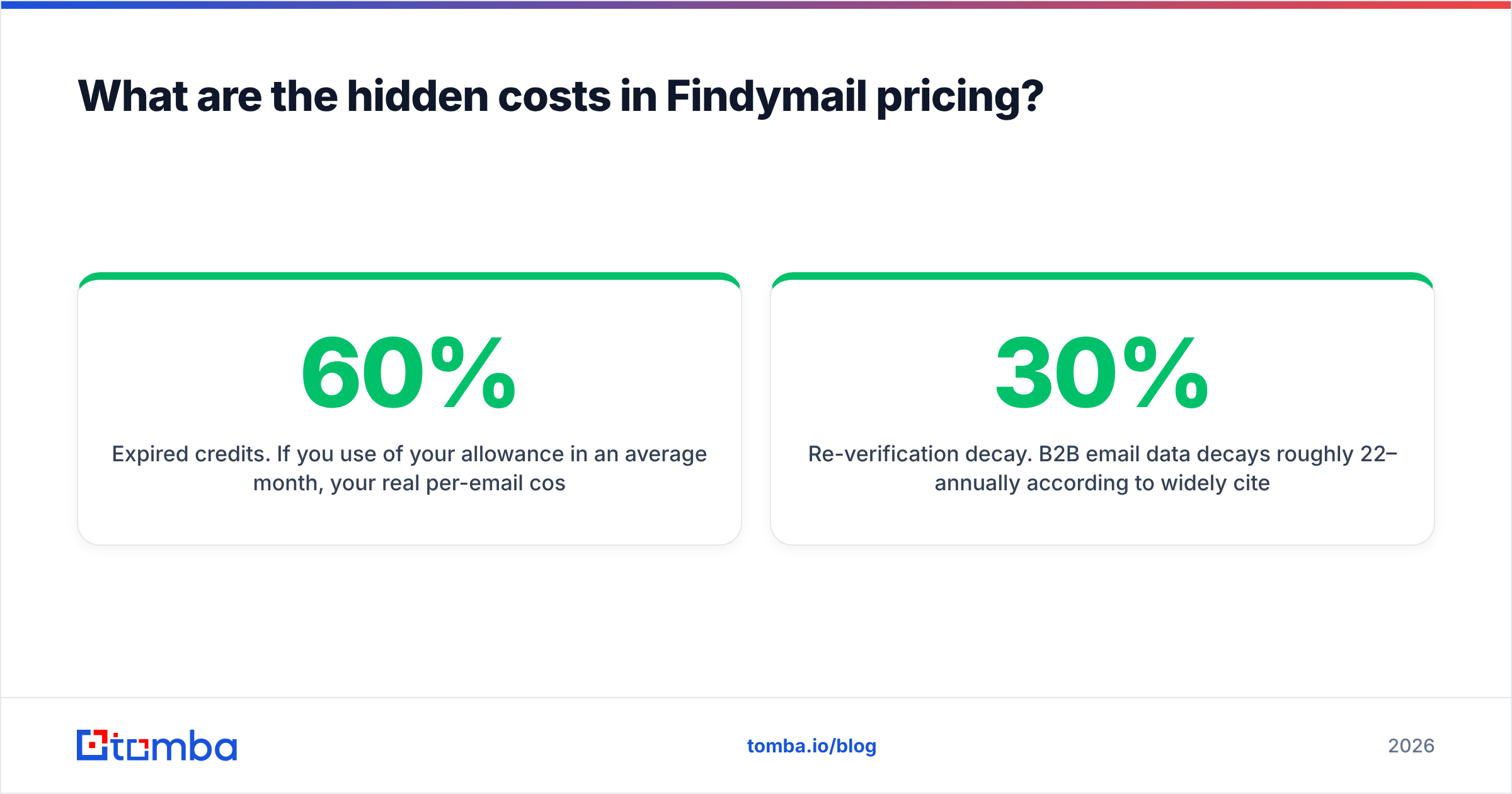
Expired credits. If you use 60% of your allowance in an average month, your real per-email cost is not $0.049 — it is $0.082. Track your actual monthly consumption for two cycles before choosing a tier, and size down rather than up. Upgrading mid-cycle is easy; getting a refund for unused capacity is not.
Seat costs at scale. Lower tiers are effectively single-user. Adding teammates on higher plans is where the bill grows faster than the credit count, which is why the Scale tier's per-email math looks worse than Growth's.
The second vendor. Email-only coverage means most multi-channel teams end up buying a phone data source, a verification tool for imported lists, or both. Budget the stack, not the line item.
Re-verification decay. B2B email data decays roughly 22–30% annually according to widely cited industry benchmarks — job changes, domain migrations, restructures. A contact you found in January is meaningfully less reliable by October. If you are mailing a list older than six months, re-verify it, and those verification runs cost credits. Pricing your outbound without a re-verification line is how a clean sender reputation quietly turns into a spam-folder problem.
Who should buy Findymail, and who should not?#
Buy it if: you run outbound against hard-to-find contacts, you hate paying for failed lookups, you already have a sending tool and phone data, and your monthly volume is predictable enough that expiring credits do not sting.
Skip it if: your lists are enterprise-heavy and easy to resolve (a per-attempt tool will be cheaper), your volume is lumpy (expiring credits punish you), you need phone numbers in the same workflow, or you want a large permanent free tier to test against before committing budget.
Consider a hybrid: many teams run a broad, cheap source for the easy 70% of a list and a premium pay-per-result tool for the stubborn remainder. That is more operational overhead, but on lists above 10,000 contacts the savings are real. Reviews on G2 show this pattern repeatedly in the "what do you use alongside" sections — very few teams run a single data vendor.
The one thing nobody should do is buy on the headline price. A $49 plan that produces 400 usable contacts is more expensive than a $99 plan that produces 4,000. Cost per usable, verified, still-employed contact is the only number that matters, and you can only get it by testing your own list.
What should you do next?#
Run the same 100 prospects through two or three tools on their free tiers. Compare three things: hit rate, bounce rate on a small send, and how many results were catch-alls you had to throw away. That takes an afternoon and will save you a year of paying for the wrong tier.
If you want a wider tool surface at the same price point, start with the Tomba Email Finder — the free plan gives you 25 searches a month with no card and no expiry, and the Starter tier at $49/mo adds domain search, catch-all verification, phone lookup, and full API access in one subscription instead of three. Test it against your own list, not against anyone's marketing chart.
Related guides#
Ready to find emails that actually work?
Join 150,000+ professionals who stopped guessing and started sending. Free credits on signup — no credit card required.
Get the Tomba newsletter
Practical outbound tactics and product updates — once every two weeks.
About the author