Findymail vs FINTRX: Which B2B Data Tool Fits Your Team?
Findymail finds verified work emails at scale. FINTRX maps family offices, RIAs, and private wealth allocators. They solve different problems — here is how to tell which one your pipeline actually needs.
TL;DR
- Findymail is a cold-outreach email finder: you feed it names, domains, or a LinkedIn Sales Navigator list and it returns verified work emails with a bounce guarantee.
- FINTRX is a private wealth intelligence database: family offices, RIAs, wealth advisors, and allocator mandates, with firm-level context you cannot scrape.
- They overlap on maybe 10% of the job. Findymail is a contact-discovery engine; FINTRX is a market map for capital raisers.
- Pricing lives in different universes — Findymail publishes self-serve tiers from around $49/mo, while FINTRX is a quote-only annual contract typically sold to asset managers and fintech vendors.
- If you sell software, services, or anything to standard B2B buyers, neither niche wealth data nor a single-source finder is enough — a multi-source email finder plus verification is usually the cheaper, broader play.
What problem does each tool actually solve?#
Start here, because "Findymail vs FINTRX" is a comparison people run after landing on both from a Google search for "B2B data tool" — and then discover they were never really competitors.
Findymail (findymail.com) is built for one motion: you already know who you want to reach, and you need their email address without burning your domain on bounces. It handles name-plus-domain lookups, bulk CSV enrichment, and Sales Navigator list exports, and it markets hard on a low bounce rate. Its natural buyer is an SDR team, an agency, or a founder running cold email through Smartlead, Instantly, or Lemlist.
FINTRX (fintrx.com) is a vertical data platform for the private wealth channel. Its records are family offices, registered investment advisors, multi-family offices, and the individual professionals inside them — plus context most generic databases never carry: AUM bands, allocation preferences, mandate history, advisory relationships. Its natural buyer is a fund raising capital, a wealth-tech vendor selling into RIAs, or an IR team building an allocator target list.
The mental model: Findymail is a phone book with a very good spell-checker. FINTRX is a survey map of one specific neighborhood, showing who owns what, how much, and what they have bought before. You would not use a phone book to plan a land purchase, and you would not buy a survey map to look up one person's number.
How do Findymail and FINTRX compare head-to-head?#
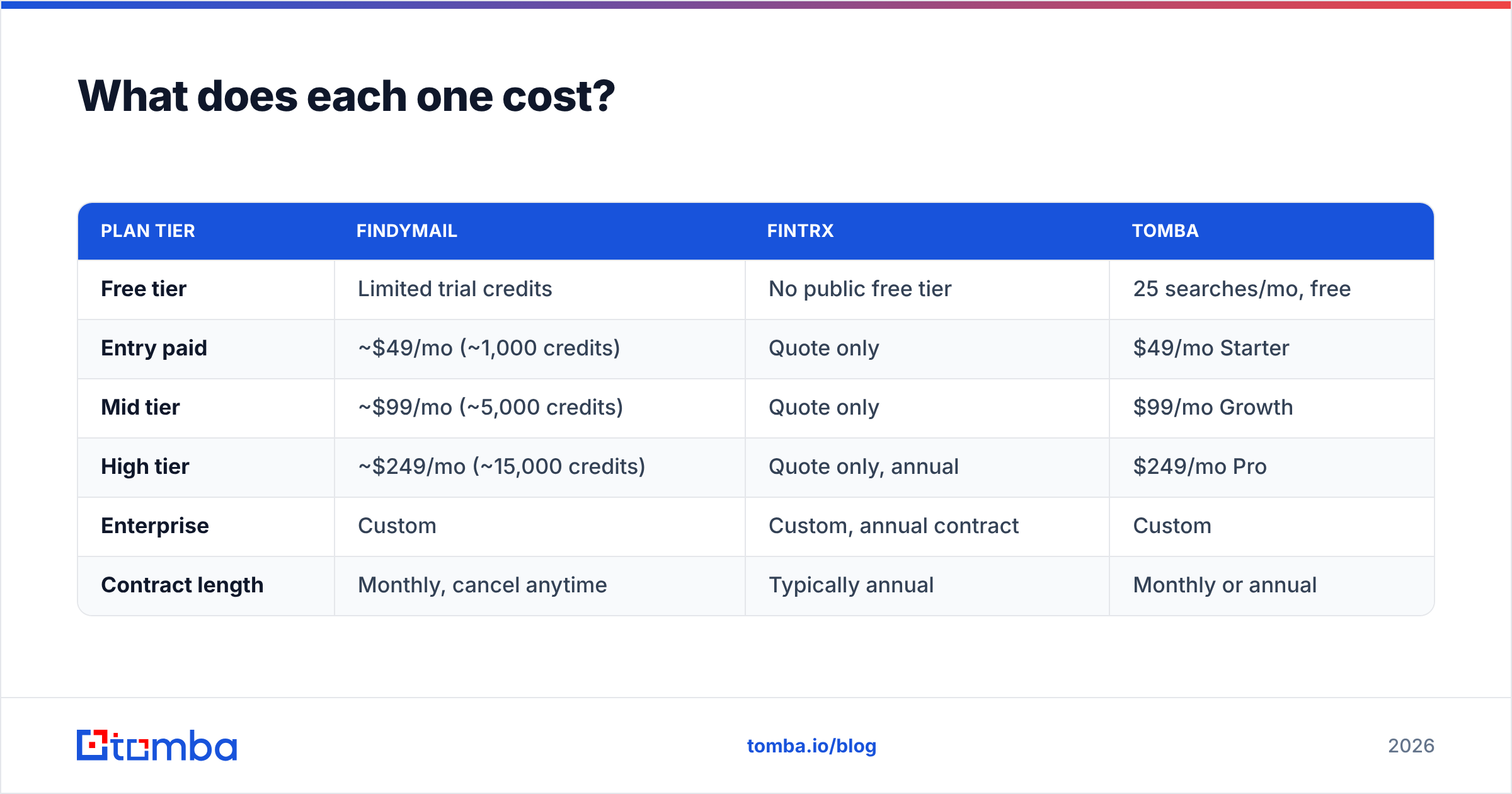
| Dimension | Findymail | FINTRX | Tomba |
|---|---|---|---|
| Core job | Find + verify work emails | Map private wealth firms & contacts | Find + verify emails across all B2B |
| Universe covered | Any company with a domain | Family offices, RIAs, wealth advisors | Any company with a domain |
| Firmographic depth | Light (company, title, domain) | Deep (AUM, mandates, allocations, relationships) | Moderate (company, role, socials, tech) |
| LinkedIn workflow | Sales Navigator list export | Not the primary workflow | LinkedIn finder + Chrome extension |
| Bulk enrichment | Yes, CSV | Yes, list export + CRM push | Yes, bulk email finder |
| Verification built in | Yes | Contact data curated, not SMTP-verified per send | Yes, dedicated email verifier |
| API access | Yes | Yes, on higher tiers | Yes, full Tomba API |
| Entry pricing | Self-serve, ~$49/mo tier | Quote only, annual contract | Free 25/mo, Starter $49/mo |
| Best for | SDRs, agencies, cold email | Fund raisers, wealth-tech GTM | Broad B2B outbound + data teams |
Read that table as three answers to three different questions, not a leaderboard. The only row where they genuinely compete is "can I get an email address for this person" — and even there, FINTRX gives you contacts as part of a curated record rather than as an on-demand lookup you fire a thousand times a day.

Which one has better data coverage?#
Wrong question, but the honest answer is: it depends entirely on who you sell to.
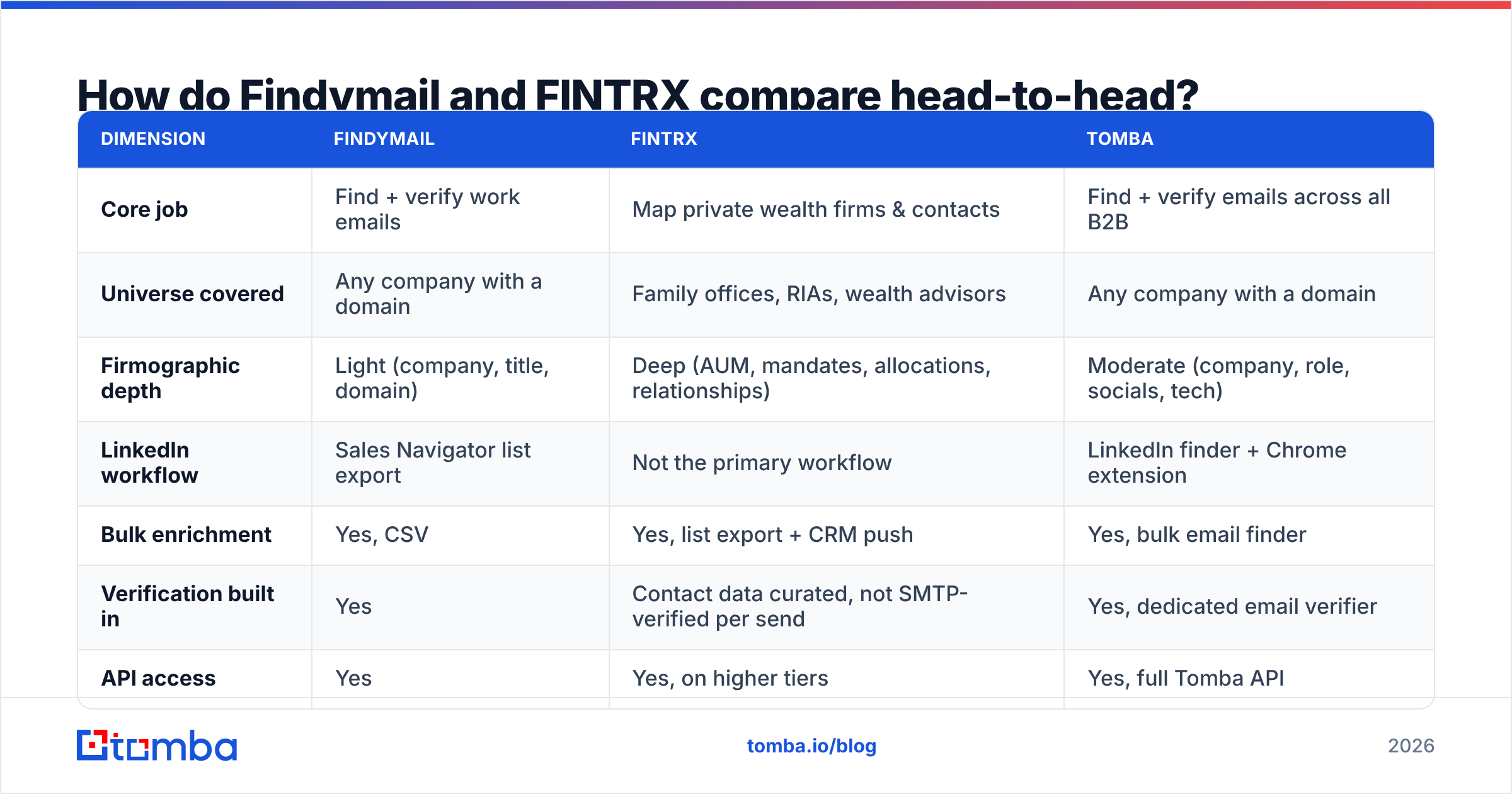
Findymail wins on breadth. Any domain, any industry, any geography with a public web presence. If your ICP is "Series A to Series C SaaS companies in North America" or "manufacturing firms with 50–500 employees," a general-purpose finder covers it. Coverage rates for general finders tend to land in the 55–75% range on clean input lists — meaning you should expect roughly a quarter to nearly half of a raw list to come back empty regardless of vendor. Anyone promising 95% coverage on cold input is measuring something else.
FINTRX wins on depth inside one vertical. FINTRX publishes figures in the range of tens of thousands of advisory firms and hundreds of thousands of wealth professionals, with several thousand family offices profiled. Those records carry attributes a scraper will never produce: whether a family office allocates to private credit, which sub-advisors they use, what their reported AUM band is. If you are raising a fund, that context is the product. The email address is almost incidental.
The failure mode people hit is buying the wrong shape of data:
- Buying vertical depth for a horizontal motion. You pay five figures for wealth data, then discover 80% of your pipeline is generic B2B SaaS buyers who are not in the database at all.
- Buying a horizontal finder for a relationship-led motion. You get 10,000 verified emails and no idea which of those RIAs actually allocates to your strategy, so your reply rate sits at 0.4%.
- Assuming "verified" means "safe to send." Verification is a point-in-time signal. A verified email from March is not a verified email in August. Job change rates in B2B run around 20% annually.
- Ignoring catch-all domains. A large slice of enterprise domains accept everything at the SMTP layer, which means naive verification marks them "valid" and your bounce rate quietly climbs. A dedicated catch-all verifier is the only reliable handling.
- Paying twice for the same contact. Enrichment credits burned on records you already have in your CRM is the single most common line-item waste in a data budget.
What does each one cost?#
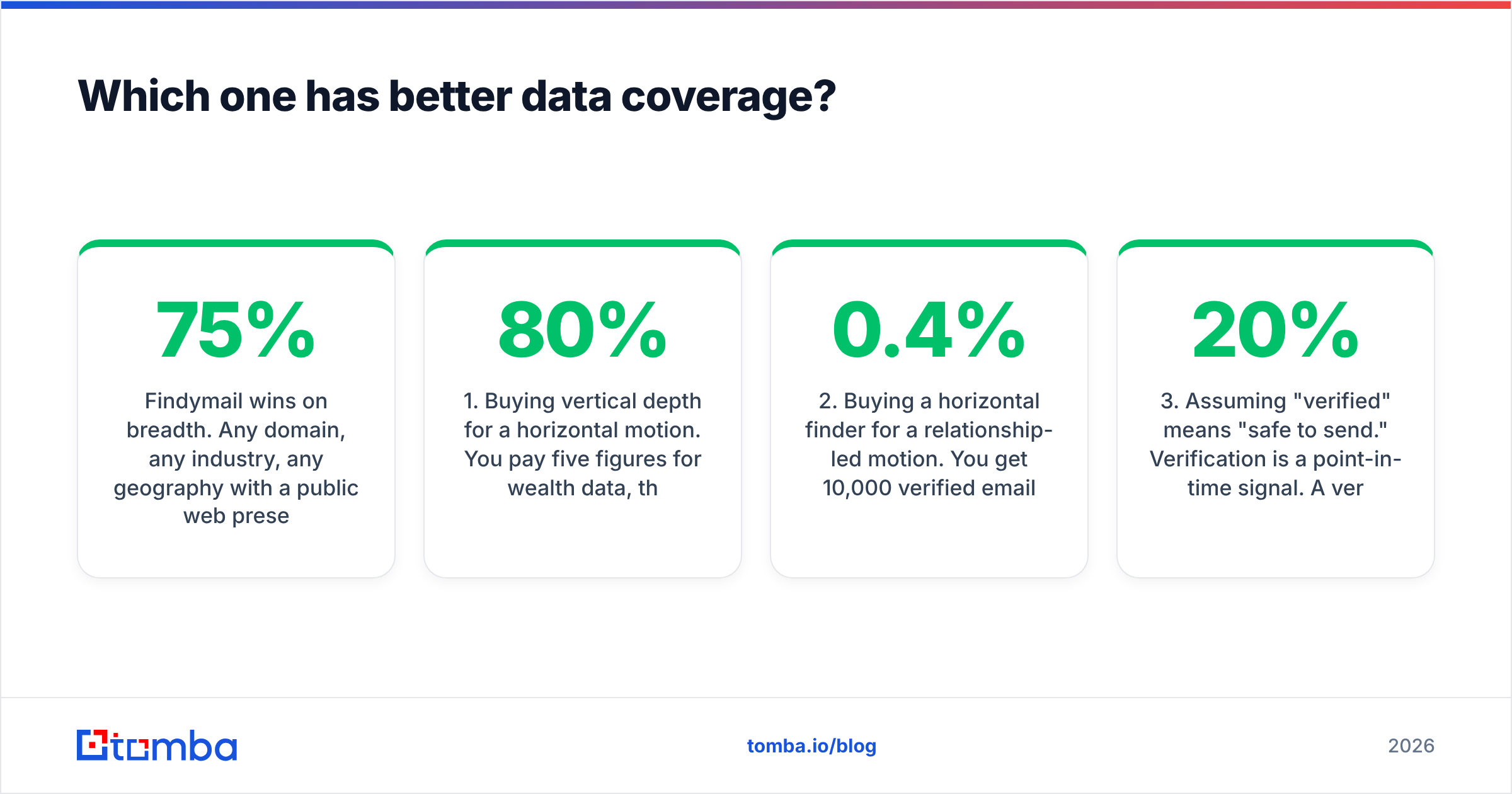
| Plan tier | Findymail | FINTRX | Tomba |
|---|---|---|---|
| Free tier | Limited trial credits | No public free tier | 25 searches/mo, free |
| Entry paid | ~$49/mo (~1,000 credits) | Quote only | $49/mo Starter |
| Mid tier | ~$99/mo (~5,000 credits) | Quote only | $99/mo Growth |
| High tier | ~$249/mo (~15,000 credits) | Quote only, annual | $249/mo Pro |
| Enterprise | Custom | Custom, annual contract | Custom |
| Contract length | Monthly, cancel anytime | Typically annual | Monthly or annual |
Vendor pricing moves, so treat published tiers as directional and confirm on the vendor's own page before you budget. Current Tomba pricing is listed publicly with no sales call required.
The structural difference matters more than the numbers. Findymail and Tomba are self-serve, credit-metered, and cancellable — you can test with a real list this week. FINTRX is enterprise-sold with a demo, a scoping call, and an annual commitment. That is not a criticism; curated vertical data genuinely costs more to maintain than crawled public data. But it does mean the two tools sit in different approval processes. One is a card swipe. The other is a procurement cycle.
If you are evaluating either, third-party review platforms like G2 are useful for one thing specifically: reading the two-star reviews to find the failure modes, not reading the five-star reviews to confirm your bias.
Who should choose Findymail?#
Pick Findymail if most of these are true:
- Your outbound runs on volume — hundreds to thousands of contacts per month.
- You build lists in LinkedIn Sales Navigator and want a clean export path.
- Your ICP is mainstream B2B: software, services, e-commerce, agencies, mid-market operators.
- You are optimizing for bounce rate above all else because your domain reputation is fragile.
- You want a tool you can start and stop without a contract.
Where it gets tight: Findymail is a single-purpose finder. If you also need phone numbers, technographics, website visitor identification, or a broader enrichment layer, you will end up stacking two or three subscriptions. That is the case people usually make when they look at a Findymail alternative — not because the finding is bad, but because the surface area is narrow relative to the price per credit.
Who should choose FINTRX?#
Pick FINTRX if most of these are true:
- You are raising capital, distributing a fund, or selling into the wealth-management channel.
- Firm-level intelligence — AUM, mandate type, allocation history — changes who you contact and what you say.
- Your deal sizes justify a four- or five-figure annual data spend against a target list measured in hundreds, not tens of thousands.
- Your motion is relationship-first: warm intros, conference targeting, and researched one-to-one outreach rather than sequenced volume.
- Compliance matters and you need a documented, curated data source rather than a scrape.
Where it gets tight: if any meaningful share of your pipeline sits outside private wealth, FINTRX simply does not cover it, and you will need a general finder alongside it. That is a stack decision, not a replacement decision.

Can you run both — and where does Tomba fit?#
Yes, and for wealth-tech GTM teams it is often the correct answer. The pattern looks like this:
- FINTRX defines the target universe. Pull the firms that match your mandate criteria. This is the part no horizontal tool replicates.
- A general finder fills the gaps. Not every relevant contact at a target firm will be in a vertical database — new hires, adjacent roles, and operations staff often are not. Run those through a domain search to map the firm's email pattern and surface everyone else.
- Verification runs last, always. Whatever the source, re-verify immediately before the send. Curated data ages; SMTP checks do not care where a record came from.
- Enrichment closes the loop. Push the combined record — firm context from the vertical source, contact detail from the finder — into your CRM through data enrichment so reps see one row, not three tabs.
This is where Tomba tends to slot in: not as a FINTRX competitor (it is not a wealth database and will not pretend to be), and not purely as a Findymail clone, but as the horizontal contact layer that keeps a vertical data investment from stranding. You get the finder, the verifier, catch-all handling, phone data, and an API on the same credit pool, with a free tier to test coverage against your actual list before you pay anything.
What should you test before you commit?#
Run the same 200-row list through every tool you are evaluating. Not a sample list from the vendor — your list, with your real ICP, including the messy rows.
Then measure four things, in this order:
- Match rate. What percentage came back with an email at all?
- Bounce rate on send. The only number that matters. Verified-but-bounced is a vendor problem, not a you problem.
- Cost per delivered contact. Divide plan cost by contacts that actually landed in an inbox, not by credits consumed.
- Time to first list. How many hours from signup to a usable, deduped, CRM-ready file?
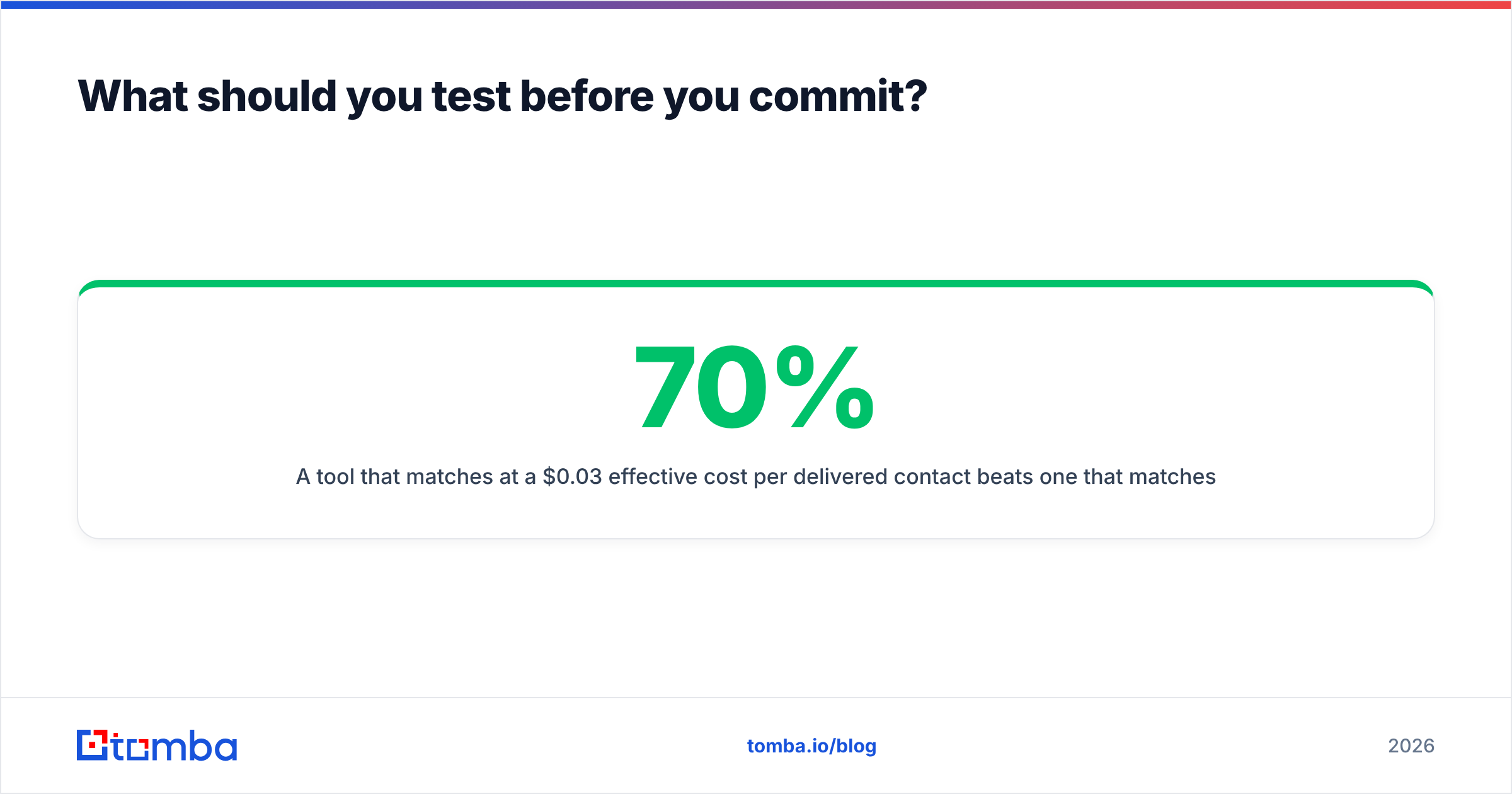
A tool that matches 70% at a $0.03 effective cost per delivered contact beats one that matches 85% at $0.30, every time, unless your deal size is enormous. And if your deal size is enormous — which is exactly the case for fund distribution — that is precisely when vertical intelligence like FINTRX earns its price and a cheap finder does not.
The verdict#
Findymail and FINTRX are not substitutes. Findymail is the better buy if you need verified work emails at volume across mainstream B2B, on a self-serve budget, with a Sales Navigator workflow. FINTRX is the better buy if your revenue depends on knowing which family offices and RIAs allocate to what, and the email address is the last mile rather than the whole product. If you are choosing between them on price alone, you have almost certainly misdiagnosed which problem you have.
For the horizontal half of that stack — finding and verifying work emails across any domain, without a sales call or an annual contract — start with the Tomba Email Finder. The free tier gives you 25 searches a month to benchmark match rate against your own list, Starter runs $49/mo, and the verifier, domain search, catch-all handling, and API all draw from the same credits. Test it against whatever you are using now on 200 real rows, and let the bounce rate decide.
Related guides#
Ready to find emails that actually work?
Join 150,000+ professionals who stopped guessing and started sending. Free credits on signup — no credit card required.
Get the Tomba newsletter
Practical outbound tactics and product updates — once every two weeks.
About the author