Findymail vs FullCircl: Which B2B Data Tool Wins in 2026?
Findymail finds verified B2B emails. FullCircl scores and monitors entire companies for regulated industries. They barely overlap — and picking the wrong one costs you a quarter. Here's the honest breakdown.
Findymail vs FullCircl is not a fair fight. One tool finds work emails. The other checks whole companies. This guide shows you which one to buy, and when you need neither.
TL;DR
- Findymail finds work emails. Give it a name and a domain, or a Sales Navigator list. It returns a verified email. Self-serve, credit-based, built for outbound teams.
- FullCircl studies companies. It covers company data, group structure, risk flags, KYB/AML checks, and alerts. It is strongest on UK and Irish firms. Sales-led, quote-only.
- The two barely overlap. Findymail answers "how do I email this person?" FullCircl answers "should we work with this company at all?"
- Need both halves without an enterprise deal? Pair a finder with an enrichment tool, such as Tomba. It costs far less.
- The short Findymail vs FullCircl price rule: Findymail sits in the low hundreds per month. FullCircl is quote-only and often five figures a year. They do not compete on price, because they do not compete.
Why do people compare Findymail vs FullCircl?#
Both tools get filed under "B2B data" in software directories. That label hides a huge gap.
Search either name on G2. You will see shared tags: sales intelligence, lead enrichment, data providers. But the buyer is different. The price differs by ten times or more. The job to be done is different too.
The Findymail vs FullCircl question tends to come up in three ways:
- A UK sales team already pays for FullCircl. Someone asks if it can supply prospect emails too, so they can drop a second tool.
- An outbound team already uses Findymail. They can find any email. They still cannot tell which accounts are worth the effort.
- A RevOps lead is building a stack from scratch. They want to know how many tools they really need.
Each case has a different answer. So let's take the tools one at a time.
What does Findymail actually do?#
Findymail finds and verifies work emails. You can read the vendor's own pitch at findymail.com. The core loop:
- Single lookup — type a first name, last name, and company domain. Get a work email back.
- LinkedIn and Sales Navigator export — a Chrome add-on pulls a list and adds an email to each row.
- Bulk CSV enrichment — upload names and domains. Download the file with emails added.
- Built-in checks — Findymail works hard to avoid emails it cannot confirm. That is the source of its low bounce rate.
- API and integrations — a REST API plus native hooks into common sequencers.
The pitch is simple. Better to return nothing than a guess. That choice has a cost: you trade hit rate for a clean list. Findymail picks the clean list. If your sending domain matters, that trade is worth paying for.
Findymail does not score companies. It does not map group structure, pull financials, check credit risk, run legal checks, or watch an account over time. It is a lookup tool, and it says so plainly.
What does FullCircl actually do?#
FullCircl came from the merger of Artesian Solutions and DueDil. It now sits in the wider onboarding and identity space. Its site is fullcircl.com.
The core parts:
- Company graph — deep records on millions of UK and Irish firms. That includes public filings, financials, group structure, and owners.
- Risk and compliance — KYB (know your business), AML screening, sanctions lists, and credit signals. Built for banks, lenders, and insurers.
- Trigger alerts — a ping when a target files accounts, swaps directors, raises money, opens a site, or hits the news.
- Rules-based targeting — set your ideal customer profile. The platform then surfaces firms that match as they qualify.
- CRM embedding — it is built to live inside Salesforce or Dynamics, not in one more tab.
The FullCircl buyer usually owns compliance, onboarding, or strategy at a large regulated firm. Its unit is the company, not the person. It tells you a lot about an account. It tells you very little about how to reach a human there.
Findymail vs FullCircl: how do they compare head-to-head?#
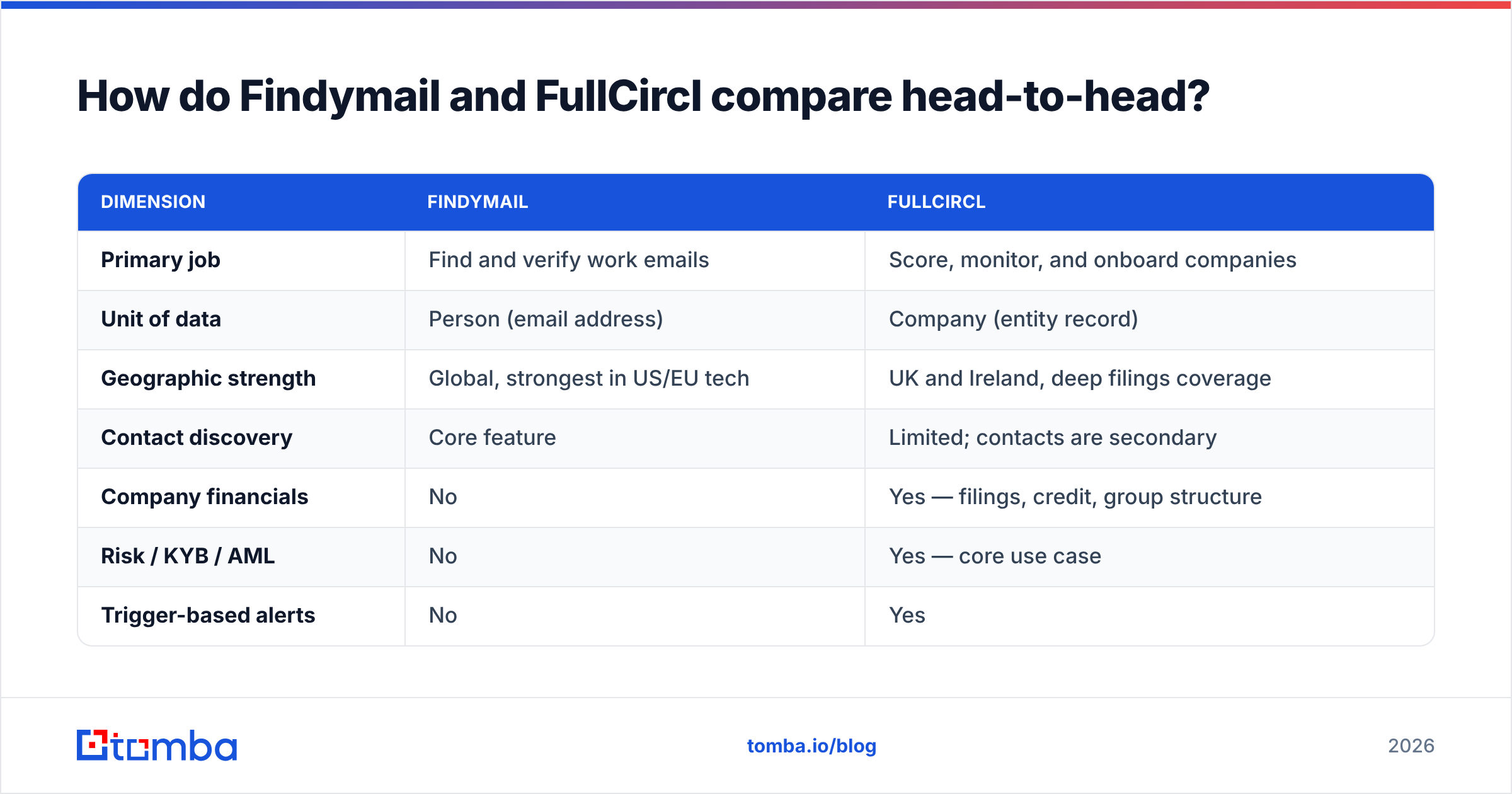
| Dimension | Findymail | FullCircl |
|---|---|---|
| Primary job | Find and verify work emails | Score, monitor, and onboard companies |
| Unit of data | Person (email address) | Company (entity record) |
| Geographic strength | Global, strongest in US/EU tech | UK and Ireland, deep filings coverage |
| Contact discovery | Core feature | Limited; contacts are secondary |
| Company financials | No | Yes — filings, credit, group structure |
| Risk / KYB / AML | No | Yes — core use case |
| Trigger-based alerts | No | Yes |
| Buying motion | Self-serve, card on file | Sales-led, annual contract |
| Typical entry price | Low hundreds per month | Quote-only, typically five figures/year |
| Time to first value | Minutes | Weeks (implementation + CRM config) |
| Best for | Outbound SDR teams, agencies, founders | Regulated firms, UK commercial teams |
The table makes a point that no feature grid can. In the Findymail vs FullCircl matchup, no line shows real competition. The two tools share a label and little else.
Which type of B2B data are you actually buying?#
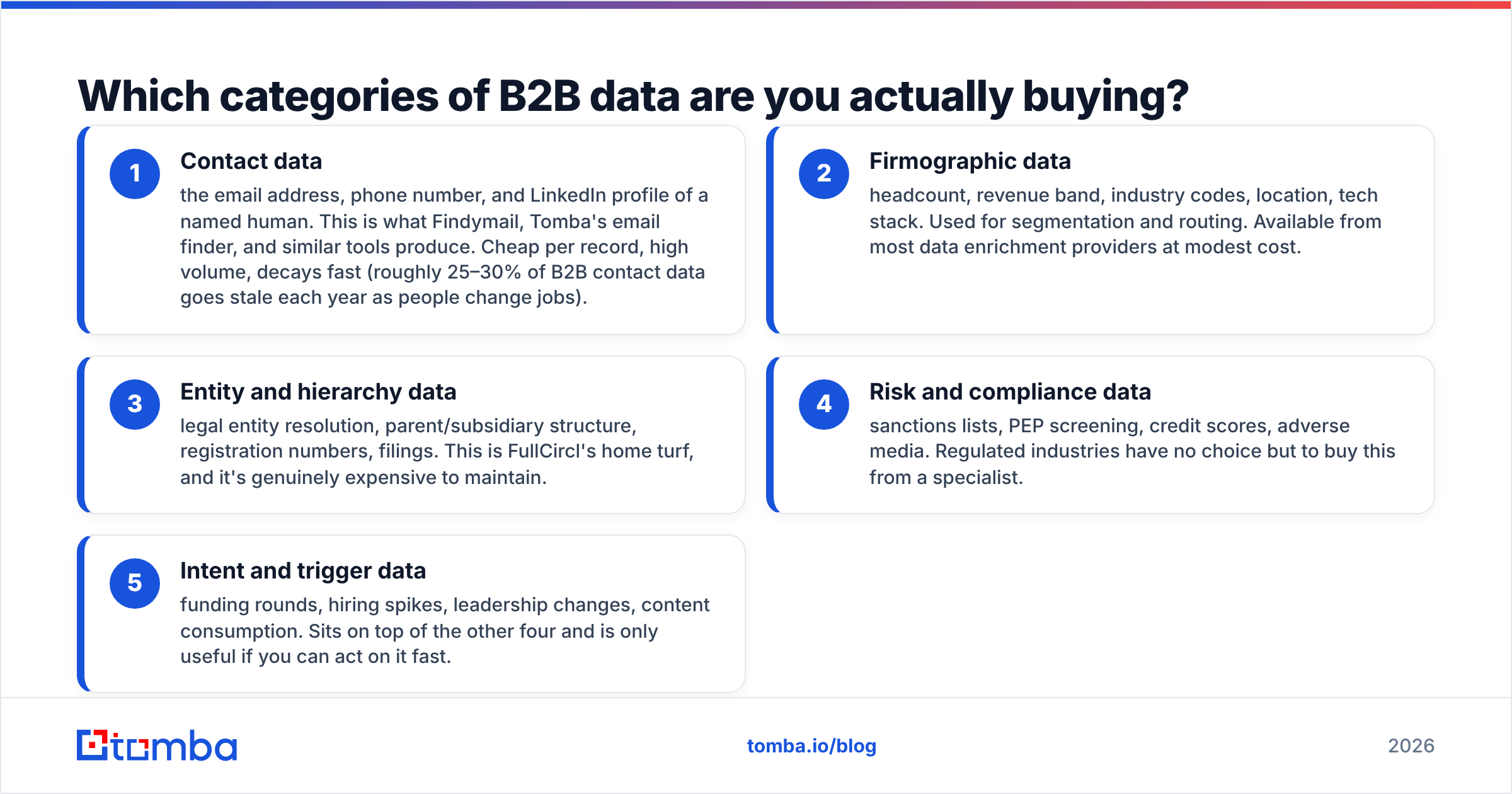
First, work out which of these five data layers your team lacks. Most stacks are short on exactly one. Buying the wrong layer is how budgets get burned.
- Contact data — the email, phone, and profile of a named person. This is what Findymail and Tomba's email finder produce. Cheap per record, and it ages fast. About a quarter of it goes stale each year as people switch jobs.
- Company facts — headcount, revenue band, industry, location, tech stack. Used to sort and route leads. Most data enrichment tools sell it at a low price.
- Entity and group data — legal entity, parent and child links, registration numbers, filings. This is FullCircl's home turf. It is costly to keep current.
- Risk and compliance data — sanctions lists, credit scores, bad press. Regulated firms have to buy this from a specialist.
- Intent and trigger data — funding rounds, hiring spikes, leader changes. It sits on top of the other four. It only helps if you can act fast.
Findymail sells layer 1. FullCircl sells layers 2 through 5, with most weight on 3 and 4. Findymail vs FullCircl looks confusing until you name the layer you lack. Then the choice makes itself.
Findymail vs FullCircl: which tool is more accurate?#
The question only works inside one layer. So let's answer it layer by layer.
For contact accuracy, Findymail is the stronger tool by design. It checks first, so its emails bounce at low single-digit rates in most user tests. The trade-off is reach. On small firms, odd domains, or unusual name formats, it returns "not found" instead of a guess.
Is that good or bad? It depends on your domain. If you cannot afford bounces, it is good. If you are unsure where you stand, run your current list through an email verifier before you blame the finder.
For company accuracy, FullCircl is well ahead — but mostly at home. Its UK and Irish data draws on public filings. That is about as solid as business data gets. Coverage outside those markets is thinner. If you sell to US mid-market SaaS, you pay for depth you never touch.
Here is a simple way to hold it. Findymail is one precise tool for one job. FullCircl is a full lab for one region. Neither is "more accurate" in the abstract.
One warning applies to both: catch-all domains. About one in five business domains accepts mail to any address. Standard checks then prove nothing. Findymail clears some of these. Many finders just mark them "risky" and move on. If catch-alls fill your list, add a catch-all verifier whatever else you buy.
Findymail vs FullCircl: how does pricing compare?#
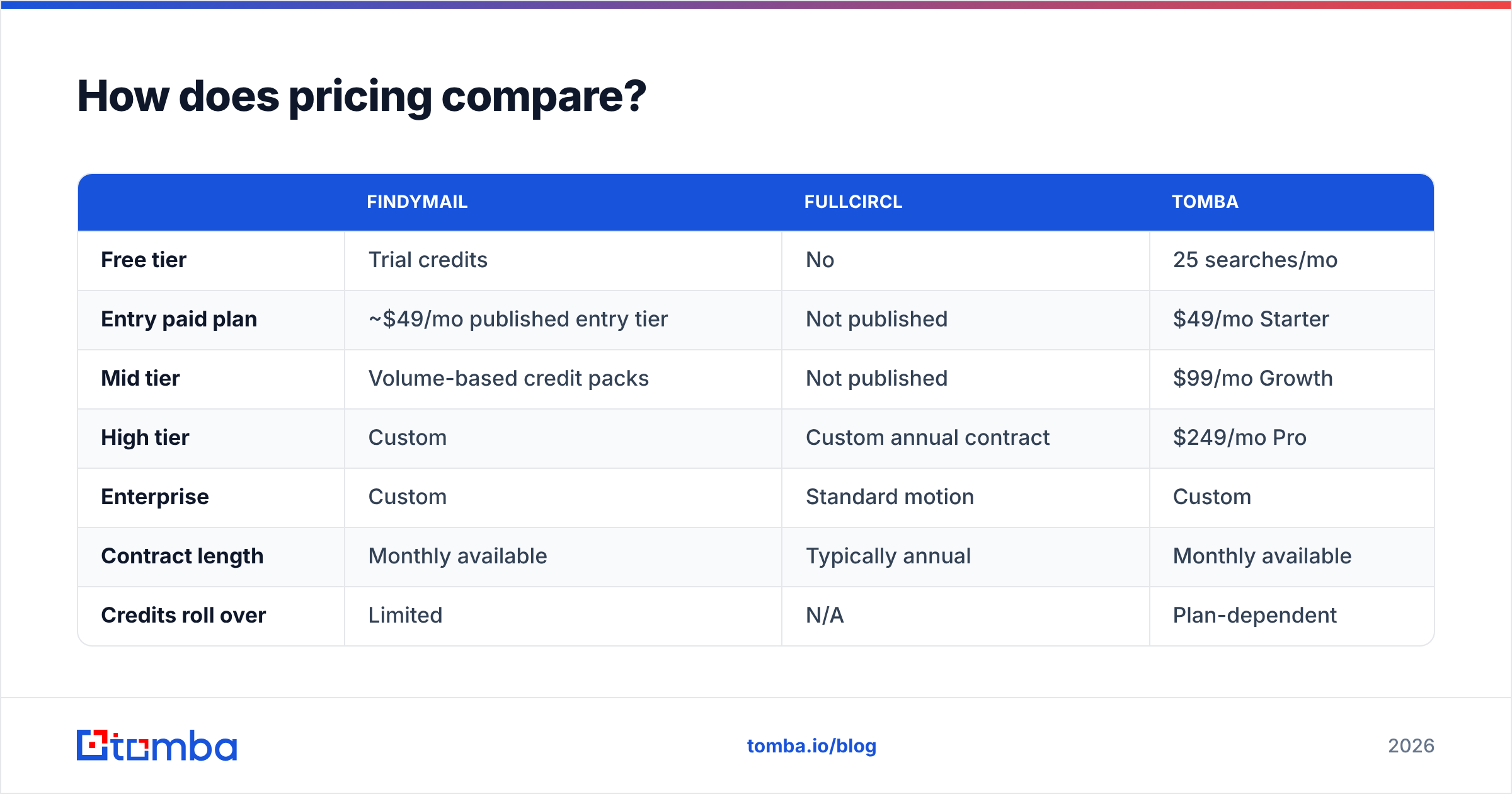
| Findymail | FullCircl | Tomba | |
|---|---|---|---|
| Free tier | Trial credits | No | 25 searches/mo |
| Entry paid plan | ~$49/mo published entry tier | Not published | $49/mo Starter |
| Mid tier | Volume-based credit packs | Not published | $99/mo Growth |
| High tier | Custom | Custom annual contract | $249/mo Pro |
| Enterprise | Custom | Standard motion | Custom |
| Contract length | Monthly available | Typically annual | Monthly available |
| Credits roll over | Limited | N/A | Plan-dependent |
| API access | Yes | Yes | Yes, all paid plans |
Two honest notes. First, vendor prices move. Check findymail.com and ask FullCircl for a quote before you build a business case. The Tomba pricing figures above are current as published.
Second, the unit differs. Findymail and Tomba sell credits: one lookup, one credit, near enough. FullCircl sells seats plus data access, with volume agreed up front. A per-record match-up means little. Compare the yearly total against the outcome you want.

Who should choose Findymail?#
Pick Findymail if most of these fit you:
- You send outbound email at volume, and bounce rate is a board-level metric.
- You source leads in Sales Navigator and want a clean export path.
- You want to be live this afternoon, not next quarter.
- You do not need financials, risk scores, or entity data.
- You sell across many countries, so a UK-deep dataset is wasted spend.
Findymail's weak spot is scope. It will not rank your 4,000 target accounts. It will not warn you when a target swaps CFO. It will not help your compliance team. If you need those things, a second tool is coming.
Who should choose FullCircl?#
Pick FullCircl if most of these fit you:
- You work in a regulated sector, such as insurance, lending, or banking. KYB and AML are not optional there.
- You sell in the UK and Ireland, where deep filing data is a real edge.
- You already run Salesforce or Dynamics and want the data inside it.
- Your motion is account-based and high value. One well-timed alert beats a thousand emails.
- You have budget for a yearly contract and patience for a rollout.
FullCircl's weak spot is contact reach and geography. It hands your reps a clean account list. Then it leaves them to work out who to email. That gap is why the Findymail vs FullCircl question gets asked at all. Teams find they need both halves.
Where does Tomba fit between the two?#
Honestly: Tomba competes with Findymail, not FullCircl. Nothing in Tomba replaces public filings or AML screening. Pretending otherwise would waste your time.
Findymail vs FullCircl leaves a gap in the middle. That gap is contact data plus enough company context to set priorities, with no enterprise contract. Tomba aims at it:
- Domain search returns every email pattern and named contact at a company. That beats one lookup at a time.
- Bulk email finder handles whole lists, with checks applied in the same pass.
- Data enrichment adds headcount, industry, location, and socials. Your CRM then holds more than an email and a guess.
- Tomba API, CLI, Sheets, Excel, and Airtable links drop the data where your team already works.
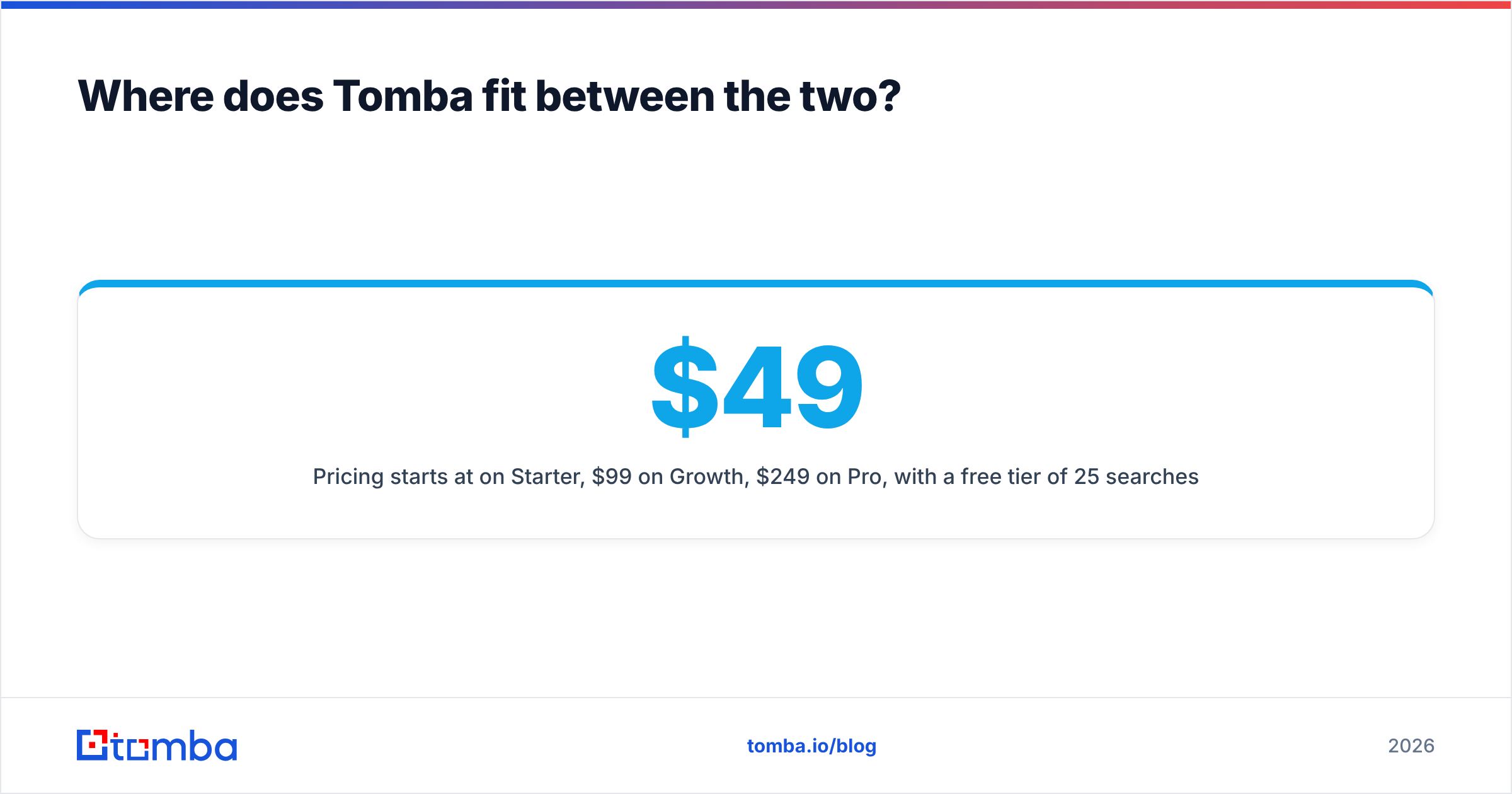
- Plans start at $49/mo Starter, $99/mo Growth, and $249/mo Pro. A free tier of 25 searches a month lets you test hit rate first.
If your gap is layer 1 plus a bit of layer 2, that is the cheaper answer. If your gap is layer 4, buy FullCircl and do not improvise.
Findymail vs FullCircl: what's the verdict for 2026?#
There is no winner, because there is no real contest. The useful verdict is a routing rule:
- Need verified emails for outbound at volume → Findymail, or a finder with a free tier so you can test hit rate first.
- Need company risk, filings, KYB/AML, and alerts in the UK or Ireland → FullCircl. No finder replaces it.
- Need both on a mid-market budget → run a finder plus an enrichment layer. Move up to a compliance platform only when the rules force you.
The Findymail vs FullCircl choice is not the costly mistake here. The costly mistake is buying an enterprise data contract to solve a $49 email problem. Or trying to satisfy an auditor with a browser extension.
Before you commit, run the same 200-row test list through each option. Measure hit rate, bounce rate, and clean-up time. That one test tells you more than any feature grid, this one included.
Ready to test the contact-data half? Start with the Tomba Email Finder. You get 25 free searches a month, no card, with checks built into every lookup. Run your real list, compare the hit rate, and decide on evidence instead of a vendor deck.
Related guides#
Ready to find emails that actually work?
Join 150,000+ professionals who stopped guessing and started sending. Free credits on signup — no credit card required.
Get the Tomba newsletter
Practical outbound tactics and product updates — once every two weeks.
About the author