Findymail vs HitHorizons: Which B2B Data Tool Wins in 2026?
Findymail finds verified work emails. HitHorizons maps European company registries. They get compared constantly, but they solve different halves of the same problem — here's which one your pipeline actually needs.
Findymail vs HitHorizons is an odd matchup. One tool finds a person's work email. The other maps European company registries. Both get sold as "B2B data," so they land on the same shortlist. They solve different problems, though, and the wrong pick costs you a quarter. Here is the plain version.
TL;DR
- They are not real competitors. Findymail is a contact-level email finder for cold outreach. HitHorizons is a company-level database built on European business registers. One hands you a person to email. The other hands you a legal entity to research.
- Choose Findymail if your problem is "I have a list of people and no valid inboxes."
- Choose HitHorizons if your problem is "I need European companies filtered by registry data, revenue band, or legal form."
- Most teams end up needing both layers. First find the company, then find the person. That is why one provider covering domain search, email finding, verification, and enrichment often beats stitching two narrow tools together.
- Watch the pricing unit. Findymail charges per email credit. HitHorizons charges per company profile. Compare the unit, not the sticker price.
What is Findymail and who is it built for?#
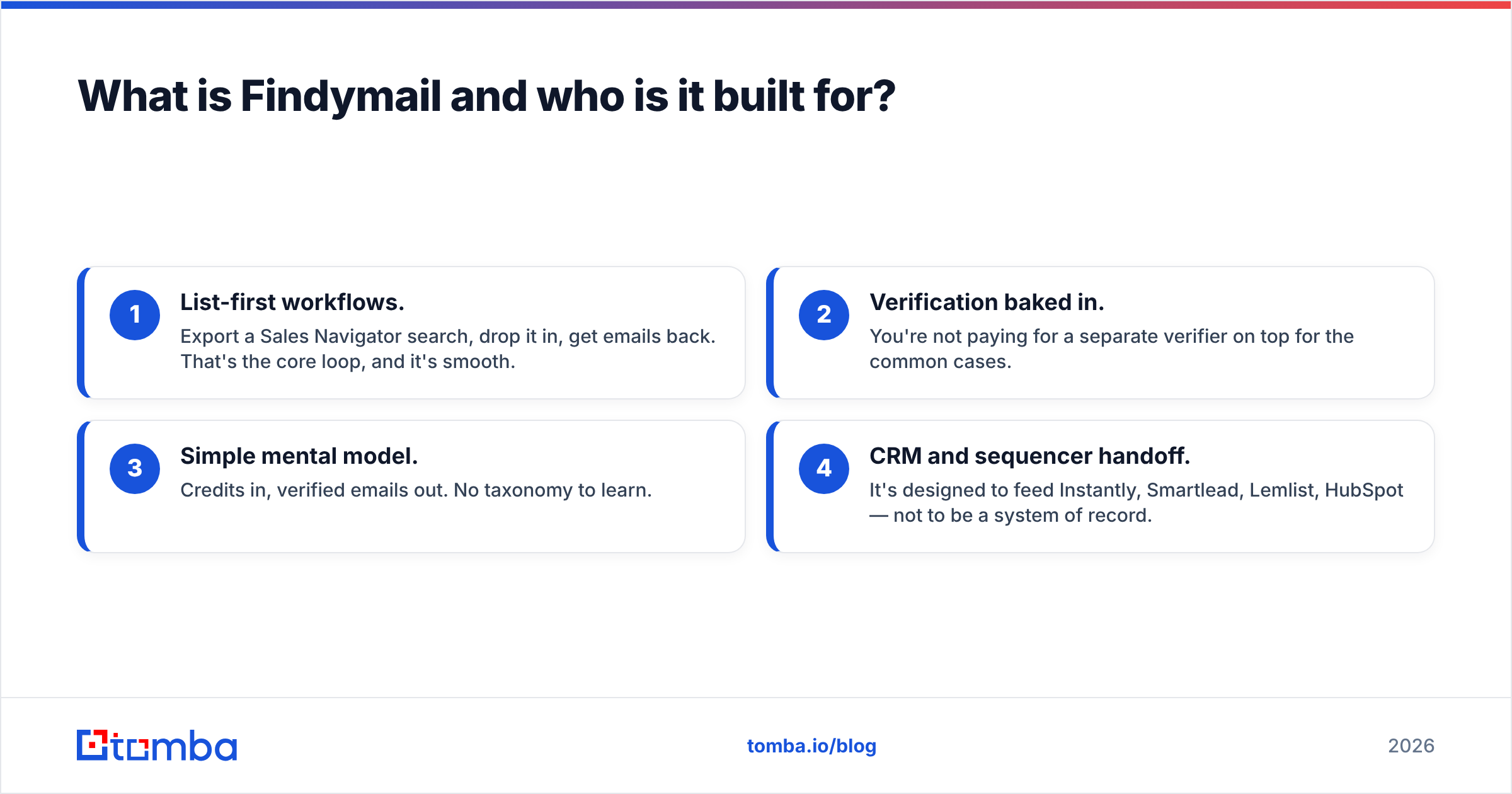
Findymail is an email finder built for outbound sales teams. You give it a name and a company, or a LinkedIn / Sales Navigator list. It returns a work email that it has already run through its own verification layer. The pitch has always been bounce protection: what comes back is safe to send to.
What it does well:
- List-first workflows. Export a Sales Navigator search, drop it in, get emails back. That is the core loop, and it is smooth.
- Verification baked in. You do not pay for a separate verifier in the common cases.
- Simple mental model. Credits in, verified emails out. There is no taxonomy to learn.
- CRM and sequencer handoff. It is designed to feed Instantly, Smartlead, Lemlist, and HubSpot. It is not a system of record.
What it does not do: it will not tell you a company's registered turnover band, its legal form, its VAT number, or its parent entity in a Czech or Portuguese registry. It is a contact tool, not a firmographic one.
What is HitHorizons and what problem does it solve?#
HitHorizons sits at the other end. It is a European company-data platform. It aggregates profiles from official business registers in roughly 50 countries, covering tens of millions of entities. Each record carries registry-grade fields: legal name, registration number, legal form, industry code, employee band, revenue band, and corporate linkage.
You use it to answer questions like:
- Which manufacturing companies in Poland have 50–200 employees and revenue above €10M?
- Is this entity a subsidiary, and of whom?
- What is the official registered address, not the marketing one on the website?
That is market research and territory planning. It is not a "who do I email Tuesday morning" job. HitHorizons offers free single-company lookups. Paid API and subscription access covers bulk pulls. RevOps buys that once and wires it into CRM enrichment or a data warehouse.
Findymail vs HitHorizons: how do they compare head-to-head?#
Here is the honest side-by-side. Pricing figures move, so confirm on each vendor's own pricing page before you sign.
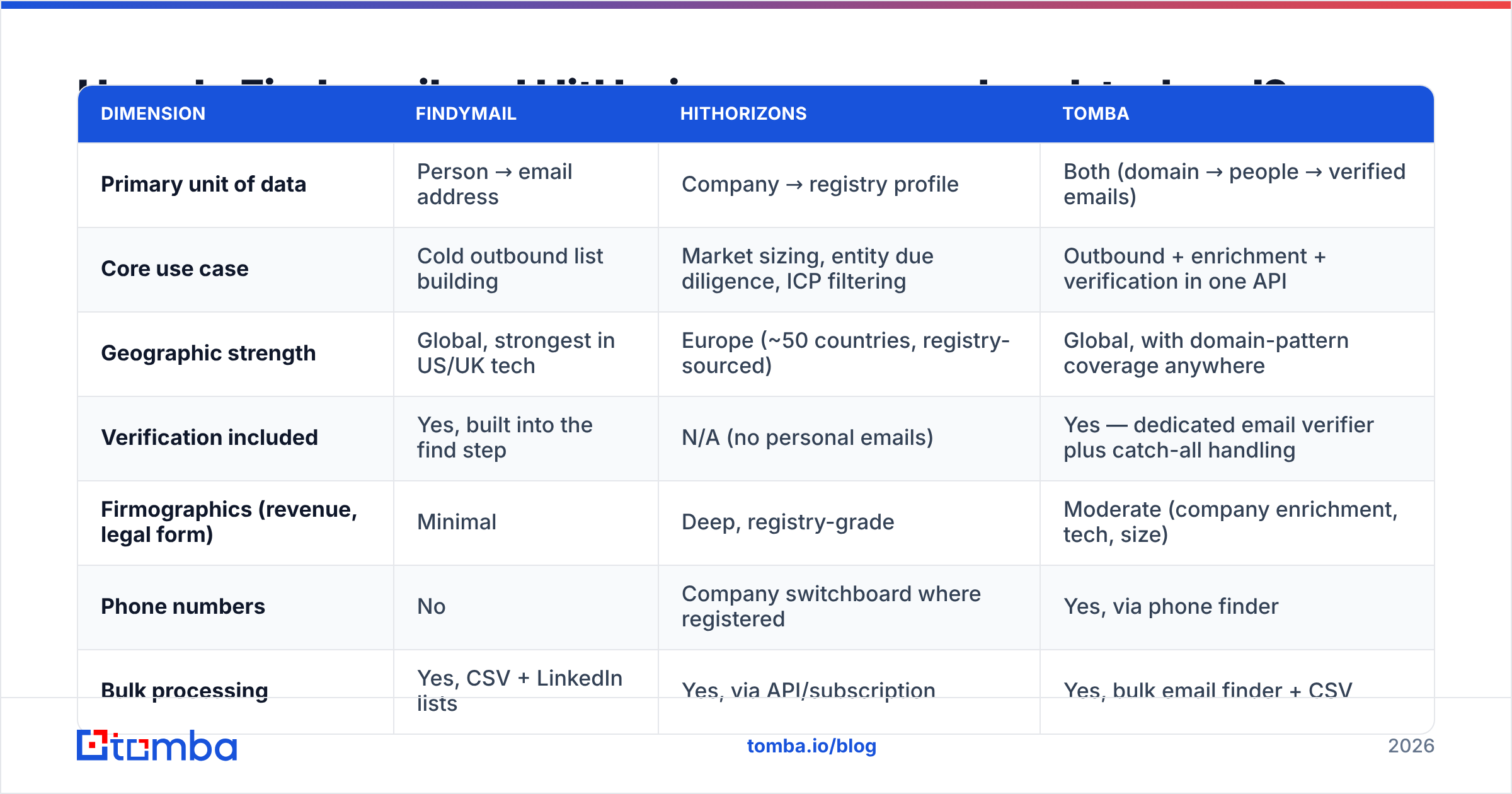
| Dimension | Findymail | HitHorizons | Tomba |
|---|---|---|---|
| Primary unit of data | Person → email address | Company → registry profile | Both (domain → people → verified emails) |
| Core use case | Cold outbound list building | Market sizing, entity due diligence, ICP filtering | Outbound + enrichment + verification in one API |
| Geographic strength | Global, strongest in US/UK tech | Europe (~50 countries, registry-sourced) | Global, with domain-pattern coverage anywhere |
| Verification included | Yes, built into the find step | N/A (no personal emails) | Yes — dedicated email verifier plus catch-all handling |
| Firmographics (revenue, legal form) | Minimal | Deep, registry-grade | Moderate (company enrichment, tech, size) |
| Phone numbers | No | Company switchboard where registered | Yes, via phone finder |
| Bulk processing | Yes, CSV + LinkedIn lists | Yes, via API/subscription | Yes, bulk email finder + CSV |
| Entry price | Around $49/mo for ~1,000 emails | Free lookups; paid API/subscription tiers, quote-based at volume | Free tier (25 searches/mo), Starter $49/mo |
| Best for | SDRs and agencies sending volume | RevOps, analysts, EU-focused GTM | Teams that need both layers without two contracts |
The table makes the real story obvious. The overlap between these two products is close to zero. If you are comparing them, you are probably not choosing between two tools. You are deciding which half of your data problem to solve first.
Where does each tool actually get its data?#
This matters more than any feature list. Data provenance predicts both accuracy and legal exposure.
Findymail works like most modern email finders. It blends crawled public sources, licensed datasets, and pattern inference from a company's known email format. Every result gets a real-time SMTP check before it is returned. The upside is freshness on individuals. People change jobs, and a crawl-plus-verify pipeline catches that faster than a static database. The downside is coverage on small companies with no public footprint.
HitHorizons pulls from official national business registers and commercial data partners. That data is authoritative, slow-moving, and legally clean. A registry does not go stale the way a job title does. It also will not tell you that Marta just became Head of Procurement last month. Registries record entities, not employees.
Tomba sits between the two models. It derives company email patterns from a large crawled corpus, cross-checks them against a verification layer, and exposes the result through one API. The data sources page documents where results come from and how confidence scores are built. Read it before you trust any vendor's accuracy claim, including ours.
Here is a practical test for all three. Take 100 contacts you already know are valid. Run them through each tool. Measure hit rate and bounce rate. Vendors optimize for whichever number they publish, so measure the one they do not.
Is Findymail better than HitHorizons for cold email?#
Yes, and it is not close. HitHorizons is not trying to win that fight.
Say your job is to load 500 verified inboxes into a sequencer this week. HitHorizons gives you company records with no personal email addresses attached. You would still need an email finder on top. Findymail hands you the email directly, already validated.
Three cases leave Findymail alone short:
- You sell to European SMEs outside tech. Registry firmographics tell you which of 40,000 German Mittelstand firms fit your ICP. Findymail cannot filter by revenue band, because it does not hold that field.
- You need compliance-grade entity data. Contracts, KYC, credit checks, and procurement flows want a registration number, not a LinkedIn URL.
- You are building a territory model, not a list. Counting addressable companies per region is a firmographic exercise.
In those cases the order is simple. Start with HitHorizons, or another firmographic source, to define the account list. Then use an email finder to fill in the contacts. That two-step is the workflow most teams land on.
What does the combined workflow cost in practice?#
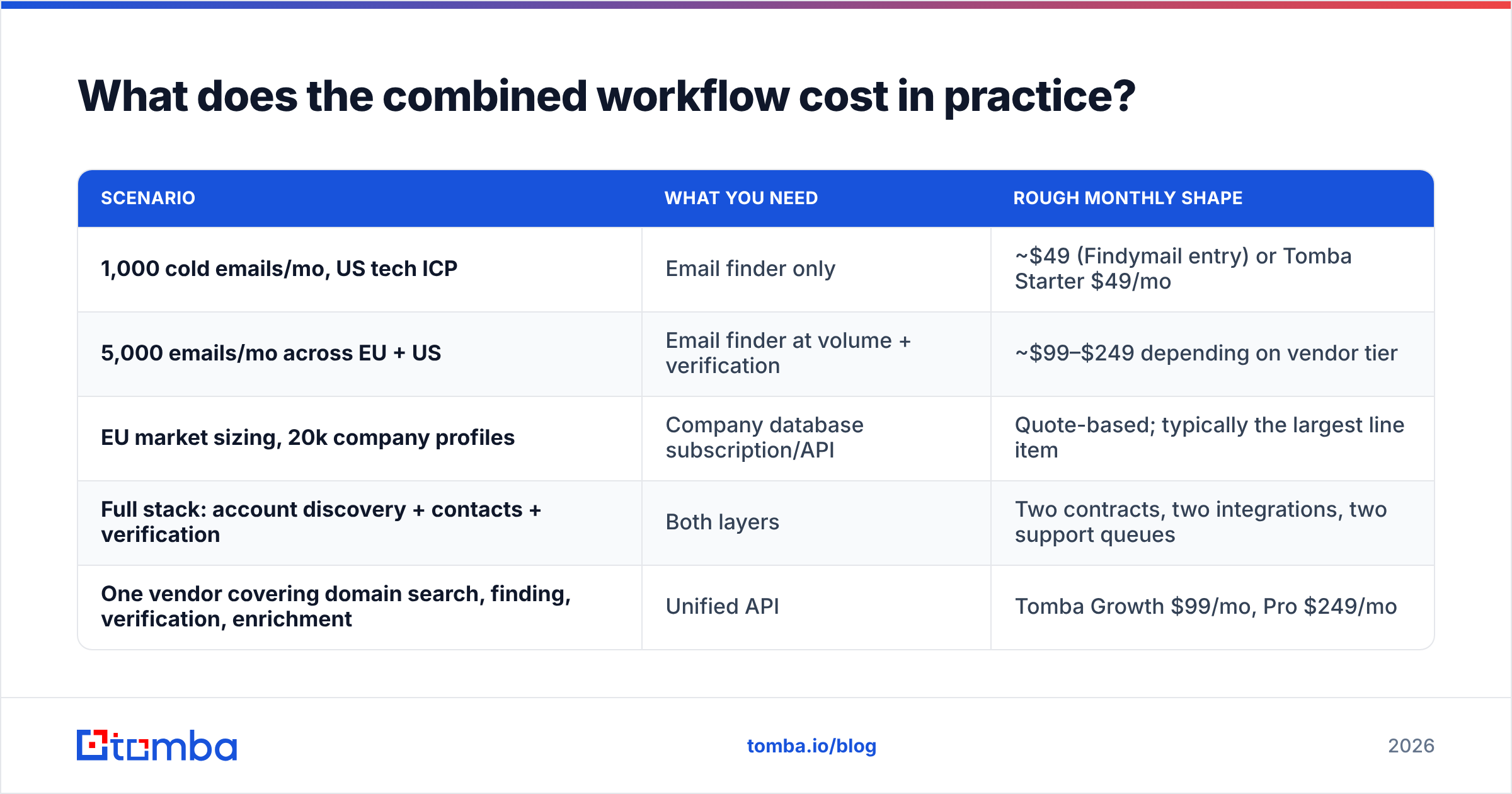
This is where teams get surprised. The two tools price on different units, so a naive comparison misleads.
| Scenario | What you need | Rough monthly shape |
|---|---|---|
| 1,000 cold emails/mo, US tech ICP | Email finder only | ~$49 (Findymail entry) or Tomba Starter $49/mo |
| 5,000 emails/mo across EU + US | Email finder at volume + verification | ~$99–$249 depending on vendor tier |
| EU market sizing, 20k company profiles | Company database subscription/API | Quote-based; typically the largest line item |
| Full stack: account discovery + contacts + verification | Both layers | Two contracts, two integrations, two support queues |
| One vendor covering domain search, finding, verification, enrichment | Unified API | Tomba Growth $99/mo, Pro $249/mo |
The hidden cost of the two-vendor path is not the invoices. It is the join. Company records are keyed by registration number. Contact records are keyed by email domain. Someone on your team spends a week writing matching logic. Budget that engineering time honestly, because it usually costs more than either subscription.
For a like-for-like credit comparison against a single provider, Tomba pricing publishes tiers openly: Free (25 searches/mo), Starter $49/mo, Growth $99/mo, Pro $249/mo, Enterprise custom.

What should you actually check before buying either one?#
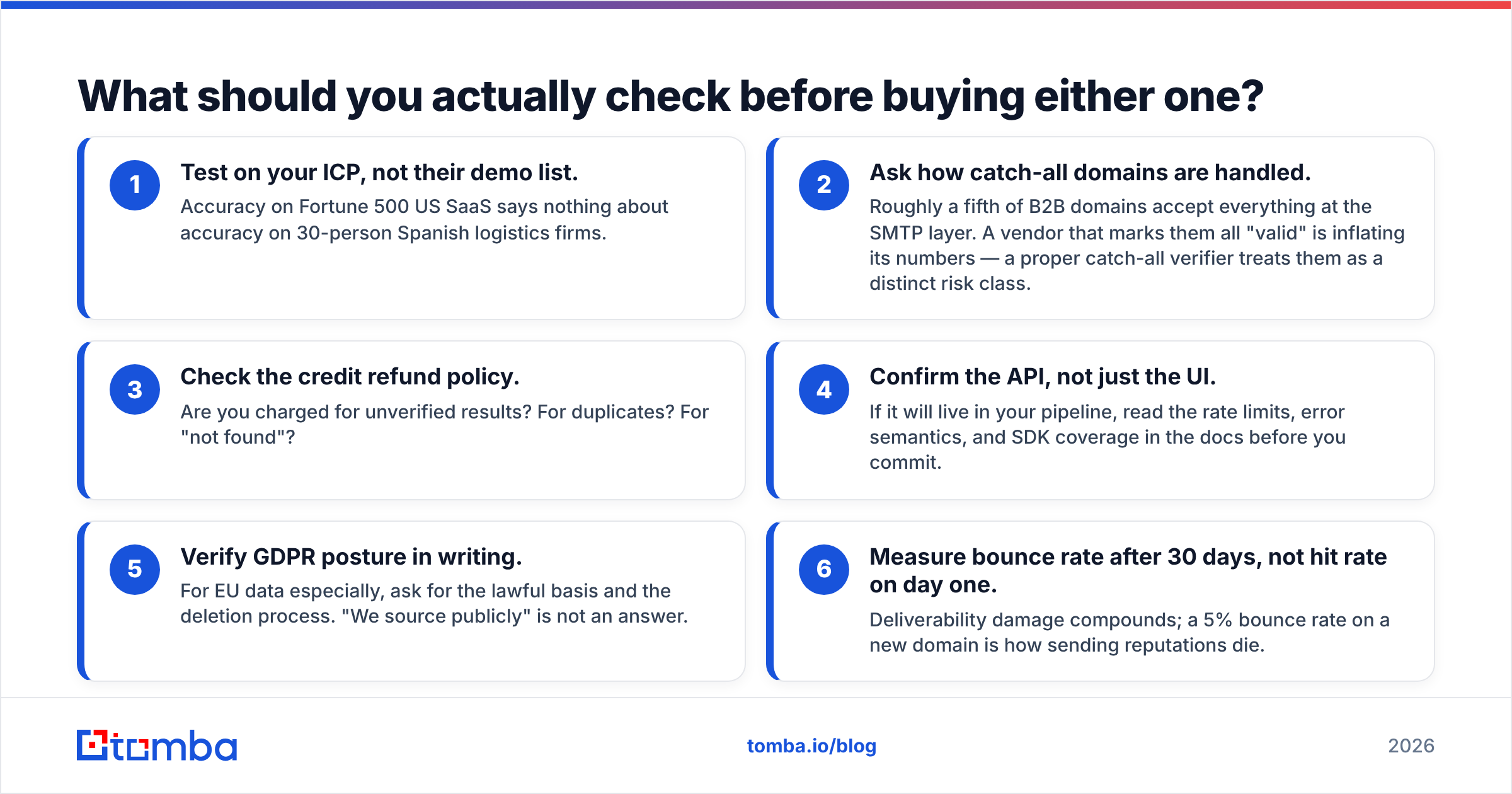
Run this checklist against any data vendor. It separates marketing claims from operational reality:
- Test on your ICP, not their demo list. Accuracy on Fortune 500 US SaaS says nothing about accuracy on 30-person Spanish logistics firms.
- Ask how catch-all domains are handled. About a fifth of B2B domains accept everything at the SMTP layer. A vendor that marks them all "valid" is inflating its numbers. A proper catch-all verifier treats them as a separate risk class.
- Check the credit refund policy. Are you charged for unverified results? For duplicates? For "not found"?
- Confirm the API, not just the UI. If it will live in your pipeline, read the rate limits, error semantics, and SDK coverage first.
- Verify GDPR posture in writing. For EU data, ask for the lawful basis and the deletion process. "We source publicly" is not an answer.
- Measure bounce rate after 30 days, not hit rate on day one. Deliverability damage compounds. A 5% bounce rate on a new domain is how sending reputations die.
Peer reviews on G2 help with the last one. Filter by company size closest to yours and read the two-star reviews first. That is where the real limits show up.
Findymail vs HitHorizons: which should you choose in 2026?#
Pick Findymail if you are an SDR, agency, or founder-led sales team. Your whole problem is turning known people into deliverable inboxes. It is focused, it works, and built-in verification saves you a second subscription.
Pick HitHorizons if you work in RevOps, market research, or finance across European markets. You need authoritative entity data: legal form, registration numbers, revenue bands, corporate hierarchies. No email finder replaces a business register.
Pick a unified provider if you are doing both, which most growing GTM teams eventually are. Run domain search to map every contactable person at a target account. Then find and verify their emails. Then enrich the record. One API, one credit pool, and one support contract remove the joining problem. That is the pitch, and it comes with limits. Tomba will not hand you a Slovak company's registry filing. It will hand you the people who work there and inboxes that do not bounce.
The wrong move is buying either tool because a comparison page says it "wins." In the Findymail vs HitHorizons debate, the two products barely touch. Decide which half of your pipeline is blocked, then buy for that.
Ready to fill the contact layer?#
If your account list is already solid and what you lack is verified email addresses, start with the Tomba Email Finder. Search by domain, name, or company. Results come confidence-scored with verification built in, and you can export straight to your sequencer or CRM. The free tier gives you 25 searches a month. That is enough to benchmark it against Findymail on your own list before you spend anything. Run the same 100 contacts through both, compare hit rate and bounce rate, and let your data pick the winner.
Related guides#
Ready to find emails that actually work?
Join 150,000+ professionals who stopped guessing and started sending. Free credits on signup — no credit card required.
Get the Tomba newsletter
Practical outbound tactics and product updates — once every two weeks.
About the author