Findymail vs LeadGenius: Which B2B Data Tool Wins in 2026?
Findymail sells verified emails by the credit. LeadGenius sells managed, human-researched datasets. They solve different problems at wildly different prices — here's which one your team actually needs.
TL;DR
- Findymail is a self-serve email finder and verifier built for SDRs who live in LinkedIn Sales Navigator and Apollo exports. Credits start around $49/mo, and its pitch is bounce-rate protection.
- LeadGenius is a managed data service — human researchers plus automation building custom datasets and hard-to-find attributes. Pricing is quote-only and typically lands in the four-to-five-figure-per-month range.
- They are not really competitors. Findymail replaces a task; LeadGenius replaces a headcount.
- If you need standard firmographic + contact data at self-serve prices with an API, a tool like Tomba covers the same job as Findymail for $49/mo with a broader toolset (verification, catch-all handling, phone, enrichment).
- Pick Findymail for volume prospecting. Pick LeadGenius when the attribute you need does not exist in any database and someone has to go find it.
What are Findymail and LeadGenius, exactly?#
Findymail is a B2B contact finder that emphasizes low bounce rates. You paste a domain or a name, or push a LinkedIn Sales Navigator list into it, and it returns verified work emails. Its differentiator is a proprietary verification layer that it claims keeps bounces under 5%, plus native list-export integrations that avoid the "scrape 2,000 rows, get 400 bad emails" problem. It is a tool, priced per credit, used daily by individual reps.
LeadGenius sits in a different category entirely. It is a managed data provider: you brief a team, and a blend of ML systems and human researchers builds you a dataset to spec. Want a list of every Shopify store in DACH that added a subscription app in the last 90 days, with the ops lead's direct dial? That is a LeadGenius request. It is not something you self-serve at 2am with a credit card.
That distinction drives every other difference — pricing model, turnaround time, data freshness, and who on your team actually touches the product.

How do Findymail and LeadGenius compare head-to-head?#
Here is the practical breakdown. Note that LeadGenius does not publish pricing; the figures below reflect commonly reported contract ranges from buyer reviews on G2 and public procurement discussions, not official rate cards.
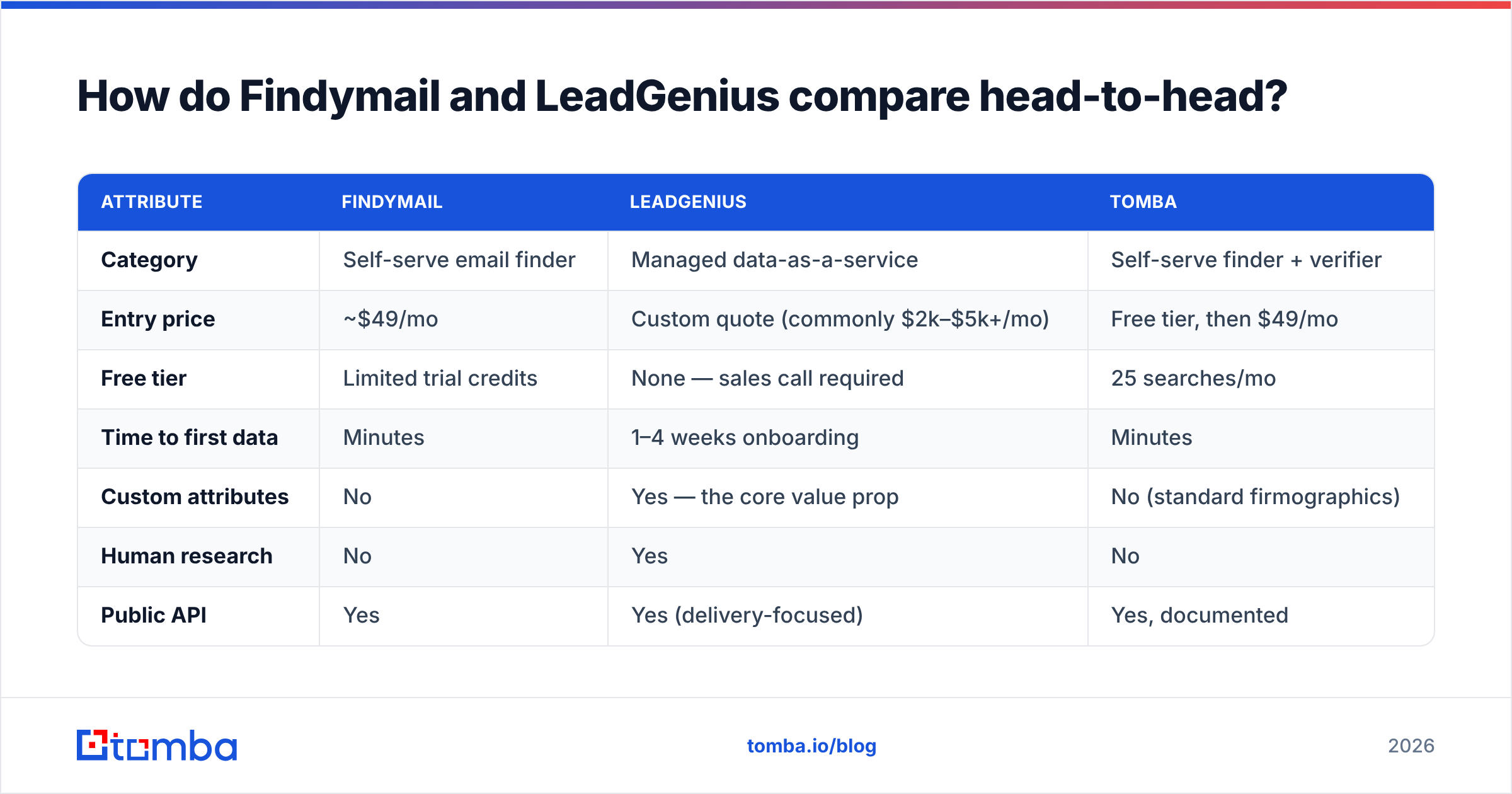
| Attribute | Findymail | LeadGenius | Tomba |
|---|---|---|---|
| Category | Self-serve email finder | Managed data-as-a-service | Self-serve finder + verifier |
| Entry price | ~$49/mo | Custom quote (commonly $2k–$5k+/mo) | Free tier, then $49/mo |
| Free tier | Limited trial credits | None — sales call required | 25 searches/mo |
| Time to first data | Minutes | 1–4 weeks onboarding | Minutes |
| Custom attributes | No | Yes — the core value prop | No (standard firmographics) |
| Human research | No | Yes | No |
| Public API | Yes | Yes (delivery-focused) | Yes, documented |
| Bulk enrichment | Yes | Yes (managed) | Yes |
| Phone numbers | Limited | Yes, researched | Yes |
| CRM sync | Zapier, native exports | Managed delivery to CRM | HubSpot, Salesforce, Pipedrive, Zapier |
| Best for | SDRs, agencies, founders | Enterprise RevOps, TAM projects | SMB to mid-market outbound teams |
The table makes the decision look simple, and mostly it is. The confusion comes from teams evaluating both because they searched "B2B contact data" and got both in the results.
Which one is more accurate?#
Accuracy means two different things here, and conflating them is the most common evaluation mistake.
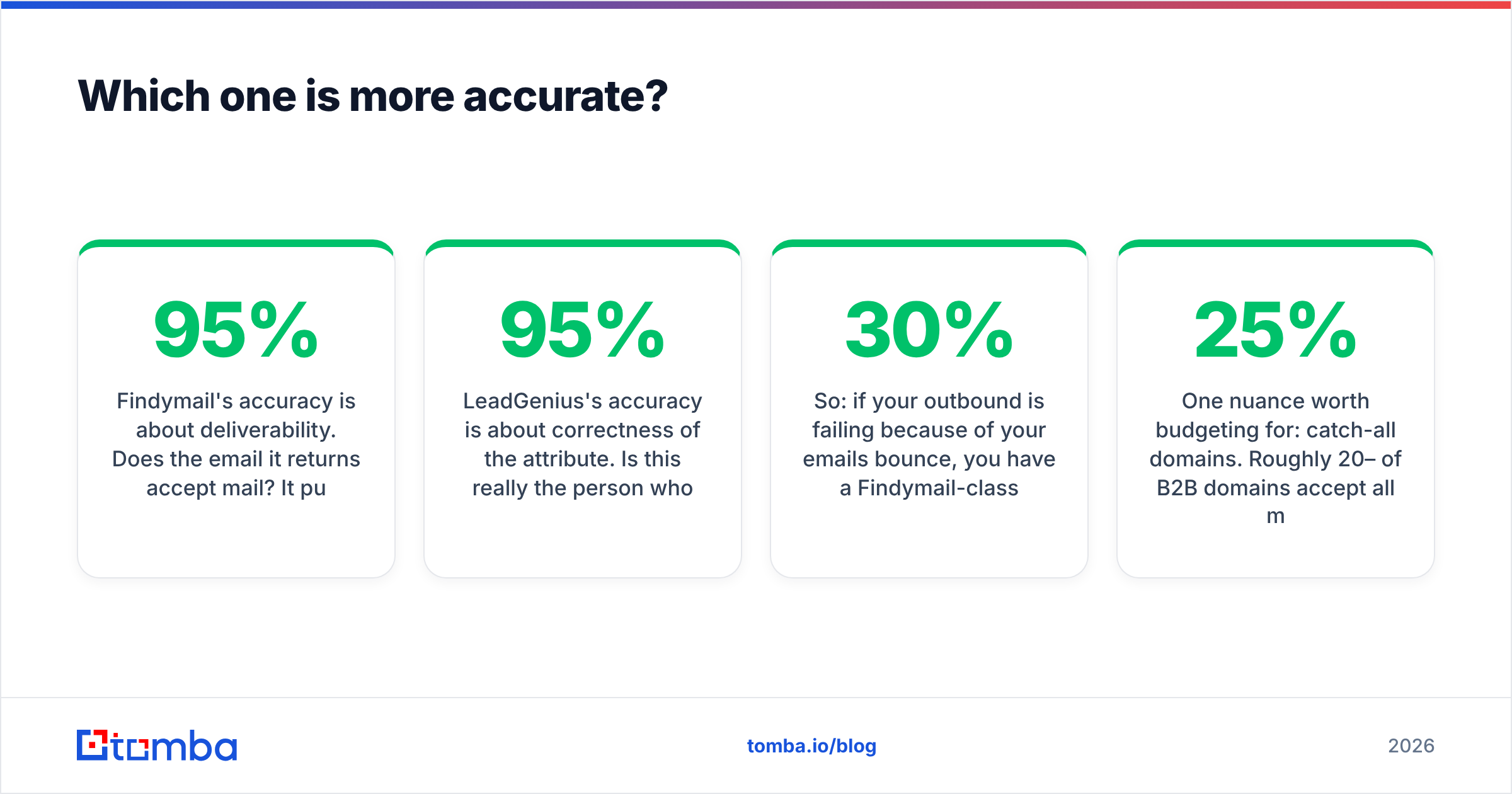
Findymail's accuracy is about deliverability. Does the email it returns accept mail? It publishes a bounce-rate guarantee and runs verification before charging a credit — you are not billed for an address it cannot validate. In practice, most independent testers put reputable finders in the 85–95% valid range on standard corporate domains, with results dropping sharply on catch-all domains and small companies with no web footprint. Findymail sits comfortably in that band.
LeadGenius's accuracy is about correctness of the attribute. Is this really the person who owns procurement at that plant? Did that company actually migrate off Zendesk last quarter? No database contains that; a researcher confirms it. When LeadGenius quotes 95%+ accuracy, they mean a human checked, which is why the price is what it is.
So: if your outbound is failing because 30% of your emails bounce, you have a Findymail-class problem, and any solid email verifier fixes it. If your outbound is failing because you cannot identify who to contact in the first place, no email finder on earth solves that — that's LeadGenius territory.
One nuance worth budgeting for: catch-all domains. Roughly 20–25% of B2B domains accept all mail, so standard SMTP verification returns "unknown." Findymail handles some of this with pattern confidence scoring. If catch-alls are a large slice of your list, a dedicated catch-all verifier is worth running as a second pass regardless of which primary tool you choose.
What does each one actually cost?#
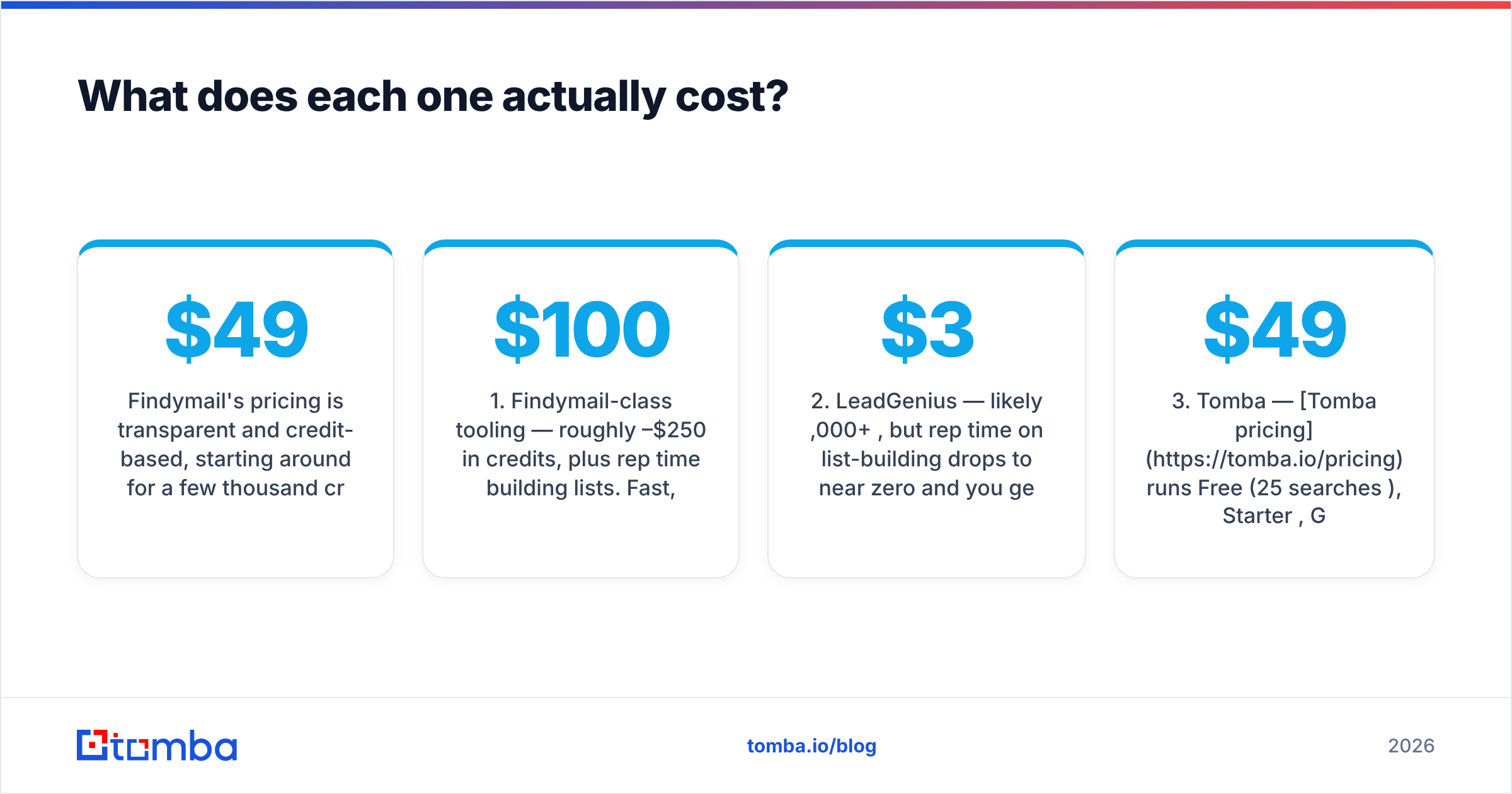
Findymail's pricing is transparent and credit-based, starting around $49/mo for a few thousand credits and scaling up through team tiers. Credits are consumed on found emails, not attempts — a meaningful detail when you compare against tools that charge for misses.
LeadGenius pricing is opaque by design. It's a services contract: scoping call, pilot dataset, annual commitment. Buyers report entry points in the low thousands per month, rising fast with volume and attribute complexity. There is no month-to-month self-serve path.
Here is how the total cost of ownership typically breaks down for a 5-person SDR team needing 10,000 verified contacts per quarter:
- Findymail-class tooling — roughly $100–$250/mo in credits, plus rep time building lists. Fast, cheap, but the list quality ceiling is whatever the underlying database holds.
- LeadGenius — likely $3,000+/mo, but rep time on list-building drops to near zero and you get attributes no database sells.
- Tomba — Tomba pricing runs Free (25 searches/mo), Starter $49/mo, Growth $99/mo, Pro $249/mo, Enterprise custom. The Growth tier covers most 5-rep teams, and the same subscription includes verification, domain search, and enrichment rather than metering each separately.
- DIY stack — a scraper plus a verifier plus a VA. Cheapest on paper, most expensive in maintenance and compliance risk.
- Do nothing — reps prospect manually in LinkedIn at roughly 15–20 contacts/hour. This is the real baseline most teams are unknowingly comparing against, and it is the most expensive option of all.
The honest read: most teams over-buy. If your ICP is "SaaS companies, 50–500 employees, VP Marketing," that is standard firmographic data available from a dozen self-serve vendors. Paying managed-data prices for it is waste.
When is LeadGenius genuinely worth it?#
Four scenarios justify the spend:
- The attribute doesn't exist in any database. Store-level headcount, equipment brands installed, whether a franchise location is corporate-owned, non-English regional data. Machines cannot infer this reliably; researchers can confirm it.
- You're sizing a TAM for a board deck. When the number needs to survive diligence, "we scraped it" is a weak answer. A managed provider's methodology is defensible.
- Your market is long-tail and offline. Manufacturing, logistics, healthcare facilities, education — sectors where the buying committee is not on LinkedIn and the company website was last updated in 2014.
- You have budget but no ops headcount. LeadGenius is genuinely cheaper than hiring two data analysts if the alternative is hiring two data analysts.
If none of those describe you, self-serve tooling wins on speed and cost every time.

When does Findymail make more sense?#
Findymail wins on the day-to-day motion. A rep builds a Sales Navigator search, exports it, and gets verified emails back in minutes without a procurement cycle. That loop is the entire job for most outbound teams, and speed of iteration beats data depth when you are still testing messaging.
Where it gets thin:
- Single-purpose. It finds and verifies emails. Phone data, technographics, and intent are outside its scope, so you end up stacking tools.
- Credit anxiety. Credit-metered pricing makes teams ration searches, which is exactly the wrong incentive when you're testing new segments.
- Coverage gaps outside North America and Western Europe. True of nearly every finder, but worth testing on your specific market before committing.
- No managed layer. If your list-building is the bottleneck rather than your email accuracy, a better finder does not help.
For teams hitting the second and fourth limits, it's worth reviewing the broader Findymail alternative landscape before renewing — several tools bundle verification, phone lookup, and enrichment into one subscription instead of metering each.
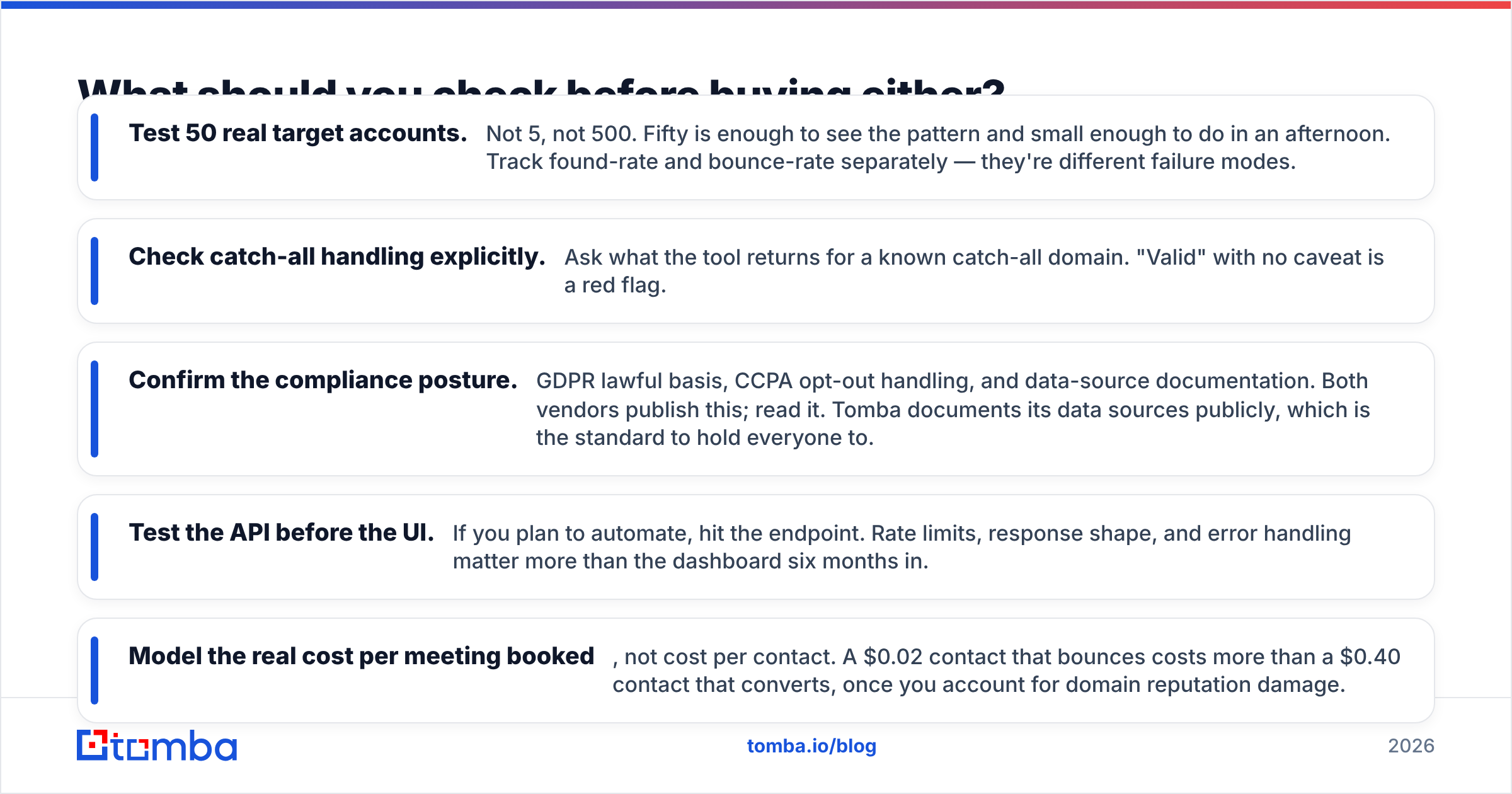
What should you check before buying either?#
Run this checklist against a sample of your actual ICP, not the vendor's demo list:
- Test 50 real target accounts. Not 5, not 500. Fifty is enough to see the pattern and small enough to do in an afternoon. Track found-rate and bounce-rate separately — they're different failure modes.
- Check catch-all handling explicitly. Ask what the tool returns for a known catch-all domain. "Valid" with no caveat is a red flag.
- Confirm the compliance posture. GDPR lawful basis, CCPA opt-out handling, and data-source documentation. Both vendors publish this; read it. Tomba documents its data sources publicly, which is the standard to hold everyone to.
- Test the API before the UI. If you plan to automate, hit the endpoint. Rate limits, response shape, and error handling matter more than the dashboard six months in.
- Model the real cost per meeting booked, not cost per contact. A $0.02 contact that bounces costs more than a $0.40 contact that converts, once you account for domain reputation damage.
That last point deserves emphasis. Bad data does not just waste credits — it degrades sender reputation, and recovering a burned domain takes weeks. Cheap data is frequently the most expensive line item in an outbound program.
Is there a middle option between the two?#
Yes, and it is where most teams should land: a self-serve platform that bundles finding, verification, and enrichment rather than making you assemble three vendors.
That's the gap Tomba targets. You get an email finder with domain-level search, a verifier that handles catch-alls as a distinct case, phone finder for direct dials, data enrichment for filling CRM gaps, and a documented Tomba API — all inside one subscription that starts free and tops out at $249/mo before enterprise. Compared against Findymail you get a wider toolset at a similar entry price; compared against LeadGenius you give up custom human research but keep roughly 95% of your budget.
It is not the right call for everyone. If you genuinely need a researcher to phone a factory in Ohio and ask who signs off on lubricant purchases, buy LeadGenius and don't look back. But if what you need is "reliable work emails for companies that already exist in standard databases, at a price that doesn't require a business case," the managed-data premium buys you nothing.
Worth noting alongside both: providers like BookYourData occupy yet another slice — pay-as-you-go prebuilt lists with a verification guarantee, which suits teams that want data without a subscription at all. Depending on how bursty your prospecting is, that model can beat both options here on pure economics.
The verdict: Findymail vs LeadGenius in 2026#
Choose Findymail if you're an SDR, founder, or agency running high-volume outbound into standard tech and services markets, you want to start today, and bounce rate is your main pain.
Choose LeadGenius if you're an enterprise RevOps or strategy team, the data you need does not exist for sale, you have real budget, and you can absorb a multi-week onboarding.
Choose neither if your bottleneck is that you're paying finder-tool prices for one capability while separately paying for verification, phone data, and enrichment. Consolidating that stack is usually a bigger cost saving than switching finders.
The framing that helps most: Findymail sells you a faster shovel. LeadGenius sells you a crew. Before you decide which, be honest about whether you're digging in the right field — the highest-accuracy contact data in the world will not save an offer nobody wants. Vendor comparison sites like Capterra are useful for feature checks, but they cannot tell you that part.
Ready to test this on your own list? Start with the Tomba Email Finder — the free tier gives you 25 searches a month with no card, enough to run the 50-account test described above against your real ICP. If the found-rate and bounce-rate hold up, Starter is $49/mo with verification, domain search, and API access included rather than metered separately. Run it side by side with whatever you're evaluating and let the numbers pick the winner.
Related guides#
Ready to find emails that actually work?
Join 150,000+ professionals who stopped guessing and started sending. Free credits on signup — no credit card required.
Get the Tomba newsletter
Practical outbound tactics and product updates — once every two weeks.
About the author