Findymail vs Leadzenai 2026: Which Email Finder Wins?
Findymail guards deliverability with verified-only exports. Leadzen.ai bundles India-heavy intent data and phone numbers. Here's which one actually fits your outbound motion in 2026 — plus where both fall short.
Findymail vs Leadzenai reads like a head-to-head. It isn't really one. Findymail is a narrow email finder. Leadzen.ai is a broad lead platform. Here's the short version, then the detail.
TL;DR
- Findymail is a deliverability-first email finder. It only bills you for emails it believes are valid, plugs into Lemlist/Smartlead/Instantly, and keeps bounce rates low on Western B2B data. It is narrow on purpose.
- Leadzen.ai is a broader lead-intelligence platform: contact discovery plus phone numbers, intent signals, and strong India/APAC coverage. But enrichment quality swings by region, and the UI carries more surface area than most SDR teams need.
- Pick Findymail if you run cold email into US/EU accounts and treat bounce rate as a KPI. Pick Leadzen.ai if you sell into India or Southeast Asia, or if you need phone plus email in one motion.
- Neither ships a strong developer API at the low end. If you need programmatic lookup, bulk verification, and a catch-all check on one bill, a third option like Tomba at $49/mo is the cheaper structural fit.
- The real cost driver isn't the sticker price. It's how each vendor charges for misses. Read the credit-consumption section before you commit annually.
What are Findymail and Leadzen.ai, actually?#
Both tools call themselves "lead generation." They mean very different things by it.
Findymail is a single-purpose email finder. The team behind it came out of the cold-email agency world. Its pitch is deliverability. It runs its own verification layer, and it does not charge a credit when it can't return a valid address. That one policy shapes everything else: the export format, the integrations, the way its reps talk. Its natural home is a Lemlist or Smartlead sequence, where a 4% bounce rate gets your domain throttled.
Leadzen.ai is a lead-intelligence platform out of India. It bundles a contact database, phone numbers, company firmographics, buying-intent signals, and a Chrome extension for LinkedIn. Its strongest asset is depth on Indian and wider APAC companies. Most US-built databases go thin there, Apollo and ZoomInfo included.
The comparison is not apples-to-apples. Pretending otherwise is how teams end up paying for the wrong thing. One is a scalpel. The other is a toolkit.

Findymail vs Leadzenai: how do they compare head to head?#
Start with product shape and price.
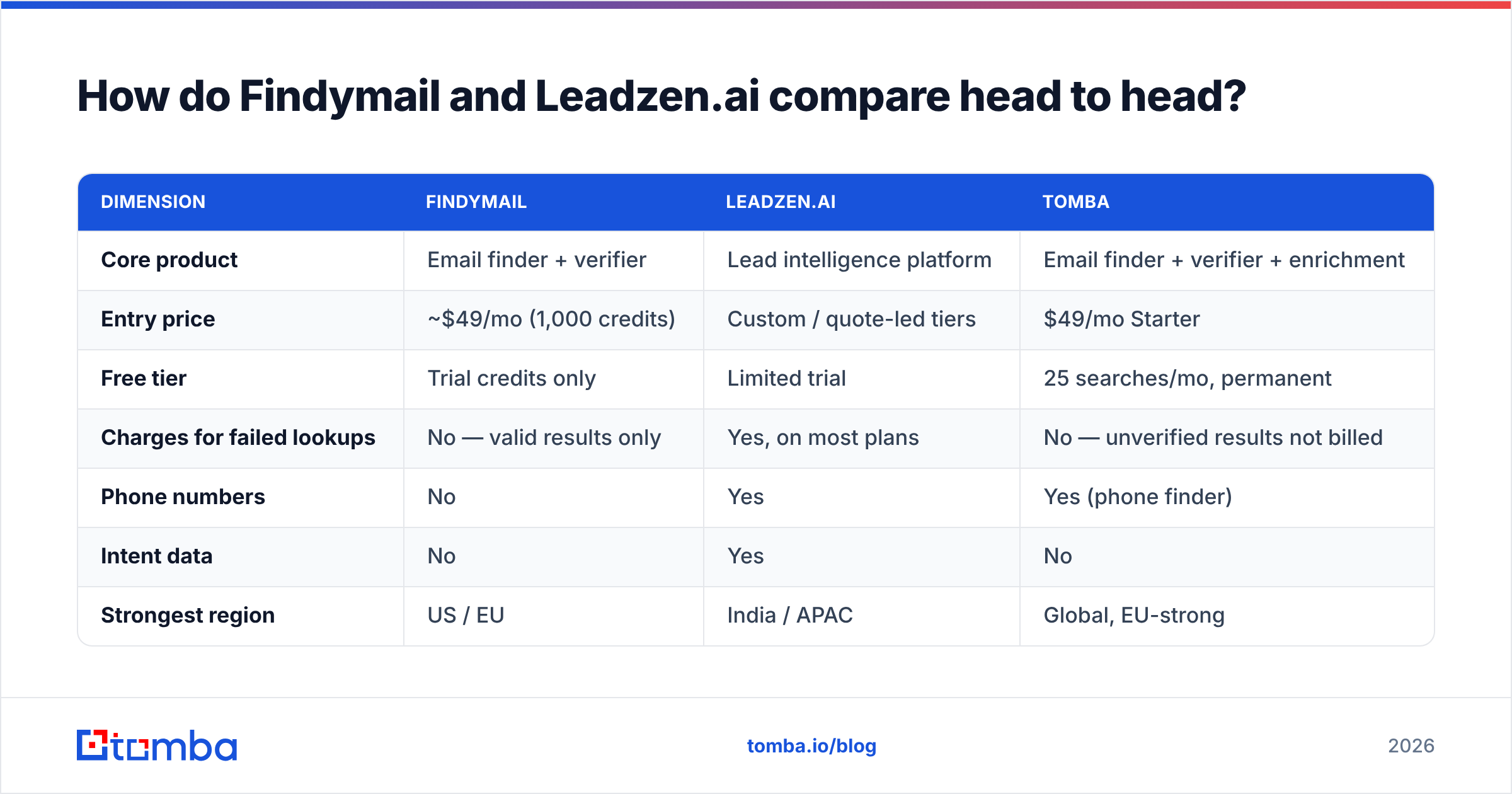
| Dimension | Findymail | Leadzen.ai | Tomba |
|---|---|---|---|
| Core product | Email finder + verifier | Lead intelligence platform | Email finder + verifier + enrichment |
| Entry price | ~$49/mo (1,000 credits) | Custom / quote-led tiers | $49/mo Starter |
| Free tier | Trial credits only | Limited trial | 25 searches/mo, permanent |
| Charges for failed lookups | No — valid results only | Yes, on most plans | No — unverified results not billed |
| Strongest region | US / EU | India / APAC | Global, EU-strong |
| Best for | Cold email teams in Western markets | APAC prospecting + multichannel | Devs and RevOps needing one API |
Then the data and integration surface.
| Dimension | Findymail | Leadzen.ai | Tomba |
|---|---|---|---|
| Phone numbers | No | Yes | Yes (phone finder) |
| Intent data | No | Yes | No |
| Public API | Yes, limited endpoints | Yes, enterprise-gated | Yes, full REST + CLI + MCP |
| Bulk CSV enrichment | Yes | Yes | Yes |
| Catch-all handling | Flags, limited resolution | Basic | Dedicated catch-all verifier |
| CRM native integrations | Lemlist, Smartlead, Instantly, HubSpot | HubSpot, Salesforce, Zoho | HubSpot, Salesforce, Pipedrive, Zapier, Make |
Pricing on both moves. Findymail publishes tiers. Leadzen.ai routes most buyers through sales, so your price depends on how well you negotiate. Confirm current numbers on the vendor's own page before you sign — Findymail and Leadzen.ai both change packaging more often than their blog posts admit.
Which one finds more valid emails?#
Findymail, in Western markets. Leadzen.ai, in India. That's the honest answer. Anyone quoting a single global accuracy number is selling you something.
Here's what drives the gap. Email finders work off three signals: addresses published on the open web, pattern inference from a company's known format (firstname.lastname@, f.lastname@, and so on), and SMTP-level validation of the guess. Findymail leans hard on that third step. It refuses to return anything it can't stand behind. That's why its hit rate looks lower on some lists. It is declining to guess, where a competitor would hand you a coin flip and bill you for it.
Leadzen.ai leans on database depth instead. When a contact sits in its index with a verified Indian corporate domain, the result is excellent. Feed it a mid-market German manufacturer and coverage drops. You get more "possible" results that still cost credits.
Three practical tests before you commit to either:
- Build a 100-row control list from your actual ICP — not a demo list the vendor supplies. Mix company sizes and countries the way your real pipeline does.
- Run both tools on the identical list and record found-rate, not accuracy claims. Found-rate is what you pay for.
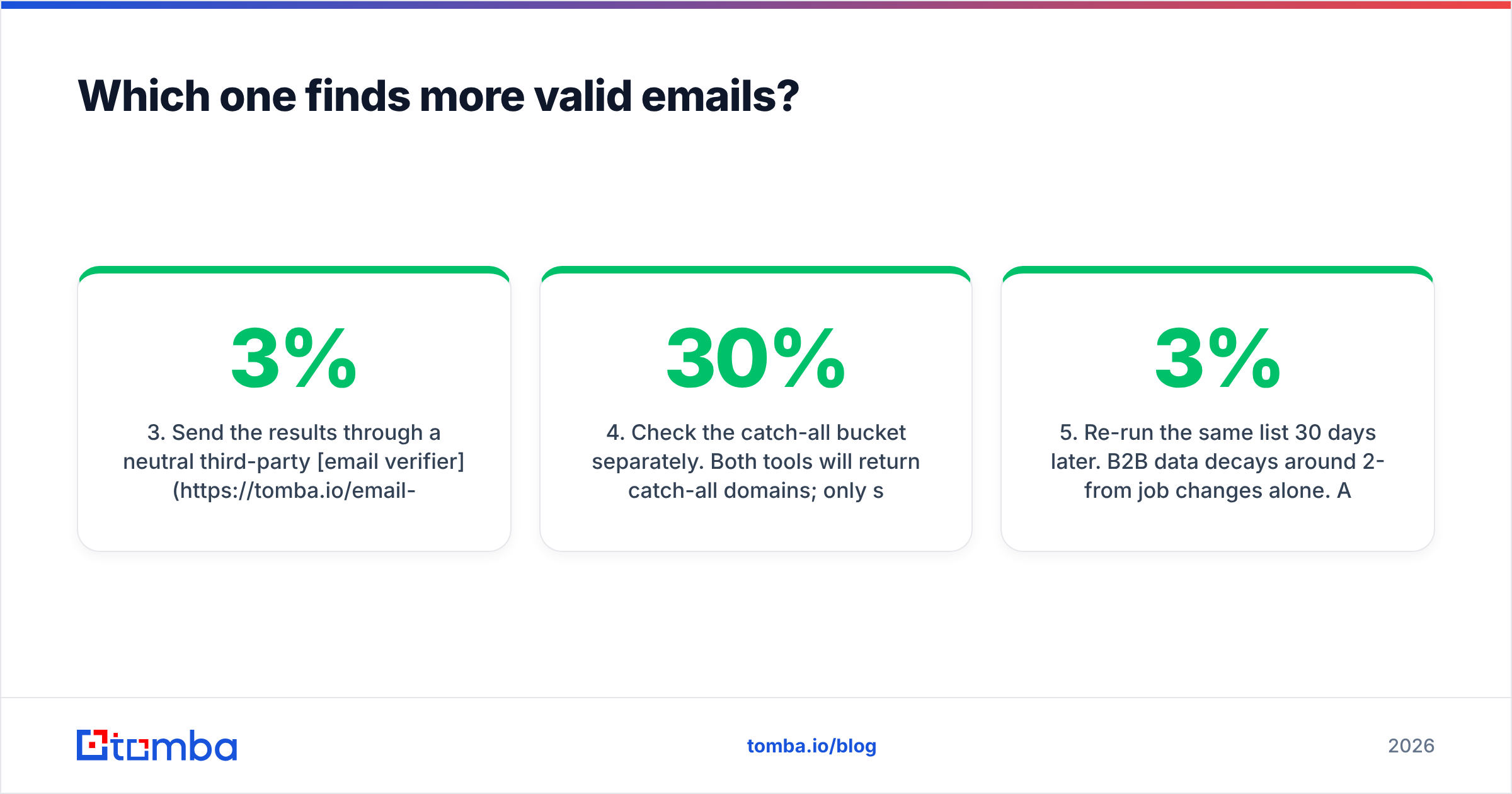
- Send the results through a neutral third-party email verifier so neither vendor grades its own homework. Anything above 3% invalid on a finder that promises verified output is a red flag.
- Check the catch-all bucket separately. Both tools return catch-all domains. Only some can tell you whether the specific mailbox exists. If 30% of your list is catch-all, a catch-all verifier is not optional.
- Re-run the same list 30 days later. B2B data decays around 2-3% per month from job changes alone. A tool that ages badly costs more than its sticker price.
How does credit consumption differ — and where does the money actually go?#
Most comparison posts skip this section. It's the one that sets your real cost per meeting.
Findymail's model: you're only charged when a valid email is returned. A search that comes back empty costs nothing. Say your team runs 5,000 lookups a month against a messy list. That policy can be worth more than a 30% discount on the sticker price. If 40% of the list is unfindable, you effectively paid for 3,000 credits instead of 5,000.
Leadzen.ai's model is closer to the industry standard. Credits are consumed per reveal, and a low-confidence reveal still consumes one. Its counter-argument is fair. You're paying for a data platform, not just an email. A phone number plus firmographics plus an intent flag in one reveal is genuinely more value than a bare email string. But if you only want the email, you're subsidizing fields you never use.
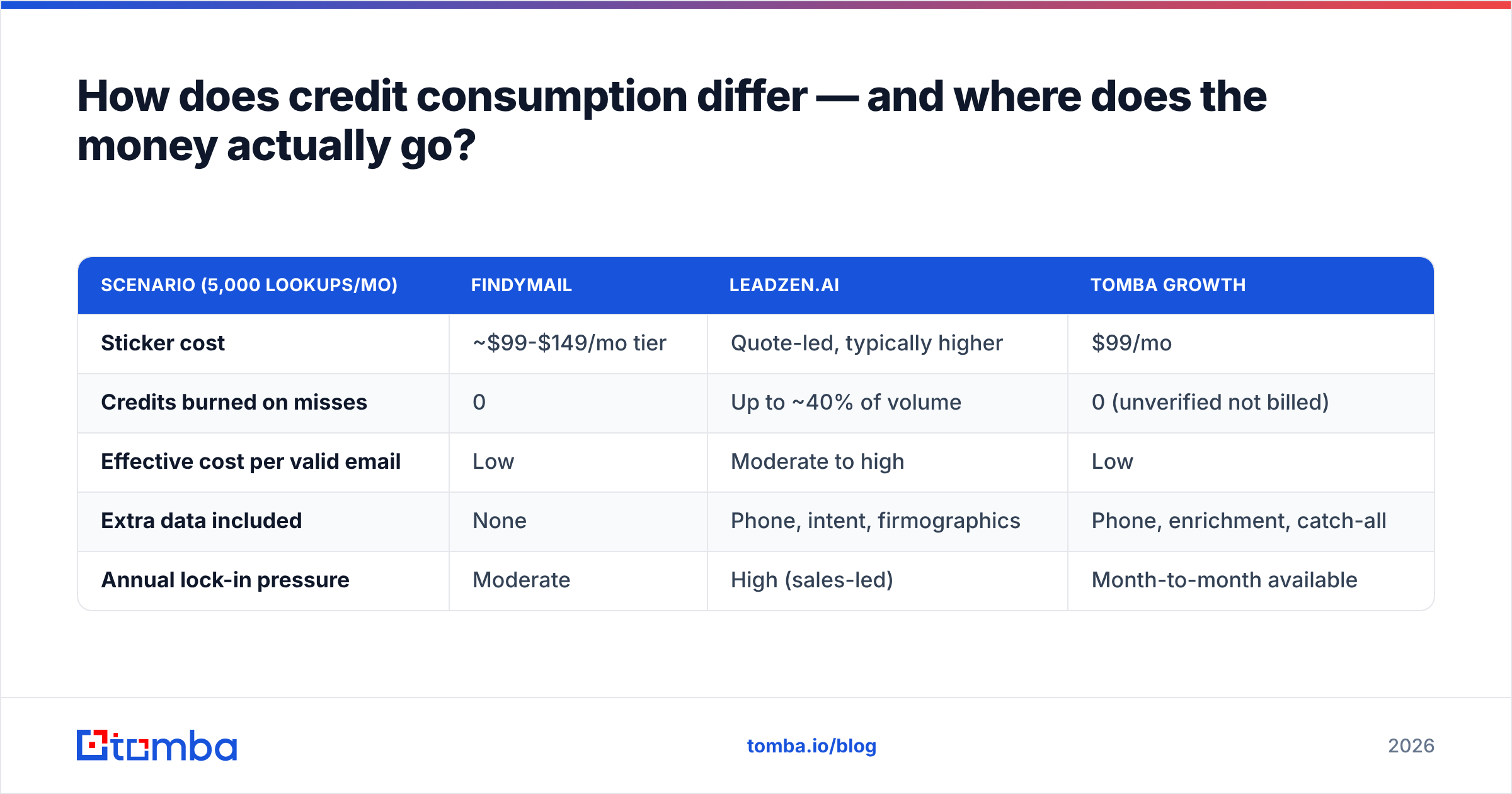
Model it out before you buy:
| Scenario (5,000 lookups/mo) | Findymail | Leadzen.ai | Tomba Growth |
|---|---|---|---|
| Sticker cost | ~$99-$149/mo tier | Quote-led, typically higher | $99/mo |
| Credits burned on misses | 0 | Up to ~40% of volume | 0 (unverified not billed) |
| Effective cost per valid email | Low | Moderate to high | Low |
| Extra data included | None | Phone, intent, firmographics | Phone, enrichment, catch-all |
| Annual lock-in pressure | Moderate | High (sales-led) | Month-to-month available |
Negotiate two things either way: credit rollover, and a written definition of a "consumed" credit. Vendors are usually flexible on the first and evasive on the second. Get the second in the contract.
Is Leadzen.ai worth it for non-APAC teams?#
Usually not, if email is your only channel.
Leadzen.ai's differentiators are real: India-first coverage, phone numbers, intent signals. If your territory runs Mumbai to Singapore, few tools have that depth. US-built databases treat the region as an afterthought, and you feel it in found-rates.
Selling into North America or Western Europe is a different story. There you pay platform pricing for a database that Apollo, Cognism, or a focused finder covers better. Buying a broad platform for one narrow job is the most common way SDR budgets get wasted. Check G2's category reviews and filter by reviewer region. On lead-intelligence tools, the regional split in satisfaction scores tells you more than the aggregate rating.
The same logic runs in reverse. Findymail will underperform on Indian mid-market accounts, because the open-web signal it infers from is thinner there. That's not a flaw in the product. It's a coverage boundary.
One more option: stack a global finder with a regional database instead of replacing one with the other. Providers like BookYourData sell verified list segments outright. That can beat a second seat-based subscription when you need one geography covered.
What are the deliverability implications of each?#
Findymail wins here, and it isn't close. But not for the reason its marketing suggests.
Bounce rate is a sender-reputation input. Mailbox providers watch what share of your sends hit dead addresses. Past roughly 3-5%, inbox placement degrades even on well-warmed domains. A finder that returns confident-but-wrong guesses doesn't just waste credits. It damages an asset you spent weeks warming. Google's own Postmaster Tools documentation is explicit: sending to invalid addresses is treated as a spam signal.
Findymail's verified-only policy is really a deliverability product wearing an email-finder label. That's the whole thesis.
Leadzen.ai makes no such promise, so the verification burden shifts to you. That's workable. Pipe exports through a dedicated verifier before they touch your sequencer. But it's a second tool, a second bill, and a second failure point. Factor it in. For multichannel teams the pipeline looks like this: Leadzen export → verifier → CRM → sequencer. Every hop is somewhere data goes stale.
Whichever you pick, keep your own email deliverability hygiene independent of vendor claims. Check your SPF and DMARC records, monitor your sender reputation, and re-verify any list older than 60 days.
What about API access and automation?#
Both have APIs. Neither makes them the centerpiece. This is where a third option often wins the evaluation.
Findymail's API covers finding and verification. That's enough for a straightforward enrichment job: pull a domain and a name, get an email back. It's clean but narrow. Want author lookup, reverse lookup, or catch-all resolution? You're combining vendors.
Leadzen.ai's API tends to sit behind enterprise tiers. A two-person startup that wants to test it programmatically hits a sales conversation before it hits a sandbox key. If you like to prototype on a Tuesday afternoon, that's a hard stop.
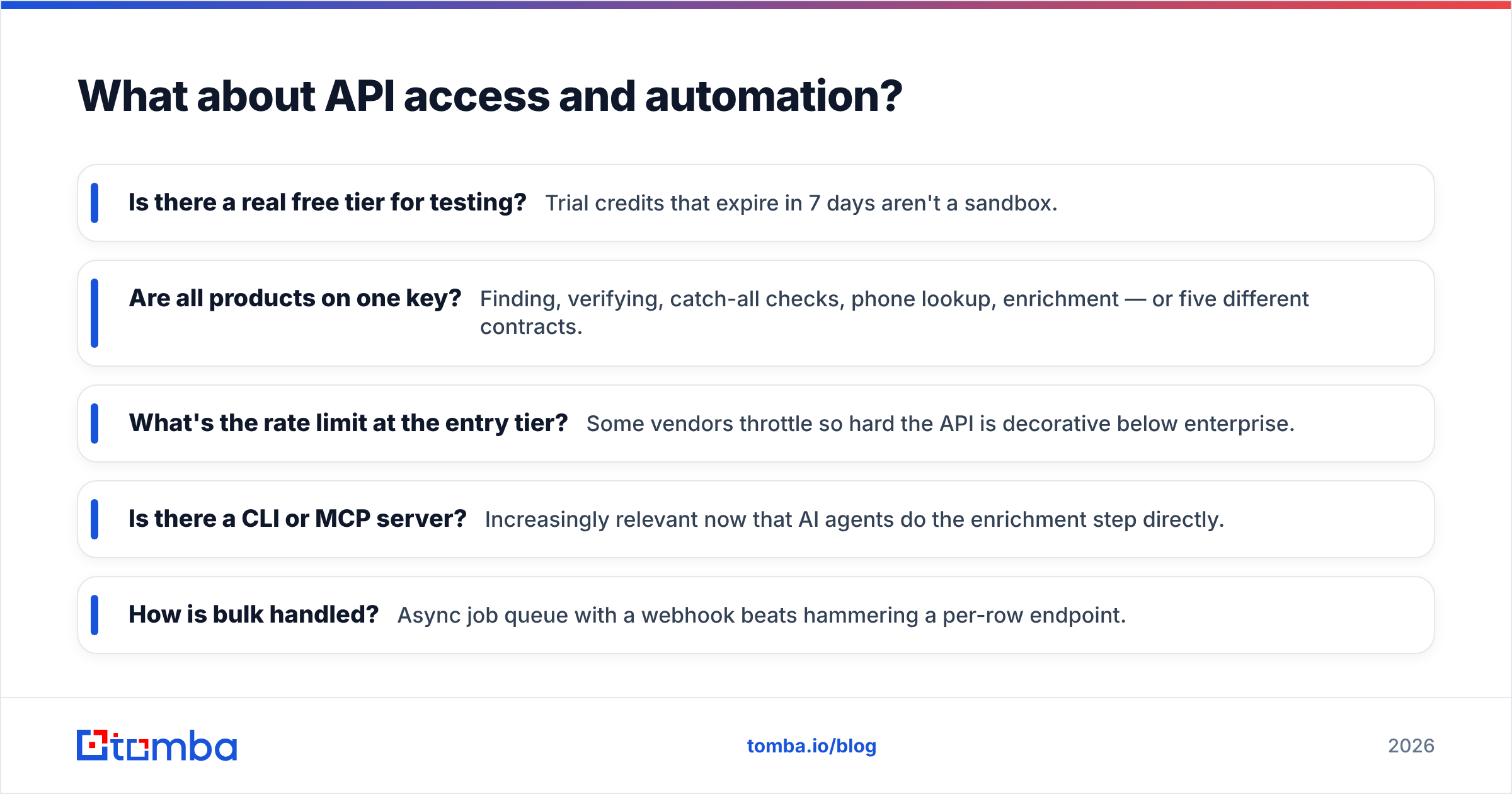
If your workflow is code-first, ask these questions:
- Is there a real free tier for testing? Trial credits that expire in 7 days aren't a sandbox.
- Are all products on one key? Finding, verifying, catch-all checks, phone lookup, enrichment — or five different contracts.
- What's the rate limit at the entry tier? Some vendors throttle so hard the API is decorative below enterprise.
- Is there a CLI or MCP server? It matters more now that AI agents run the enrichment step directly.
- How is bulk handled? An async job queue with a webhook beats hammering a per-row endpoint.
This is the gap where the Tomba API comes up in evaluations. One key covers domain search, finding, verification, catch-all, and enrichment. The free tier stays free at 25 searches, so you can test before any card. Tomba pricing starts at $49/mo Starter and $99/mo Growth, month-to-month, with no sales gate to get a key.

Findymail vs Leadzenai: which should you actually buy in 2026?#
Decide by motion, not by feature count.
Buy Findymail if:
- Cold email is your primary channel and bounce rate is a tracked KPI
- You sell into the US, UK, or Western Europe
- You already run Lemlist, Smartlead, or Instantly and want a native handoff
- You want predictable credit burn and no sales call
Buy Leadzen.ai if:
- India or APAC is a meaningful share of your pipeline
- You run multichannel — email plus phone plus LinkedIn
- Intent signals genuinely change how you prioritize accounts (be honest here; most teams say yes and then never use them)
- You have the budget for platform pricing and the discipline to use a platform
Look at a third option if:
- You need programmatic access at a startup price point
- Your list is global and no single regional database covers it
- You want finding, verification, catch-all, and enrichment on one bill
- You're tired of paying per-tool for what should be one API
The stacking approach is underrated. Use a focused finder for volume, a dedicated verifier as a neutral gate, and a regional data source for territories your primary tool misses. That's often cheaper and more accurate than one platform that claims to do everything. The overhead is one extra step, which any Zapier or Make workflow absorbs.
What's the fastest way to test both before committing?#
Run a 200-contact bake-off. Most Findymail vs Leadzenai debates end in a single afternoon this way.
Export 200 rows from your CRM that match your ICP. Use real accounts you're working, not a scraped sample. Strip the emails. Feed the name-plus-domain pairs into each tool. Then compare four numbers: found-rate, credits consumed, third-party-verified valid rate, and time-to-result including setup friction.
Most teams find the winner isn't the tool with the better demo. It's the one that burned fewer credits to produce the same number of usable addresses. That ratio is your true unit cost. It's also the only number that survives contact with a real quarter.
Want a neutral third data point in that bake-off? Run the same 200 rows through the Tomba Email Finder. The free tier gives you 25 searches with no card, Starter is $49/mo, and the same key covers verification, catch-all checks, and data enrichment. So you can see whether consolidating beats stacking before you sign anyone's annual contract. Start free, run your own list, and let the found-rate decide.
Related guides#
Ready to find emails that actually work?
Join 150,000+ professionals who stopped guessing and started sending. Free credits on signup — no credit card required.
Get the Tomba newsletter
Practical outbound tactics and product updates — once every two weeks.
About the author