Findymail vs SalesIntel (2026): Which B2B Data Tool Wins?
Findymail sells speed and bounce-free email exports. SalesIntel sells human-verified depth and intent data. We break down accuracy, pricing, phone coverage and export limits to show which one actually fits your motion.
TL;DR
- Findymail is a fast, self-serve email finder built around LinkedIn and Sales Navigator exports, with a bounce-replacement policy. Best for founders and SDRs who live in a list-building workflow.
- SalesIntel is a full B2B data platform — human-verified contacts, direct dials, firmographics, technographics and Bombora intent — sold on annual contracts. Best for mid-market and enterprise RevOps teams.
- They are not really competitors. One is a $49–$249/month tool; the other is usually a five-figure annual commitment with onboarding and seat licensing.
- Accuracy claims differ in kind, not just degree: Findymail optimises for deliverable emails, SalesIntel optimises for correct human records that a researcher has touched.
- If you want SalesIntel-grade verification without the contract, a per-credit finder plus a dedicated verification layer (Tomba's model) covers most of the gap for a fraction of the spend.
What is Findymail and who actually uses it?#
Findymail is a self-serve email finder and verifier. You feed it a name and a domain, a LinkedIn profile, or an entire Sales Navigator search, and it returns work emails it believes will land. The pitch on findymail.com has been consistent since launch: exports that do not bounce, and no charge for emails it cannot verify.
The typical user is a founder, an agency owner, or a two-to-five-person SDR team running cold email out of Instantly, Smartlead or Lemlist. They are not buying a data platform — they are buying a step in a pipeline that ends in a sequencer.
Findymail's opinionated choices matter here:
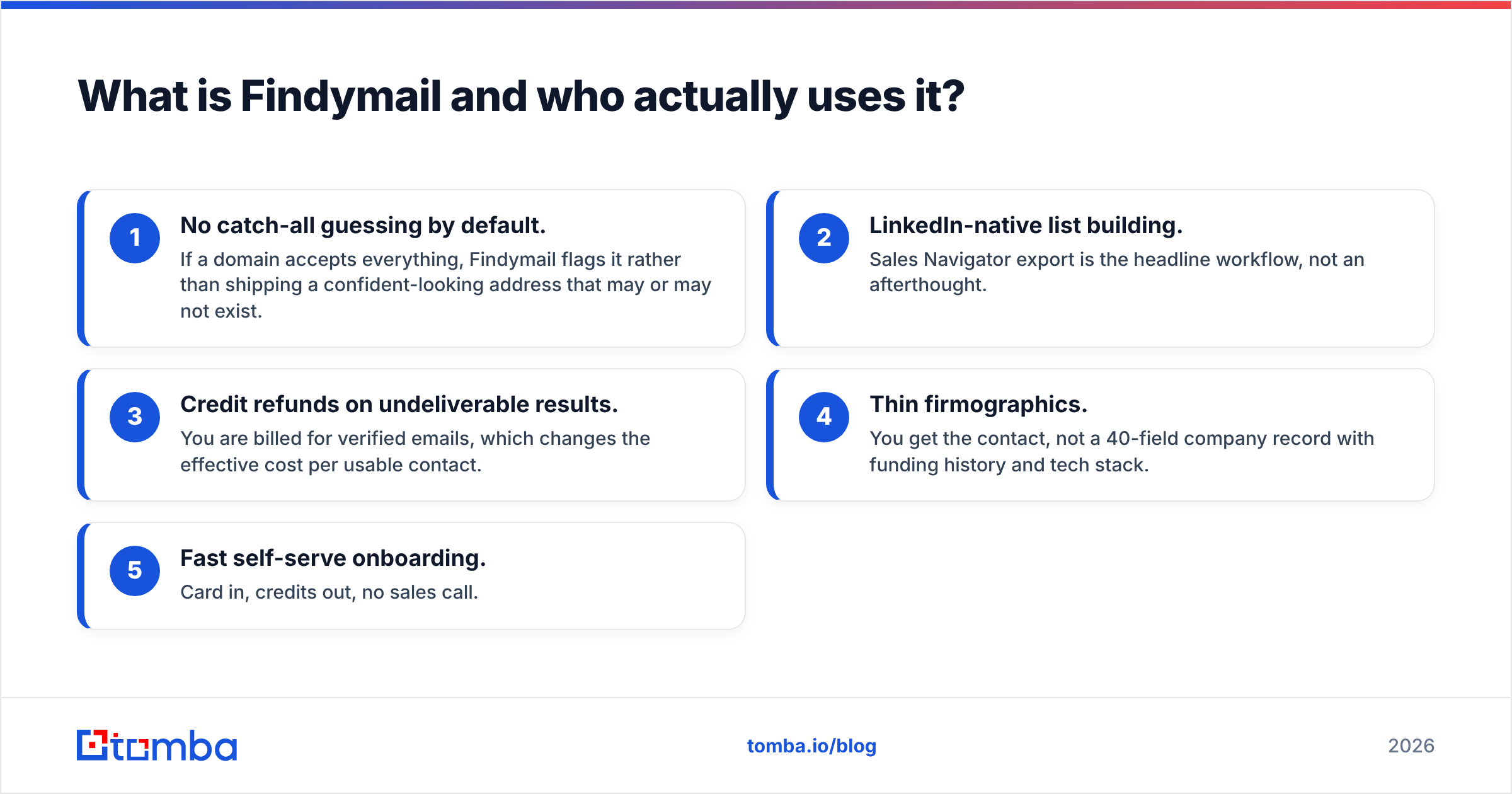
- No catch-all guessing by default. If a domain accepts everything, Findymail flags it rather than shipping a confident-looking address that may or may not exist.
- LinkedIn-native list building. Sales Navigator export is the headline workflow, not an afterthought.
- Credit refunds on undeliverable results. You are billed for verified emails, which changes the effective cost per usable contact.
- Thin firmographics. You get the contact, not a 40-field company record with funding history and tech stack.
- Fast self-serve onboarding. Card in, credits out, no sales call.
That last point is the real differentiator against SalesIntel, and it shapes everything below.
What is SalesIntel and what are you paying for?#
SalesIntel sits in a different category: a B2B contact and company database with a research team behind it. Its core claim is human verification — records re-checked by people on a rolling cycle, not just SMTP pings — plus direct-dial phone coverage, technographic filters, and intent signals licensed from Bombora.
You use SalesIntel the way you use ZoomInfo or Cognism: build a target account list inside the platform, layer intent and firmographic filters, push contacts into Salesforce or HubSpot, and hand a scored list to reps. The RevDriver Chrome extension surfaces records while reps browse LinkedIn or company sites.
The commercial model follows: annual contract, seat-based licensing, credit or export allowances negotiated per deal, and an implementation conversation before you see a real number. Public pricing is not published, and reviews on G2 consistently describe quotes in the low five figures per year for small teams and higher for enterprise deployments.

Findymail vs SalesIntel: how do they compare head to head?#
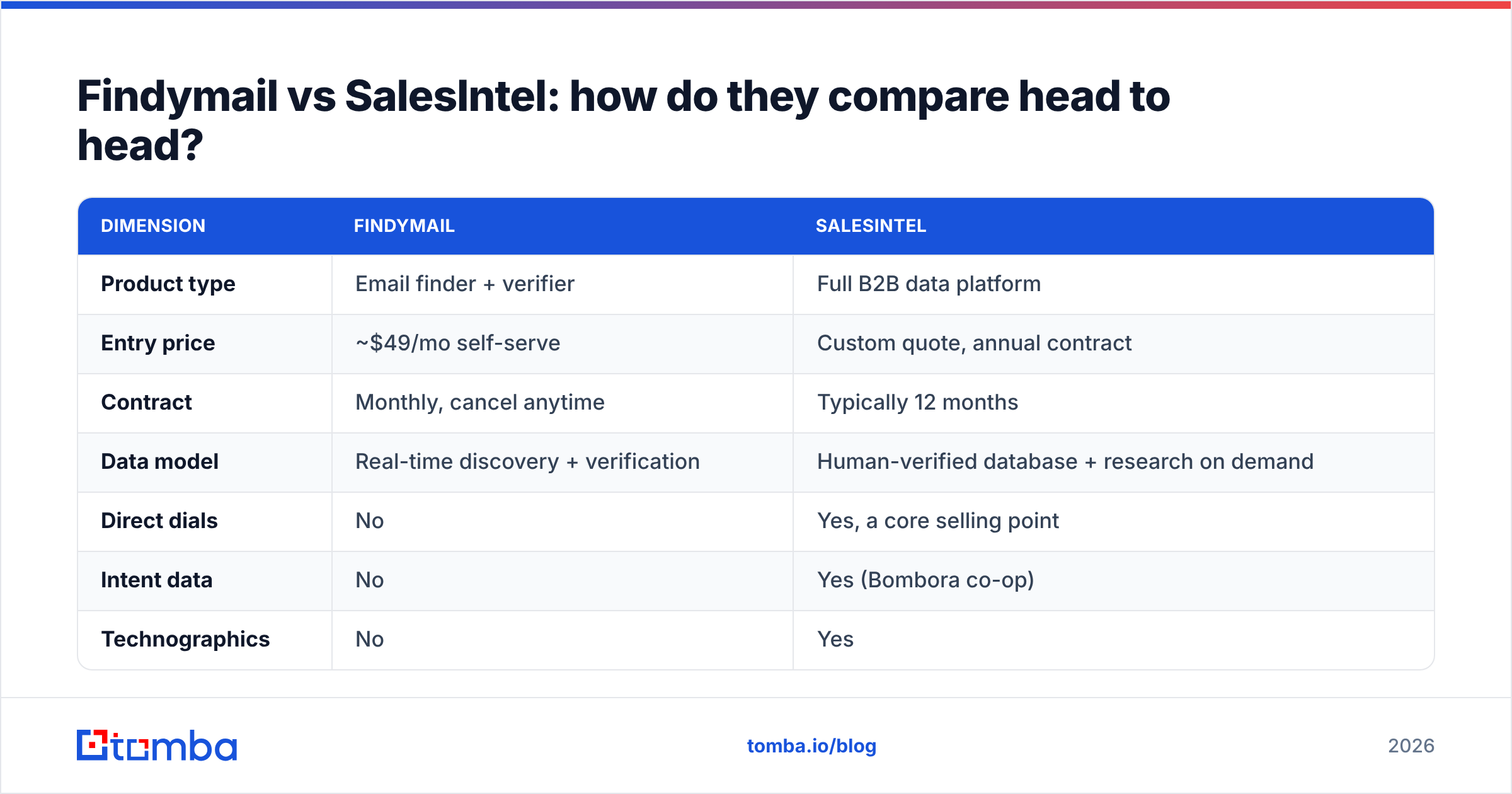
Here is the honest side-by-side. Treat pricing as directional — Findymail publishes tiers, SalesIntel quotes them.
| Dimension | Findymail | SalesIntel |
|---|---|---|
| Product type | Email finder + verifier | Full B2B data platform |
| Entry price | ~$49/mo self-serve | Custom quote, annual contract |
| Contract | Monthly, cancel anytime | Typically 12 months |
| Data model | Real-time discovery + verification | Human-verified database + research on demand |
| Direct dials | No | Yes, a core selling point |
| Intent data | No | Yes (Bombora co-op) |
| Technographics | No | Yes |
| LinkedIn / Sales Nav export | Yes, native | Via RevDriver extension |
| CRM sync | Basic / via Zapier | Native Salesforce, HubSpot, Outreach, Salesloft |
| Bounce policy | Credits refunded on unverified results | Accuracy guarantee via research team |
| Time to first list | Minutes | Days to weeks (onboarding) |
| Best for | Founders, agencies, small SDR teams | Mid-market and enterprise RevOps |
The table makes the real question obvious. You are not choosing between two email finders. You are choosing between buying a tool and buying a data subscription — and those decisions get made by different people with different budgets.
Which one has better data accuracy?#
Neither wins outright, because they measure accuracy differently.
Findymail's definition is deliverability. A "good" result is an address that accepts mail. The system discards ambiguous results rather than shipping them, which keeps bounce rates low but also keeps coverage lower on hard domains — small companies with no public footprint, catch-all configurations, and regions where role-based addresses dominate. Users routinely report low single-digit bounce rates on Findymail exports, which is the number that matters if your inbox reputation is fragile.
SalesIntel's definition is record correctness. A "good" record is one where a researcher confirmed that this person holds this title at this company and this is their line. That catches things SMTP checks never will: someone who left in March but whose mailbox still accepts mail, a title that changed after a reorg, a company that got acquired. It also decays differently — human verification cycles run on a schedule, so a record verified nine months ago may be stale even though it is technically "verified."

The practical takeaway: if your problem is bounces killing your domain, Findymail's model solves it directly. If your problem is reps calling people who left the company, SalesIntel's model solves it directly. If you have both problems — and most outbound teams do — you need a finder and an independent verification pass, which is why teams increasingly separate discovery from validation. Running an email verifier over any list, regardless of source, is cheap insurance against both failure modes.
One more accuracy caveat that applies to both: catch-all domains. Roughly a fifth of B2B domains accept all mail, and no SMTP check can resolve them. Findymail declines to guess. SalesIntel leans on its research layer. A dedicated catch-all verifier is the third option, and it is the one most teams skip until their first big bounce event.
How do the pricing models actually differ?#
This is where the two tools stop being comparable in any useful way.
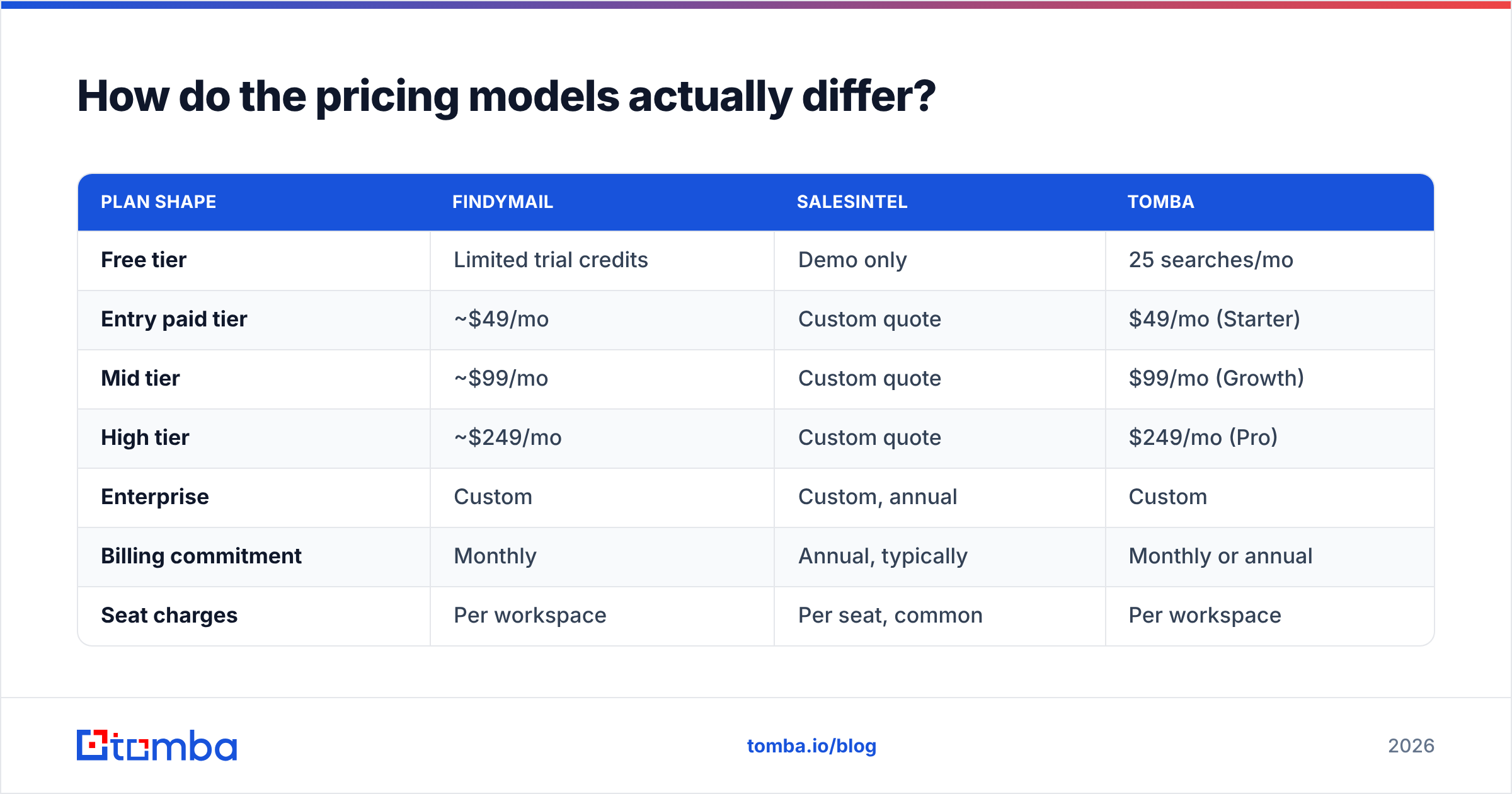
| Plan shape | Findymail | SalesIntel | Tomba |
|---|---|---|---|
| Free tier | Limited trial credits | Demo only | 25 searches/mo |
| Entry paid tier | ~$49/mo | Custom quote | $49/mo (Starter) |
| Mid tier | ~$99/mo | Custom quote | $99/mo (Growth) |
| High tier | ~$249/mo | Custom quote | $249/mo (Pro) |
| Enterprise | Custom | Custom, annual | Custom |
| Billing commitment | Monthly | Annual, typically | Monthly or annual |
| Seat charges | Per workspace | Per seat, common | Per workspace |
| API access | Yes | Yes, contract-dependent | Yes on paid plans |
Two things worth flagging before you sign anything.
Seat licensing compounds. A quote that looks reasonable for three reps often doubles at six. Ask for the per-seat number, not the blended one, and ask what happens when you add a rep mid-term.
Credit rollover and export caps are where the surprises live. Many database platforms cap how many records you can export per month or per year regardless of your credit balance. That is fine if you are drip-prospecting; it is painful if you need to build a 30,000-record TAM list in Q1. Get the export ceiling in writing.

For self-serve tools, the analogous trap is credit definition. Does a failed lookup cost a credit? Does a verification cost a separate credit from a find? Findymail's refund policy is genuinely good here. Compare it against published Tomba pricing and any other finder you are evaluating on a cost-per-usable-contact basis, not cost-per-credit.
What about phone numbers, intent data, and enrichment?#
If you need direct dials, this comparison ends quickly: SalesIntel has them, Findymail does not. Human-verified mobile numbers are one of SalesIntel's strongest arguments and a legitimate reason to pay platform prices, especially for teams running a genuine multi-channel motion where the call is the primary touch and email is support.
Intent data is more contested. Bombora's co-op signal tells you an account is researching a topic; it does not tell you who at that account cares, or whether the research was a bored intern. Teams that get value from intent have a defined play attached to the signal — a specific sequence, a specific offer, triggered within days. Teams that buy intent as a general "prioritisation layer" mostly generate dashboards nobody opens. Be honest about which one you are before you pay for it.
Enrichment sits between the two. SalesIntel enriches inbound records against its database as a native workflow. Findymail does not really play here. If enrichment is your actual need — filling gaps in an existing CRM rather than building new lists — an API-first data enrichment approach usually costs less than a platform seat, because you are paying per record touched instead of per user per year. The same logic applies to B2B phone numbers: if you need dials for 500 accounts, buying them per lookup beats licensing a database you will query twice a quarter.
Which tool fits which team?#
Choose Findymail if:
- Your workflow starts in LinkedIn or Sales Navigator and ends in a cold email sequencer.
- You are protecting a young sending domain and bounce rate is your primary constraint.
- You need to start today without a procurement cycle.
- Your budget is under $300/month and you would rather spend the rest on sending infrastructure.
Choose SalesIntel if:
- Direct dials are non-negotiable because calling is your main channel.
- You are targeting mid-market or enterprise accounts where firmographic and technographic filtering meaningfully narrows the list.
- You have a RevOps function that will actually operationalise intent signals into plays.
- You need native CRM sync with governance — field mapping, dedupe rules, audit trails — not a Zapier bridge.
- Annual budget exists and is already allocated to a data line item.
Choose neither if your real problem is that you are sending 3,000 emails a month from one mailbox with no warmup. Better data will not fix an infrastructure problem, and both tools will happily take your money while your sender reputation collapses.
Where does Tomba fit between them?#
Honestly: in the gap that this comparison exposes.
Findymail is excellent at what it does and deliberately narrow. SalesIntel is broad and priced accordingly. A lot of teams sit in between — they need more than name-plus-domain lookups, but they cannot justify an annual platform contract, and they specifically do not want seat-based pricing that punishes them for adding a rep.
That middle is where a modular stack works. Tomba's email finder handles discovery by name, domain or company. Domain search maps an entire company's contactable staff in one call, which is the closest self-serve equivalent to a database's account view. Verification, catch-all checking and phone lookup are separate, composable steps rather than bundled seats. And the Tomba API means the whole thing can live inside your own enrichment job instead of a vendor UI.

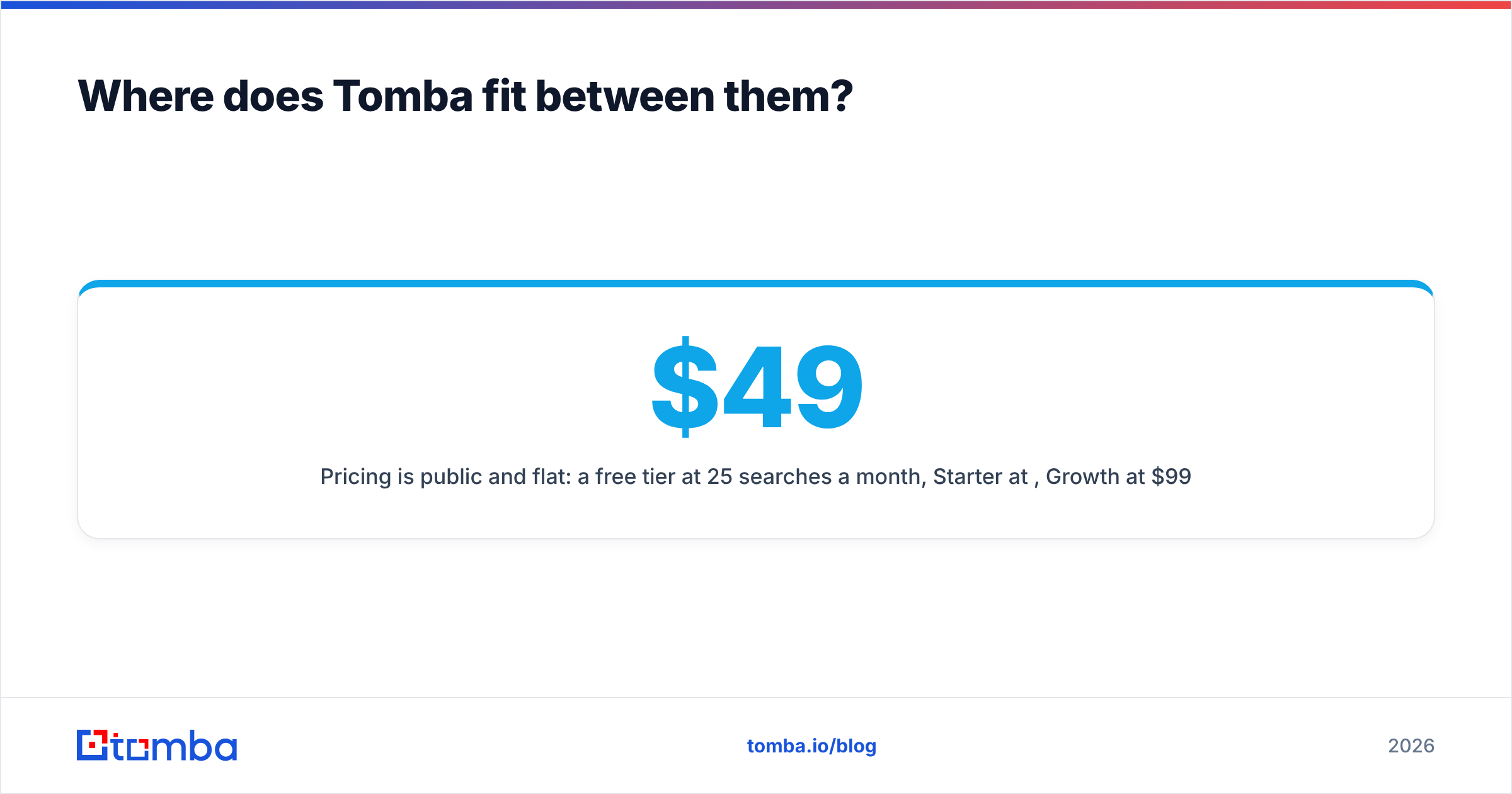
Pricing is public and flat: a free tier at 25 searches a month, Starter at $49/mo, Growth at $99/mo, Pro at $249/mo, and custom Enterprise terms. No seat multiplier, no annual lock to get a usable tier. For teams that need volume rather than a research department, bulk lead generation at those price points covers a meaningful share of what a platform contract is sold for.
That is not a claim that Tomba replaces SalesIntel's research team or its direct dials — it does not, and pretending otherwise would be dishonest. It is a claim that a large number of teams buy a platform when they needed a pipeline component, and pay 10x for the mismatch.
What is the verdict on Findymail vs SalesIntel?#
For a small outbound team running email-first: Findymail. It is cheaper, faster to adopt, and its bounce policy aligns the vendor's incentives with yours. You will hit coverage limits on obscure domains, and you will need a separate verification and catch-all strategy, but you will be sending within an hour.
For a funded mid-market or enterprise team running calls plus email with a RevOps function to operate it: SalesIntel. The direct dials and human-verified records genuinely justify the price if you will use the intent and technographic layers. If you will not, you are buying a very expensive contact list.
For everyone in between — and that is more teams than either vendor's marketing admits — build the stack instead of buying the suite. Discovery, verification, catch-all handling and phone lookup as separate, metered components, wired together through an API, will cost less and break in more predictable ways than a bundled seat you renew out of inertia.
Ready to test the middle path? Start with the Tomba Email Finder — the free tier gives you 25 searches a month with no card, enough to benchmark hit rate against your current Findymail or SalesIntel exports on the same 50 target accounts. Run the same list through all three, count usable contacts, divide by cost. That number, not a feature grid, is the only comparison that decides anything.
Related guides#
Ready to find emails that actually work?
Join 150,000+ professionals who stopped guessing and started sending. Free credits on signup — no credit card required.
Get the Tomba newsletter
Practical outbound tactics and product updates — once every two weeks.
About the author