Findymail vs SeamlessAI: Which B2B Email Finder Wins in 2026?
Findymail and Seamless.AI solve the same problem in opposite ways: one is a lean, accuracy-obsessed finder, the other a full contact database with a sales AI wrapped around it. Here is how they actually compare on cost, data quality, and export freedom.
Findymail vs SeamlessAI is a fight between two different tools, not two versions of the same one. One finds and verifies emails for a list you already have. The other sells you the list. Here is how the two compare on price, data quality, and export limits.
TL;DR
- Findymail is a narrow, accuracy-first email finder built for outbound teams that already have a list of names and companies. It charges per verified email found and refuses to burn credits on catch-all guesses.
- Seamless.AI is a contact database with a search engine, Chrome extension, and AI writer bolted on. You search by persona and industry instead of uploading names — but pricing is quote-based and credit limits get contentious.
- If your bottleneck is "I have 5,000 prospects and need their emails," Findymail wins on cost-per-valid-email. If your bottleneck is "I don't know who to contact yet," Seamless.AI's database is the more useful starting point.
On price and proof:
- Neither publishes a transparent, self-serve API-first plan the way Tomba does at $49/mo, which matters if you're embedding enrichment into a product or a RevOps pipeline.
- Test both on the same 200-row list before you commit. Vendor-published accuracy numbers are marketing; your ICP is the only benchmark that counts.
Findymail vs SeamlessAI: what are these tools, actually?#
They get compared constantly, but they are not the same category of tool.
Findymail is an email-finding and verification service. You give it a person's name plus a company domain (or a LinkedIn URL, or a Sales Navigator export), and it returns a work email it believes is deliverable. Its whole pitch is simple: it only charges you for emails it can verify. It also skips risky catch-all addresses. Those addresses inflate a rival's "found" rate while wrecking your bounce rate.
Seamless.AI is a B2B contact database. You search for "VP of Engineering at 200–1,000 employee SaaS companies in Texas." It returns a list of people with emails and phone numbers attached. It also ships a Chrome extension, an AI writer, a buyer-intent module, and CRM integrations. It's closer in shape to Apollo or ZoomInfo than to a pure finder.
That difference drives nearly every practical trade-off below. A finder is a resolver — it needs input. A database is a discovery tool — it generates the input. Confusing the two is the number-one reason teams end up paying for both.
How do Findymail and Seamless.AI compare head to head?#
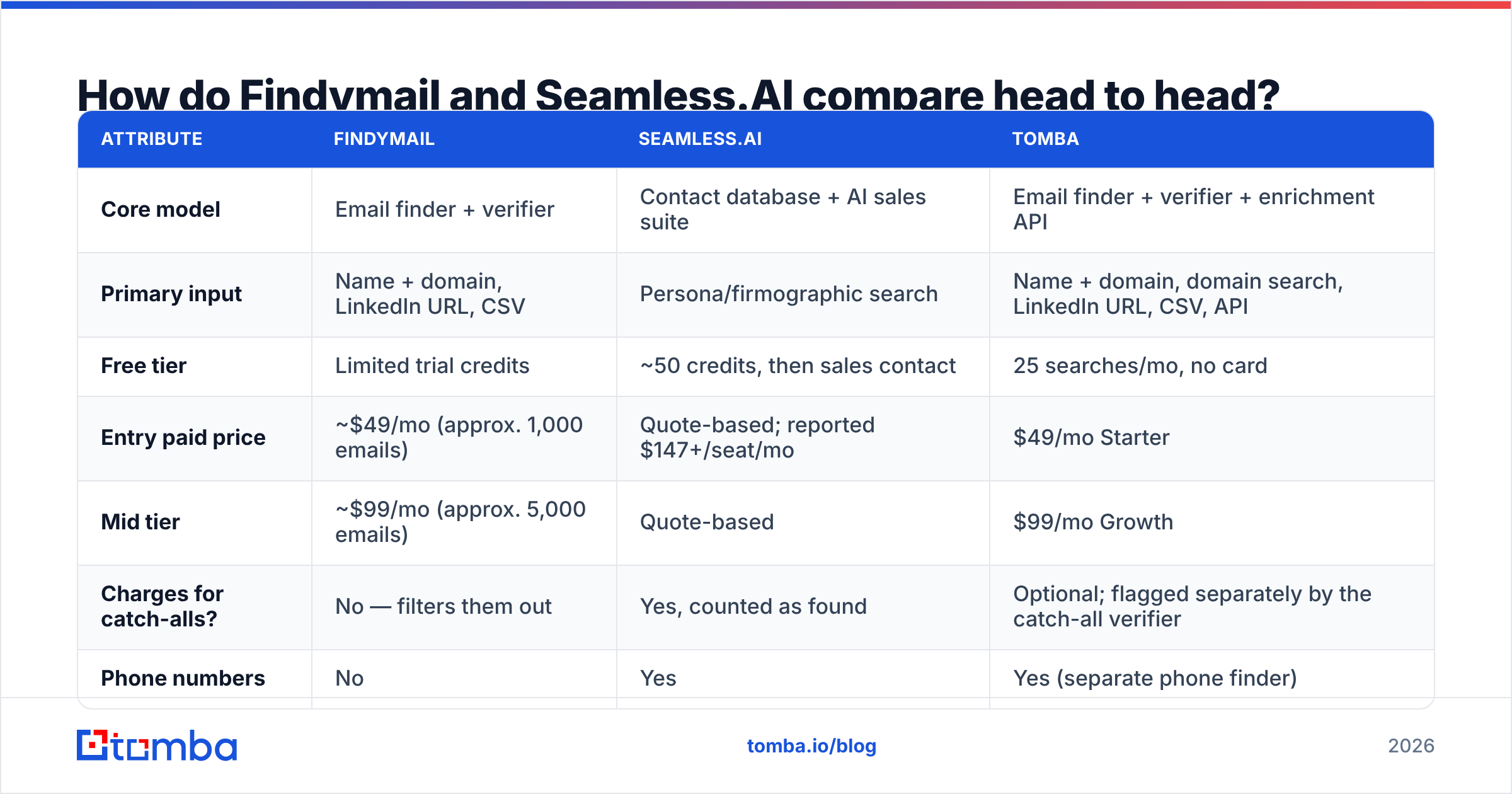
Here's the practical comparison. Pricing moves, so treat these as of early 2026 and verify on each vendor's page before you buy — Seamless.AI in particular does not publish self-serve pricing for its paid tiers, which is itself a data point.
| Attribute | Findymail | Seamless.AI | Tomba |
|---|---|---|---|
| Core model | Email finder + verifier | Contact database + AI sales suite | Email finder + verifier + enrichment API |
| Primary input | Name + domain, LinkedIn URL, CSV | Persona/firmographic search | Name + domain, domain search, LinkedIn URL, CSV, API |
| Free tier | Limited trial credits | ~50 credits, then sales contact | 25 searches/mo, no card |
| Entry paid price | ~$49/mo (approx. 1,000 emails) | Quote-based; reported $147+/seat/mo | $49/mo Starter |
| Mid tier | ~$99/mo (approx. 5,000 emails) | Quote-based | $99/mo Growth |
| Charges for catch-alls? | No — filters them out | Yes, counted as found | Optional; flagged separately by the catch-all verifier |
| Phone numbers | No | Yes | Yes (separate phone finder) |
| Public API | Yes | Yes, on higher tiers | Yes, on every paid plan |
| Contract friction | Self-serve, monthly | Annual contracts common; cancellation reported as manual | Self-serve, monthly |
| Best for | Resolving a known list | Building a list from scratch | Both, plus programmatic use |

Two rows matter most. First, catch-all handling — this single policy difference explains most of the gap between the two tools' claimed hit rates. Second, contract friction. Findymail and Tomba are both card-on-file, cancel-in-the-dashboard products. Seamless.AI is sales-led. Multiple G2 reviews mention annual commitments and a cancellation process that requires a phone call. That's not a scandal. It's just a different buying experience, and you should know which one you're signing up for.
Which one finds more valid emails?#
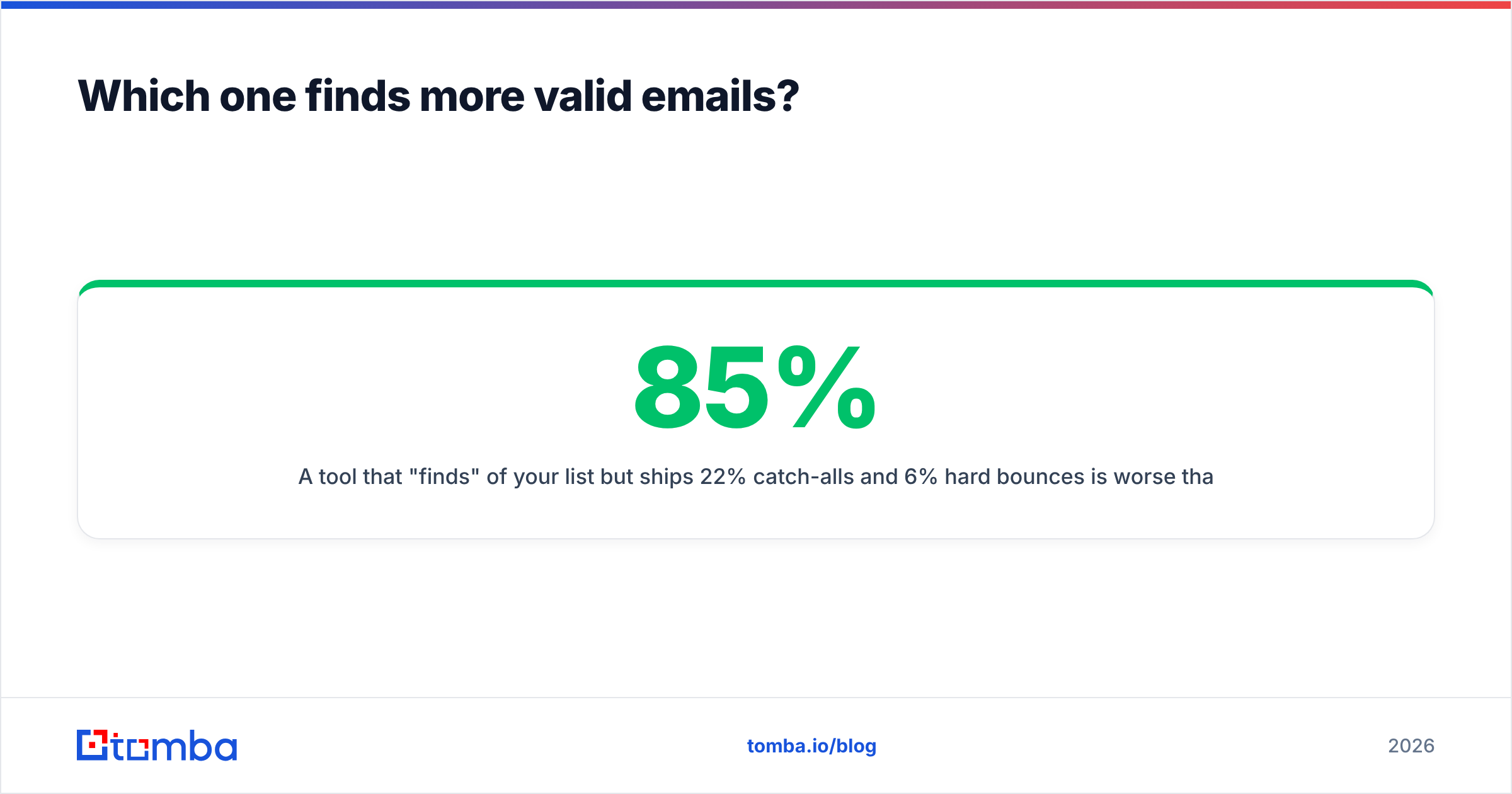
Wrong question. The right question is cost per email that actually lands in an inbox.
Say one tool "finds" 85% of your list but ships 22% catch-alls and 6% hard bounces. It is worse than a tool that finds 62% and bounces at 1.5%. The first one damages your sender reputation, and that costs you the whole campaign, not just the bad rows.
Findymail's positioning leans hard into this. By refusing to return unverifiable catch-all addresses, its raw find rate looks lower on a side-by-side. But the addresses it does return tend to hold up. Seamless.AI works the other way. It usually returns something for a contact, pulled from its stored records, and leaves the freshness question to you. On fast-moving segments — startups, agencies, anyone who changed jobs in the last 18 months — stale database records are the main failure mode.

Here's the honest framing: no vendor's published accuracy number will predict your result. Accuracy is segment-dependent. A tool tuned on US SaaS mid-market will underperform on German Mittelstand manufacturers or Japanese enterprises. Anyone quoting a single global percentage is quoting a marketing figure.
What you can control is the process. Run every list through an independent email verifier regardless of which finder produced it. Treat the finder's own "verified" flag as a claim, not a guarantee.
What do the credit systems really cost you?#
This is where the sticker price and the invoice diverge. Six mechanics to check on any finder before you buy. The first three decide what you pay per record:
- What counts as a credit. Findymail bills on emails found. Seamless.AI bills on records unlocked. A search that returns nothing should cost you nothing — confirm this in writing. Tomba follows the same "pay for results" logic and publishes the limits openly on its pricing page.
- Whether catch-alls are billable. If a tool charges full price for an address it can't verify, you're paying for a coin flip. Ask directly.
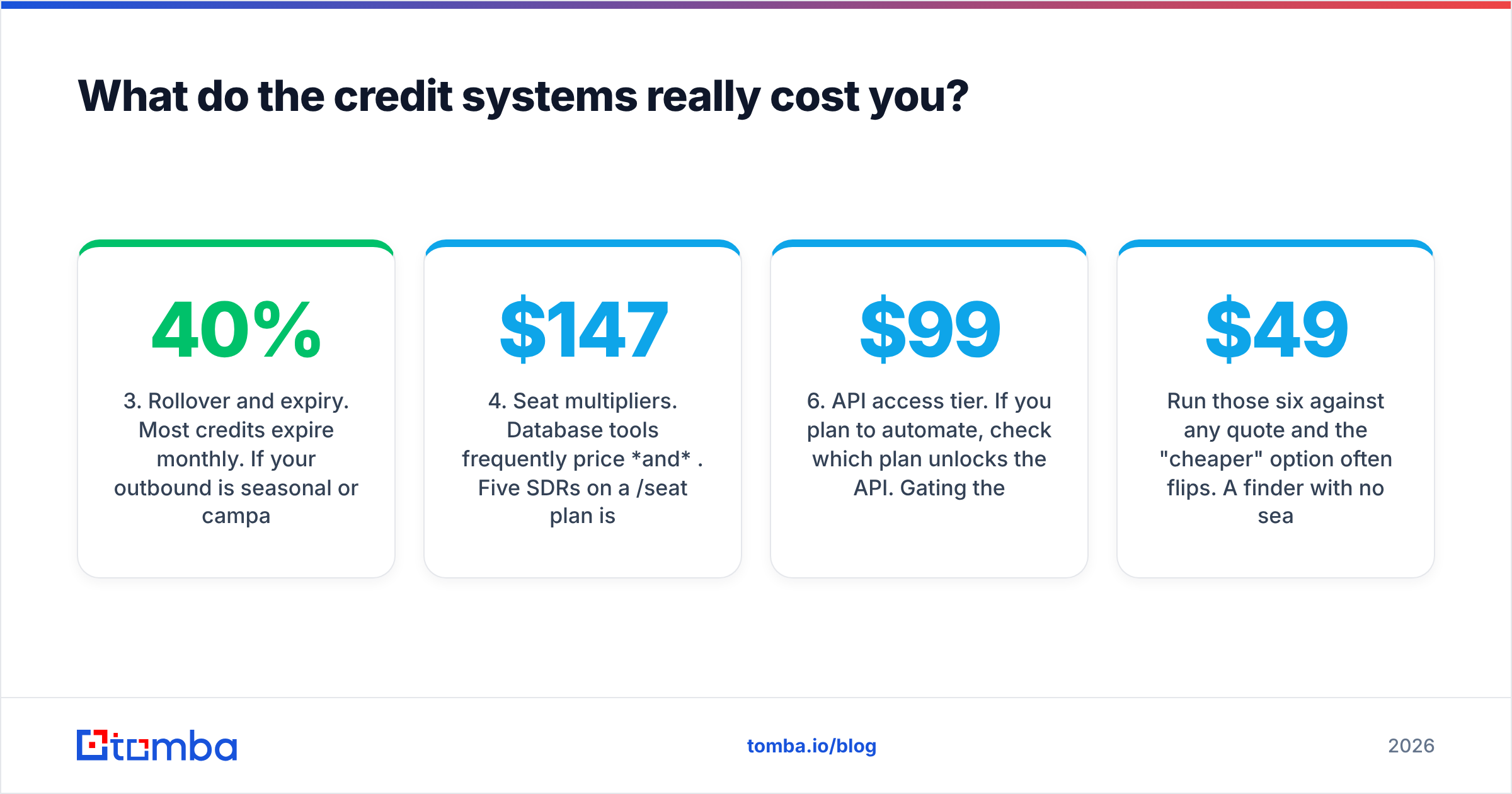
- Rollover and expiry. Most credits expire monthly. If your outbound is seasonal or campaign-driven, monthly expiry can waste 30–40% of what you bought. Annual plans sometimes front-load credits; sometimes they don't.
The next three decide your ceiling — how far the plan lets you scale:
- Seat multipliers. Database tools frequently price per seat and per credit. Five SDRs on a $147/seat plan is $735/mo before you've enriched a single record. Finder tools generally price the workspace, not the head count.
- Export ceilings. Some database vendors cap how many records you can export per day or per contract, even when you have credits left. That cap is the real limit on your outbound volume.
- API access tier. If you plan to automate, check which plan unlocks the API. Gating the API behind an enterprise tier turns a $99 tool into a $2,000 one the moment you want to script it.
Run those six against any quote and the "cheaper" option often flips. A $49 finder with no seat multiplier and API access included frequently beats a $147/seat database once you count the humans.
Who should choose Findymail?#
Pick Findymail if most of these describe you:
- You already source prospects from LinkedIn Sales Navigator, conference lists, or a scraper, and you just need emails resolved.
- Deliverability is a board-level concern — you're running cold outbound and a 5% bounce rate would get your domain throttled.
- You want a monthly, self-serve, cancel-anytime relationship with a small tool rather than an annual platform contract.
- You don't need phone numbers, intent data, or a built-in sequencer, because you already run Instantly, Smartlead, Lemlist, or similar.
- You're a one-to-five-person team where seat-based pricing would be punitive.
Findymail's weakness is the flip side of its focus: it won't tell you who to email. If you don't have a source of names, you'll need a database anyway, and now you're paying two vendors.
If Findymail's approach appeals but the credit ceiling or the feature scope doesn't fit, the Findymail alternative comparison walks through the same trade-offs against Tomba's plan structure.
Who should choose Seamless.AI?#
Pick Seamless.AI if:
- You're starting from zero. No list, no CRM history, no scraper. The search-by-persona workflow is genuinely faster than building a list manually.
- You need phone numbers alongside emails. Cold calling teams get real value from a combined record; a pure email finder leaves half the job undone.
- You want one platform. Buyer intent, writer, extension, CRM sync in a single login has organizational value, even when each individual module is beaten by a specialist.
- You have a team large enough to absorb seat pricing. At 15+ SDRs, per-seat platform economics start looking less absurd relative to the headcount cost.
The counterweight: quote-based pricing means you cannot budget without a sales call, and the annual-contract norm removes your ability to walk after a bad month. Read the renewal clause. If your data needs are narrow, you'll be paying for six modules to use one.
Teams that like the database breadth but want the commercial terms of a self-serve tool usually end up looking at the Seamless.AI alternative route — pairing a lean finder with a cheaper list source.
What about catch-all domains — the thing nobody explains?#
A catch-all domain accepts mail to any address at that domain, valid or not. anything@catchall-company.com returns a positive SMTP response even though nobody reads it. Roughly a fifth of B2B domains are configured this way, and the share is higher among enterprises using aggressive spam gateways.
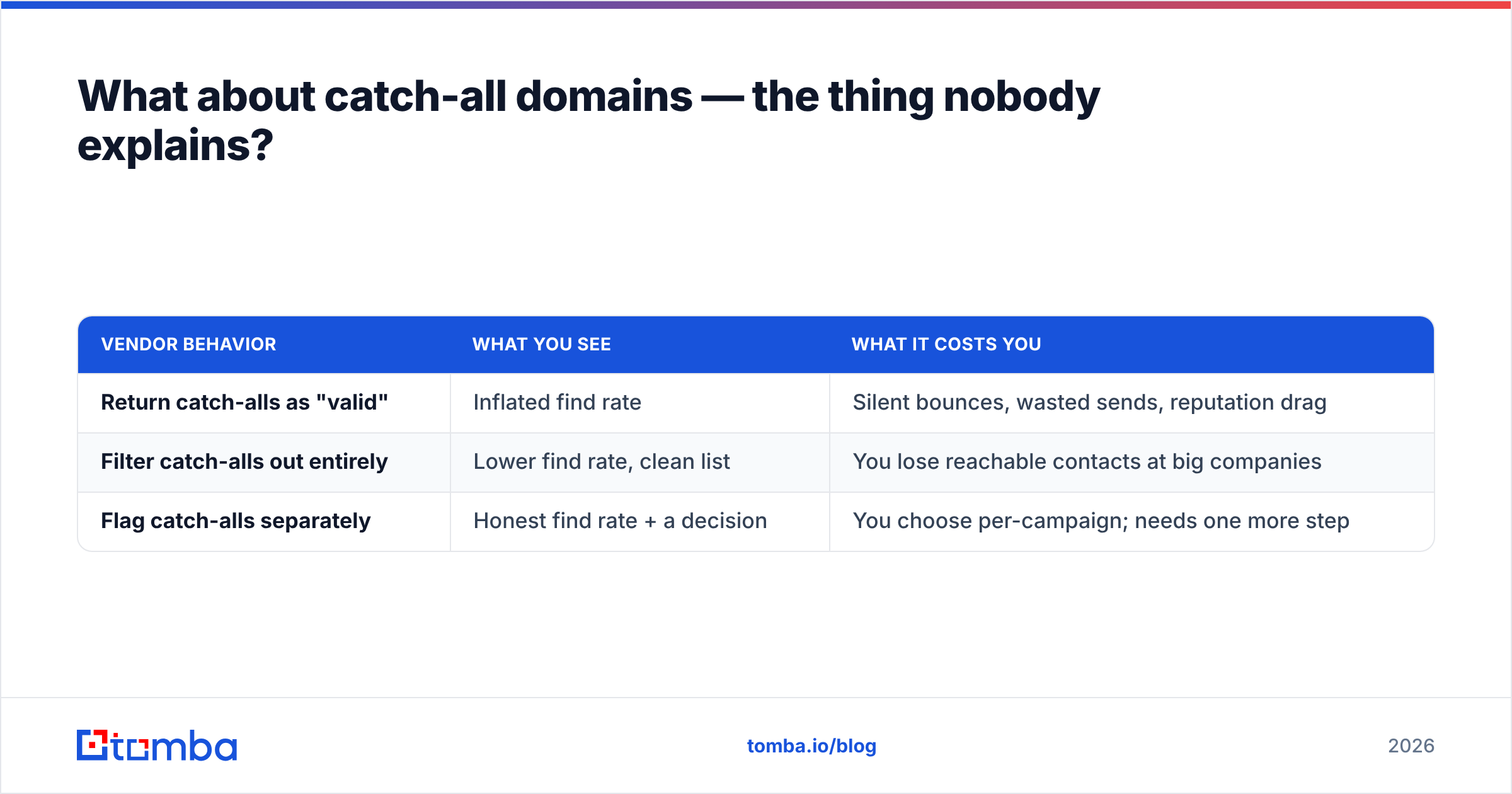
This creates a three-way split in how vendors behave:
| Vendor behavior | What you see | What it costs you |
|---|---|---|
| Return catch-alls as "valid" | Inflated find rate | Silent bounces, wasted sends, reputation drag |
| Filter catch-alls out entirely | Lower find rate, clean list | You lose reachable contacts at big companies |
| Flag catch-alls separately | Honest find rate + a decision | You choose per-campaign; needs one more step |
The third option is the only defensible one at scale, which is why a dedicated catch-all verifier exists as a distinct product rather than a hidden setting. For low-volume, high-value ABM lists, sending to a flagged catch-all is usually worth the risk. For a 20,000-contact blast on a young domain, it isn't.
Whichever tool you pick, know which of the three behaviors it exhibits. Findymail is squarely in camp two. Database vendors, including Seamless.AI, tend toward camp one because find-rate is a headline metric in their marketing.
How do you run a fair test between them?#
Don't trust anyone's benchmark, including this one. Run your own Findymail vs SeamlessAI test in an afternoon:
- Build a 200-row control list from your actual ICP. Include company name, domain, first name, last name. Deliberately mix segments: 25% enterprise, 50% mid-market, 25% sub-50-employee. Include at least 20 non-US companies.
- Run the identical file through each tool. No cherry-picking, no manual cleanup between runs.
- Record four numbers per tool: rows returned, rows marked catch-all/risky, credits consumed, and wall-clock time.
- Verify every output with a third-party verifier — not the finder's own verdict. Independent verification is the whole point.
- Send a real, small campaign to a 50-row sample from each and record the actual bounce rate after 72 hours. This is the only number that matters.
- Divide. Total spend ÷ inbox-delivered contacts = your true cost per usable lead. Compare that figure, not the monthly price.
Most teams that run this exercise discover their expensive platform and their cheap finder land within a few percentage points on deliverable contacts — and the price gap is 3x. Others discover the opposite for their specific vertical. That's the point: you can't know without testing.
What's the verdict?#
Findymail wins on cost-per-valid-email and commercial simplicity. Seamless.AI wins on discovery and breadth. So Findymail vs SeamlessAI comes down to one question: do you need to find out who to email, or just how to reach them? They're complements more often than competitors, which is awkward if you were hoping to buy one.
The uncomfortable middle case — and it's the most common one — is a team that needs both discovery and reliable resolution, doesn't want two invoices, and can't justify enterprise pricing. That's the gap Tomba was built for: a self-serve email finder with domain search for discovery, verification and catch-all handling built in, an API included on every paid plan, and published pricing that starts at $49/mo with a free tier of 25 searches so you can test before you talk to anyone.
Start with the free tier, run the 200-row control test above against whatever you're using now, and let the bounce rate pick the winner. Try the Tomba Email Finder — no sales call, no annual contract, and you'll know within an hour whether it beats your current cost per usable lead.
Related guides#
Ready to find emails that actually work?
Join 150,000+ professionals who stopped guessing and started sending. Free credits on signup — no credit card required.
Get the Tomba newsletter
Practical outbound tactics and product updates — once every two weeks.
About the author