Findymail vs SourceScrub (2026): Which Data Tool Wins?
Findymail finds verified emails for cold outreach. SourceScrub sources private companies for deal teams. They get compared constantly, but they solve different problems — here is the honest breakdown, with pricing, accuracy and a clear pick.
Findymail vs SourceScrub is a common shortlist, and it is usually the wrong one. Findymail finds and verifies work emails. SourceScrub finds private companies. Both get filed under "B2B data," so buyers line them up. Here is the honest Findymail vs SourceScrub breakdown: what each tool does, what each costs, and which one you actually need.
TL;DR
- Findymail is an email finder and verifier for cold outreach teams. SourceScrub is a private-company sourcing platform for private equity, M&A and corp dev teams.
- The two overlap on "B2B data" and almost nowhere else.
- Sending 5,000 cold emails a month? Findymail is the tool that matters.
- Building a list of 400 bootstrapped manufacturers at $10M–$50M in revenue? SourceScrub is the tool that matters.
- Findymail posts monthly pricing from about $49/mo. SourceScrub sells annual seat contracts through a sales call. Expect a five-figure commitment, not a credit card.
- Neither is a full GTM data stack. Findymail is thin on firmographics. SourceScrub is thin on verified personal emails.
- Need finding, verification, enrichment and an API on a self-serve plan? A platform like Tomba covers more of the stack for less.
What are Findymail and SourceScrub, exactly?#
Short answer: one is a contact-data tool, the other is a company-discovery tool. The Findymail vs SourceScrub matchup only exists because both get filed under "B2B data" in software directories.
Findymail is an email-finding and verification service for cold email operators. You feed it a name and a domain, a LinkedIn profile, or a Sales Navigator export. It returns a business email that has been checked for bounce risk.
Its headline promise is deliverability. The product is sold on a bounce guarantee: credits are refunded when an address bounces. That tells you who it is for. Agencies, SDR teams and founders running volume outbound care about a sub-3% bounce rate, not org charts.
SourceScrub is a deal-sourcing platform for private markets. It holds a database of millions of private companies. Records are enriched with human-verified data, growth signals, conference and tradeshow attendee lists, buyer's guides and sourcing lists.
Those lists are pulled from thousands of curated web sources. Its users sit at private equity firms, investment banks and corporate development groups. They need to find companies nobody else has found, track them over time, and push them into DealCloud, Affinity or Salesforce.
The practical split: Findymail answers "what is this person's email?" SourceScrub answers "which companies should we even look at?"
What does Findymail actually do well?#
Findymail's strength is narrow and real. It does four things:
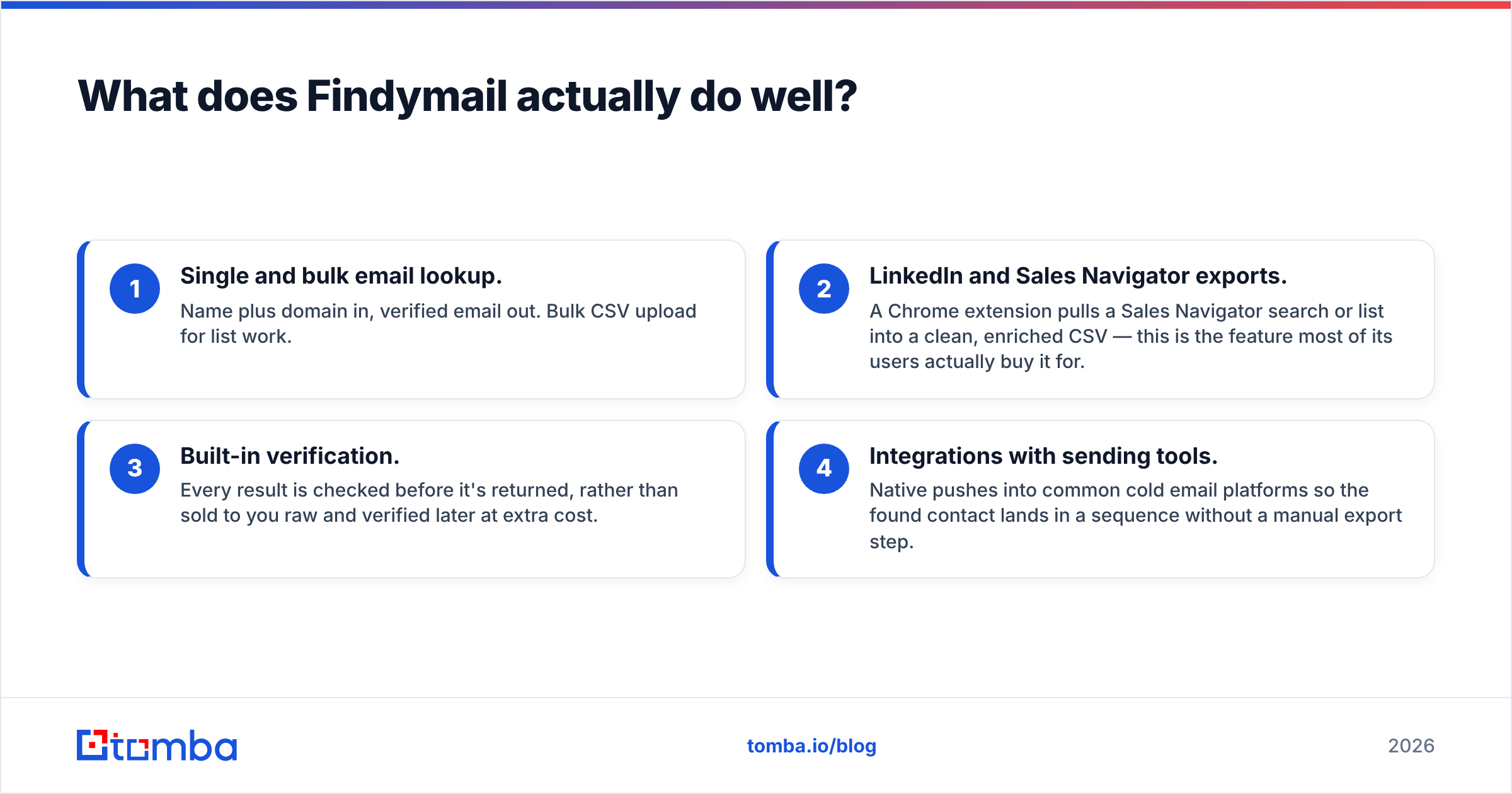
- Single and bulk email lookup. Name plus domain in, verified email out. Bulk CSV upload handles list work.
- LinkedIn and Sales Navigator exports. A Chrome extension pulls a Sales Navigator search into a clean, enriched CSV. Most users buy the tool for this.
- Built-in verification. Every result is checked before it is returned, not sold raw and verified later at extra cost.
- Integrations with sending tools. Contacts push straight into common cold email platforms, with no manual export step.
That is the whole product. The focus is a feature, not a limitation. Findymail does not try to be a CRM, an intent platform or a sequencer.
Where it thins out: firmographic depth. You get contact data, not a research surface. There is no real filtering by revenue band, funding stage, ownership or growth signal.
So if your ICP is more complex than "job title X at companies using Y," you will source the company list somewhere else. Findymail then handles the last mile.
What does SourceScrub actually do well?#
SourceScrub finds companies that are hard to find on purpose. Private, founder-owned, never raised a round, no press coverage. That kind of business never shows up in a Crunchbase filter, because it has no funding history to filter on.
The mechanics that make that work:
- Sourcing lists. Tens of thousands of curated lists: conference exhibitor rosters, association directories, award lists, buyer's guides. Each is parsed into structured company records. This is the moat. Anyone can scrape LinkedIn. Parsing a 2026 trade-show exhibitor PDF into clean firmographics is much harder.
- Human-verified enrichment. A research team checks key fields instead of trusting automated crawls. That matters when a partner acts on a revenue estimate.
- Growth signals. Headcount trend, job postings, web traffic and sourcing frequency. Sourcing frequency counts how often a company appears across independent lists, as a proxy for market relevance.
- CRM sync built for deal flow. DealCloud and Affinity, not just Salesforce, because that is what private-market teams run on.
Where it thins out for outbound teams: person-level contact data. SourceScrub tells you a company exists, that it grew 40% last year, and who the founder is.
Getting a verified, deliverable email for that founder at scale is not the point of the platform. Most SourceScrub users pair it with a separate email finder to close that gap.
Findymail vs SourceScrub: how do they compare head-to-head?#
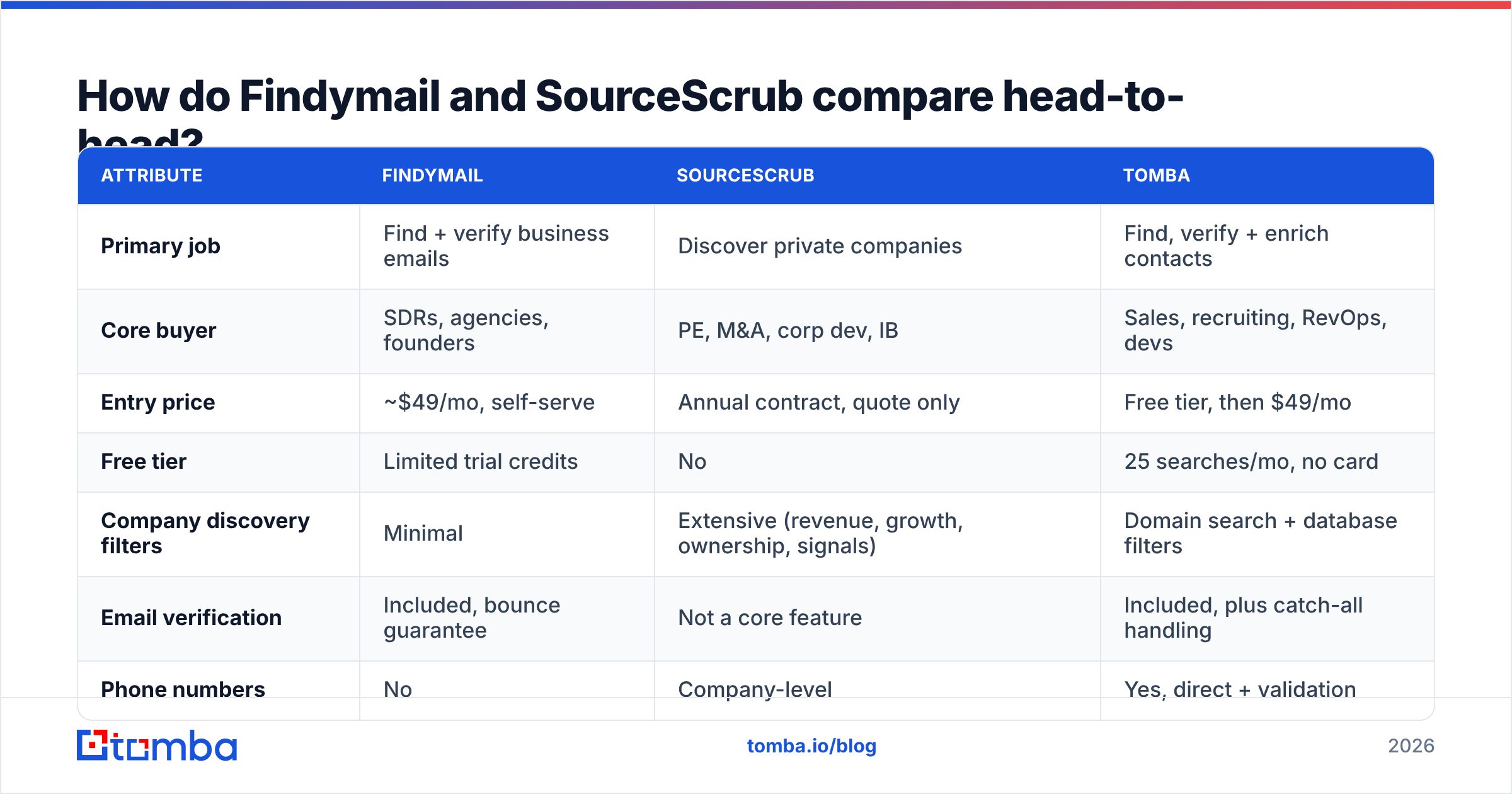
Here is the direct comparison. Tomba is included as a reference point, since it competes with Findymail on the contact-data side.
| Attribute | Findymail | SourceScrub | Tomba |
|---|---|---|---|
| Primary job | Find + verify business emails | Discover private companies | Find, verify + enrich contacts |
| Core buyer | SDRs, agencies, founders | PE, M&A, corp dev, IB | Sales, recruiting, RevOps, devs |
| Entry price | ~$49/mo, self-serve | Annual contract, quote only | Free tier, then $49/mo |
| Free tier | Limited trial credits | No | 25 searches/mo, no card |
| Company discovery filters | Minimal | Extensive (revenue, growth, ownership, signals) | Domain search + database filters |
| Email verification | Included, bounce guarantee | Not a core feature | Included, plus catch-all handling |
| Phone numbers | No | Company-level | Yes, direct + validation |
| API access | Yes, on higher plans | Limited / partner-level | Yes, on all paid plans |
| Bulk processing | CSV upload | List export | Bulk finder + verifier |
| Contract length | Monthly, cancel anytime | Annual, seat-based | Monthly or annual |
| Best for | Volume cold outreach | Proprietary deal flow | Outbound + enrichment at API scale |

Read that table twice and the verdict falls out on its own. These tools do not replace each other. A PE associate cannot run deal sourcing on Findymail. An SDR manager cannot justify a SourceScrub seat to send cold email.
So the real question for most buyers is not "which one." It is "which layer of my stack is actually broken."
How accurate is each one, and what does accuracy cost you?#
Accuracy means different things on each side of Findymail vs SourceScrub. Mixing the two definitions is how teams end up paying for the wrong tool.
For Findymail, accuracy means deliverability. The metric is bounce rate: out of 1,000 addresses returned, how many hard-bounce when you send.
Anything above 3–5% starts to damage domain reputation, and mailbox providers now enforce that hard. Findymail's bounce guarantee is a credible signal. A vendor that refunds credits for bounces has skin in the game.
For SourceScrub, accuracy means the revenue estimate, headcount and ownership status are right. A wrong email costs you one bounce. A wrong revenue estimate costs an associate two weeks of diligence on a company that was never in the mandate.

Two things are worth knowing whichever vendor you pick:
- Coverage and accuracy trade off against each other. A tool that returns an email for 90% of your list is either better than its rivals or looser about the word "verified." Always test on a list where you already know the answers.
- Catch-all domains are where vendors quietly differ. About a fifth of business domains accept every address at the SMTP layer, so normal verification returns "unknown." Some vendors count those as found. Some drop them. If you send to many enterprise or agency domains, run them through a dedicated catch-all verifier first.
Findymail vs SourceScrub pricing: what does each one cost?#
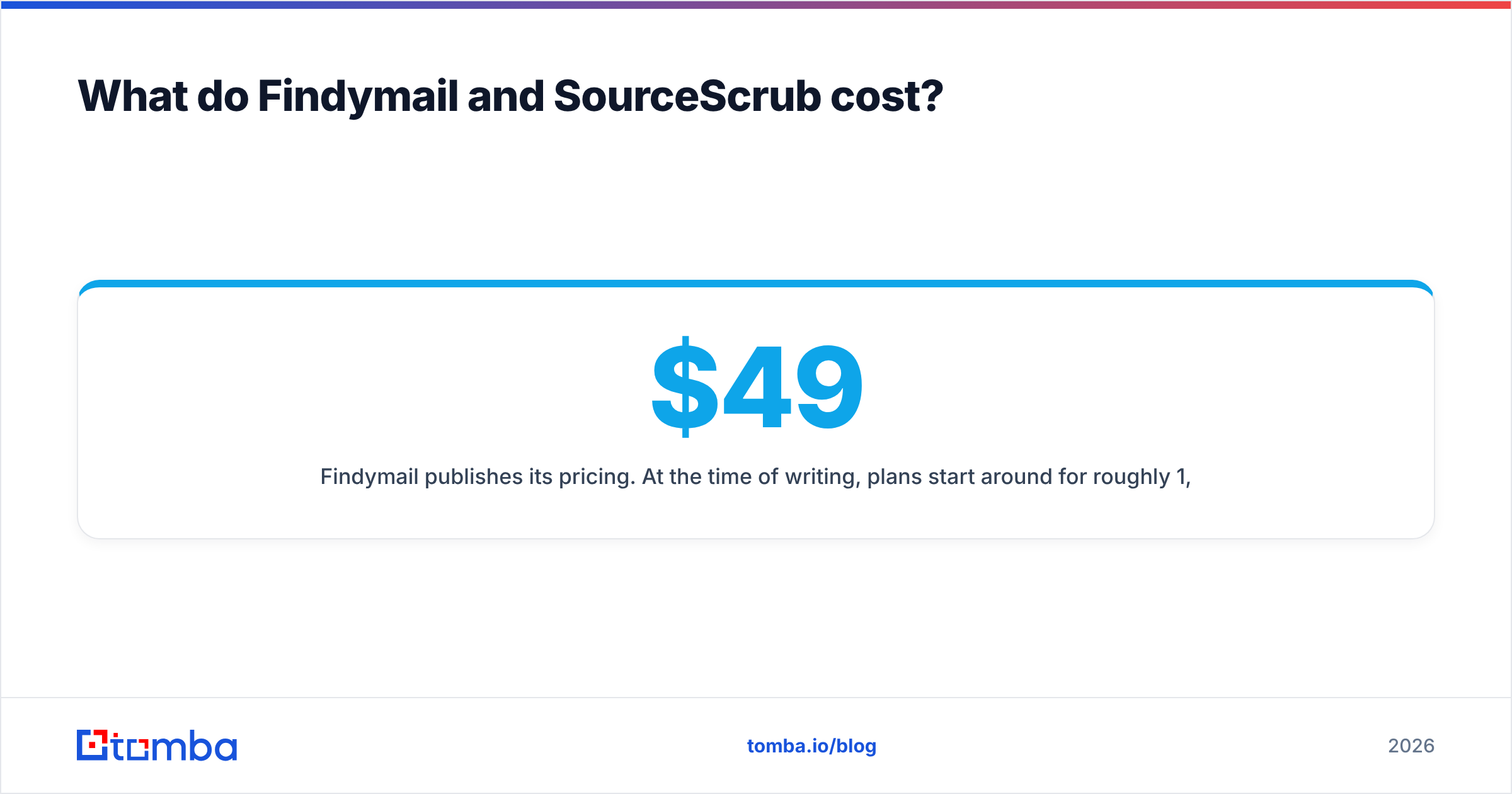
Findymail publishes its pricing. Plans start near $49/mo for roughly 1,000 email credits. The next step is about $99/mo for around 5,000 credits, then $249/mo for higher volume.
Credits are used per successful find. Billing is monthly and there is no sales call. Check the pricing page before you budget, because email-data vendors reprice often.
SourceScrub does not publish pricing. It is a quote-driven, seat-based annual contract sold through a demo. Public reviews on G2 describe it as a serious line item, not a small tool expense.
That is normal for private-market data. The comparison set is PitchBook and Grata, not Hunter and Findymail. Budget for a five-figure annual commitment, per-seat scaling and a procurement cycle.

In Findymail vs SourceScrub, the shape of the cost matters more than the number. Findymail scales with usage and you can switch it off next month. SourceScrub is fixed for a year, whether or not your associates log in.
If you are evaluating SourceScrub, one question decides renewal: how many proprietary deals did it actually source? Not how many companies sit in the database.
Which one fits your GTM motion?#
Match the tool to the job, not to the category label:
- You run volume cold email. Pick Findymail, or a cheaper finder with equal verification. You need deliverable addresses and a bounce guarantee. Company research is not your bottleneck.
- You source proprietary private-market deals. Pick SourceScrub. No outbound tool will surface a founder-owned $30M HVAC roll-up that six other funds have not called yet.
- You do both, with thesis-driven outbound. Buy the company layer where your ICP lives. Pair it with a cheap, API-accessible contact layer. Paying enterprise rates for contact data you can get for $49/mo is the most common overspend we see.
- You are a developer or RevOps engineer. Neither side of Findymail vs SourceScrub is ideal here. Findymail's API is fine but plan-gated. SourceScrub is not built for programmatic enrichment. You want an email finder API with predictable per-request pricing.
- You are a recruiter or agency. Findymail's Sales Navigator export is the draw. Check whether you also need phone numbers, because neither tool has strong person-level phone coverage.
Where does Tomba fit in this comparison?#
Tomba competes with Findymail, not SourceScrub. It belongs on your shortlist if the contact-data layer is what you are shopping for.
The overlap is clear. Both find and verify business emails, both handle bulk work, and both plug into outbound tooling. Four differences decide it:
- A genuine free tier. 25 searches a month, no card. Test accuracy on your own list before you commit. Findymail's trial is credit-limited and time-boxed.
- More of the stack in one subscription. Beyond the finder you get an email verifier, domain search, catch-all handling, phone finder and data enrichment.
- API on every paid plan. It is not gated behind an upgrade. The same goes for the CLI, Sheets add-on and Chrome extension.
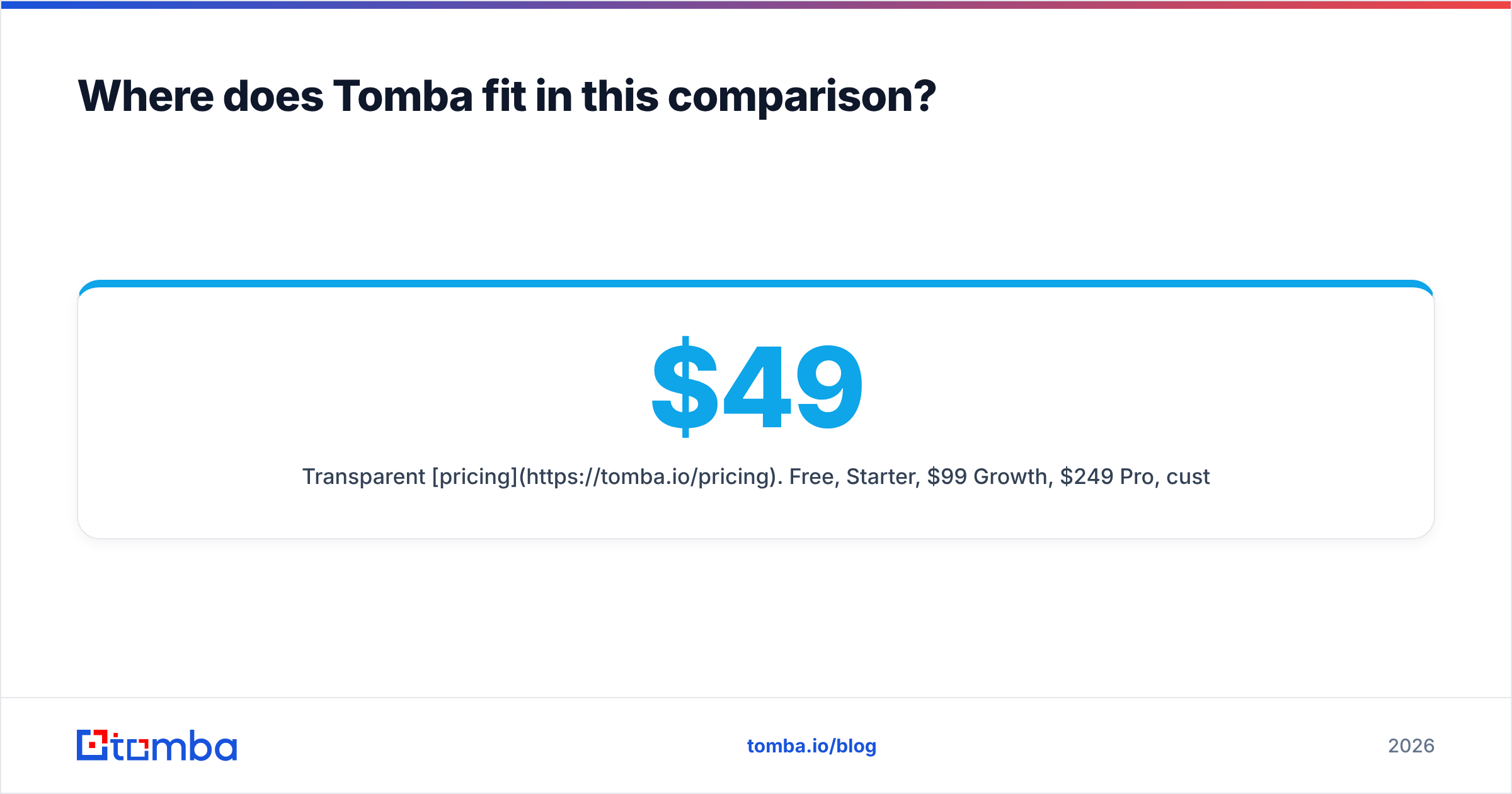
- Transparent pricing. Free, $49/mo Starter, $99/mo Growth, $249/mo Pro, custom Enterprise. No quote call to learn whether you can afford it.
Tomba will not replace SourceScrub. It has no conference-list parsing, no human-verified revenue estimates and no DealCloud workflow. If your job is deal sourcing, buy the deal-sourcing tool.
But many teams use a SourceScrub seat partly as an expensive contact-lookup tool. Splitting that job out is an easy budget win. If you are shopping the outbound side, our Findymail alternative breakdown goes deeper on the feature-by-feature diff.
What's the verdict on Findymail vs SourceScrub?#
Findymail wins if the question is "how do I email these people." It is cheaper, self-serve and monthly, and it does one job well. The bounce guarantee is worth real money at volume.
SourceScrub wins if the question is "who should I talk to that nobody else has found." No outbound tool comes close on private-company discovery. The sourcing-list infrastructure is genuinely hard to copy.
Most teams should stop running the Findymail vs SourceScrub comparison at all. Define which layer is broken instead. If you cannot find companies worth contacting, buy company data.
If you cannot reach the people at companies you already know, buy contact data. Buy it from a vendor that bundles verification, phone numbers, enrichment and an API. Paying four vendors for one workflow is how data budgets quietly triple.
Test before you commit, either way. Pull 100 records you can verify yourself, run them through each tool, and count what came back correct. Vendor accuracy numbers are marketing. Your own list is the only benchmark that matters.
Start with the layer you can test today. If contact data is your bottleneck, run your next 25 lookups through the Tomba Email Finder for free. No card, no demo call, no annual contract.
Upload the same list you would give Findymail, or pull from your SourceScrub export. Compare hit rate and bounce rate side by side, and let your own numbers pick the winner. Plans start at $49/mo with the verifier, phone finder, enrichment and API included.
Related guides#
Ready to find emails that actually work?
Join 150,000+ professionals who stopped guessing and started sending. Free credits on signup — no credit card required.
Get the Tomba newsletter
Practical outbound tactics and product updates — once every two weeks.
About the author