Findymail vs Techsalerator: Which B2B Data Tool Wins in 2026?
Findymail sells verified email discovery for outbound teams. Techsalerator sells bulk data licenses. We compare pricing, accuracy, coverage, and workflow fit to show which one your team should actually buy in 2026.
TL;DR
- Findymail is a per-contact email finder built for outbound SDR workflows — self-serve plans, bounce guarantees, and native Clay/Lemlist/Instantly hooks. Pricing starts around $49/mo for 1,000 credits.
- Techsalerator is a bulk data licensing vendor. You buy datasets (B2B contacts, firmographics, consumer, geospatial) as files or API feeds, usually under a quote-based contract with a meaningful minimum spend.
- They are not really the same product. Findymail answers "what is this specific person's email?" Techsalerator answers "give me every company in Germany with 50-200 employees."
- Pick Findymail if you run sequences off a list you build weekly. Pick Techsalerator if you're populating a data warehouse or building a product on licensed data.
- If you want both motions — verified per-contact lookup and bulk enrichment — a single API like Tomba covers the middle ground at $49/mo without a licensing contract.
What is Findymail and who actually uses it?#
Findymail is a B2B email finder that positions itself around one promise: the emails it returns won't bounce. It grew out of the Clay/Lemlist ecosystem, and its customer base skews heavily toward agencies and SDR teams running high-volume cold email.
The workflow is simple. You feed it a LinkedIn URL, a name plus a domain, or a CSV. It returns a verified work email or nothing at all. That "or nothing at all" matters — Findymail deliberately withholds low-confidence guesses instead of charging you for a pattern-generated address that will bounce. Most competitors monetize the guess. Findymail doesn't, and that's the core of its pitch.
What you get:
- Per-contact lookup — single search, bulk CSV upload, or API.
- LinkedIn Sales Navigator export — scrape a list, enrich in one pass.
- Bounce credit refunds — invalid results are typically credited back.
- Native integrations — Clay, Lemlist, Instantly, Smartlead, HubSpot, Zapier.
- Credit-based pricing — no seat tax on the lower tiers.
The limits are equally clear. Coverage is narrower than the giant databases: if a person has no public digital footprint, Findymail returns nothing. There's no firmographic layer worth speaking of — no funding data, no tech stack, no intent signals. And credits are consumed per successful find, so a low-hit-rate list burns your allowance faster than the headline price suggests.

What is Techsalerator and how is it different?#
Techsalerator is a data licensing company, not a prospecting tool. That distinction changes almost everything about how you'd evaluate it.
Techsalerator sells datasets. B2B contact files, company firmographics, consumer records, geospatial and POI data, mobile IDs, healthcare provider lists — across a claimed 200+ countries. You describe the slice you want (industry, geography, employee band, job function), they scope it, quote it, and deliver it as a flat file, an S3 drop, an API feed, or through a marketplace listing.
The buyer is different too. Findymail's buyer is an SDR manager with a company card. Techsalerator's buyer is a data engineer, a RevOps lead building an ICP model, or a product team that needs licensed data inside their own application. Deals are quote-based and typically start in the thousands, not at $49.
That model has real advantages. You own the file. There's no per-credit meter running while your enrichment job loops. You can join it against your CRM, run it through your own scoring model, and refresh on a contracted cadence. For anyone building a data product, licensing beats API metering on unit economics at scale.
It also has real costs. Bulk files are a snapshot — accuracy decays from the moment of delivery, and B2B contact data decays fast (roughly 2-3% of records go stale every month as people change jobs). Unless your contract includes frequent refreshes, you're emailing a dataset that ages badly. Verification is on you. And there's no "look up this one person right now" button, which is exactly what an SDR needs at 9am on a Tuesday.
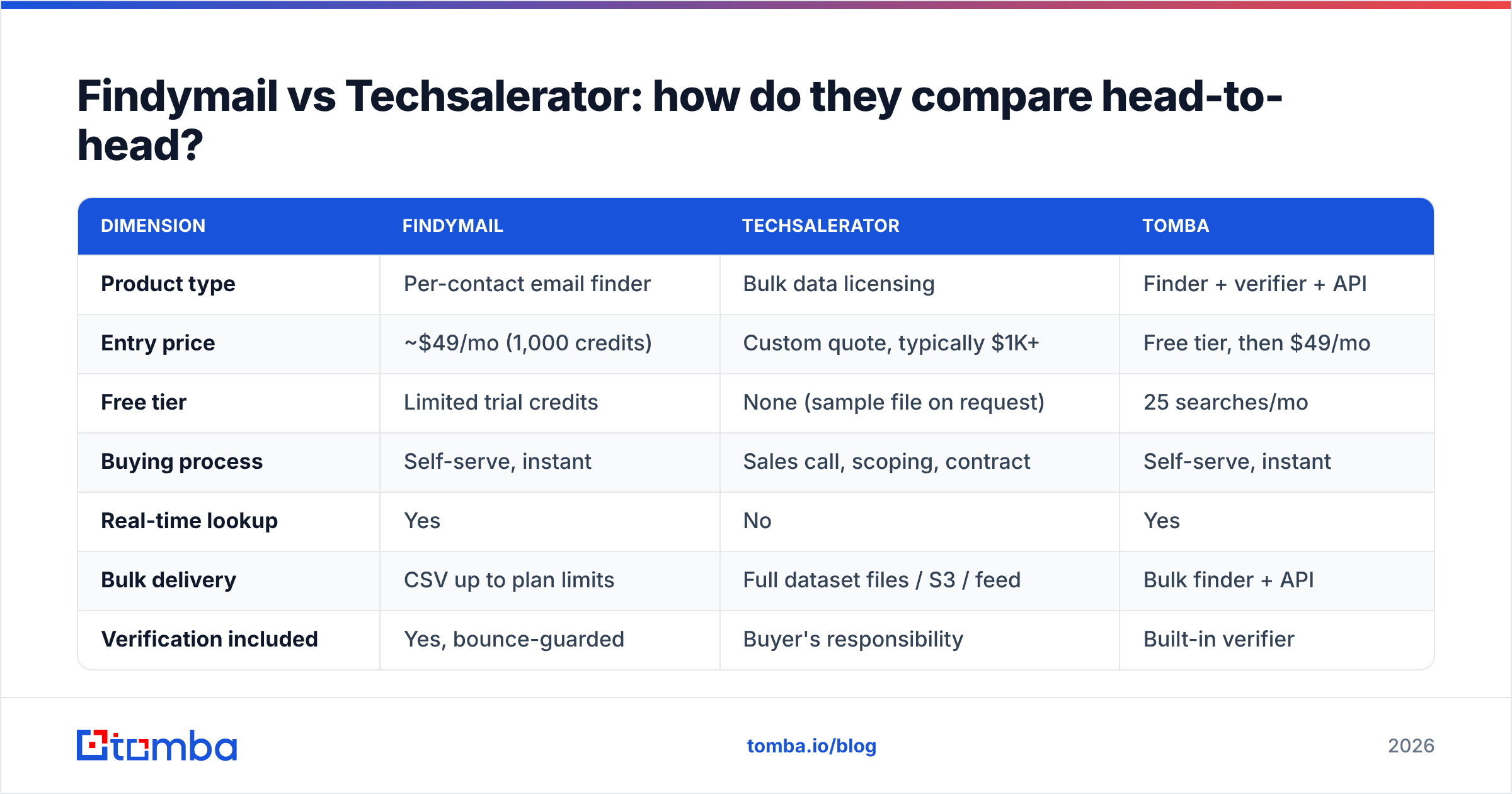
Findymail vs Techsalerator: how do they compare head-to-head?#
| Dimension | Findymail | Techsalerator | Tomba |
|---|---|---|---|
| Product type | Per-contact email finder | Bulk data licensing | Finder + verifier + API |
| Entry price | ~$49/mo (1,000 credits) | Custom quote, typically $1K+ | Free tier, then $49/mo |
| Free tier | Limited trial credits | None (sample file on request) | 25 searches/mo |
| Buying process | Self-serve, instant | Sales call, scoping, contract | Self-serve, instant |
| Real-time lookup | Yes | No | Yes |
| Bulk delivery | CSV up to plan limits | Full dataset files / S3 / feed | Bulk finder + API |
| Verification included | Yes, bounce-guarded | Buyer's responsibility | Built-in verifier |
| Firmographics | Minimal | Extensive | Company enrichment |
| Geographic breadth | Strong US/EU | 200+ countries claimed | Global, domain-driven |
| Data freshness | On-demand (fresh at query) | Snapshot + contracted refresh | On-demand (fresh at query) |
| Best for | SDR sequences, agencies | Data warehouses, data products | Both, at SMB pricing |
| Contract lock-in | Monthly, cancel anytime | Annual / per-dataset licence | Monthly, cancel anytime |
The table makes the real decision visible: this isn't a feature fight, it's a category fight. You're choosing between renting lookups and buying a dataset.
Which one is more accurate?#
Accuracy means two different things here, and conflating them is how teams waste money.
Findymail's accuracy is transactional. When you ask for one person's email, it either returns a verified address or declines. Findymail publicly targets sub-5% bounce rates and refunds credits on invalids. Because the lookup happens at query time, the answer reflects the world as of today. The trade-off is hit rate — you'll see 50-70% coverage on a typical B2B list, lower on SMB or non-English markets.
Techsalerator's accuracy is statistical. A licensed file of 2 million contacts will contain a mix: some records fresh, some 18 months old. Vendors in this space commonly cite 85-95% accuracy at delivery, but that figure describes the file at a moment in time, not the address you're about to email six weeks later. If you buy bulk data, budget for a verification pass before it touches a sending domain — run it through an email verifier and expect to discard a slice of what you paid for.
Here's the practical rule most teams learn the expensive way: bulk data is a targeting asset, not a sending asset. Use it to define your ICP, size the market, and build account lists. Then resolve and verify the actual contact emails at send time with a real-time finder. Mixing those two jobs is how you torch sender reputation.
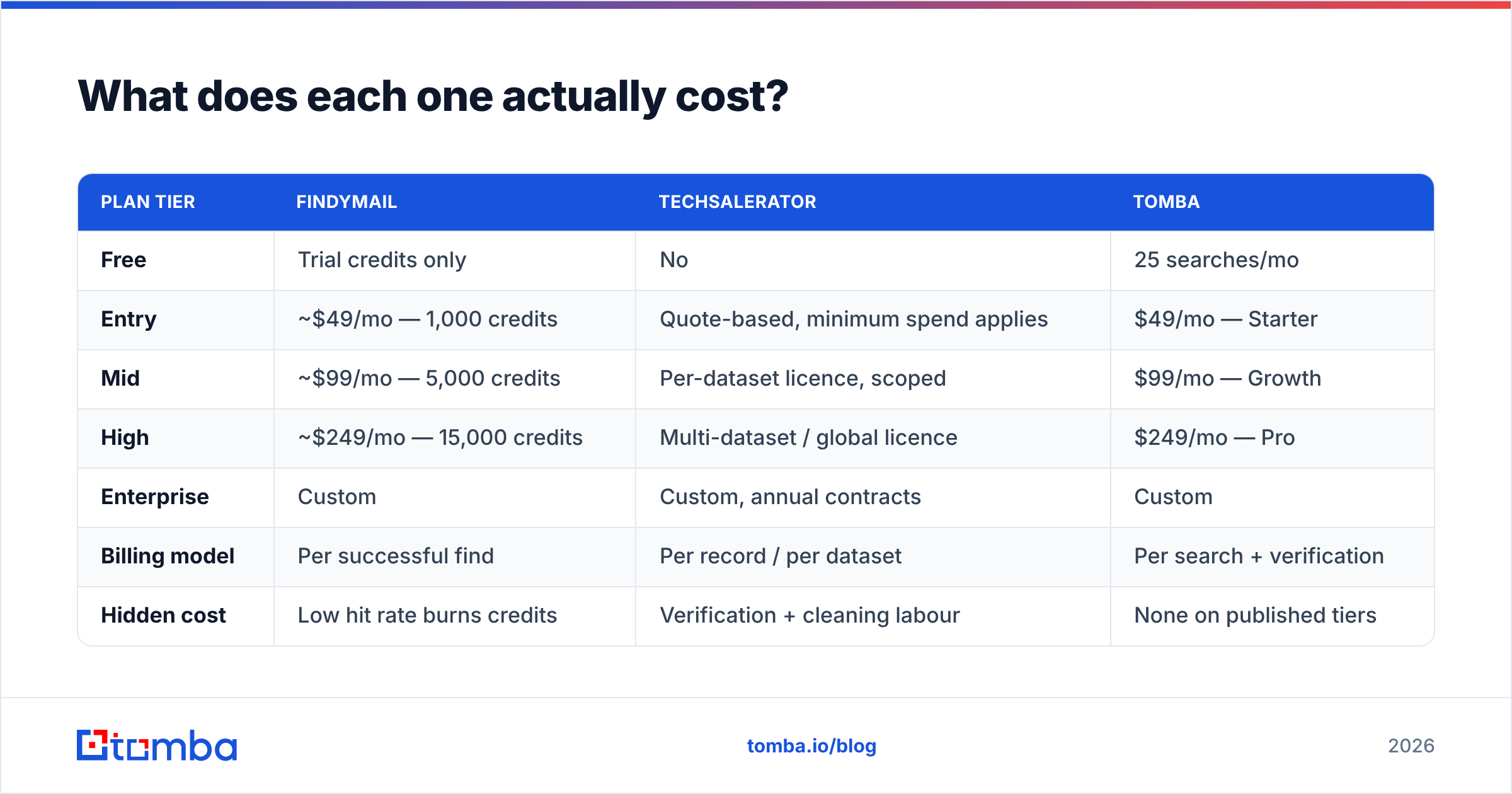
What does each one actually cost?#
| Plan tier | Findymail | Techsalerator | Tomba |
|---|---|---|---|
| Free | Trial credits only | No | 25 searches/mo |
| Entry | ~$49/mo — 1,000 credits | Quote-based, minimum spend applies | $49/mo — Starter |
| Mid | ~$99/mo — 5,000 credits | Per-dataset licence, scoped | $99/mo — Growth |
| High | ~$249/mo — 15,000 credits | Multi-dataset / global licence | $249/mo — Pro |
| Enterprise | Custom | Custom, annual contracts | Custom |
| Billing model | Per successful find | Per record / per dataset | Per search + verification |
| Hidden cost | Low hit rate burns credits | Verification + cleaning labour | None on published tiers |
Note the asymmetry. Findymail's cost is predictable but meters on usage — a 10,000-row list with a 55% hit rate costs you 5,500 credits. Techsalerator's cost is front-loaded and negotiated; you may pay once for a file and use it for a year, but you also pay for records you'll never contact, plus the internal engineering hours to clean, dedupe, and verify them.
Ask any bulk-data vendor these five questions before signing:
- What's the refresh cadence — and is it included or billed separately?
- What's the match rate against my existing CRM? Request a sample and test it.
- What's the licence scope — internal use only, or can it power a customer-facing product?
- What's the GDPR/CCPA basis for the EU and California records in the file?
- What happens on accuracy shortfall — is there a credit, or is it caveat emptor?

Is there a middle option between the two?#
Yes, and for most teams under 200 employees it's the right one.
The gap between these two products is real: Findymail is too narrow if you need company-level data and coverage beyond email, while Techsalerator is too heavy if you're not staffing a data team. What most revenue teams actually want is a single API that does real-time lookup, verification, and reasonable bulk throughput — without a licensing negotiation.
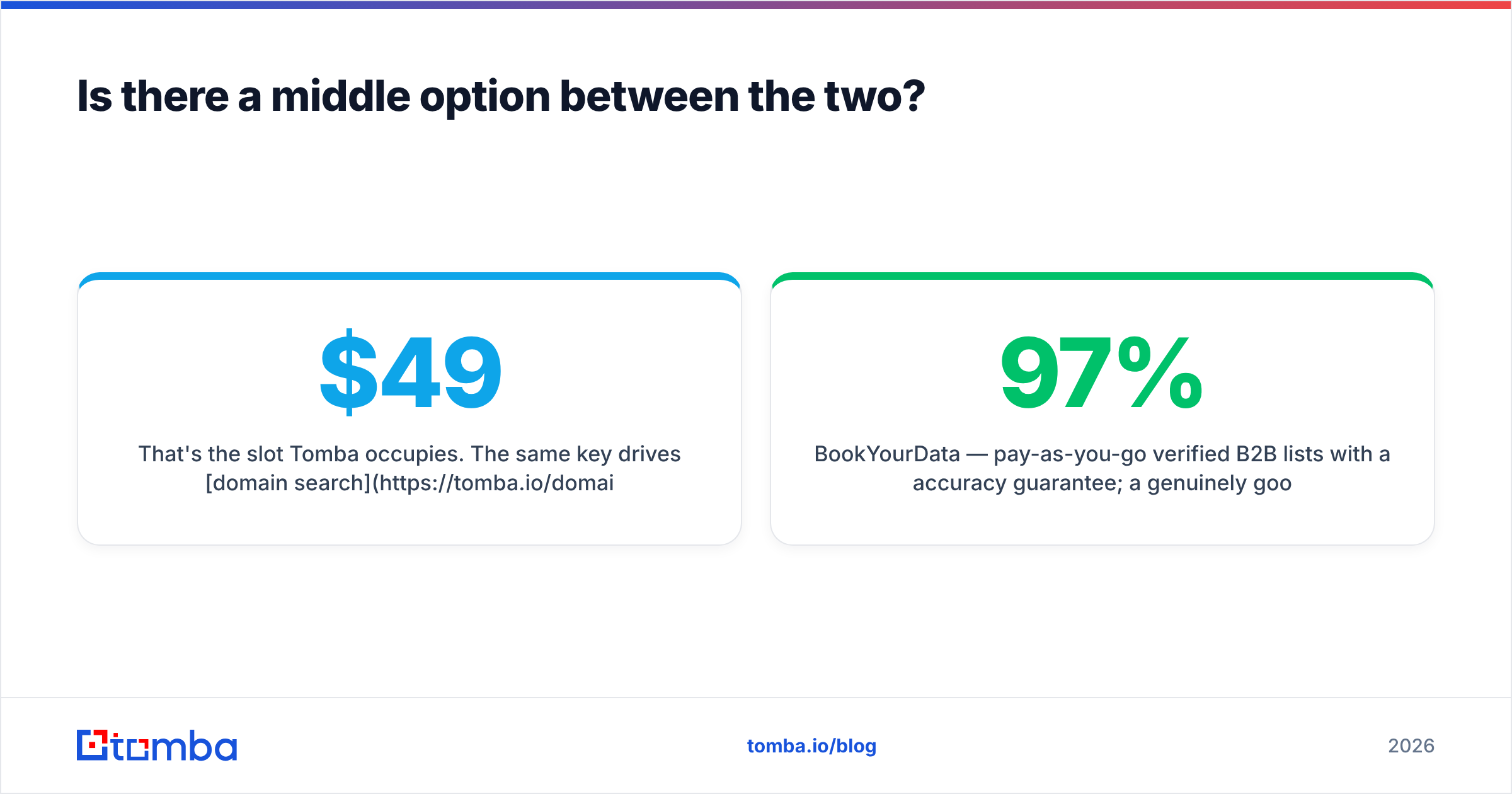
That's the slot Tomba occupies. The same key drives domain search for finding every published address at a company, per-contact finding, verification, catch-all verification for domains that accept everything, phone lookup, and data enrichment. Pricing is published: free tier at 25 searches/mo, Starter $49/mo, Growth $99/mo, Pro $249/mo, Enterprise custom. No quote call, no minimum spend.
Other names worth having on your shortlist depending on the motion:
- Apollo — database plus sequencer, strong if you want prospecting and sending in one seat.
- BookYourData — pay-as-you-go verified B2B lists with a 97% accuracy guarantee; a genuinely good fit when you want a clean list without a licensing contract, and priced far below enterprise data vendors.
- Clearbit/HubSpot Breeze — firmographic enrichment inside the HubSpot stack.
- ZoomInfo — the enterprise default, priced accordingly.
Cross-check any of these on G2 before you commit; category pages there surface the complaints vendors don't publish, especially around contract renewal terms.
How do you choose between Findymail and Techsalerator?#
Decide by the job, not the feature list.
Choose Findymail if:
- Your team builds prospect lists weekly from LinkedIn or Sales Navigator.
- Bounce rate is the metric your deliverability depends on.
- You want to start today without a procurement cycle.
- Your volume is under ~20,000 finds per month.
- You already live inside Clay, Lemlist, Instantly, or Smartlead.
Choose Techsalerator if:
- You're populating a warehouse, a lakehouse, or an internal ICP model.
- You need firmographics, geospatial, or non-B2B datasets alongside contacts.
- You need international coverage in markets most email finders skip.
- You have engineering capacity to clean, verify, and refresh.
- Your budget is annual and five figures, not monthly and three.
Choose neither — go with a unified API — if:
- You need both motions but can't justify two vendors.
- You want per-contact accuracy and bulk throughput on one key.
- You want published pricing and no annual lock-in.
- Your team is 5-50 people and there's no dedicated data engineer.
One more consideration nobody puts in the comparison grid: compliance posture. Real-time lookup tools resolve public professional data at the moment you ask, which is easier to defend under GDPR legitimate-interest reasoning than holding a licensed file of millions of EU records you may never contact. If you operate in Europe, get your legal team's read before you buy bulk. Gartner and similar analyst coverage of the B2B data market is worth reading on this specific risk.
What's the verdict for 2026?#
Findymail wins on workflow. Techsalerator wins on scale and breadth. Neither wins outright, because they're solving different problems.
If someone hands you a mandate to "improve outbound reply rates," Findymail is the faster path — it slots into a sequencer, it protects your domain, and you can prove ROI in a fortnight. If the mandate is "build our account universe" or "power this feature with licensed data," Techsalerator is a legitimate vendor in a category where legitimate vendors are surprisingly rare.
The failure mode to avoid is buying the wrong category. Teams that license a bulk file and blast it straight into a cold sequence get burned on deliverability within two weeks. Teams that try to build an ICP model out of one-by-one API lookups burn through credits and still don't have market coverage. Match the tool to the job.
And if the honest answer is "we need a bit of both, on an SMB budget" — that's the case for consolidating on a single API rather than running two contracts.
Ready to test real-time accuracy against your own list? Start with the Tomba Email Finder — 25 free searches per month, no card required, with verification built into every result so you see the hit rate on your actual ICP before you commit a dollar. Upload 100 rows from your last campaign, compare what comes back, and let the data pick your vendor. Full Tomba pricing is published — Starter $49/mo, Growth $99/mo, Pro $249/mo — so there's nothing to negotiate before you find out.
Related guides#
Ready to find emails that actually work?
Join 150,000+ professionals who stopped guessing and started sending. Free credits on signup — no credit card required.
Get the Tomba newsletter
Practical outbound tactics and product updates — once every two weeks.
About the author