Findymail vs Xverum: Which B2B Data Tool Wins in 2026?
Findymail finds verified emails one prospect at a time. Xverum sells bulk B2B datasets by the million. Here's which one actually fits your GTM motion — and what each really costs.
TL;DR
- Findymail is a per-contact email finder built for sales reps: search a name or domain, get a verified email, push it into your sequencer. Pricing starts around $49/mo for 1,000 credits.
- Xverum is a bulk B2B dataset provider: 700M+ profiles and 100M+ company records delivered as files or via API, priced per dataset subscription — typically four figures per year, not per month.
- They are not really competitors. One is a rep-facing tool, the other is a data-engineering input. Choosing wrong costs you either budget or coverage.
- If you need verified, deliverable emails at reasonable volume with an API, Tomba sits between them: $49/mo Starter, $99/mo Growth, $249/mo Pro, with a free tier at 25 searches.
- Decision rule: fewer than ~20K contacts a year and a human doing the prospecting → Findymail or Tomba. Feeding a warehouse, an ABM model, or a data product → Xverum.
What is Findymail and who actually uses it?#
Findymail is an email-finding tool aimed at outbound sales teams. You give it a name plus a company domain (or a LinkedIn URL, or a list), and it returns a business email address that it claims to have verified before charging you a credit.
Its selling points are narrow and deliberate:
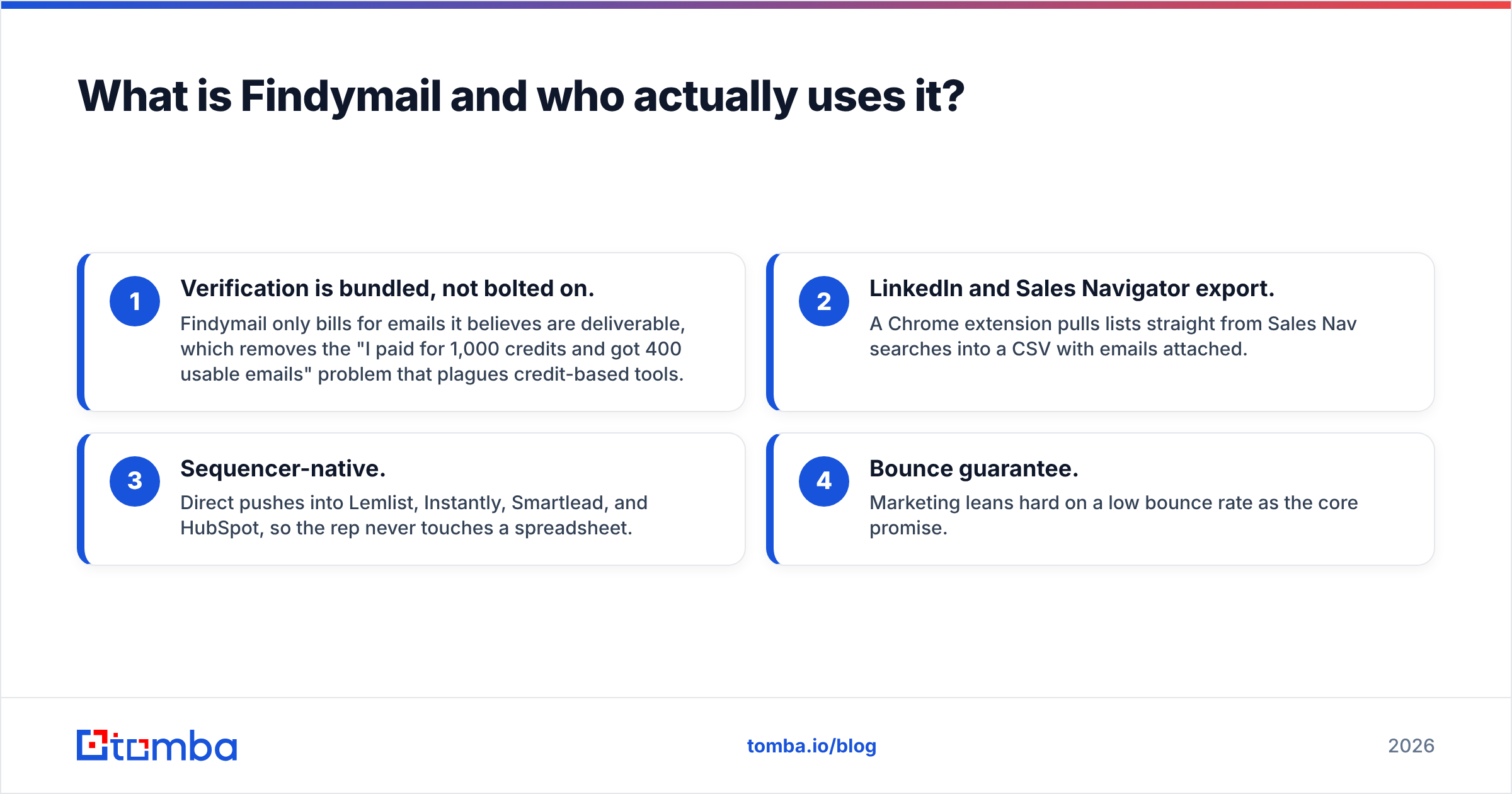
- Verification is bundled, not bolted on. Findymail only bills for emails it believes are deliverable, which removes the "I paid for 1,000 credits and got 400 usable emails" problem that plagues credit-based tools.
- LinkedIn and Sales Navigator export. A Chrome extension pulls lists straight from Sales Nav searches into a CSV with emails attached.
- Sequencer-native. Direct pushes into Lemlist, Instantly, Smartlead, and HubSpot, so the rep never touches a spreadsheet.
- Bounce guarantee. Marketing leans hard on a low bounce rate as the core promise.
The typical Findymail user is an SDR, a founder doing their own outbound, or a small agency running cold email for clients. Volume is measured in thousands of contacts per month, not millions. If you want a side-by-side with the broader category, we keep a running Findymail alternative breakdown.

What is Xverum and why is it priced so differently?#
Xverum is a web data provider, not a prospecting app. It sells structured B2B datasets — company firmographics, employee profiles, job postings, product and location data — scraped at scale and delivered as recurring feeds.
You do not sit in a Xverum dashboard and look up "the VP of Marketing at Acme." You subscribe to a dataset, receive it as JSON/CSV to S3, GCS, or Azure, or hit a bulk API, and load it into your own systems. Their public positioning is around 700M+ person profiles and 100M+ company records with regular refresh cycles.
That means Xverum's buyer is a data engineer, a RevOps lead building an in-house ICP model, or a company that resells or embeds data in its own product. Pricing is subscription-based per dataset and quoted on request — the practical entry point is thousands of dollars annually, not a $49 credit card charge.
Here's the mental model: Findymail is a vending machine, Xverum is a wholesale pallet delivery. Both give you contact data. One serves a rep who needs 40 emails before lunch. The other serves a pipeline that needs 4 million rows before the next model retrain.
Findymail vs Xverum: how do they compare head to head?#
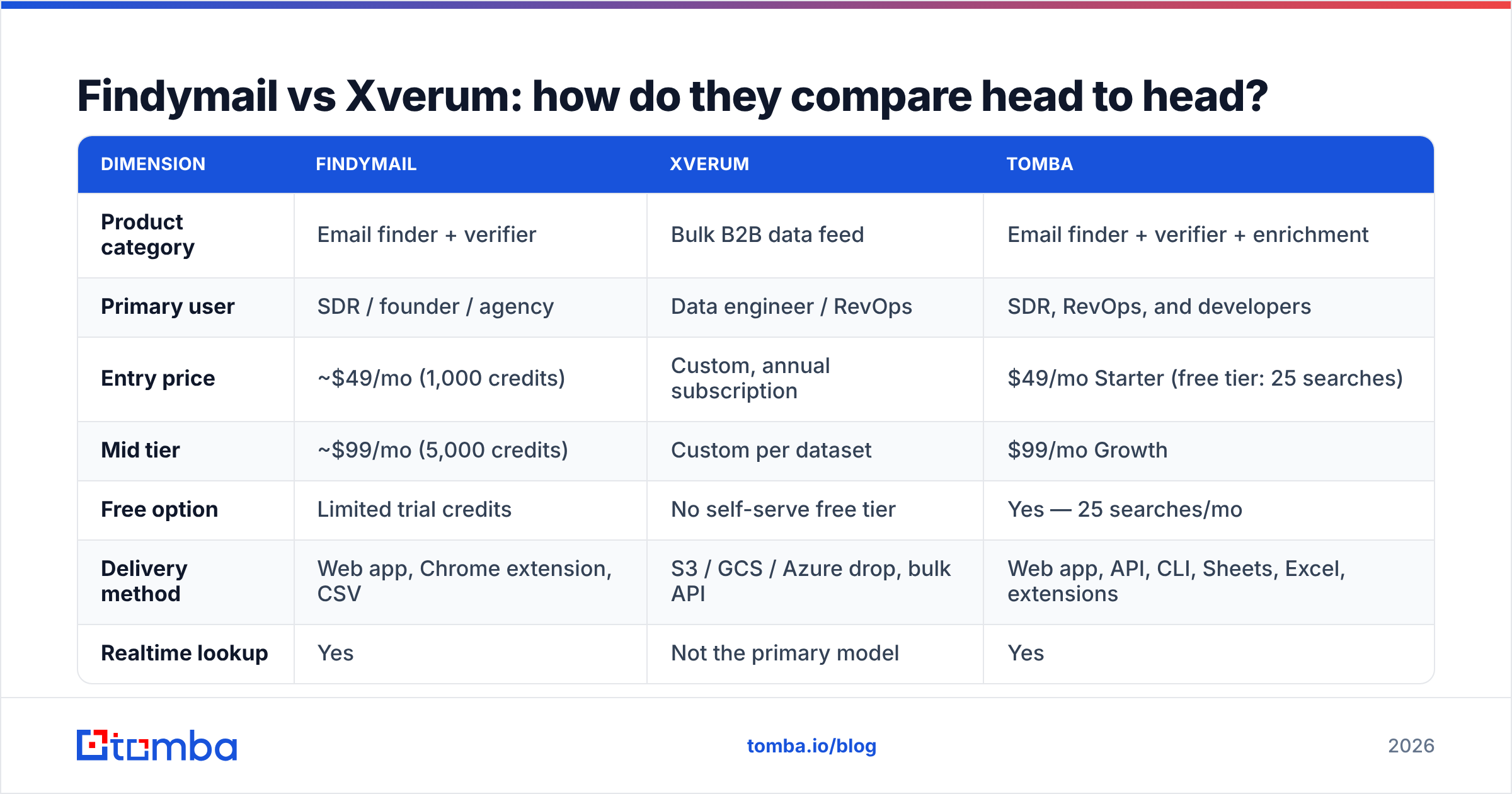
| Dimension | Findymail | Xverum | Tomba |
|---|---|---|---|
| Product category | Email finder + verifier | Bulk B2B data feed | Email finder + verifier + enrichment |
| Primary user | SDR / founder / agency | Data engineer / RevOps | SDR, RevOps, and developers |
| Entry price | ~$49/mo (1,000 credits) | Custom, annual subscription | $49/mo Starter (free tier: 25 searches) |
| Mid tier | ~$99/mo (5,000 credits) | Custom per dataset | $99/mo Growth |
| Free option | Limited trial credits | No self-serve free tier | Yes — 25 searches/mo |
| Delivery method | Web app, Chrome extension, CSV | S3 / GCS / Azure drop, bulk API | Web app, API, CLI, Sheets, Excel, extensions |
| Realtime lookup | Yes | Not the primary model | Yes |
| Coverage scale | Per-query, on-demand | 700M+ profiles, 100M+ companies | On-demand + B2B database |
| Verification included | Yes, before billing | Not a verification service | Yes — email verifier + catch-all handling |
| Best for | Cold email at 1K–20K/mo | Warehouse, ABM models, data products | Teams that need both UI and API |
| Setup effort | Minutes | Days to weeks (ingestion pipeline) | Minutes for UI, hours for API |
The table makes the real conclusion obvious: these tools rarely appear on the same shortlist for the same buyer. If you're comparing them, you're probably at a fork in your GTM roadmap — do we buy a rep tool, or do we build a data layer?
Which one is more accurate?#
Accuracy means two different things here, and conflating them is the most common mistake.
For Findymail, accuracy = deliverability. Does the email bounce? Findymail's model verifies before it charges, so its practical accuracy claim is a low bounce rate on the emails it returns. The trade-off is coverage: tools that refuse to return unverifiable addresses return fewer addresses overall. On hard domains — catch-all servers, small companies with no public footprint — you'll get "not found" more often than you'd like.
For Xverum, accuracy = freshness and completeness. Does the profile reflect the person's current title and employer? Was the company record refreshed this quarter? Bulk providers are judged on refresh cadence and field-level fill rate, not on SMTP validation. Xverum publishes regular update cycles, but any dataset of that size will carry stale rows — that's physics, not a vendor failure.

The practical implication: if you buy from Xverum, budget for a verification layer on top. Loading 2M unverified addresses into a sending tool is how you burn a domain. Run bulk data through a catch-all verifier or a standard verification pass before it ever reaches a sequencer. If you buy Findymail, verification is already priced in — you're paying a premium per contact for that convenience.
Independent user reviews on G2 are the fastest sanity check on either vendor's claims, since both publish their own accuracy numbers with no shared methodology.
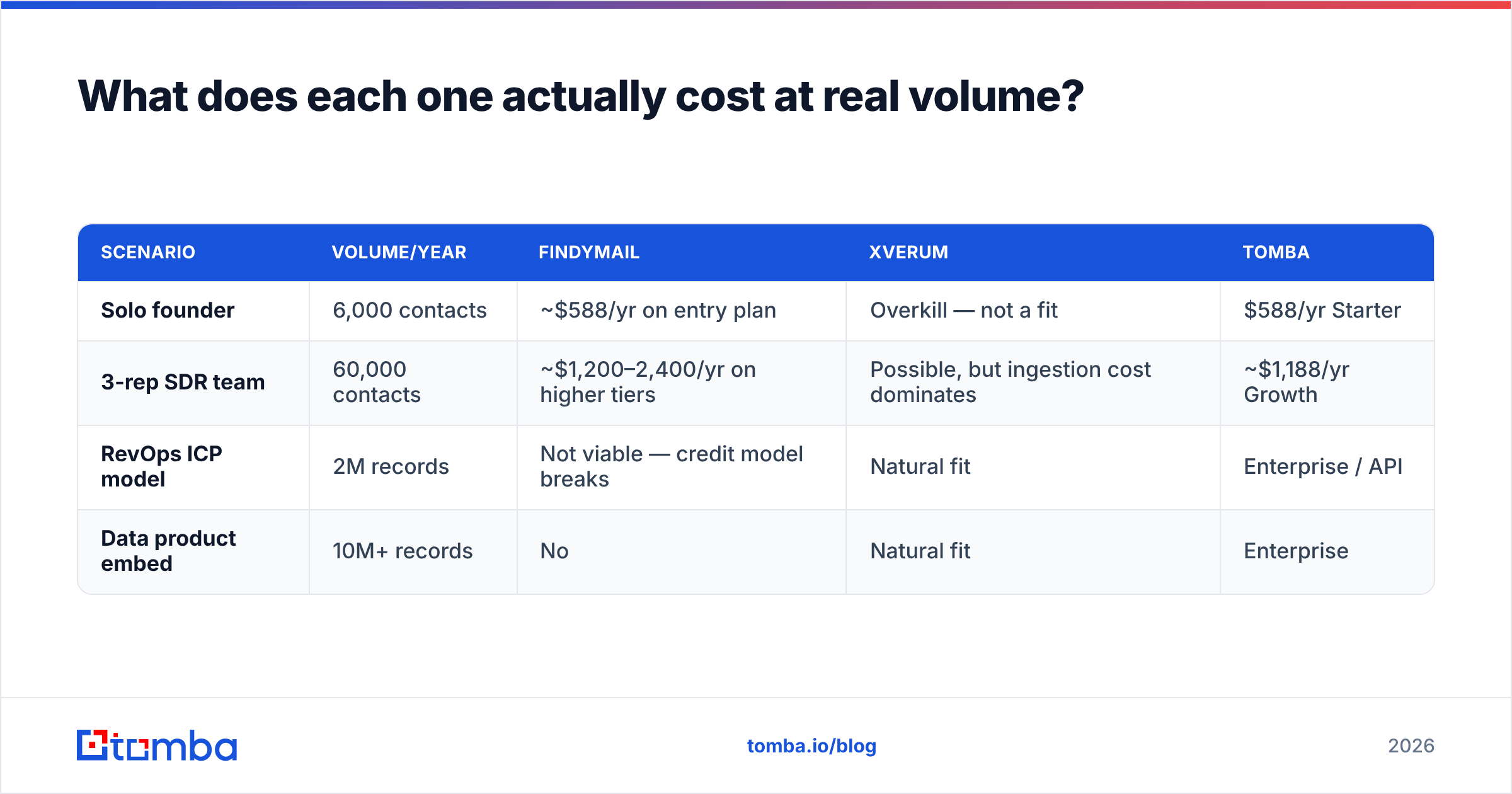
What does each one actually cost at real volume?#
Sticker price is misleading. Model your true cost per usable contact instead.
| Scenario | Volume/year | Findymail | Xverum | Tomba |
|---|---|---|---|---|
| Solo founder | 6,000 contacts | ~$588/yr on entry plan | Overkill — not a fit | $588/yr Starter |
| 3-rep SDR team | 60,000 contacts | ~$1,200–2,400/yr on higher tiers | Possible, but ingestion cost dominates | ~$1,188/yr Growth |
| RevOps ICP model | 2M records | Not viable — credit model breaks | Natural fit | Enterprise / API |
| Data product embed | 10M+ records | No | Natural fit | Enterprise |
Three cost lines people forget:
- Ingestion engineering. A Xverum feed needs a pipeline, a schema, dedup logic, and someone who owns it. That's often more expensive in year one than the subscription itself.
- Wasted credits. With any per-credit tool, your effective price is
plan cost ÷ usable emails, notplan cost ÷ credits. A tool that returns fewer but cleaner results can be cheaper per usable contact even at a higher headline price. - Deliverability damage. One bad send to unverified bulk data can cost you weeks of email deliverability recovery. That's the most expensive line item and it never shows up on an invoice.
When should you pick Xverum over Findymail?#
Pick Xverum when the data is an input to a system, not to a human. Concrete triggers:
- You're building an ICP or propensity model and need firmographic + technographic breadth across an entire market, not just the accounts a rep already picked.
- You're powering a product feature — a directory, an enrichment API of your own, a market-intelligence dashboard.
- You need job-posting or hiring-signal data for intent scoring, which per-contact finders simply don't sell.
- Your volume is in the millions and per-credit pricing would cost more than a full-time engineer.
- You need international coverage at depth — bulk providers usually beat per-lookup tools outside North America and Western Europe.
Pick Findymail when a human is going to read the row: a rep is going to email this person this week, and you'd rather pay a premium than manage infrastructure. Peer tools in this bracket include BookYourData, which sells pay-as-you-go verified B2B contacts with no subscription lock-in — a solid middle option if you want bulk-style purchasing without an annual data contract.
Is there a middle path between the two?#
Yes, and it's where most teams actually land. The gap between "1,000 credits in a browser tab" and "700M rows in a bucket" is enormous, and the practical answer is a tool that gives you UI for reps and API for engineering on the same billing account.
That's the slot Tomba occupies:
- Email finder for on-demand lookups by name or company, and domain search when you want every public address at a company at once.
- Bulk email finder for list-level work — upload 10,000 rows, get verified results back — without an ingestion project.
- Tomba API, plus a CLI, MCP server, Sheets add-on, and Excel add-in, so RevOps can automate the same data the reps see.
- Verification built in, including catch-all handling, so you're not stitching a second vendor onto the workflow.
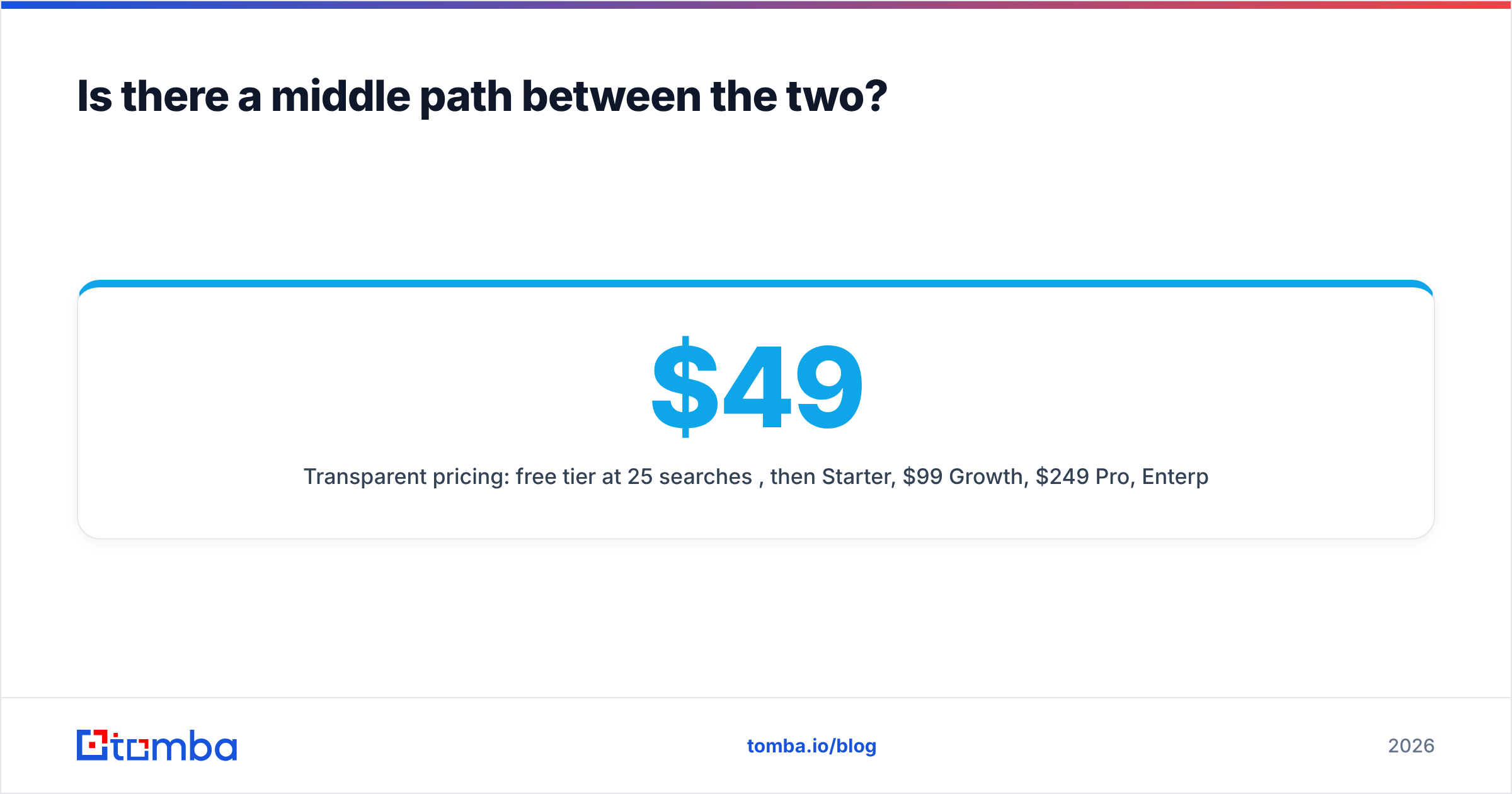
- Transparent pricing: free tier at 25 searches/mo, then $49 Starter, $99 Growth, $249 Pro, Enterprise custom. Full Tomba pricing is public — no "contact sales to learn the entry price."
Practical hybrid architecture that works well in 2026:
- Buy breadth from a bulk provider only if you have a modeling or product use case that justifies it.
- Run every address destined for a sending tool through verification first.
- Use a real-time finder for the accounts reps are working this quarter — those are the records where freshness matters most and where a stale bulk row does the most damage.
- Keep enrichment in one place so attribution and dedup stay sane. Data enrichment that lives in the same system as your finder avoids the classic three-vendor merge nightmare.
What do reviewers and buyers get wrong about this comparison?#
Mistake 1: assuming bigger database = better results. A 700M-profile dataset that's 30% stale on titles gives you worse outbound results than 500 freshly verified emails at your ICP accounts. Volume is a coverage metric, not a quality metric.
Mistake 2: ignoring compliance. Bulk scraped data carries GDPR and CCPA obligations you inherit the moment you load it. Read the vendor's compliance documentation and check how they handle deletion requests — Gartner and similar analysts flag data provenance as the top procurement risk in B2B data buying. Ask for the lawful-basis story in writing.
Mistake 3: treating verification as optional. Every bounce compounds. Once your sender reputation drops, even your good emails start landing in spam, and the recovery period costs you a quarter of pipeline. Verify before you send, always.
Mistake 4: buying for the pilot, not the steady state. Findymail at 1,000 credits looks cheap in month one. At 20,000 contacts a month, the arithmetic changes completely. Model 12 months out before signing anything annual.
Mistake 5: skipping the free test. Both categories let you sample. Take a list of 50 known-good contacts you can independently confirm, run it through every candidate, and count the hits. Thirty minutes of testing beats thirty pages of vendor marketing. You can run a quick sanity check with a free email checker before you commit a credit card.
Findymail vs Xverum: the verdict#
Findymail wins if a human is the consumer of the data, your volume is under roughly 20,000 contacts a year, you want verification bundled, and you want to be sending this afternoon.
Xverum wins if a system is the consumer of the data, your volume is in the millions, you have engineering capacity to ingest a feed, and your use case needs breadth (firmographics, job postings, international coverage) that per-lookup tools don't sell.
Neither wins if what you actually need is a single account that does real-time lookup for reps and programmatic access for RevOps, with verification included and pricing you can read on a public page. That's the most common profile among growing outbound teams, and it's the gap most of these comparisons never name.
Start with the Tomba Email Finder — the free tier gives you 25 searches a month with no card required, which is enough to run the 50-contact accuracy test described above against your own known-good list. If the hit rate holds up on your ICP, Starter at $49/mo covers most solo and small-team outbound, and Growth at $99/mo scales it. Test with your data, not with a vendor's benchmark.
Related guides#
Ready to find emails that actually work?
Join 150,000+ professionals who stopped guessing and started sending. Free credits on signup — no credit card required.
Get the Tomba newsletter
Practical outbound tactics and product updates — once every two weeks.
About the author