Fintech Sales in 2026: How to Sell to Regulated Buyers
Fintech deals stall in compliance review, not in the demo. Here's how the 2026 fintech sales cycle actually works — buying committees, security reviews, pricing models, and the outbound playbook that survives all three.
TL;DR
- Fintech sales cycles run 30-90% longer than general B2B SaaS because two extra gatekeepers — security and compliance — sit between the champion and the signature.
- The economic buyer is rarely the person who books the demo. In most fintech deals you are selling to a committee of 5-8: a product or ops champion, a CFO or CRO, a CISO, a compliance officer, and often legal.
- Your outbound has to lead with regulatory relevance (a new rule, an audit deadline, a licence renewal), not features. Generic "boost revenue" copy dies in this segment.
- Contact data quality matters more here than anywhere else: fintech orgs have high headcount churn, heavy title inflation, and strict inbound filtering. Bad emails burn your domain fast.
- Build your pipeline around triggers — funding rounds, charter approvals, new market launches, key hires — and enrich the resulting account list with verified contacts before you send a single email.
What is fintech sales, and how is it different?#
Fintech sales is B2B selling where the buyer is a financial institution, a payments company, a lender, an insurer, or a fintech startup — and where the purchase is constrained by regulation, security review, and money-movement risk.
The difference is not the product. It's the number of people who can say no.
In a standard SaaS deal, a VP of Marketing with budget authority can buy a $30k tool in two calls. In fintech, that same $30k tool touches customer PII, possibly transaction data, and almost certainly a vendor risk questionnaire. Now you have a CISO reviewing your SOC 2 report, a compliance lead checking whether your subprocessors sit in an approved jurisdiction, and a procurement team that will not sign your standard MSA.
Three structural realities define the segment:
- Regulatory gravity. Every buying decision gets weighed against what an examiner or auditor will think of it. If your product cannot be explained to a regulator in one paragraph, it will not clear review.
- Vendor risk as a gate, not a formality. Financial firms run formal third-party risk management programs. Expect a 100-300 question security questionnaire, penetration test evidence, and often an on-site or virtual assessment.
- Committee economics. The person who feels the pain (an ops manager drowning in manual reconciliation) is almost never the person who signs. Your job is to arm the champion to sell internally.

Who actually buys in a fintech deal?#
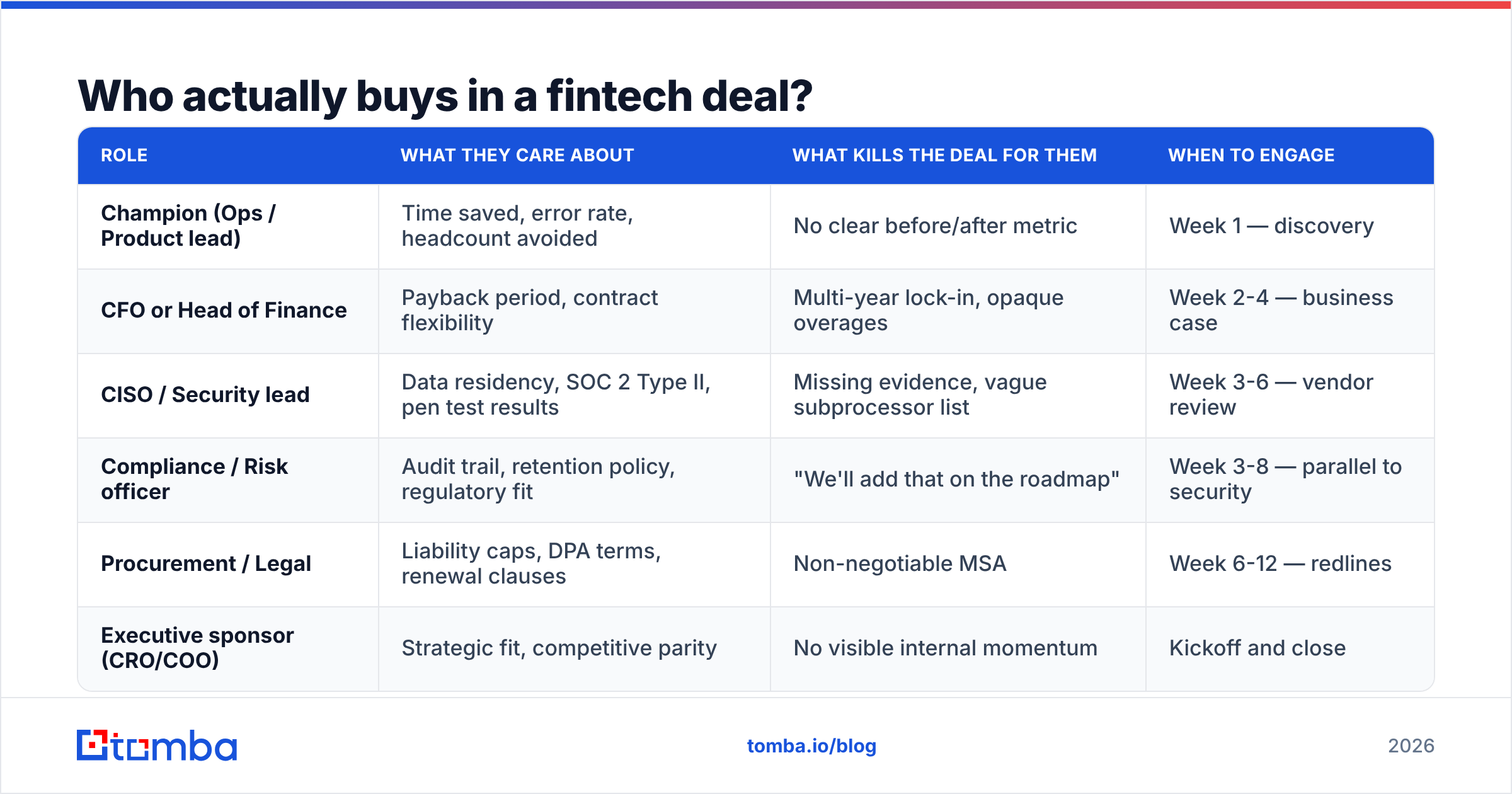
Map the committee before you write the first email. Here's what a typical mid-market fintech buying group looks like and what each member actually cares about.
| Role | What they care about | What kills the deal for them | When to engage |
|---|---|---|---|
| Champion (Ops / Product lead) | Time saved, error rate, headcount avoided | No clear before/after metric | Week 1 — discovery |
| CFO or Head of Finance | Payback period, contract flexibility | Multi-year lock-in, opaque overages | Week 2-4 — business case |
| CISO / Security lead | Data residency, SOC 2 Type II, pen test results | Missing evidence, vague subprocessor list | Week 3-6 — vendor review |
| Compliance / Risk officer | Audit trail, retention policy, regulatory fit | "We'll add that on the roadmap" | Week 3-8 — parallel to security |
| Procurement / Legal | Liability caps, DPA terms, renewal clauses | Non-negotiable MSA | Week 6-12 — redlines |
| Executive sponsor (CRO/COO) | Strategic fit, competitive parity | No visible internal momentum | Kickoff and close |
The single biggest efficiency gain in fintech sales is running security and compliance review in parallel with the business case, not after it. Most reps sequence them — demo, business case, then hand over the security packet — and add four to six weeks to every cycle for no reason.
Send your trust materials proactively at the end of the second call. If you have a public trust center, link it in the follow-up. If you don't, build one; the cost is a weekend and it removes a recurring three-week delay.
Why do fintech sales cycles take so long?#
Because there are three clocks running, and they rarely run at the same time.
Clock one: the business case. This is the normal SaaS clock — discovery, demo, ROI model, pricing negotiation. Four to eight weeks in mid-market.
Clock two: vendor risk. Security questionnaire, evidence collection, sometimes a live assessment. Two to twelve weeks depending on the institution. A tier-1 bank will take longer than a Series B neobank, and both take longer than they promise.
Clock three: budget calendar. Financial institutions run tight, committee-approved budgets. If you miss the quarterly planning window, you wait for the next one — regardless of how much the champion loves you.
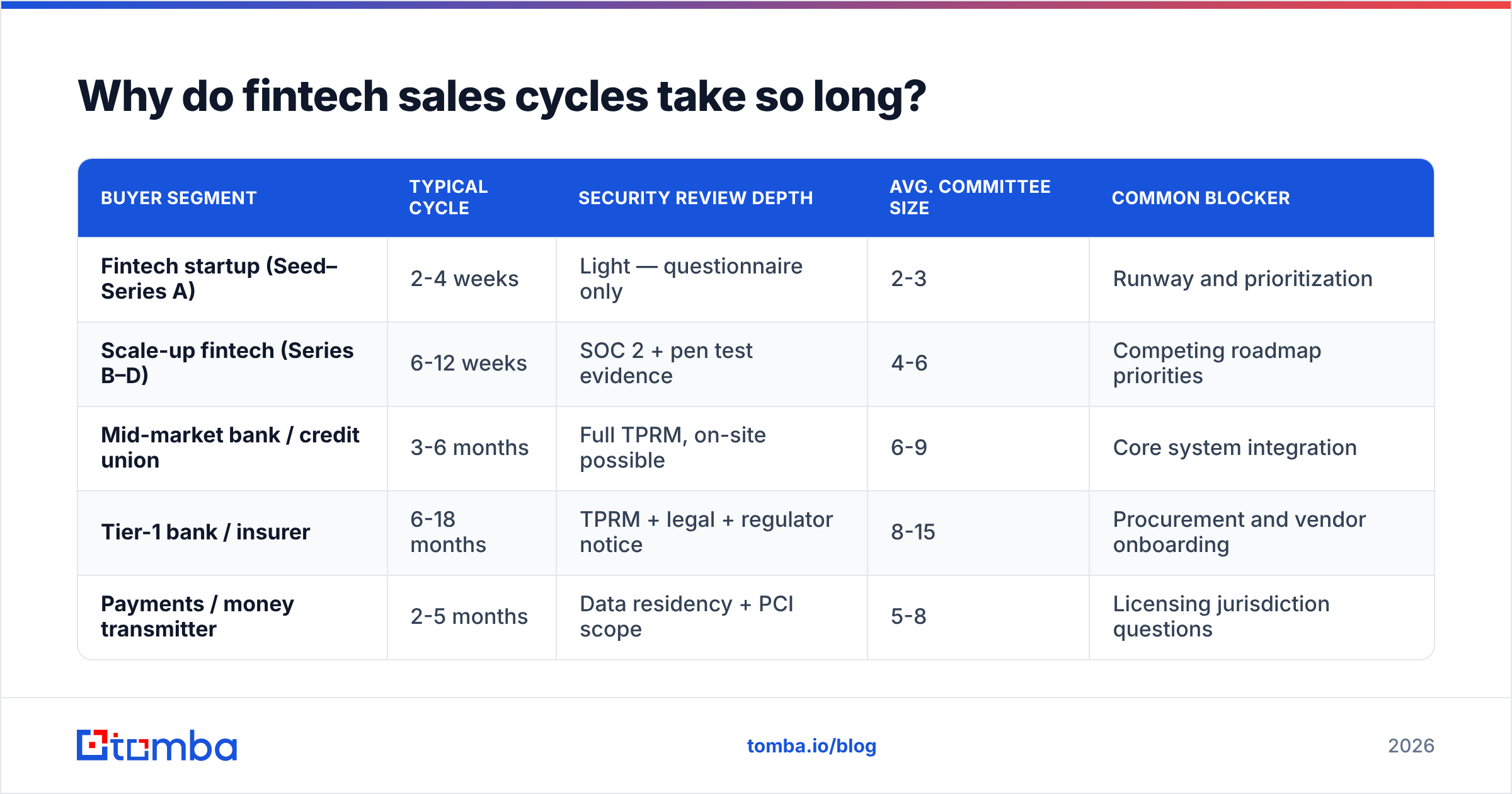
Here's how the timelines actually compare across buyer types:
| Buyer segment | Typical cycle | Security review depth | Avg. committee size | Common blocker |
|---|---|---|---|---|
| Fintech startup (Seed–Series A) | 2-4 weeks | Light — questionnaire only | 2-3 | Runway and prioritization |
| Scale-up fintech (Series B–D) | 6-12 weeks | SOC 2 + pen test evidence | 4-6 | Competing roadmap priorities |
| Mid-market bank / credit union | 3-6 months | Full TPRM, on-site possible | 6-9 | Core system integration |
| Tier-1 bank / insurer | 6-18 months | TPRM + legal + regulator notice | 8-15 | Procurement and vendor onboarding |
| Payments / money transmitter | 2-5 months | Data residency + PCI scope | 5-8 | Licensing jurisdiction questions |
The practical lesson: qualify on cycle length, not just fit. A tier-1 logo is worth chasing only if your runway and quota period can absorb an 18-month cycle. Most early-stage fintech vendors should build pipeline in the top two rows and treat enterprise deals as a slower, separately-resourced motion. Gartner's research on B2B buying consistently shows larger buying groups correlate with longer, lower-conviction decisions — regulated industries sit at the extreme end of that curve.
What does a fintech outbound sequence look like?#
Feature-led outbound does not work here. Regulatory-relevance-led outbound does.
The structure that converts:
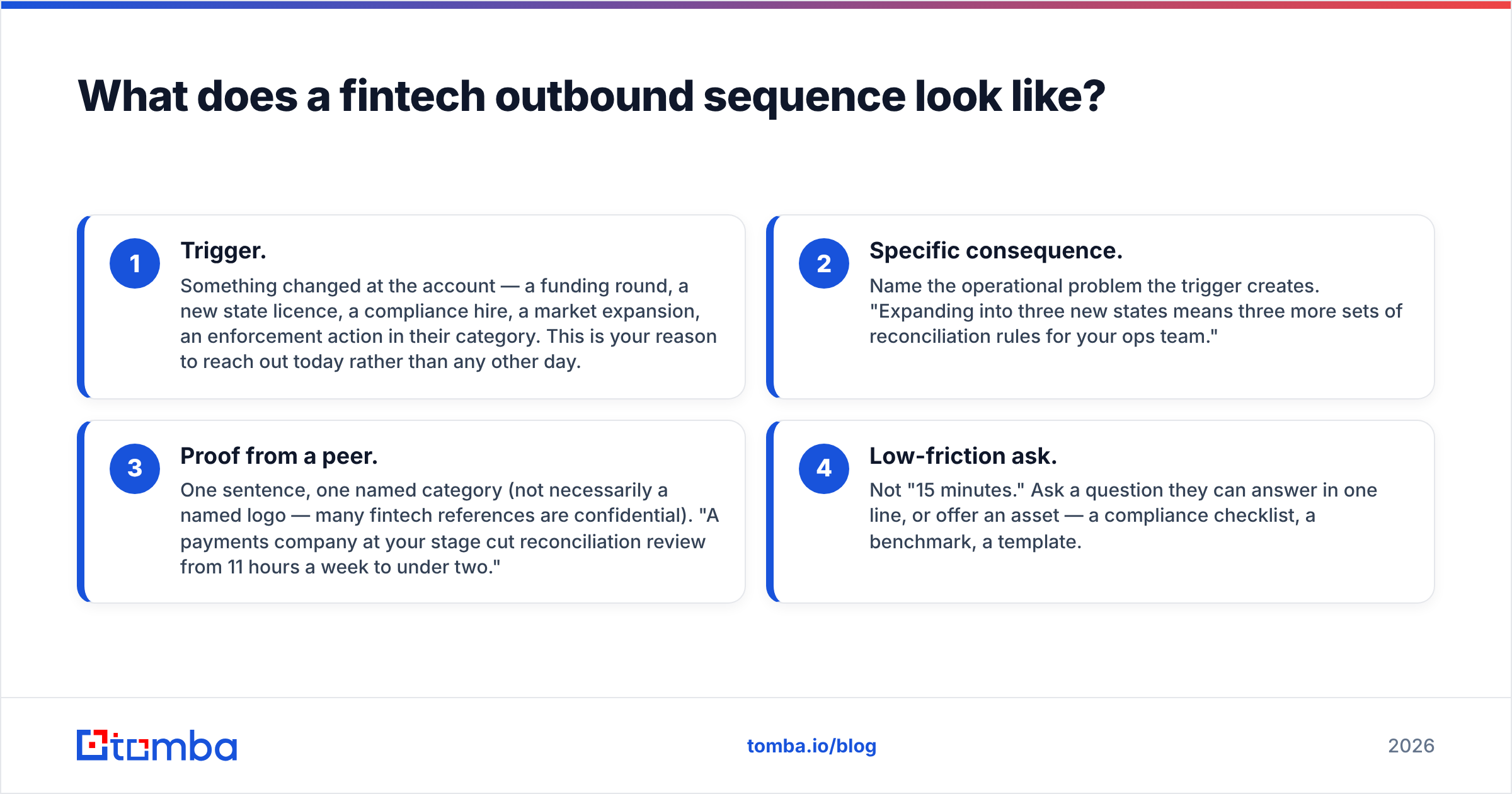
- Trigger. Something changed at the account — a funding round, a new state licence, a compliance hire, a market expansion, an enforcement action in their category. This is your reason to reach out today rather than any other day.
- Specific consequence. Name the operational problem the trigger creates. "Expanding into three new states means three more sets of reconciliation rules for your ops team."
- Proof from a peer. One sentence, one named category (not necessarily a named logo — many fintech references are confidential). "A payments company at your stage cut reconciliation review from 11 hours a week to under two."
- Low-friction ask. Not "15 minutes." Ask a question they can answer in one line, or offer an asset — a compliance checklist, a benchmark, a template.
A working example:
Subject: your Texas MTL approval
Saw the Texas MTL cleared last month — congrats. Most teams that add a state in Q3 end up rebuilding their reconciliation logic twice: once for the new rules, once when the auditor pushes back.
We built the mapping layer that handles this for a similar-stage payments team. Took their monthly close from 6 days to 2.
Worth a look, or are you handling this in-house?
That's 78 words. It names a real event, a real consequence, and asks a binary question. Compare it to whatever your current sequence opens with.
For follow-up cadence: four to six touches over three weeks, mixing email and LinkedIn. Fintech buyers are heavy LinkedIn outreach responders because compliance teams often restrict what they'll click in email. A connection request with a one-line note frequently outperforms email three in the sequence.
How do you build a fintech prospect list that doesn't burn your domain?#
This is where most fintech outbound programs quietly fail. Financial institutions run aggressive inbound filtering — Proofpoint, Mimecast, Microsoft Defender with tightened policies. A 6% bounce rate that a generic SaaS list might survive will get your domain throttled inside two weeks when you're mailing banks.
Build the list in this order:
Step 1 — Define the account trigger, not the persona. Start from events: new funding (Crunchbase, PitchBook), new licences (NMLS registry, state regulators), new compliance hires (LinkedIn job changes), new product launches (press releases, changelog pages). Accounts with a fresh trigger convert at multiples of cold accounts.
Step 2 — Map the committee inside each account. For each target account you need at minimum the champion persona and the economic buyer. A domain search across the company domain returns the addressable contacts and the company's email pattern in one pass, which is faster than hunting person by person.
Step 3 — Verify before you send. Every address. Fintech companies churn staff and rotate aliases aggressively, and many use catch-all domains that make naive verification useless. Run the list through an email verifier, and use a catch-all verifier for the domains that return "accept-all" — otherwise you're guessing on a meaningful slice of your list.
Step 4 — Enrich for personalization inputs. Title, seniority, tenure, location, tech stack. You need these to write the "specific consequence" line in step 2 of your sequence. Data enrichment turns a bare email list into something you can actually segment.
Step 5 — Warm and pace. New sending domain? Three weeks of warmup minimum before volume. Cap daily sends per mailbox in the 30-50 range for regulated-industry targets. Watch your sender reputation weekly, not monthly.
A note on data providers: no single source has complete coverage of financial services contacts. Waterfall enrichment — checking multiple providers in sequence until you get a verified hit — is standard practice for teams selling into this segment. Providers like BookYourData maintain strong verified B2B coverage and are a reasonable component of a multi-source stack, particularly for direct-dial and industry-segmented lists. The point is not which single vendor wins; it's that a single vendor is rarely enough at fintech-grade accuracy requirements.
What should you actually measure in fintech sales?#
Standard SaaS metrics mislead in this segment because the denominator is different. Track these instead:
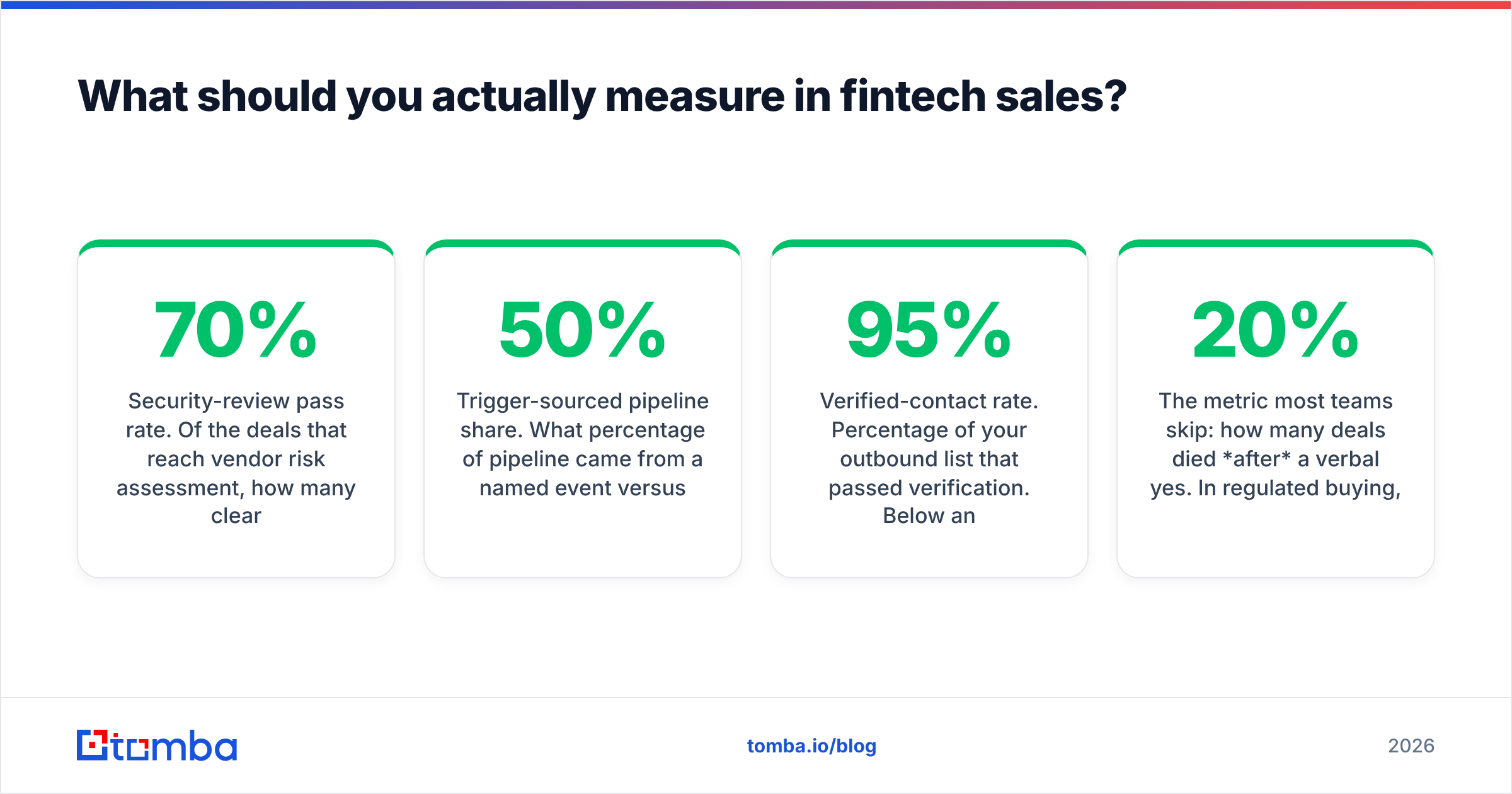
- Security-review pass rate. Of the deals that reach vendor risk assessment, how many clear it? If this is below 70%, your problem is product or documentation, not selling.
- Time-in-stage for compliance review. Isolate this from total cycle time. It is the most compressible part of your funnel and the least measured.
- Committee coverage. Percentage of open opportunities where you have engaged three or more distinct roles. Single-threaded fintech deals close at a fraction of multi-threaded ones.
- Trigger-sourced pipeline share. What percentage of pipeline came from a named event versus a static list pull? Push this above 50%.
- Verified-contact rate. Percentage of your outbound list that passed verification. Below 95% and you should not be sending.
- Reply-to-meeting conversion. In fintech, a high response rate with low meeting conversion usually means you're reaching the right accounts but the wrong seniority.
The metric most teams skip: how many deals died after a verbal yes. In regulated buying, verbal commitment from a champion means less than it does elsewhere. If more than 20% of your verbal-yes deals die in procurement or security, your qualification is running too shallow.
How should you price and package for fintech buyers?#
Three patterns work; one consistently fails.
Works — usage-based with a floor. Financial buyers understand transaction volume pricing intuitively because it maps to how they think about their own economics. A committed floor gives your CFO predictability and theirs a clear budget line.
Works — per-seat with role tiers. Simple to model, easy to expand, survives procurement scrutiny. Give compliance and audit users a cheaper read-only tier so the whole risk team gets access without a budget fight.
Works — platform fee plus modules. Lets the champion buy a small entry wedge and expand after proving value, which fits how fintech budget cycles actually release money.
Fails — opaque "contact us" enterprise pricing with no anchor. Fintech procurement teams benchmark everything. If they cannot find a public anchor price, they assume the number is arbitrary and negotiate from a position of suspicion. Publish something, even a starting-from figure.
On contract terms, expect to negotiate: liability caps (they will want them raised), data processing addenda, right-to-audit clauses, and business continuity commitments. Pre-approve your fallback positions on each before the first redline arrives — deals lose weeks bouncing between legal teams over terms your CEO would have approved in five minutes.
For a broader view of how buying committees in regulated industries evaluate vendors, HubSpot's sales research and peer-review data on G2 are useful sanity checks on where your positioning sits relative to alternatives your buyer is already reading about.
What's changing in fintech sales for 2026?#
Four shifts worth planning around:
AI vendor scrutiny is now its own review track. If your product touches an LLM, expect a separate model-risk questionnaire: training data provenance, whether customer data is used for training, model version pinning, and human-in-the-loop controls. Prepare this document before you need it.
Buying committees got bigger, not smaller. The pattern across enterprise software has been more stakeholders per decision, and financial services leads that trend. Multi-threading is no longer an advanced tactic; it's table stakes.
Trust centers became a qualification filter. Buyers increasingly check for a public security page before taking a first call. No trust center reads as "early stage and risky" whether or not that's true.
Data provenance questions reach vendors' vendors. Compliance teams now ask where your contact data comes from, especially under GDPR and state privacy laws. If you're doing outbound into EU-regulated entities, know your provider's data sources well enough to answer that in writing.
Where should you start this quarter?#
Pick one segment, build one trigger list, and run one clean sequence. Concretely:
- Choose the buyer segment whose cycle length fits your runway (from the table above).
- Define two or three triggers you can monitor weekly.
- Pull 200 accounts matching those triggers.
- Map three roles per account — champion, economic buyer, and the security or compliance contact.
- Verify every address, then send.
The list-building step is the one most teams under-invest in and it's the one that determines whether the other four matter. Sending an excellent sequence to unverified contacts at the wrong accounts produces exactly nothing except a damaged domain.
Start with the Tomba Email Finder to build and verify your fintech account list — domain search to map each company's contacts, verification to protect your sending reputation, and enrichment to give you the personalization inputs your sequences need. The free tier covers 25 searches a month if you want to test your ICP before committing, and paid plans start at $49/mo on Tomba pricing. Build the list properly once, and every downstream metric in this post gets easier.
Related guides#
// get started
Find, verify and enrich your first contacts today
Start on the free plan with 25 searches a month, then scale when your team is ready.
Free plan · No credit card required · GDPR & CCPA
// about the author