9 Best FINTRX Alternatives in 2026 for Wealth Prospecting
FINTRX owns the family-office niche, but the seat price and contact-data gaps push a lot of teams to look elsewhere. Here are nine FINTRX alternatives compared on coverage, contact accuracy, and what you actually pay.
TL;DR
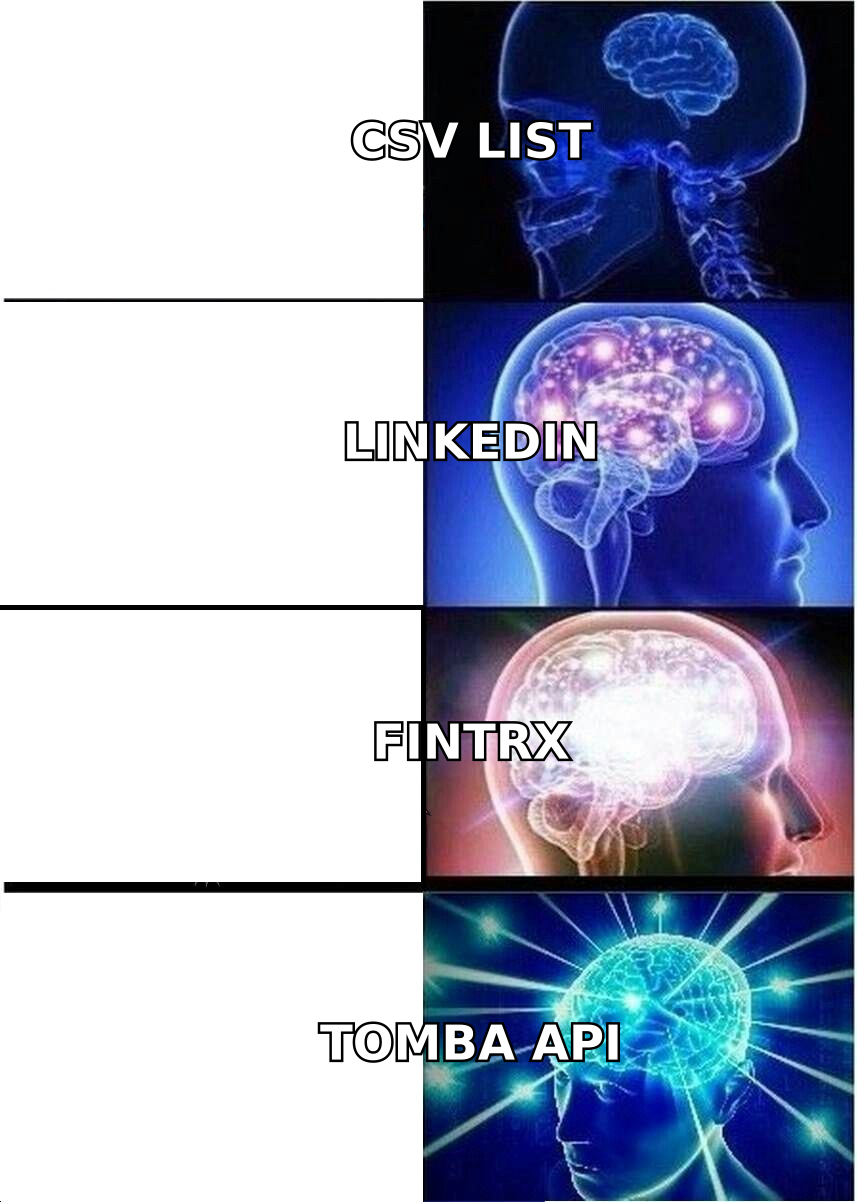
- FINTRX is a specialist database for family offices, RIAs, and private wealth allocators. Nothing on this list replaces it one-for-one — the alternatives split into allocator databases, general B2B data platforms, and contact-accuracy layers.
- The two complaints that push teams to look for FINTRX alternatives are the same every time: annual seat pricing that scales badly across a team, and contact records (email/phone) that go stale between refresh cycles.
- If you need allocator coverage, look at Dakota Marketplace, Preqin, PitchBook, or ISS Market Intelligence (Discovery Data). If you need reach, look at ZoomInfo, Cognism, or BookYourData.
- If your firmographic layer is fine and only the emails are failing, don't buy a second database — bolt a verification layer on top. That's a $49–$99/month problem, not a $20,000/year one.
- Best move for most mid-size teams in 2026: one allocator database for the account list, plus a finder/verifier for the contacts.
What is FINTRX and who actually uses it?#
FINTRX is a private wealth intelligence platform. It maps family offices (single and multi), registered investment advisors, and the people inside them — investment mandates, AUM bands, asset-class preferences, decision-maker roles, and the relationships between entities.
The buyers are narrow and specific: fund managers raising capital, private placement teams, alternative asset sponsors, wealth-tech vendors selling into RIAs, and IR teams that need to know which family office in Dallas has actually written a check into lower-middle-market private credit.
That specificity is the whole product. A generic B2B database will tell you a firm exists and give you a headcount. FINTRX tries to tell you what it invests in. That is genuinely hard data to assemble, and it's why the platform commands a premium.
It's also why "FINTRX alternatives" is a messier search than it looks. Half the people typing it want a cheaper allocator database. The other half want the same account list, but with contact data that doesn't bounce. Those are different purchases.
Why do teams look for FINTRX alternatives?#
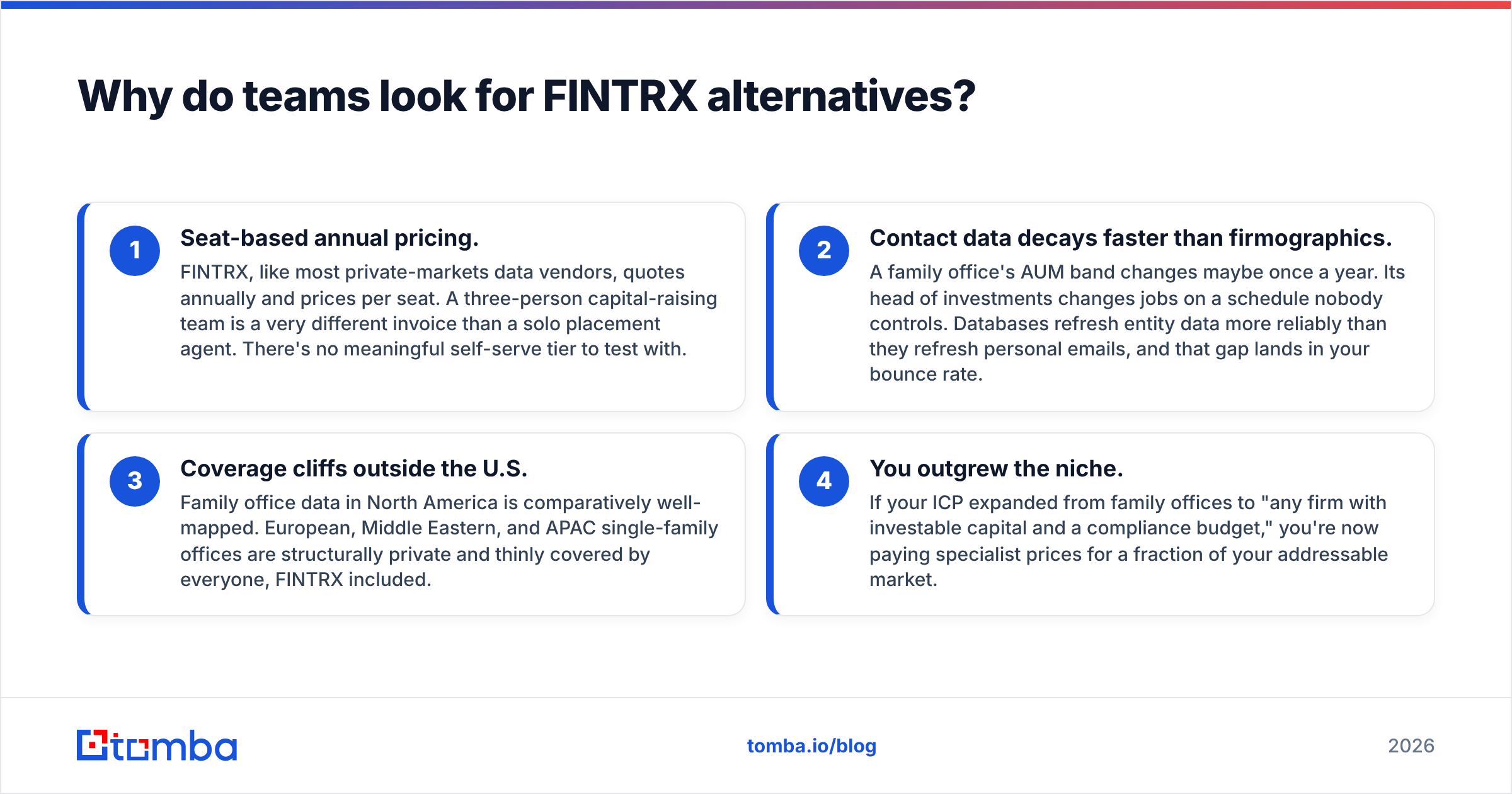
Four reasons come up repeatedly in review threads on G2 and in procurement conversations:
- Seat-based annual pricing. FINTRX, like most private-markets data vendors, quotes annually and prices per seat. A three-person capital-raising team is a very different invoice than a solo placement agent. There's no meaningful self-serve tier to test with.
- Contact data decays faster than firmographics. A family office's AUM band changes maybe once a year. Its head of investments changes jobs on a schedule nobody controls. Databases refresh entity data more reliably than they refresh personal emails, and that gap lands in your bounce rate.
- Coverage cliffs outside the U.S. Family office data in North America is comparatively well-mapped. European, Middle Eastern, and APAC single-family offices are structurally private and thinly covered by everyone, FINTRX included.
- You outgrew the niche. If your ICP expanded from family offices to "any firm with investable capital and a compliance budget," you're now paying specialist prices for a fraction of your addressable market.
How should you evaluate a FINTRX alternative?#
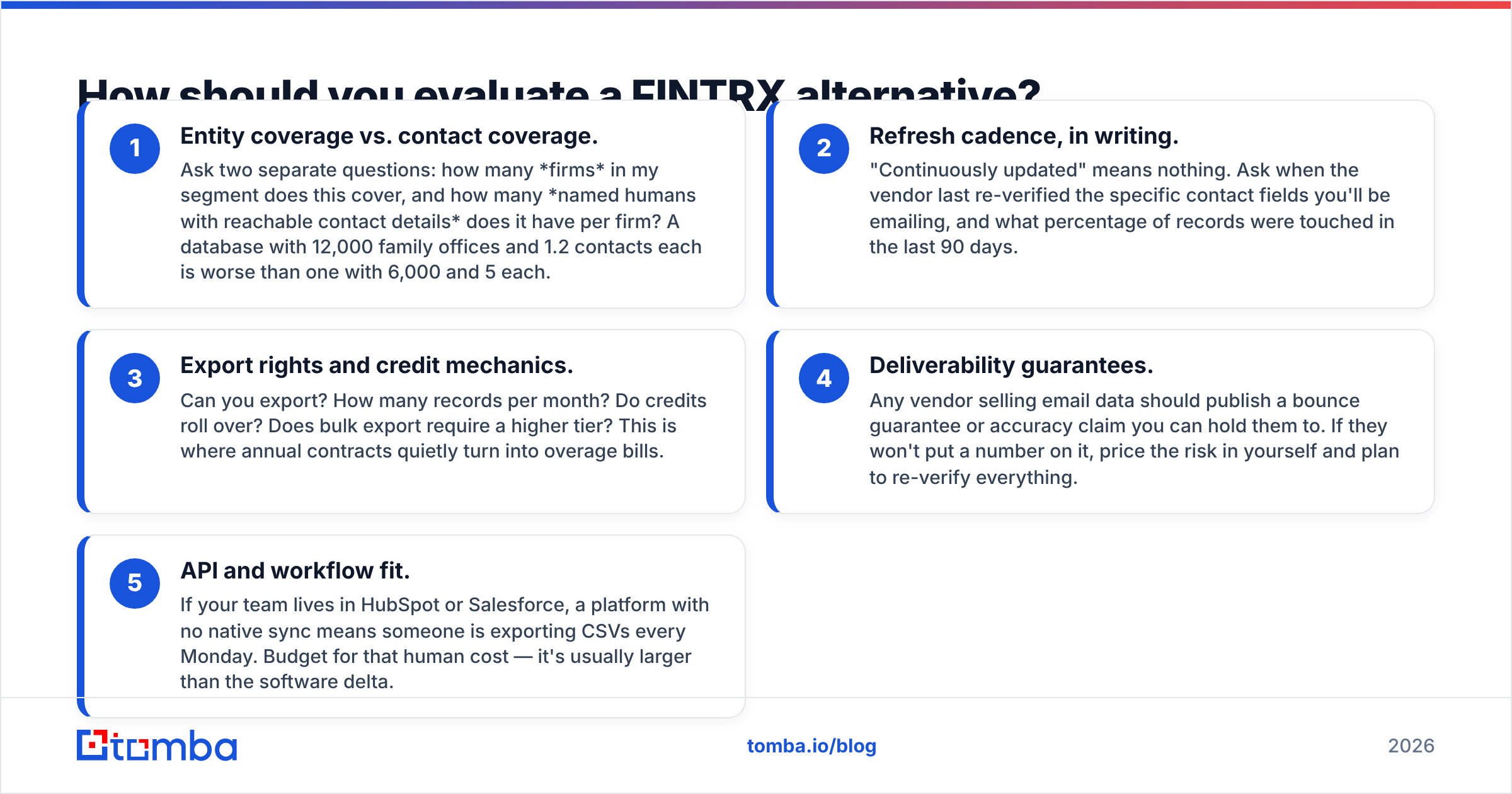
Score every option on these five dimensions before you look at a single price. Most teams get this backwards — they compare invoices, buy the cheap one, and discover the coverage gap in month two.
- Entity coverage vs. contact coverage. Ask two separate questions: how many firms in my segment does this cover, and how many named humans with reachable contact details does it have per firm? A database with 12,000 family offices and 1.2 contacts each is worse than one with 6,000 and 5 each.
- Refresh cadence, in writing. "Continuously updated" means nothing. Ask when the vendor last re-verified the specific contact fields you'll be emailing, and what percentage of records were touched in the last 90 days.
- Export rights and credit mechanics. Can you export? How many records per month? Do credits roll over? Does bulk export require a higher tier? This is where annual contracts quietly turn into overage bills.
- Deliverability guarantees. Any vendor selling email data should publish a bounce guarantee or accuracy claim you can hold them to. If they won't put a number on it, price the risk in yourself and plan to re-verify everything.
- API and workflow fit. If your team lives in HubSpot or Salesforce, a platform with no native sync means someone is exporting CSVs every Monday. Budget for that human cost — it's usually larger than the software delta.
What are the best FINTRX alternatives in 2026?#
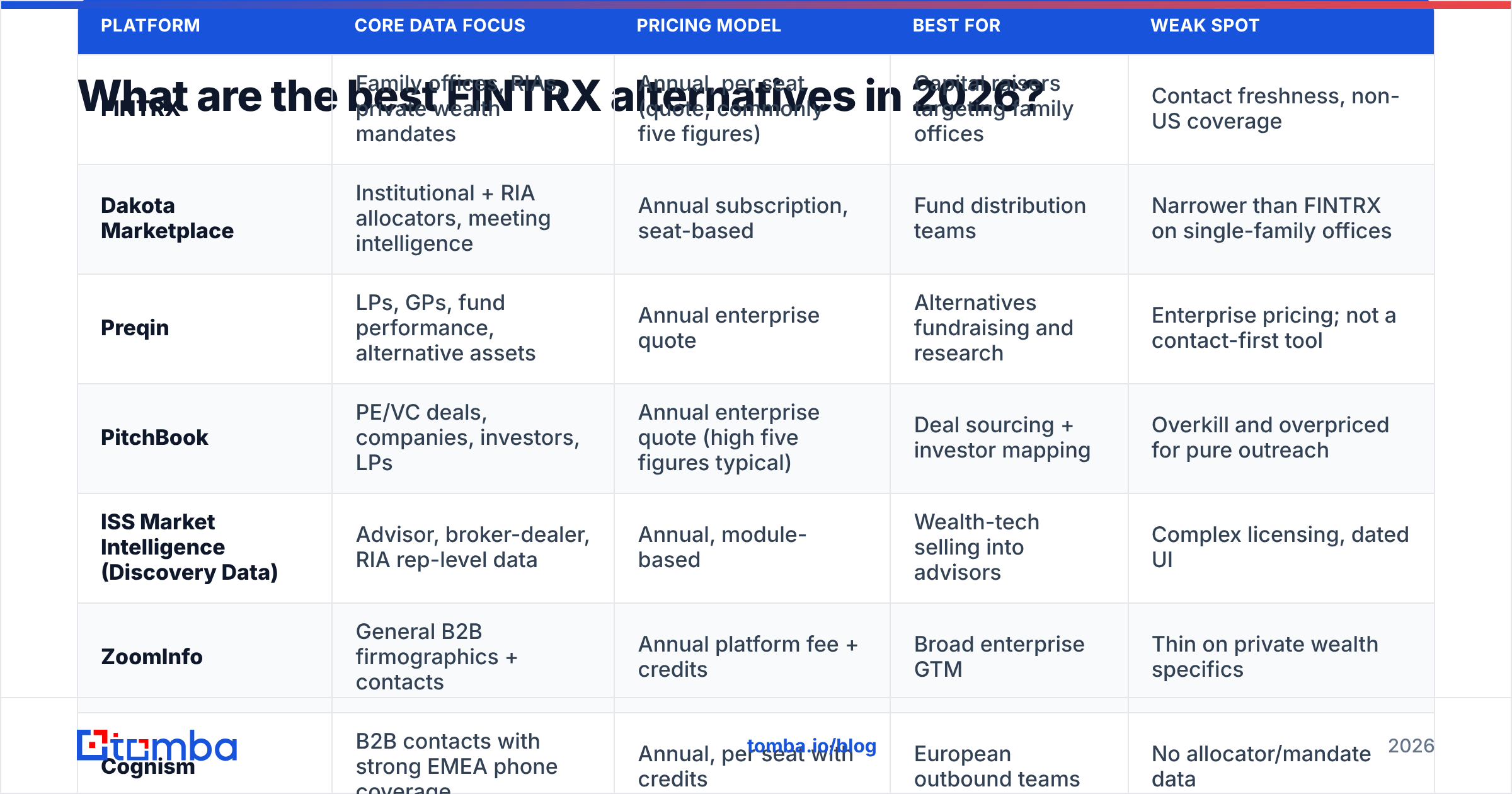
Here's the comparison. Pricing for private-markets data vendors is quote-based and moves; treat the ranges below as directional and confirm with the vendor before you budget.
| Platform | Core data focus | Pricing model | Best for | Weak spot |
|---|---|---|---|---|
| FINTRX | Family offices, RIAs, private wealth mandates | Annual, per seat (quote; commonly five figures) | Capital raisers targeting family offices | Contact freshness, non-US coverage |
| Dakota Marketplace | Institutional + RIA allocators, meeting intelligence | Annual subscription, seat-based | Fund distribution teams | Narrower than FINTRX on single-family offices |
| Preqin | LPs, GPs, fund performance, alternative assets | Annual enterprise quote | Alternatives fundraising and research | Enterprise pricing; not a contact-first tool |
| PitchBook | PE/VC deals, companies, investors, LPs | Annual enterprise quote (high five figures typical) | Deal sourcing + investor mapping | Overkill and overpriced for pure outreach |
| ISS Market Intelligence (Discovery Data) | Advisor, broker-dealer, RIA rep-level data | Annual, module-based | Wealth-tech selling into advisors | Complex licensing, dated UI |
| ZoomInfo | General B2B firmographics + contacts | Annual platform fee + credits | Broad enterprise GTM | Thin on private wealth specifics |
| Cognism | B2B contacts with strong EMEA phone coverage | Annual, per seat with credits | European outbound teams | No allocator/mandate data |
| BookYourData | Verified B2B email lists, pay-as-you-go | Credit packs, no annual lock-in | Fast, budget-flexible list building | List-based rather than relationship intelligence |
| Tomba | Email finding, verification, enrichment, API | Free tier, then $49 / $99 / $249 per month | Turning any account list into reachable contacts | Not an allocator database |
Dakota Marketplace#
The closest philosophical sibling to FINTRX. Dakota built its database out of an actual fundraising practice, so the data is organized around how allocators buy — meeting notes, allocation history, contact roles that matter for a raise. Teams that run institutional and RIA channels together tend to prefer it. It leans more institutional than FINTRX leans family office; if single-family offices are your entire pipeline, that difference matters.
Preqin#
Preqin is the alternative-assets research standard, now inside BlackRock. Strongest on LP commitments, fund performance benchmarks, and GP intelligence. Use it when you need to know what a limited partner has actually committed to over the last decade — that's a different question than "who do I email." Enterprise-priced accordingly.
PitchBook#
PitchBook covers deals, companies, investors, and increasingly LPs. It's a research terminal that happens to include contacts, not a prospecting tool with research attached. Fantastic if you're sourcing deals or mapping cap tables. If your job is 200 outbound emails a week to family offices, you are paying for a library to use one shelf.
ISS Market Intelligence / Discovery Data#
Rep-level advisor data — the FINRA and SEC-registered universe, down to individual reps and their affiliations. If you sell technology, insurance, or products to advisors rather than raising capital from allocators, this dataset is more directly useful than FINTRX. Licensing is modular and negotiation-heavy.
ZoomInfo#

The general-purpose heavyweight. Enormous contact volume, deep intent and technographic layers, mature CRM integrations. What it doesn't have is mandate intelligence — it won't tell you a multi-family office allocates to real assets. If your ICP has widened past private wealth, ZoomInfo covers more ground per dollar. If it hasn't, you'll be filtering noise.
Cognism#
Strong in EMEA, particularly mobile numbers, with a compliance posture (DNC screening, GDPR workflows) that European teams appreciate. Same caveat as ZoomInfo: it's a contact database, not an allocator database. Pair it with a specialist source rather than replacing one.
BookYourData#
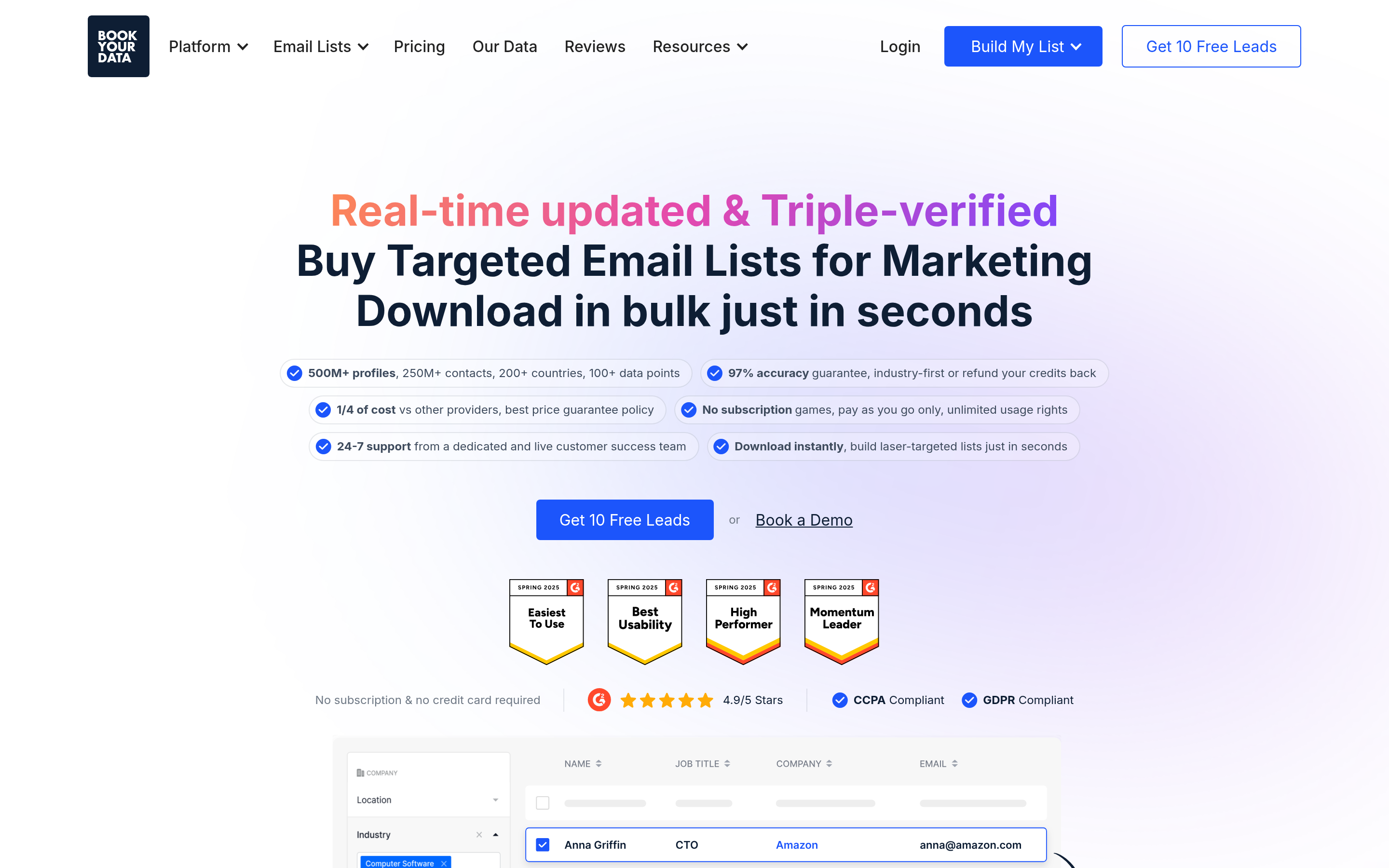
A different model worth taking seriously: pay-as-you-go verified B2B email lists with no annual seat commitment. You filter by industry, title, geography, and company size, then buy the credits you need. For teams that raise in bursts — a quarterly campaign rather than an always-on motion — not signing a twelve-month contract is a real advantage, and the verification guarantee means you're not buying decay. It won't give you investment mandates, but it wasn't built to.
Tomba#
Tomba sits in a different layer entirely, and that's the point. It doesn't try to know which family office likes private credit. It takes the account list you already have — from FINTRX, Dakota, an SEC Form ADV pull, a conference attendee sheet — and finds and verifies the people. The email finder resolves names and domains into addresses, the email verifier checks them against live mail servers before you send, and data enrichment fills in role, seniority, and company fields. Free tier is 25 searches a month; paid plans run $49, $99, and $249. See Tomba pricing for the credit breakdowns.

Is a cheaper FINTRX alternative actually cheaper?#
Only if you count the same things. Run the math on cost per contacted prospect, not cost per record.
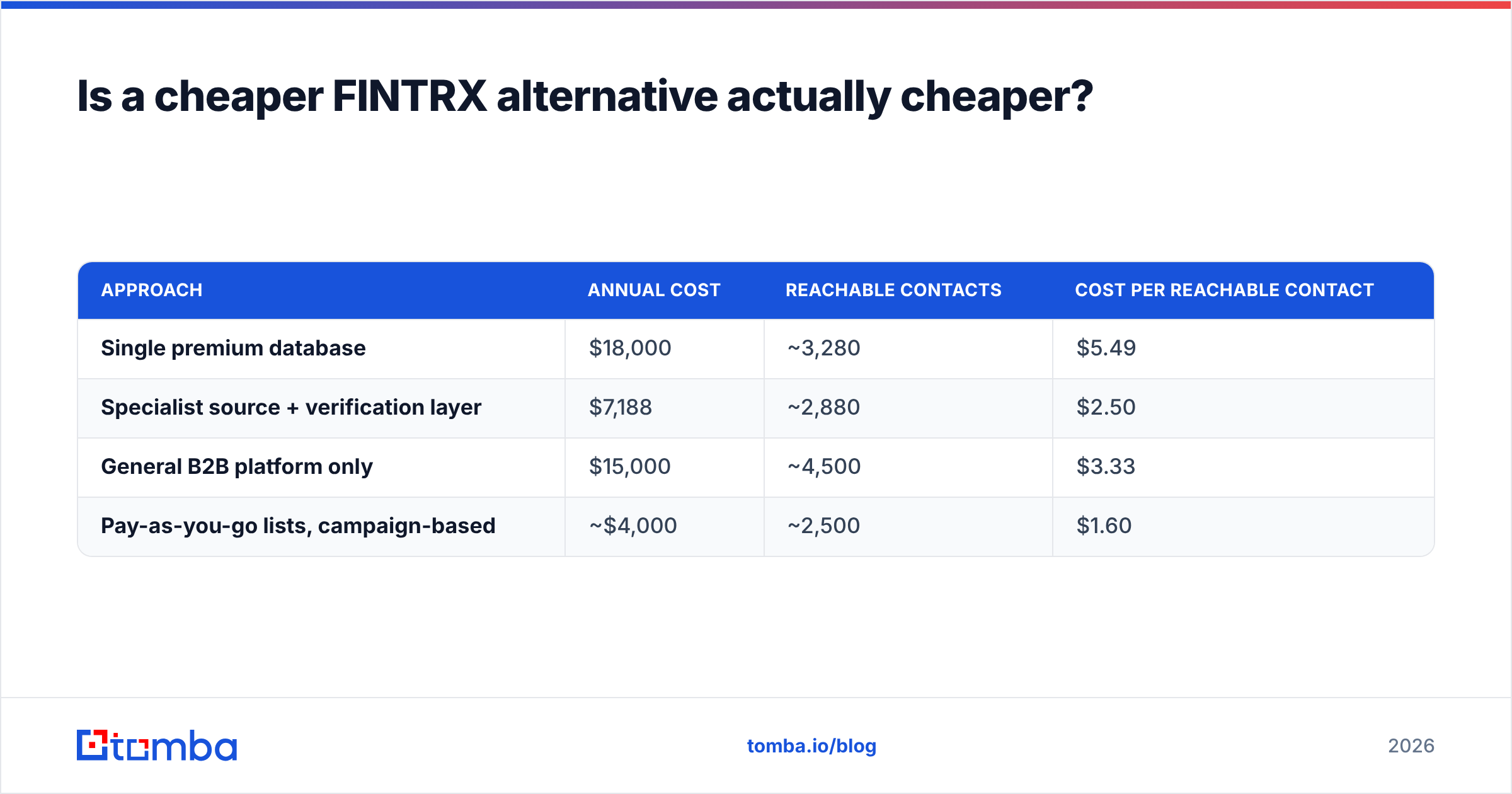
Take a $18,000/year database that gives you 4,000 exportable contacts. That's $4.50 per contact. Now apply a realistic 18% bounce-and-bad-data rate on year-old contact fields, and you're at $5.49 per reachable contact — before anyone opens anything.
Now take a $6,000/year specialist source with 3,000 contacts plus a $99/month verification and finding layer. That's $7,188 for 3,000 records, or $2.40 each — and because you verified before sending, your reachable rate is closer to 96%, so $2.50 per reachable contact.
The stacked approach usually wins on unit economics, and it wins twice: your sender reputation stays intact. Hard bounces above roughly 2% are what get an outbound domain throttled, and once that happens, the quality of your database stops mattering at all.
| Approach | Annual cost | Reachable contacts | Cost per reachable contact |
|---|---|---|---|
| Single premium database | $18,000 | ~3,280 | $5.49 |
| Specialist source + verification layer | $7,188 | ~2,880 | $2.50 |
| General B2B platform only | $15,000 | ~4,500 | $3.33 |
| Pay-as-you-go lists, campaign-based | ~$4,000 | ~2,500 | $1.60 |
The pay-as-you-go row looks best on paper, and for burst-mode fundraising it often is. The catch is that you're buying a snapshot, not a relationship-intelligence system — you lose the "who did this person work with before" context that specialist platforms exist to provide.
Can you build a FINTRX alternative yourself?#
Partially, and it's more viable than vendors would like you to believe — for the entity layer.
SEC Form ADV filings are public. Every RIA above the registration threshold files one, and it includes AUM, client types, custodian relationships, and control persons. Family offices that manage outside capital often appear there too. You can pull the full dataset, filter it to your criteria, and end up with a defensible account list for the cost of an afternoon.
What you cannot build cheaply is the contact layer. Form ADV gives you a firm and a compliance contact, not the head of investments and her working email. That's the gap where a bulk email finder or the Tomba API earns its place — feed in company domains and names, get back verified addresses at a per-record cost measured in cents.
Where DIY genuinely breaks down is mandate intelligence. Knowing that a single-family office in Chicago quietly allocates to venture secondaries is not in any filing. It comes from surveys, event intelligence, and analyst work — which is exactly what you're paying FINTRX, Preqin, and Dakota for. If that intelligence drives your targeting, keep paying for it. If it doesn't, you're subsidizing research you never open.
Which FINTRX alternative should you pick?#
- You raise capital from family offices, full stop. Stay with FINTRX or trial Dakota Marketplace head-to-head. Nothing generic replaces mandate data.
- You raise from institutions and allocators broadly. Dakota or Preqin, depending on whether you need meeting intelligence or performance benchmarks.
- You sell products or software to RIAs and advisors. ISS Market Intelligence for the rep-level universe, or a Form ADV pull plus a contact layer if budget is tight.
- Your ICP has widened beyond private wealth. ZoomInfo or Cognism, chosen by geography — Cognism if EMEA phone data matters, ZoomInfo if you're US-heavy.
- You run campaign bursts, not always-on outbound. Credit-based list building through BookYourData avoids paying twelve months for four months of work.
- Your account list is fine and your bounce rate isn't. Don't buy another database. Add verification and finding on top of what you already own.
That last case is more common than the other five combined. Teams renew a five-figure contract to fix a problem that was never a coverage problem — it was a freshness problem, and freshness is solved at the contact layer, cheaply.
Ready to fix the contact layer?#
If your allocator list is solid but the emails keep bouncing, start where the leak actually is. Run your existing accounts through the Tomba Email Finder to resolve names and domains into verified, deliverable addresses — free for your first 25 searches, $49/month once you're ready to scale, with an API and bulk workflows for when you are. Keep the database you trust for intelligence. Stop paying database prices for contact data you can verify yourself for a fraction of it.
Related guides#
Ready to find emails that actually work?
Join 150,000+ professionals who stopped guessing and started sending. Free credits on signup — no credit card required.
Get the Tomba newsletter
Practical outbound tactics and product updates — once every two weeks.
About the author