FinTRX vs Apollo.io: Which B2B Data Platform Wins in 2026?
One platform owns private wealth data. The other owns volume prospecting. Here is an honest, side-by-side breakdown of FinTRX vs Apollo.io — coverage, pricing, accuracy, and which one actually fits your outbound motion in 2026.
FinTRX vs Apollo.io is a fair fight only if you skip the sales decks. One tool owns private wealth data. The other owns raw volume. This guide compares coverage, price, and data quality so you can pick in one sitting.
TL;DR
- FinTRX is a vertical database. It maps registered investment advisors (RIAs), family offices, broker-dealers, and the people inside them. Nothing general-purpose goes as deep.
- Apollo.io is a horizontal engine. Hundreds of millions of contacts, plus sequences, a dialer, and CRM sync in one seat. Breadth over depth.
- They are not real substitutes. FinTRX vs Apollo.io comes down to one thing. Is your ICP a niche you can name, or a filter you can build?
- The price models clash. FinTRX quotes annual deals. Apollo lists seats from about $49 per user each month, with credit caps that bite at scale.
- Both need a check. Neither vendor promises every email lands. Pair your pick with an email verifier before you send.
What is FinTRX and who is it built for?#
FinTRX is a private wealth data platform. The whole product answers one question. Who manages money, how much, and how do you reach them?
It holds firm records for RIAs, family offices, wirehouses, and broker-dealers. It also holds people records: advisors, principals, chief investment officers, and gatekeepers. On top of that sit fields a general database never models. Think AUM bands, custodian ties, allocation habits, public filings, and advisor moves between firms.
The buyer is narrow and clear. Asset managers raising capital. Alternative investment sponsors. Fintech vendors selling into wealth management. IR teams who need to know when a $2B RIA switches custodians. For them, FinTRX does not compete with a prospecting tool. It competes with a research analyst and a stack of Form ADV PDFs.
Scope is the trade. If your ICP is "Series B SaaS with 50-200 staff," FinTRX has almost nothing for you. You can check the current coverage claims on the FinTRX site. But the shape of the data never changes. It is deep and narrow by design.
What is Apollo.io and where does it actually win?#
Apollo.io makes the opposite bet. It is a broad B2B database, with hundreds of millions of contacts across every industry. Around it sits a work layer: sequences, a dialer, email sending, a Chrome add-on, meeting booking, and two-way CRM sync.
The database is not the real edge. Plenty of vendors hold big databases. The edge is speed. One rep can go from filter to booked meeting without leaving the tab. Build a list by headcount, tech, funding, or job title. Enrich it. Drop it in a sequence. Track replies. That is why Apollo.io grew so fast, and why reviewers on G2 rank it high on ease of use.
The gaps show up just as often. Contact data on small firms goes stale fast. Job titles lag by months. Credit limits and export caps bite right when a campaign starts to work. And the all-in-one promise means each part is fine, not great.

FinTRX vs Apollo.io: how do they compare head-to-head?#
Here is the honest side-by-side. The figures reflect public info at the time of writing. Check current terms with each vendor before you sign.
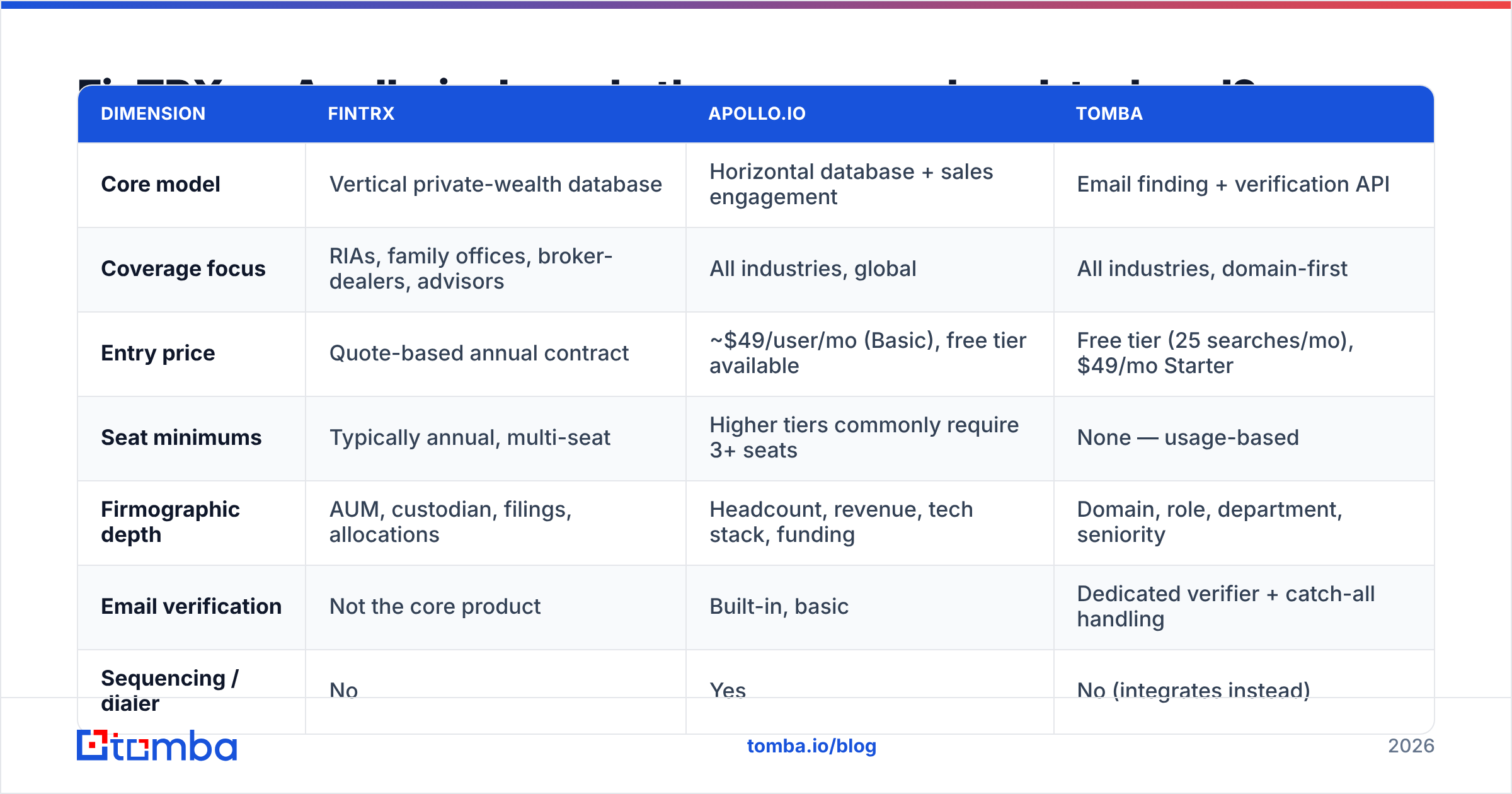
| Dimension | FinTRX | Apollo.io | Tomba |
|---|---|---|---|
| Core model | Vertical private-wealth database | Horizontal database + sales engagement | Email finding + verification API |
| Coverage focus | RIAs, family offices, broker-dealers, advisors | All industries, global | All industries, domain-first |
| Entry price | Quote-based annual contract | ~$49/user/mo (Basic), free tier available | Free tier (25 searches/mo), $49/mo Starter |
| Seat minimums | Typically annual, multi-seat | Higher tiers commonly require 3+ seats | None — usage-based |
| Firmographic depth | AUM, custodian, filings, allocations | Headcount, revenue, tech stack, funding | Domain, role, department, seniority |
| Email verification | Not the core product | Built-in, basic | Dedicated verifier + catch-all handling |
| Sequencing / dialer | No | Yes | No (integrates instead) |
| API access | Available on enterprise plans | Available, credit-metered | On all paid plans |
| Best for | Capital raising into wealth channels | High-volume multi-industry outbound | Accurate contact discovery at low cost |
The table makes the point better than prose. In a real FinTRX vs Apollo.io test, the two barely overlap. A capital-raising team will find no wealth filters in Apollo. A SaaS rep will find that 99% of the FinTRX records do not apply.
How do the pricing models actually differ?#
Most reviews go sideways here. The two vendors do not price the same unit.
- FinTRX prices access. You buy a yearly deal per firm, with seat tiers and add-on modules. There is no public price card. Your cost depends on how well you haggle. Expect a slow buying cycle.
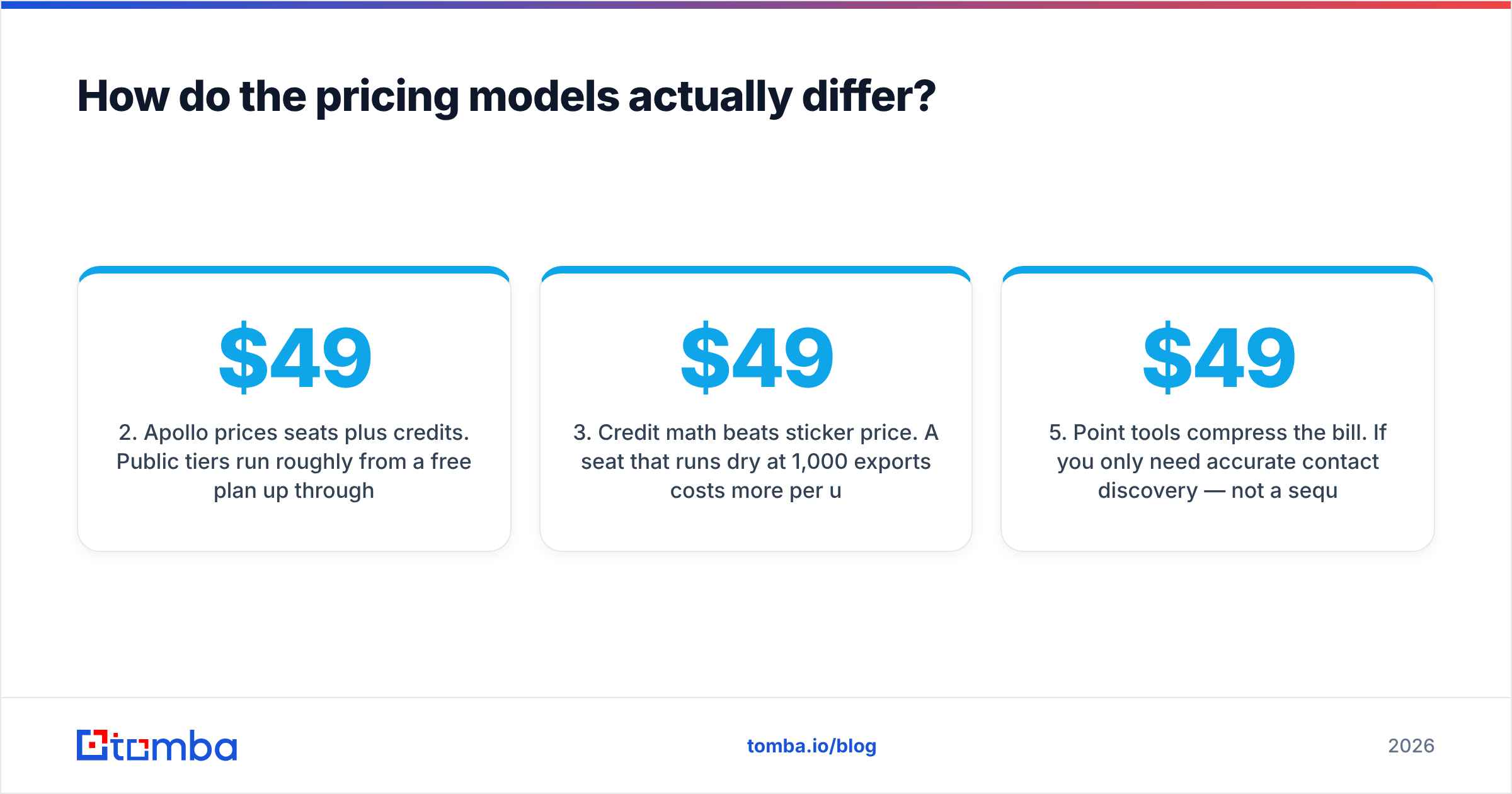
- Apollo prices seats plus credits. Public tiers run from a free plan up through Basic (about $49 per user each month), Professional, and Organization. Annual billing cuts the rate.
- Credits are the catch. Export, mobile, and enrich credits are metered on their own. Heavy users hit the ceiling long before the month ends.
Then do the math on your own volume, not on the sticker.
- Credit math beats sticker price. A $49 seat that runs dry at 1,000 exports can cost more per usable contact than a bigger tier.
- Seat minimums hide in the quote. Apollo's higher tiers often ask for three seats. A two-person team still pays for three.
- Point tools cut the bill. If you only need good contact data, a focused tool charges a flat rate. See the Tomba pricing tiers: free, $49 Starter, $99 Growth, $249 Pro, custom Enterprise. No seat multiplier.
The pattern is simple. FinTRX charges for data you cannot build yourself. Apollo charges for a workflow you could stitch from three tools. The first is a moat. The second is convenience, and convenience pricing is worth a stress test. So in a FinTRX vs Apollo.io budget review, model your real usage first.
Which one gives you better data accuracy?#
Data quality is where FinTRX vs Apollo.io gets heated. But it is the wrong question. The better one is: accurate about what?
FinTRX accuracy rests on public filings and human research. Form ADV data is public and structured. So firm records like AUM, custodian, and status are solid and easy to audit. Advisor moves are tracked on purpose, since that is the trigger its buyers want. Direct contact data is softer. Personal emails and cell numbers at small RIAs are hard for anyone to keep fresh.
Apollo accuracy rests on scale and user uploads. Its email data holds up for mid-market and large firms with clear naming rules. It slips on small firms, recent job changes, and non-US regions. Cell numbers draw the most complaints in public reviews. The database is huge, so it holds more coverage and more dead rows.
Neither one fixes the last mile. An address that worked last year may bounce today. That is why good teams run a separate check on every list. Catch-all domains are common at finance firms with strict mail gates. Those need a catch-all verifier, not a plain SMTP ping.
A simple workflow that works with either vendor:
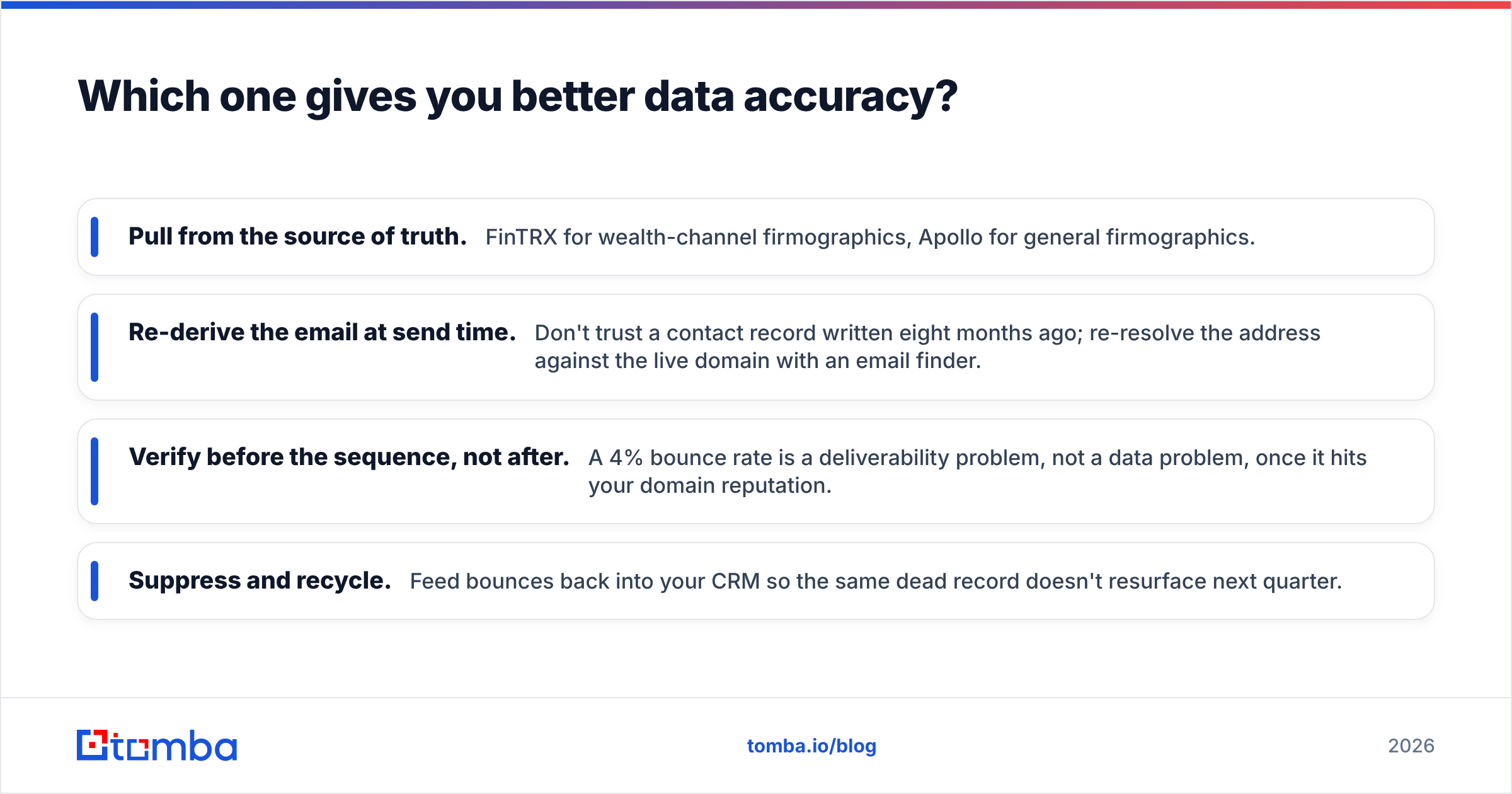
- Pull from the source of truth. FinTRX for wealth firms. Apollo for the rest.
- Re-derive the email at send time. Do not trust a record written eight months ago. Resolve it again with an email finder.
- Verify before the sequence, not after. A 4% bounce rate hurts your domain, not just your list.
- Suppress and recycle. Feed bounces back to your CRM so dead records stay dead.

When should you choose FinTRX over Apollo.io?#
The FinTRX vs Apollo.io call gets easy once you name your buyer.
Choose FinTRX when all of these hold:
- Your ICP is set by capital, not by size or tech stack. You target firms for what they manage, allocate, or custody.
- You need entity links: parent firms, sub-advisors, tied broker-dealers. Not a flat contact list.
- Trigger events matter. An advisor leaving a wirehouse for an RIA is a signal you can act on in days.
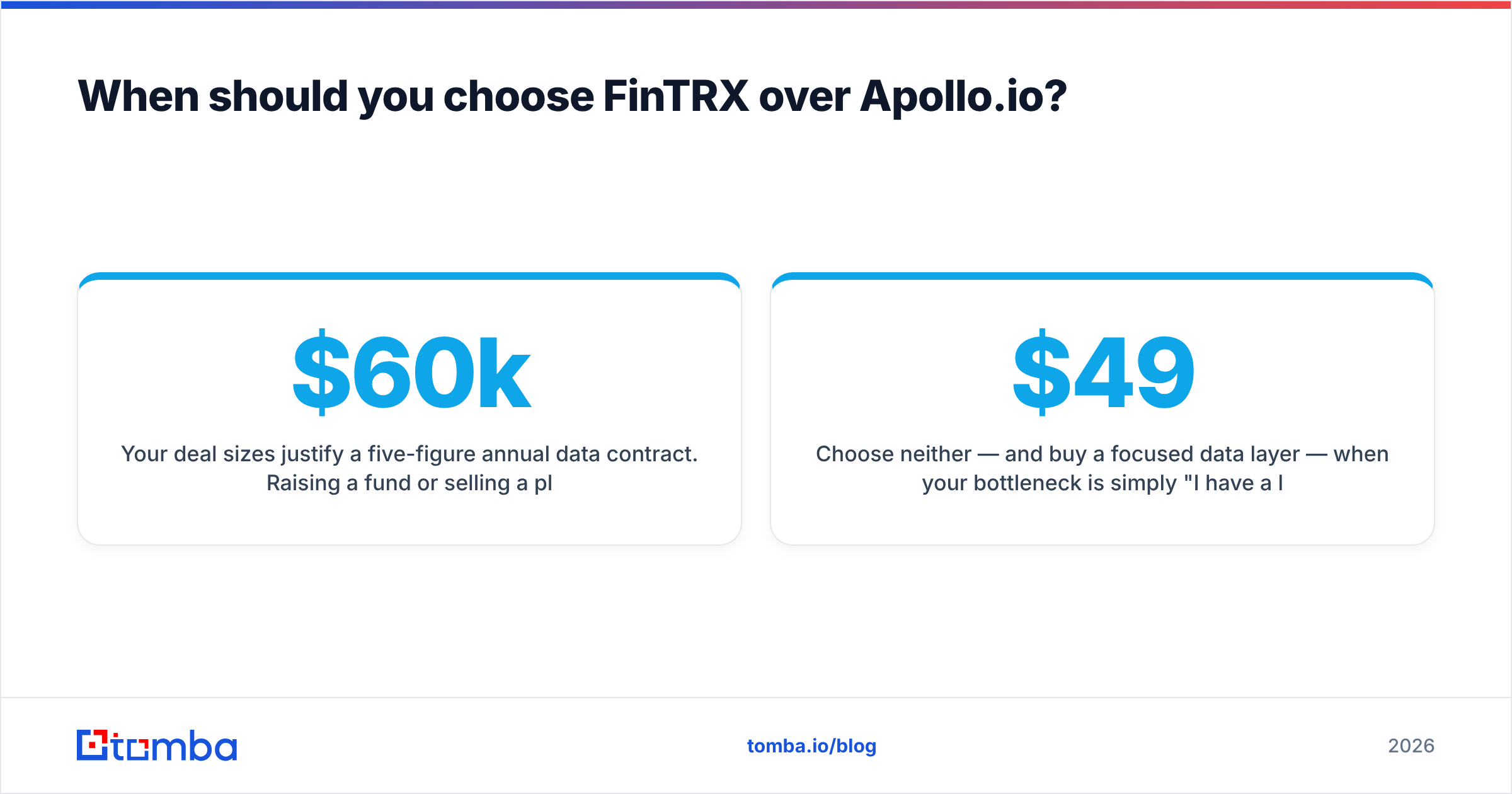
- Your deal sizes cover a five-figure data contract. Raising a fund does. Selling a $99 per month app does not.
Choose Apollo.io when:
- Your ICP spans many industries and you need volume more than nuance.
- Your team wants one tool, and will accept "good enough" in each part.
- You are early, and the free or Basic tier gets you to product-market fit before you tune the data layer.
- You do not already pay for a sequencer. If you do, half of Apollo's value is a duplicate.
Choose neither when your gap is one line. You have a list of firms and you need the right person's verified email. That is a $49 problem, not a $30k problem. A domain search against your target list solves it in minutes. The Tomba API then drops the result into the CRM or sequencer you already trust.
Can you run both without wasting budget?#
FinTRX vs Apollo.io does not have to be either/or. Plenty of wealth-tech teams run both. The split is clean.
FinTRX sets the account universe. It tells you which 3,400 RIAs match your thesis, and who sits inside them. Apollo covers the buyers FinTRX does not model: the CTO at a fintech vendor, the ops lead at a custodian, the compliance consultant in between.
Under both sits a find-and-verify layer that cleans whatever comes out. Teams skip this step. Then they blame the database when the real cause was a 6% bounce rate. Run every list through bulk verification before the first send.
If you are cutting tools instead, drop the overlap in the send layer first. Most teams pay for sequencing twice and never notice.
What do teams get wrong in this evaluation?#
Four mistakes show up in almost every FinTRX vs Apollo.io review.
Comparing record counts. "50 million contacts" against "900,000 wealth contacts" means little when only one set holds your buyers. Test coverage of your own ICP with a sample.
Running a trial with no control list. Take 50 accounts you know cold, where you have verified emails and current titles. Run them through both tools. Score match rate against the truth. That one test beats a month of demos.
Ignoring the exit. Ask about export rights before you sign. Some vertical databases limit bulk export, or block the CRM sync you keep after you leave. That clause decides if you rent a workflow or own an asset.
Treating verification as optional. Google and Yahoo now enforce bulk sender rules, and complaint limits are real. Sending to unchecked data is a delivery risk, and the blast radius is your whole domain.
The bottom line#
FinTRX wins if you sell into private wealth and need firm-level intel no broad vendor holds. Apollo.io wins if you need wide coverage plus a send layer in one seat, and you can live with mixed freshness. But most teams stuck on FinTRX vs Apollo.io have a third problem. They need verified contact data at a price that does not scale with headcount.
That is the gap Tomba fills. Point the Tomba Email Finder at a domain and a name. You get a verified work address, a confidence score, and the sources behind it. Keep the database and sequencer you already pay for. Start free at 25 searches a month. Move to $49 a month when it proves out, and stop paying seat multipliers for data you only needed once.
Related guides#
Ready to find emails that actually work?
Join 150,000+ professionals who stopped guessing and started sending. Free credits on signup — no credit card required.
Get the Tomba newsletter
Practical outbound tactics and product updates — once every two weeks.
About the author