FINTRX vs LeadzenAI (2026): Which B2B Data Tool Wins?
One sells deep private-wealth intelligence to asset raisers. The other sells cheap, high-volume B2B lead discovery. Here is an honest breakdown of FINTRX vs LeadzenAI — coverage, data quality, pricing reality, and who should buy which.
FINTRX vs LeadzenAI is a match-up that trips up a lot of buyers. One tool sells deep private-wealth data. The other sells cheap leads in bulk. Here is the plain breakdown: coverage, data quality, real prices, and who should buy which.
TL;DR
- FINTRX vs LeadzenAI is not a real fight. They do different jobs. FINTRX is a private-wealth database. It covers family offices, RIAs, and the people who invest for them. LeadzenAI is a broad B2B lead tool with a LinkedIn add-on and bulk search.
- Buy FINTRX if you raise money. It tells you which family office backs your kind of fund. Buy LeadzenAI if you need lots of leads on a small budget.
- The prices sit miles apart. FINTRX quotes a yearly deal in the four- to five-figure range. LeadzenAI sells credit packs at app-store prices.
- Neither tool is a strong email checker. Both need a verify step before you hit send.
- Say your only gap is the email address. You have the name and the company. Then a simple email finder costs far less than either one.
What are FINTRX and LeadzenAI?#
They fix different problems. Both just happen to sit under the "B2B data" label.
FINTRX maps the private wealth world. Its data covers family offices, registered investment advisors, wealth managers, and their staff. It also tracks where those firms put money. That matters a lot if you raise a fund. You can search by AUM, asset class, past deals, place, and job title. The contact record is not the point. The insight is.
LeadzenAI is a prospecting tool. It indexes a wide pool of B2B contacts. A Chrome add-on pulls names from LinkedIn profiles and search pages. You can also run bulk lookups. It returns emails, phone numbers, and basic company facts. The data is wide, not deep. The price reflects that.
So FINTRX vs LeadzenAI is not a "which tool is better" question. Ask a better one. Which market do you sell to? And what does a wrong guess cost you?
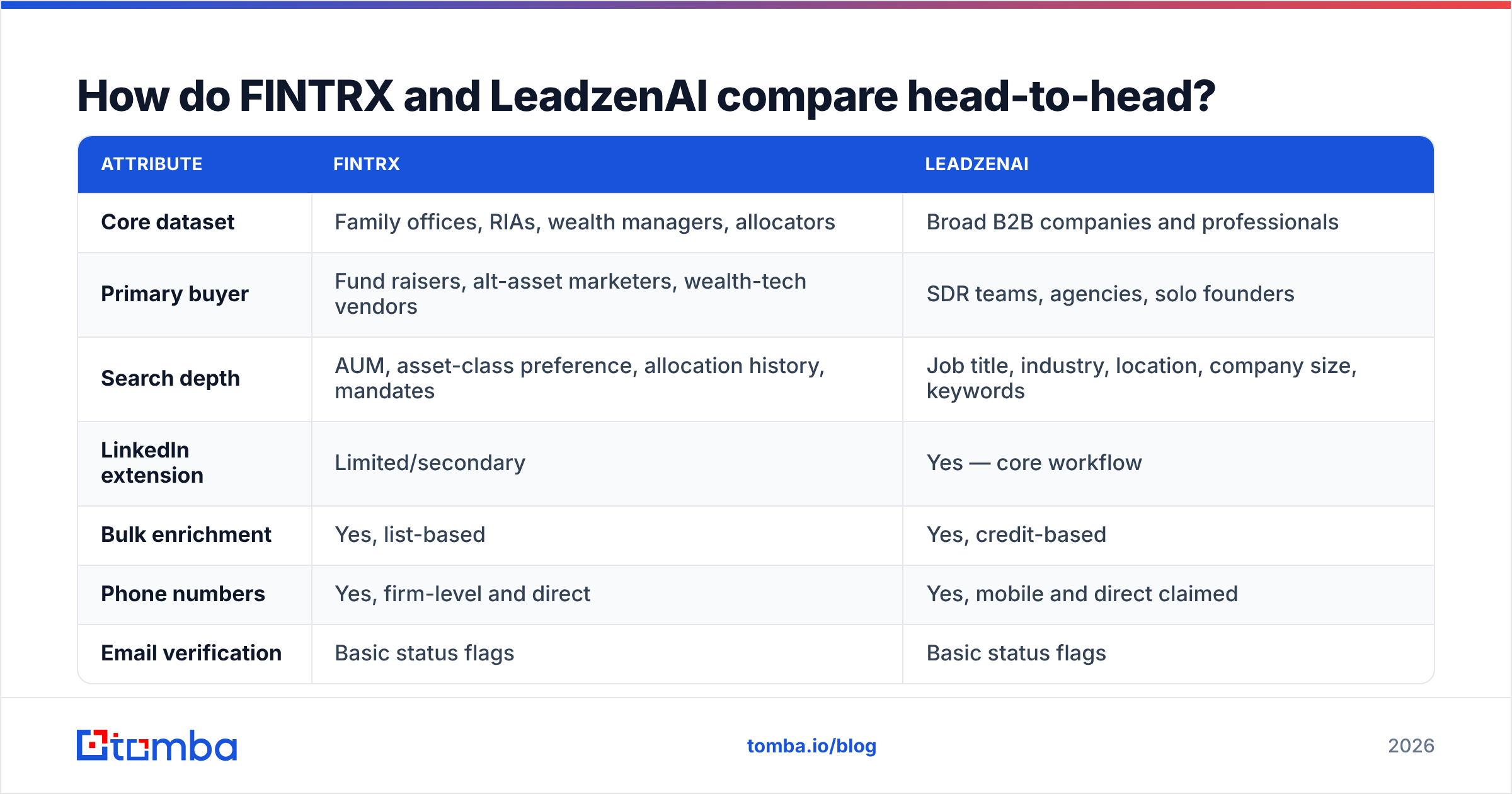
FINTRX vs LeadzenAI: the head-to-head table#
| Attribute | FINTRX | LeadzenAI |
|---|---|---|
| Core dataset | Family offices, RIAs, wealth managers, allocators | Broad B2B companies and professionals |
| Primary buyer | Fund raisers, alt-asset marketers, wealth-tech vendors | SDR teams, agencies, solo founders |
| Search depth | AUM, asset-class preference, allocation history, mandates | Job title, industry, location, company size, keywords |
| LinkedIn extension | Limited/secondary | Yes — core workflow |
| Bulk enrichment | Yes, list-based | Yes, credit-based |
| Phone numbers | Yes, firm-level and direct | Yes, mobile and direct claimed |
| Email verification | Basic status flags | Basic status flags |
| Pricing model | Annual contract, quote only | Self-serve credit tiers |
| Typical entry cost | Four to five figures per year | Tens of dollars per month |
| Free tier | Demo only | Limited trial credits |
| Best at | Knowing who allocates to what | Getting many contacts fast |
The table shows the real choice. FINTRX charges a lot for context you cannot scrape. LeadzenAI charges very little for reach. You could build some of that reach yourself. Neither one is overpriced. They are priced for different jobs.

Who is FINTRX built for?#
Five buyer types get real value. If you are not one of them, the contract is hard to defend.
- Fund managers raising money. You need backers with a track record in your strategy. Think private credit, venture, or real assets. "Rich people" is not a target list.
- Wealth-tech and fintech sellers. Your buyers are RIAs and family offices. Firm details drive your segments: AUM tier, custodian, tech stack, and headcount.
- Private banks and multi-family offices. Growth teams there care about who knows whom. That map beats a raw contact count.
- Placement agents and IR consultants. You get paid for warm intros. One good insight can cover the year.
- M&A and advisory firms in wealth. Owner structures and firm ties feed the deal thesis.
Spot the pattern. Each contact is worth a lot. One meeting can bring in seven figures of new capital. Paying for curated data makes sense there. It does not when your average deal is $4,000 a year.
What does LeadzenAI do well?#
LeadzenAI sells volume and easy access. The add-on grabs contacts while you browse LinkedIn. The bulk module takes list uploads. Credits let you start small. No purchase order needed.
Where it holds up:
- Fast first value. Sign up, install the add-on, and export a CSV the same day.
- Cost per contact. For high-volume, low-ticket outbound, the math works. FINTRX will never match it.
- Regional reach. India and nearby APAC markets look stronger than on many US-first tools. That counts if it is your patch.
- Easy to learn. There is no new system to study. Filter, export, send.
Where it strains:
- Shallow checks. Wide databases hold stale records. A status flag is not a live mailbox test. Trust it too much and you burn your sending domain.
- Thin extras. You get contact fields. You do not get deal history or relationship maps.
- Rules risk. Cold outreach to finance pros is a touchy area. Where the data came from matters more than it does in plain SaaS sales.
How good is the contact data?#
Vendor accuracy claims deserve doubt. Look at the method, not the number.
FINTRX has a small, slow-moving world to cover. There are only so many family offices. People research them by hand. Firm facts move by the quarter, not by the day. That makes firm-level data quite solid. Email delivery is another story. Wealth pros often sit behind catch-all domains and strict filters.
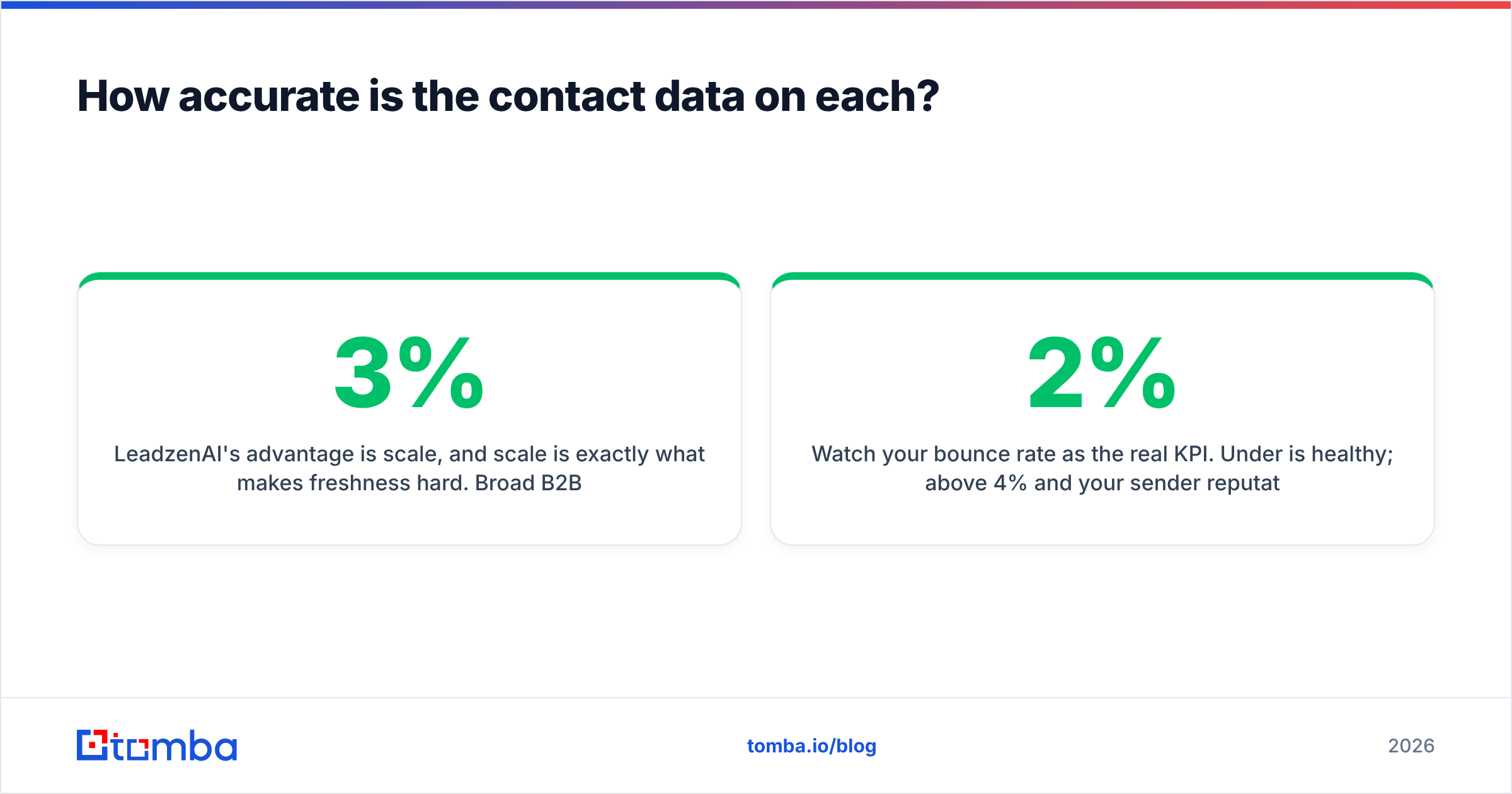
LeadzenAI wins on scale. Scale is also why fresh data is hard. Broad B2B records go stale at about 2–3% a month. People switch jobs. Teams get reshuffled. Domains move. Over a year, a big slice of any static list dies.
Guardrails that apply to both:
- Never send to a raw export. Run each list through an email verifier first.
- Split out catch-all domains. Finance domains skew catch-all. A catch-all verifier tells you if the mailbox is likely real.
- Re-check every quarter. Anything older than 90 days needs a fresh pass.
- Test the pattern. Say a tool returns
first.last@but the firm mostly usesflast@. That record was guessed, not seen. - Watch bounce rate. Under 2% is fine. Above 4% and your sender score is already hurting.

FINTRX vs LeadzenAI pricing: what will you pay?#
Neither vendor makes this easy. Here is the honest state of play. Check current numbers with each vendor before you budget.
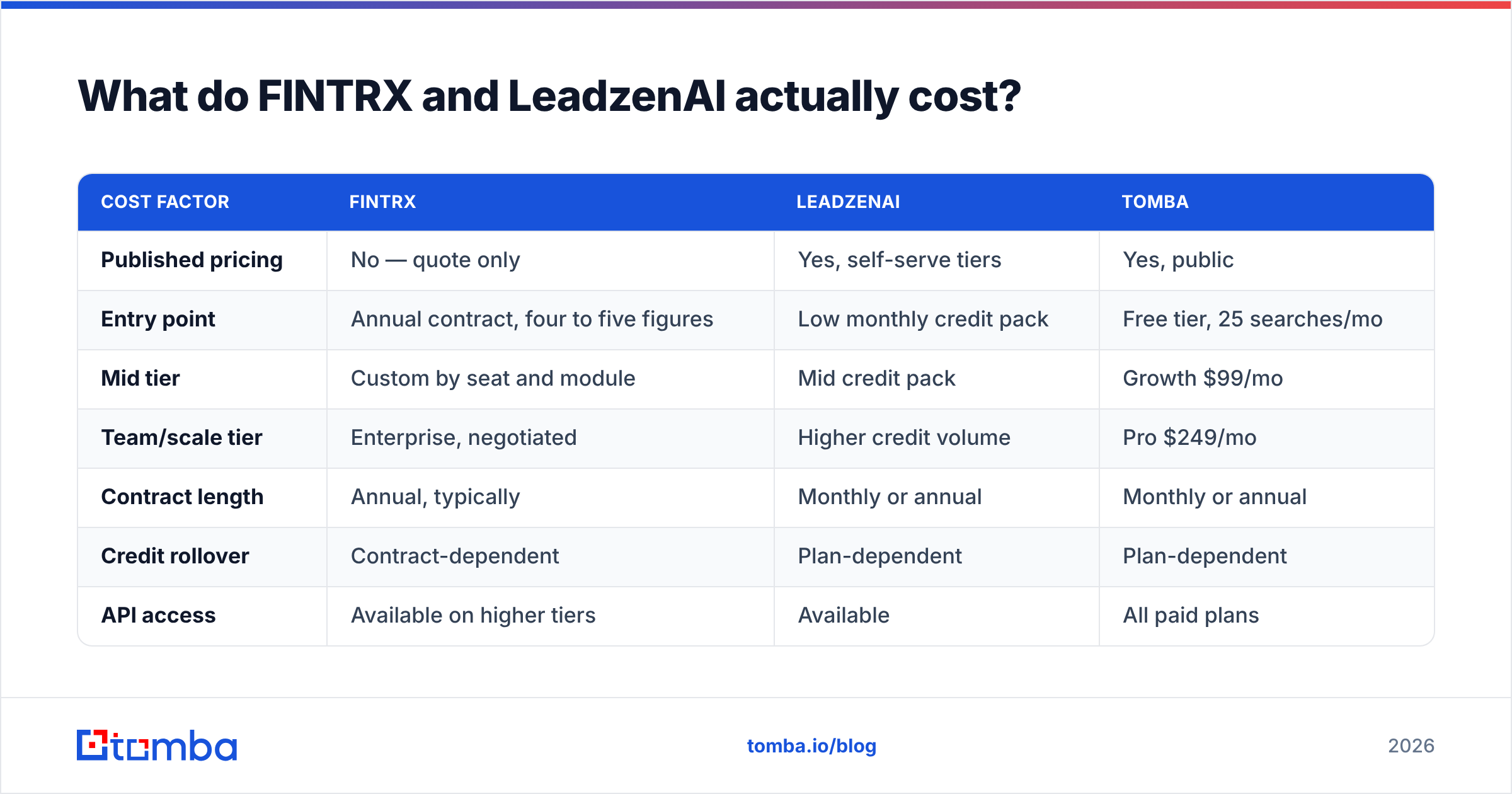
| Cost factor | FINTRX | LeadzenAI | Tomba |
|---|---|---|---|
| Published pricing | No — quote only | Yes, self-serve tiers | Yes, public |
| Entry point | Annual contract, four to five figures | Low monthly credit pack | Free tier, 25 searches/mo |
| Mid tier | Custom by seat and module | Mid credit pack | Growth $99/mo |
| Team/scale tier | Enterprise, negotiated | Higher credit volume | Pro $249/mo |
| Contract length | Annual, typically | Monthly or annual | Monthly or annual |
| Credit rollover | Contract-dependent | Plan-dependent | Plan-dependent |
| API access | Available on higher tiers | Available | All paid plans |
The structure matters more than the digits. FINTRX is a budget line. It needs a business case and a renewal talk. LeadzenAI goes on a company card. Do not compare the two on price alone. Compare cost per booked meeting that fits your ICP.
Want a sanity check on how buyers rate these tools? G2's sales intelligence category shows review counts and dates. Keep one thing in mind. Review counts favor the firms that chase reviews hardest.
Which one should you pick?#
Work through these in order.
- Is your market private wealth? Say you raise capital or sell to RIAs and family offices. Then FINTRX is the only one of the two that answers your real question. No general B2B tool knows which family office backed private credit last year.
- Do you run volume outbound? You may need thousands of contacts a month across many industries. LeadzenAI wins that math by a wide margin.
- Is your gap discovery or contact? These are two problems. Discovery sounds like "I do not know who to target." Contact sounds like "I know who. I just need a working email." Buying a discovery platform to fix a contact gap is the classic overspend here.
- What is your real monthly volume? Under a few hundred lookups, neither pricing model fits. A pay-as-you-go email finder covers it for less.
- Do you need it in a workflow or a CSV? Check the integrations first if your team lives in a CRM. Reps drop any tool that sits outside their daily flow.
Do you need either one?#
Here is the question most comparison posts skip.
Many teams weighing FINTRX vs LeadzenAI are not short on accounts. They already have a list. It came from a conference, an investor database, a partner, or their own CRM. What they lack is one thing. They need a verified email for a named person at a known domain.
That is a smaller and cheaper problem. Domain search returns the people and email patterns at a firm you already picked. A bulk email finder runs a list of names and domains in one pass. Verification stays a separate step, so nothing raw reaches your sequencer.
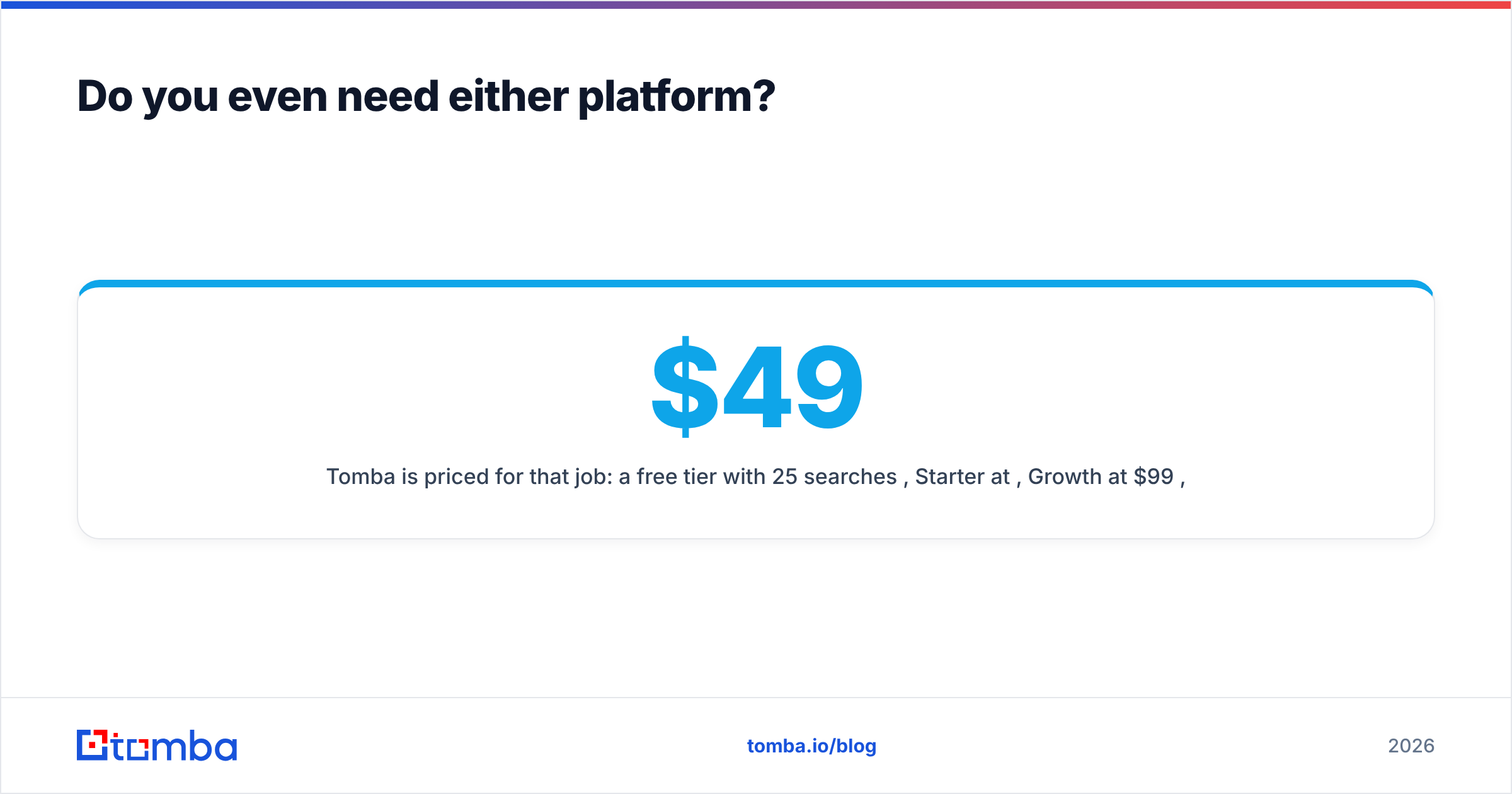
Tomba is priced for that job. The free tier gives 25 searches a month. Starter is $49/mo, Growth is $99/mo, and Pro is $249/mo. Full Tomba pricing is public, not locked behind a demo. It does not replace FINTRX deal insight. Nothing does. It replaces paying platform prices to solve a lookup.
Many teams end up stacking. Use a deep data source where context wins the deal. Use your own research and CRM for the rest. Then run a fast email check across all of it before you send.
The verdict on FINTRX vs LeadzenAI#
FINTRX wins if you sell to or raise from private wealth. The data is hand-built. The search filters are ones no general tool offers. The price holds up when one backer talk can pay for the year. Expect a yearly contract and a demo-led sale.
LeadzenAI wins if you run volume outbound on a lean budget. APAC reach is a bonus. Know that you buy breadth, not depth. Build a verify step into your process. Do not trust export flags.
Neither wins if you just need good emails for accounts you already know. That is a tool mismatch, and it costs you either way. You either overpay for insight you ignore, or you underpay and eat the bounces.
Write your real bottleneck in one sentence. Does it say "I do not know who to target"? Buy a database. Does it say "I know who, I cannot reach them"? Buy a finder and a verifier.
Ready to fix the contact half of the problem? Tomba Email Finder turns a name and a company domain into a verified work email. You also get domain search, bulk runs, and an API on every paid plan. Start free with 25 searches a month. Test it on your own list. Scale from $49/mo once it earns it. No demo call. No yearly lock-in.
Related guides#
Ready to find emails that actually work?
Join 150,000+ professionals who stopped guessing and started sending. Free credits on signup — no credit card required.
Get the Tomba newsletter
Practical outbound tactics and product updates — once every two weeks.
About the author