FinTRX vs OneMoreLead: B2B Data Comparison for 2026
One is a wealth-management intelligence platform built for RIA and family office coverage. The other is a bulk B2B contact database sold on volume. Here is how FinTRX and OneMoreLead actually differ on data, pricing, and outbound fit.
TL;DR: FinTRX vs OneMoreLead
These two tools are not really substitutes. One goes deep on wealth management. The other goes wide on general B2B. Here is the short version.
- They are not competitors. FinTRX sells deep data on a narrow universe: RIAs, family offices, and private wealth. OneMoreLead sells breadth — millions of general B2B contacts at a self-serve price.
- Selling into wealth management? FinTRX is the specialist. You pay for firm-level context: AUM, custodian, advisor moves, Form ADV lineage.
- Selling into everyone else? FinTRX is overkill and priced like it. OneMoreLead costs far less per record, but you must check the data yourself.
- Neither is a live email finder. Both hand you a static list. Emails decay about 2–3% per month, so a January list is stale by June.
- Most teams need a list plus a live layer. That is where a per-lookup tool like the Tomba Email Finder fits alongside either vendor.
What is FinTRX and who is it actually for?#
FinTRX is a private wealth data and research platform. Its whole premise is vertical depth. It does not try to index every company on earth. It maps the registered investment advisor (RIA), family office, and broker-dealer world in detail.
So the record you get is not just "name, title, email." It reads more like a research file:
- Firm-level financials — assets under management, account counts, fee structures, and the filings those figures come from.
- Advisor-level detail — role, tenure, licenses, and often the list of firms an advisor has moved between.
- Custodial and platform links — which custodian a firm clears through, which portfolio tools it runs, which broker-dealer it belongs to.
- Family office coverage — single-family and multi-family offices. These are hard to map, because most never advertise.
- Contact data on top of all that — direct emails and phone numbers on the profiles above.
The buyer is usually an asset manager, fund sponsor, fintech vendor, or wholesaler. Their whole market is a few tens of thousands of firms. When the market is that small, four figures a month for clean segmentation is a fair trade. You can check current coverage claims on the FinTRX site. The numbers move as they expand.
What is OneMoreLead and how does it differ?#
OneMoreLead is a general-purpose B2B contact database. You filter by industry, company size, job title, and location. You get a list. You export it as CSV. That is the product.
The pitch is simple: a large pool of mostly US B2B contacts, at a price far under the enterprise data vendors. It leans on self-serve plans and lifetime deals, so agencies and small outbound teams like it. They need volume more than nuance. Check the current tiers on the OneMoreLead site before you buy. Self-serve pricing at this end of the market changes often.
What you do not get is the vertical context FinTRX is built around. There is no AUM field, no custodian mapping, no advisor tracking. A wealth management firm looks like any other 50-person company: SIC code, headcount band, contacts, done.

FinTRX vs OneMoreLead: how do they compare head to head?#
Here is the practical breakdown. Treat every vendor figure as a claim to test against your own sample. Trusting the marketing number is the most common mistake in B2B data buying.
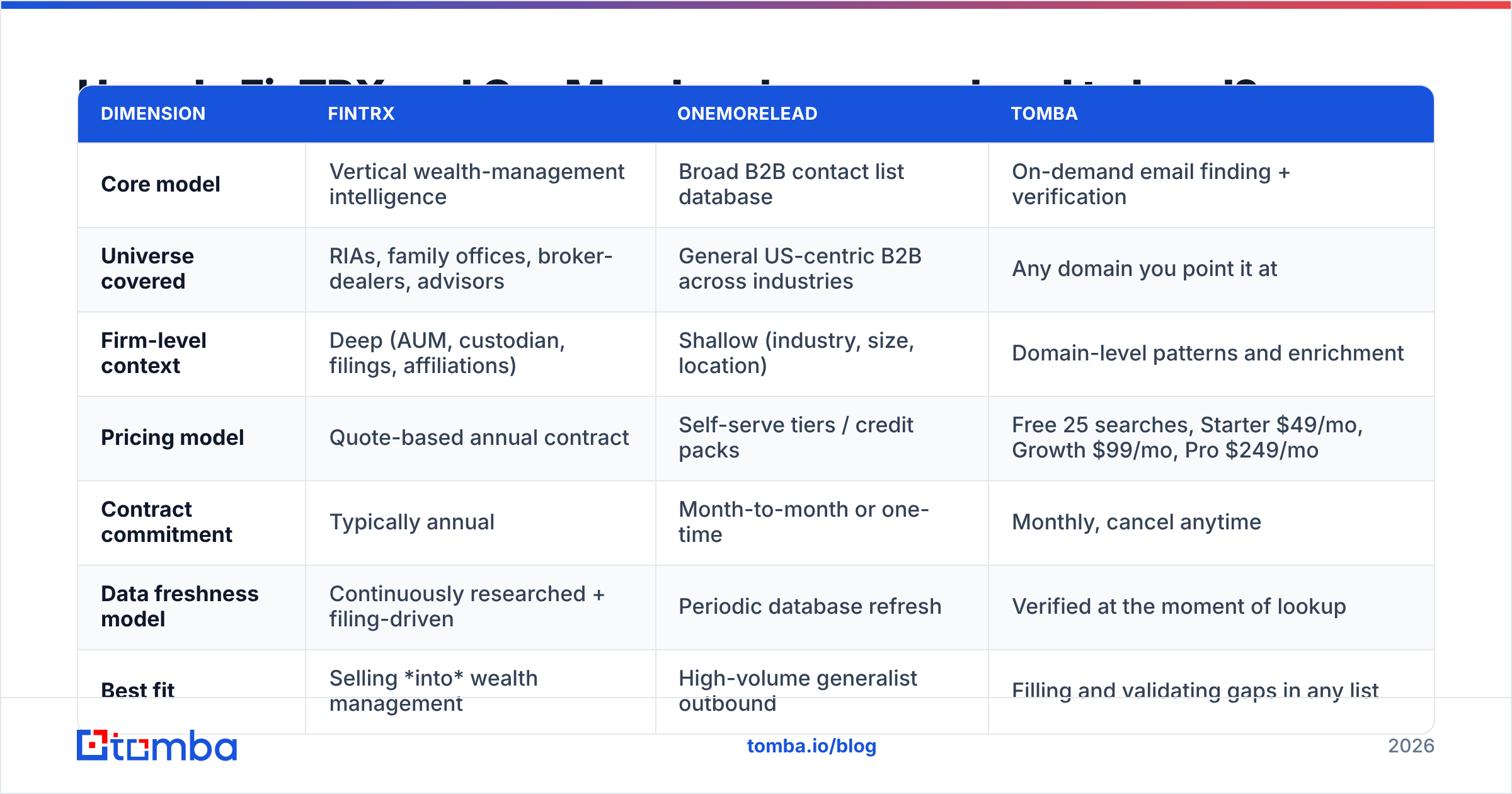
| Dimension | FinTRX | OneMoreLead | Tomba |
|---|---|---|---|
| Core model | Vertical wealth-management intelligence | Broad B2B contact list database | On-demand email finding + verification |
| Universe covered | RIAs, family offices, broker-dealers, advisors | General US-centric B2B across industries | Any domain you point it at |
| Firm-level context | Deep (AUM, custodian, filings, affiliations) | Shallow (industry, size, location) | Domain-level patterns and enrichment |
| Pricing model | Quote-based annual contract | Self-serve tiers / credit packs | Free 25 searches, Starter $49/mo, Growth $99/mo, Pro $249/mo |
| Contract commitment | Typically annual | Month-to-month or one-time | Monthly, cancel anytime |
| Data freshness model | Continuously researched + filing-driven | Periodic database refresh | Verified at the moment of lookup |
| Best fit | Selling into wealth management | High-volume generalist outbound | Filling and validating gaps in any list |
| API access | Available on higher tiers | Limited | Full Tomba API on all paid plans |
| Verification included | Vendor-side, not user-controlled | Vendor-claimed, no live recheck | Live SMTP-level email verifier |
The table makes the real choice clear. You are not picking between two versions of the same thing. You are picking between depth in one vertical and breadth across all of them. Both leave a verification gap you have to close yourself.
Which one has better data accuracy?#
Wrong question. Ask instead: accurate about what, and accurate when?
FinTRX has a real edge on firm attributes. Its records are tied to regulatory filings, which are public, dated, and audited. When FinTRX states a firm's assets, a filing sits behind the number. Generic databases cannot match that. They guess at firmographics from web scraping and self-reported profiles.
OneMoreLead has a real edge on volume. If you need 20,000 operations managers at mid-market manufacturers, FinTRX does not have them and never claimed to.
On email deliverability, both face the same physics. Contact data decays because people change jobs. Industry estimates put B2B email decay near 22–30% a year, or roughly 2–3% a month. That decay hits a curated wealth record just as hard as a bulk list row. A static export is a photo of a moving object.
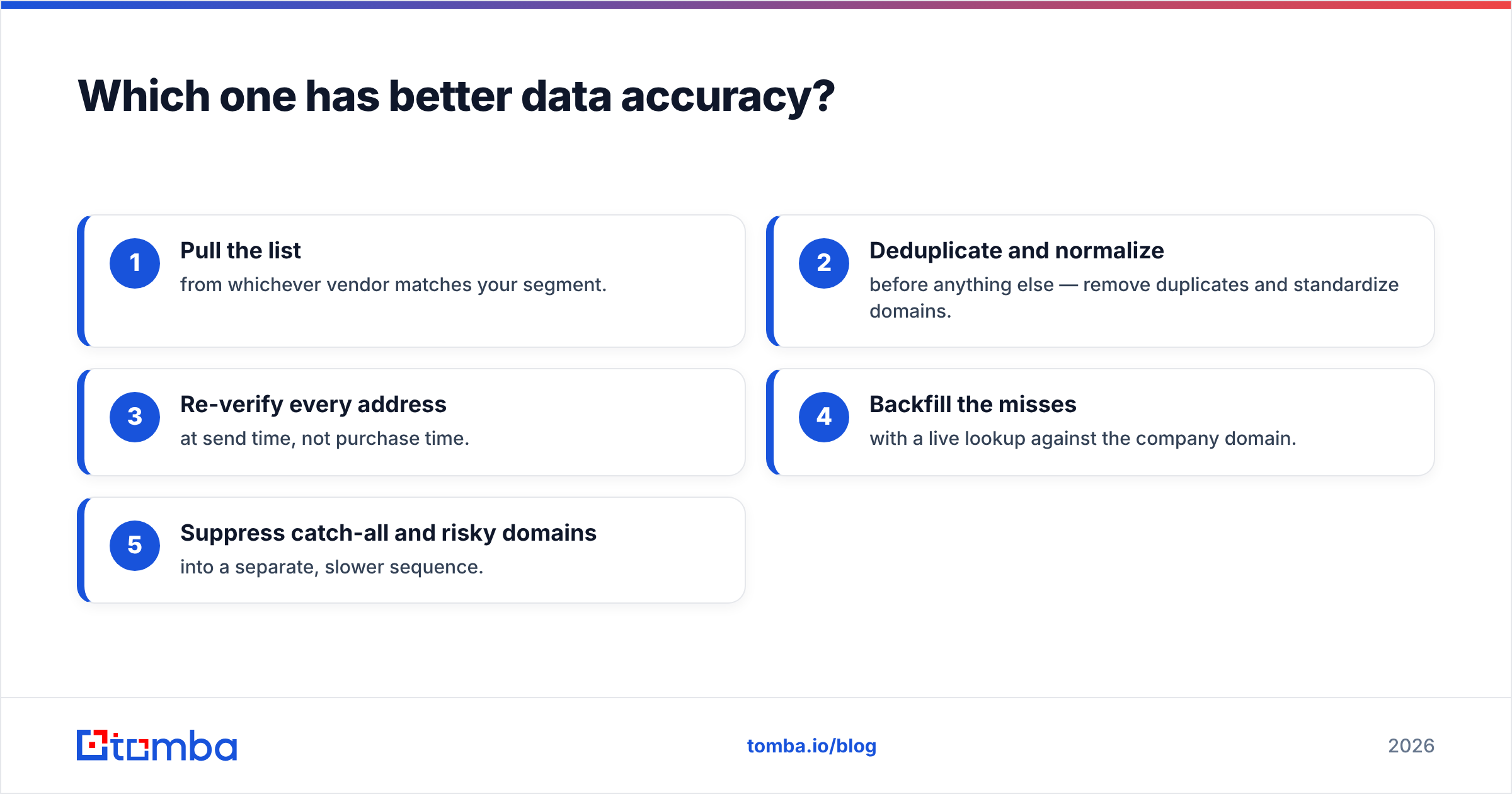
So experienced teams treat any bought list as input, not output. The workflow that protects your domain looks like this:
- Pull the list from whichever vendor matches your segment.
- Deduplicate and normalize before anything else — remove duplicates and standardize domains.
- Re-verify every address at send time, not purchase time.
- Backfill the misses with a live lookup against the company domain.
- Suppress catch-all and risky domains into a separate, slower sequence.
Skip step three and your bounce rate tells your ESP that you are a spammer. That is not a data problem. It is a sender reputation problem you caused yourself.
How does pricing really compare?#
FinTRX does not publish prices. That is the usual signal for annual-contract enterprise software. Expect a quote in the four- to five-figure range per year, based on seats, modules, and export volume. Expect a demo and a sales cycle too. That is not a knock. For a specialist dataset with a small buyer pool, quote-based pricing is normal.
OneMoreLead publishes prices and sells self-serve. You will pay far less per record. What you give up is negotiated data guarantees, dedicated support, and any accuracy SLA.
The hidden cost sits in a third column nobody quotes you: the cost of bad records. Buy 50,000 cheap contacts, bounce 25% of them, and you did not save money. You spent it on domain reputation, which is much harder to rebuild than to protect. A 12,500-record bounce event on a warm domain can take weeks to clean up.
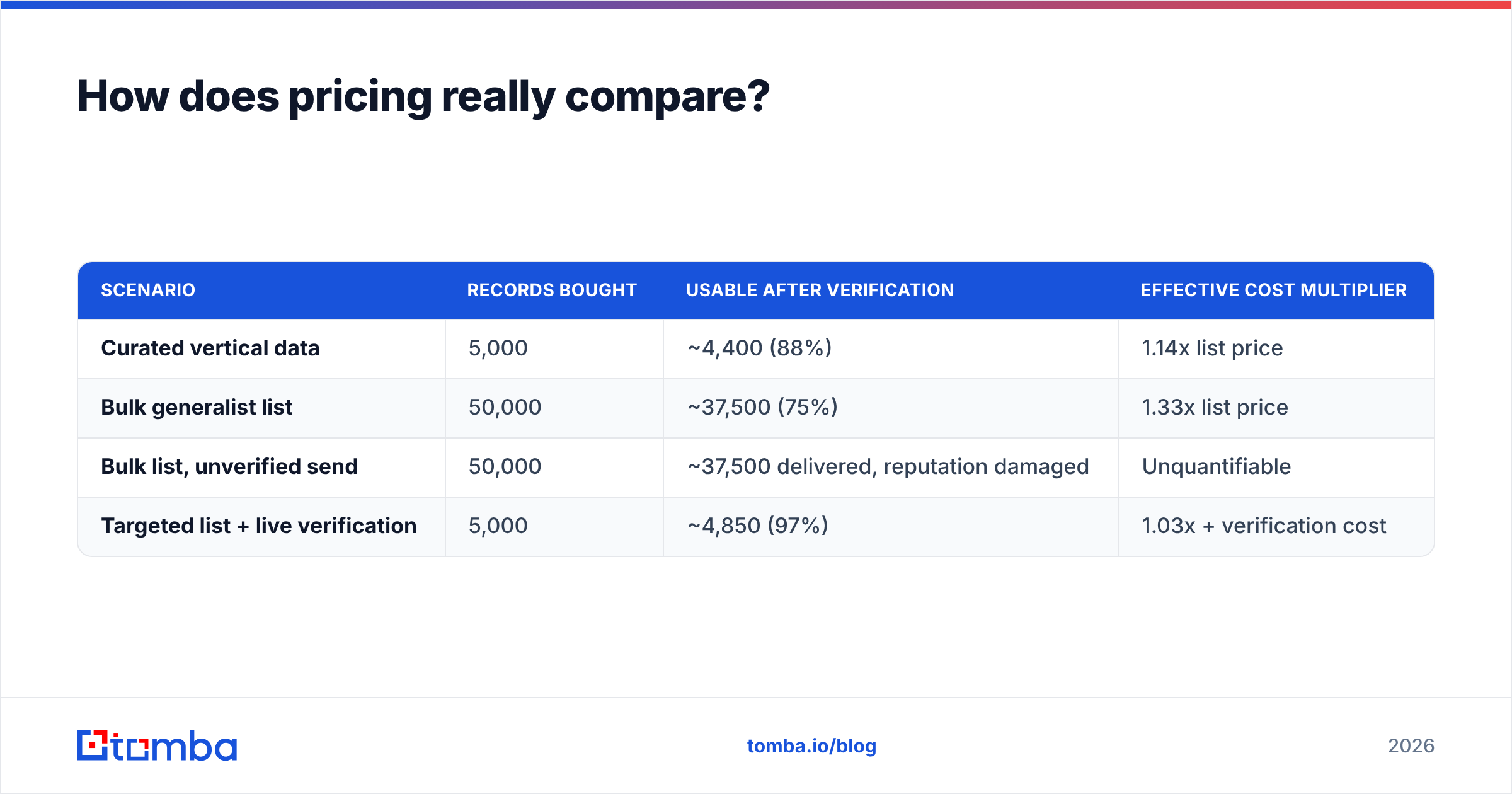
Run the math on cost per usable contact, not cost per contact:
| Scenario | Records bought | Usable after verification | Effective cost multiplier |
|---|---|---|---|
| Curated vertical data | 5,000 | ~4,400 (88%) | 1.14x list price |
| Bulk generalist list | 50,000 | ~37,500 (75%) | 1.33x list price |
| Bulk list, unverified send | 50,000 | ~37,500 delivered, reputation damaged | Unquantifiable |
| Targeted list + live verification | 5,000 | ~4,850 (97%) | 1.03x + verification cost |
Those percentages are illustrative, not measured. The point is the order, not the decimals. Verification costs less than the bounces it prevents. You can also test any vendor's claims with a free email checker on a sample before you sign.
Is FinTRX or OneMoreLead better for cold outbound?#
For cold outbound, the answer depends on the shape of your ICP.
Choose FinTRX if:
- Your buyers are RIAs, family offices, wealth advisors, or broker-dealers.
- Your qualification rests on firm attributes you cannot scrape: AUM tiers, custodian links, fee models.
- Your deal sizes justify a five-figure data spend. Selling a $60k platform into 400 target firms? The math works.
- You need advisor movement alerts as a trigger event.
Choose OneMoreLead if:
- Your ICP is a common B2B profile: SaaS, manufacturing, professional services, healthcare admin.
- You need volume now, at a price a small agency can absorb.
- You already own a verification layer and treat bought lists as raw material.
- You are testing several ICPs and cannot justify a specialist contract for any one of them.
Choose neither as your only source if:
- Your ICP is international. Both skew US-heavy.
- You need contacts at very small or brand-new companies, where static databases lag hardest.
- Your outbound depends on freshness: hiring triggers, funding events, role changes.
This market also has more than two options. Vendors like BookYourData sell verified, pay-as-you-go B2B lists with per-record accuracy guarantees. That is a different commercial model from both FinTRX's annual contract and OneMoreLead's bulk tiers. Get at least three quotes before you commit. The price spread in B2B data is wider than in almost any other software category.
What does a complete data stack look like in 2026?#
The teams with the best outbound numbers do not buy one database. They run a layered stack:
- Layer 1 — Target definition. Build the account list first, from whichever source knows your vertical best. For wealth management that is FinTRX. For generalist B2B, a bulk provider or LinkedIn export works fine.
- Layer 2 — Contact discovery. For each target domain, find the specific people in the specific roles. A domain search returns the current contacts on a company domain, plus the email pattern that domain uses. That holds up far better than a two-year-old CSV row.
- Layer 3 — Verification. Every address gets checked before it enters a sequence. Non-negotiable.
- Layer 4 — Enrichment. Add the fields your sequencing tool needs. Contact enrichment fills in titles, seniority, social profiles, and company data on thin records.
- Layer 5 — Ongoing hygiene. Re-verify your active database every quarter. Suppress hard bounces for good.
Layer 1 is where FinTRX and OneMoreLead compete. Layers 2 through 5 are where both of them stop. That is also where most of your deliverability outcome is decided.
What are the main drawbacks of each?#
FinTRX drawbacks:
- Useless outside financial services. If your ICP shifts, the contract does not.
- Quote-based pricing means no fast, low-commitment trial.
- An annual commitment is a real risk if your GTM motion is still unsettled.
OneMoreLead drawbacks:
- Little to no vertical context. You get contacts, not intelligence.
- Verification quality is vendor-asserted. You cannot inspect the method.
- Coverage of very small businesses and non-US markets is thin.
- Static exports age the moment you download them.
Shared drawback: neither is built to answer "what is this person's email address, right now?" That is a lookup problem, not a database problem, and it needs a live tool.
Which should you choose?#
The FinTRX vs OneMoreLead decision comes down to three cases.
Selling into wealth management with real deal sizes? FinTRX, and it is not close. Nothing generic replicates filing-anchored AUM and custodian data. Budget for it as a core GTM cost, not a tool.
Running generalist outbound on a tight budget? OneMoreLead gets you volume cheaply. Just accept that verification is your job. Build that step in before your first send, not after your first bounce spike.
Not sure yet, or running several ICPs? Do not sign an annual contract. Start with per-lookup tooling, prove which segment responds, then buy depth in the vertical that worked. It is the dull answer and usually the right one.
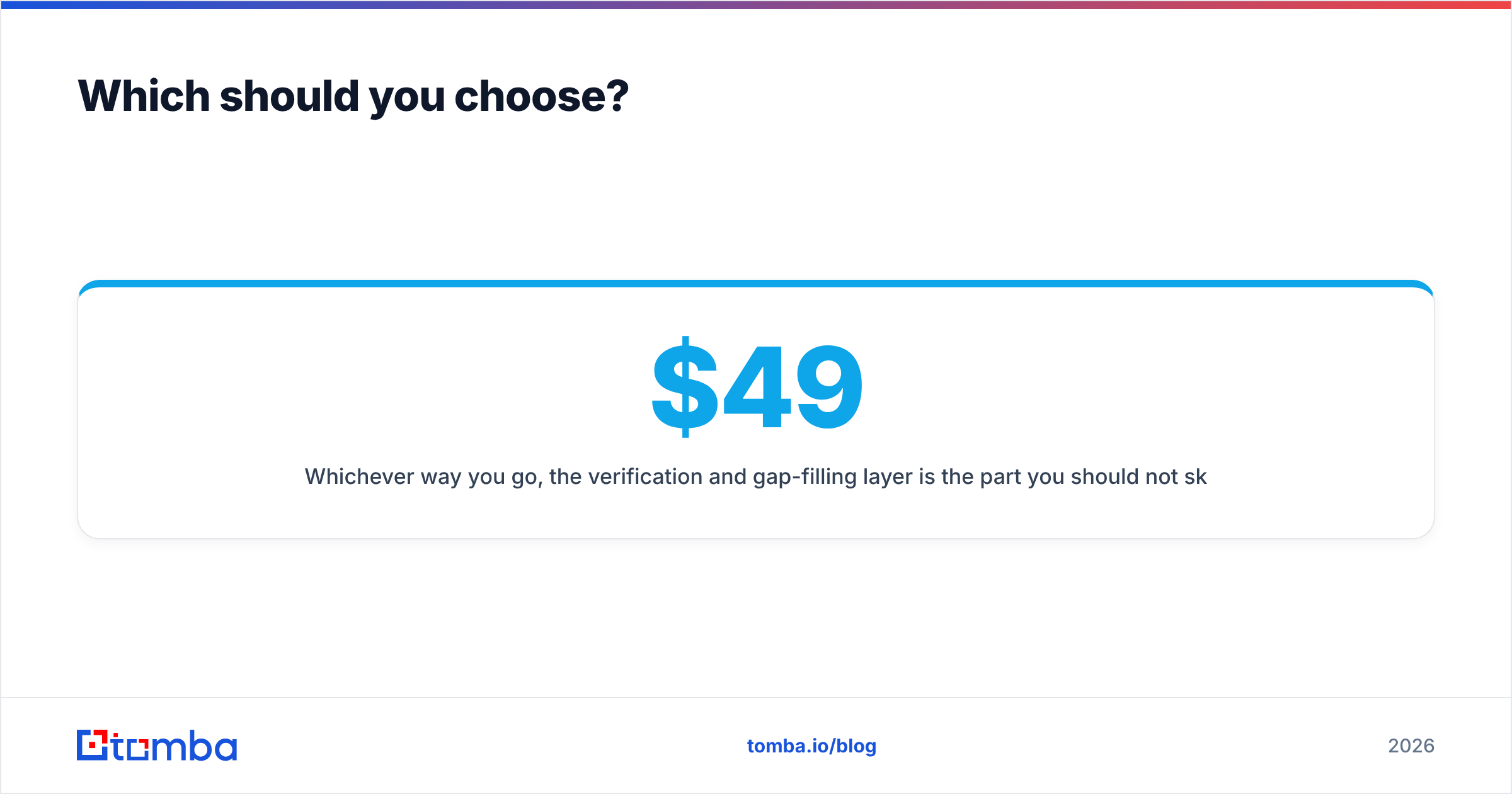
Whichever way you go, do not skip the verification and gap-filling layer. Tomba's pricing starts free at 25 searches a month, then $49/mo Starter, $99/mo Growth, and $249/mo Pro. That is a rounding error next to an enterprise data contract, and cheap insurance against a stale list.
Start here: point the Tomba Email Finder at twenty domains from your target list. Verify what comes back. Compare it against whatever your database vendor gave you. Twenty lookups will tell you more about your data quality than twenty vendor demos. If the gap is large, you know which layer to fix first.
Related guides#
Ready to find emails that actually work?
Join 150,000+ professionals who stopped guessing and started sending. Free credits on signup — no credit card required.
Get the Tomba newsletter
Practical outbound tactics and product updates — once every two weeks.
About the author