FinTRX vs SignalHire: Which B2B Data Tool Wins in 2026?
FinTRX sells depth in private wealth. SignalHire sells breadth across every industry. They are not really competitors — and picking the wrong one costs you a year of budget. Here is the honest breakdown.
FinTRX vs SignalHire is a fair question, but it hides a trap. The two tools do not do the same job. FinTRX maps one niche market. SignalHire finds contact details almost anywhere. This guide breaks the FinTRX vs SignalHire choice down by price, data, and fit, so you buy the right shape of tool.
TL;DR
- FinTRX is a vertical database for private wealth: family offices, RIAs, and wealth advisors. It sells on annual contracts, and pricing is quote-only.
- SignalHire is a horizontal contact finder. You get a browser extension, credit packs, and public prices.
- Sell into wealth management? FinTRX gives you firm context no general tool has. Sell anything else, and it is the wrong shape of tool.
- SignalHire wins on clear pricing, speed, and breadth. But paying per reveal gets costly once you enrich thousands of rows a month.
- Neither tool is built for the boring job most teams have: turning a list of company domains into verified work emails. A dedicated email finder does that for far less.
- The realistic 2026 stack: one niche database only if your buyers demand it, plus a cheap finder for everything else.
What are FinTRX and SignalHire, exactly?#
They solve different problems. Most FinTRX vs SignalHire write-ups blur that line.
FinTRX is a private wealth data platform. It maps a niche that big public databases handle badly. Think single and multi-family offices, registered investment advisors, and wealth teams. Records carry details a generic provider will never hold: AUM bands, custodian ties, allocation habits, ADV filing data, and team structure. Contact details come with the record, but they are not the point.
SignalHire is a contact finder in the classic sense. You install a browser extension. Open a LinkedIn profile, a GitHub account, or a company page, then click reveal. It returns work emails, personal emails, and phone numbers from a pooled database of hundreds of millions of profiles. It also adds light hiring features such as pipelines, notes, and team sharing. Many of its users are recruiters, not sellers.
Here is the plain translation. FinTRX tells you who is worth calling in one market. SignalHire tells you how to reach almost anyone. Buying one and expecting the other's job is the most common mistake in the FinTRX vs SignalHire debate.
FinTRX vs SignalHire: how do they compare head-to-head?#
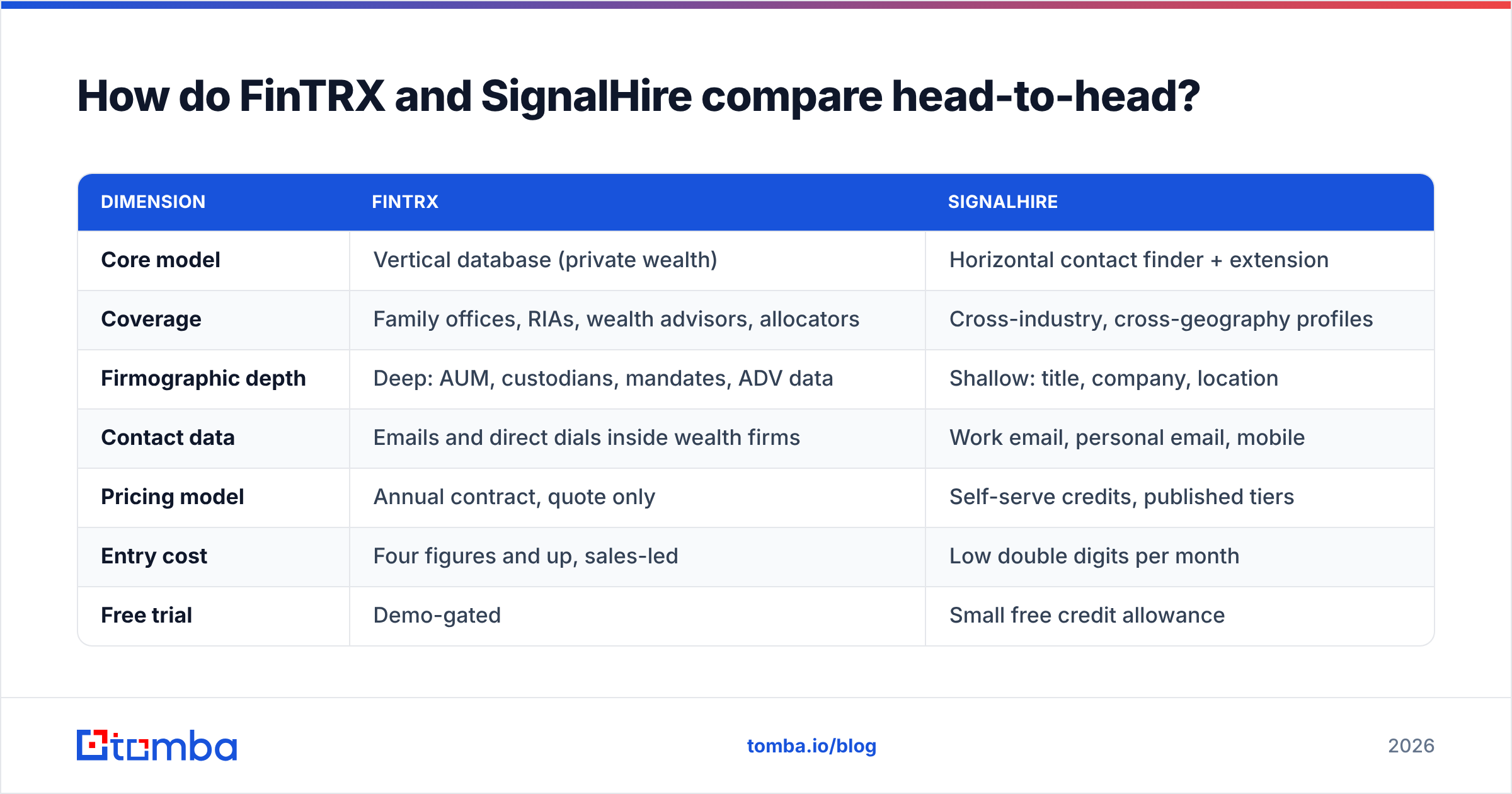
| Dimension | FinTRX | SignalHire |
|---|---|---|
| Core model | Vertical database (private wealth) | Horizontal contact finder + extension |
| Coverage | Family offices, RIAs, wealth advisors, allocators | Cross-industry, cross-geography profiles |
| Firmographic depth | Deep: AUM, custodians, mandates, ADV data | Shallow: title, company, location |
| Contact data | Emails and direct dials inside wealth firms | Work email, personal email, mobile |
| Pricing model | Annual contract, quote only | Self-serve credits, published tiers |
| Entry cost | Four figures and up, sales-led | Low double digits per month |
| Free trial | Demo-gated | Small free credit allowance |
| Bulk enrichment | CSV export from saved lists | Bulk reveal, CSV upload |
| API | Available on higher tiers | Yes, credit-metered |
| Best for | Asset raisers, fintech selling to wealth | Recruiters, generalist SDR teams |
| Worst for | Anyone outside private wealth | Deep account research |

The table hides one gap. FinTRX gets more useful the longer you work a single market. You learn which family offices back your category, and the platform remembers it for you. SignalHire stays flat and transactional. Every reveal costs the same, whether it is your first or your ten-thousandth. That gap shows up when you budget for a year, not a month.
FinTRX vs SignalHire: which has better email accuracy?#
Accuracy claims and inbox reality often differ. Judge each tool by segment, not by brand.
FinTRX is strong inside its lane. Records are checked against public filings and firm sites, not scraped at web scale. So hit rates on RIA and family office contacts hold up well. Job titles stay current too, which is rare in small firms where people wear four hats. Step outside private wealth and there is nothing there. That is not a flaw. It is the product boundary.
SignalHire acts like every large pooled database. Coverage is strong for US and Western European tech, marketing, and engineering roles. It is thinner for small business, non-English markets, and regulated niches. Personal emails and mobiles are its edge over pure work-email tools.
But personal data goes stale fast, and it carries the most GDPR risk. Reviews on G2 follow the usual pattern for this class of tool. Users praise the speed of the extension. They complain about credits burned on empty reveals, or on people who left months ago.

Three rules survive every bake-off we have run:
- Never treat a vendor's confidence score as a send decision. Run every list through an independent email verifier first. A 4% bounce on a 5,000-address send costs you more than verification ever will.
- Test on your own target list, not the demo list. Pull 100 real accounts, run both tools, and count verified deliverable addresses. Not "found" addresses.
- Split found from reachable. Catch-all domains inflate every hit rate. Handle them with a catch-all verifier instead of hoping they are safe.
FinTRX vs SignalHire pricing: what does each cost in 2026?#
This is the sharpest split between the two. It is also where most reviews end early.
FinTRX does not publish prices. You book a demo, share your team size and use case, and get an annual quote. Reported deals for small teams sit in the low-to-mid four figures per seat per year. Treat any number you read online as a rough guide, then get your own quote. Contracts run yearly, are seat-based, and usually include onboarding.
SignalHire lists tiers and sells credits. Entry plans start in the low tens of dollars a month for a few hundred reveals. Volume deals and annual prepay bring the per-credit rate down. A small free allowance lets you test first. Check current numbers on their pricing page before you budget. Credit vendors change packaging often.

Here is how the money behaves at three real volumes:
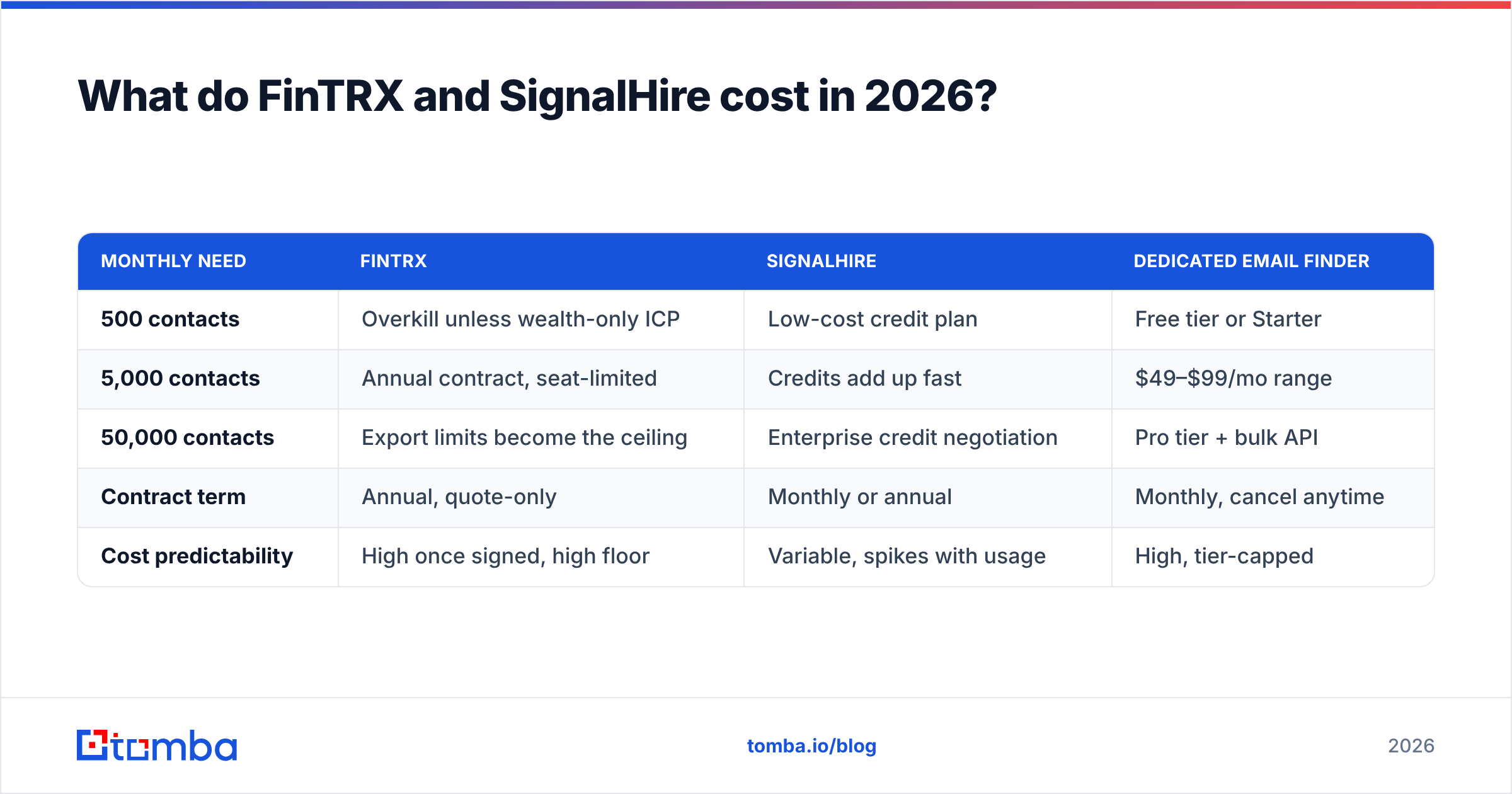
| Monthly need | FinTRX | SignalHire | Dedicated email finder |
|---|---|---|---|
| 500 contacts | Overkill unless wealth-only ICP | Low-cost credit plan | Free tier or Starter |
| 5,000 contacts | Annual contract, seat-limited | Credits add up fast | $49–$99/mo range |
| 50,000 contacts | Export limits become the ceiling | Enterprise credit negotiation | Pro tier + bulk API |
| Contract term | Annual, quote-only | Monthly or annual | Monthly, cancel anytime |
| Cost predictability | High once signed, high floor | Variable, spikes with usage | High, tier-capped |
The pattern is simple. FinTRX has a high floor and a steady ceiling. SignalHire has a near-zero floor and no clear ceiling. A generic finder gives you a low floor and a capped ceiling. That is why it often ends up as the volume layer, even in stacks that also pay for a niche database.
Who should choose FinTRX?#
Pick FinTRX when the hard question is who do I call? and the easy one is what is their email?
- Fund managers raising money from family offices. The allocation and mandate data is the product. No broad tool replaces it.
- Fintech and wealthtech vendors selling to RIAs. Custodian and AUM data lets you rank the firms that can afford your software.
- Private banks and boutique advisory firms tracking advisor moves and rival teams.
- Teams with a yearly budget and a long sales cycle. A six-month deal cycle absorbs a four-figure data contract. A two-week cycle does not.
Do not buy FinTRX because it also has emails. You would pay a research premium for a field you can get anywhere.
Who should choose SignalHire?#
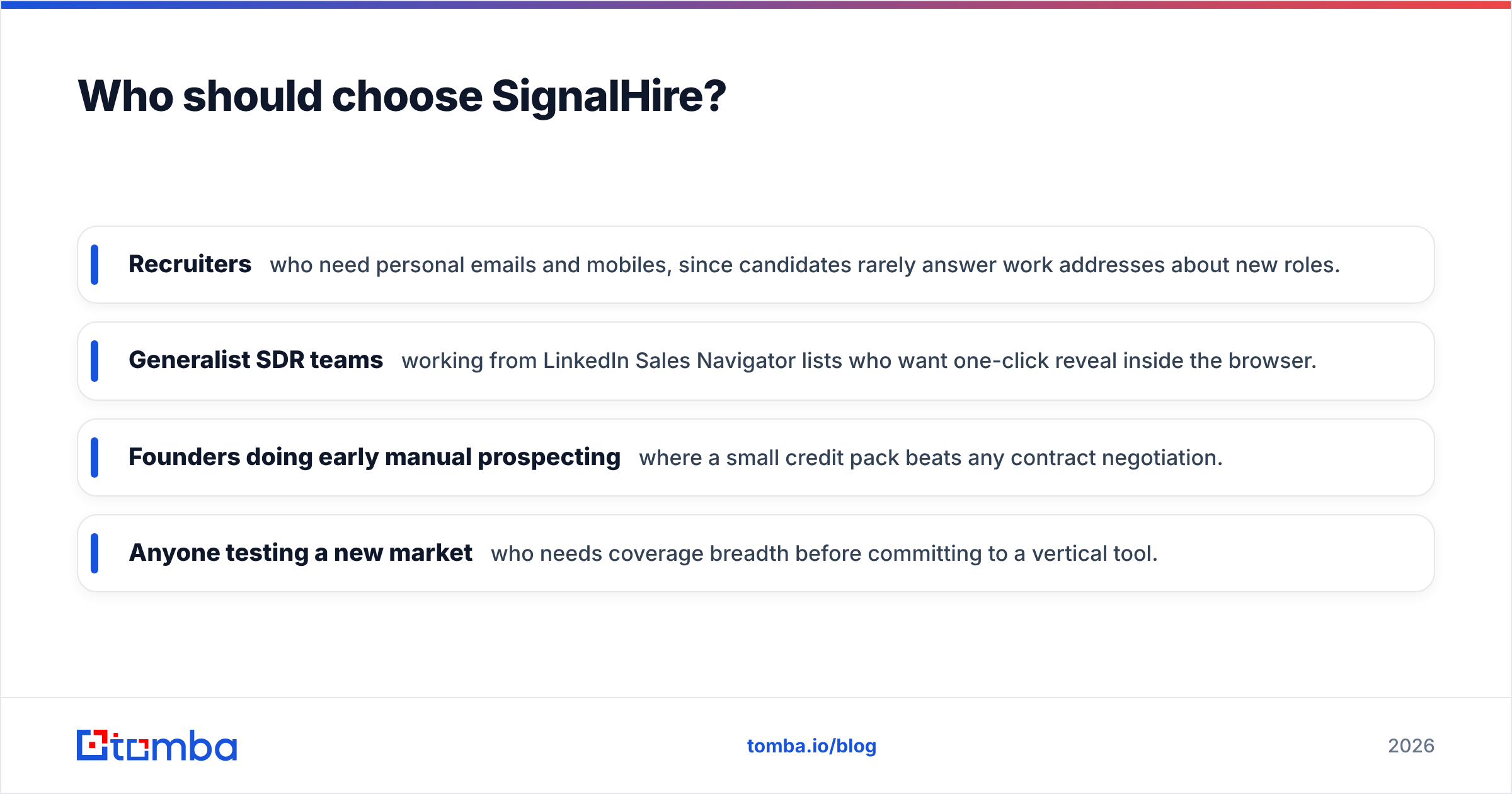
Pick SignalHire when your problem is reach, not research.
- Recruiters who need personal emails and mobiles. Candidates rarely reply to a work address about a new job.
- Generalist SDR teams working LinkedIn lists who want one-click reveal in the browser.
- Founders doing early manual outreach, where a small credit pack beats a contract talk.
- Anyone testing a new market who needs breadth before they commit to a niche tool.
Where it strains: steady, high-volume work. Push thousands of rows a month through it and two things bite. Credit costs climb, and pooled profiles go stale. At that point you want a domain-pattern finder plus verification.
Where does a dedicated email finder fit in this stack?#
Most teams weighing FinTRX vs SignalHire end up needing a third tool. Both are built to find people one at a time. The daily job is finding addresses by the thousand.
That third layer works like this:
- Domain-first search. You already know the target companies from your list, your CRM, or a niche database. Domain search returns every address it can find at a company, plus the email pattern. You do not pay per profile.
- Pattern-based finding. Give a first name, last name, and domain, and get a verified work email. It is the cheapest unit of prospecting, and it scales in a straight line.
- Verification before send. SMTP checks, MX checks, disposable and role-account flags, and clear catch-all handling. Run it on every address, whatever the source.
- Bulk and API work. Bulk processing for list uploads, plus an API for CRM triggers. Nobody clicks a browser extension 400 times a day.
- Enrichment last. Add titles, company size, socials, and phones once the address checks out.
This is where Tomba sits. Prices are public and flat: a free tier with 25 searches a month, Starter at $49/mo, Growth at $99/mo, Pro at $249/mo, and custom Enterprise.
There is no annual lock-in and no per-reveal roulette. Tomba will never tell you which family office backs private credit. That is FinTRX's job. It also does not chase mobile numbers the way SignalHire does. It makes the high-volume address layer cheap and checkable, and that is the part that quietly eats budget in both tools.

FinTRX vs SignalHire: what is the verdict?#
If private wealth is your whole market, buy FinTRX. Nothing broad matches its firm data. One closed allocation pays for the contract. Budget it as research spend, not contact spend, and pair it with a cheap verify layer.
If you sell across industries or you recruit, start with SignalHire. You get public prices, a working extension, personal contact data, and no procurement cycle. Watch the credit burn. Re-check the math once monthly volume passes a few thousand records.
If you just need verified work emails at scale, neither one is efficient. Test all three shapes on the same 100 accounts. Count verified deliverable addresses, divide by cost, and let the number decide.
One last note. Your sending reputation does not care where the data came from. Bad addresses from a premium database bounce as hard as bad addresses from a scraped pool. Verification is not optional in 2026. It is the cheapest insurance in the stack.
Ready to test the volume layer? Start with the Tomba Email Finder free tier. Run 25 searches against your real target accounts. Then compare the verified count to the quote sitting in your inbox. If a $49/mo plan covers 80% of the job, spend the rest on the data you truly cannot get elsewhere.
Related guides#
Ready to find emails that actually work?
Join 150,000+ professionals who stopped guessing and started sending. Free credits on signup — no credit card required.
Get the Tomba newsletter
Practical outbound tactics and product updates — once every two weeks.
About the author