FINTRX vs SMARTe (2026): Which B2B Data Platform Wins?
FINTRX sells depth in private wealth. SMARTe sells breadth in global contact data. They are not really competitors, and picking the wrong one wastes a year of budget. Here is the honest breakdown.
TL;DR
- FINTRX and SMARTe are not real competitors. FINTRX is a vertical database for private wealth (family offices, RIAs, wealth advisors). SMARTe is a horizontal global contact database with mobile numbers and intent signals.
- Choose FINTRX if your buyer manages money. Choose SMARTe if your buyer could be anyone with a job title, anywhere on earth.
- Neither publishes transparent per-seat pricing. Both run annual, sales-quoted contracts, which makes a side-by-side cost comparison harder than it should be.
- Both platforms decay. Private wealth contacts churn firms constantly, and global contact data ages at roughly 2-3% per month, so a verification layer is non-optional regardless of which you buy.
- Most teams end up with a specialist database plus a cheap, high-accuracy email layer on top. That second layer is where a tool like Tomba costs $49/mo instead of five figures a year.
What are FINTRX and SMARTe, exactly?#
They solve different problems, and the FINTRX vs SMARTe question usually comes up because someone put "B2B data platform" on both G2 categories and called it a day.
FINTRX is a private wealth intelligence platform. Its dataset is built around family offices, registered investment advisors, wealth advisory firms, and the people inside them. It pulls from regulatory filings (Form ADV is the backbone), plus proprietary research and manual enrichment. If you sell alternative investments, fund products, fintech infrastructure to wealth managers, or private placements, FINTRX is one of a small handful of vendors that even has your market mapped.
SMARTe is a global B2B contact and company database. It leans hard on international coverage (EMEA and APAC in particular, where most US-first vendors get thin), mobile phone numbers, and a Chrome extension that surfaces contacts while you browse LinkedIn or a company site. It is closer in spirit to Apollo, Lusha, or Cognism than to anything in the wealth-management space.
So the honest framing is not "which is better." It is "which market are you selling into, and does a vertical database earn its premium over a horizontal one?"

How do FINTRX and SMARTe compare head-to-head?#
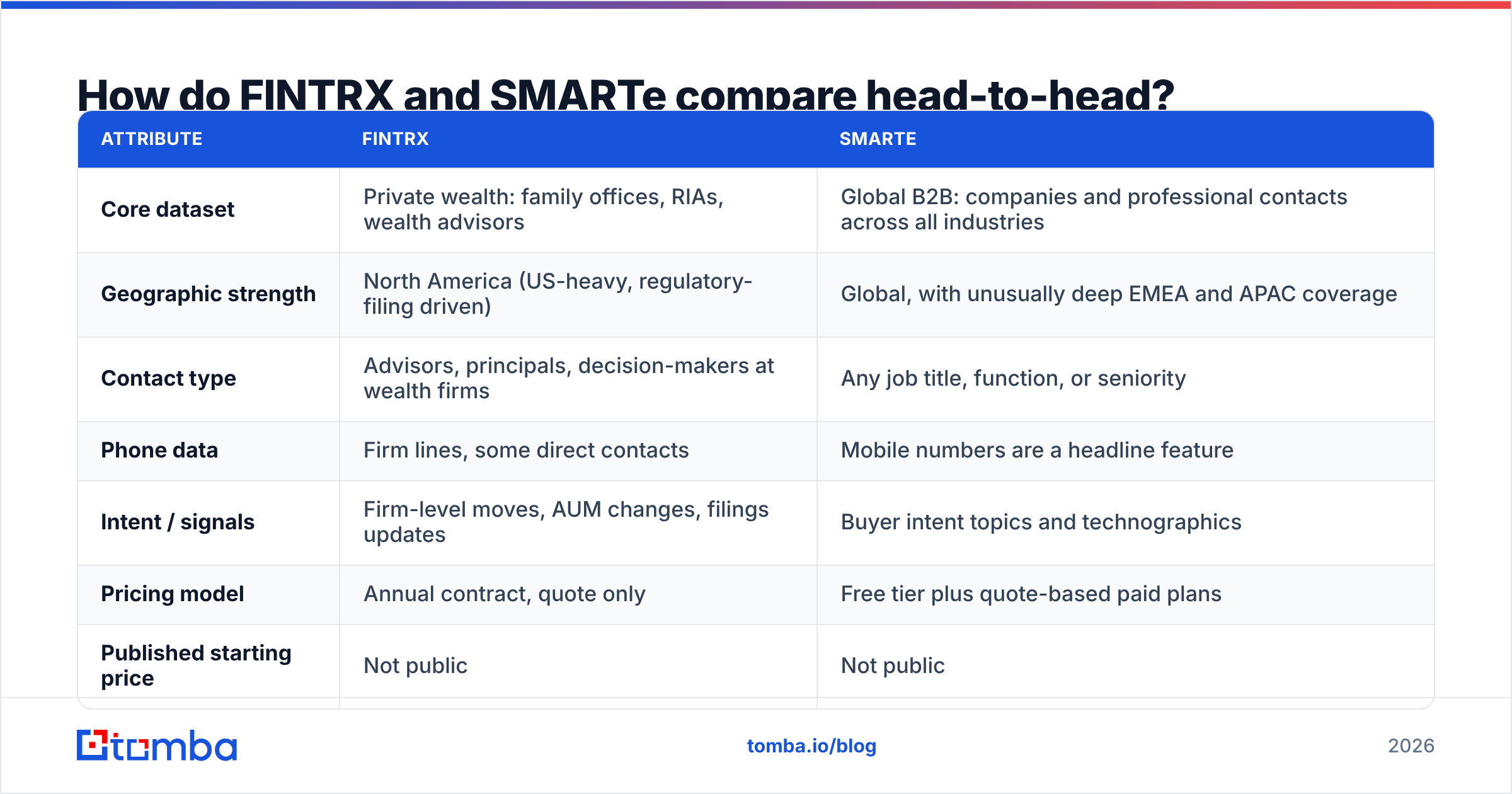
Here is the practical comparison. Treat coverage numbers as vendor-published marketing claims, not audited figures, because neither company submits its database to third-party verification.
| Attribute | FINTRX | SMARTe |
|---|---|---|
| Core dataset | Private wealth: family offices, RIAs, wealth advisors | Global B2B: companies and professional contacts across all industries |
| Geographic strength | North America (US-heavy, regulatory-filing driven) | Global, with unusually deep EMEA and APAC coverage |
| Contact type | Advisors, principals, decision-makers at wealth firms | Any job title, function, or seniority |
| Phone data | Firm lines, some direct contacts | Mobile numbers are a headline feature |
| Intent / signals | Firm-level moves, AUM changes, filings updates | Buyer intent topics and technographics |
| Pricing model | Annual contract, quote only | Free tier plus quote-based paid plans |
| Published starting price | Not public | Not public |
| CRM integrations | Salesforce, HubSpot | Salesforce, HubSpot, Outreach, Salesloft |
| Best fit | Asset managers, fund raisers, wealthtech vendors | SDR teams doing volume outbound across regions |
| Worst fit | Anything outside financial services | Niche wealth-management targeting |
The table makes the split obvious. FINTRX is depth in one vertical. SMARTe is breadth across all of them. Paying for FINTRX to prospect SaaS CTOs is like buying a surgical microscope to read a menu.
Which platform has better data coverage?#
Both, depending on what you mean by "better."
FINTRX wins on completeness inside its niche. Because a huge slice of its data derives from Form ADV filings with the SEC, the firm-level layer is close to authoritative. You get AUM, client counts, custodian relationships, and advisor rosters that a horizontal vendor simply does not model. Wikipedia's overview of the registered investment adviser structure is worth five minutes if you are new to why filings make this dataset possible.
SMARTe wins on raw reach. It indexes tens of millions of companies and hundreds of millions of contacts, and its non-US coverage is genuinely better than most US-headquartered competitors. If your TAM includes Germany, India, Singapore, and Brazil, SMARTe's list will be materially longer than what you get from an Apollo or a ZoomInfo pull.
Where both struggle is the same place every database struggles: contact-level freshness.
- Job changes. Roughly one in five B2B contacts changes role annually. In wealth management, advisor movement between firms is even more frequent, and breakaway advisors are a constant churn source.
- Email format drift. Companies migrate domains, get acquired, or change from
first.last@toflast@. Databases lag that change by months. - Catch-all domains. Financial firms disproportionately run catch-all mail servers, which means a "valid" flag from an SMTP ping is meaningless without a specialized catch-all verifier.
- Compliance suppression. GDPR and state privacy laws force suppression of records that were fine last quarter, and vendors do not always propagate that downstream.
- Stale phone data. Mobile numbers age faster than emails once someone leaves a company-issued line.
None of that is an indictment of either vendor. It is the physics of the category. It is also why teams that buy a database and skip verification see 15-30% bounce rates on their first send and blame the wrong thing.
What does FINTRX vs SMARTe cost in practice?#
Neither publishes a price page, which tells you both sell through a sales team with room to negotiate. Based on public reviews on G2 and buyer reports, here is the realistic shape of a deal:
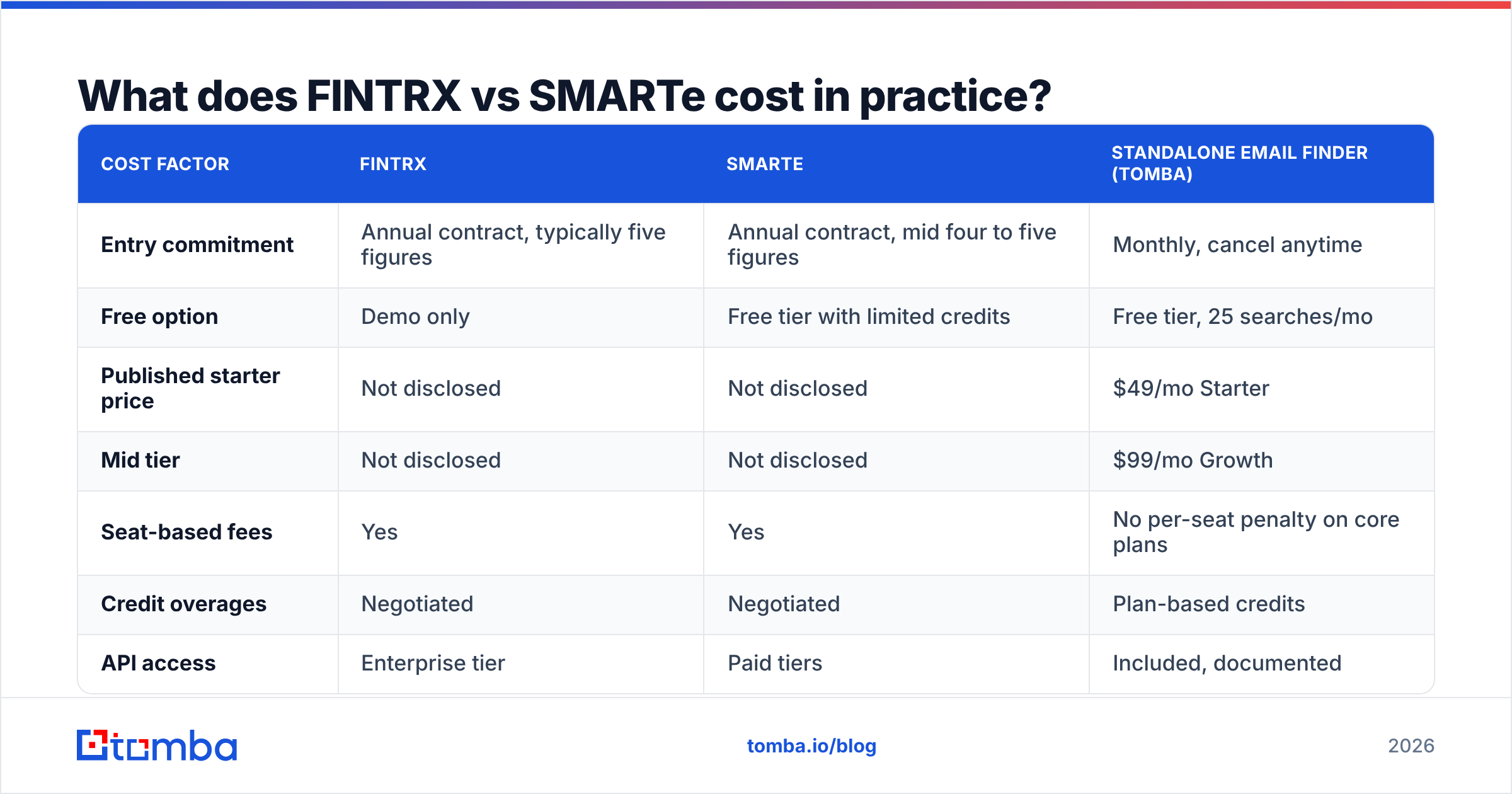
| Cost factor | FINTRX | SMARTe | Standalone email finder (Tomba) |
|---|---|---|---|
| Entry commitment | Annual contract, typically five figures | Annual contract, mid four to five figures | Monthly, cancel anytime |
| Free option | Demo only | Free tier with limited credits | Free tier, 25 searches/mo |
| Published starter price | Not disclosed | Not disclosed | $49/mo Starter |
| Mid tier | Not disclosed | Not disclosed | $99/mo Growth |
| Seat-based fees | Yes | Yes | No per-seat penalty on core plans |
| Credit overages | Negotiated | Negotiated | Plan-based credits |
| API access | Enterprise tier | Paid tiers | Included, documented |
The pattern is familiar: vertical intelligence platforms charge for research labor, not just records. FINTRX employs analysts who maintain firm profiles by hand, and you are paying for that headcount. SMARTe charges for global collection infrastructure and compliance overhead.
What you are not paying either vendor for is real-time email validation at send time. That is a separate job, and it is priced completely differently. You can see the gap plainly against published Tomba pricing, where a full month of finding and verifying costs less than a single hour of most enterprise data contracts.
If you want a middle path that avoids annual lock-in entirely, BookYourData is a solid option to evaluate alongside these two. It sells verified B2B lists on a pay-as-you-go basis with an accuracy guarantee, which suits teams that need a defined list once rather than a subscription they use twice a quarter.
Is FINTRX better than SMARTe for outbound email?#
For pure outbound volume, SMARTe. For outbound precision in wealth management, FINTRX. But there is a caveat that matters more than the choice itself.
Neither platform is a deliverability tool. They hand you addresses; they do not protect your domain reputation. Send a FINTRX advisor list straight into a cold sequence without validating it and you will hit spam traps that a filings-derived dataset inevitably contains, because filings list addresses that were current at filing time, not today.
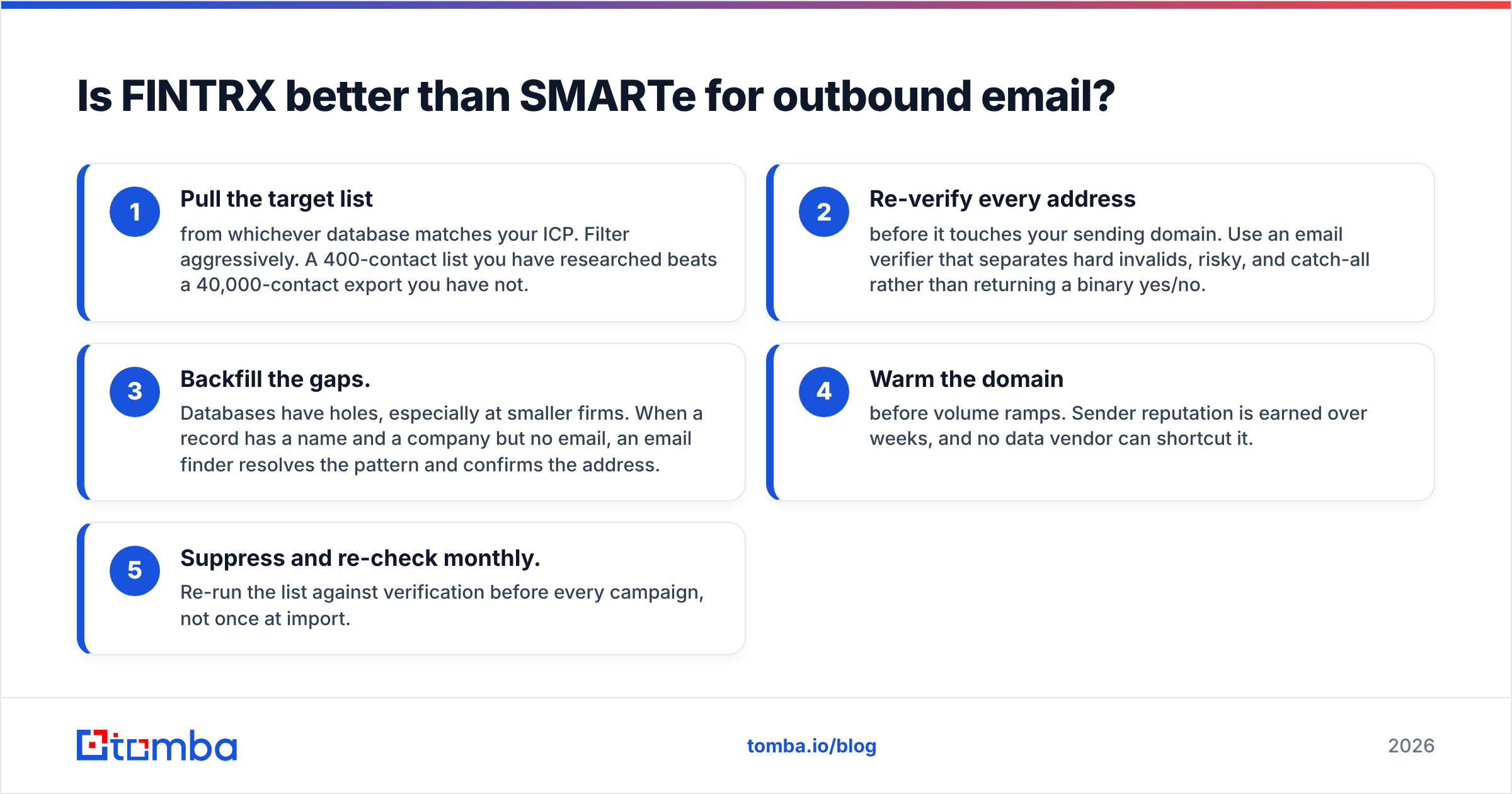
The workflow that actually holds up looks like this:
- Pull the target list from whichever database matches your ICP. Filter aggressively. A 400-contact list you have researched beats a 40,000-contact export you have not.
- Re-verify every address before it touches your sending domain. Use an email verifier that separates hard invalids, risky, and catch-all rather than returning a binary yes/no.
- Backfill the gaps. Databases have holes, especially at smaller firms. When a record has a name and a company but no email, an email finder resolves the pattern and confirms the address.
- Warm the domain before volume ramps. Sender reputation is earned over weeks, and no data vendor can shortcut it.
- Suppress and re-check monthly. Re-run the list against verification before every campaign, not once at import.

Step 2 is where most teams lose money on their data contract. They pay a premium for records, skip a $49 verification step, and then attribute the resulting 22% bounce rate to "bad data." Sometimes it is bad data. Often it is six-month-old good data.
Where does an email finder fit alongside FINTRX or SMARTe?#
Think of the database as the map and the email finder as the GPS. The map tells you which firms and people exist and why they matter. The GPS confirms the specific address is reachable right now.
Concretely, teams use the two layers like this:
- Enrichment on inbound. A demo request comes in with a work email. Reverse-resolve the company, then use data enrichment to fill firmographics before routing. Your primary database handles the strategic firm profile; the enrichment layer handles the speed.
- Filling database gaps. FINTRX will not have every advisor at a 12-person RIA. Run the firm domain through a domain search and you often surface the missing three contacts in seconds.
- Pre-send hygiene. Bulk-verify the export. Drop hard bounces, quarantine risky, route catch-alls to a slower, lower-volume channel.
- Cost control. Instead of buying extra database credits at enterprise rates, you use a low-cost finder for the marginal lookups that fall outside your contracted volume.
This is not a pitch to replace either vendor. FINTRX's filings research and SMARTe's international footprint are things a lightweight email tool does not attempt. It is a pitch to stop paying enterprise per-record rates for a job that costs cents.
Which should you choose in 2026?#
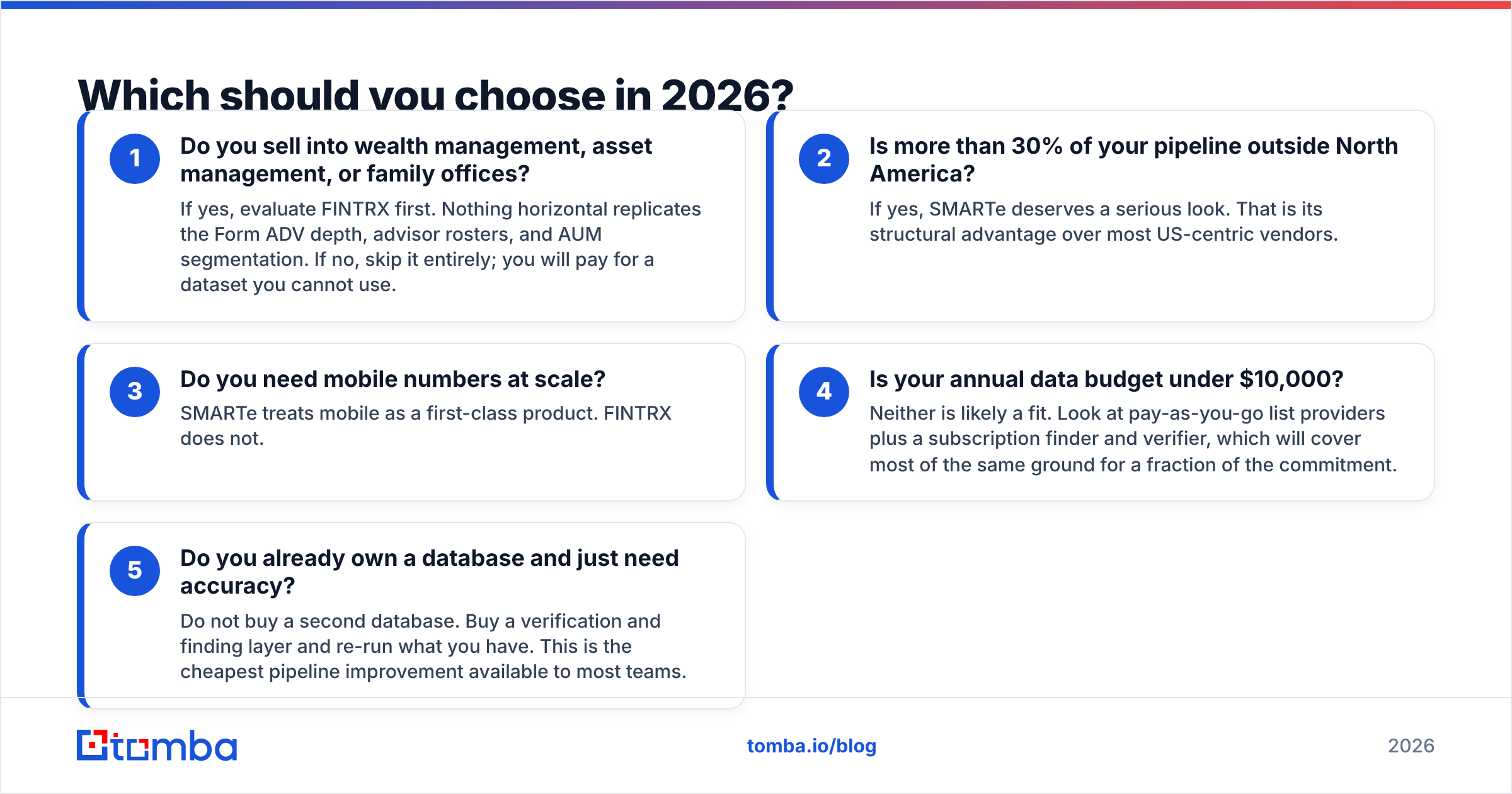
Use this decision path. It resolves the FINTRX vs SMARTe question in about thirty seconds.
- Do you sell into wealth management, asset management, or family offices? If yes, evaluate FINTRX first. Nothing horizontal replicates the Form ADV depth, advisor rosters, and AUM segmentation. If no, skip it entirely; you will pay for a dataset you cannot use.
- Is more than 30% of your pipeline outside North America? If yes, SMARTe deserves a serious look. That is its structural advantage over most US-centric vendors.
- Do you need mobile numbers at scale? SMARTe treats mobile as a first-class product. FINTRX does not.
- Is your annual data budget under $10,000? Neither is likely a fit. Look at pay-as-you-go list providers plus a subscription finder and verifier, which will cover most of the same ground for a fraction of the commitment.
- Do you already own a database and just need accuracy? Do not buy a second database. Buy a verification and finding layer and re-run what you have. This is the cheapest pipeline improvement available to most teams.
One more thing worth saying plainly: run a paid pilot on a sample of your actual ICP before signing anything annual. Ask each vendor for 500 records matching your exact filters, verify them independently, and count how many are deliverable. Vendors quote accuracy rates against their own definitions. Your bounce log does not lie.
For anyone in a hurry, the short version is that FINTRX is a specialist tool that is worth its price only if you sell to money managers, and SMARTe is a generalist tool that is worth its price mainly if your outbound crosses continents. Everyone else is overbuying.
Ready to fix the accuracy layer first?#
Before you sign a five-figure annual contract, find out how much of your existing list is still deliverable. Run your current export through the Tomba Email Finder and the verifier alongside it. The free tier gives you 25 searches a month to sanity-check the problem, Starter is $49/mo, and Growth is $99/mo with the API included. If verification alone recovers your bounce rate, you may not need a new database at all. If it does not, at least you will walk into the FINTRX or SMARTe demo knowing exactly what you are buying.
Related guides#
Ready to find emails that actually work?
Join 150,000+ professionals who stopped guessing and started sending. Free credits on signup — no credit card required.
Get the Tomba newsletter
Practical outbound tactics and product updates — once every two weeks.
About the author