FinTRX vs Tomba (2026): Wealth Data or B2B Email Finder?
FinTRX sells deep private-wealth data on RIAs and family offices. Tomba finds and verifies work emails on any domain from $49/mo. Here's which one actually fits your pipeline, and when running both is the smarter call.
FinTRX vs Tomba comes down to one question. Do you need deep wealth-market data, or do you need a work email that lands? FinTRX does the first job. Tomba does the second.
TL;DR
- Not the same category. FinTRX is a private-wealth database. It covers RIAs, family offices, and wealth advisors. Tomba is an email finder and verifier. It works on any company domain.
- Pick FinTRX if you sell only into wealth management. You get AUM, firm hierarchy, advisor moves, and regulatory context on each record.
- Pick Tomba if your buyers span industries. You have the company and the name. You need an email that will not bounce. Plans start at $49/mo, with a free tier.
- Pricing is the sharpest split. Tomba lists its plans in public. FinTRX is quote-only, annual, and per seat.
- Running both is normal. Target with FinTRX. Find and verify contacts with Tomba.
What is the real difference between FinTRX and Tomba?#
The FinTRX vs Tomba debate shows up in one spot. A team sells software, funds, or services into wealth management. They want to know if one tool can cover the whole motion. It cannot. The reason is structural.
FinTRX is a private wealth data platform. It goes deep in one vertical: registered investment advisors, family offices, wealth managers, and the people who work there. The value is not the email address. The value is context. Which firm is this? Roughly how much does it manage? Who is the custodian? What does it like to buy? Who just moved where? Asset managers and fund sponsors pay for that context.
Tomba is the opposite shape. It is a horizontal contact layer. Give it a domain, a name, or a LinkedIn profile. It returns a work email with a confidence score. Then it verifies the address before you send.
Tomba does not know what a custodian is. It does know how firstname.lastname@ and finitial.lastname@ patterns behave across millions of domains. It also tells you whether the mailbox accepts mail.
So one tool is vertical intelligence. The other is plumbing. "Which has better data?" is the wrong question in FinTRX vs Tomba. Ask which layer of your funnel is broken today.
How do FinTRX and Tomba compare feature by feature?#
Here is the head-to-head on the things that change your day.
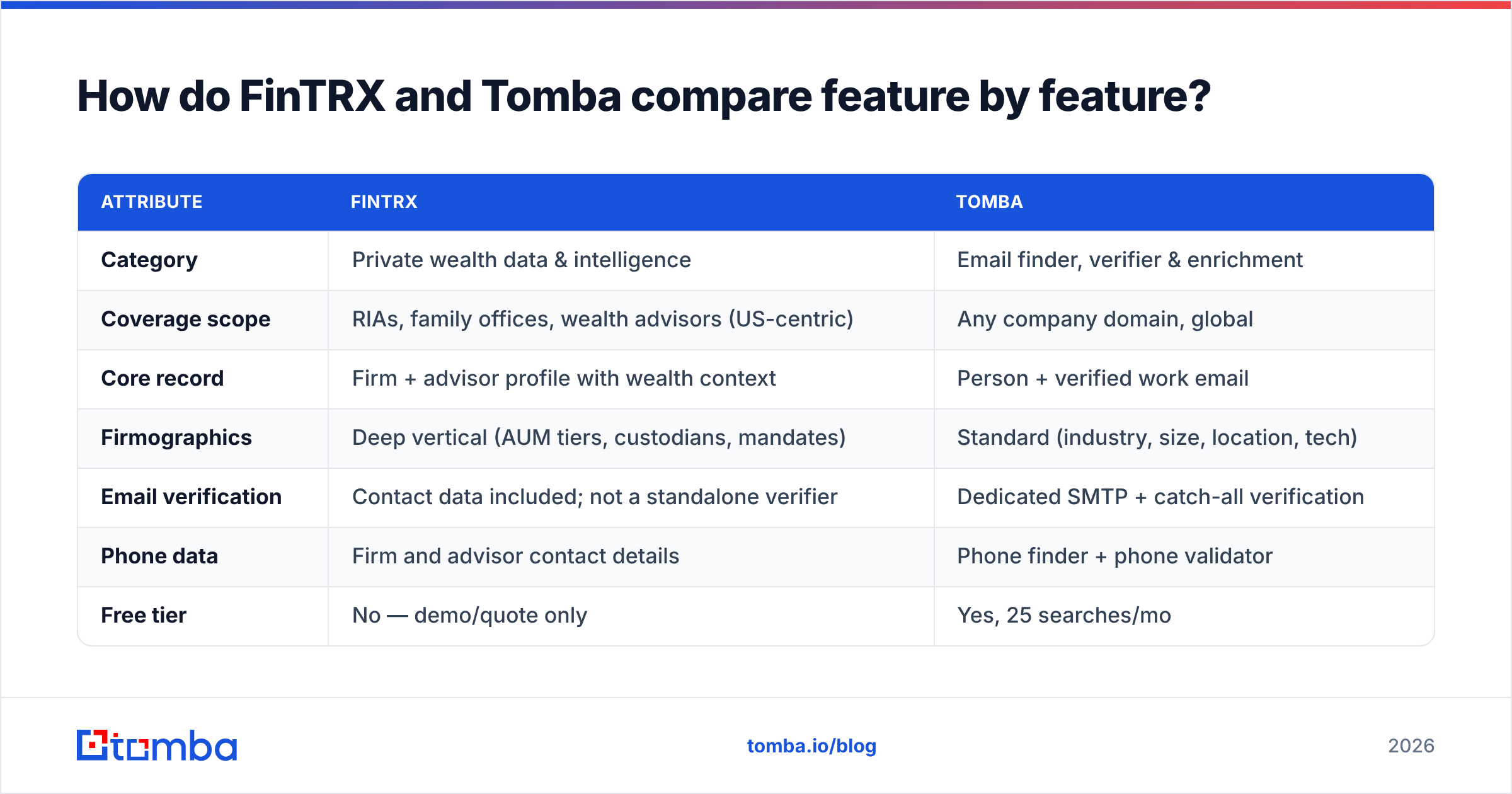
| Attribute | FinTRX | Tomba |
|---|---|---|
| Category | Private wealth data & intelligence | Email finder, verifier & enrichment |
| Coverage scope | RIAs, family offices, wealth advisors (US-centric) | Any company domain, global |
| Core record | Firm + advisor profile with wealth context | Person + verified work email |
| Firmographics | Deep vertical (AUM tiers, custodians, mandates) | Standard (industry, size, location, tech) |
| Email verification | Contact data included; not a standalone verifier | Dedicated SMTP + catch-all verification |
| Phone data | Firm and advisor contact details | Phone finder + phone validator |
| Free tier | No — demo/quote only | Yes, 25 searches/mo |
| Entry price | Quote-only, annual, seat-based | $49/mo Starter |
| API access | Available on enterprise agreements | Public API on all paid plans |
| Bulk processing | Exports within seat limits | Bulk finder + bulk verify |
| Spreadsheet workflow | CSV export, CRM sync | Google Sheets, Excel, Airtable add-ins |
| Best for | Wealth-management GTM teams | Multi-industry outbound and RevOps |
Two rows matter most. The free tier row changes how you test. You can run your own list through Tomba in ten minutes, with no sales call. A FinTRX trial runs through a demo first.
The API access row decides where the data can live. With an API, it sits inside your product or your automations. Without one, it lives in a UI that someone has to open.
Which one has the data you actually need?#
Split this into a few smaller questions.
1. Do you need firm-level intelligence? Think AUM bands, custodian ties, advisor tenure, breakaway moves, and family-office mandates. If your pitch changes based on who holds the assets, no horizontal tool will get you there. FinTRX exists because that data is hard to build and rarely shows up in generic B2B databases.
2. Do you need a live email for one named person? That is a different problem. It means pattern inference, catch-all handling, SMTP checks, and constant re-checks as people switch jobs. That is Tomba's job. It works for a 12-person RIA and for a factory in Lyon.
3. Do you need both, for the same person? Often yes. Vertical data says the firm is worth a shot. A verified email makes the message land.
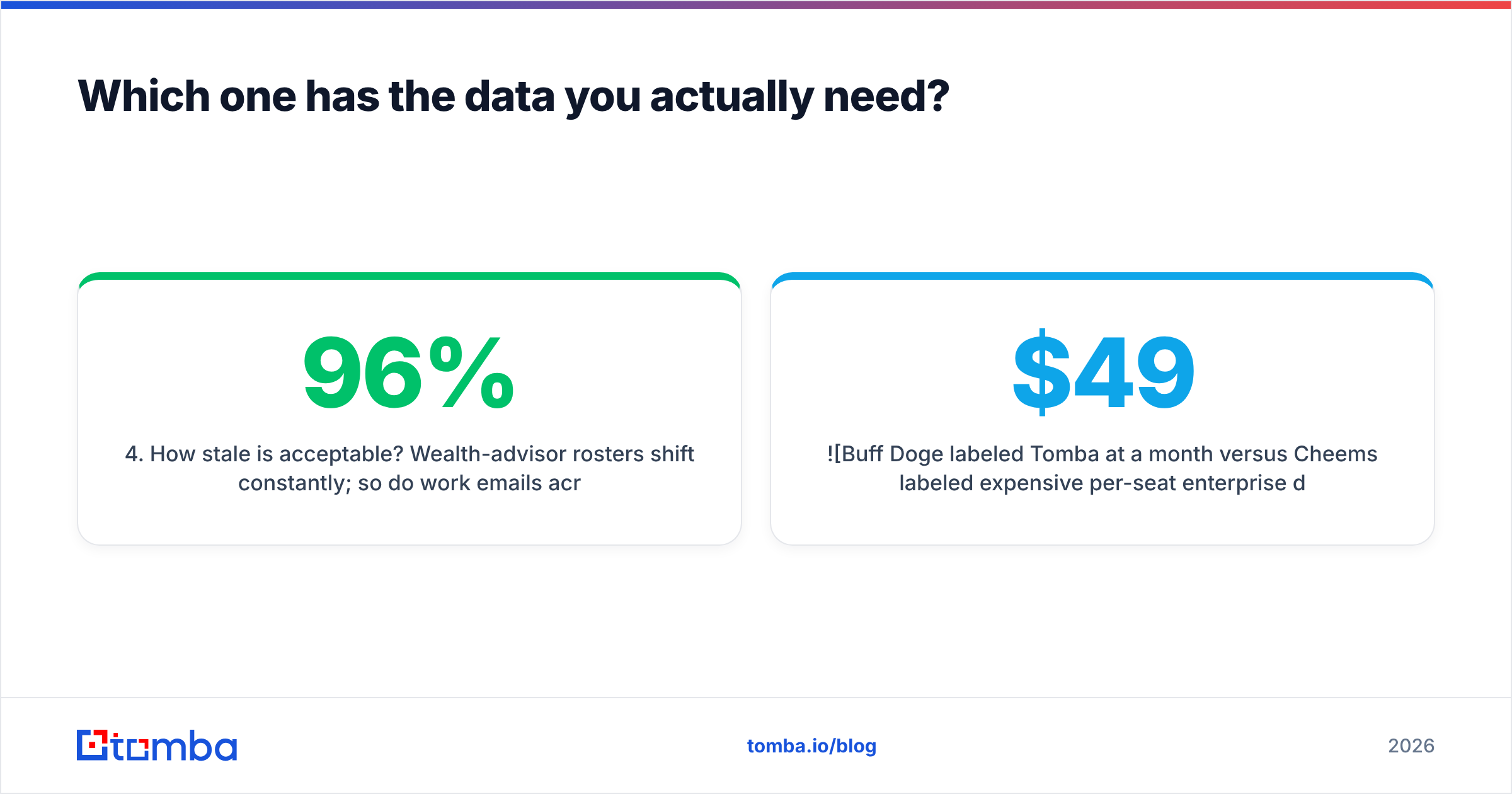
4. How stale can the list be? Advisor rosters move. So do work emails, in every industry. Re-verify before each campaign. A list that was 96% valid in January is not 96% valid in August.
5. What happens outside the vertical? The day your ICP adds fintech vendors or other B2B buyers, a wealth-only dataset returns blanks. Then you are back to a general email finder anyway.
One more note for the FinTRX vs Tomba shortlist. Much RIA firm data starts life as a public filing. You can read those yourself at the SEC's adviser disclosure site. Vendors add real value by structuring and maintaining that data. Still, knowing the source keeps you honest when a vendor claims it is the only one with it.

What does each platform cost in 2026?#
Cost is where FinTRX vs Tomba gets awkward for buyers who want a fast answer.
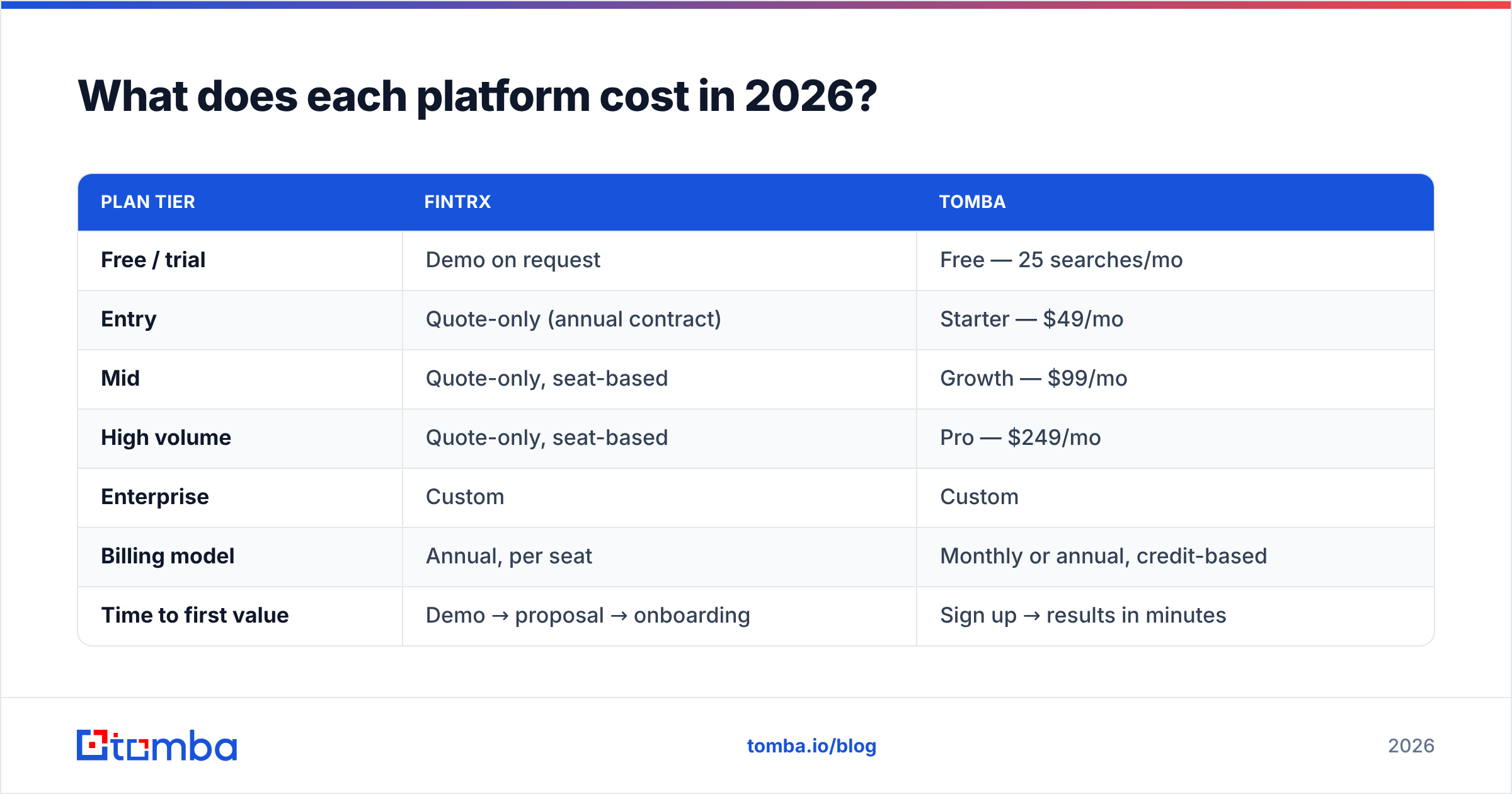
| Plan tier | FinTRX | Tomba |
|---|---|---|
| Free / trial | Demo on request | Free — 25 searches/mo |
| Entry | Quote-only (annual contract) | Starter — $49/mo |
| Mid | Quote-only, seat-based | Growth — $99/mo |
| High volume | Quote-only, seat-based | Pro — $249/mo |
| Enterprise | Custom | Custom |
| Billing model | Annual, per seat | Monthly or annual, credit-based |
| Time to first value | Demo → proposal → onboarding | Sign up → results in minutes |
FinTRX does not publish prices. That is standard for vertical data platforms. The number depends on seats and modules. Treat any figure you find on a third-party blog with care, and get a written quote. Peer reviews on G2 help you sanity-check the experience, but they are not a price list.
Tomba's pricing is public and self-serve. Free covers 25 searches a month. Starter is $49/mo, Growth is $99/mo, Pro is $249/mo, and Enterprise is custom. One rep can test the tool against a real list this afternoon, with no procurement cycle. That also makes Tomba a cheap control group: run 200 known-good contacts through both and compare bounce rates.
One honest caveat. A $49/mo email finder and a five-figure wealth-data license do not fight over the same budget line. "FinTRX is expensive" misreads the product. Ask this instead: what does the vertical data buy me that I cannot approximate, and is it worth the gap?
When should you choose FinTRX?#
Choose FinTRX when all of these are true.
- Your whole market is wealth management. Fund managers raising from RIAs. Sponsors targeting family offices. Vendors selling advisor tools.
- Segments drive revenue, not volume. You work a small, known universe with care. You are not blasting 20,000 contacts a month.
- You need context in line one. "I saw you custody at X and allocate to Y" beats "Hi {{first_name}}."
- You can sign an annual data contract and fill enough seats to justify it.
- Compliance matters. Regulated buyers often have to show where a record came from.
Are you a two-person startup still testing the segment? Then a vertical license is early. Prove the market with cheaper tools first.
When should you choose Tomba?#
Choose Tomba when the block is reach, not market intelligence.
- Your ICP spans industries and a vertical database returns nothing on half your list.
- You already have the accounts. A conference list, a scraped directory, a CRM import. Domain search lists the people at a company. The email finder resolves one name.
- Bounces are hurting deliverability. A real email verifier with catch-all handling is not the same as "contact data included."
- You want the data in your systems. The Tomba API, CLI, Sheets and Excel add-ins, and CRM links let enrichment run as a job instead of a manual export.
- You need to move this week. Free tier, then $49/mo. No procurement.
The trade-off is real, so say it plainly. Tomba will not tell you a firm's AUM band or its custodian. It is a reachability layer, not a wealth-intelligence layer.

Can you run FinTRX and Tomba together?#
Yes. For most wealth-focused GTM teams, that is the real answer to FinTRX vs Tomba, not a diplomatic dodge.
A stack that works:
- Target in the vertical tool. Build the firm list in FinTRX by AUM, geography, mandate, and advisor criteria. No horizontal tool copies this part.
- Export the firms and named contacts you plan to work this quarter.
- Find and verify in Tomba. Run the list through bulk email finding and verification. Catch-all domains are common at small advisory firms on Microsoft 365. They get flagged, not silently bounced.
- Fill the gaps. Use data enrichment to add titles, LinkedIn profiles, and phone numbers before the record hits your CRM.
- Re-verify before every campaign. Not once at import. Every time.
That split also guards your sender reputation, which is the quiet cost of bad data. A 6% bounce rate on a 3,000-contact send does more damage than the price gap between any two tools on this page.
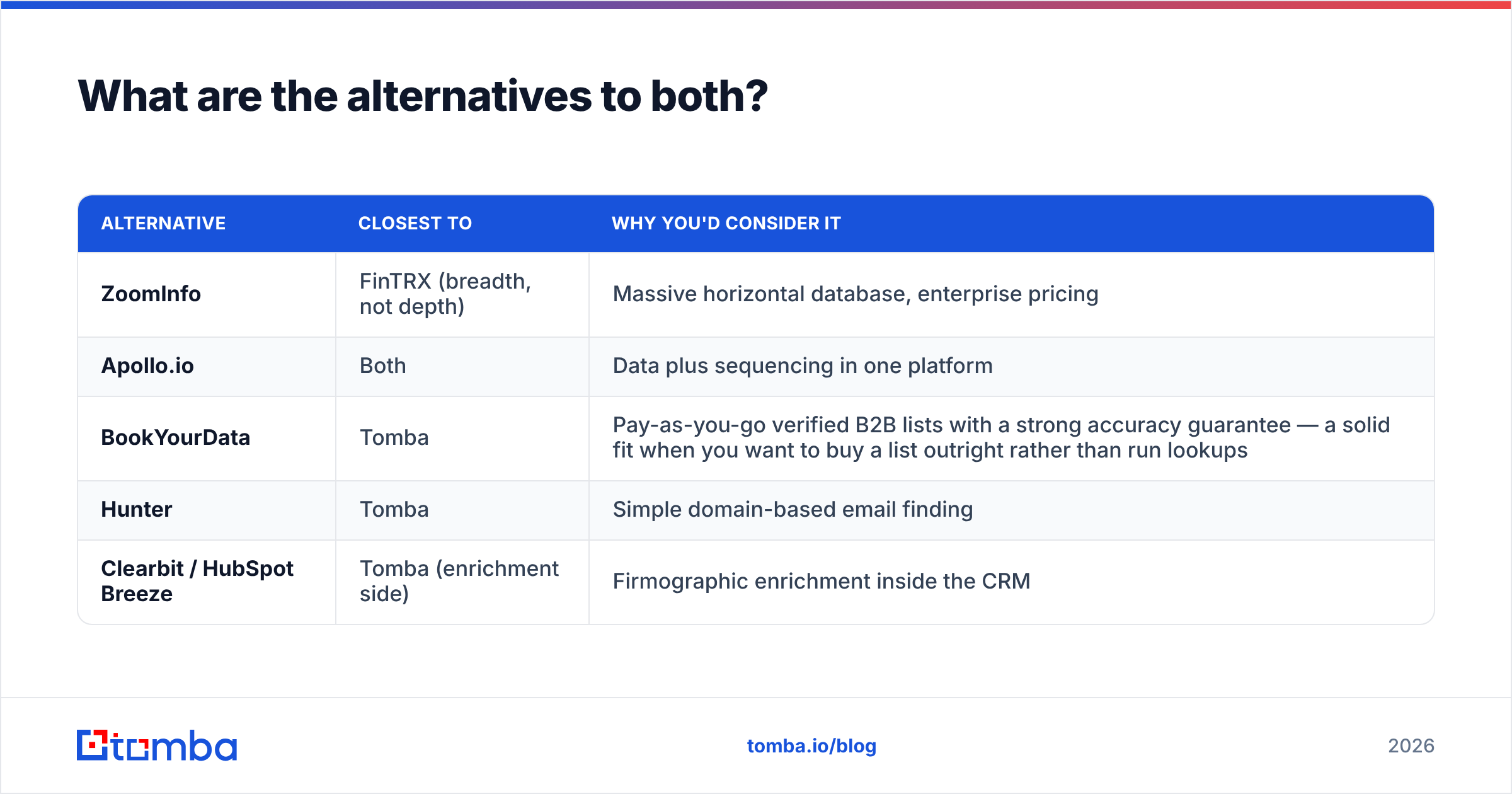
What are the alternatives to both?#
Neither tool is your only option, and an honest comparison should say so.
| Alternative | Closest to | Why you'd consider it |
|---|---|---|
| ZoomInfo | FinTRX (breadth, not depth) | Massive horizontal database, enterprise pricing |
| Apollo.io | Both | Data plus sequencing in one platform |
| BookYourData | Tomba | Pay-as-you-go verified B2B lists with a strong accuracy guarantee — a fit when you want to buy a list outright |
| Hunter | Tomba | Simple domain-based email finding |
| Clearbit / HubSpot Breeze | Tomba (enrichment side) | Firmographic enrichment inside the CRM |
BookYourData suits one clear preference: "give me a clean list I own." That is a different purchase model, and a good one for one-off campaigns. Apollo suits teams that want prospecting and sending in a single seat, though many teams split data from sending again later. The Apollo alternative guide covers those trade-offs.
What's the verdict on FinTRX vs Tomba?#
Sell only into wealth management, and lead with firm intelligence? FinTRX earns its price, and Tomba will not replace it. Prospect across industries, or fight bounces and missing emails? Tomba solves that for a fraction of the cost, and it starts free.
For most teams working RIAs and family offices at scale, the answer to FinTRX vs Tomba is both. FinTRX for targeting. Tomba for reach. The two budgets do not compete, and the pair beats either one alone.
The cheapest way to settle it is a test. Pull 200 contacts you know are good. Run them through both. Compare valid rates and bounce rates. Data-quality claims are marketing. Your own bounce log is evidence.
Start with the Tomba Email Finder. The free tier gives you 25 searches a month with no card. That is enough to benchmark accuracy before you sign anything annual. If it holds up, $49/mo Starter puts verified contact data behind every campaign you run, in any vertical you enter next.
Related guides#
Ready to find emails that actually work?
Join 150,000+ professionals who stopped guessing and started sending. Free credits on signup — no credit card required.
Get the Tomba newsletter
Practical outbound tactics and product updates — once every two weeks.
About the author