First ECO Pricing Reviews (2026): Pros, Cons, Verdict
First ECO sells project signals, not contact data — and it sells them by quote. Here is what the pricing model actually looks like, what reviewers praise and complain about, and when a cheaper stack wins.
Most First ECO pricing reviews stop at the same wall: there is no public price list. This guide breaks down what a quote covers, what buyers say they pay, and when a cheaper stack wins.
TL;DR
- First ECO is a French business-signals service. It scans public sources for early-stage projects — construction, energy, environment, industry — and sends them to sales teams as leads. It is not an email finder or a contact database.
- There is no public price list. Quotes are annual and scoped by territory, sector, and seats. That opacity is the loudest complaint in First ECO pricing reviews.
- Reported deals start in the low four figures a year for one region. National, multi-sector access runs into five figures. Treat every number here as a reported range, not a rate card.
- Signal quality is genuinely good. The gaps are contact data, workflow depth, and no way to scale spend down mid-contract.
- Need verified decision-maker emails at scale? A per-credit tool at $49/mo does that job for a fraction of the price. The two stack well together.
What is First ECO, and what are you actually paying for?#
First ECO (first-eco.com) is a project-detection service. Analysts and crawlers comb through public tenders, planning permissions, local press, municipal minutes, industrial announcements and environmental filings. What they find is packaged as a structured "business signal": a company, a project, a budget estimate where available, a stage, and a date.
The pitch is timing. A construction supplier does not want a list of every general contractor in France. It wants to know that a specific 40-unit development in Isère just cleared planning. First ECO sells that moment.
That framing matters when you judge the price. You are not buying a database. You are buying an editorial and monitoring service with a human cost baked in. So the pricing behaves like a media subscription — annual, territory-scoped, seat-based — rather than like a data tool with credits and self-serve checkout.
Three things First ECO is not:
- Not a contact database. Signals identify companies and projects. Getting the named decision-maker and a working inbox is a separate job, usually handled by an email finder or an enrichment layer.
- Not a sequencer. There is no cold email engine, no cadence builder, no deliverability tooling.
- Not global. Coverage is strongest in France and francophone Europe. If your ICP is US mid-market SaaS, this is the wrong category entirely.
First ECO pricing reviews: what does it actually cost in 2026?#
Short answer: nobody outside a signed contract knows exactly. First ECO publishes no rate card and prices each deal on scope.
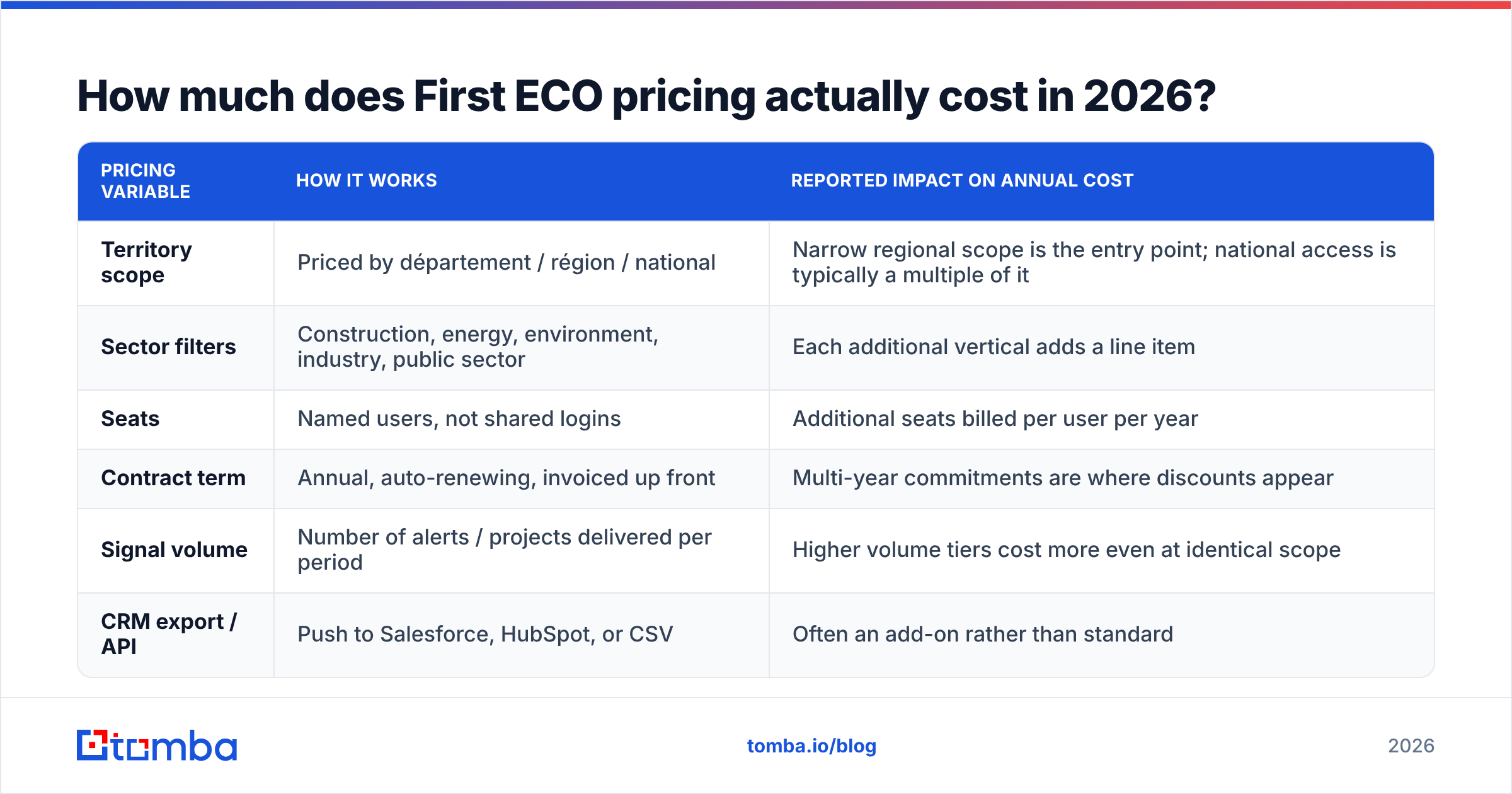
Here is the honest version of what shapes a quote, with reported ranges from buyers and resellers. Verify every figure against your own quote — these are directional, not contractual.
| Pricing variable | How it works | Reported impact on annual cost |
|---|---|---|
| Territory scope | Priced by département / région / national | Narrow regional scope is the entry point; national access is typically a multiple of it |
| Sector filters | Construction, energy, environment, industry, public sector | Each additional vertical adds a line item |
| Seats | Named users, not shared logins | Additional seats billed per user per year |
| Contract term | Annual, auto-renewing, invoiced up front | Multi-year commitments are where discounts appear |
| Signal volume | Number of alerts / projects delivered per period | Higher volume tiers cost more even at identical scope |
| CRM export / API | Push to Salesforce, HubSpot, or CSV | Often an add-on rather than standard |
The pattern buyers describe is simple. A single-region, single-sector, one-seat subscription lands in the low thousands of euros per year. Add two regions, a second vertical, and three seats, and you are into a five-figure annual commitment. There is no free tier and no month-to-month escape hatch.
Compare that shape to a self-serve tool. Tomba's pricing runs a free tier at 25 searches/mo, Starter at $49/mo, Growth at $99/mo, Pro at $249/mo, and custom Enterprise. You can start Tuesday afternoon without a call. You cannot do that with First ECO — and for some buyers, that alone decides it.
What do First ECO reviews say — the real pros?#
Review coverage on aggregators like G2 and Capterra is thin for French-market vendors. Most useful signal comes from user forums, agency case notes, and reference calls. The consistent praise:
- Early-stage timing. The core promise holds up. Reps say they reached a project owner before an RFP existed. That is where win rates are highest.
- Human curation. Analysts read and structure the signals. You get fewer false positives than a raw Google Alerts setup, and summaries you can quote in a first email.
- Local depth. Municipal and regional sources that no global platform indexes. If your territory is a French département, that coverage is hard to replicate.
- Sales-ready framing. Each signal reads like a reason to call. That fixes the "I have data but no angle" problem.
- Account management. Buyers report responsive onboarding and scope tuning in the first quarter.
What are the cons buyers flag most often?#
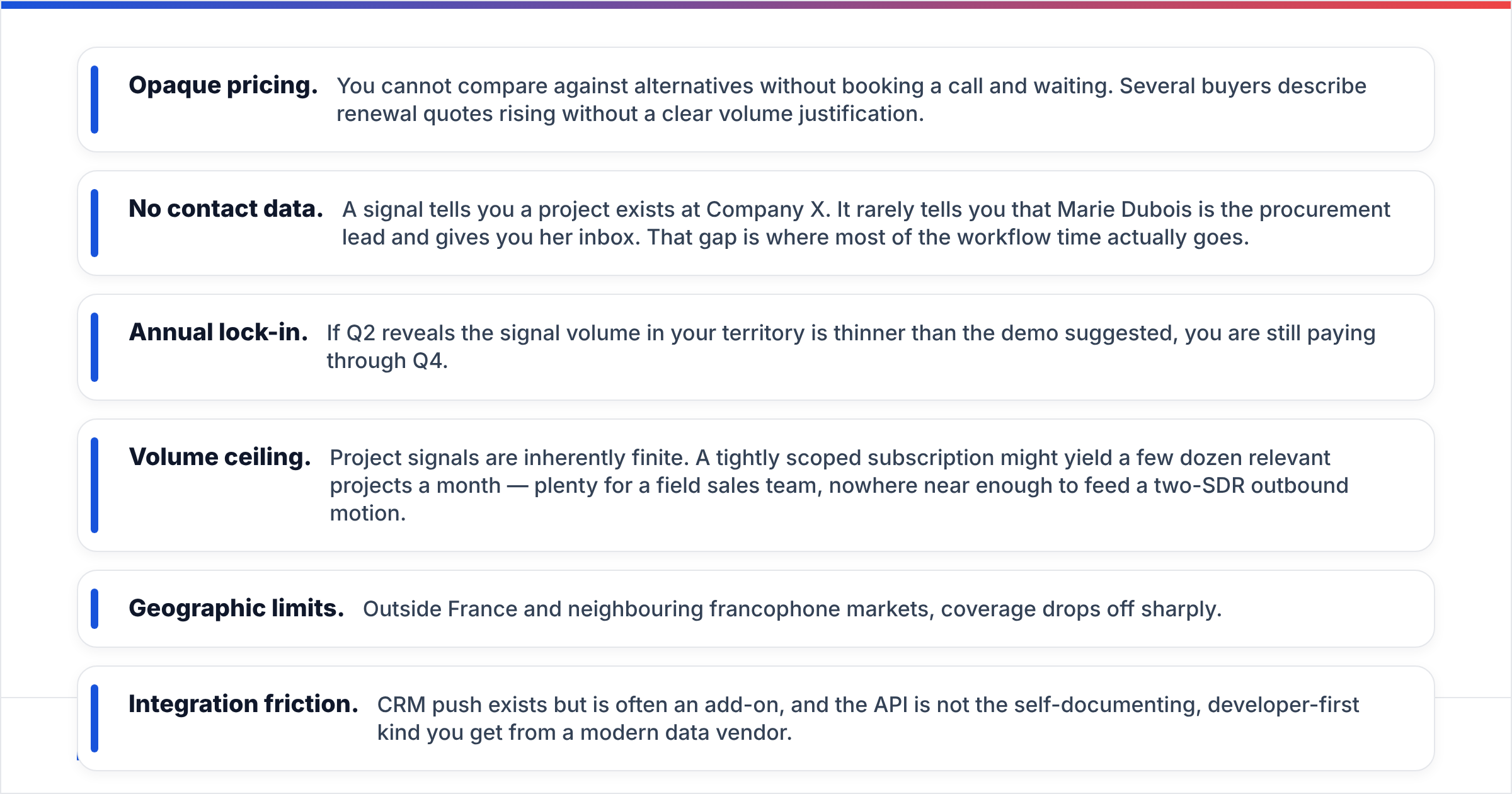
- Opaque pricing. You cannot compare vendors without booking a call. Buyers in First ECO pricing reviews also report renewal quotes rising with no clear volume justification.
- No contact data. A signal says a project exists at Company X. It rarely names the procurement lead or hands you her inbox. That gap eats most of the workflow time.
- Annual lock-in. If Q2 shows thin signal volume in your territory, you still pay through Q4.
- Volume ceiling. Project signals are finite. A tight scope may yield a few dozen projects a month. Plenty for field sales, nowhere near enough for two SDRs.
- Geographic limits. Outside France and nearby francophone markets, coverage drops off sharply.
- Integration friction. CRM push exists, but it is often an add-on. The API is not the developer-first kind you get from modern data vendors.
How does First ECO compare to the alternatives?#
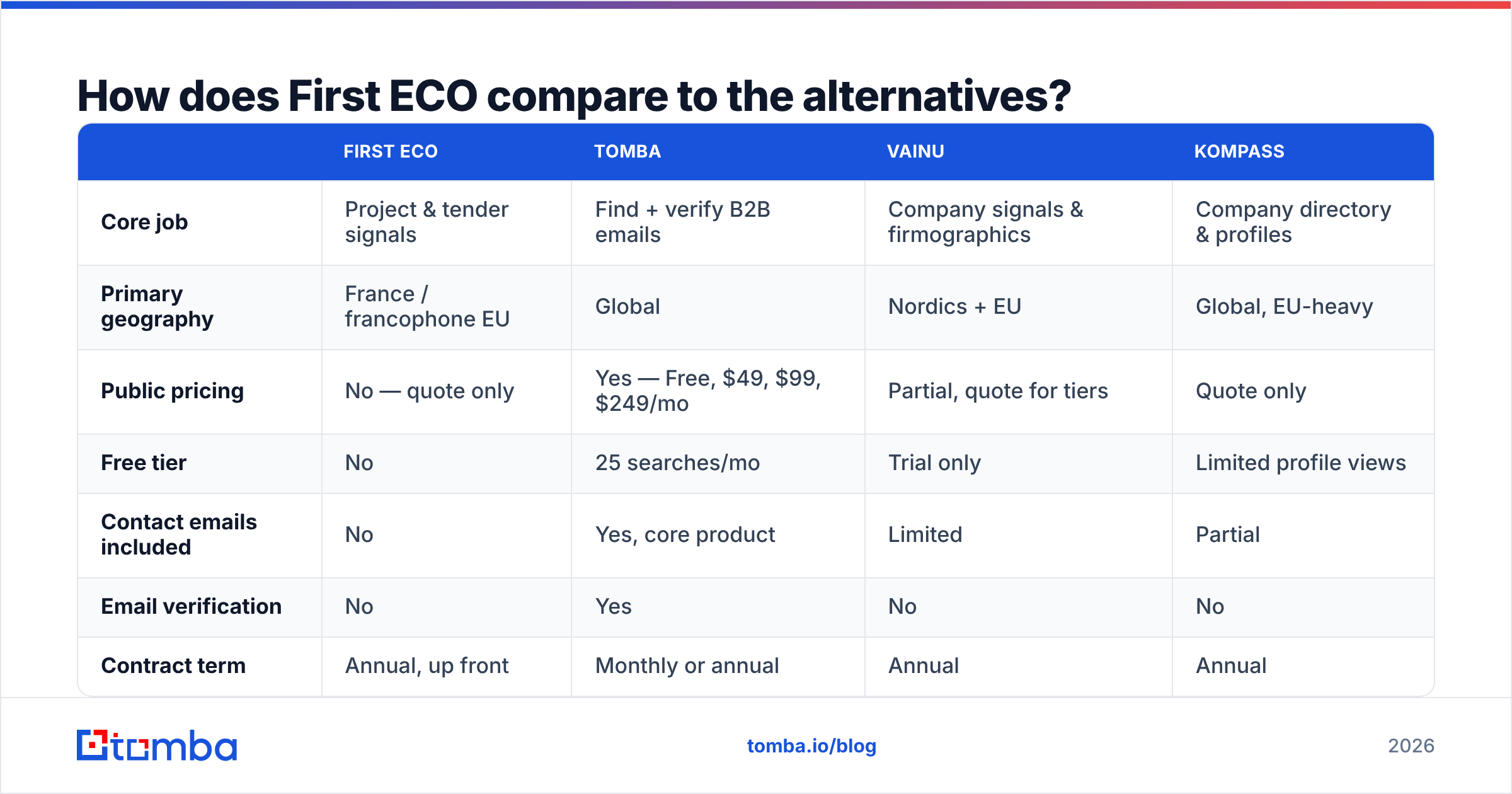
Direct comparison is awkward, because these tools solve adjacent problems. Read the table as "what job does each one do, and what does entry cost look like" — not as a straight feature race.
| First ECO | Tomba | Vainu | Kompass | |
|---|---|---|---|---|
| Core job | Project & tender signals | Find + verify B2B emails | Company signals & firmographics | Company directory & profiles |
| Primary geography | France / francophone EU | Global | Nordics + EU | Global, EU-heavy |
| Public pricing | No — quote only | Yes — Free, $49, $99, $249/mo | Partial, quote for tiers | Quote only |
| Free tier | No | 25 searches/mo | Trial only | Limited profile views |
| Contact emails included | No | Yes, core product | Limited | Partial |
| Email verification | No | Yes | No | No |
| Contract term | Annual, up front | Monthly or annual | Annual | Annual |
| API access | Add-on | Included from paid tiers | Yes | Enterprise |
| Best for | Field sales chasing projects | SDR teams needing reachable contacts | Nordic account-based sales | Broad company research |
The honest read: First ECO and a contact-data tool are complements, not substitutes. First ECO answers which project. A domain search and email verifier answer who to email and will it bounce. Teams that buy only the signals layer end up doing the contact hunt by hand. That cost never appears in the quote.
Is First ECO worth it for your team?#
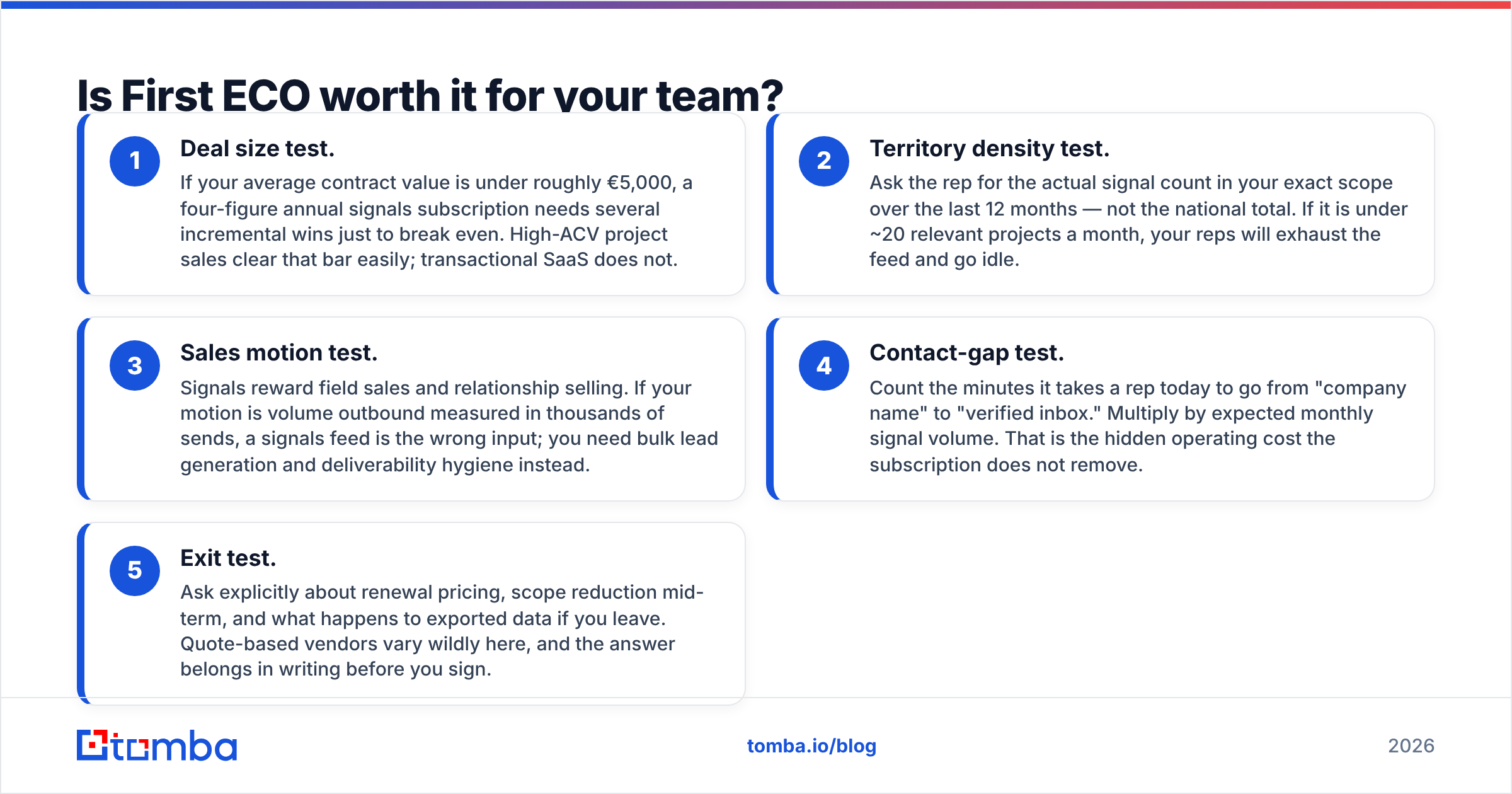
Run these five checks before the quote call. They decide the answer better than any feature list.
- Deal size test. Is your average contract value under €5,000? A four-figure subscription then needs several extra wins just to break even.
- Territory density test. Ask for the real signal count in your exact scope over 12 months, not the national total. Under ~20 projects a month and your reps will run dry.
- Sales motion test. Signals reward field sales. If you send thousands of emails a month, you need bulk lead generation and deliverability hygiene instead.
- Contact-gap test. Time how long a rep takes to go from company name to verified inbox. Multiply that by monthly signal volume. The cost stays after you sign.
- Exit test. Ask about renewal pricing, mid-term scope cuts, and what happens to exported data. Get the answers in writing.
How do you negotiate a better First ECO quote?#
- Start narrower than you want. Buy one region and one vertical for year one. Expanding at renewal is easier than clawing budget back.
- Ask for the historical signal count in your scope, in writing, before the term is set. If the vendor will not share it, that is information too.
- Push seats to the end. Territory and sector are the rigid axes. Seat count is where reps have room.
- Time it. Vendors with annual contracts feel quarter-end and year-end pressure. A December quote is not a June quote.
- Bundle the CRM export. If it is an add-on, make it a condition of signing, not a surprise in month two.
What should you pair it with?#
Whatever you decide on the signals layer, the contact layer is non-negotiable. A project alert with no reachable human is a to-do, not a lead. The pattern that works:
- Signal arrives (First ECO, a tender portal, or plain news monitoring).
- Resolve the company domain, then run a domain search to pull the relevant roles.
- Verify before sending. Bounce rates above 3% damage sender reputation, and a wasted signal costs more than a wasted send.
- Personalise using the project detail. That is the whole reason you bought signals.
Steps 2 and 3 are where a purpose-built tool pays for itself in minutes rather than quarters.
The verdict#
First ECO is a good product with a pricing model that filters its own market. Do you sell high-value products into French construction, energy, or environmental projects? Do your reps close on timing and relationships? Then the quote is probably defensible. Ask for the signal counts and negotiate scope down for year one.
If you need volume, global coverage, transparent pricing, or contact data, it is not the tool. No amount of negotiating fixes that mismatch.
Ready to close the contact gap? Signals tell you which company to chase. The Tomba Email Finder tells you exactly who to email there — name, role, verified inbox. It starts free at 25 searches a month, then $49/mo on Starter, with no quote call and no annual lock-in. Pair it with whatever signal source you land on and project alerts turn into replies the same day.
Related guides#
Ready to find emails that actually work?
Join 150,000+ professionals who stopped guessing and started sending. Free credits on signup — no credit card required.
Get the Tomba newsletter
Practical outbound tactics and product updates — once every two weeks.
About the author