Your First Sales Hire: When to Make It and Who to Pick
Most founders hire their first salesperson a quarter too early and pick the wrong profile. Here is the readiness checklist, the AE-vs-SDR-vs-sales-lead decision, comp math, and the 90-day ramp plan that works in 2026.
TL;DR
- Do not make your first sales hire until you have personally closed 10-15 deals with a repeatable pitch, a written ICP, and a documented objection list. Before that, you are outsourcing discovery, not selling.
- The default first hire in 2026 is a full-cycle AE, not an SDR and not a VP of Sales. SDRs need a closer to feed; VPs need a team to manage. You have neither.
- Budget roughly $180k-$240k all-in for year one (base, variable, tools, data, ramp lost time) for a mid-market US AE. That number, not "we need more revenue," is the real gate.
- Ramp is 90 days and it is measurable: week 4 = first self-sourced meeting, week 8 = first self-sourced opportunity, week 12 = first self-closed deal or a clear leading-indicator trend.
- Hand the rep pipeline infrastructure on day one — ICP list, verified contact data, sequences, CRM fields. A rep who spends week two building lists is a rep you will fire in month six for the wrong reason.
Why does the first sales hire fail so often?#
Because most founders hire to escape sales, not to scale it.
The pattern is predictable. Revenue is growing off founder relationships, the founder is exhausted, and someone on the board says "you need a salesperson." A rep gets hired, given a laptop, a CRM login, and a vague target. Six months later the rep has closed one deal — probably an inbound one the founder would have closed anyway — and everyone concludes "sales hires don't work at our stage."
The failure was in the setup, not the person. A first sales hire is not a discovery engine. They cannot figure out who your buyer is, why they buy, what they object to, and what pricing survives a procurement review. That is founder work. The rep's job is to repeat something you have already proven repeatable.
Think of it like a restaurant. The founder is the chef who invented the menu by cooking hundreds of plates and watching what came back. The first hire is the second cook. If the recipe is written down, the second cook is productive in weeks. If the recipe lives only in the chef's head, the second cook produces expensive garbage and quits.
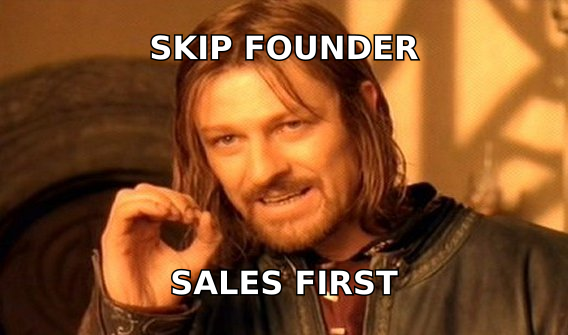
When are you actually ready to make your first sales hire?#
You are ready when you can answer all six of these in writing, without hedging. Not "roughly," not "it depends on the deal" — in writing, in a doc a stranger could read.
- You have closed 10-15 deals yourself at something close to your target price. Ten is the floor. Below that you cannot distinguish a pattern from a coincidence.
- Your ICP fits in two sentences — industry, company size, the specific role that feels the pain, and the trigger event that makes them look. "B2B SaaS companies" is not an ICP. "Series A-B vertical SaaS companies, 20-80 employees, where the Head of RevOps just inherited a broken CRM" is.
- Your win rate from qualified opportunity to closed-won is above 20%. Below that, you have a positioning problem and every hire amplifies it.
- Sales cycle length is known and stable — you can say "34 days median, 60 at P90" rather than "somewhere between two weeks and forever."
- You have a written objection log with the top five objections and the response that actually works for each. If your handling of "you're too expensive" is improvised each time, it is not transferable.
- You have 12+ months of runway after the hire's fully loaded cost. A rep who gets 90 days before the cash panic starts will be fired before ramp completes, and you will have burned $60k learning nothing.
If you miss two or more, keep selling. Founder-led sales is not a phase you failed to exit — it is the phase where the sellable asset gets built. First Round Review and a stack of operator posts say the same thing in different words: premature sales hiring is the most common Series A cash burn mistake.
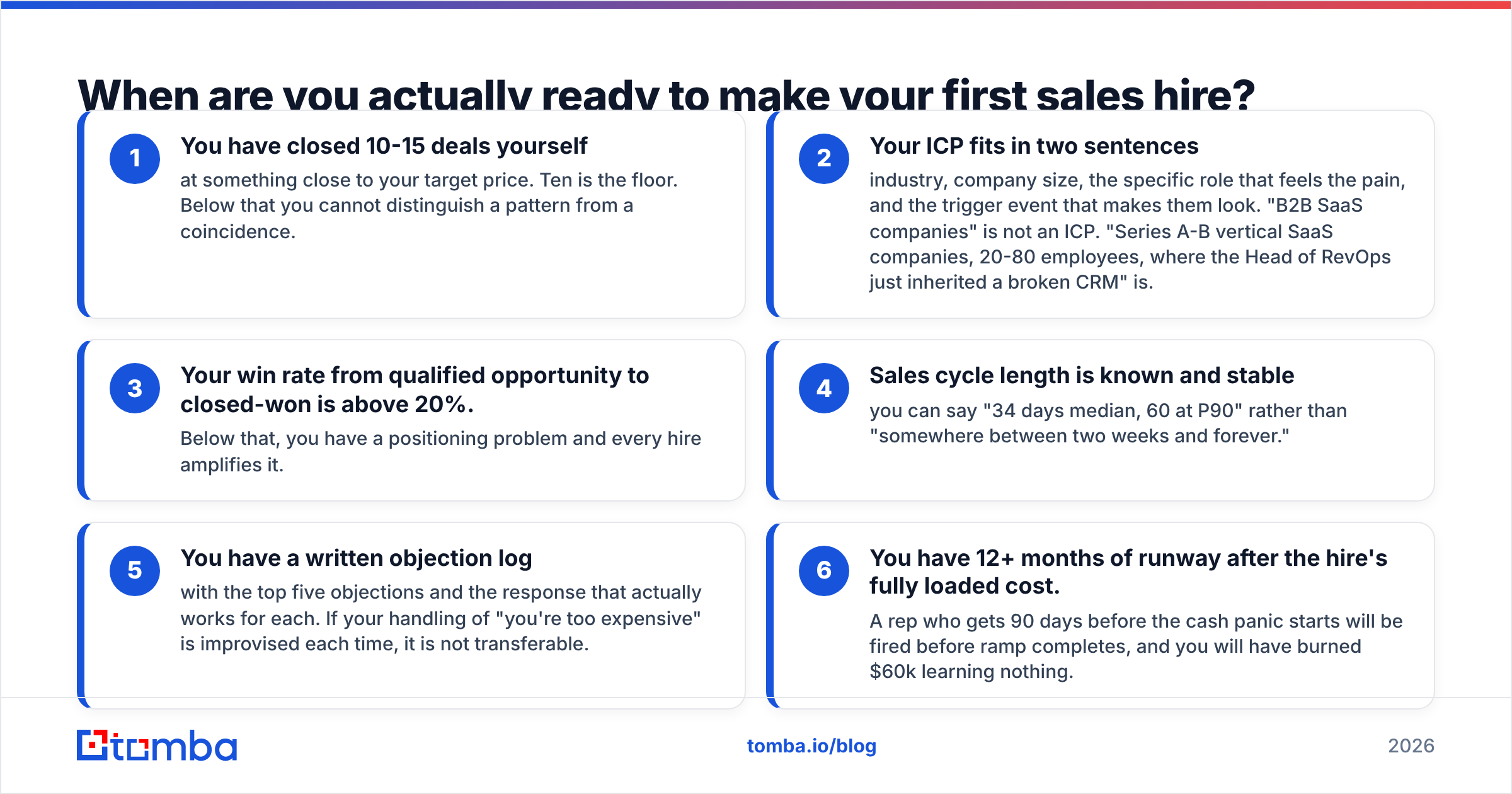
Who should the first sales hire be: AE, SDR, or sales leader?#
Default to a full-cycle AE. Here is the honest comparison of the three real options.
| Dimension | Full-cycle AE | SDR / BDR | VP Sales / Head of Sales |
|---|---|---|---|
| Typical US base (2026) | $80k-$110k | $50k-$65k | $160k-$200k |
| OTE (on-target earnings) | $160k-$220k | $80k-$100k | $300k-$400k |
| All-in year-one cost | $180k-$240k | $95k-$125k | $340k-$450k |
| Time to first closed deal | 60-100 days | Never (they don't close) | 120-180 days |
| What they need from you | Proven pitch, lead source | An AE to hand meetings to | A team and a playbook to scale |
| Best when | You have demand, no capacity | You have closers, no top-of-funnel | You have 3+ reps hitting quota |
| Main failure mode | Hired before playbook exists | Booked meetings nobody closes | Hired to build, expected to manage |
| Founder time required | 8-10 hrs/week for 90 days | 4-6 hrs/week | 5 hrs/week, plus ego management |
The AE wins for most companies under $2M ARR for one reason: they are the only profile that produces revenue by themselves. An SDR produces meetings, which is an input, not an outcome — and if you are still the only closer, you have just bought yourself more selling work, not less.
The VP hire is the seductive mistake. Founders hire a VP from a company 50x their size expecting a playbook and get a manager with no one to manage, a compensation package that eats a third of the sales budget, and a discovery that they have not personally prospected in nine years. Gartner's sales research consistently shows leadership hires underperform when brought in below the scale their operating model assumes. Hire the VP when you have three reps and a repeatable number, not before.
One important exception: if your ACV is above roughly $75k and deals involve multi-stakeholder procurement, an experienced enterprise AE or a player-coach sales lead can be the right first hire — because in that world, credibility in the room is the product. Below that ACV, hire the AE.
What should you pay a first sales hire in 2026?#
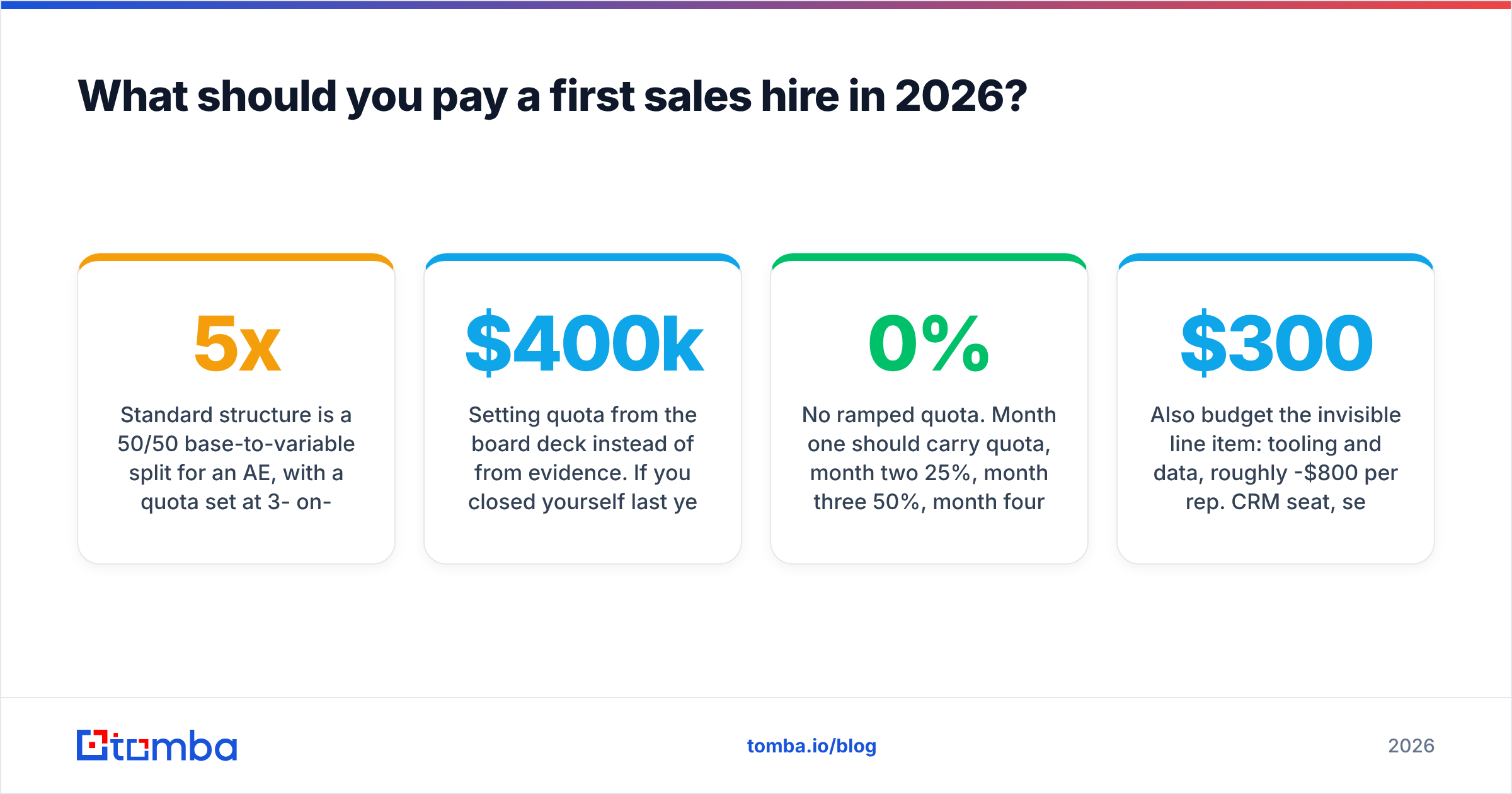
Standard structure is a 50/50 base-to-variable split for an AE, with a quota set at 3-5x on-target earnings. If OTE is $180k, quota lands between $540k and $900k in new ARR. For a first hire, use the low end — 3x — because they carry playbook-building risk that a rep on an established team does not.
Three things founders get wrong on comp:
- Setting quota from the board deck instead of from evidence. If you closed $400k yourself last year working part-time on sales, do not hand a new rep $800k. Take your own annualized run rate, discount for their lack of founder credibility, and set the number there.
- No ramped quota. Month one should carry 0% quota, month two 25%, month three 50%, month four onward 100%. Skipping the ramp means the rep is "behind" from week one and starts discounting to catch up.
- Guarantees that end too early. A 90-day guarantee on variable comp is standard and cheap insurance. A rep worried about rent in month two closes bad deals.
Also budget the invisible line item: tooling and data, roughly $300-$800/month per rep. CRM seat, sequencing tool, contact data, call recording. Skip this and the rep spends their expensive hours doing manual research. Tomba's Tomba pricing starts at $49/mo on Starter and $99/mo on Growth, which covers contact discovery for one rep comfortably; the free tier's 25 searches a month is fine for evaluating, not for running a territory.
How do you set up the first sales hire to succeed?#
Everything below should exist before their start date. Not "we'll build it together" — before.
- A named target list of 300-500 accounts that match the written ICP, with tiering. Not a filter saved in a tool. An actual list.
- Verified contact data for the top two personas at each account. This is where most setups quietly fail: the rep gets a list of company names and burns week two doing manual lookups. Build the list with domain search to pull contacts by company, run it through an email verifier so bounces don't damage your sender reputation, and hand it over clean. Use bulk lead generation if you're building the whole territory in one pass.
- Three working sequences — cold outbound, inbound follow-up, and re-engagement — that you personally used to book meetings. Not templates from a blog post. Yours, with reply-rate data attached.
- A CRM with five required fields and no more. Stage, next step, close date, deal source, primary objection. Every field beyond that is a compliance tax on a rep who is already overwhelmed.
- A recorded call library. Five to ten of your own calls: two great, two disasters, one negotiation. This teaches more in an afternoon than a week of shadowing.
- A written comp plan and quota ramp, signed before day one. Ambiguity here poisons month three.
What does a good 90-day ramp look like?#
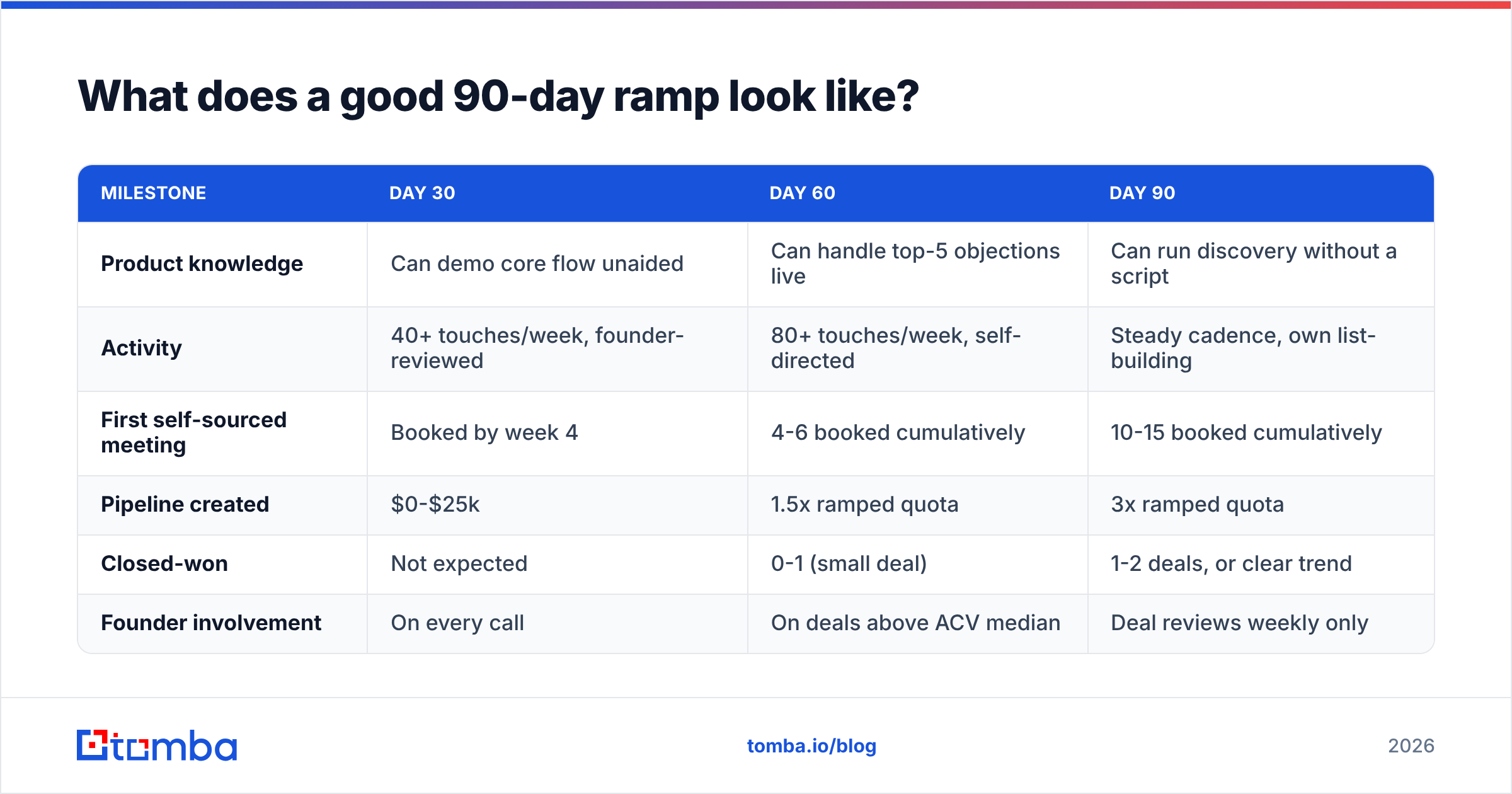
Measure leading indicators, not revenue. Revenue in the first 90 days is mostly luck and inherited pipeline.
| Milestone | Day 30 | Day 60 | Day 90 |
|---|---|---|---|
| Product knowledge | Can demo core flow unaided | Can handle top-5 objections live | Can run discovery without a script |
| Activity | 40+ touches/week, founder-reviewed | 80+ touches/week, self-directed | Steady cadence, own list-building |
| First self-sourced meeting | Booked by week 4 | 4-6 booked cumulatively | 10-15 booked cumulatively |
| Pipeline created | $0-$25k | 1.5x ramped quota | 3x ramped quota |
| Closed-won | Not expected | 0-1 (small deal) | 1-2 deals, or clear trend |
| Founder involvement | On every call | On deals above ACV median | Deal reviews weekly only |
Two rules for reading this table. First, pipeline created is the honest 90-day metric — it survives long sales cycles, closed-won does not. Second, if the rep misses the day-30 column, the problem is almost always onboarding, and if they miss the day-90 column after hitting day 30, the problem is usually fit or territory quality. Diagnose in that order.
Hold a formal 30/60/90 review with written notes. Most first-hire relationships fail because nobody said "you are behind" out loud until month five, at which point it is a firing conversation instead of a coaching one.
How do you know if the hire is working — or if you should cut?#
The uncomfortable truth: you will know by day 60, and you will spend until day 150 hoping you were wrong.
Green flags by day 60 — they are asking better discovery questions than you wrote down; they have found an ICP segment you missed; they are self-sourcing pipeline without prompting; they are correcting your positioning based on calls.
Red flags by day 60 — activity is high but conversations are shallow; every stalled deal has an external explanation; they need the founder on every call to advance anything; they cannot articulate why a lost deal was lost.
Give a real 30-day performance plan with specific numbers when you see red flags. If it does not move, cut in month four. A bad first rep costs more than the salary — they burn your best accounts, and territory damage takes 6-12 months to heal.
On the sourcing side, when you go back to market, look at candidates who have sold at your stage, not just in your industry. Someone who carried quota at a 40-person company with no marketing support is far better prepared than someone who hit 120% at a company with an inbound firehose. G2's sales software category reviews are useful for understanding what stack a candidate is fluent in — a rep whose entire career ran on a mature enterprise stack often struggles when the tooling is three tabs and a spreadsheet.
What comes after the first sales hire?#
Do not hire the second rep until the first one hits 80% of a full quota for two consecutive quarters. That is the proof that the playbook — not the person, not the founder — is producing revenue.
The sequence that works:
- First AE hits quota → you have a repeatable motion
- Second AE hires and ramps faster than the first → the motion is transferable, not personality-dependent
- SDR joins to feed both AEs → top-of-funnel becomes a specialized function
- Sales lead or player-coach at 3-4 reps → management becomes a real job
- RevOps and process → around 6-8 reps, when spreadsheets break
Skipping steps is the most expensive mistake in early GTM. Every founder who hired three reps at once to "see who sticks" ended up with three unramped reps, one exhausted founder, and a churned territory.
Ready to hand your first rep a pipeline instead of a spreadsheet?#
The single highest-leverage thing you can do before your first sales hire starts is remove list-building from their first month. Build the target account list yourself, enrich it, verify it, and drop it in their CRM before day one.
Tomba's Email Finder finds professional email addresses by domain, name, or company, with verification built into the same workflow so your new rep sends into clean inboxes instead of bounce traps. Start on the free tier to build your first ICP list, move to Starter at $49/mo when the rep signs, and let them spend week two selling instead of Googling. That is the difference between a first sales hire who ramps in 90 days and one you quietly regret.
Related guides#
Ready to find emails that actually work?
Join 150,000+ professionals who stopped guessing and started sending. Free credits on signup — no credit card required.
Get the Tomba newsletter
Practical outbound tactics and product updates — once every two weeks.
About the author