Five9 vs RingCentral in 2026: Which Contact Center Wins?
Five9 is a contact-center specialist. RingCentral is a phone system that grew a contact center. That difference decides which one your sales team should buy — here is the honest breakdown on price, AI, dialers, and uptime.
TL;DR
- Five9 is a contact center first. It was built for high-volume inbound and outbound queues, and its predictive dialer, workforce management, and agent-desktop depth still beat RingCentral's.
- RingCentral is a phone system that grew a contact center. If most of your headcount needs a business phone, video, and messaging — and only a slice needs a real agent queue — RingCentral is far cheaper per seat.
- Price gap is roughly 3x per seat. RingCentral's UCaaS seats sit in the $20–$35/user/month range on annual billing; Five9's contact center tiers start around $119/user/month list.
- Both are AI-heavy in 2026 — agent assist, transcription, summaries, virtual agents. Five9's AI is tuned for queue deflection; RingCentral's is tuned for meetings and general comms.
- Neither fixes bad numbers. Dialer efficiency collapses if 30% of your contacts are wrong, so the data layer matters more than the phone layer for outbound teams.
What are Five9 and RingCentral, actually?#
They solve overlapping problems from opposite directions, and that's the whole comparison in one sentence.
Five9 is CCaaS — Contact Center as a Service. It exists to route, dial, record, score, and staff conversations at volume. Everything in the product assumes there is a queue, a supervisor watching a wallboard, and a service level to hit. It does not try to be your company phone system for the finance department.
RingCentral started as UCaaS — Unified Communications as a Service. RingEX is a cloud PBX with video, SMS, and team messaging bolted into one app. RingCentral then added contact center capability in two forms: RingCX (its own native, AI-first contact center) and RingCentral Contact Center (the older NICE-powered enterprise tier).
So the real question isn't "which product is better." It's which shape of problem you have:
- Mostly agents, few desk phones — 40 SDRs hammering a dialer, a support queue with SLAs, WFM forecasting. Five9 is the natural fit.
- Mostly employees, few agents — 300 staff who need a number and video, plus a 15-person support desk. RingCentral wins on total cost, easily.
- Both, at enterprise scale — you'll evaluate Five9 alongside NICE and Genesys, and RingCentral will likely lose the CCaaS half on depth.
- Outbound sales specifically — you care about dial rate, local presence, connect rate, and CRM logging. Five9 is stronger out of the box; RingCX has closed much of the gap and costs less.
- Global footprint — RingCentral's carrier coverage and international numbering is generally the easier path.
- Heavy compliance load — HIPAA, PCI, FedRAMP-adjacent requirements. Both have programs; Five9 has more contact-center-specific tooling around recording pause/resume and consent.
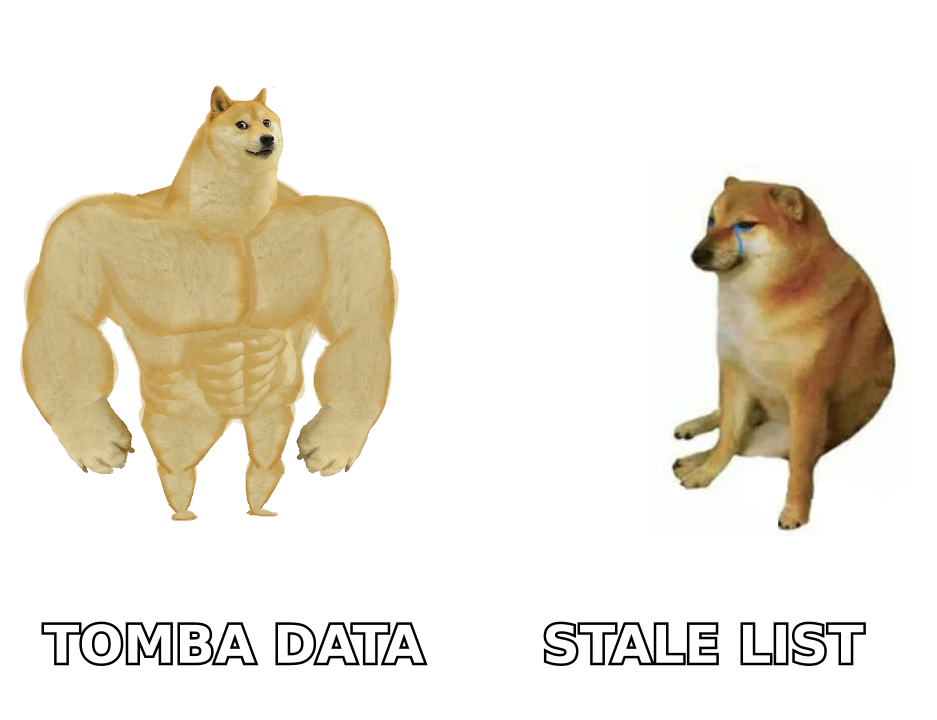
How do Five9 and RingCentral compare feature by feature?#
Here's the head-to-head that matters when you're actually scoring vendors.
| Capability | Five9 | RingCentral (RingEX + RingCX) |
|---|---|---|
| Primary category | CCaaS (contact center) | UCaaS with contact center add-on |
| Core strength | Omnichannel routing, dialers, WFM | Business phone, video, messaging in one app |
| Outbound dialers | Predictive, power, progressive, preview | Progressive/preview in RingCX; predictive on higher tiers |
| Workforce management | Native WFM + WFO suite | Lighter native WFM; partners for depth |
| Video conferencing | Not the focus (integrates) | Native, unlimited on most plans |
| Team messaging | No | Native |
| AI agents / virtual agents | Five9 AI Agents, Agent Assist | RingSense AI, RingCX AI agents |
| CRM integrations | Deep Salesforce, HubSpot, Zendesk, ServiceNow | Salesforce, HubSpot, Microsoft, Zendesk |
| Typical buyer | Contact center ops leader | IT / telecom owner |
| Published uptime SLA | 99.999% available | 99.999% available on qualifying plans |
| Free trial | Demo-led, no self-serve trial | Self-serve trial on RingEX |
The pattern is consistent: Five9 goes deeper where a contact center lives, RingCentral goes wider where a company lives. If you read the G2 category grids for CCaaS and UCaaS, you'll see the same split reflected in reviewer segments — Five9 skews mid-market-to-enterprise contact center, RingCentral skews SMB-to-mid-market general business comms.
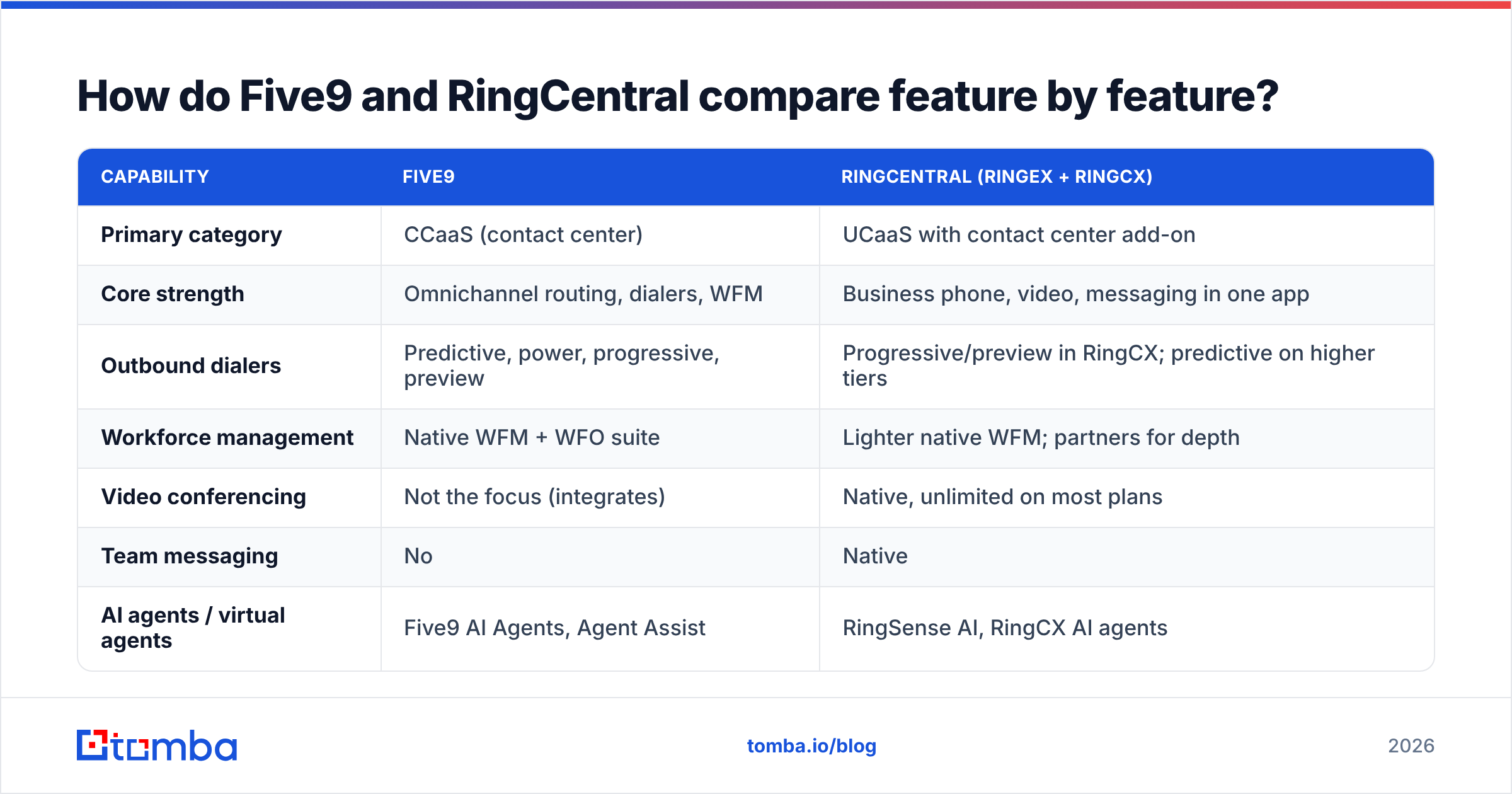
What does each one cost in 2026?#
Prices below are vendor list prices at the time of writing. Both companies negotiate hard on multi-year, multi-hundred-seat deals, and neither publishes the full picture (telephony minutes, AI consumption, professional services, and number provisioning all get quoted separately). Treat this as a starting range, not a quote.
| Plan | Five9 (per user/mo, list) | RingCentral (per user/mo, annual) |
|---|---|---|
| Entry UCaaS seat | Not applicable | RingEX Core ~$20 |
| Mid UCaaS seat | Not applicable | RingEX Advanced ~$25 |
| Top UCaaS seat | Not applicable | RingEX Ultra ~$35 |
| Entry contact center | Digital / Core ~$119 | RingCX ~$65 |
| Mid contact center | Premium ~$169 | Contact Center tiers ~$100+ |
| Full omnichannel + WFO | Optimum ~$229 / Ultimate ~$279 | Enterprise CC, quote-based |
| Minimum practical commitment | Annual, seat minimums common | Monthly available, annual discounted |
| AI add-ons | Priced separately by usage | RingSense bundled on some tiers, add-on on others |
The takeaway most buyers miss: you are rarely comparing one number to one number. A 200-person company with 25 agents pays RingCentral for 175 cheap UCaaS seats plus 25 contact center seats. The same company buying Five9 still needs a phone system for the other 175 people. Model the blended cost, not the sticker.
Where Five9 earns the premium is when agent productivity is the P&L line. A predictive dialer that squeezes 15 more connects per agent per day across 60 agents dwarfs a $60/seat delta. Where it doesn't earn it: a 12-person support desk that answers 40 tickets a day.
Which is better for outbound sales teams?#
Five9, if outbound is the whole job. RingCX, if outbound is one motion among several and budget is real.
Five9's dialing stack is the mature one. Predictive dialing with pacing control, answering-machine detection, local presence, campaign management, and list scrubbing are first-class features rather than add-ons. Supervisors get live barge/whisper/monitor and campaign-level analytics that map cleanly onto SDR management.
RingCX has caught up faster than most analysts expected. It handles progressive and preview dialing well, its AI-first design means transcription and scoring are on by default rather than upsold, and at roughly $65/agent it undercuts Five9 badly. What you give up is the long tail: complex blended inbound/outbound routing, deep WFM forecasting, and the compliance tooling for regulated outbound at scale.
One under-discussed factor: regulatory drift. Outbound calling rules keep tightening — consent requirements, call labeling, and carrier-level spam scoring. Both vendors now surface branded caller ID and reputation monitoring, but you should ask each rep specifically how they handle number rotation and spam-flag remediation, because a beautiful dialer connected to a flagged number pool is worthless.
How do the AI features stack up?#
Both vendors reframed themselves as AI companies in 2025–2026. The substance differs.
Five9 AI centers on containment and assist. AI Agents handle inbound intents end to end, Agent Assist surfaces real-time guidance and post-call summaries, and the analytics layer scores 100% of interactions rather than a QA sample. The metrics Five9 sells against are deflection rate, average handle time, and QA coverage — classic contact center economics.
RingSense is broader but shallower per use case. It transcribes and summarizes calls and meetings, scores conversations, and feeds coaching insights across the whole organization — not just agents. For a revenue team that wants Gong-adjacent call intelligence without buying Gong, that's genuinely useful. For a 400-seat support center that needs intent-level containment, it's not the same tool.
A neutral way to decide: if your AI business case is cost per contained interaction, look at Five9. If it's visibility into what everyone said on every call, look at RingCentral. Gartner's CCaaS and UCaaS Magic Quadrants (both on gartner.com) split the vendors the same way, which is a reasonable sanity check on your shortlist.

What about reliability, support, and implementation?#
Both advertise 99.999% availability, and both have had public incidents — that's true of every cloud voice provider at scale. The differences show up in the operational details:
- Implementation time. RingEX can be live in days for a small company. Five9 deployments involving routing logic, CRM screen-pops, and WFM realistically run 6–12 weeks with professional services.
- Who owns it internally. RingCentral is usually IT-owned. Five9 is usually ops-owned, and needs someone who actually enjoys building IVR flows.
- Support tiers. Both gate faster response times behind higher plans. Ask for the named-CSM threshold in writing.
- Contract shape. Five9 seat minimums and annual terms are the norm. RingCentral is more forgiving month to month, which matters if headcount is volatile.
- Migration risk. Porting numbers is the same pain in both directions. Budget two weeks of overlap and don't schedule a cutover in Q4.
Which one should you actually pick?#
Choose Five9 if: agents outnumber non-agents, you run blended inbound/outbound, you need native WFM, your QA program is real, or you're replacing an on-prem Avaya/Genesys stack. The premium is justified by throughput.
Choose RingCentral if: the whole company needs phone and video, your contact center is a minority of seats, you want one vendor and one bill, you value self-serve setup, or your international numbering needs are broad. RingCX gives you a credible contact center at roughly half of Five9's entry price.
Choose neither if: you're a 10-person startup doing outbound. A lightweight dialer plugged into your CRM will cost a fraction of either platform and you won't use 80% of what you're paying for. Revisit at 20+ reps.
Why does your contact data decide the outcome more than the platform?#
Because dialer math is brutal and everyone underestimates it.
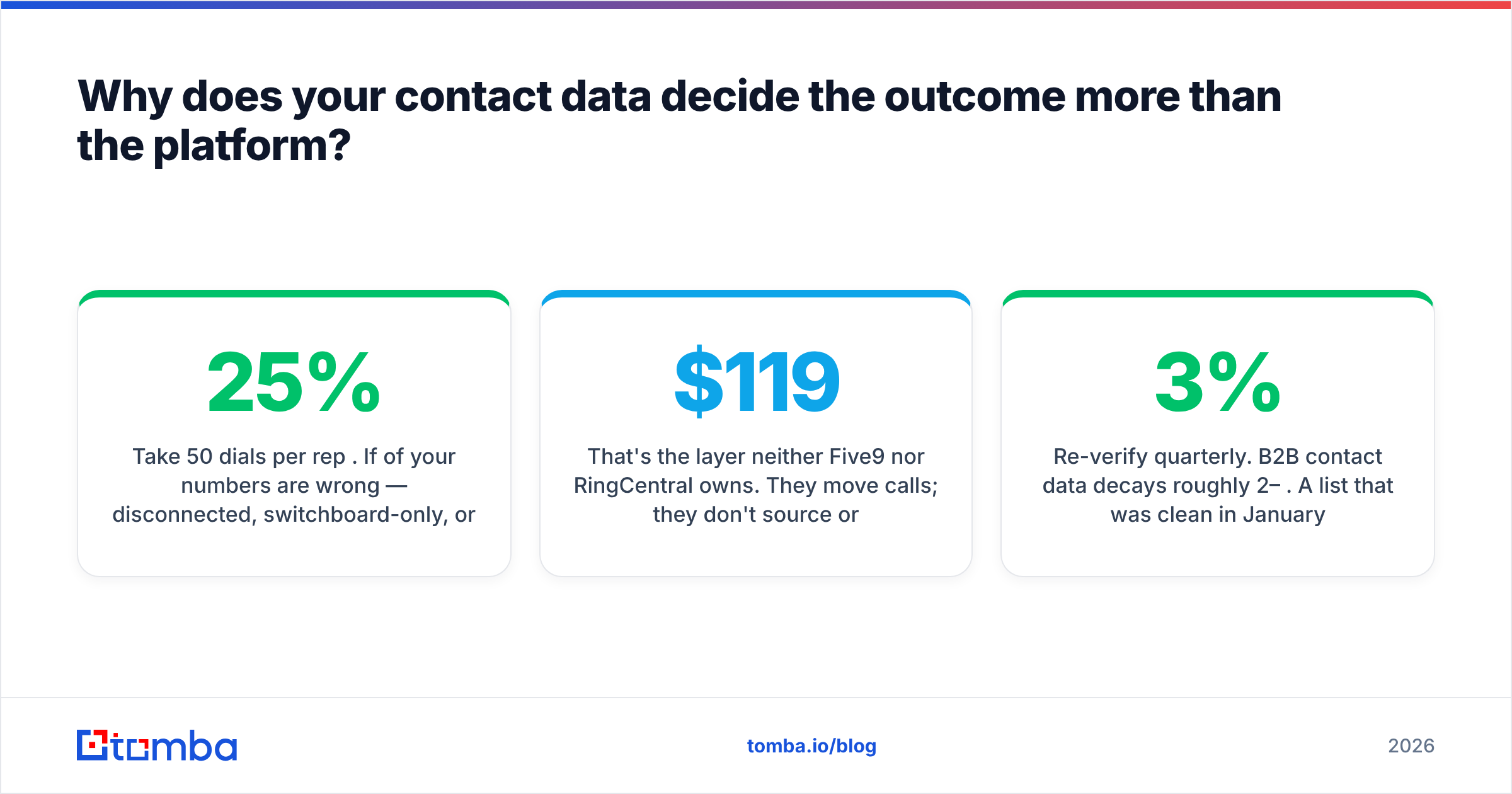
Take 50 dials per rep per day. If 25% of your numbers are wrong — disconnected, switchboard-only, or belonging to someone who left 18 months ago — you're not losing 25% of your output. You're losing that plus the wrap-up time, plus the CRM cleanup, plus the spam-score damage from repeatedly hitting dead numbers. Carriers notice patterns like that, and once your outbound numbers get flagged, no amount of predictive pacing saves the campaign.
That's the layer neither Five9 nor RingCentral owns. They move calls; they don't source or validate the underlying records. Before you argue about $119 versus $65 a seat, audit what percentage of your dial list is actually reachable.
Practical fixes that pay for themselves faster than a platform migration:
- Validate before you load. Run every list through a phone validator so line type, carrier, and reachability are known before a rep burns a dial on it.
- Source direct numbers, not switchboards. A phone finder that returns direct dials changes connect rates more than dialer pacing settings do.
- Enrich the record, not just the number. Title, company size, and tech stack from contact enrichment let you route and prioritize instead of dialing alphabetically.
- Keep email and phone in sync. Multichannel sequences fall apart when the email bounces and the call goes nowhere; an email verifier closes that half.
- Re-verify quarterly. B2B contact data decays roughly 2–3% per month. A list that was clean in January is measurably worse by April.
What's the honest verdict on Five9 vs RingCentral?#
Five9 wins the contact center on merit. RingCentral wins the company on economics. If you scored them on a single axis you'd be comparing a specialist tool to a platform, and the specialist always looks better on the specialist's home turf.
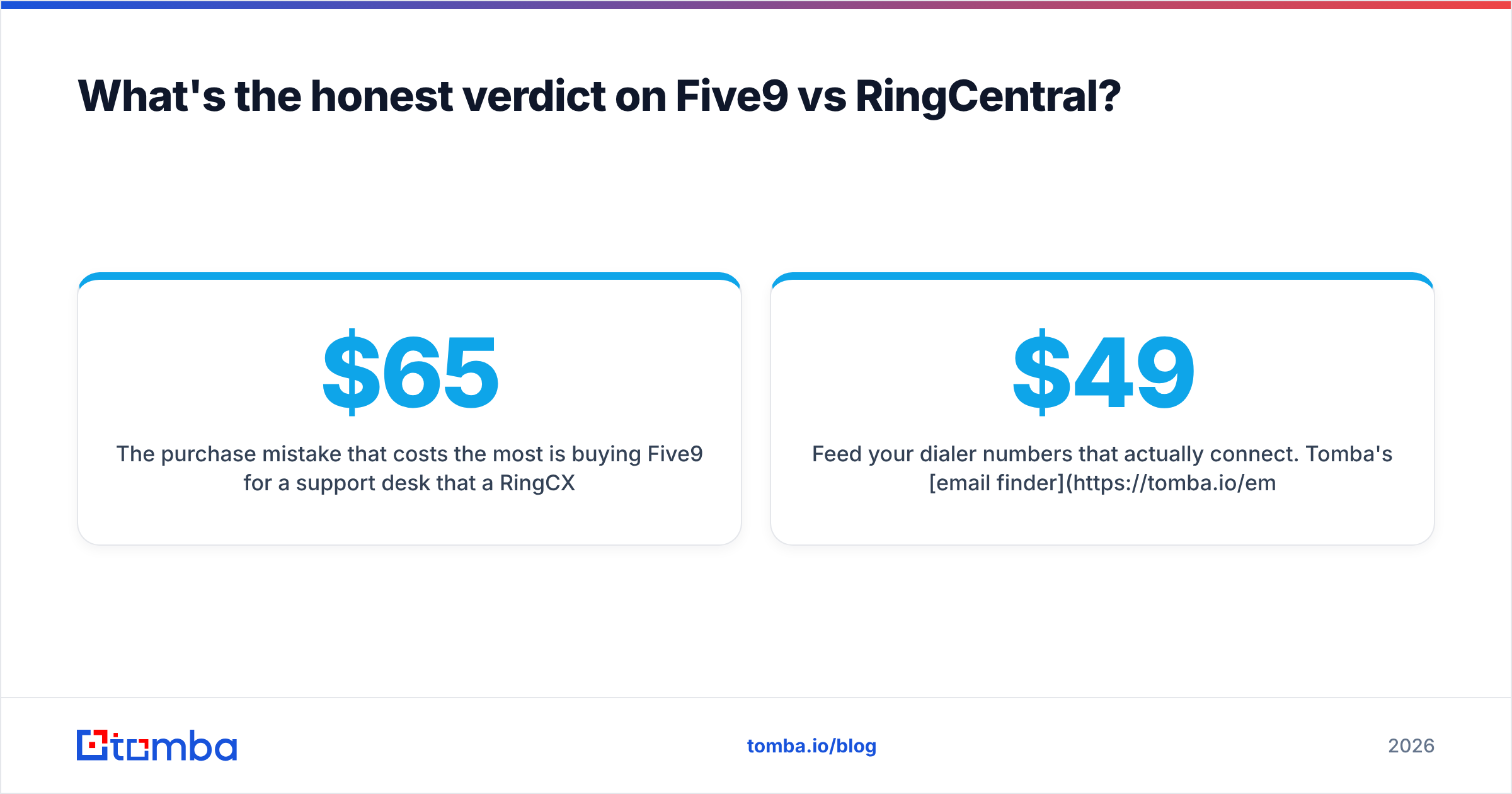
The purchase mistake that costs the most is buying Five9 for a support desk that a $65 RingCX seat would have handled, or buying RingCentral for a 100-agent outbound operation that then spends a year fighting the limits of a lighter contact center. Count your agents, count your non-agents, model the blended per-seat cost across both populations, and the answer usually decides itself in a spreadsheet before you ever take a demo.
Then fix the layer neither of them touches. A great dialer pointed at a stale list is an expensive way to reach voicemail.
Feed your dialer numbers that actually connect. Tomba's email finder and its phone, enrichment, and verification tools give sales teams verified contact data before it hits the queue — free tier includes 25 searches a month, Starter is $49/mo, and Growth is $99/mo. See full Tomba pricing, or start with the free tier and measure your connect rate before and after.
Related guides#
Ready to find emails that actually work?
Join 150,000+ professionals who stopped guessing and started sending. Free credits on signup — no credit card required.
Get the Tomba newsletter
Practical outbound tactics and product updates — once every two weeks.
About the author