Flike Pricing Reviews Pros and Cons: 2026 Buyer's Guide
Flike doesn't publish a public price list, which makes the real cost hard to pin down. Here's what Flike actually charges, what reviewers praise, where it falls short, and when a data-first stack costs less.
Short on time? This Flike pricing reviews pros and cons guide gives you the real per-seat numbers, the praise and the gripes from working sales teams, and the one gap the tool leaves open.
TL;DR
- Flike is an AI sales copilot. It drafts cold emails, follow-ups and LinkedIn messages inside Gmail, Outreach, Salesloft and HubSpot. It is a writing layer, not a data layer.
- Flike does not publish a price list. Buyers report $50–$75 per user per month on annual terms. Confirm every number in writing.
- Reviews praise the time saved on first drafts. The common gripes: generic output on niche ICPs, thin analytics, and pricing opacity.
- The biggest hidden cost is not the license. It is bad contact data. AI copy sent to a dead address still bounces.
- If your gap is what to say, Flike earns its seat. If your gap is who to reach, a verified data stack (Tomba starts at $49/mo) wins.
What is Flike and who is it actually for?#
Flike is an AI sales copilot. It sits on top of the tools your reps already live in — Gmail, Outlook, LinkedIn outreach, Outreach.io, Salesloft, HubSpot. It writes the next message in a sequence, using your past winning emails, CRM context and prospect signals. You highlight a thread, hit the extension, and get a draft that mirrors how your team already sells.
Think of it like a ghostwriter who has read every deal your team ever closed. It doesn't find the prospect, doesn't check whether the address is real, and doesn't send at scale. It writes.
That framing matters for the buying decision, because it defines what Flike can and cannot fix:
- What Flike fixes well — blank-page paralysis, inconsistent messaging across a ramping team, slow reply-handling on live threads.
- What Flike partially fixes — personalization depth. It's only as good as the signals you pipe into it.
- What Flike does not fix — contact discovery, email verification, deliverability infrastructure, sending volume, or list hygiene.
- What Flike quietly depends on — a clean CRM. Garbage fields in, garbage merge tags out.
- Who it fits — SDR and AE teams of 5–50 who already have data and sequencing solved and want messaging consistency.
If you're an early-stage team that hasn't yet nailed who to email, a copilot is the second problem, not the first.
How much does Flike cost in 2026?#
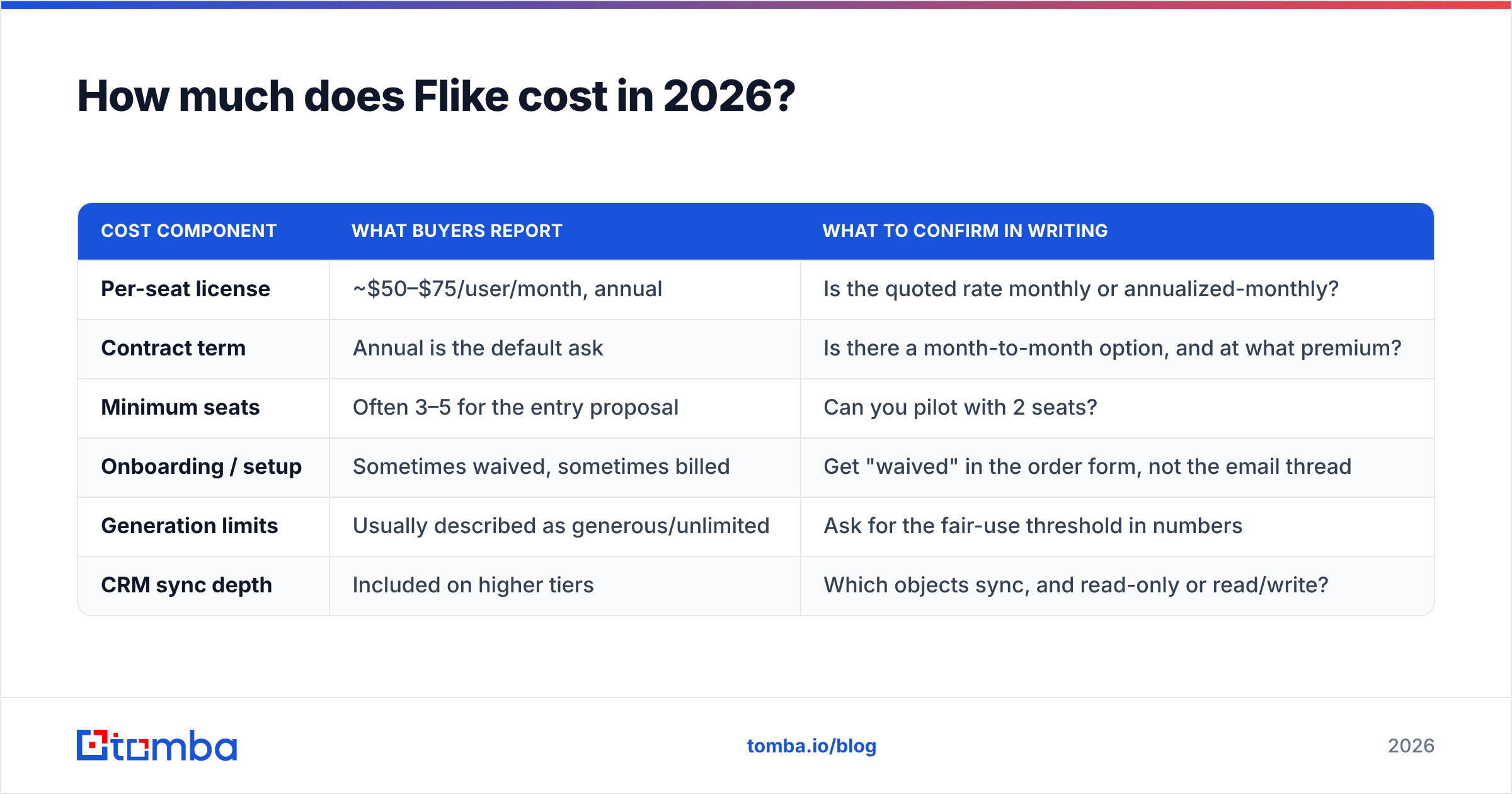
Short answer: Flike is quote-only, and that's the first thing to weigh. There is no self-serve pricing page with published tiers on flike.co at the time of writing. You book a demo, describe your team size, and receive a proposal. That is a legitimate motion for a sales-tech vendor, but it shifts leverage to the seller and makes budgeting harder.
What buyers report, across marketplace listings and peer conversations:
| Cost component | What buyers report | What to confirm in writing |
|---|---|---|
| Per-seat license | ~$50–$75/user/month, annual | Is the quoted rate monthly or annualized-monthly? |
| Contract term | Annual is the default ask | Is there a month-to-month option, and at what premium? |
| Minimum seats | Often 3–5 for the entry proposal | Can you pilot with 2 seats? |
| Onboarding / setup | Sometimes waived, sometimes billed | Get "waived" in the order form, not the email thread |
| Generation limits | Usually described as generous/unlimited | Ask for the fair-use threshold in numbers |
| CRM sync depth | Included on higher tiers | Which objects sync, and read-only or read/write? |
The pattern is familiar. The sticker price is per seat and predictable. The variance comes from term length, seat minimums, and whether the CRM or sequencer integration you need is bundled or gated. Ask specifically whether your sequencer (Outreach, Salesloft, Apollo, HubSpot Sales Hub) is in the base package. Integration tiers are the most common surprise line item in AI sales tooling.
One more thing worth pricing out: a copilot is charged per seat, not per result. A 12-rep team at $65 a seat is roughly $9,360 a year, before anyone measures a lift in response rate. Set a baseline reply rate before the pilot starts, or you will have no way to defend the renewal.
What do Flike reviews actually say?#
Peer reviews on G2 and similar directories cluster into a consistent shape. Volume is modest, since Flike is a smaller vendor than Regie.ai or Lavender. Read individual reviews rather than the aggregate star count.
What reviewers consistently praise:
- Speed on first drafts. The most repeated benefit is minutes saved per message, especially on reply-handling where reps otherwise stall.
- Tone matching. Because it trains on your closed-won threads, output reads more like your team than a generic LLM prompt does.
- In-workflow UX. The browser extension means no tab-switching. That is why adoption survives past week two, the usual failure point for AI tools.
- Ramp time for new reps. Managers report new hires sounding on-brand faster, which is a real enablement win.
What reviewers consistently criticize:
- Generic output on niche ICPs. If you sell something technical or regulated, the drafts need heavier editing. Several reviewers call the first version "80% there" — and the last 20% is the hard part.
- Thin reporting. Attribution from AI-drafted message to booked meeting is weak. You will need your sequencer or CRM to prove ROI.
- Pricing opacity. Prospects dislike having to sit through a demo to learn a number. This shows up repeatedly in review free-text.
- Dependence on clean inputs. Reviewers who fed it a messy CRM got messy personalization.
None of that is disqualifying. It's the normal profile of a focused point solution: excellent at one job, silent on the adjacent ones.
What are the real pros and cons of Flike?#
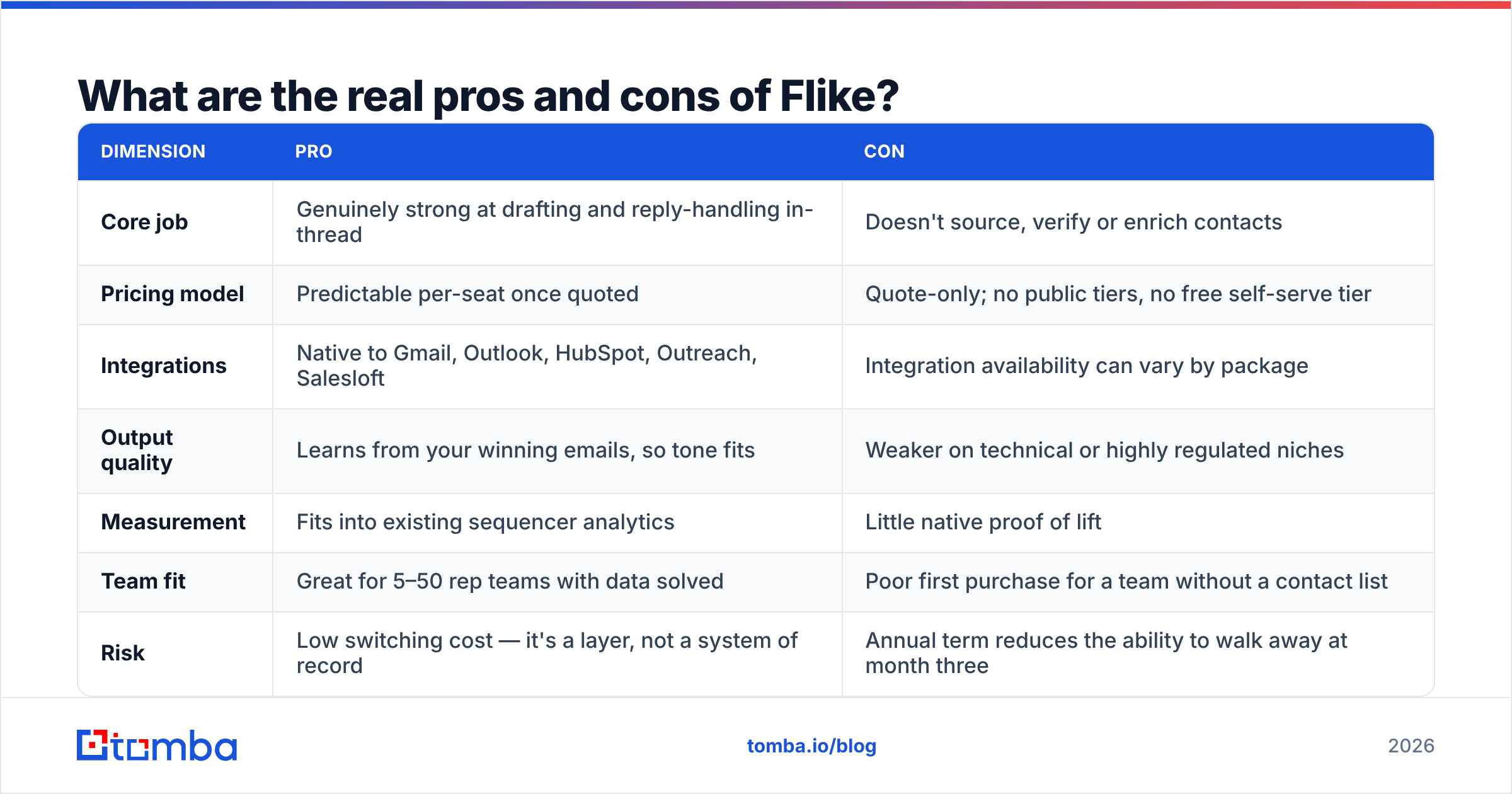
Here is the honest ledger on Flike pricing reviews pros and cons, stripped of vendor language.
| Dimension | Pro | Con |
|---|---|---|
| Core job | Genuinely strong at drafting and reply-handling in-thread | Doesn't source, verify or enrich contacts |
| Pricing model | Predictable per-seat once quoted | Quote-only; no public tiers, no free self-serve tier |
| Integrations | Native to Gmail, Outlook, HubSpot, Outreach, Salesloft | Integration availability can vary by package |
| Output quality | Learns from your winning emails, so tone fits | Weaker on technical or highly regulated niches |
| Measurement | Fits into existing sequencer analytics | Little native proof of lift |
| Team fit | Great for 5–50 rep teams with data solved | Poor first purchase for a team without a contact list |
| Risk | Low switching cost — it's a layer, not a system of record | Annual term reduces the ability to walk away at month three |
The cleanest way to read that table: Flike is a margin improver, not a pipeline creator. It makes existing outbound motion better. It does not create outbound motion where none exists.
Is Flike worth it compared to the alternatives?#
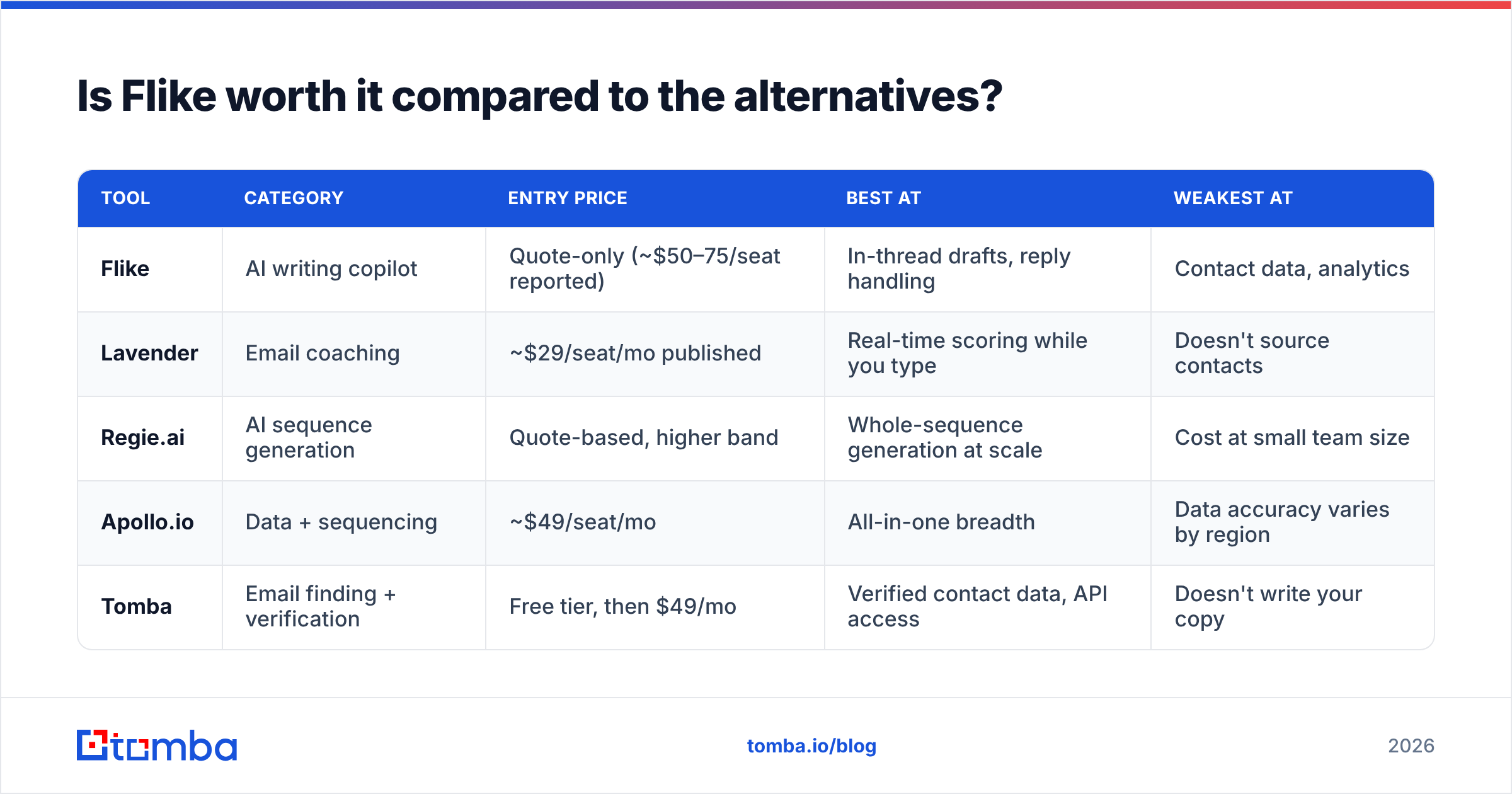
Depends entirely on which gap you're closing. Copilots, sequencers and data providers get lumped into "AI sales tools" and they solve genuinely different problems.
| Tool | Category | Entry price | Best at | Weakest at |
|---|---|---|---|---|
| Flike | AI writing copilot | Quote-only (~$50–75/seat reported) | In-thread drafts, reply handling | Contact data, analytics |
| Lavender | Email coaching | ~$29/seat/mo published | Real-time scoring while you type | Doesn't source contacts |
| Regie.ai | AI sequence generation | Quote-based, higher band | Whole-sequence generation at scale | Cost at small team size |
| Apollo.io | Data + sequencing | ~$49/seat/mo | All-in-one breadth | Data accuracy varies by region |
| Tomba | Email finding + verification | Free tier, then $49/mo | Verified contact data, API access | Doesn't write your copy |
Two practical readings of that table:
If you already have verified contacts and a sequencer, Flike (or Lavender, if you want coaching rather than generation) is a rational $50–75/seat add-on. The break-even is low. One extra meeting per rep per quarter usually covers it.
If your bounce rate is above 3% or your list is patchy, buying a copilot first is spending money at the wrong end of the funnel. Better copy sent to a dead mailbox is still a bounce. Bounces damage sender reputation in a way no amount of AI phrasing repairs.
What does Flike not do — and what does that cost you?#
This is the part most Flike reviews skip. A copilot assumes the contact record already exists and is correct. In practice, B2B contact data decays fast. People change jobs, domains get consolidated, and catch-all servers accept everything while delivering nothing.
The downstream cost of that assumption:
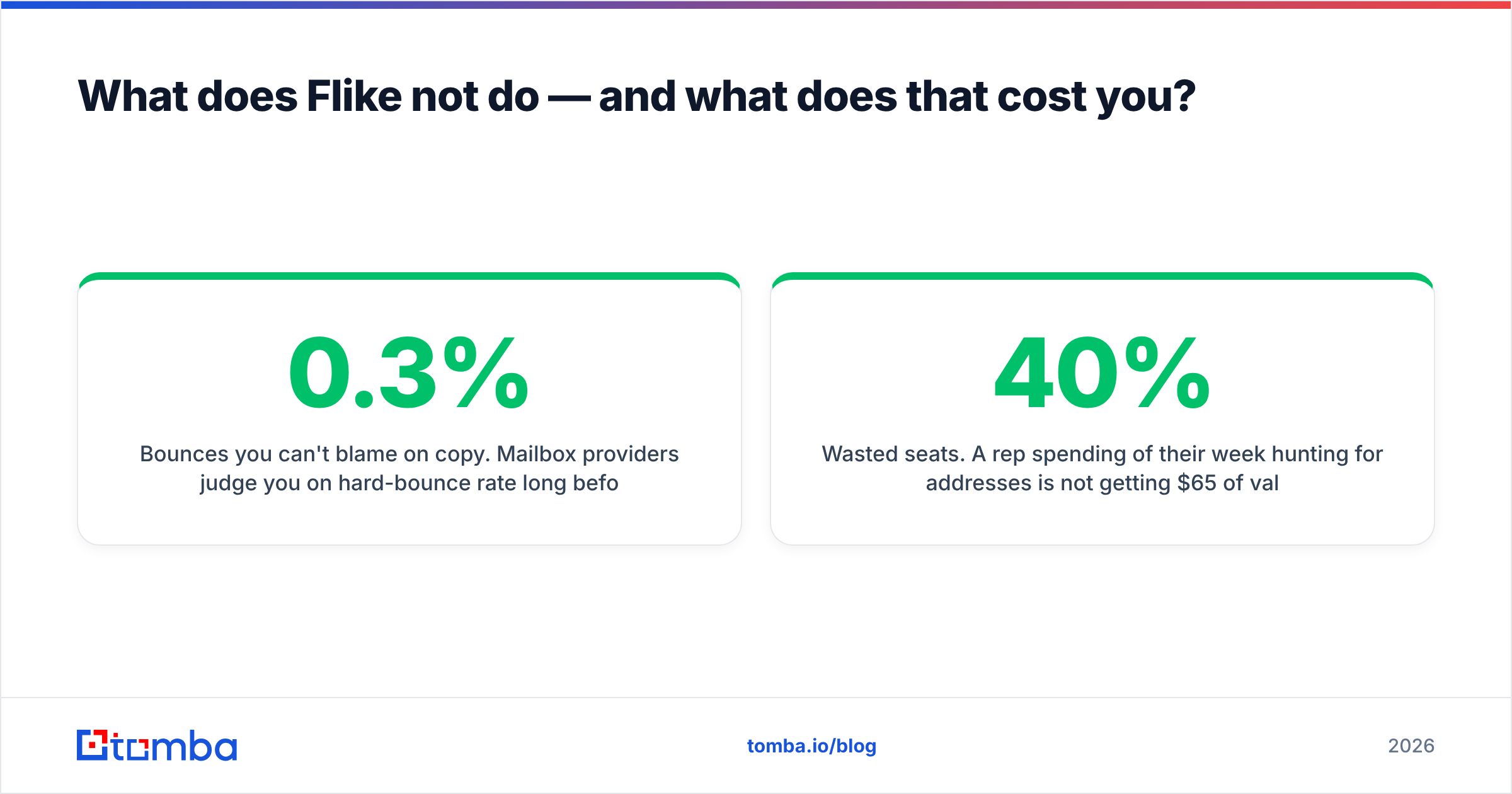
- Bounces you can't blame on copy. Mailbox providers judge you on hard-bounce rate long before they judge your prose. Google and Microsoft's bulk-sender rules put the practical ceiling near 0.3%, with 2% as the panic line.
- Wasted seats. A rep who spends 40% of the week hunting for addresses is not getting $65 a month of value from a drafting tool.
- Polluted training signal. Flike learns from your past threads. Threads that never got delivered teach it nothing useful.
- False negatives on ICP fit. A "no reply" from a wrong address looks identical to a "no reply" from a disinterested buyer in your reporting.
The fix isn't another AI layer. It's a verification step ahead of the send. Run your list through an email verifier and a catch-all verifier before a sequence starts. That removes the failure mode copy tools cannot see. HubSpot's own sales research makes the same point in different words: list quality moves reply rate more than subject-line tinkering does.
Who should buy Flike, and who should skip it?#
Buy Flike if:
- You run 5+ reps and message consistency is genuinely uneven across the team.
- Your reps live in Gmail/Outlook threads and reply-handling is the bottleneck, not prospecting.
- You already have a clean, verified contact database and a sequencer you trust.
- You can baseline reply rate now and re-measure at day 60.
Skip Flike (for now) if:
- You're 1–3 reps. The per-seat math rarely clears at that size. A good prompt library plus a cold email AI tool gets you most of the way for free.
- Your bounce rate is above 3%. Fix data first. It's cheaper, and the ROI shows up in a week.
- You sell into a niche where every message needs a subject-matter expert's hand. You'll edit more than you save.
- You can't get a month-to-month or short-term pilot. Annual commitments on unproven lift are how tool sprawl starts.
How to negotiate if you do proceed: ask for a 60-day paid pilot at 3 seats with a documented success metric, request the integration list in the order form, get onboarding waived in writing, and ask what happens to your generated-content history if you churn.
How should you sequence your GTM spend?#
Run the order of operations, not the order of excitement:
- Data first. Verified emails, correct titles, current companies. Nothing downstream works without this.
- Deliverability second. SPF, DKIM, DMARC, warmed domains, and sane volume. Check your SPF record before you scale sending.
- Sequencing third. A tool that actually sends and tracks.
- Copy quality fourth. This is where Flike, Lavender or Regie.ai earn their keep.
- Analytics fifth. Attribution that tells you which of the four above is actually broken.
Teams that buy in reverse order — copilot first, data last — are the ones filing support tickets about bounce rates in month two.
Final verdict on Flike pricing reviews pros and cons#
Flike is a focused AI copilot. It does real work for teams whose bottleneck is message quality, and reported pricing near $50–$75 per seat is fair for that job. Two things to walk in knowing. The quote-only model means you should negotiate term and seat minimums hard. And the tool assumes a data foundation it does not provide.
If that foundation is the actual gap — and for most teams under 50 reps, it is — start there. The Tomba Email Finder finds verified professional addresses by domain, name or company. The free tier covers 25 searches a month, and paid plans start at $49/mo (Growth $99/mo, Pro $249/mo). Pair it with the email verifier so every address your AI copy reaches is one that actually exists. See full Tomba pricing, or wire it into your stack with the Tomba API. Get the data right, then let the copilot do what it's good at.
Related guides#
Ready to find emails that actually work?
Join 150,000+ professionals who stopped guessing and started sending. Free credits on signup — no credit card required.
Get the Tomba newsletter
Practical outbound tactics and product updates — once every two weeks.
About the author