Floik Pricing Reviews Pros and Cons: A 2026 Buyer's Guide
Floik promises interactive demos, how-to guides and videos from one recording. Here is what the plans really cost per seat, where reviewers push back, and when a cheaper stack beats it.
Here is the short version of Floik pricing reviews pros and cons. You get the real per-seat cost, the praise from users, the complaints that keep coming up, and the point where a cheaper stack wins.
TL;DR
- Floik records a product flow once, then turns it into three assets: an interactive demo, a written how-to guide, and a narrated video.
- Pricing is per editor seat. The free tier is a trial, not a plan. Real spend starts when you add editors and drop the Floik branding.
- Reviewers love the three-in-one workflow and the AI voiceover. They gripe about seat math, re-capture work, and thin analytics.
- Rivals are Arcade, Storylane, Supademo, and Loom. Your use case picks the winner.
- A demo only pays back if the right person watches it. An email finder from $49/mo often moves pipeline faster than a fifth editor seat.
What is Floik, and who actually buys it?#
Floik is an AI-assisted content tool for software teams. You record a product flow once in the browser. Floik then turns that one capture into three outputs: a clickable demo, a step-by-step guide with screenshots, and a video with an AI voiceover. Check the official Floik site before you buy. This category ships fast, and plan sheets change often.
The buyer profile splits into three groups, and each one values a different part of the product:
- Product marketing — wants an interactive demo on the pricing page and in paid campaigns. Anonymous visitors can then tour the product before they book a call.
- Sales and pre-sales — wants a leave-behind after discovery. The champion can re-run the demo for the buying committee without a second live call.
- Customer support and success — wants how-to guides that stay current, so the help centre stops rotting after each UI change.
- Founder-led GTM at seed stage — wants all three from one seat, because there is no one else to do it.
That last group gives Floik most of its early love. It is also where the pricing talk gets sharpest. A three-person startup will not pay a per-seat platform rate for a tool one person opens twice a month.

How does Floik pricing actually work in 2026?#
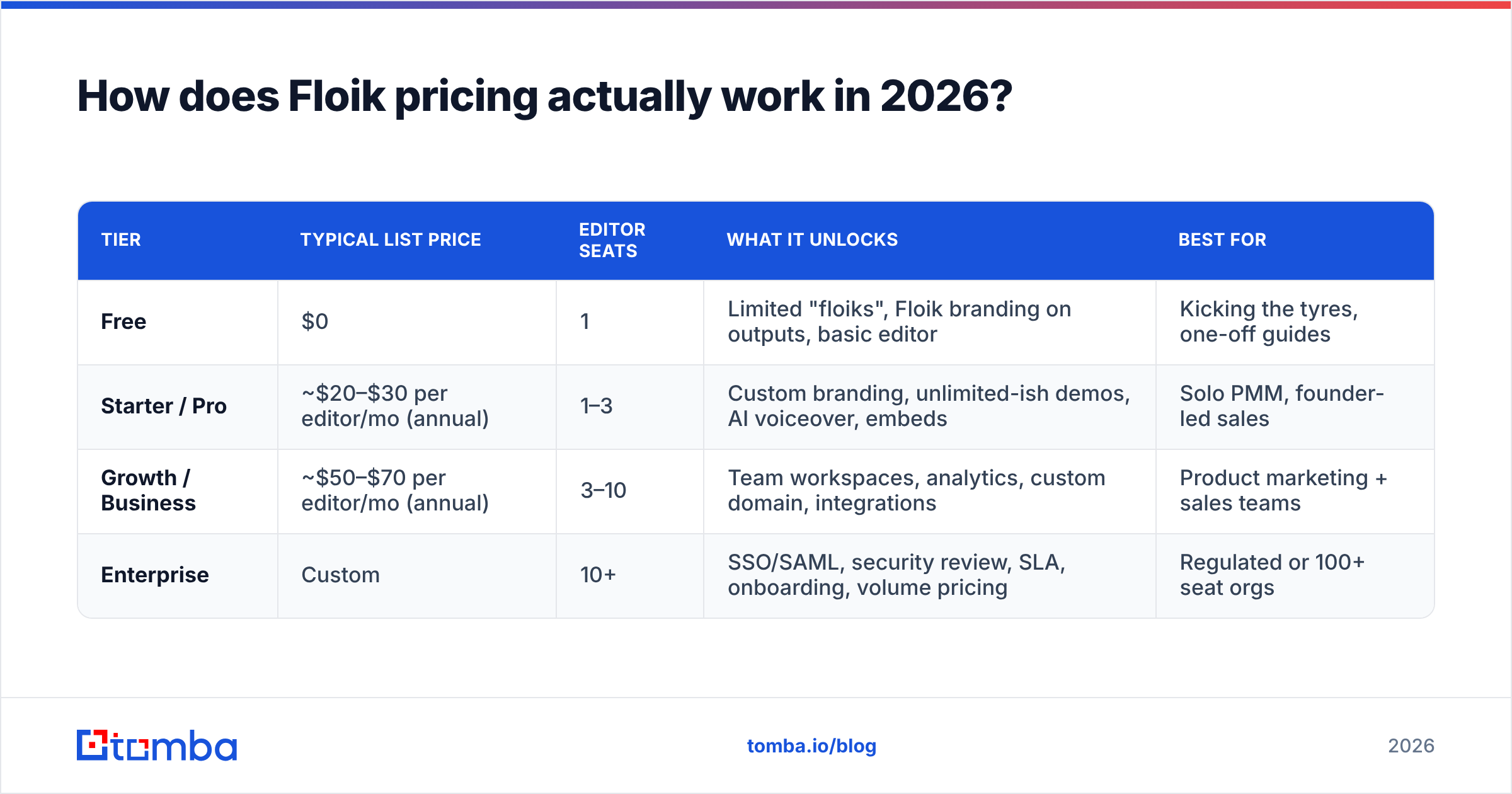
Floik follows the standard demo-tool structure. A free tier caps output volume. One or two paid self-serve tiers are priced per editor seat. A custom enterprise tier adds SSO, security review, and volume discounts. Viewers cost you nothing. Editors do.
Here is the shape of what you are buying. Treat these figures as the list structure at the time of writing. Confirm the exact numbers on Floik's own pricing page. Tiers in this category get repriced two or three times a year.
| Tier | Typical list price | Editor seats | What it unlocks | Best for |
|---|---|---|---|---|
| Free | $0 | 1 | Limited "floiks", Floik branding on outputs, basic editor | Kicking the tyres, one-off guides |
| Starter / Pro | ~$20–$30 per editor/mo (annual) | 1–3 | Custom branding, unlimited-ish demos, AI voiceover, embeds | Solo PMM, founder-led sales |
| Growth / Business | ~$50–$70 per editor/mo (annual) | 3–10 | Team workspaces, analytics, custom domain, integrations | Product marketing + sales teams |
| Enterprise | Custom | 10+ | SSO/SAML, security review, SLA, onboarding, volume pricing | Regulated or 100+ seat orgs |
Three pricing mechanics matter more than the headline number:
- Annual vs monthly. The advertised price is almost always the annual-commit rate. Monthly billing runs 20–25% higher. If you are testing the category, pay monthly for a quarter and eat the premium.
- Seat inflation. Demo tools spread. One PMM buys it. Then two AEs want to personalise demos. Then support wants guides. A $30 seat becomes $30 × 6 fast. Decide upfront whether AEs get editor seats or just share links.
- Branding removal is a paywall, not a feature. Floik-branded outputs on the free tier are the conversion lever. If the demo sits on your website, you pay at least the entry tier from day one.
Gartner's sales technology research is a useful neutral read on how vendors structure tiers. The seat-plus-feature-gate model Floik uses is the category norm, not a quirk.
What do Floik reviews say?#
Pull the review sites and a consistent picture forms. Most of the public debate about Floik pricing reviews pros and cons happens right here.
G2's demo automation category shows how Floik stacks up against Storylane, Arcade, and Supademo on ratings and review volume. Floik is a younger entrant, so its review count is smaller. That cuts both ways. Fewer reviews means less signal. The reviews that do exist are unusually specific about workflow.
What reviewers repeat as praise:
- The one-recording-three-outputs pipeline saves a full pass of work. Teams that used to record in Loom, screenshot in Snagit, and write in Notion collapse three tools into one.
- The AI voiceover is good enough to ship internally and for mid-funnel content. Nobody calls it broadcast quality. It does remove the "we need to re-record because Sarah left" problem.
- The editor has a low learning curve. Reviewers report a first useful output inside an hour. That is the real benchmark for a tool nobody has time to learn.
- Support responsiveness gets called out often. That is typical of a smaller vendor, and a real advantage while it lasts.
What reviewers repeat as criticism:
- Re-capture friction. When your product UI changes, some flows need re-recording rather than a surgical edit. Every demo tool has this problem. Floik has not solved it either.
- Analytics depth. You get view counts and step drop-off. You do not get the account-level, CRM-synced demo intelligence that specialist platforms sell as their core value.
- Integration breadth. There are fewer native connectors than established rivals offer. Zapier and webhooks cover most gaps, but "cover the gap" is not "native".
- Seat pricing for occasional editors. The most common complaint is not the rate. It is paying a full editor seat for someone who publishes twice a quarter.
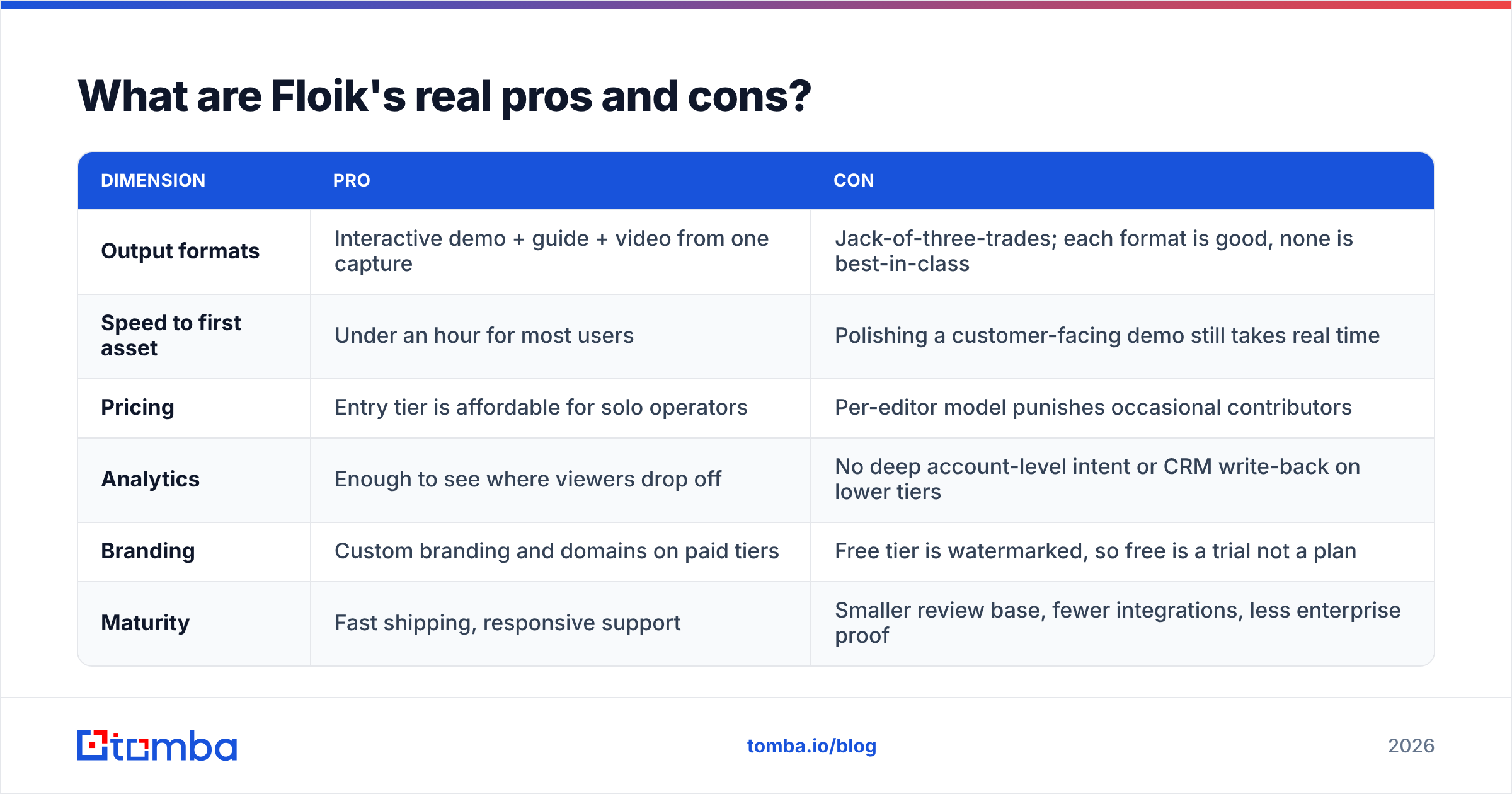
Floik pricing reviews pros and cons: the honest scorecard#
Strip the marketing and the trade-off is clear. Floik buys you speed and format flexibility. It asks you to accept less depth than a category specialist.
| Dimension | Pro | Con |
|---|---|---|
| Output formats | Interactive demo + guide + video from one capture | Jack-of-three-trades; each format is good, none is best-in-class |
| Speed to first asset | Under an hour for most users | Polishing a customer-facing demo still takes real time |
| Pricing | Entry tier is affordable for solo operators | Per-editor model punishes occasional contributors |
| Analytics | Enough to see where viewers drop off | No deep account-level intent or CRM write-back on lower tiers |
| Branding | Custom branding and domains on paid tiers | Free tier is watermarked, so free is a trial not a plan |
| Maturity | Fast shipping, responsive support | Smaller review base, fewer integrations, less enterprise proof |
The honest verdict: if your bottleneck is producing demo content, Floik is a strong buy. If your bottleneck is measuring demo engagement and routing it into pipeline, you will outgrow the lower tiers. Price the enterprise conversation before you commit.
How does Floik compare to Arcade, Storylane, Supademo, and Loom?#
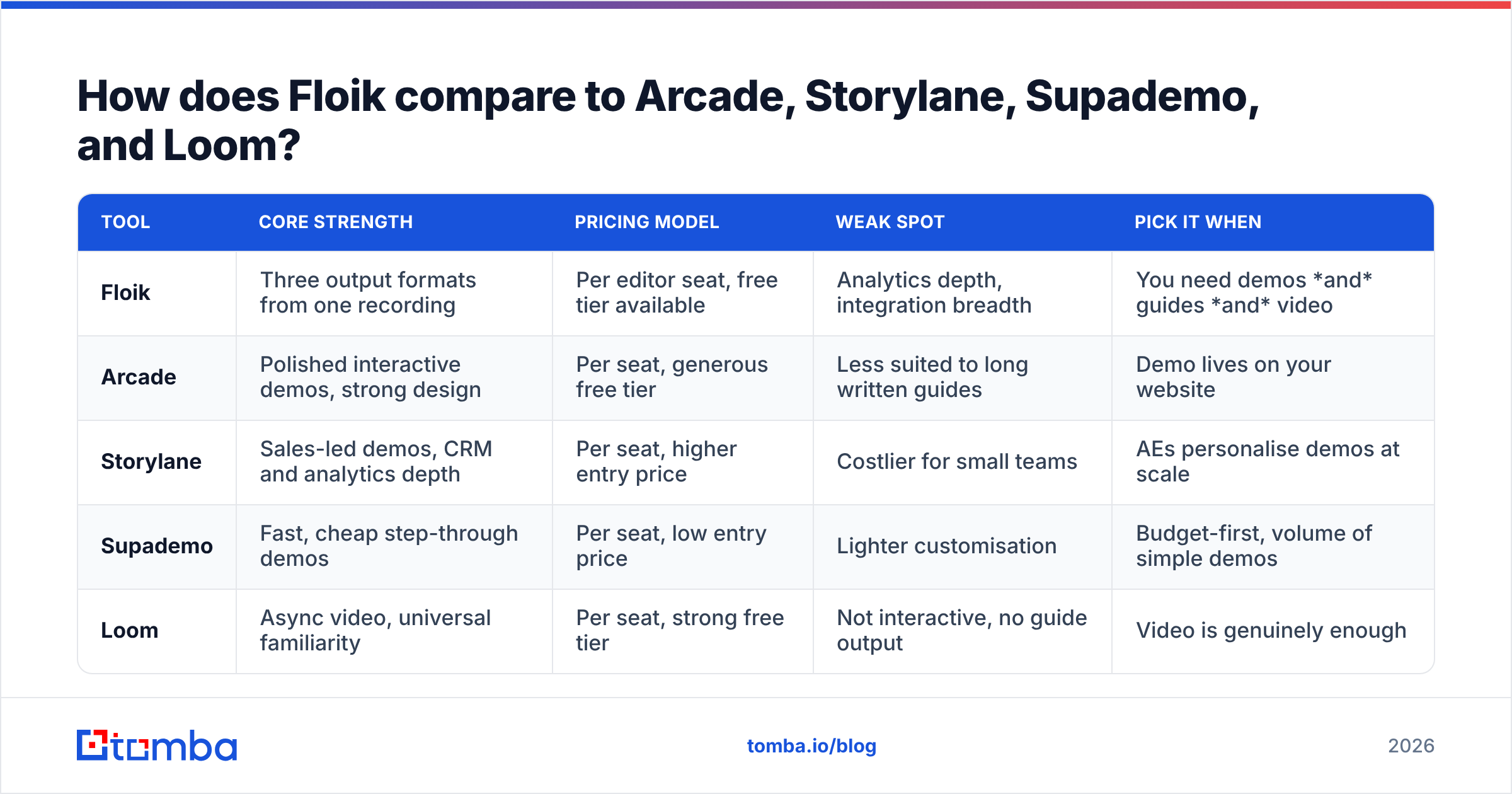
The four names you will short-list against Floik occupy different corners of the same market.
| Tool | Core strength | Pricing model | Weak spot | Pick it when |
|---|---|---|---|---|
| Floik | Three output formats from one recording | Per editor seat, free tier available | Analytics depth, integration breadth | You need demos and guides and video |
| Arcade | Polished interactive demos, strong design | Per seat, generous free tier | Less suited to long written guides | Demo lives on your website |
| Storylane | Sales-led demos, CRM and analytics depth | Per seat, higher entry price | Costlier for small teams | AEs personalise demos at scale |
| Supademo | Fast, cheap step-through demos | Per seat, low entry price | Lighter customisation | Budget-first, volume of simple demos |
| Loom | Async video, universal familiarity | Per seat, strong free tier | Not interactive, no guide output | Video is genuinely enough |
Two rules of thumb from watching teams run this evaluation:
- If more than half your use cases are written help-centre content, Floik's guide output is the differentiator. The real comparison is then Floik vs a docs tool, not Floik vs Arcade.
- If more than half are AE-personalised sales demos with CRM attribution, Storylane-class analytics is what you are buying. Floik's lower tiers will feel thin within two quarters.
Is Floik worth it for your team size?#
Run the maths against outcomes, not features.
- Solo founder / one-person marketing. Yes, at the entry tier. One seat, three output formats, branding removed. The alternative is three subscriptions and more context switching.
- 5–15 person GTM team. Probably, but cap editor seats at two or three. Give AEs share links, not editor access. This is where teams overspend by handing a seat to everyone.
- Enterprise with security review. Get the custom quote. Compare it against Storylane and Arcade in the same cycle. Floik's enterprise footprint is smaller, so push harder on SSO, data residency, and SLA specifics before signing.
- Support-led org. Strong fit. The guide output alone can replace a documentation workflow, and support teams rarely need the deep sales analytics that Floik lacks.

What's the hidden cost nobody puts in the demo-tool budget?#
Distribution. A demo tool has zero ROI until the right person watches the demo. That is a contact-data problem, not a content problem.
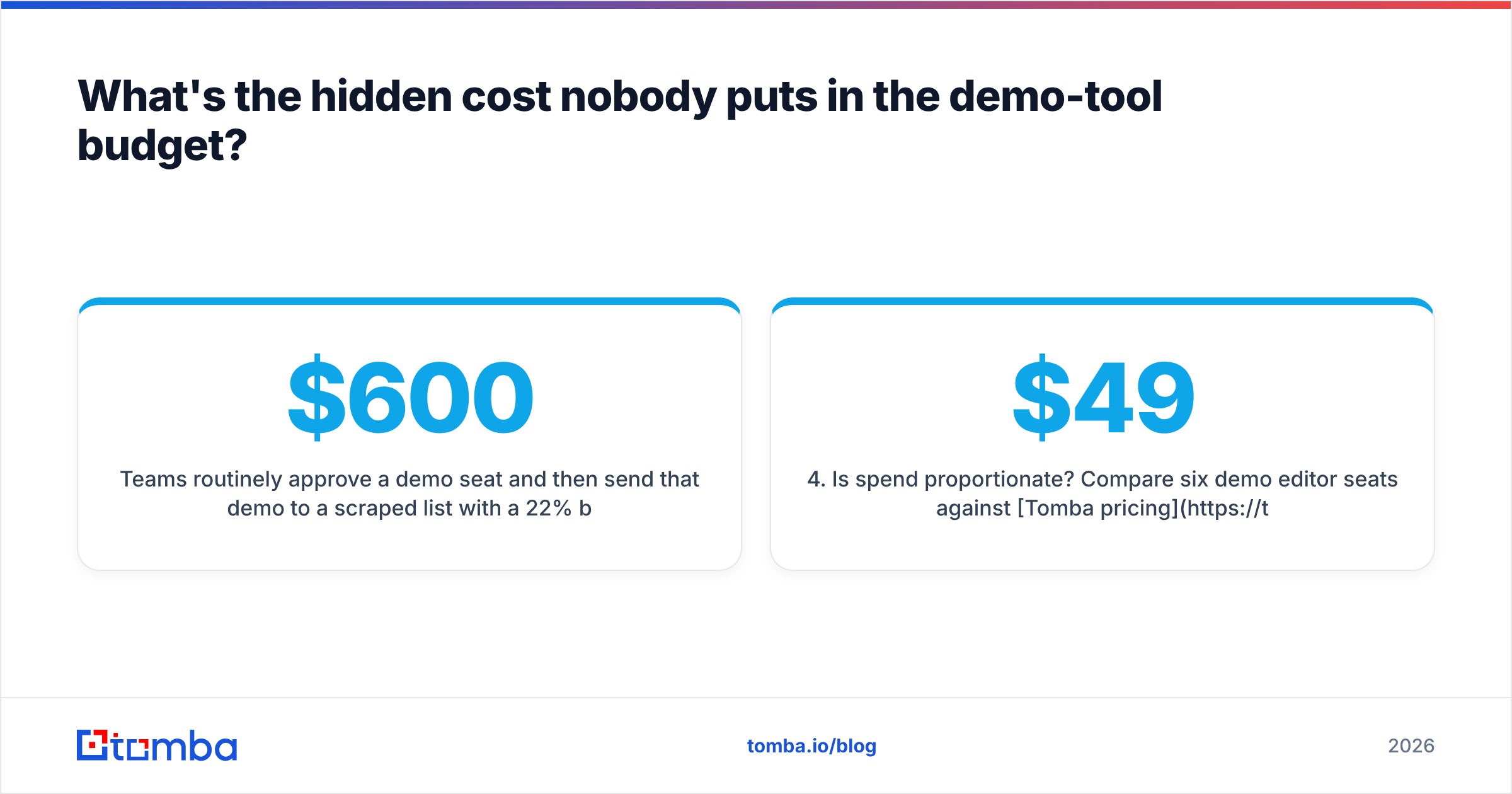
Teams routinely approve a $600/year demo seat, then send that demo to a scraped list with a 22% bounce rate. The demo was never the constraint. Before you add a fourth editor seat, check the cheaper end of the funnel:
- Are you reaching decision makers or generic inboxes? A domain search returns the named contacts at a target company instead of info@ black holes.
- Is your list clean before send? Run an email verifier before every campaign. It protects your sender reputation, and a burned domain costs more than any SaaS seat.
- Are you enriching demo viewers? Anonymous demo views are worth little. A reverse email lookup turns a view into a routable lead.
- Is spend proportionate? Compare six demo editor seats against Tomba pricing: Free at 25 searches/mo, Starter at $49/mo, Growth at $99/mo, Pro at $249/mo. Ask which line item books more first meetings this quarter.
The point is not that Floik is expensive. Demo tooling and contact data are complements, and most teams fund the first while starving the second.
What should you check before you sign?#
Run this five-item checklist during the trial, not after:
- Re-record one flow after a UI change. Time it. That number, not the demo of the demo, tells you your true maintenance cost.
- Export the analytics you will actually report on. If you cannot get step drop-off into your reporting stack, the tier is wrong.
- Test the embed on your real site. Load time and mobile behaviour vary more than vendors admit.
- Price the annual plan against monthly for two years. Include seat growth at your realistic hiring rate, not today's headcount.
- Ask about downgrade behaviour. What happens to published demos if you drop a tier or a seat? Get the answer in writing.
FAQ#
Does Floik have a free plan? Yes — a limited free tier with Floik branding on outputs. It is a trial mechanism, not a plan you can run a public demo library on.
Is Floik cheaper than Storylane or Arcade? At the entry tier, generally yes. At the team tier, the gap narrows quickly once you add editor seats and need analytics. Compare total seats and not headline rates.
Can Floik replace Loom? For product walkthroughs, yes. For quick async messages to a colleague, Loom's free tier and familiarity still win.
Do viewers count as seats? No. Pricing is per editor. This is the single biggest lever you control — restrict editor access and share view links widely.
Is Floik good for help documentation? This is arguably its strongest use case. The step-by-step guide output with auto-captured screenshots is faster than writing docs manually.
Where should your next dollar go?#
If your demo content is the bottleneck, Floik at the entry tier is a defensible buy. It is cheap enough to test and broad enough to replace two or three tools. Cap your editor seats, pay monthly for a quarter, and re-evaluate before the annual commit. That is the short version of Floik pricing reviews pros and cons: cheap to start, easy to outgrow.
But if your demos are good and nobody watches them, the fix is upstream. Find the named decision makers at the accounts you want. Verify the addresses before you send. Put the demo in front of people who can buy. Start with the Tomba Email Finder — the free tier gives you 25 searches a month to test the theory, and Starter runs $49/mo if the pipeline math works. That is one demo seat's worth of budget doing a very different job.
Related guides#
Ready to find emails that actually work?
Join 150,000+ professionals who stopped guessing and started sending. Free credits on signup — no credit card required.
Get the Tomba newsletter
Practical outbound tactics and product updates — once every two weeks.
About the author