FloppyData Pricing 2026: Reviews, Pros and Cons Explained
A neutral breakdown of how FloppyData charges, what reviewers actually report, and the real cost per usable contact once bounces and duplicates are stripped out.
TL;DR
- FloppyData sells B2B contact data on a credit model, so the sticker price on the plan page is never the price you actually pay per usable contact.
- The number that matters is cost per deliverable record — after bounces, duplicates, and role accounts are removed. That figure is usually 2–4x the headline rate.
- Reviewers consistently praise the low entry cost and breadth of records; the recurring complaint across budget data vendors is variable accuracy on smaller companies and non-US regions.
- If you buy bulk data, budget for verification. Running exports through an email verifier before your sequencing tool sees them is non-negotiable.
- Cheaper alternative path: skip the bulk database entirely and pull contacts on demand. Tomba pricing starts at a free tier (25 searches/mo) and $49/mo Starter, with no minimum-seat commitment.
Prices and plan structures change. Everything below reflects what was published at the time of writing — always confirm current numbers on the vendor's own page before you buy.
What is FloppyData?#
FloppyData is a B2B contact-data provider. You search a database of company and contact records, filter by attributes like industry, headcount, job title, and location, then export what matches into a CSV or push it into your CRM. It sits in the same product category as sales-intelligence platforms listed on G2's sales intelligence category — the pitch is volume and price, not workflow depth.
That positioning matters for how you evaluate it. FloppyData is not an email-finding API you call one contact at a time inside a workflow. It is a bulk data source. You are buying a list, and the economics of buying a list are different from the economics of enriching a lead you already care about.
Two questions decide whether the purchase is smart:
- What is the real per-record cost after you delete everything unusable?
- Does your motion actually need bulk, or do you need precision on a named account list?
Most teams that regret a data purchase got question two wrong, not question one.
How does FloppyData pricing work?#
Like nearly every data vendor in this tier, FloppyData charges in credits. One credit buys one record reveal — an email, a phone number, or a full contact profile depending on the plan and the data type. Credits come in packs or in a monthly subscription, and the effective unit price drops as the pack size rises.
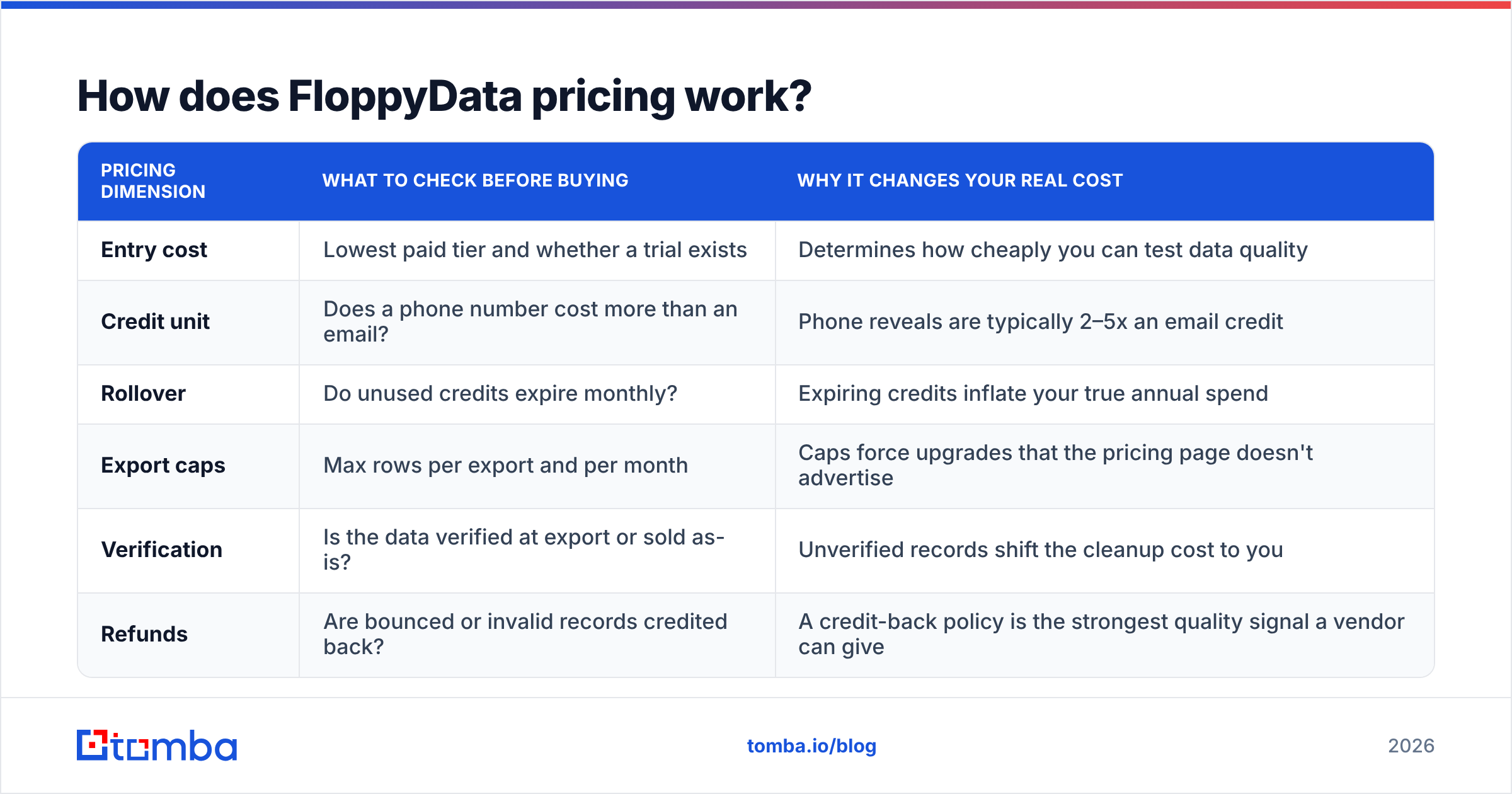
Here is the structure you should expect to evaluate, with the questions to ask on each line:
| Pricing dimension | What to check before buying | Why it changes your real cost |
|---|---|---|
| Entry cost | Lowest paid tier and whether a trial exists | Determines how cheaply you can test data quality |
| Credit unit | Does a phone number cost more than an email? | Phone reveals are typically 2–5x an email credit |
| Rollover | Do unused credits expire monthly? | Expiring credits inflate your true annual spend |
| Export caps | Max rows per export and per month | Caps force upgrades that the pricing page doesn't advertise |
| Verification | Is the data verified at export or sold as-is? | Unverified records shift the cleanup cost to you |
| Refunds | Are bounced or invalid records credited back? | A credit-back policy is the strongest quality signal a vendor can give |
The refund line is the one to press on. A vendor confident in its data will replace or credit invalid records. A vendor that sells "as-is" is telling you, politely, that verification is your job and your budget.

What do FloppyData reviews actually say?#
Review coverage for FloppyData is thinner than for the enterprise incumbents — you will find scattered entries on Capterra and G2 rather than thousands of validated reviews. Read that as a caution flag on sample size, not as evidence of poor quality.
Across the budget B2B data category, review sentiment clusters into predictable patterns:
- Praise for price. Buyers coming off enterprise contracts consistently report large savings, and that is genuinely the category's strongest argument.
- Praise for filter breadth. Firmographic filtering is table stakes now, and reviewers rarely complain about it.
- Complaints about accuracy variance. Data on large US tech companies tends to be strong. Data on sub-50-employee firms, non-English markets, and recently changed roles degrades noticeably.
- Complaints about stale titles. With ~20–30% annual job turnover in B2B, any database is decaying the moment it is compiled. Vendors differ in refresh cadence, and cheap vendors usually refresh less often.
- Support responsiveness varies. Smaller vendors often win here — you get a human. Others are email-only with slow turnaround.
Treat every star rating as a hypothesis, not a finding. The only review that matters is the one you generate: export 200 records in your exact ICP, verify them independently, and count how many survive.
How accurate is the data you're paying for?#
This is where headline pricing quietly falls apart. Suppose a vendor sells credits at $0.05 per record and delivers 70% deliverable emails after you strip catch-alls, bounces, duplicates, and role addresses like info@ or sales@. Your real cost is $0.071 per usable contact — and that is before you count the hours spent cleaning.

Run this arithmetic before every purchase:
- Buy the smallest possible test batch. 200–500 records in your exact ICP, never a full-year commitment on day one.
- Deduplicate first. Remove rows already in your CRM. Paying twice for a contact you own is the most common invisible cost.
- Verify independently. Do not trust the seller's own validity flag. Use a separate email verification pass so the grader isn't the vendor.
- Segment catch-all domains. Catch-all servers accept everything and tell you nothing. Handle them with a dedicated catch-all verifier rather than lumping them in with valid records.
- Divide. Total spend ÷ surviving deliverable records = your true cost per lead. Compare vendors only on this number.
Data decay is a structural problem, not a vendor-specific failing — the underlying issue is well documented under general data quality principles. Every provider fights it. Your job is to find out who is losing that fight in your segment.
How does FloppyData compare to other B2B data tools?#
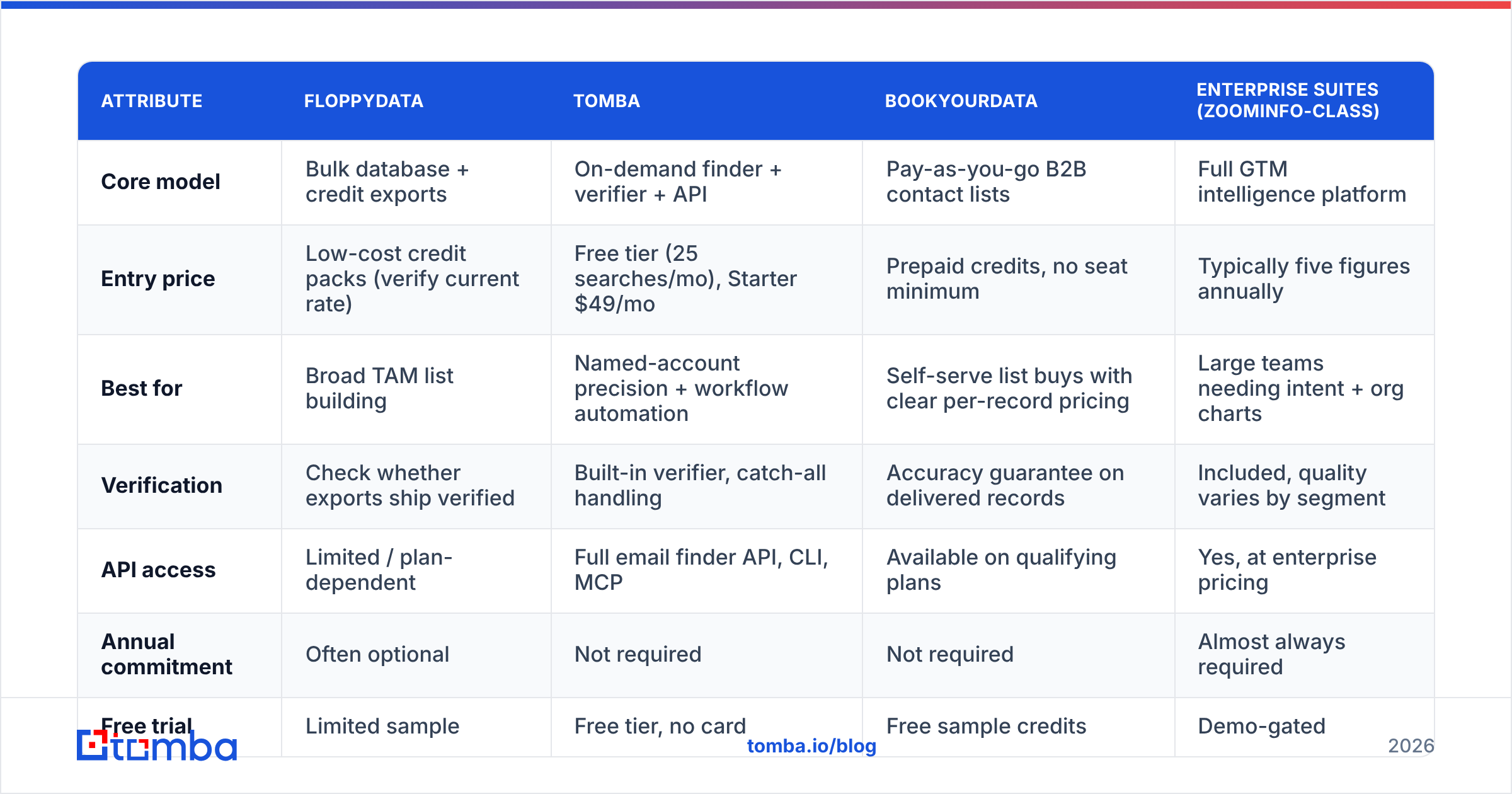
Different buying motions want different tools. A bulk database, a precision finder, and an enterprise intelligence suite are not substitutes for each other, even though their marketing pages look identical.

| Attribute | FloppyData | Tomba | BookYourData | Enterprise suites (ZoomInfo-class) |
|---|---|---|---|---|
| Core model | Bulk database + credit exports | On-demand finder + verifier + API | Pay-as-you-go B2B contact lists | Full GTM intelligence platform |
| Entry price | Low-cost credit packs (verify current rate) | Free tier (25 searches/mo), Starter $49/mo | Prepaid credits, no seat minimum | Typically five figures annually |
| Best for | Broad TAM list building | Named-account precision + workflow automation | Self-serve list buys with clear per-record pricing | Large teams needing intent + org charts |
| Verification | Check whether exports ship verified | Built-in verifier, catch-all handling | Accuracy guarantee on delivered records | Included, quality varies by segment |
| API access | Limited / plan-dependent | Full email finder API, CLI, MCP | Available on qualifying plans | Yes, at enterprise pricing |
| Annual commitment | Often optional | Not required | Not required | Almost always required |
| Free trial | Limited sample | Free tier, no card | Free sample credits | Demo-gated |
BookYourData deserves a fair mention here: its per-record pricing is unusually transparent for the category, and it publishes an accuracy guarantee — which is exactly the credit-back signal recommended above. If your motion genuinely needs prepaid bulk lists, it is a legitimate peer to evaluate alongside FloppyData.
The enterprise column exists to make one point: you are almost certainly not choosing between FloppyData and ZoomInfo. You are choosing between "buy volume cheaply and clean it" and "pull fewer, better records on demand."
What are the pros of FloppyData?#
Low barrier to entry. You can test the product without a procurement cycle, a demo call, or an annual contract. For a two-person outbound team, that alone is worth a lot.
Volume economics. If you need 50,000 records for a broad TAM mapping exercise or a market-sizing project, per-record pricing at this tier beats enterprise platforms by an order of magnitude.
Straightforward filtering. Firmographic search with export is a solved problem, and it works. You are not paying for a learning curve.
No seat tax. Enterprise suites charge per seat, which punishes small teams that want three people looking at the same data. Credit-based vendors mostly don't.
Useful for enrichment backfill. If you have a CRM full of company names and missing contacts, a bulk source can be a cheap way to backfill — provided you dedupe and verify on the way in.
What are the cons of FloppyData?#
Accuracy varies by segment. Expect strong coverage on large US companies and weaker coverage on SMBs, EMEA/APAC markets, and freshly changed roles. Test your specific segment; category-wide averages tell you nothing about your ICP.
Verification cost is externalized. If exports are not verified at the point of delivery, your effective price is the sticker price plus verification plus cleanup labor. Model that before comparing vendors.
Credit expiry risk. Monthly credits that don't roll over are a real cost. A team that uses 60% of its allotment is paying a 40% premium it never sees on an invoice.
Thin third-party review base. Fewer independent reviews means less signal about edge cases, support quality, and long-term reliability. You are underwriting more risk yourself.
Bulk encourages bad outbound. This is the underrated cost. Cheap volume tempts teams to blast 10,000 contacts, which torches sender reputation and drags down deliverability for the whole domain. The data isn't the problem — the behavior it enables is.
Who should buy FloppyData, and who shouldn't?#
Buy it if: you are doing genuine TAM research, you need tens of thousands of records for analysis rather than outreach, your ICP skews toward mid-market and enterprise US companies, and you already own a verification step in your pipeline.
Skip it if: you run named-account outbound against a list of 200 target companies, you need contacts enriched at the moment a lead enters your CRM, you sell into SMBs or non-US markets, or you have no verification layer and no intention of building one.
The second profile describes most B2B sales teams under 50 people. For them, a bulk database is the wrong shape of tool at any price — the constraint is not "not enough contacts," it is "not enough right contacts, right now, inside the workflow."
That is a domain search and on-demand lookup problem. You give it a company, it returns the people who match your target roles, verified, at the moment you need them. No credit expiry, no 40,000-row CSV rotting in Google Drive, no cleanup project.
How do you cut your real cost per usable contact?#
Regardless of which vendor you pick, these five moves reduce spend more than any discount negotiation will:
- Dedupe against your CRM before you export. The cheapest record is the one you already own.
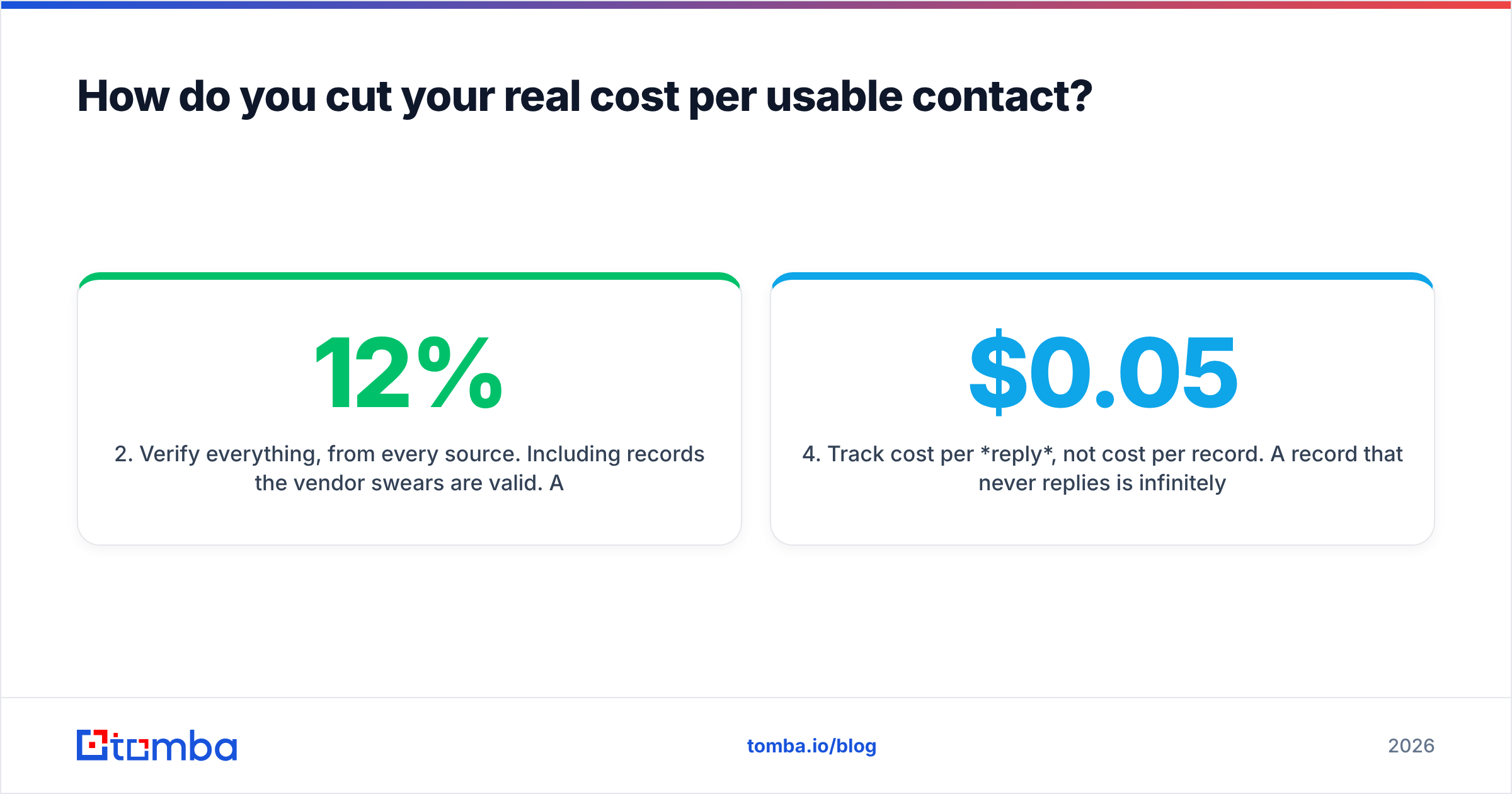
- Verify everything, from every source. Including records the vendor swears are valid. A separate verification pass pays for itself the first time it catches a 12% bounce batch.
- Cap volume deliberately. Sending less to better-targeted contacts beats sending more. Reply rate is a function of relevance, not list size.
- Track cost per reply, not cost per record. A $0.05 record that never replies is infinitely expensive. A $0.30 record that books a meeting is free.
- Automate the pull, not the blast. Trigger enrichment when an account enters your pipeline — via API or a bulk email finder run on a real target list — instead of buying a database "just in case."
The bottom line on FloppyData pricing#
FloppyData is honestly priced for what it is: a cheap way to get a lot of B2B records. If your bottleneck is genuinely volume and you have the discipline to verify and dedupe, it can work out to a defensible cost per usable contact. Verify the current plan terms directly on floppydata.com — credit rates, rollover rules, and export caps in this category change often.
But be clear-eyed about the trade. You are buying raw material, not finished goods, and the finishing cost lands on you.
If what you actually need is accurate contacts on demand — pulled per company, verified before they reach your sequencer, and available via API, CLI, or Chrome extension — start with the Tomba Email Finder. The free tier gives you 25 searches a month with no card, Starter is $49/mo, and Growth is $99/mo, so you can run the 200-record accuracy test described above against your own ICP before committing a dollar. Test both. Compare cost per deliverable contact. Let the arithmetic pick the winner.
Related guides#
Ready to find emails that actually work?
Join 150,000+ professionals who stopped guessing and started sending. Free credits on signup — no credit card required.
Get the Tomba newsletter
Practical outbound tactics and product updates — once every two weeks.
About the author