Floworks AI Pricing in 2026: Real Costs, Limits & Options
Floworks sells an AI SDR, not a public price list. Here's how its quote-based pricing actually works in 2026, where the add-ons hide, and how it compares to a $49/mo data-plus-sequencer stack.
TL;DR
- Floworks does not publish a simple self-serve price card the way most email tools do. Its AI SDR product (Alisha, built on the company's ThorV2 agent stack) is sold as a seat-plus-usage contract, usually after a demo, and usually annual.
- Expect the entry point for a real AI SDR deployment to land in the high hundreds to low thousands of dollars per month, not the $49–$99 range you're used to from data tools. Verify current numbers on floworks.ai before you budget — quote-based pricing moves.
- The sticker price is rarely the whole bill. Data credits, inbox infrastructure, warmup, CRM seats, and implementation time all sit outside the line item.
- An AI SDR is priced against a human SDR ($70k–$110k fully loaded in the US), not against a lead database. That's the comparison that decides whether it's worth it.
- If your bottleneck is contact data rather than message volume, a $49/mo finder-plus-verifier stack solves 80% of the problem for about 5% of the cost. Start there, then decide if you need the agent.
What is Floworks AI, and what are you actually paying for?#
Floworks is an AI sales agent company. Its headline product is an AI SDR — an agent that researches accounts, drafts personalized outreach, sends it, handles replies, and books meetings into a calendar. Under the hood the company markets its own agentic architecture (ThorV2) as the reason its function-calling is more reliable than a generic GPT wrapper stitched onto a sequencer.
That framing matters for pricing. You are not buying a database and you are not buying an email sender. You're buying labor substitution. The pitch is that one subscription replaces or augments a headcount slot, so the price anchors to salary, not to software.
Concretely, a Floworks-style AI SDR contract typically bundles:
- The agent seat — the "employee" itself. One agent, mapped to one persona, one mailbox identity, one set of goals. This is the core recurring line item.
- Contact data and enrichment — either bundled credits or a pass-through to a third-party data provider. Ask which, because it changes the real cost per meeting dramatically.
- Sending infrastructure — mailboxes, domains, warmup. Some vendors include it, some assume you bring your own.
- Onboarding and ICP configuration — the human work of teaching the agent your positioning, objections, and qualification rules. Often a one-time fee or a "we'll do it during the pilot" concession.
- Integrations — CRM sync, calendar, Slack, sometimes a data warehouse connector. Usually gated to higher tiers.
If a quote does not itemize those five things, you don't have a quote. You have a number.
How does Floworks AI pricing work in 2026?#
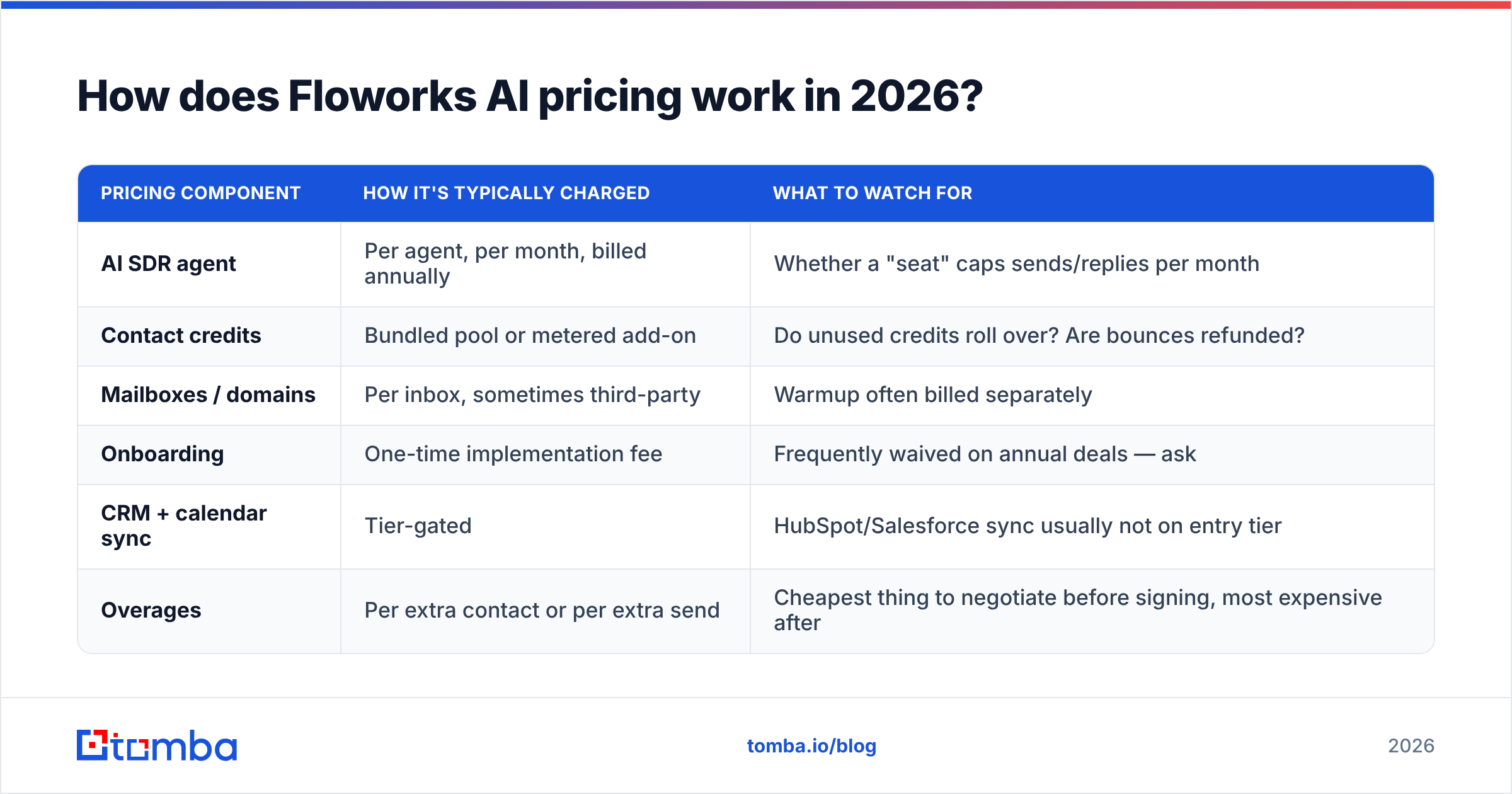
Quote-based, annual-leaning, and usage-aware. Here's the structure you should expect to negotiate against.
| Pricing component | How it's typically charged | What to watch for |
|---|---|---|
| AI SDR agent | Per agent, per month, billed annually | Whether a "seat" caps sends/replies per month |
| Contact credits | Bundled pool or metered add-on | Do unused credits roll over? Are bounces refunded? |
| Mailboxes / domains | Per inbox, sometimes third-party | Warmup often billed separately |
| Onboarding | One-time implementation fee | Frequently waived on annual deals — ask |
| CRM + calendar sync | Tier-gated | HubSpot/Salesforce sync usually not on entry tier |
| Overages | Per extra contact or per extra send | Cheapest thing to negotiate before signing, most expensive after |
Two structural facts about this pricing model are worth internalizing.
First, "AI SDR" pricing is deliberately opaque. Vendors in this category — Floworks, 11x, Artisan, Regie, AiSDR and the rest — mostly keep pricing behind a demo because the value story only lands after a conversation about your quota and headcount plan. That's a legitimate sales strategy, not a red flag. But it does mean two companies of similar size can pay very different amounts for the same product, and the difference is negotiation, not features.
Second, the unit is meetings, not emails. Most AI SDR contracts are sold on a projected cost-per-meeting. If a vendor quotes you $2,000/mo and forecasts 12 qualified meetings, they're selling you a $167 meeting. Hold them to that number in the pilot. Independent buyer reviews on G2 are the fastest way to sanity-check whether a category's forecast meeting volume survives contact with reality.
What does Floworks AI cost compared to the alternatives?#
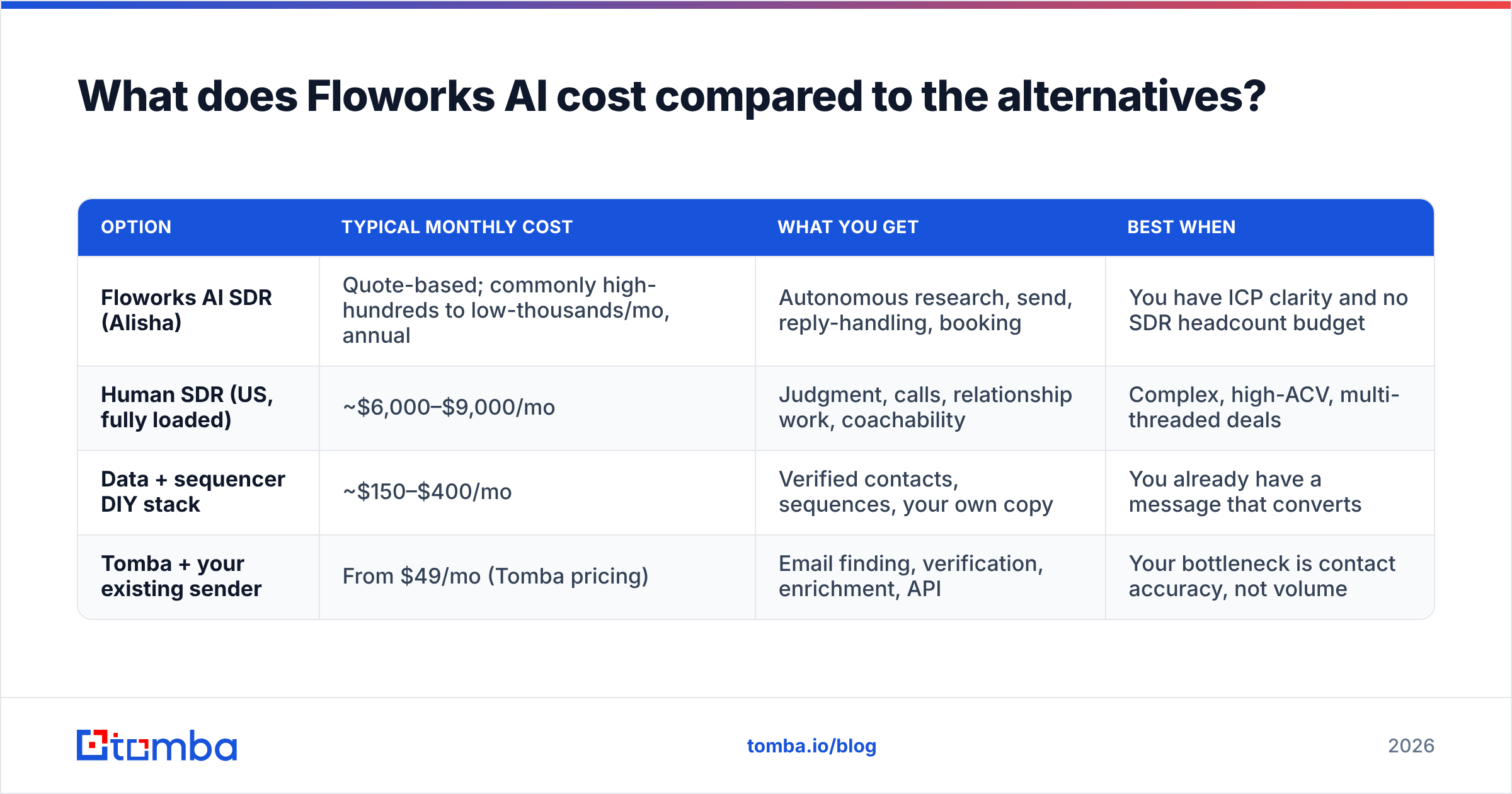
The honest comparison isn't Floworks vs. another AI SDR. It's Floworks vs. the three other ways you could hit the same pipeline number.
| Option | Typical monthly cost | What you get | Best when |
|---|---|---|---|
| Floworks AI SDR (Alisha) | Quote-based; commonly high-hundreds to low-thousands/mo, annual | Autonomous research, send, reply-handling, booking | You have ICP clarity and no SDR headcount budget |
| Human SDR (US, fully loaded) | ~$6,000–$9,000/mo | Judgment, calls, relationship work, coachability | Complex, high-ACV, multi-threaded deals |
| Data + sequencer DIY stack | ~$150–$400/mo | Verified contacts, sequences, your own copy | You already have a message that converts |
| Tomba + your existing sender | From $49/mo (Tomba pricing) | Email finding, verification, enrichment, API | Your bottleneck is contact accuracy, not volume |
Read that table twice. The AI SDR sits between a DIY stack and a headcount hire — which is exactly where it should sit, and exactly why it's hard to evaluate. It's too expensive to buy casually and too cheap to require board approval, so it tends to get bought on vibes.
The decision rule I'd use: if you can't already point to a sequence that books meetings when a human runs it, an AI SDR will scale a message that doesn't work. Agents amplify. They don't diagnose.
Where do the hidden costs show up in an AI SDR contract?#
Four places, consistently.
- Data quality pass-through. If the agent burns credits on stale contacts, you pay twice: once for the credit, once in sender reputation when the bounce rate climbs. Any AI SDR is only as good as the list underneath it. Run contacts through an independent email verifier before the agent touches them, regardless of what the vendor promises about built-in validation.
- Inbox infrastructure. Realistic outbound at volume needs multiple domains and 8–20 warmed mailboxes. At $3–$6 per mailbox per month plus warmup tooling, that's a few hundred dollars nobody mentions on the pricing call.
- Ramp time. Budget four to eight weeks before an AI SDR produces steady meetings — ICP tuning, copy iteration, deliverability stabilization. On an annual contract, that's roughly 10–15% of the term spent getting to baseline. Negotiate a delayed start date or a pilot month.
- The human you still need. Someone owns the agent: reviewing drafts, approving exceptions, handling the replies that need a real answer. Vendors call this "5 hours a week." Plan for 10 in month one.
None of these make the category a bad buy. They just mean the "replaces a $90k SDR for $2k/mo" math is really "replaces most of a $90k SDR for $2k/mo plus $600 infra plus 20% of a manager's time."
Is an AI SDR actually cheaper than a human SDR?#
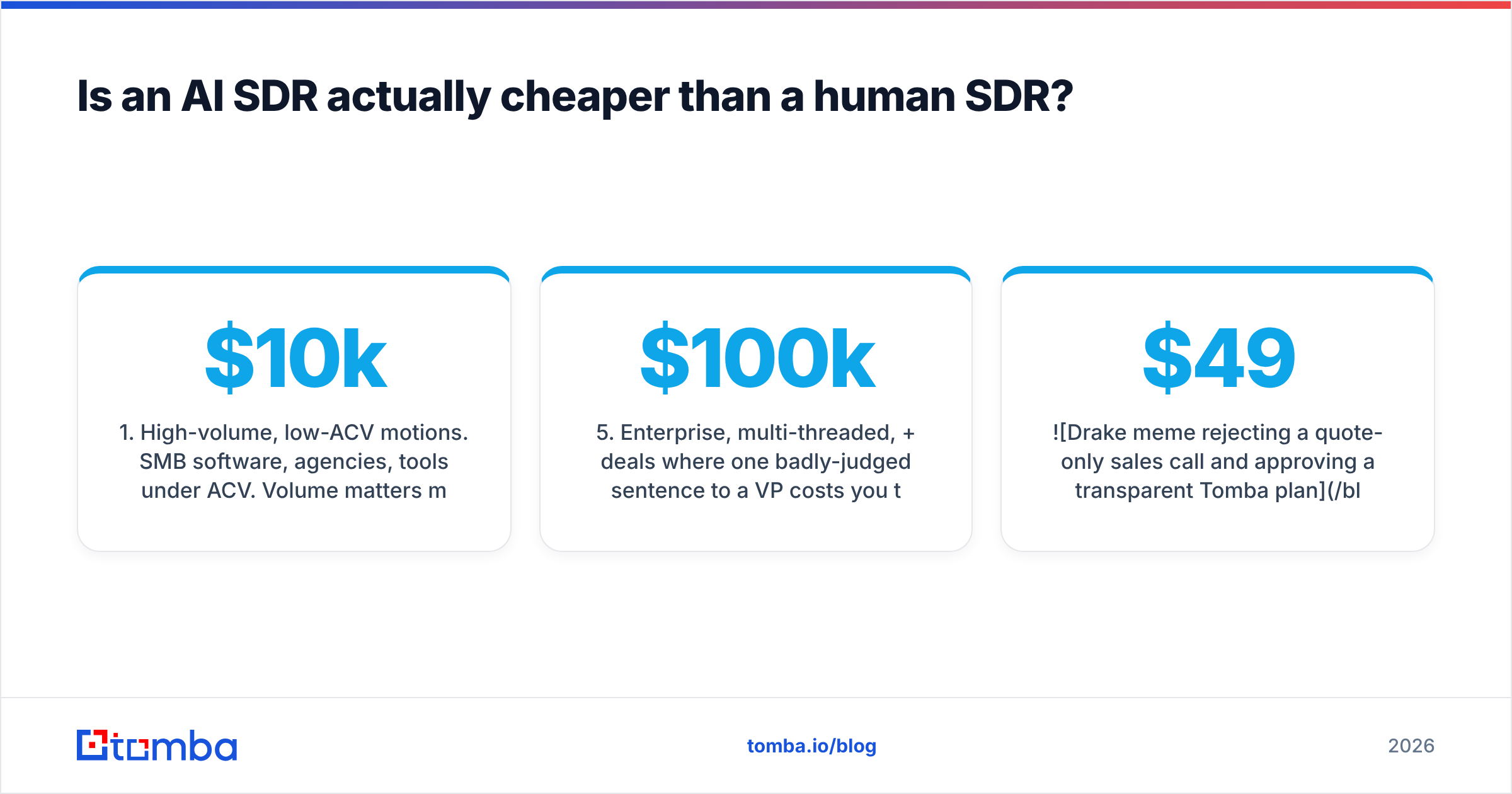
On raw cost per email sent, obviously yes — by an order of magnitude. On cost per qualified meeting, it depends entirely on deal complexity.
Where AI SDRs win on economics:
- High-volume, low-ACV motions. SMB software, agencies, tools under $10k ACV. Volume matters more than nuance.
- Well-defined ICPs. "Shopify stores doing 7 figures with a Klaviyo install" is agent-friendly. "Innovative mid-market manufacturers" is not.
- Territory coverage gaps. Working the long tail your human reps never get to.
- Always-on inbound follow-up. Speed-to-lead within minutes, at 2am, without a rota.
Where humans still win:
- Enterprise, multi-threaded, $100k+ deals where one badly-judged sentence to a VP costs you the account.
- Anything requiring discovery on a call. Phone still converts — which is why pairing outbound email with verified B2B phone numbers usually lifts connect rates more than another AI-written variant does.
Research from HubSpot and most major sales-benchmark reports lands in the same place: personalization improves reply rates, but only when it's relevant personalization. An agent that opens with "I saw your company posted on LinkedIn" is doing the form of research without the substance, and prospects have learned to spot it.
Who should buy Floworks, and who should wait?#
Buy it if:
- You have a proven outbound message and no budget or time to hire SDRs.
- Your ICP is definable in filters, not in narrative.
- Your ACV is high enough that 8–12 extra meetings a month clearly clears the contract cost.
- You have someone who will own the agent daily. Not "the whole team will check it."
Wait if:
- You're pre-product-market-fit and still testing positioning weekly. The agent will lock in whatever you tell it, at scale.
- Your list is the problem. If 30% of your contacts bounce, no agent architecture fixes that.
- You need a public, predictable price to get finance approval. Quote-based annual contracts create procurement friction that a $49 card charge doesn't.
- Your team is two people and outbound is a side quest. Start with tooling, graduate to an agent.
That last case is more common than the category's marketing suggests. Plenty of teams discover that once their contact data is accurate and their sequence is tightened, they don't need an autonomous agent — they need 500 more correct email addresses a month.
How do you build a cheaper stack that does most of the job?#
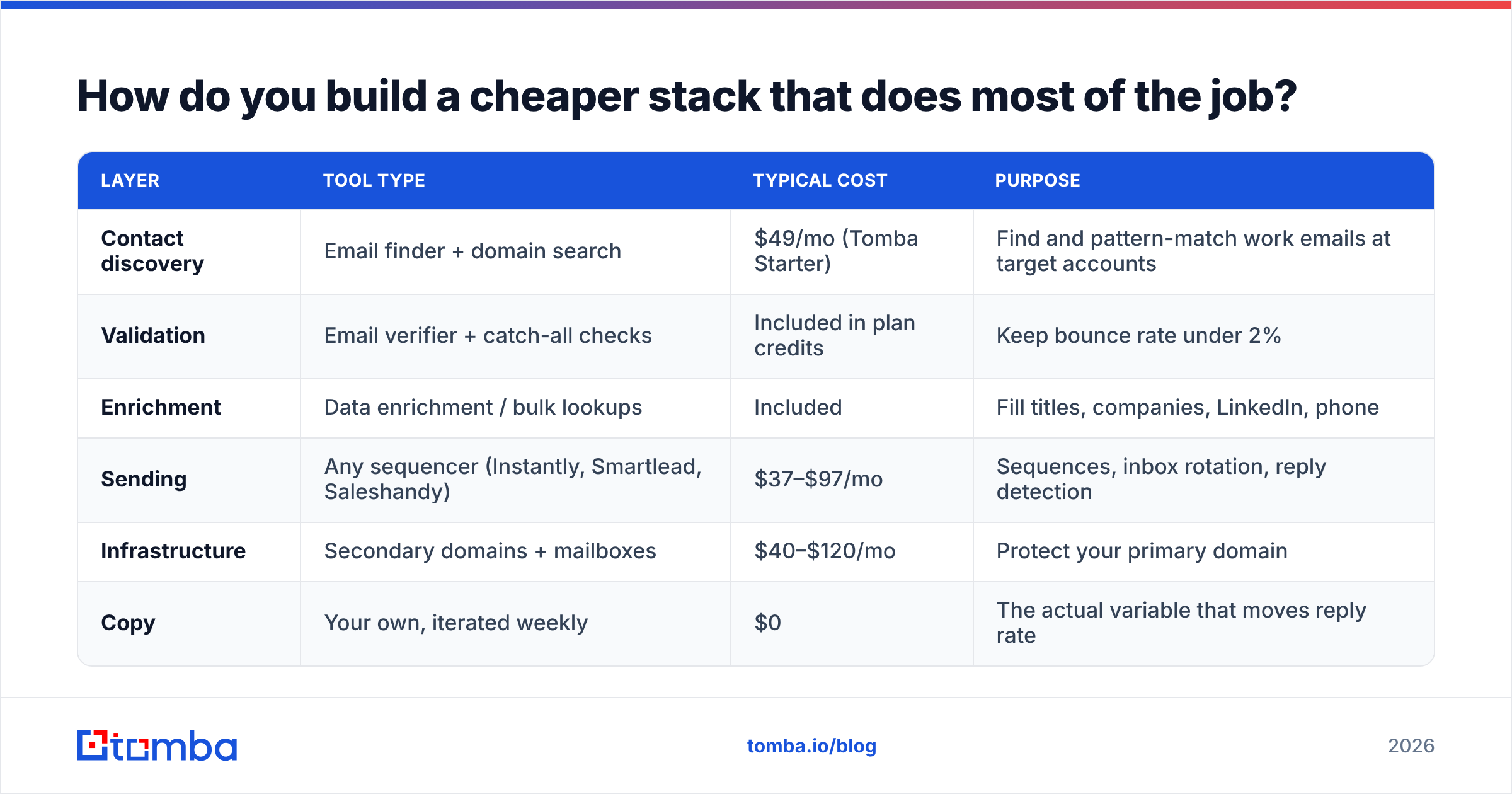
Here's the pragmatic alternative, roughly $150–$250/mo all-in for a small team, and it's the setup I'd test before signing any annual AI SDR contract.
| Layer | Tool type | Typical cost | Purpose |
|---|---|---|---|
| Contact discovery | Email finder + domain search | $49/mo (Tomba Starter) | Find and pattern-match work emails at target accounts |
| Validation | Email verifier + catch-all checks | Included in plan credits | Keep bounce rate under 2% |
| Enrichment | Data enrichment / bulk lookups | Included | Fill titles, companies, LinkedIn, phone |
| Sending | Any sequencer (Instantly, Smartlead, Saleshandy) | $37–$97/mo | Sequences, inbox rotation, reply detection |
| Infrastructure | Secondary domains + mailboxes | $40–$120/mo | Protect your primary domain |
| Copy | Your own, iterated weekly | $0 | The actual variable that moves reply rate |
Tomba's own tiers are public and flat: free at 25 searches/month, Starter $49/mo, Growth $99/mo, Pro $249/mo, Enterprise custom. If you need lists in batches, the bulk email finder handles CSV-scale work without per-lookup surprises, and the Tomba API drops the same lookups into whatever agent or workflow you build yourself.
The point isn't that a DIY stack beats an AI SDR. It's that it gives you the data you need to evaluate an AI SDR. Run it for 60 days, measure your real reply and meeting rate with a human writing the copy, then hand Floworks that benchmark and ask them to beat it. Now you're negotiating with evidence instead of a forecast slide.
What questions should you ask on the Floworks pricing call?#
Bring these six, in this order:
- What exactly is included in one agent seat — sends per month, contacts per month, mailboxes, reply handling?
- Where does the contact data come from, and who eats the cost of a bounce?
- What's the contract term and is there a pilot? A 30–60 day paid pilot with an exit is a reasonable ask.
- What's the projected cost per qualified meeting, and how is "qualified" defined in writing?
- What happens at renewal if usage grew — is there an uplift cap?
- Which CRM integrations are on my tier, specifically, not on the roadmap?
If the answers are crisp, you're dealing with a mature commercial team and the price is probably fair for what it is. If the answers slide into "it depends on your use case" three times running, slow the deal down.
The bottom line on Floworks AI pricing#
Floworks sells a real product in a real category, and quote-based pricing is normal for AI agents that anchor to headcount. But you cannot evaluate any AI SDR — Floworks or otherwise — until you know your own baseline reply rate on clean data. Buy the baseline first.
Start with the data layer. Tomba's Email Finder gets you verified, deliverable contacts at your target accounts from $49/mo, with a free tier to test the accuracy on your own ICP before you spend anything. Get the list right, prove the message works, then decide whether an agent is worth four figures a month to run it faster.
Related guides#
Ready to find emails that actually work?
Join 150,000+ professionals who stopped guessing and started sending. Free credits on signup — no credit card required.
Get the Tomba newsletter
Practical outbound tactics and product updates — once every two weeks.
About the author