Floworks AI Reviews (2026): Alisha AI SDR Tested, Priced, Rated
An independent look at Floworks AI and its Alisha AI SDR agent: what it automates well, where the data layer breaks down, what it really costs, and which teams should walk away.
TL;DR
- Floworks AI is an AI SDR platform built around Alisha, an autonomous agent that researches accounts, writes outbound email, handles replies, and books meetings — pitched as a replacement for the first rung of an SDR team.
- The product works best when your ICP is narrow, your offer is proven, and your CRM data is already clean. It is not a fix for a vague ICP or a weak offer.
- Pricing is quote-gated. There is no self-serve card-swipe tier at the time of writing, so expect a demo, an annual commitment, and a contract negotiation before you see a number.
- The most common complaint pattern across AI SDR tools — Floworks included — is contact data quality, not agent intelligence. Bad emails still bounce no matter how good the copy is.
- Best fit: mid-market B2B teams with 2+ SDRs already, doing 5,000+ touches a month, who want to redeploy humans to conversations instead of list-building.
What is Floworks AI?#
Floworks AI is an agentic outbound sales platform. Instead of selling you a sequencer and letting your reps drive it, it sells you an AI SDR agent — branded Alisha — that owns a slice of the top-of-funnel workflow end to end.
The pitch, from Floworks' own site, is roughly: give the agent an ICP, a value proposition, and a mailbox, and it will build the target list, research each account, personalize the first touch, run the follow-up cadence, classify replies, handle objections, and drop booked meetings into your AE's calendar.
That places Floworks in the same product category as Artisan, 11x, Regie.ai, and AiSDR — a category that barely existed three years ago and is now crowded. Gartner's research on AI in sales has been consistent on the theme: the automation wins are real at the task level, and consistently oversold at the job level.
Floworks' technical differentiator is a proprietary function-calling model the company calls ThorV2, which it markets as more accurate and cheaper at tool-use than general-purpose LLM wrappers. Treat the benchmark claims the way you'd treat any vendor-published benchmark: directionally interesting, not independently verified. What matters to you is whether the agent reliably calls your CRM, your enrichment source, and your calendar without hallucinating fields.
What does Alisha AI SDR actually do day to day?#
Strip the marketing and the agent covers five jobs:
- List building and ICP targeting — pulls accounts and contacts matching filters you define (industry, headcount, tech stack, title, geography), from a bundled data layer.
- Account research — scrapes the company site, recent news, job postings, and social signals to generate a personalization angle per prospect.
- Email drafting and sending — writes the first touch plus follow-ups, sends from connected mailboxes, respects sending limits and warmup schedules.
- Reply handling — classifies inbound replies (interested, not now, wrong person, unsubscribe), answers basic objections, and routes anything ambiguous to a human.
- Meeting booking — negotiates a time and writes the event to the AE's calendar, with CRM logging on both sides.
The interesting part is job #4. Most "AI SDR" tools stop at sending. Reply handling is where an agent either saves you real hours or generates the kind of tone-deaf response that burns a live account. In practice, teams that get value here run a human-in-the-loop approval gate for the first 30–60 days and only loosen it once they trust the classification.

How much does Floworks AI cost?#
This is the first honest caveat in any Floworks AI review: there is no published self-serve price. Pricing is demo-gated and quoted per deployment, which is standard for the AI SDR category and frustrating if you're a five-person team trying to budget.
From publicly reported deal sizes across this category, an AI SDR seat-equivalent generally lands somewhere between a few hundred and a few thousand dollars a month, usually annual, usually with a credit allocation for enrichment and sends layered on top. Always confirm current numbers directly with the vendor — this category re-prices frequently.
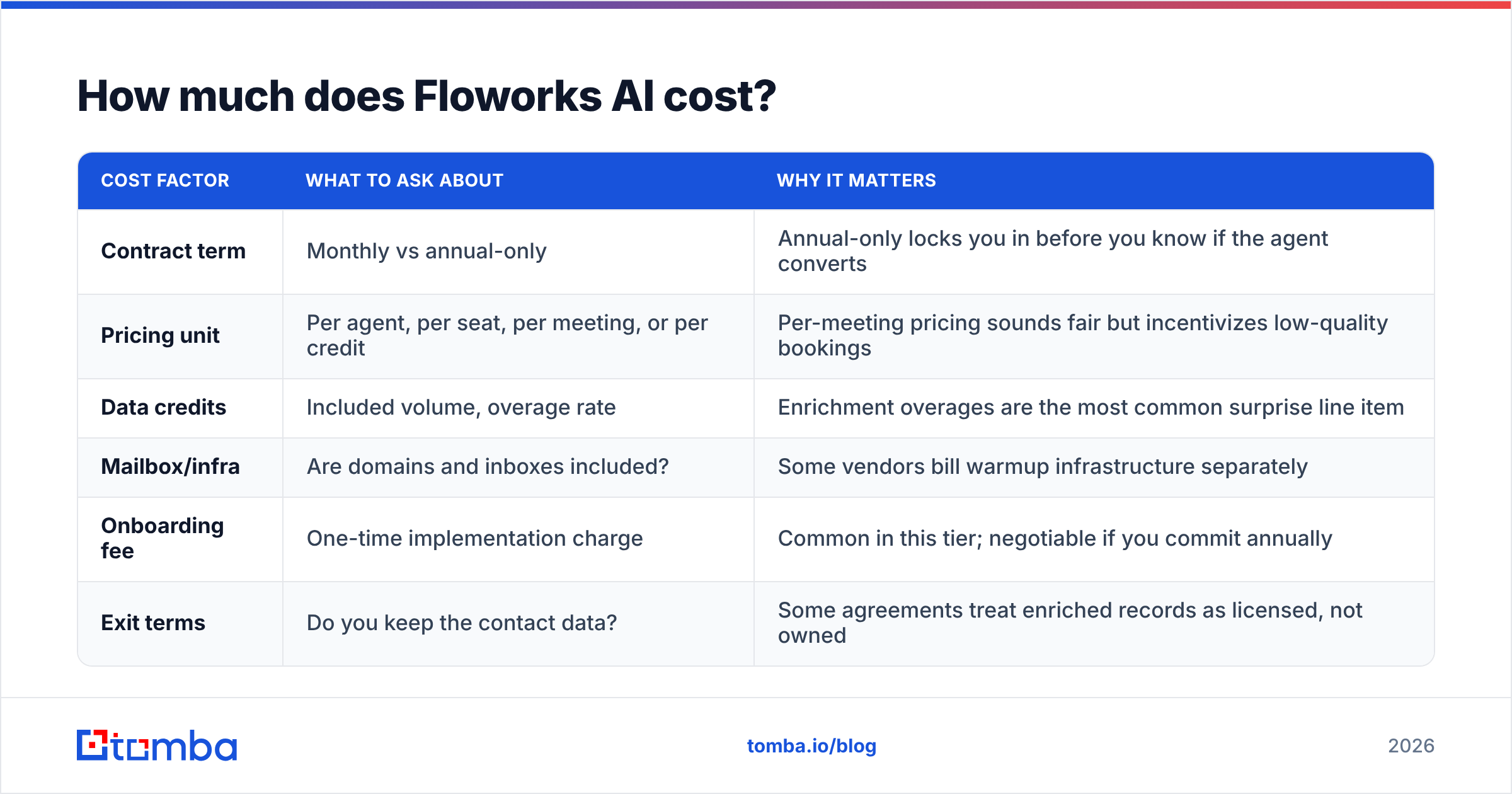
| Cost factor | What to ask about | Why it matters |
|---|---|---|
| Contract term | Monthly vs annual-only | Annual-only locks you in before you know if the agent converts |
| Pricing unit | Per agent, per seat, per meeting, or per credit | Per-meeting pricing sounds fair but incentivizes low-quality bookings |
| Data credits | Included volume, overage rate | Enrichment overages are the most common surprise line item |
| Mailbox/infra | Are domains and inboxes included? | Some vendors bill warmup infrastructure separately |
| Onboarding fee | One-time implementation charge | Common in this tier; negotiable if you commit annually |
| Exit terms | Do you keep the contact data? | Some agreements treat enriched records as licensed, not owned |
The exit-terms question is the one nobody asks in the demo and everybody regrets. If the contact records you paid to enrich can't leave with you, you're renting your pipeline.
How do Floworks AI reviews compare to other AI SDR tools?#
Here's the honest field map. Prices are published entry points where a vendor publishes them and "quote only" where they don't — verify before you buy, since this category changes pricing every couple of quarters. Cross-check current sentiment on G2 before committing to any of them.
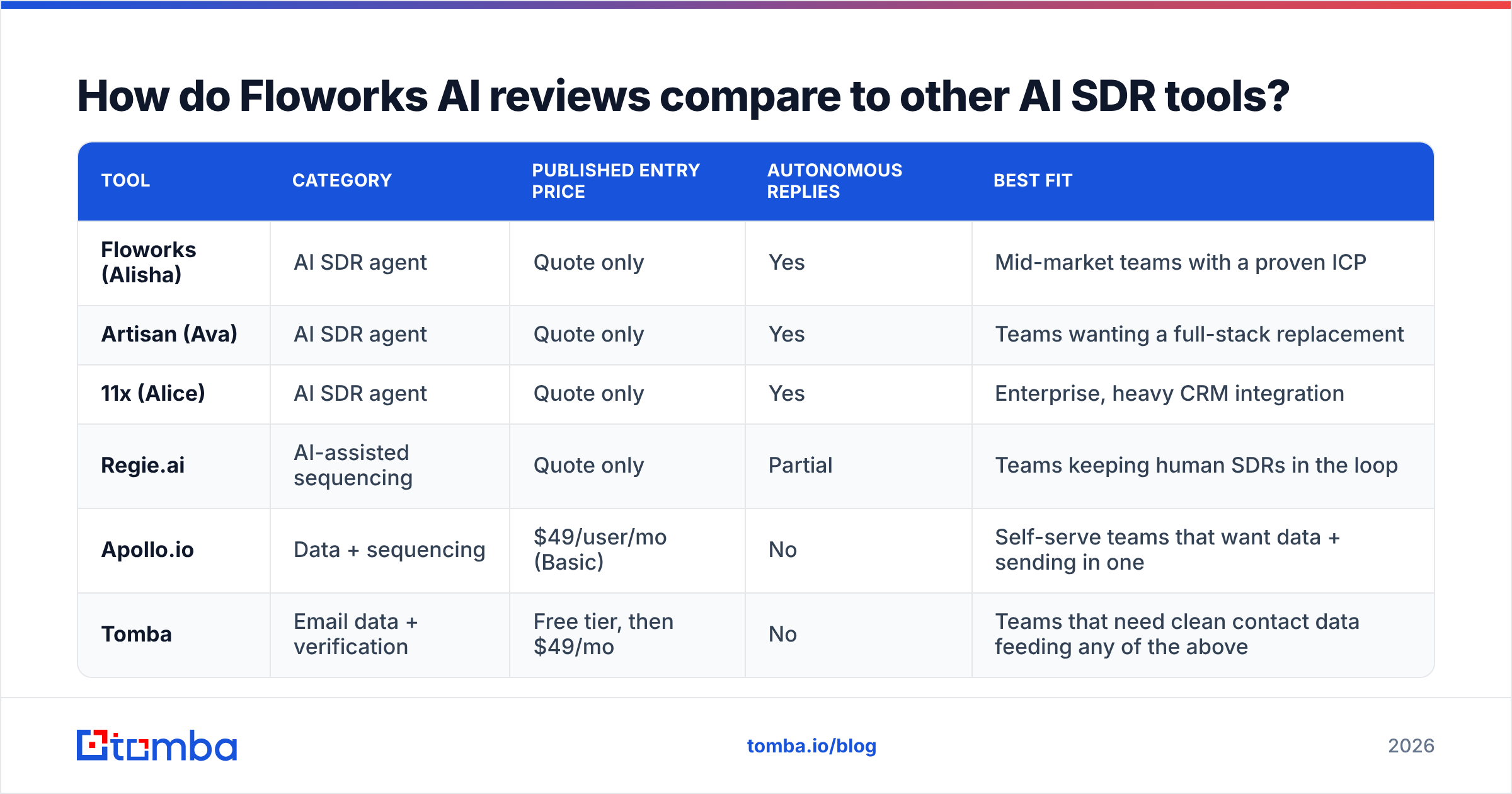
| Tool | Category | Published entry price | Autonomous replies | Best fit |
|---|---|---|---|---|
| Floworks (Alisha) | AI SDR agent | Quote only | Yes | Mid-market teams with a proven ICP |
| Artisan (Ava) | AI SDR agent | Quote only | Yes | Teams wanting a full-stack replacement |
| 11x (Alice) | AI SDR agent | Quote only | Yes | Enterprise, heavy CRM integration |
| Regie.ai | AI-assisted sequencing | Quote only | Partial | Teams keeping human SDRs in the loop |
| Apollo.io | Data + sequencing | $49/user/mo (Basic) | No | Self-serve teams that want data + sending in one |
| Tomba | Email data + verification | Free tier, then $49/mo | No | Teams that need clean contact data feeding any of the above |
Notice the last row is a different shape. Tomba isn't an AI SDR — it's the data layer that every row above depends on. That distinction matters more than the feature checkboxes, and it's the reason so many AI SDR pilots underperform.
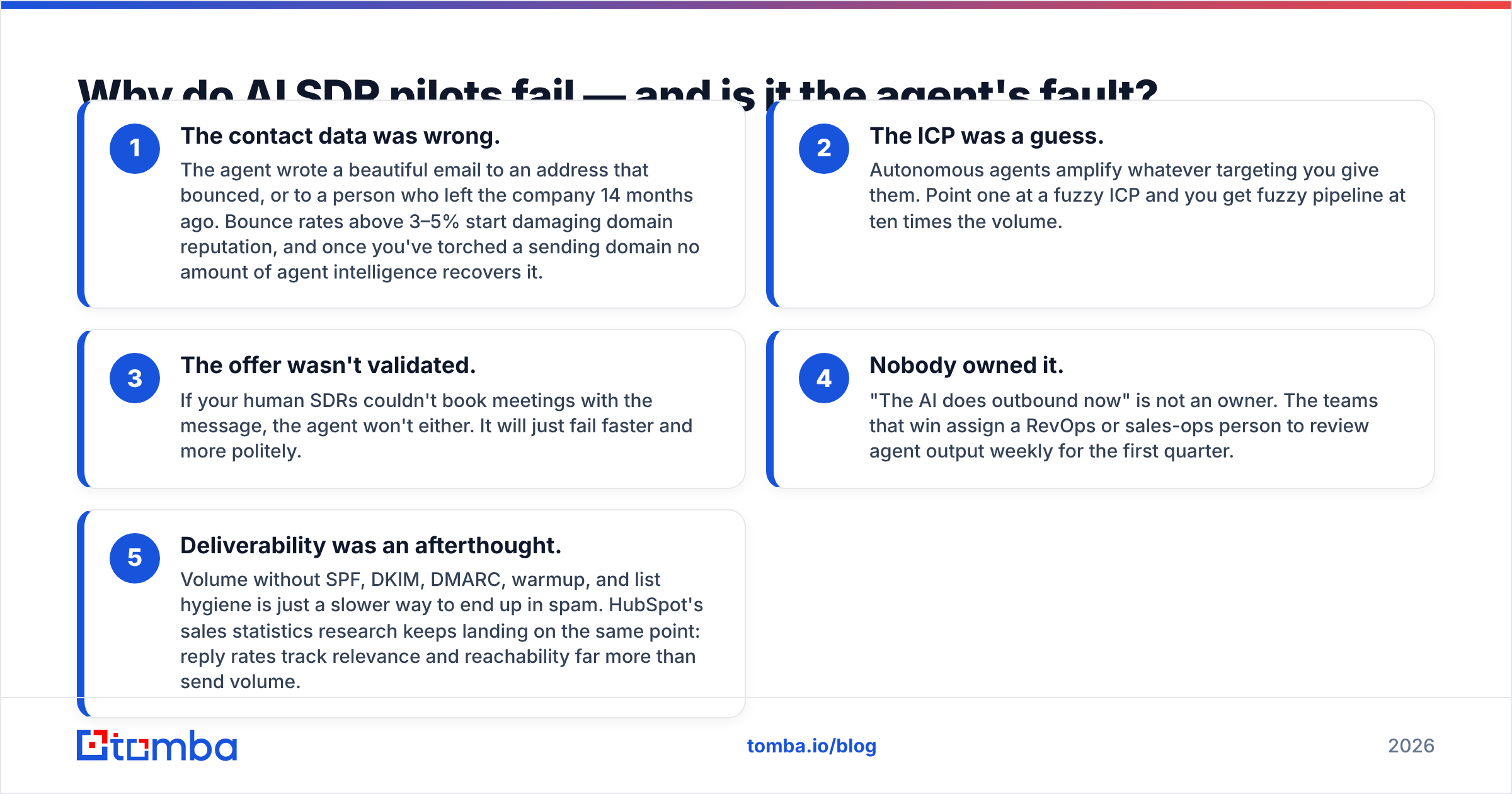
Why do AI SDR pilots fail — and is it the agent's fault?#
Usually not. Across teams that churn out of this category, the failure pattern is remarkably consistent:
- The contact data was wrong. The agent wrote a beautiful email to an address that bounced, or to a person who left the company 14 months ago. Bounce rates above 3–5% start damaging domain reputation, and once you've torched a sending domain no amount of agent intelligence recovers it.
- The ICP was a guess. Autonomous agents amplify whatever targeting you give them. Point one at a fuzzy ICP and you get fuzzy pipeline at ten times the volume.
- The offer wasn't validated. If your human SDRs couldn't book meetings with the message, the agent won't either. It will just fail faster and more politely.
- Nobody owned it. "The AI does outbound now" is not an owner. The teams that win assign a RevOps or sales-ops person to review agent output weekly for the first quarter.
- Deliverability was an afterthought. Volume without SPF, DKIM, DMARC, warmup, and list hygiene is just a slower way to end up in spam. HubSpot's sales statistics research keeps landing on the same point: reply rates track relevance and reachability far more than send volume.
The fix for #1 and #5 is unglamorous and cheap relative to an AI SDR contract: verify every address before the agent touches it. Running your list through an email verifier and catching catch-all domains before send is a ten-minute step that protects a six-figure outbound program. If a bundled data layer is producing a bounce rate you don't like, you don't have to abandon the platform — you can front-load a cleaner source and feed it in.
What are the real limits of Floworks AI in 2026?#
Every review that only lists strengths is a press release. The constraints worth knowing before you sign:
- Quote-gated pricing slows evaluation. You can't run a $200 experiment. You run a demo, then a pilot, then a contract. That's fine for a VP with budget and painful for a founder-led sales motion.
- Personalization has a ceiling. Agent research is good at surfacing the obvious hook — funding round, new hire, tech stack change. It's weak on the non-obvious insight that makes a senior buyer reply. Your best human SDR still out-writes it on your top 50 accounts.
- Reply handling needs supervision early. Objection handling on a live deal is the highest-risk automation in the stack. Keep the approval gate on longer than the vendor suggests.
- Data coverage varies by segment. Bundled B2B data is generally strong on US mid-market SaaS and thinner on EMEA SMB, regulated industries, and non-English markets. Test coverage on your actual ICP during the pilot, not on the vendor's sample list.
- It doesn't replace an SDR manager. It replaces list-building and first-touch drafting. Coaching, discovery quality, and pipeline hygiene are still human jobs.
- Attribution gets murky. When the agent books a meeting off a sequence that overlapped a paid campaign and a human LinkedIn touch, expect arguments about credit.
None of these are disqualifying. They're the difference between a pilot that produces a renewal and one that produces a Slack thread about why nobody's using the tool.
Who should buy Floworks AI — and who should skip it?#
Buy it if:
- You already have 2+ SDRs and know your cost per meeting.
- Your ICP is specific enough to write down in one sentence.
- Your offer converts at a known rate from cold email today.
- You have someone who will own agent output weekly.
- You're at 5,000+ touches a month, where automation math actually works.
Skip it if:
- You're pre-product-market-fit and still testing messaging. Test with humans; it's cheaper and you learn more.
- Your total addressable list is under a few thousand accounts. At that size, precision beats volume and a good rep plus a good email finder will outperform an agent.
- Your buyers are in a segment where bundled data coverage is thin.
- You need transparent, self-serve pricing to get a purchase approved.
- Your current bounce rate is already above 5%. Fix the data layer first, then automate.
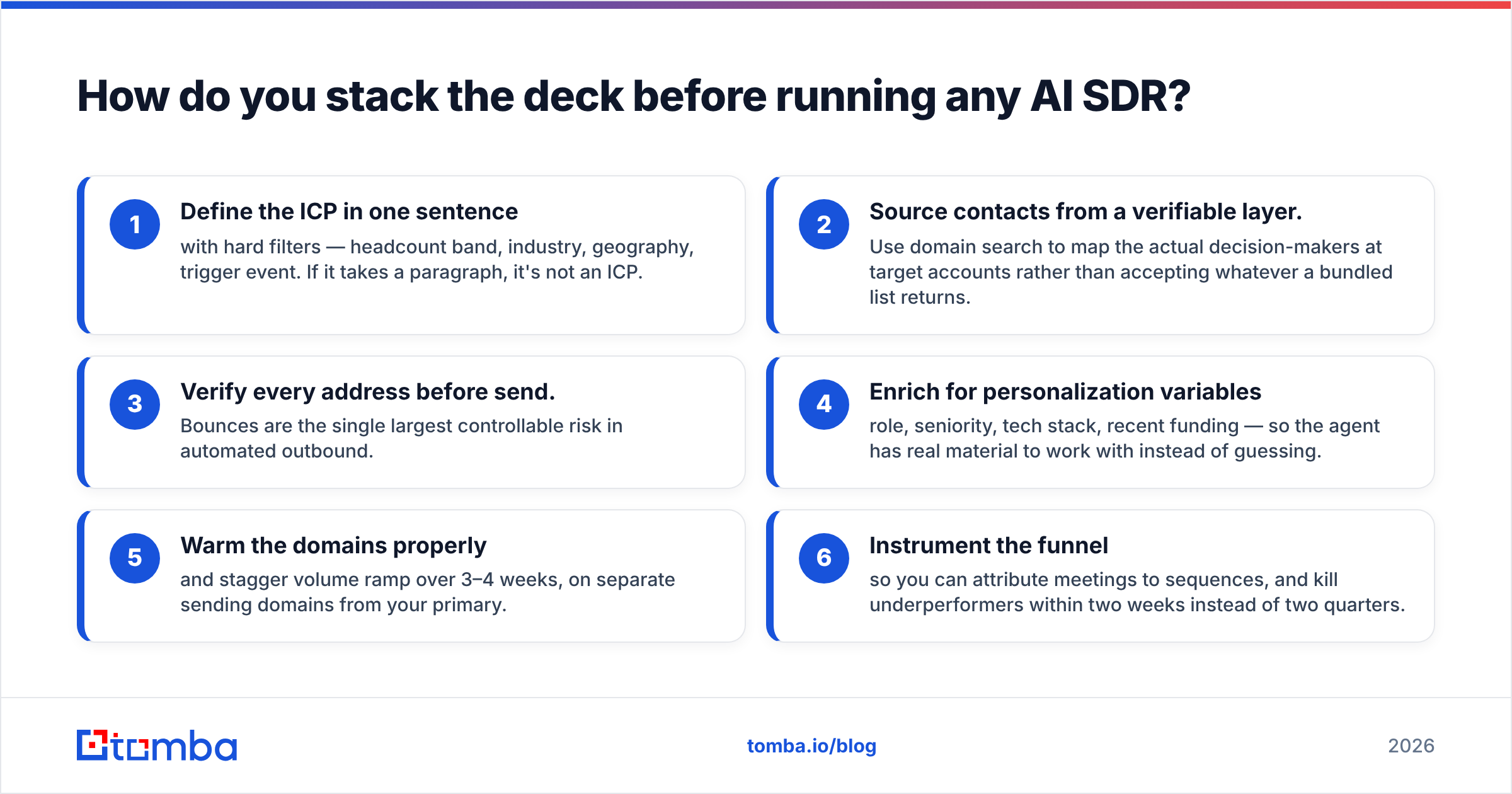
How do you stack the deck before running any AI SDR?#
Whatever platform you pick, the prep work is the same and it's the part that predicts the outcome:
- Define the ICP in one sentence with hard filters — headcount band, industry, geography, trigger event. If it takes a paragraph, it's not an ICP.
- Source contacts from a verifiable layer. Use domain search to map the actual decision-makers at target accounts rather than accepting whatever a bundled list returns.
- Verify every address before send. Bounces are the single largest controllable risk in automated outbound.
- Enrich for personalization variables — role, seniority, tech stack, recent funding — so the agent has real material to work with instead of guessing.
- Warm the domains properly and stagger volume ramp over 3–4 weeks, on separate sending domains from your primary.
- Instrument the funnel so you can attribute meetings to sequences, and kill underperformers within two weeks instead of two quarters.
Steps 2, 3, and 4 are the ones teams skip because they're boring. They're also the only steps that determine whether the expensive part works. If you'd rather wire this into your existing stack programmatically, the Tomba API handles find, verify, and enrich in a single pipeline, and Tomba pricing starts free at 25 searches a month so you can benchmark data quality against your current source before you spend anything.
Final verdict on Floworks AI#
Floworks is a credible entry in the AI SDR category with a genuinely differentiated take on tool-use reliability. If you're mid-market, past product-market fit, and running enough volume that list-building is eating an FTE, it's worth a demo — go in with the exit-terms and data-coverage questions ready, and insist on testing against your real ICP during the pilot.
If you're smaller, still testing messaging, or currently fighting a bounce-rate problem, the money is better spent one layer down. An agent that sends 10,000 personalized emails to a list that's 20% stale isn't an outbound program — it's a deliverability incident with good copy.
Start with the data. Run your target accounts through the Tomba Email Finder to build a verified, deduplicated contact list, then point whatever AI SDR you choose at it. The free tier gives you 25 searches a month to compare accuracy against your current source, and Starter is $49/mo when you're ready to scale — a fraction of any AI SDR contract, and the reason that contract will pay off.
Related guides#
Ready to find emails that actually work?
Join 150,000+ professionals who stopped guessing and started sending. Free credits on signup — no credit card required.
Get the Tomba newsletter
Practical outbound tactics and product updates — once every two weeks.
About the author