Folk Pricing Reviews Pros and Cons: The 2026 CRM Verdict
Folk is a slick, relationship-first CRM, but per-seat pricing and enrichment credit caps decide whether it fits your team. Here's the honest cost breakdown, the real pros and cons, and when to pick something else.
Folk pricing reviews pros and cons usually skip the part that matters most: the seat price is not the whole bill. Enrichment credits are the second meter. They decide whether Folk lands cheap or expensive for your team. Here is the honest math.
TL;DR
- Folk is a lightweight, relationship-first CRM priced per seat — roughly $20–$25/user/month on the entry plan and around $40–$45/user/month on the higher tier when billed annually. Always confirm current numbers on folk's own pricing page before you budget.
- There is no free plan. You get a time-limited trial, then it's a paid seat for every person who touches the CRM — including part-time contributors.
- The biggest hidden cost isn't the seat. It's enrichment credits: email lookups and contact data are metered, and heavy prospecting teams burn through the included pool fast.
- Folk wins on speed, LinkedIn capture, and shared pipelines. It loses on deep reporting, complex permissions, and cost-per-contact at scale.
- Best fit: 2–10 person agencies, founders, recruiters, and BD teams who live in LinkedIn and email. Worst fit: high-volume outbound teams who need thousands of verified emails a month.
What is Folk and who actually uses it?#
Folk is a CRM built around relationships, not tickets. Think of a filing cabinet versus a contact-shaped notebook. Old CRMs make you feed the system. Folk tries to feed itself, pulling in what you already do in Gmail, Outlook, and LinkedIn.
The product's center of gravity is the browser extension. You're on a LinkedIn profile or a company site, you click, and the contact lands in a pipeline with fields already filled in. You also get shared contact lists, custom pipelines, email sequences, and notes synced from your inbox. The integration list is short but clean.
The typical Folk customer is not a 200-rep sales floor. It's an agency owner tracking 40 warm partnerships, or a recruiter running six searches. It's a founder juggling investors and design partners. It's a three-person BD team that dropped a bloated CRM because nobody updated it. If your workflow is "I meet people, I follow up, I need context," Folk is aimed squarely at you.
That framing matters for a pricing review. Folk isn't competing on volume economics. It's competing on whether your team will actually use the thing.
How does Folk pricing actually work in 2026?#
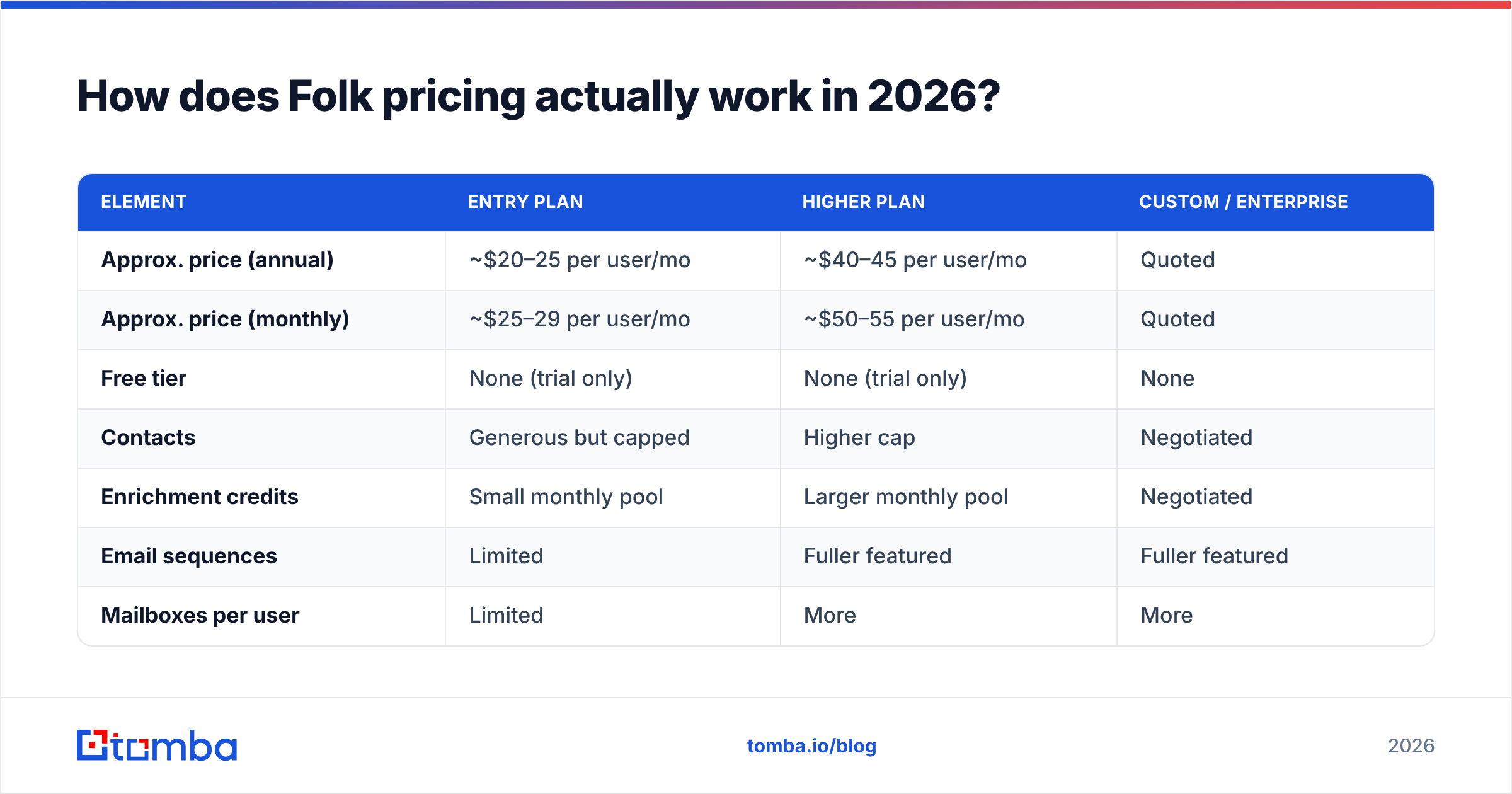
Folk uses a per-seat subscription with a small number of tiers, plus metered credits for data enrichment. There is no perpetual free tier — you trial it, then you pay.
Here is the structure as published today. Treat the dollar figures as directional. Check the vendor page before you budget, since Folk has repriced more than once.
| Element | Entry plan | Higher plan | Custom / enterprise |
|---|---|---|---|
| Approx. price (annual) | ~$20–25 per user/mo | ~$40–45 per user/mo | Quoted |
| Approx. price (monthly) | ~$25–29 per user/mo | ~$50–55 per user/mo | Quoted |
| Free tier | None (trial only) | None (trial only) | None |
| Contacts | Generous but capped | Higher cap | Negotiated |
| Enrichment credits | Small monthly pool | Larger monthly pool | Negotiated |
| Email sequences | Limited | Fuller featured | Fuller featured |
| Mailboxes per user | Limited | More | More |
| Advanced permissions / SSO | No | Partial | Yes |
| Support | Standard | Priority | Dedicated |
Two structural details drive almost every complaint and every compliment in Folk reviews:
- Every human needs a seat. There's no cheap read-only viewer role on the entry plan. If your ops person, your founder, and your two contractors all need visibility, that's four seats, not one.
- Credits are the second meter. Finding and verifying email addresses inside Folk consumes credits from a monthly pool. The pool resets; unused credits generally don't roll forward in any meaningful way.
- Annual billing is the real price. The monthly-billing premium is meaningful — usually 15–25%. Most published "Folk is $25" claims are quoting the annual rate.
- Sequences are tiered. Basic outreach exists lower down, but the volume, mailbox count, and automation depth you need for real outbound sit on the upper plan.
What do Folk reviews say about the pros?#
Pull the recurring themes out of Folk's G2 reviews and user threads and the positives cluster tightly:
Adoption is genuinely high. This is the number one praise, and it's not a soft benefit. A CRM nobody updates has a real cost measured in lost deals. Folk's interface is closer to a spreadsheet-plus than an enterprise system, so non-sales people actually maintain it.
The LinkedIn capture flow is fast. The extension pulls a profile into a pipeline in a couple of clicks with fields already populated. For recruiters and partnership teams working profile-by-profile, this removes the single most tedious step of the day.
Inbox sync is unobtrusive. Emails and meeting history attach to contacts without you thinking about it, which is what "relationship CRM" is supposed to mean in practice.
Setup takes an afternoon, not a quarter. No implementation partner, no six-week discovery. You import a CSV, define a pipeline, and you're operational. Compared to a Salesforce or even a fully-configured HubSpot rollout, the time-to-value difference is enormous.
Pricing is legible. Two main tiers, published numbers, no mandatory onboarding fee. That's more transparency than half this category offers.
What are the cons buyers keep flagging?#
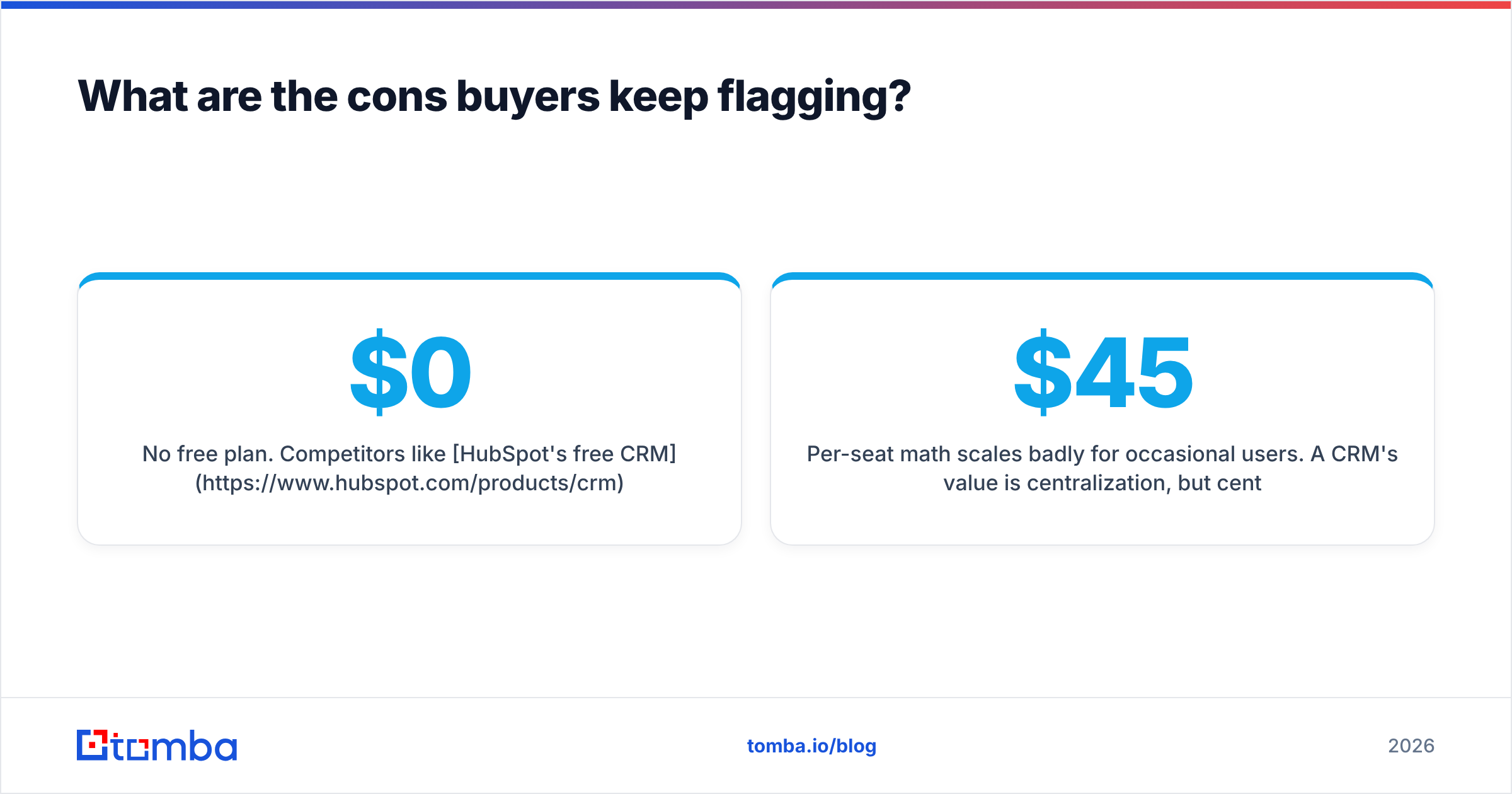
No free plan. Competitors like HubSpot's free CRM let you sit at $0 indefinitely and upgrade when revenue justifies it. Folk asks for a card after the trial. For a bootstrapped founder testing three CRMs, that's friction.
Reporting is thin. You get pipeline views and basic counts. You do not get cohort analysis, multi-touch attribution, forecast rollups, or the kind of custom dashboards a RevOps lead expects. Teams that grow into reporting requirements usually migrate out rather than upgrade.
Credit anxiety is real. This is the most common surprise in Folk reviews. The CRM makes it easy to enrich contacts, so people enrich contacts. Then the pool is empty on the 12th of the month. You either buy more credits or stop enriching. Neither answer feels good when you priced the tool as a flat per-seat cost.
Permissions and governance are limited. Granular field-level permissions, audit trails, and approval flows aren't the focus. If you're in a regulated industry or you need to restrict who sees which accounts, this will bite.
Per-seat math scales badly for occasional users. A CRM's value is centralization, but centralization means giving access to people who log in twice a month. At $45/seat, three occasional users cost $1,620/year to mostly read data.

Is Folk worth it compared to the alternatives?#
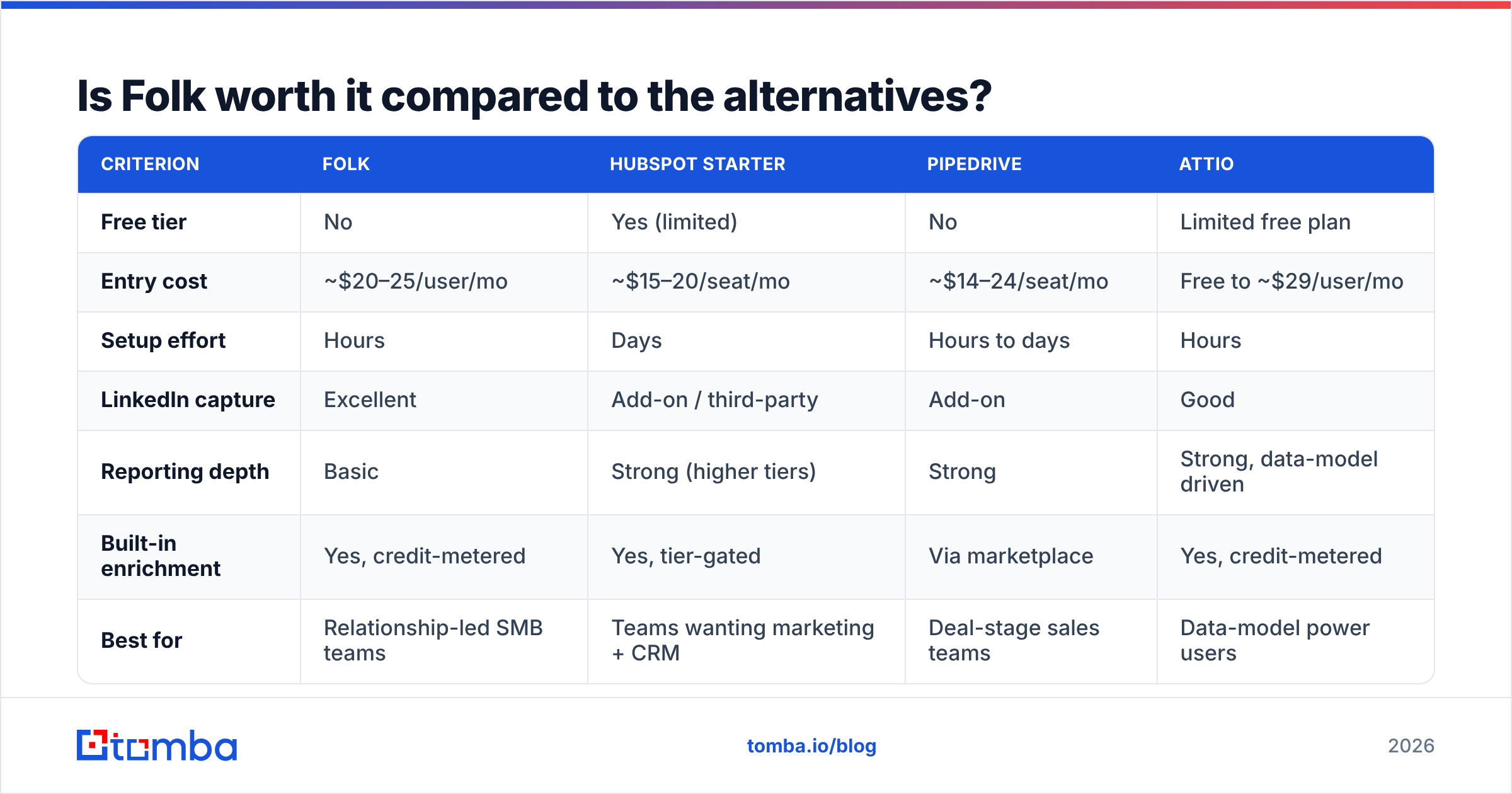
Depends on which axis you're optimizing. Here's the honest positioning against the tools Folk is most often shortlisted against.
| Criterion | Folk | HubSpot Starter | Pipedrive | Attio |
|---|---|---|---|---|
| Free tier | No | Yes (limited) | No | Limited free plan |
| Entry cost | ~$20–25/user/mo | ~$15–20/seat/mo | ~$14–24/seat/mo | Free to ~$29/user/mo |
| Setup effort | Hours | Days | Hours to days | Hours |
| LinkedIn capture | Excellent | Add-on / third-party | Add-on | Good |
| Reporting depth | Basic | Strong (higher tiers) | Strong | Strong, data-model driven |
| Built-in enrichment | Yes, credit-metered | Yes, tier-gated | Via marketplace | Yes, credit-metered |
| Best for | Relationship-led SMB teams | Teams wanting marketing + CRM | Deal-stage sales teams | Data-model power users |
| Weak spot | Reporting, permissions | Cost creep at scale | Relationship context | Learning curve |
The pattern: Folk is the fastest path from zero to a CRM your team maintains. It is not the cheapest path to volume, and it is not the deepest analytics platform. If your buying trigger is "our spreadsheet broke," Folk is a strong answer. If it's "we need forecast accuracy," it isn't.
For a broader view of contact-data options and where each one sources its records, it's worth comparing data sources across vendors before you commit — enrichment quality varies far more than pricing pages suggest.
What does Folk really cost per contact?#
Most Folk pricing reviews pros and cons roundups stop right here. The seat price is the sticker. The cost per usable contact is the number that hits your CAC.
Run the math for a five-person BD team on the higher plan:
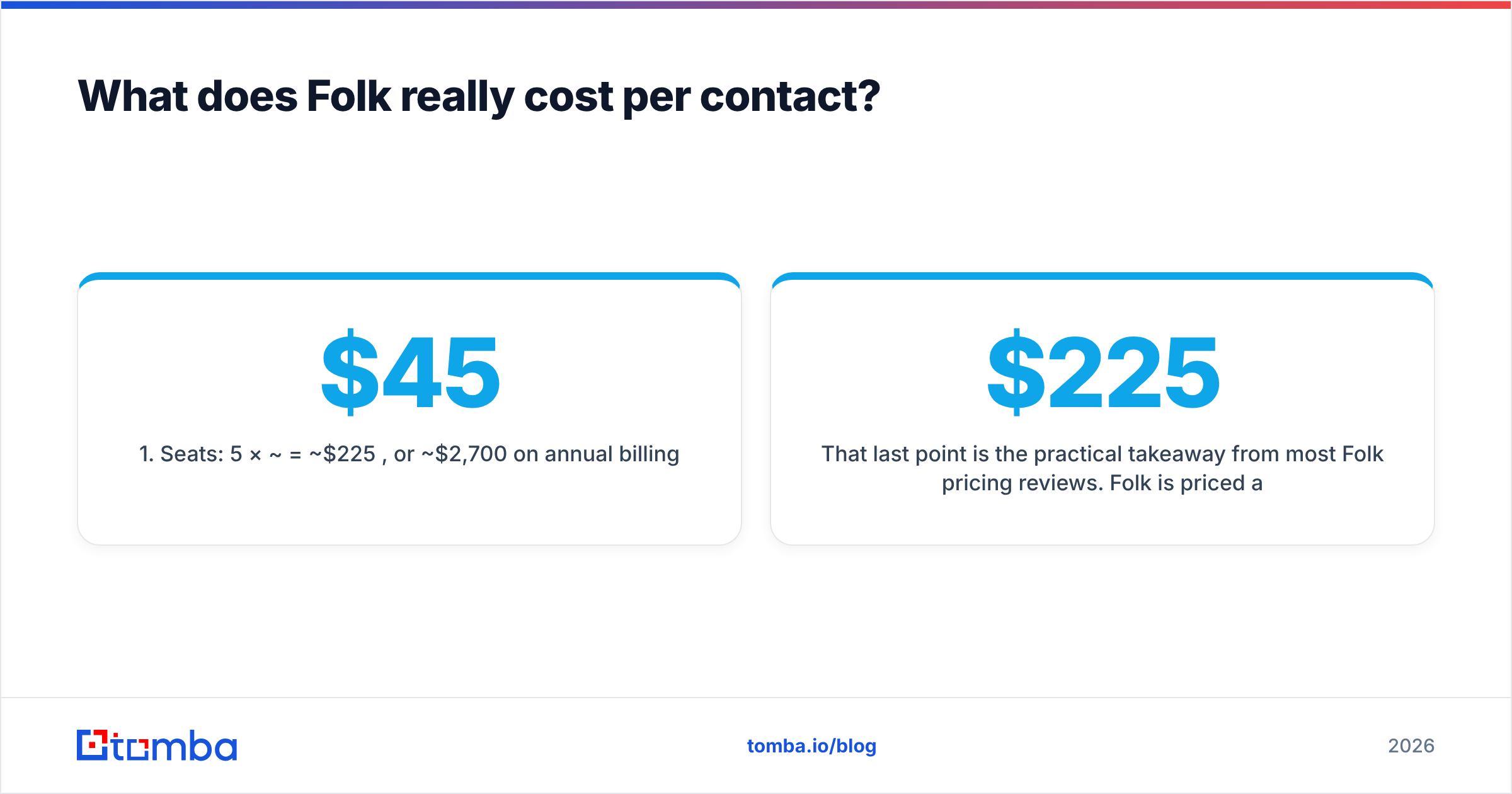
- Seats: 5 × ~$45/mo = ~$225/mo, or ~$2,700/year on annual billing.
- Included credits: enough for casual enrichment, not campaigns. Assume a few thousand lookups a month across the account.
- Real prospecting volume: a team of five running even modest outbound needs 3,000–8,000 fresh contacts a month.
- The gap: you either buy credit top-ups at retail rates or you source contact data outside the CRM and import it.
- Verification: enriched addresses still bounce. Without a separate email verifier pass, you're paying twice — once for the lookup, once in sender reputation.
- The effective rate: teams who do this properly typically end up paying for the CRM and a dedicated data layer, which is fine as long as you budgeted for both.
That last point is the practical takeaway. Folk is priced as a relationship system with enrichment as a convenience feature. It is not priced as a prospecting data platform. Trying to make it one is how a $225/month tool turns into a $700/month tool.
The healthier setup is to split the layers. A dedicated finder and verifier handles volume sourcing at a predictable rate. The CRM handles relationships and pipeline. A bulk email finder run once a week feeds a clean CSV into Folk. That costs less than credit top-ups, and it gives you verification data the CRM won't.
Who should buy Folk, and who should skip it?#
Buy Folk if:
- Your team is 2–15 people and relationship context matters more than forecast math.
- You source most contacts from LinkedIn, events, and referrals rather than bulk lists.
- Previous CRM attempts died from low adoption.
- You want to be running this week, not next quarter.
- Your enrichment needs are measured in hundreds per month, not thousands.
Skip Folk if:
- You need a permanent free tier while you validate the business.
- Reporting, forecasting, or attribution are board-level requirements.
- You run high-volume outbound and need 5,000+ verified addresses monthly.
- Compliance requires granular permissions, audit logs, or strict data residency.
- More than a third of your seats would be read-only occasional users.
The honest middle ground: plenty of teams run Folk as the relationship layer and a separate data provider as the sourcing layer. That combination usually costs less than upgrading either tool to do the other's job, and it keeps your contact data portable if you ever migrate CRMs. Worth checking the integrations available on the data side before you lock the stack in.
How should you evaluate Folk during the trial?#
Don't spend the trial admiring the interface. Test the three things that decide renewal:
- Import your real messy data, not a clean sample. Duplicate handling and field mapping are where CRMs actually break.
- Burn credits deliberately in week one. Find out how many lookups your real workflow consumes, then multiply by four. That's your monthly credit reality.
- Make one non-sales teammate use it unprompted for five days. Adoption is Folk's whole value proposition — verify it applies to your team, not the reviewer's.
- Export everything on day 12. Confirm you can get your data out cleanly before you're dependent on it.
- Price the annual commitment honestly. Compare the annual rate against 12 months of monthly billing plus expected credit top-ups, not against the headline number.
The verdict on Folk pricing reviews pros and cons#
Folk is fairly priced for what it is: a fast, well-designed, relationship-first CRM that people actually maintain. At roughly $20–45 per seat it sits mid-market. That is cheaper than a configured enterprise CRM and dearer than a free starter plan. It is worth the premium if adoption has been your bottleneck.
The pros and cons resolve cleanly. The pros are speed, capture, and usability. The cons are reporting depth, governance, and the credit meter that quietly turns a fixed cost into a variable one. Nothing here is a dealbreaker for a small relationship-led team. All of it is a dealbreaker for a volume outbound operation.
If you land on Folk, budget for the data layer separately from day one. Tomba's email finder handles the sourcing side at a predictable rate. The free tier gives you 25 searches a month to test the match rate against your own list. After that it's $49/month on Starter, $99/month on Growth, and $249/month on Pro, with verification included rather than metered. Run the finder, verify the addresses, and push clean records into Folk. Let each tool do the job it was priced for. Compare the numbers on Tomba pricing against a month of Folk credit top-ups, and the split-stack case makes itself.
Related guides#
Ready to find emails that actually work?
Join 150,000+ professionals who stopped guessing and started sending. Free credits on signup — no credit card required.
Get the Tomba newsletter
Practical outbound tactics and product updates — once every two weeks.
About the author