Follow Up Boss Alternatives: 9 Real Estate CRMs Compared
Follow Up Boss starts at $69/user/mo and climbs fast once you add seats, dialers, and lead routing. Here are 9 alternatives compared on price, automation depth, and who each one actually fits.
TL;DR
- Follow Up Boss (now part of Zillow) starts at $69/user/month on Grow, $69/user/month equivalent tiers scale to Pro and Platform — the real cost shows up when you add seats, dialer minutes, and integrations.
- The best alternative depends on team size: Sierra Interactive and Boomtown for lead-gen-plus-CRM bundles, Lofty for AI-heavy workflows, Wise Agent and LionDesk for solo agents under $50/month, HubSpot or Pipedrive for teams that want a general CRM they control.
- Nobody switches CRMs because of the CRM. They switch because per-seat pricing punishes growth, or because the lead data going in is garbage.
- A CRM does not create contacts — it stores them. Pair whichever CRM you pick with a dedicated data layer so the records you sync are verified, not guessed.
- If your outbound motion is B2B (investors, property managers, commercial brokers, referral partners), the contact-sourcing problem is bigger than the CRM problem.
What is Follow Up Boss and why do people leave it?#
Follow Up Boss is a real estate CRM built around one idea: speed to lead. It pulls leads from Zillow, Realtor.com, your IDX site, and 250+ other sources, routes them to agents by round-robin or rule, and nags everybody until someone actually calls. It has been the default answer for growing real estate teams for close to a decade, and Zillow acquired it in 2023.
It is genuinely good software. The reasons teams leave rarely have to do with the feature list:
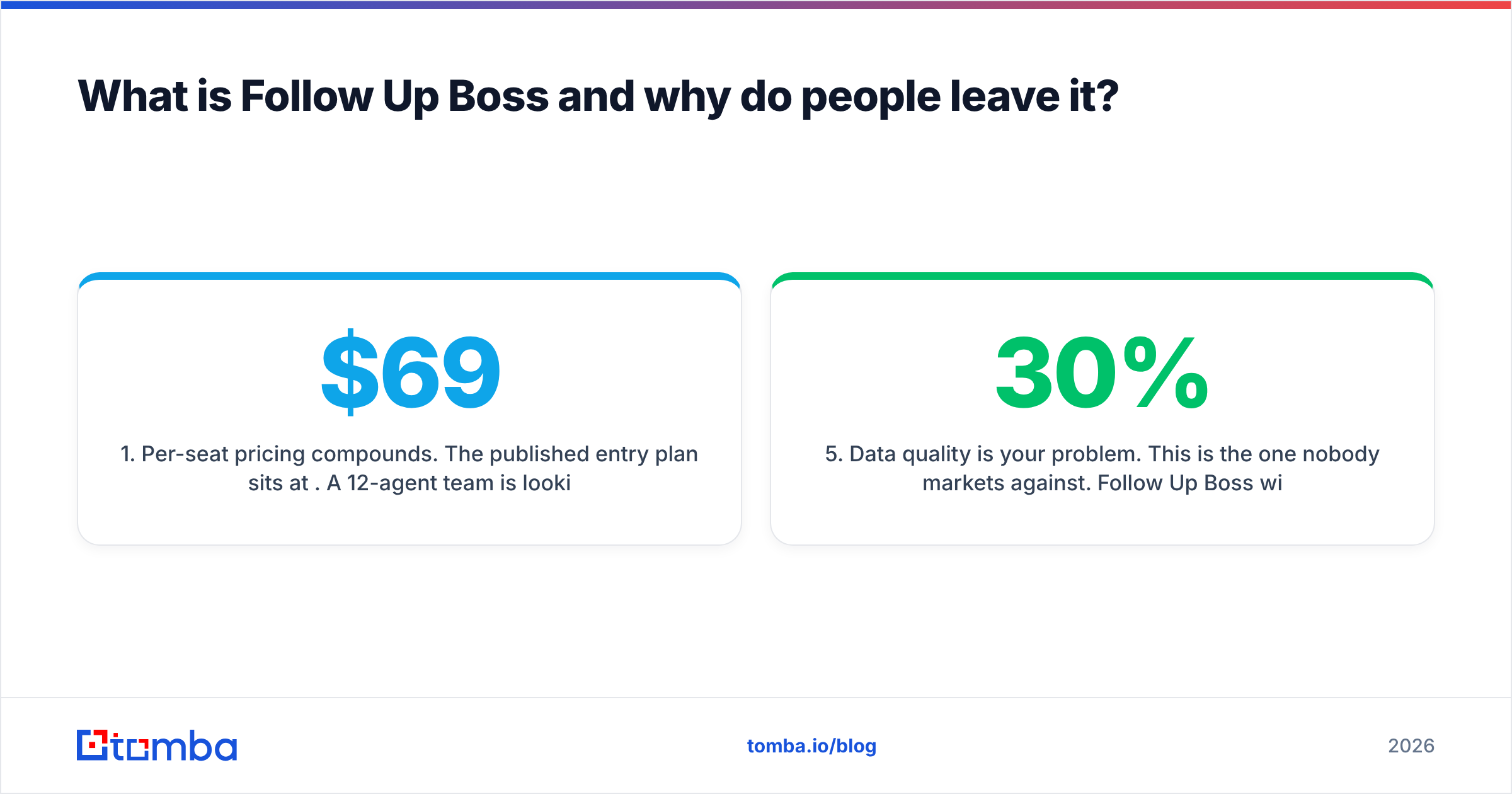
1. Per-seat pricing compounds. The published entry plan sits at $69 per user per month. A 12-agent team is looking at roughly $828/month before dialer add-ons. Grow to 30 agents and you are past $2,000/month for a contact database with automation on top.
2. Zillow ownership. Some brokerages have a strategic objection to routing their pipeline data through a portal they also compete with. Whether that concern is rational is a separate argument — it is real, and it drives switching.
3. No built-in lead generation. Follow Up Boss manages leads. It does not create them. Competitors like Sierra Interactive and Boomtown bundle IDX websites and paid-ad management, so you are buying one line item instead of four.
4. Thin reporting for larger orgs. Once you are running multiple teams, ISAs, and lead sources, the native dashboards start to feel like they were designed for a 6-agent shop — because they were.
5. Data quality is your problem. This is the one nobody markets against. Follow Up Boss will happily store 40,000 records, 30% of which have dead email addresses. The CRM does not verify anything.
What should you actually compare when evaluating alternatives?#
Skip the feature-matrix theater. Five variables decide whether a switch is worth the migration pain:
- True per-seat cost at your headcount — Multiply the advertised price by your real agent count, then add dialer, texting, and integration fees. Most "cheaper" CRMs stop being cheaper at 10+ seats.
- Lead source coverage — If 70% of your volume comes from Zillow Flex or Realtor.com, a CRM without native parsing means you are building Zapier duct tape on day one.
- Automation depth vs. setup burden — Action Plans in Follow Up Boss are simple by design. Lofty and Sierra offer more branching logic, but somebody on your team has to own building it.
- Data ownership and export — Can you pull a full CSV with custom fields, notes, and call logs on 30 days' notice? Ask before signing, not during the breakup.
- Where the contacts come from — A CRM is a storage layer. If your sourcing is manual LinkedIn scraping and purchased lists, switching CRMs changes nothing about your connect rate.
That last point is where most switching projects quietly fail. Teams spend six weeks migrating, then discover their bounce rate is still 22% because the underlying data was never verified. Running a list through an email verifier before import costs less than one month of any CRM on this list and fixes more of the actual problem.
Which Follow Up Boss alternatives are worth considering in 2026?#
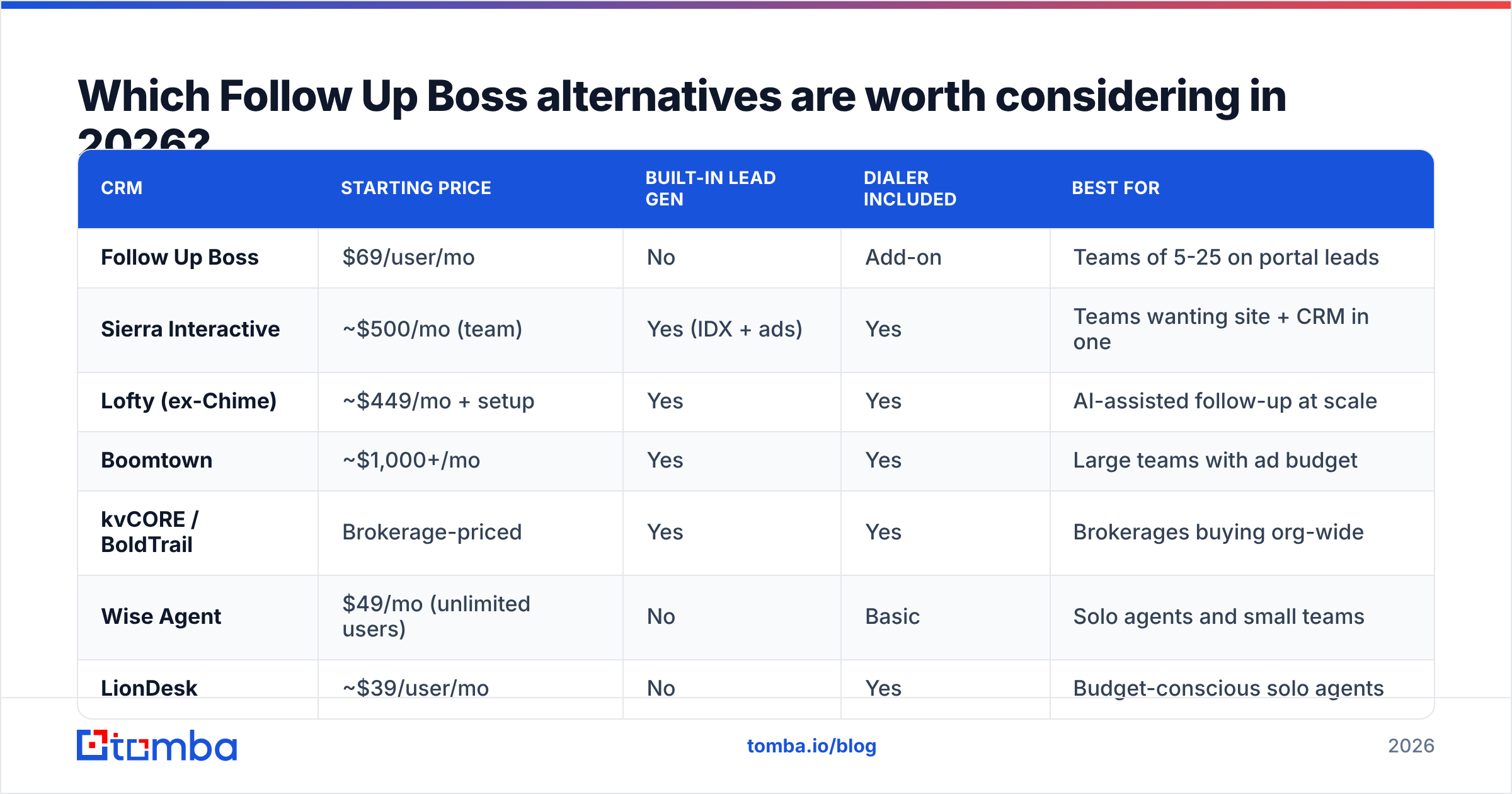
Here is the honest comparison. Prices are the publicly listed starting points as of early 2026 — always confirm directly, since real estate CRM pricing changes constantly and annual contracts often shift the math.
| CRM | Starting price | Built-in lead gen | Dialer included | Best for |
|---|---|---|---|---|
| Follow Up Boss | $69/user/mo | No | Add-on | Teams of 5-25 on portal leads |
| Sierra Interactive | ~$500/mo (team) | Yes (IDX + ads) | Yes | Teams wanting site + CRM in one |
| Lofty (ex-Chime) | ~$449/mo + setup | Yes | Yes | AI-assisted follow-up at scale |
| Boomtown | ~$1,000+/mo | Yes | Yes | Large teams with ad budget |
| kvCORE / BoldTrail | Brokerage-priced | Yes | Yes | Brokerages buying org-wide |
| Wise Agent | $49/mo (unlimited users) | No | Basic | Solo agents and small teams |
| LionDesk | ~$39/user/mo | No | Yes | Budget-conscious solo agents |
| Pipedrive | $24/user/mo | No | Add-on | Teams wanting a flexible general CRM |
| HubSpot Sales Hub | $20/user/mo (Starter) | No | Yes | B2B-leaning real estate ops |
A few notes the table cannot carry:
Sierra Interactive is the closest thing to a straight upgrade if your pain is "I want the CRM and the website to be the same product." Their IDX search experience converts well, and the CRM logic is genuinely strong. The catch is a floor price that makes no sense below about 8 agents.
Lofty (formerly Chime) leans hardest into AI — an AI ISA that texts leads, smart campaign suggestions, predictive scoring. When it works, it is impressive. Setup fees and a heavier learning curve are the trade.
Boomtown is the enterprise answer. Their success-management layer is real, not a support ticket queue. So is the price.
BoldTrail (the kvCORE successor from Inside Real Estate) usually enters through the brokerage, not the team. If your brokerage already pays for it, your per-agent cost is often zero — which changes the calculus entirely, even if the UX is busier than Follow Up Boss.
Wise Agent at $49/month for unlimited users is the most underrated line in this table. For a 4-person team it is roughly one-fifth the cost of Follow Up Boss. You give up polish and lead-source breadth, not core function.
Pipedrive and HubSpot are not real estate CRMs, and that is the point. If your business is commercial brokerage, property management, PropTech sales, or investor relations, a general B2B CRM plus a proper data stack beats a residential-optimized tool. HubSpot's free tier also has no user limit, which reframes the budget conversation.
Is a cheaper CRM actually cheaper?#
Usually not, and here is the arithmetic teams skip.
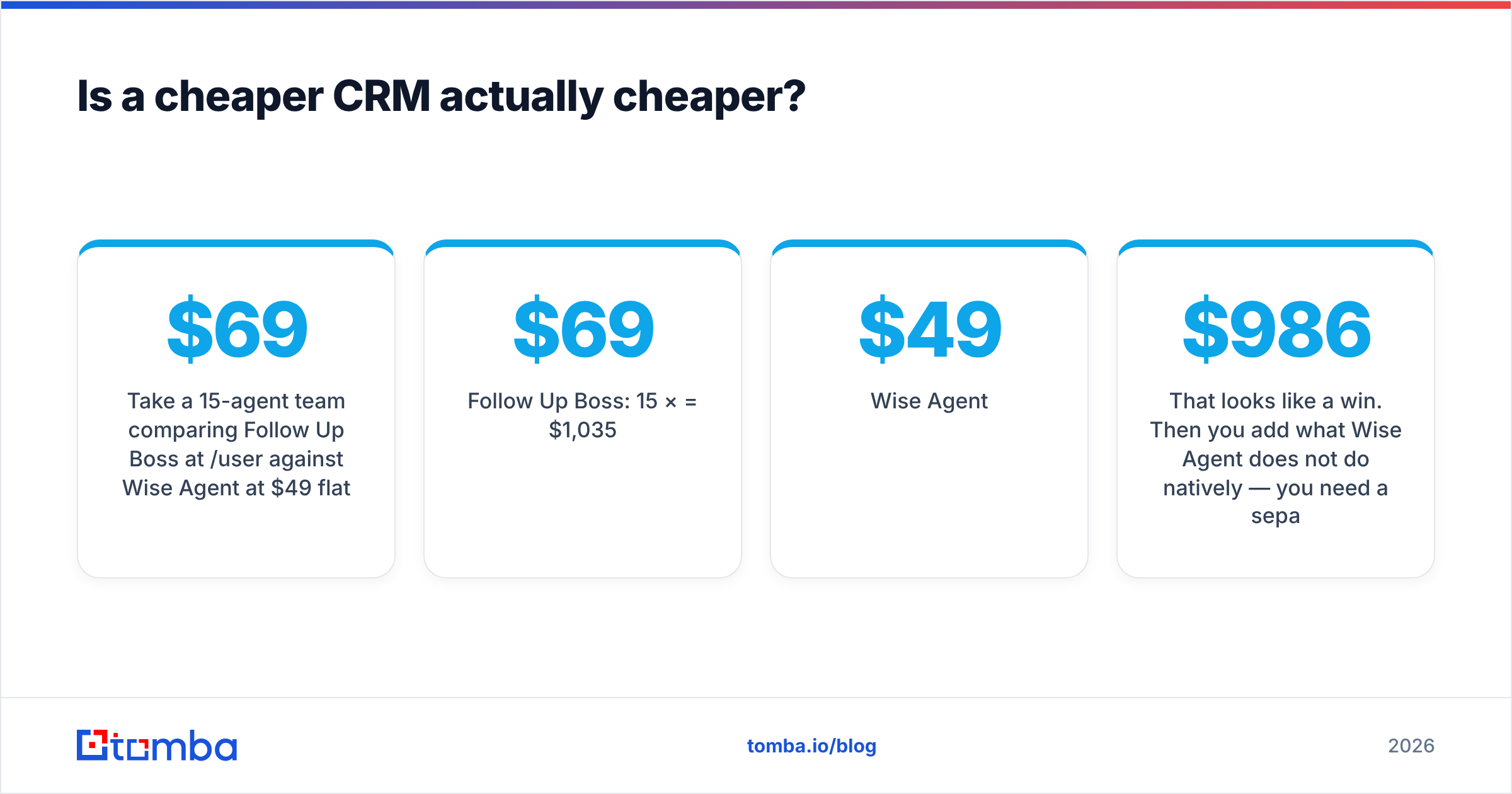
Take a 15-agent team comparing Follow Up Boss at $69/user against Wise Agent at $49/month flat:
- Follow Up Boss: 15 × $69 = $1,035/month
- Wise Agent: $49/month
That looks like a $986/month win. Then you add what Wise Agent does not do natively — you need a separate dialer ($99/mo), a separate mass-texting tool ($79/mo), and someone spending 6-10 hours/month maintaining Zapier connections that Follow Up Boss handles natively. At a $60/hour loaded cost, that is another $360-600 in labor.
Real delta: still positive, roughly $400-500/month. But it is half of what the sticker suggested, and you absorbed operational fragility to get it.
The inverse is also true. Teams that move up to Sierra or Boomtown often kill three other subscriptions — IDX site, ad management retainer, separate CRM — and land net-neutral with fewer integration points to babysit.
The rule: compare total stack cost per agent per month, not CRM line items. Write down every tool the CRM replaces or requires, then run the number.
How do you fix lead data quality regardless of which CRM you pick?#
This is the part of the switching decision that actually moves revenue, and no CRM vendor will bring it up in a demo.
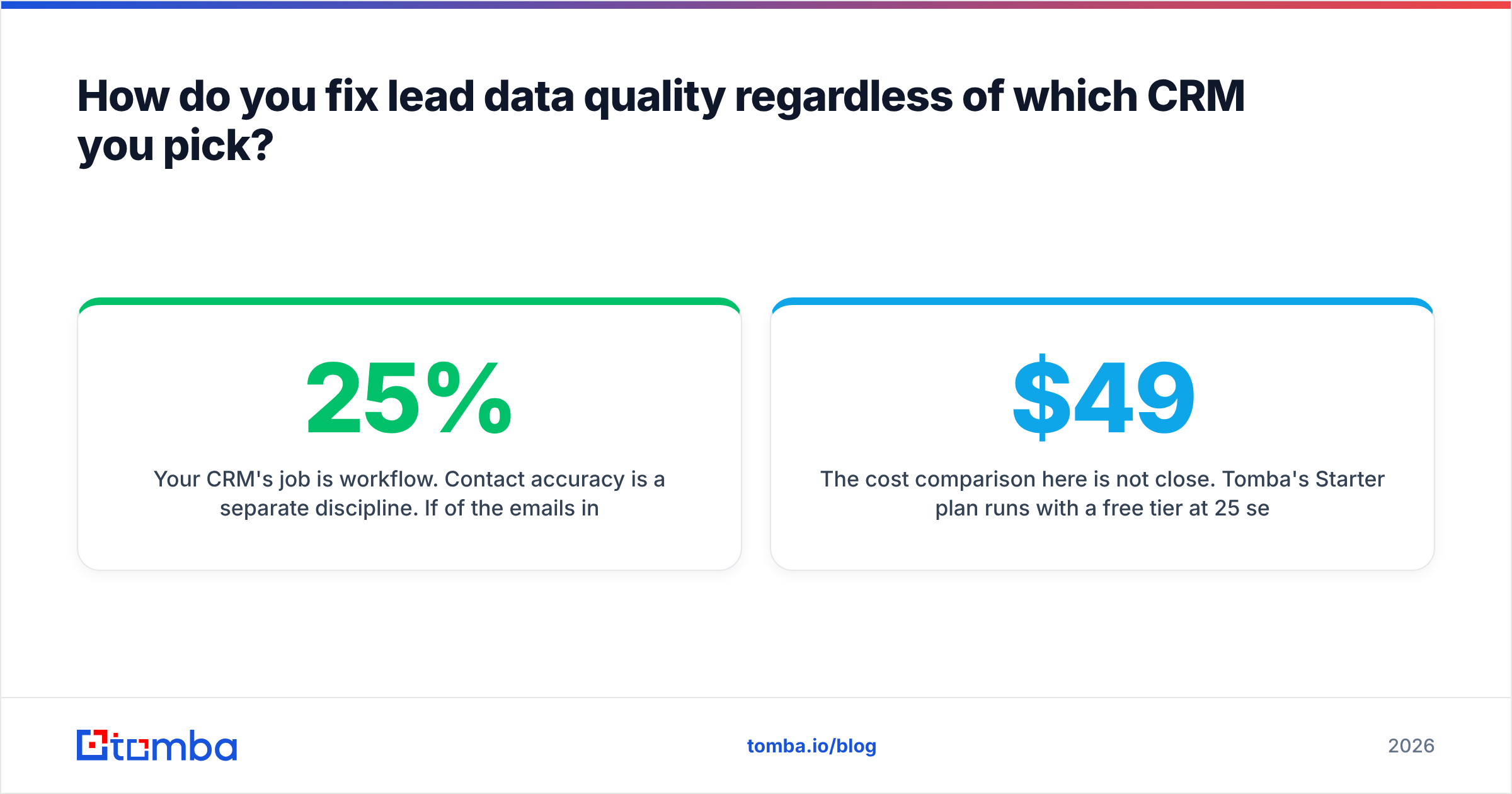
Your CRM's job is workflow. Contact accuracy is a separate discipline. If 25% of the emails in your database bounce, changing where those emails are stored changes nothing — you have simply relocated the problem into a nicer interface.
A workable data layer sits in front of whichever CRM you choose:
- Source — Find verified professional emails by company domain or by name. A domain search on a property management firm, brokerage, or commercial landlord returns the team's addresses and the company's email pattern in one call. That matters for B2B-side real estate: recruiting agents, sourcing investors, selling to PropTech.
- Verify before import — Run every list through verification so you are not importing bounces. Catch-all domains are the silent killer here; a catch-all verifier tells you which accept-all servers are actually safe to send to instead of guessing.
- Enrich on entry — When a lead comes in with a name and a company but no phone, data enrichment fills the gaps so agents are not manually Googling.
- Automate the handoff — Push verified records into your CRM via the Tomba API or a native connector. Tomba's HubSpot integration and Zapier support cover the common paths into whatever CRM you land on.

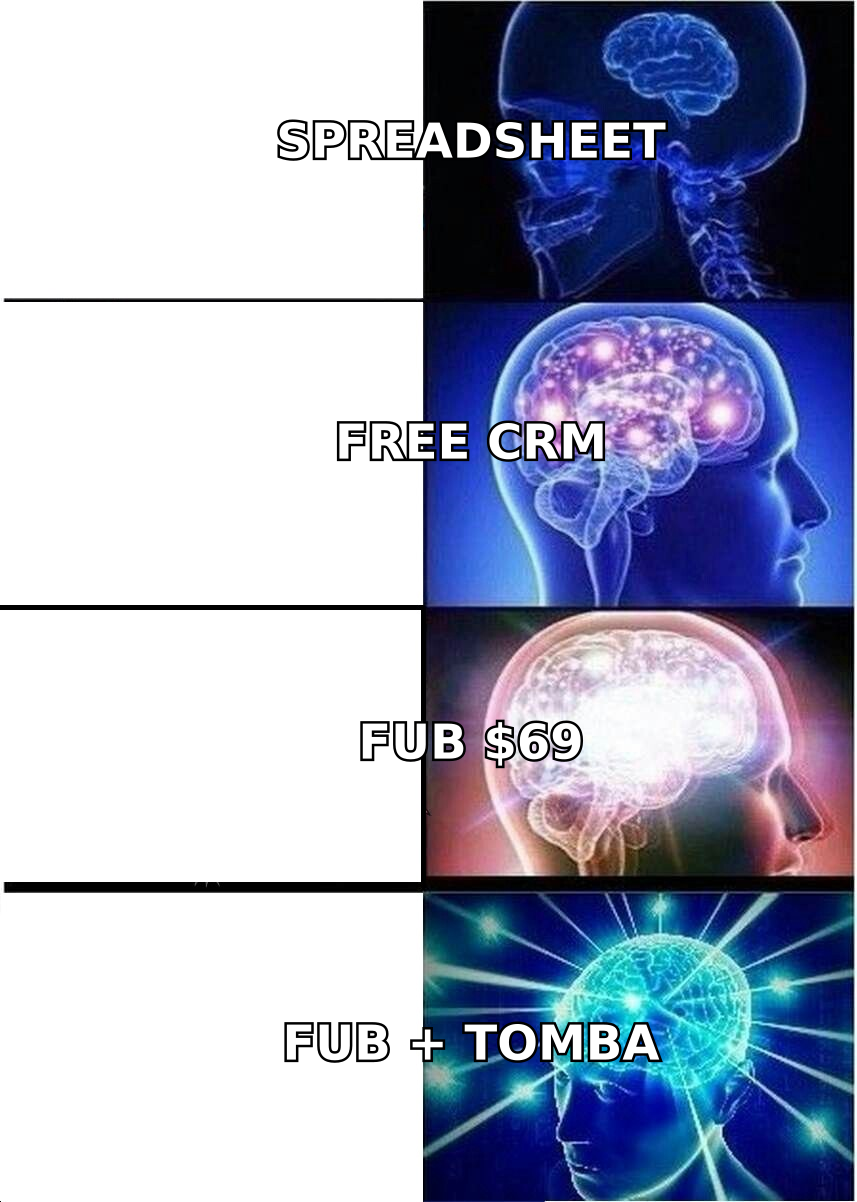
The cost comparison here is not close. Tomba's Starter plan runs $49/month with a free tier at 25 searches to test the accuracy first. That is less than one Follow Up Boss seat, and it improves the performance of every seat you have. Full Tomba pricing runs $49 Starter, $99 Growth, $249 Pro, with Enterprise custom.
When should you stay on Follow Up Boss?#
Switching CRMs costs 3-8 weeks of reduced productivity. Do not do it for a 10% feature gain. Stay put if:
- Your volume is portal-driven. Nobody parses Zillow, Realtor.com, and Homes.com leads more reliably. That is a moat.
- Your team is 5-20 agents and adoption is high. The single biggest predictor of CRM ROI is whether agents actually log activity. If yours do, protect that.
- You have built meaningful automation. Action Plans, smart lists, and lead routing rules represent months of accumulated tuning. Rebuilding them elsewhere is not free.
- Your objection is price, not function. Negotiate first. Annual commitments and multi-seat counts have more flex than the pricing page implies.
Switch if you have hit a hard ceiling: you need bundled lead gen, you need brokerage-wide deployment, you have a strategic objection to Zillow, or your headcount growth has made per-seat pricing genuinely untenable.
Independent review volume on G2 is worth skimming before any decision — filter to reviewers at your company size, because a 3-agent team and a 200-agent brokerage are effectively reviewing different products.
What does a sensible evaluation process look like?#
Four weeks, not four months:
- Week 1 — Audit your current stack. List every tool, its cost, and what breaks if you remove it. Export a sample of 500 CRM contacts and run them through verification. The bounce rate you find will reframe the whole project.
- Week 2 — Shortlist three. No more. Pick one cheaper option, one lateral option, one bundled option. Demo each with your own data, not their sandbox.
- Week 3 — Test migration on a subset. Import 200 real contacts into your top choice. Check that custom fields, tags, and notes survive. This is where most tools fail quietly.
- Week 4 — Pilot with three agents. Your most organized agent, your most resistant agent, and your newest hire. If the resistant one logs activity by day 10, you have a winner.
Then decide. And whichever CRM wins, plug the data layer in before migration, not after — importing clean records once beats cleaning a dirty database forever.
The bottom line#
Follow Up Boss is not a bad product. It is an expensive product with a specific shape, and that shape stops fitting somewhere between 20 and 40 agents, or the moment your business leans B2B instead of B2C.
Pick your alternative by constraint: budget (Wise Agent, LionDesk), bundled lead gen (Sierra, Boomtown, BoldTrail), AI automation (Lofty), or general-purpose flexibility (HubSpot, Pipedrive). Then be honest that the CRM was probably never the bottleneck.
Fix the input before you rebuild the container. Tomba's Email Finder sources verified professional email addresses by domain, name, or company — the B2B contacts your CRM was supposed to be full of but isn't. Start on the free tier at 25 searches a month, run it against a company you already know, and check the accuracy yourself before you spend another dollar on seats.
Related guides#
Ready to find emails that actually work?
Join 150,000+ professionals who stopped guessing and started sending. Free credits on signup — no credit card required.
Get the Tomba newsletter
Practical outbound tactics and product updates — once every two weeks.
About the author