Follow Up Email After Email: Timing, Templates, and Rules
Most replies to cold outreach never come from the first send. Here's how many follow-ups to write, how far apart to space them, and what each one should actually say.
TL;DR
- A follow up email after email one is not a reminder — it is a second attempt with new information. Re-sending "just bumping this" wastes the slot.
- Three to five total touches over 12–18 days is the range where most B2B teams see reply rate gains flatten. Past touch six, you buy complaints, not meetings.
- Space touches on a widening curve (day 0, +3, +5, +7), not a fixed daily drumbeat.
- Same-thread replies work for short sequences; a fresh subject line works better when your last touch was more than two weeks ago.
- Before you blame your copy, verify the list. A bounced address never had a chance to reply, and bounces drag the whole domain's deliverability down.
What is a follow up email after email one?#
A follow up email after email is any message you send to the same contact after your first email went unanswered. In practice it is the workhorse of B2B outreach: the opener gets attention, the follow-ups get replies.
Think of it like knocking on a neighbor's door. The first knock might land while they're in the shower. The second knock, thirty seconds later, is not rude — it's the one they actually hear. But the sixth knock, at the same volume, on the same door, is when they stop thinking "someone's here" and start thinking "someone won't leave."
The technical definition matters less than the practical one: each follow-up is a fresh chance to change the variable that failed. Maybe the timing was wrong. Maybe the value proposition didn't fit the person. Maybe the first email never reached the inbox at all. A good sequence tests a different hypothesis at each step instead of repeating the same one louder.
Why do follow-ups outperform the first email?#
Because the first email competes against a full inbox, and the second one competes against a half-remembered name.
Three mechanics are doing the work:
- Recognition. A prospect who saw your name Tuesday processes your Friday message faster. Familiarity lowers the cost of reading.
- Timing roulette. Reply behavior depends heavily on what else landed that hour. Sending twice multiplies your chances of hitting a quiet window.
- Deliverability drift. Some first emails land in Promotions, Other, or a quarantine queue. A second send from an established sender thread has a different routing history.
- Compounding context. Each touch lets you add a case study, a trigger event, or a data point the opener didn't have room for.
Most published outreach benchmarks — including HubSpot's sales research — show reply rates continuing to climb through the third or fourth touch before flattening. The curve shape matters more than any single vendor's number: gains are real early and marginal late.
How many follow-ups should you send before stopping?#
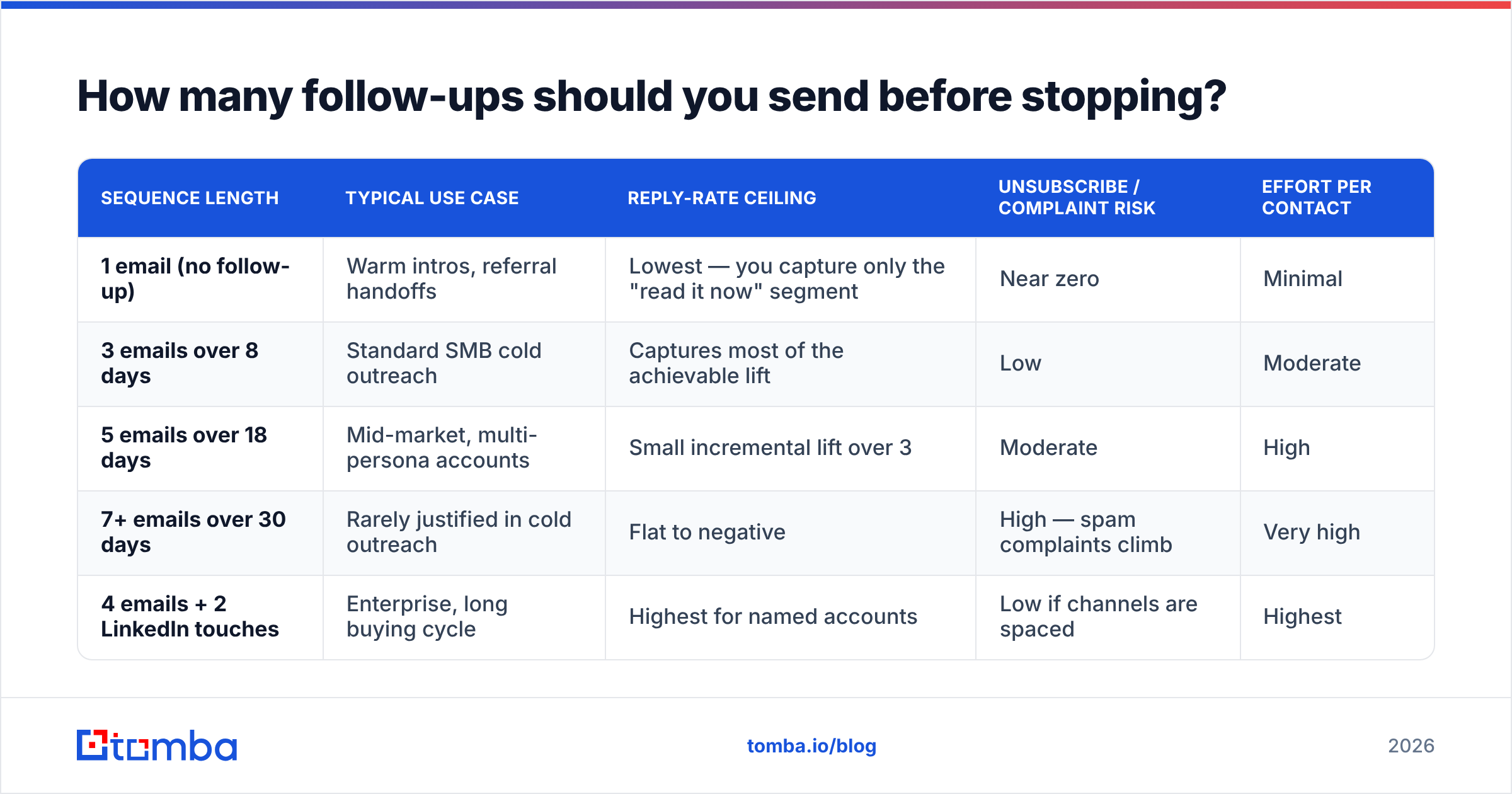
Between three and five total emails, including the opener, is the defensible range for cold B2B outreach. Warm inbound follow-up justifies fewer; enterprise accounts with multiple stakeholders justify more spread across channels.
Here's how the common sequence lengths trade off:
| Sequence length | Typical use case | Reply-rate ceiling | Unsubscribe / complaint risk | Effort per contact |
|---|---|---|---|---|
| 1 email (no follow-up) | Warm intros, referral handoffs | Lowest — you capture only the "read it now" segment | Near zero | Minimal |
| 3 emails over 8 days | Standard SMB cold outreach | Captures most of the achievable lift | Low | Moderate |
| 5 emails over 18 days | Mid-market, multi-persona accounts | Small incremental lift over 3 | Moderate | High |
| 7+ emails over 30 days | Rarely justified in cold outreach | Flat to negative | High — spam complaints climb | Very high |
| 4 emails + 2 LinkedIn touches | Enterprise, long buying cycle | Highest for named accounts | Low if channels are spaced | Highest |
The stop rule matters as much as the count. Stop early when you get an explicit no, when the contact leaves the company, when your email bounces, or when the account moves to a competitor. Stop on schedule otherwise — an open-ended sequence is a complaint generator.
What's the right interval between follow-ups?#
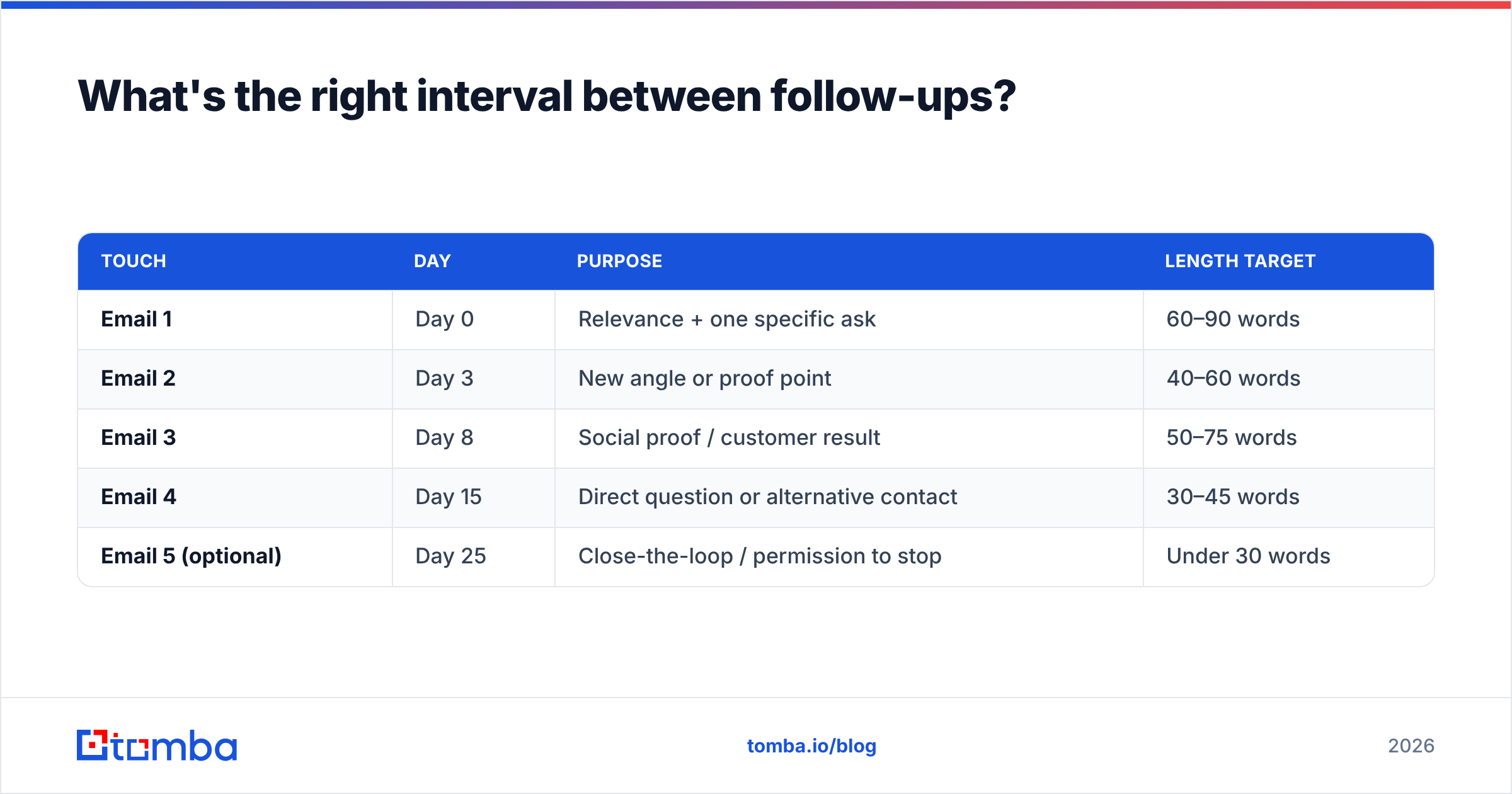
Widen the gaps as you go. A tight opener-to-bump gap catches people who genuinely missed the first message; later touches need breathing room so they read as persistence rather than pressure.
| Touch | Day | Purpose | Length target |
|---|---|---|---|
| Email 1 | Day 0 | Relevance + one specific ask | 60–90 words |
| Email 2 | Day 3 | New angle or proof point | 40–60 words |
| Email 3 | Day 8 | Social proof / customer result | 50–75 words |
| Email 4 | Day 15 | Direct question or alternative contact | 30–45 words |
| Email 5 (optional) | Day 25 | Close-the-loop / permission to stop | Under 30 words |
Two adjustments worth making. First, avoid sending every touch at the same hour — you're training the recipient's eye to skip you. Second, respect the calendar: a sequence that runs its final three touches through a holiday week has effectively wasted them. Pause and resume rather than burning slots into an empty office.
What should each follow-up actually say?#
Each message needs a job. If you can't state the job in one sentence, delete the message and shorten the sequence.
- Follow-up one — the missed-context bump. Assume the first email was never read. Restate the value in a single line and change the ask to something smaller. "Worth a 10-minute look?" beats "Can we book 30 minutes Thursday?"
- Follow-up two — the proof drop. Add one concrete result from a comparable company: named vertical, named metric, short window. Specificity is the whole point. "Cut sourcing time 40% for a 60-rep team" outperforms "helped many teams save time."
- Follow-up three — the objection preempt. Name the reason they probably haven't replied. "If this is a 2027 problem, say so and I'll close the file" gives them a low-cost exit that often produces a real answer instead of silence.
- Follow-up four — the redirect. Ask whether someone else owns the decision. This converts dead threads into warm internal referrals more often than any clever subject line.
- Follow-up five — the permission close. One sentence, no pitch, no attachment. "Closing this out unless you'd like me to circle back in Q4?" Reply rates on this touch are frequently the second-highest in the whole sequence.
What none of them should do: apologize for emailing, guilt the recipient, or use false-reply subject lines like "Re: our conversation" when no conversation happened. Fabricated thread history is the fastest way to turn a neutral prospect into a spam complaint.
What do good follow-up templates look like?#
Adapt these — don't paste them verbatim. Copy that thousands of senders use loses whatever edge it had.
Follow-up 1 (Day 3) — missed context
Subject: quick one on {{pain}}
Hi {{first_name}} — sending this back to the top in case it got buried.
{{Company}} is hiring three AEs this quarter, which usually means your SDRs start burning hours on list building. We fix that half of the problem.
Worth a 10-minute look, or is this handled?
Follow-up 2 (Day 8) — proof drop
Subject: {{similar_company}} numbers
One data point rather than another pitch: a 40-rep team in {{vertical}} cut prospecting research from 9 hours a week to under 2 after moving list building off the reps' plate.
Happy to send the one-page breakdown — no call needed. Want it?
Follow-up 3 (Day 15) — redirect
Subject: wrong person?
{{first_name}}, if pipeline sourcing isn't yours, who owns it these days? Happy to take this off your inbox and over to them.
Follow-up 4 (Day 25) — permission close
Subject: closing the loop
Assuming this isn't a priority right now — I'll stop here. If that's wrong, one word gets us back on track.
If you want a wider starting library, Tomba's cold email templates collection is free to browse, and the subject line generator is useful for testing whether your follow-up subject reads as a bump or as a new pitch.
Should you reply in the thread or start a new one?#
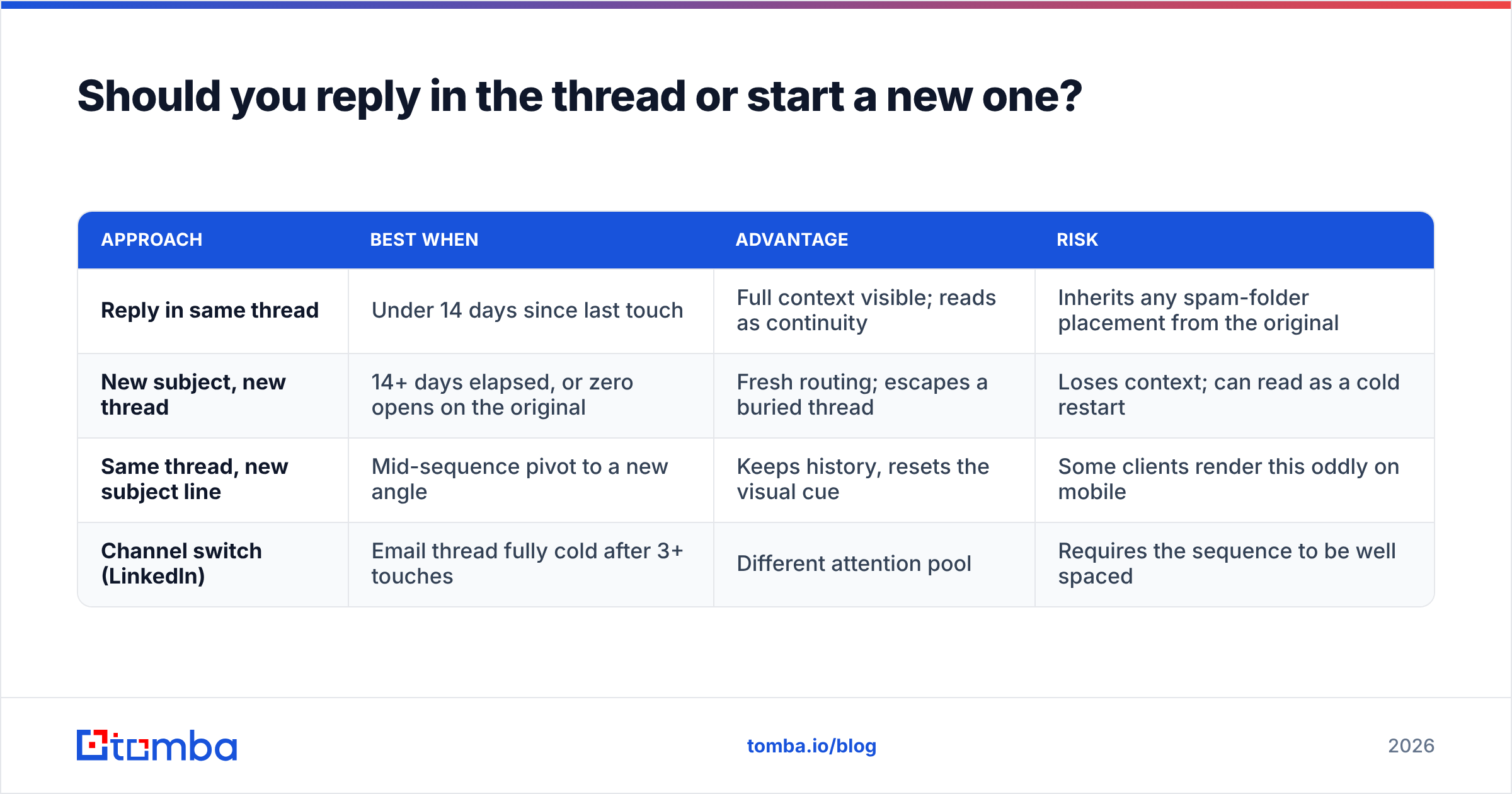
Both work. The deciding variable is elapsed time and whether the original email was ever opened.
| Approach | Best when | Advantage | Risk |
|---|---|---|---|
| Reply in same thread | Under 14 days since last touch | Full context visible; reads as continuity | Inherits any spam-folder placement from the original |
| New subject, new thread | 14+ days elapsed, or zero opens on the original | Fresh routing; escapes a buried thread | Loses context; can read as a cold restart |
| Same thread, new subject line | Mid-sequence pivot to a new angle | Keeps history, resets the visual cue | Some clients render this oddly on mobile |
| Channel switch (LinkedIn) | Email thread fully cold after 3+ touches | Different attention pool | Requires the sequence to be well spaced |
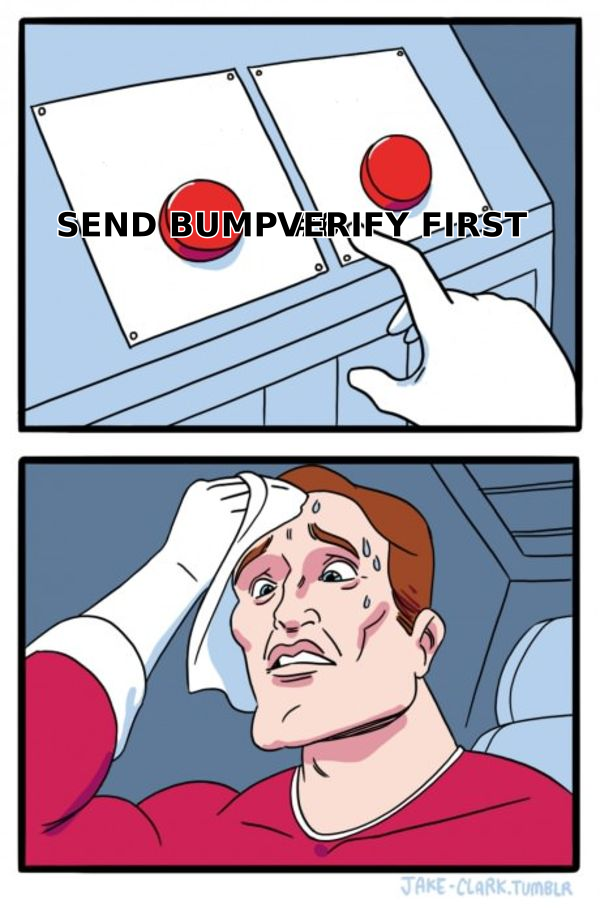
One practical rule: if your email tool reports zero opens across the first two touches, stop rewriting copy. Copy is not your problem. Either the address is wrong or your messages aren't reaching the inbox.
Why do follow-ups fail even when the copy is good?#
Because a large share of "no reply" outcomes are really "no delivery" outcomes, and no sequence survives a bad address.
Three failure modes account for most of it:
- Hard bounces. The mailbox doesn't exist. Every bounce is a signal to mailbox providers that you're sending to a list you didn't clean, and it degrades email deliverability for every message that follows — including the ones going to valid contacts.
- Catch-all domains. The server accepts everything, so a naive check reports "valid" for addresses that quietly vanish. This is where a lot of phantom "sent, never replied" data comes from. A dedicated catch-all verifier is the only reliable way to separate real mailboxes from black holes on these domains.
- Role addresses. info@, sales@, support@ get routed to shared queues where cold outreach dies. They inflate your send volume and depress your reply rate at the same time.
The fix order is boring but effective: verify the list, then check authentication (SPF, DKIM, DMARC), then rewrite copy. Running an email verifier pass before a sequence launch typically removes enough dead weight to change your reported reply rate without touching a single word of the email.
How do you measure whether your follow-ups are working?#
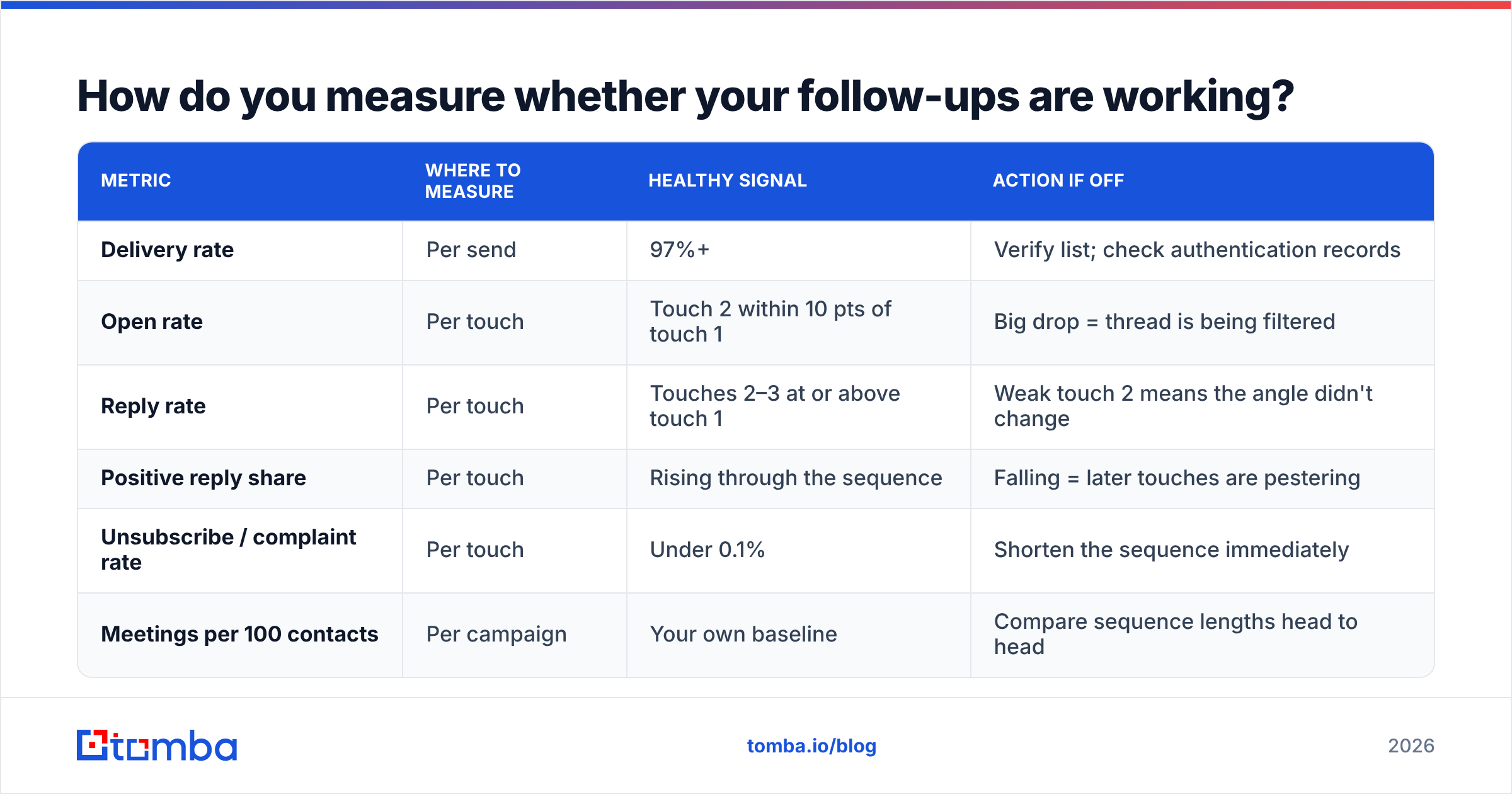
Track per-touch, not per-sequence. Sequence-level averages hide which specific message is carrying the campaign and which one is just burning goodwill.
| Metric | Where to measure | Healthy signal | Action if off |
|---|---|---|---|
| Delivery rate | Per send | 97%+ | Verify list; check authentication records |
| Open rate | Per touch | Touch 2 within 10 pts of touch 1 | Big drop = thread is being filtered |
| Reply rate | Per touch | Touches 2–3 at or above touch 1 | Weak touch 2 means the angle didn't change |
| Positive reply share | Per touch | Rising through the sequence | Falling = later touches are pestering |
| Unsubscribe / complaint rate | Per touch | Under 0.1% | Shorten the sequence immediately |
| Meetings per 100 contacts | Per campaign | Your own baseline | Compare sequence lengths head to head |
The most useful diagnostic is the touch-level response rate curve. If touch four still outperforms touch two, your sequence is too short. If touch three already underperforms touch one and complaints are creeping up, cut the sequence and put the effort into better targeting instead.
For benchmarking your stack against peers rather than against your own history, category pages on G2 are a reasonable neutral reference — the reviews usually surface deliverability complaints that vendor sites won't. And if you're formalizing the process internally, the general framing in the email marketing literature on frequency capping applies directly to outbound sequences too.
What are the most common follow-up mistakes?#
- Repeating the original email with "just checking in" on top. No new information, no new reason to reply.
- Fixed 24-hour intervals. Reads as automated because it is.
- Attaching a deck to touch two. Attachments to cold contacts hurt deliverability and rarely get opened.
- Never closing the loop. Sequences that just stop leave the contact in limbo and cost you the easy "actually, next quarter" reply.
- Following up on unverified addresses. Five touches to a dead mailbox is five bounces against your sending domain.
- Ignoring the reply that isn't a yes. "Not now" is a scheduling instruction, not a rejection. Route it to a nurture list with a real date.
Get the list right before you write another follow-up#
The best follow up email after email one is the one that reaches a real person who plausibly has the problem you solve. Everything else — cadence, subject lines, template phrasing — is optimization on top of that.
Start by making sure your contacts exist. Tomba's Email Finder locates professional addresses by name, company, or domain, returns a confidence score with each result, and pushes verified contacts straight into your sequencing tool. The free tier includes 25 searches a month so you can test accuracy on your own accounts before paying anything; paid plans start at $49/mo, with full Tomba pricing published up front. Clean the list first, then let the follow-ups do their job.
Related guides#
Ready to find emails that actually work?
Join 150,000+ professionals who stopped guessing and started sending. Free credits on signup — no credit card required.
Get the Tomba newsletter
Practical outbound tactics and product updates — once every two weeks.
About the author