Follow Up Email After Introduction: Templates That Get Replies
Warm intros die in the inbox more often than cold emails do. Here's the timing, structure, and eight tested templates for a follow up email after introduction that actually gets a reply.
TL;DR
- A warm introduction converts 3-5x better than a cold email, but only if you reply within 24 hours — after 72 hours the referral's social capital has already evaporated.
- Your first message is not a pitch. It is a thank-you to the connector, a one-line credibility anchor, and a single low-friction ask. Nothing else.
- Move the connector to BCC on your first reply. It signals competence and frees them from a thread they never wanted to babysit.
- Three follow-ups maximum, spaced roughly 3, 7, and 14 days out, each adding new information rather than repeating the last one.
- If the intro came from a conference list, a mutual investor, or a LinkedIn thread and you only have a name and company, verify the address before you send — a bounce on a referred contact burns two relationships at once.
What Is a Follow Up Email After Introduction?#
A follow up email after introduction is any message you send in the thread that begins when a mutual contact connects you to someone new. It splits into two distinct jobs that most people collapse into one, badly.
The first job is the response email — your reply to the introduction itself, sent within a day. The second job is the nudge sequence — the messages you send when the response email gets ignored, which happens roughly half the time even on genuinely warm intros.
Think of it like being handed a business card by a friend at a dinner party. The card is not the relationship. Your friend spent a small amount of their own credibility to hand it over, and how fast and how gracefully you use it determines whether they ever hand you another one.
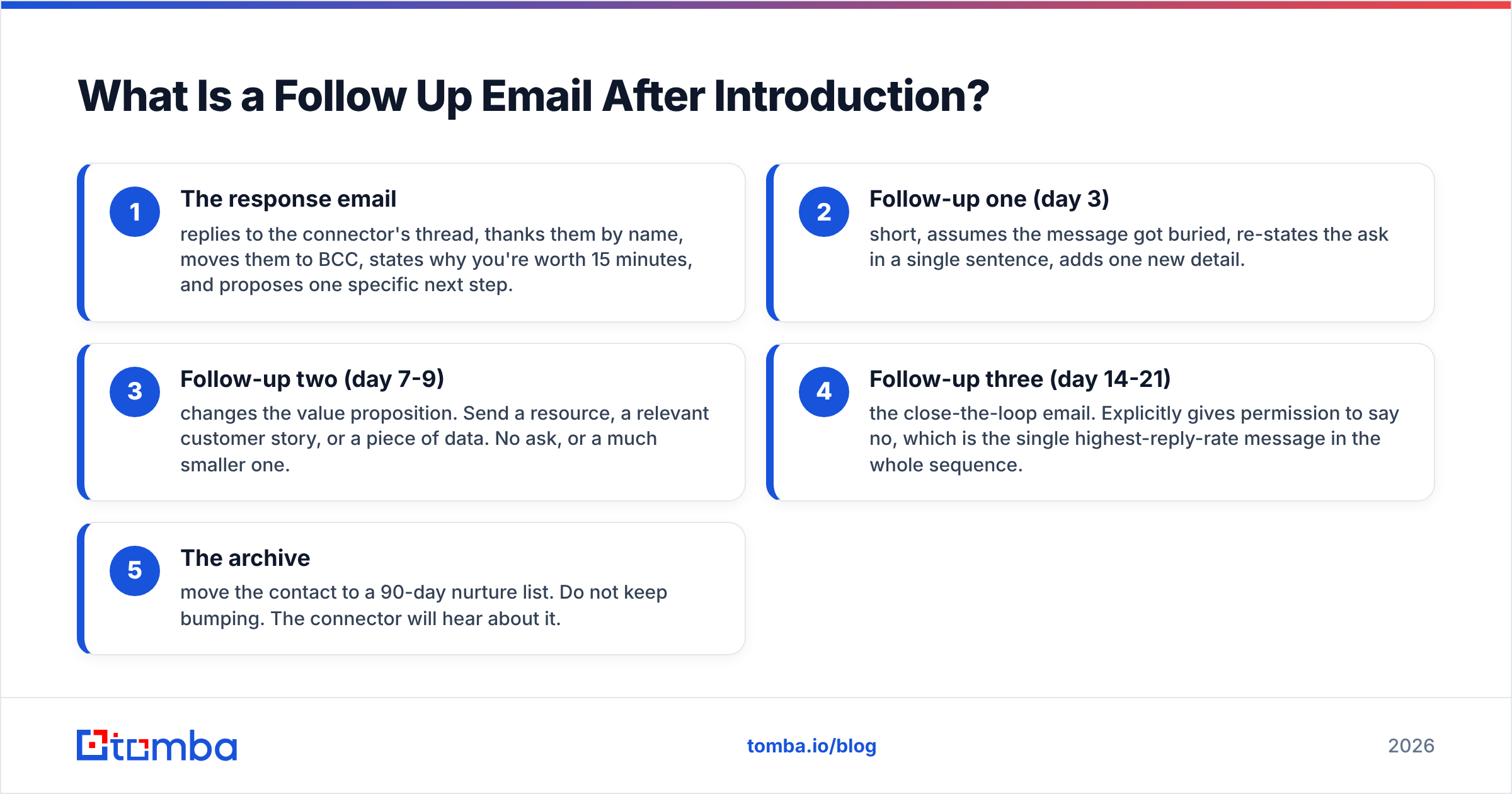
Here is the structural difference between the two jobs:
- The response email — replies to the connector's thread, thanks them by name, moves them to BCC, states why you're worth 15 minutes, and proposes one specific next step.
- Follow-up one (day 3) — short, assumes the message got buried, re-states the ask in a single sentence, adds one new detail.
- Follow-up two (day 7-9) — changes the value proposition. Send a resource, a relevant customer story, or a piece of data. No ask, or a much smaller one.
- Follow-up three (day 14-21) — the close-the-loop email. Explicitly gives permission to say no, which is the single highest-reply-rate message in the whole sequence.
- The archive — move the contact to a 90-day nurture list. Do not keep bumping. The connector will hear about it.

Why Do So Many Warm Intros Go Cold?#
Because people treat a referral like a guaranteed meeting rather than a slightly-warmer cold email.
The referred contact agreed to an introduction as a favour to your connector, not as a commitment to you. Research consistently shows that referred leads close at meaningfully higher rates — HubSpot's sales data has long put referral-sourced deals well above outbound-sourced ones — but that advantage only holds if you convert the goodwill fast.
Four things kill warm intros in practice:
- Latency. You reply four days later. The connector's endorsement has decayed, and the recipient has re-classified you from "person my friend vouched for" to "person emailing me."
- Over-asking. Your first reply asks for a 45-minute discovery call, a demo, and an intro to their VP of Engineering. The recipient does the math on effort versus obligation and stalls.
- Leaving the connector on the thread. Every subsequent message pings someone who did their part already. It reads as neediness and it costs you future referrals.
- No follow-up plan. One reply, silence, and you assume it was a no. Most intro threads that convert do so on message two or three, not message one.
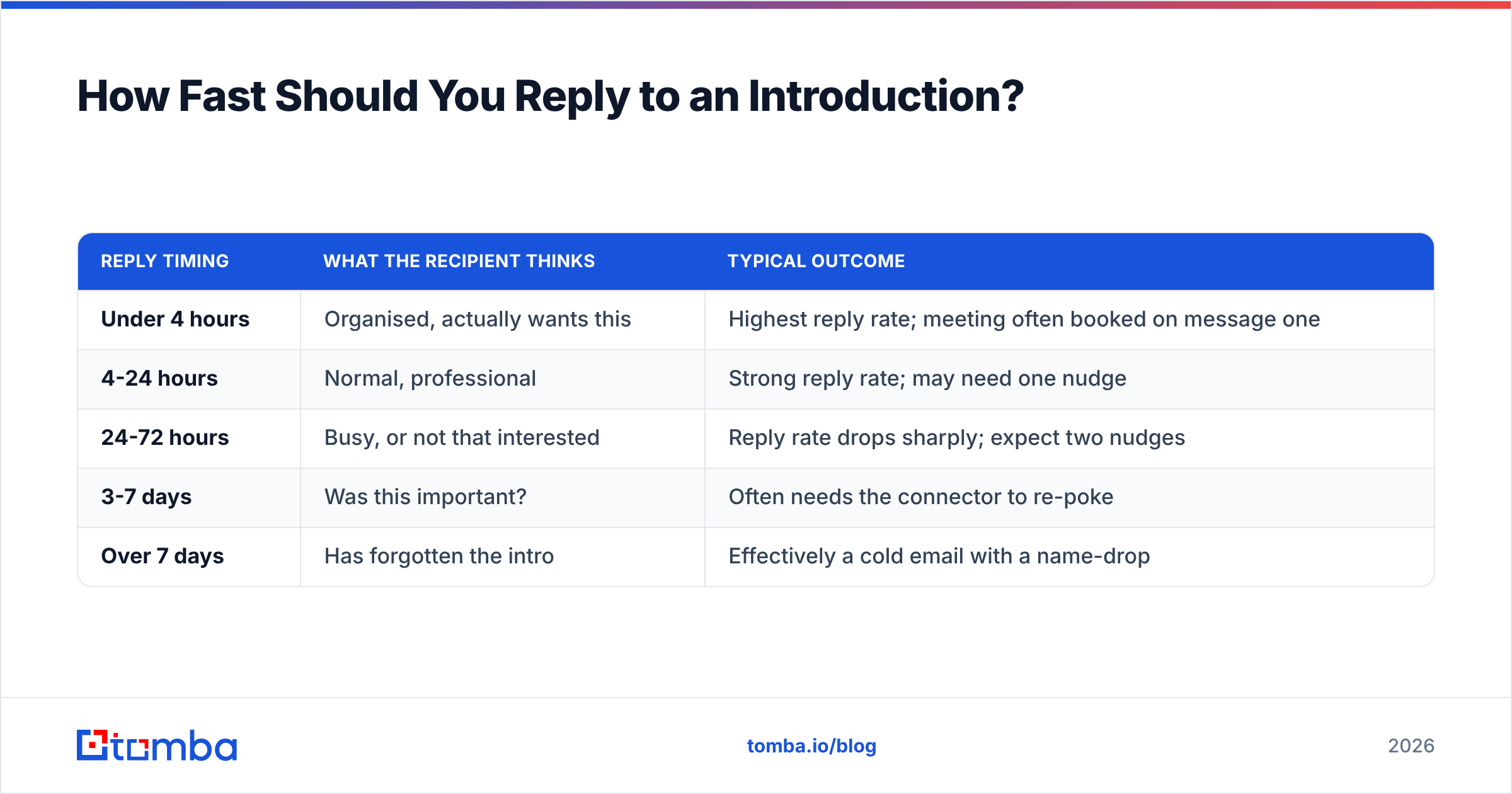
How Fast Should You Reply to an Introduction?#
Within 24 hours. Same business day if you can manage it.
There is no scientifically precise cutoff, but the practical pattern is consistent across sales teams: the reply that lands while the connector's email is still in the recipient's unread stack gets read. The reply that lands next week gets triaged with everything else.
| Reply timing | What the recipient thinks | Typical outcome |
|---|---|---|
| Under 4 hours | Organised, actually wants this | Highest reply rate; meeting often booked on message one |
| 4-24 hours | Normal, professional | Strong reply rate; may need one nudge |
| 24-72 hours | Busy, or not that interested | Reply rate drops sharply; expect two nudges |
| 3-7 days | Was this important? | Often needs the connector to re-poke |
| Over 7 days | Has forgotten the intro | Effectively a cold email with a name-drop |
The asymmetry matters. Replying fast costs you nothing; replying slowly costs you the entire premium you were handed. If you genuinely cannot write a thoughtful reply today, send a two-line holding message — "Thanks Sarah, great to meet you Marcus. I'm heads-down until Thursday but wanted to say hello properly — I'll send something substantive then." That preserves the timeline.
What Should the First Reply Actually Say?#
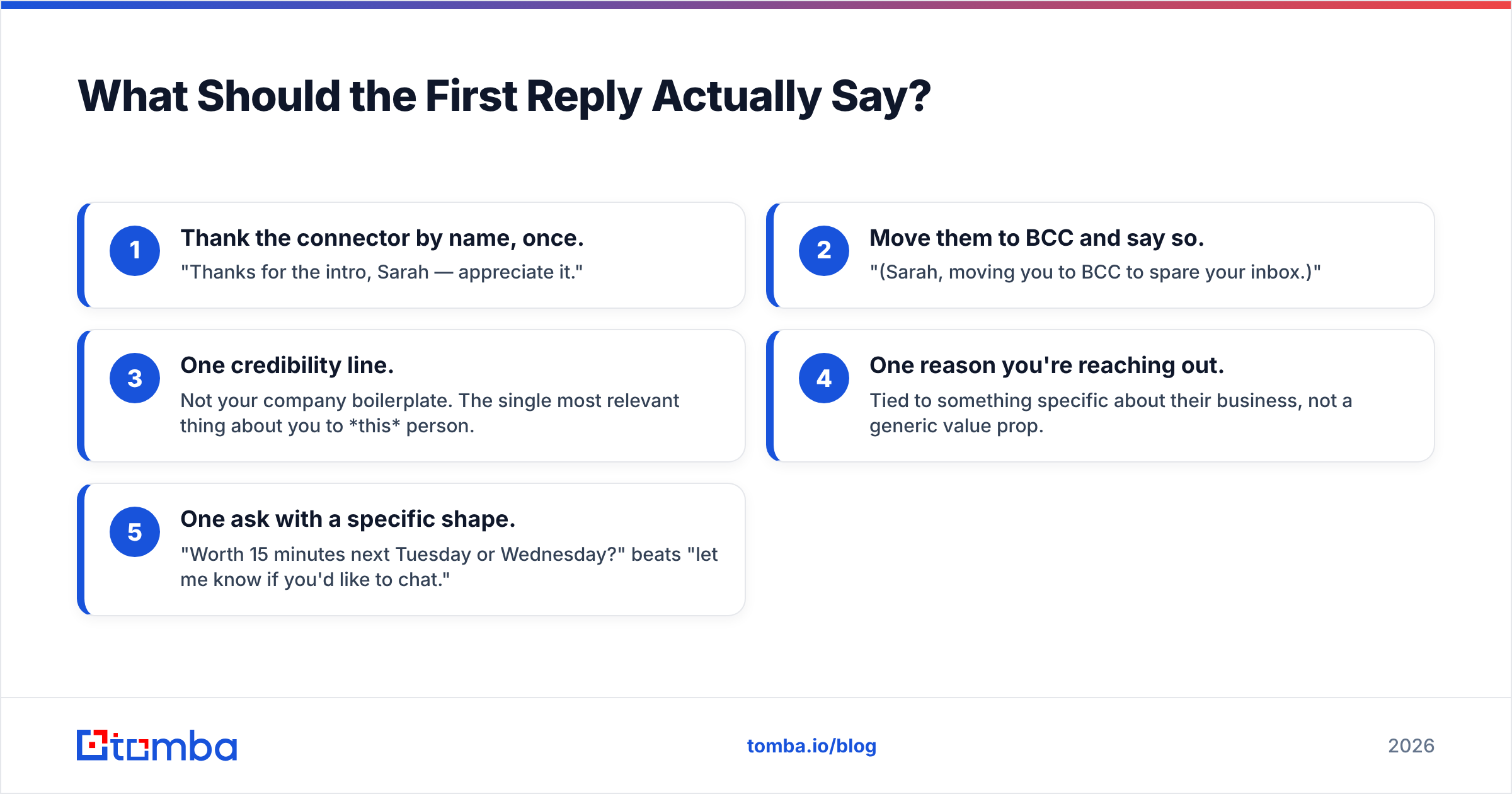
Five elements, in this order, in under 120 words.
- Thank the connector by name, once. "Thanks for the intro, Sarah — appreciate it."
- Move them to BCC and say so. "(Sarah, moving you to BCC to spare your inbox.)"
- One credibility line. Not your company boilerplate. The single most relevant thing about you to this person.
- One reason you're reaching out. Tied to something specific about their business, not a generic value prop.
- One ask with a specific shape. "Worth 15 minutes next Tuesday or Wednesday?" beats "let me know if you'd like to chat."
Here is the template most teams end up converging on:
Subject: (keep the connector's original subject line)
Sarah — thanks for connecting us, genuinely appreciate it. Moving you to BCC.
Marcus, good to meet you. Quick context: we handle data hygiene for outbound teams, and the reason Sarah thought this was worth a conversation is that you're scaling the SDR team from 4 to 12 this quarter — that's usually the exact point where list quality starts costing more than it saves.
Happy to walk you through what we've seen at that headcount, or just send over the two numbers most teams get wrong. 15 minutes Tuesday or Wednesday afternoon?
Either way, good to be connected.
Note what is absent: no attached deck, no calendar link dumped in the first line, no three-paragraph company history, no "I'd love to pick your brain." The last one is the most quietly damaging phrase in professional email — it asks for time while offering nothing.
What Do the Follow-Up Messages Look Like?#
Each one has a different job. Repeating message one with "just bumping this" is the fastest way to get filtered.
Follow-up 1 — day 3. The assumption-of-burial.
Marcus — floating this back up in case it got buried. Still happy to do 15 minutes if useful. One thing I forgot to mention: we did this same exercise with a team that went 5 to 14 SDRs last year and their connect rate held steady instead of dropping. Happy to share what they changed.
Follow-up 2 — day 7-9. The value drop.
Marcus — no ask here. Wrote up the four checks we run on a list before it goes into a sequence: [link]. Number three is the one that surprises most people. If it's useful and you want to talk it through, I'm around. If not, no hard feelings.
Follow-up 3 — day 14-21. The permission to close.
Marcus — I'll stop here so I'm not cluttering your inbox. If timing's wrong, that's completely fine — just let me know and I'll check back in Q4. If it's worth 15 minutes, my calendar's open Thursday.
That last message reliably outperforms everything before it. People reply to a door closing far more readily than to a door being held open. The response rate lift on a genuine breakup email is one of the most consistently reproduced findings in outbound.
Warm Intro vs Cold Email vs Re-Engagement: What Changes?#
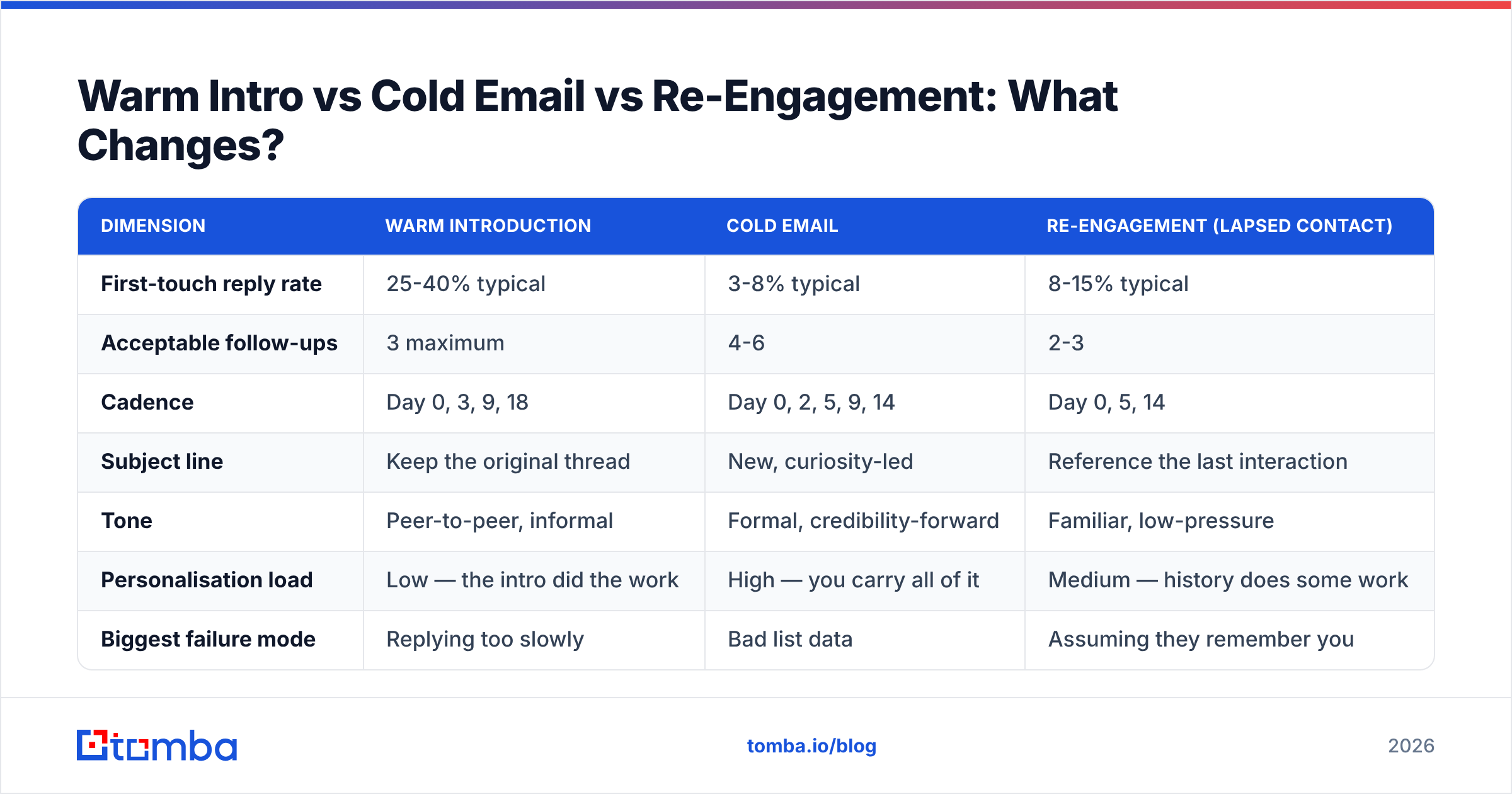
The mechanics of follow-up shift depending on how you got the contact. Treating all three the same is why sequences underperform.
| Dimension | Warm introduction | Cold email | Re-engagement (lapsed contact) |
|---|---|---|---|
| First-touch reply rate | 25-40% typical | 3-8% typical | 8-15% typical |
| Acceptable follow-ups | 3 maximum | 4-6 | 2-3 |
| Cadence | Day 0, 3, 9, 18 | Day 0, 2, 5, 9, 14 | Day 0, 5, 14 |
| Subject line | Keep the original thread | New, curiosity-led | Reference the last interaction |
| Tone | Peer-to-peer, informal | Formal, credibility-forward | Familiar, low-pressure |
| Personalisation load | Low — the intro did the work | High — you carry all of it | Medium — history does some work |
| Biggest failure mode | Replying too slowly | Bad list data | Assuming they remember you |
| Connector risk | High — your behaviour reflects on them | None | Low |
The connector-risk row is the one people underweight. In a cold sequence, an aggressive follow-up costs you one prospect. In an intro thread, it costs you the prospect and the person who vouched for you, who now has to decide whether introducing you again is worth the hassle.
What If You Only Have a Name, Not an Email?#
This is more common than the clean scenario. Someone mentions a person worth meeting, a mutual contact says "you should talk to Priya at Northwind," an investor lists three portfolio CEOs in a Slack message — and then nobody actually sends the email.
You have two options. Wait for a formal introduction that may never come, or find the address yourself and open with a referral-anchored message.
The second is usually correct, provided you do it carefully:
- Get the address right the first time. A bounce on a name your mutual contact gave you is worse than not sending. Use a proper email finder rather than guessing at first.last@company.com, and run it through an email verifier before it goes out.
- Name the connector in the first line, not the third. "Priya — Daniel Osei suggested I reach out" has to be the opening clause, or it reads as cold.
- Tell the connector you're doing it. A one-line heads-up ("going to email Priya directly and mention you — shout if that's awkward") protects the relationship and often prompts them to send a real intro anyway.
- Match the domain pattern. If you're finding several people at the same company, run a domain search first so you know the organisation's actual format instead of testing permutations one at a time.
- Watch for catch-all domains. A catch-all accepts everything, so a "valid" result means very little. A dedicated catch-all verifier is the difference between a real address and a guess that happens not to bounce.
Getting the mechanics right here also matters for email deliverability. Referred contacts are frequently at companies with strict filtering, and a pattern of bounces on your sending domain will land your genuinely warm messages in spam alongside your speculative ones. Google's own Postmaster Tools documentation is the fastest way to see whether your domain reputation is drifting before it costs you a reply.
How Do You Track Intro Threads Without a Full CRM?#
Warm intros are low-volume and high-value, which makes them exactly the wrong shape for a sequencing tool and exactly the right shape for a lightweight tracker.
A minimal system that works:
| Field | Why it matters |
|---|---|
| Connector name | So you can report back and close the loop with them |
| Intro date | Your latency clock starts here |
| Reply sent | Timestamp — anything over 24h is a process failure worth noticing |
| Follow-up count | Hard cap at 3; the field enforces the discipline |
| Next action date | Prevents the thread from silently dying |
| Outcome | Meeting / no / archived — feeds the thank-you note back to the connector |
Six columns in a spreadsheet beats a half-configured pipeline stage nobody updates. If you already run one, folding intro threads into your CRM as a separate source type is worth doing, because the conversion math is so different from outbound that blending them makes both numbers meaningless.
The step almost everyone skips: tell the connector what happened. One line, either way. "Sarah — met with Marcus, we're doing a pilot in March. Thanks again." Or "Sarah — timing wasn't right for Marcus but he was generous with his time. Appreciate the intro." That single email is the entire mechanism by which people introduce you a second time.
What Are the Most Common Mistakes?#
- Changing the subject line on your first reply. It breaks the thread and detaches you from the connector's endorsement. Keep it, at least until the conversation has its own momentum.
- CC-ing the connector on every follow-up. You are asking them to witness your persistence. They did not sign up for that.
- Sending a calendar link as the first ask. It transfers work to someone who owes you nothing yet. Propose two concrete windows instead; offer the link once they say yes.
- Writing more than 120 words in the first reply. Length reads as effort to you and as obligation to them.
- Pitching in message one. The intro bought you a conversation, not a demo slot.
- Giving up after one nudge. Roughly half of intro-sourced meetings get booked on message two or three. One-and-done leaves most of the value on the table.
- Guessing at the address. If you're constructing the email yourself, a bounce doesn't just fail — it tells the recipient's mail server you're guessing, and it tells your connector you were sloppy.
Does Any of This Change in 2026?#
Two things have shifted, and both push in the same direction: shorter and more specific.
Inbox filtering has gotten materially stricter. Bulk-sender requirements from Google and Yahoo now enforce authentication and complaint-rate thresholds that used to be advisory, and reputation is increasingly evaluated per-domain rather than per-message. Practically, that means the sloppy speculative volume you send on Monday degrades the warm intro you send on Friday. Reviews on G2's sales-intelligence category show buyers increasingly filtering vendors on data accuracy specifically for this reason.
The second shift is recipient behaviour. AI-drafted email is now abundant enough that generically polished writing has become a negative signal. A first reply that references something only a human who did five minutes of homework would know — a specific hire, a product change, a conference talk — now outperforms a smoother but interchangeable paragraph by a wide margin. The formatting-perfect three-paragraph message with a tidy value proposition looks exactly like the forty others in the folder.
Short version: reply within a day, write like a person, ask for one small thing, follow up three times with new information each time, and close the loop with the connector regardless of outcome. That is the whole method.
Getting the Address Right Before You Send#
Everything above assumes the message arrives. When the introduction is formal and the connector CCs both parties, that is handled for you. When it is not — a name dropped in conversation, a referral from a customer, a "you two should talk" that never turned into an email — the address becomes your problem, and a bounce costs you two relationships instead of one.
Tomba Email Finder exists for exactly that gap: find a verified professional address from a name and a company domain, confirm it before you send, and open the thread with your connector's name in the first line rather than a delivery failure notice. The free tier covers 25 searches a month, which is more than enough for the volume of genuine warm intros most people handle; paid plans start at $49/mo on Starter if you're running referrals at team scale. Full Tomba pricing is public, and where Tomba gets data is documented rather than hand-waved.
Find the address, verify it, then spend your effort on the 120 words that actually matter.
Related guides#
Ready to find emails that actually work?
Join 150,000+ professionals who stopped guessing and started sending. Free credits on signup — no credit card required.
Get the Tomba newsletter
Practical outbound tactics and product updates — once every two weeks.
About the author