Follow Up Email After Sales Pitch: 7 Templates That Work
Most pitches don't die in the room — they die in the four days of silence afterward. Here's the timing, structure, and seven copy-paste templates that turn a polite "we'll discuss internally" into a booked next step.
TL;DR
- Send the first follow up email after sales pitch within 24 hours, while the prospect can still remember your slide 7 without opening the deck.
- The recap-plus-next-step structure beats "just checking in" by a wide margin: summarize what they said, restate the business case in their words, propose one specific action.
- Plan a 5-touch sequence over roughly 21 days, not an indefinite drip. Each touch must add something new — a number, a case, an answer, a deadline.
- Multi-thread by touch three. If your champion goes quiet, the deal is stuck in someone else's inbox, not theirs.
- Bad contact data kills more follow-ups than bad copy. Verify addresses for the extra stakeholders you add mid-cycle before you send anything.
What counts as a follow up email after a sales pitch?#
A follow up email after a sales pitch is any message you send after a live presentation, demo, or discovery-plus-pitch call, with the goal of moving the deal to a defined next step. It is not a thank-you note. It is not a "circling back." It is a short written artifact that does three jobs at once:
- Reconstructs the meeting for the people who attended and were half-listening.
- Sells for you internally to the people who did not attend at all — the CFO, the security reviewer, the skeptical VP who will read your bullet points and nothing else.
- Removes ambiguity about what happens next and who does it.
That second job is the one most reps ignore. Enterprise buying groups now average six to ten people, and the person you pitched will forward your email rather than re-explain your product. If your follow-up cannot survive being forwarded without you in the room, it is not finished.
The distinction matters because it changes the writing. A thank-you note is about politeness. A follow-up is a document. Write it as though it will be pasted into a Slack channel you will never see — because it will be.
Why do most post-pitch follow-ups fail?#
Failure is usually structural, not stylistic. Here are the five patterns that show up in almost every underperforming sequence:
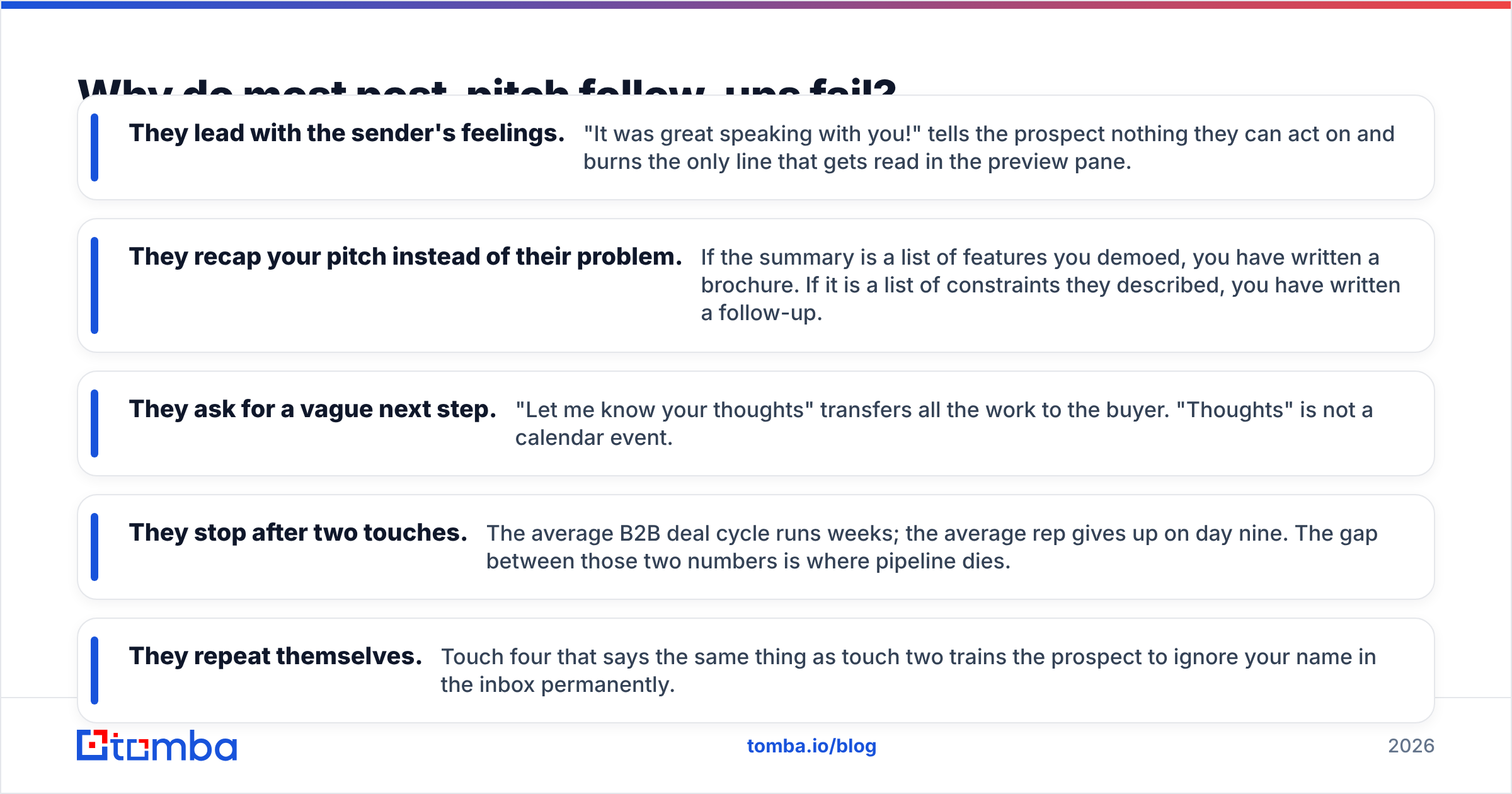
- They lead with the sender's feelings. "It was great speaking with you!" tells the prospect nothing they can act on and burns the only line that gets read in the preview pane.
- They recap your pitch instead of their problem. If the summary is a list of features you demoed, you have written a brochure. If it is a list of constraints they described, you have written a follow-up.
- They ask for a vague next step. "Let me know your thoughts" transfers all the work to the buyer. "Thoughts" is not a calendar event.
- They stop after two touches. The average B2B deal cycle runs weeks; the average rep gives up on day nine. The gap between those two numbers is where pipeline dies.
- They repeat themselves. Touch four that says the same thing as touch two trains the prospect to ignore your name in the inbox permanently.
There's a sixth, quieter failure: sending to the wrong address. When you expand from one attendee to a four-person buying committee, you're guessing at emails for people you've never met. A guessed address either bounces — damaging your sender reputation — or silently lands nowhere. Run new stakeholders through an email verifier before the second touch, not after the deal stalls.
When should you send each follow-up?#
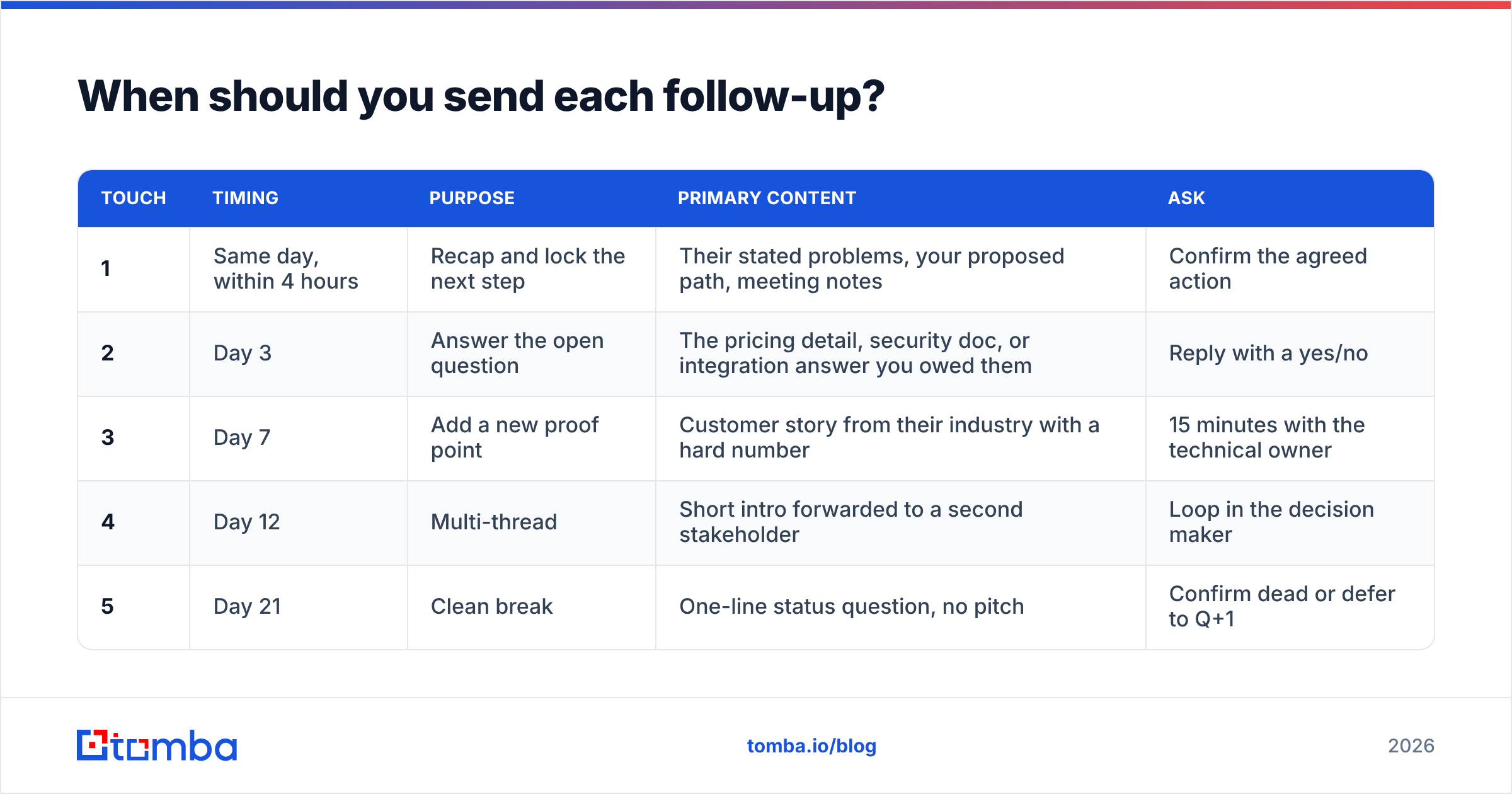
Timing is a variable you control completely, which makes it the cheapest lever available. Here's a cadence that works for a mid-market deal with a 3–8 week cycle:
| Touch | Timing | Purpose | Primary content | Ask |
|---|---|---|---|---|
| 1 | Same day, within 4 hours | Recap and lock the next step | Their stated problems, your proposed path, meeting notes | Confirm the agreed action |
| 2 | Day 3 | Answer the open question | The pricing detail, security doc, or integration answer you owed them | Reply with a yes/no |
| 3 | Day 7 | Add a new proof point | Customer story from their industry with a hard number | 15 minutes with the technical owner |
| 4 | Day 12 | Multi-thread | Short intro forwarded to a second stakeholder | Loop in the decision maker |
| 5 | Day 21 | Clean break | One-line status question, no pitch | Confirm dead or defer to Q+1 |
Two rules override the table. First, if the prospect gave you a date ("we're reviewing budget on the 14th"), every touch anchors to that date instead. Second, if they replied to a previous touch, the clock resets — you're in a conversation now, and conversation beats cadence.
Send times matter less than the industry claims, but they're not zero. Tuesday through Thursday, 7–9am in the recipient's timezone, still outperforms Friday afternoon for reply rate. Don't over-optimize this; a mediocre email at the perfect hour still loses to a good email at a random one. Research from HubSpot's sales blog and call-analysis work published by Gong both point the same direction: content and specificity dominate timing.
What should the first follow-up contain?#
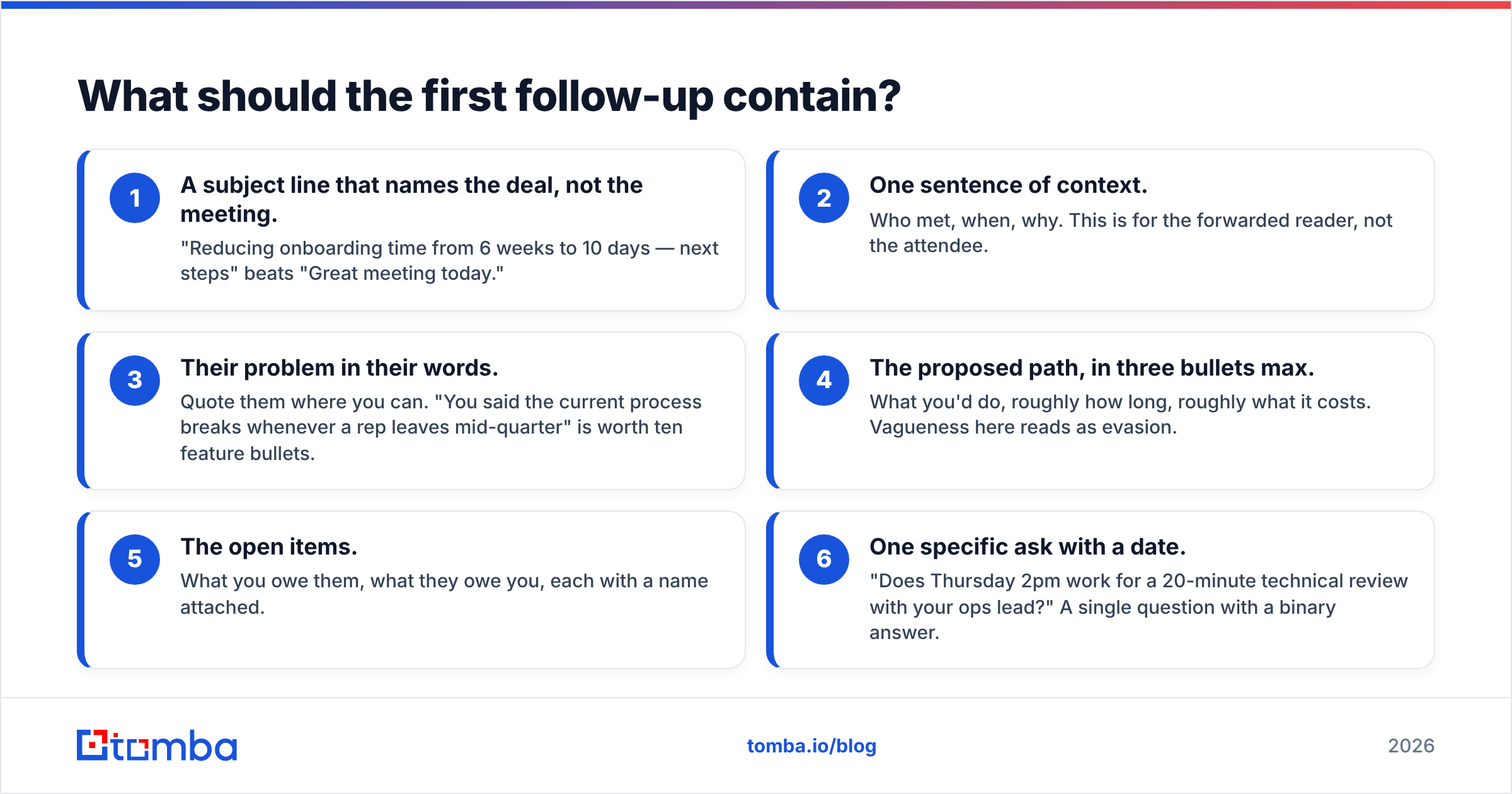
The 24-hour email is the one that matters most. Build it from these six components, in this order:
- A subject line that names the deal, not the meeting. "Reducing onboarding time from 6 weeks to 10 days — next steps" beats "Great meeting today."
- One sentence of context. Who met, when, why. This is for the forwarded reader, not the attendee.
- Their problem in their words. Quote them where you can. "You said the current process breaks whenever a rep leaves mid-quarter" is worth ten feature bullets.
- The proposed path, in three bullets max. What you'd do, roughly how long, roughly what it costs. Vagueness here reads as evasion.
- The open items. What you owe them, what they owe you, each with a name attached.
- One specific ask with a date. "Does Thursday 2pm work for a 20-minute technical review with your ops lead?" A single question with a binary answer.
Keep the whole thing under 200 words. If your recap needs more space, the pitch itself was unfocused, and a longer email won't fix that.
Which follow-up templates actually get replies?#
Copy these, then rewrite them in your own voice. A template you paste verbatim reads like a template.
Template 1 — The 24-hour recap
Subject: Cutting onboarding from 6 weeks to 10 days — next steps

Priya — thanks for the time today. Recapping for you and anyone
you forward this to:

The problem you described: every new rep takes ~6 weeks to
productivity, and the handover breaks when someone leaves
mid-quarter.

What we'd do: automate the data handoff (2 weeks to deploy),
run it in parallel with your current process for one cycle,
then cut over. Roughly $X/mo at your seat count.

Open items:
- Me: security questionnaire to you by Wednesday
- You: confirm whether Marcus needs to approve the data flow

Does Thursday 2pm work for a 20-minute technical review?
Template 2 — The owed answer (day 3)
Subject: Re: Cutting onboarding — the SOC 2 question

You asked whether we cover subprocessor disclosure. We do —
full list is in section 4 of the attached report, updated in
March.

Anything else blocking the technical review?
Template 3 — The relevant proof point (day 7)
Subject: How a 40-person ops team did this in 3 weeks

Not a pitch — this is the closest situation to yours I've seen.
Same team size, same mid-quarter handover problem. They cut
ramp time to 11 days and kept it there for two quarters.

Two paragraphs, no gate: [link]

Worth 15 minutes with your ops lead?
Template 4 — The multi-thread (day 12)
Subject: Intro to your ops lead?

Priya — my read is this needs a technical yes before it can
get a budget yes. Would you forward the note below to whoever
owns the handover process?

---
Hi — Priya and I met last week about the onboarding handover.
Short version: we automate the data transfer so a rep leaving
mid-quarter doesn't reset the clock. 20 minutes to show you
how it maps to your stack?
---
Template 5 — The value-add, no ask
Subject: The benchmark you asked about

The ramp-time number you wanted: median is 5.4 weeks for teams
your size, top quartile is under 3.

No ask here — figured it was useful for your Q3 planning either
way.
Template 6 — The deadline anchor
Subject: Your Aug 14 budget review

You mentioned budget gets reviewed on the 14th. If this is
going in that cycle, I'd need to get you a signed-off scope by
the 11th.

Want me to build it, or should we look at the next cycle?
Template 7 — The clean break (day 21)
Subject: Closing the loop

Priya — I'll assume this isn't a priority right now and stop
filling your inbox.

If that's wrong, one word back and I'll pick it up. If it's
right, when should I check in — Q4?
The clean break gets more replies than any other template in the sequence. People answer it because it costs them nothing and ends the discomfort.
How do post-pitch follow-up channels compare?#
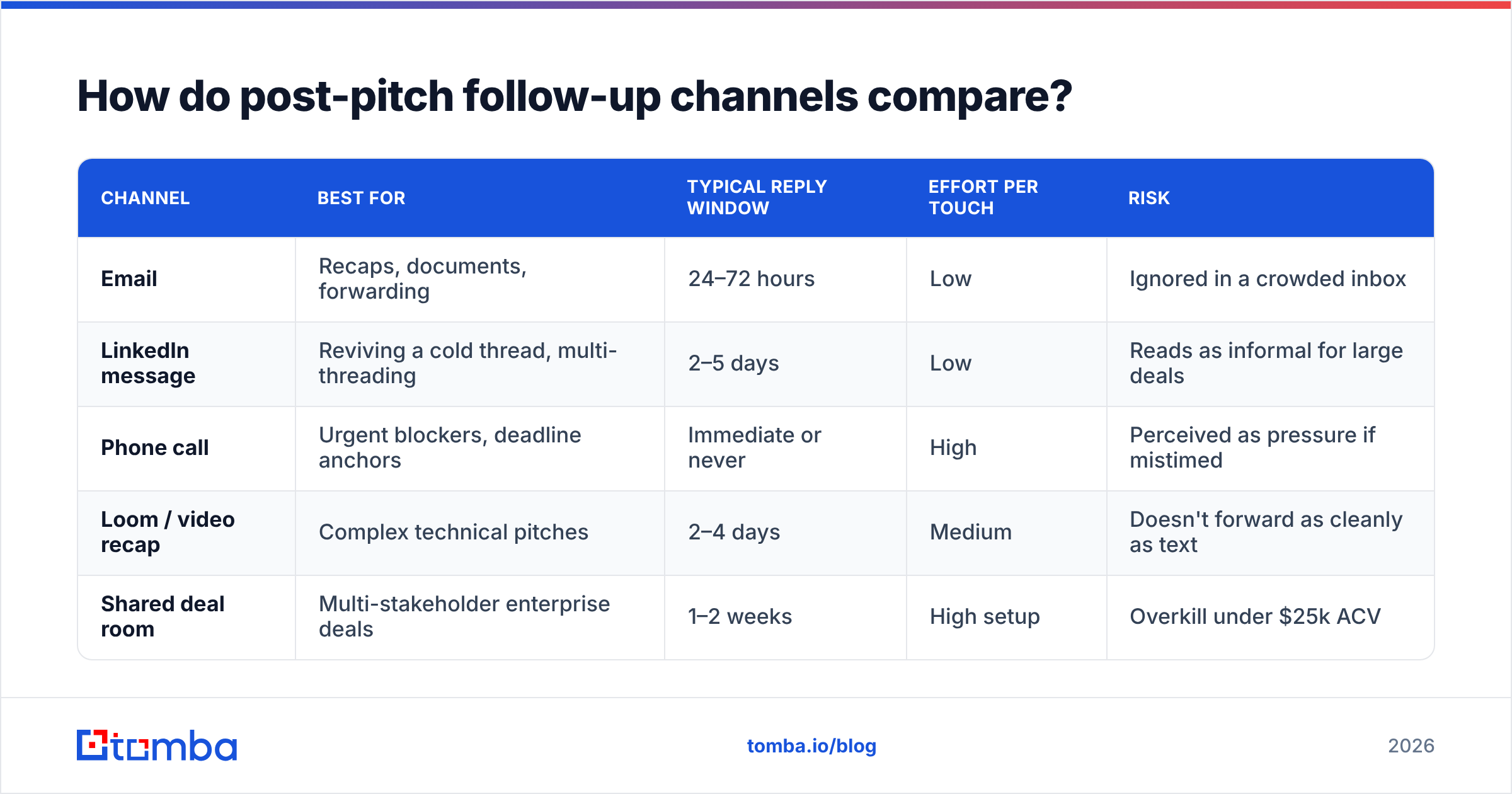
Email is the default, but it isn't the only channel, and mixing them raises reply rates without raising annoyance. Here's the honest comparison:
| Channel | Best for | Typical reply window | Effort per touch | Risk |
|---|---|---|---|---|
| Recaps, documents, forwarding | 24–72 hours | Low | Ignored in a crowded inbox | |
| LinkedIn message | Reviving a cold thread, multi-threading | 2–5 days | Low | Reads as informal for large deals |
| Phone call | Urgent blockers, deadline anchors | Immediate or never | High | Perceived as pressure if mistimed |
| Loom / video recap | Complex technical pitches | 2–4 days | Medium | Doesn't forward as cleanly as text |
| Shared deal room | Multi-stakeholder enterprise deals | 1–2 weeks | High setup | Overkill under $25k ACV |
The practical combination for most B2B deals: email for touches 1, 2, 3, and 5; LinkedIn outreach or a call for touch 4 when you're trying to reach someone who never agreed to hear from you. If you need direct dials for that call, a phone finder beats guessing at the switchboard.
How many follow-ups are too many?#
Five is the working number for a single pitch cycle. Not because five is magic, but because by touch five you've either had a reply, earned a soft no, or confirmed the deal was never real.
The wrong question is "how many." The right question is "how many with new information." A rep who sends eight emails, each with a genuinely useful data point, an answer, or a relevant customer story, will out-perform a rep who sends three that all say "following up on my last note." Volume isn't the irritant — repetition is.
Three signals tell you to stop early:
- Hard no with a reason. Take it, thank them, ask when to revisit. Don't argue.
- Bounce or hard silence across all channels. Check whether they left the company before you assume they're ignoring you — a reverse email lookup resolves this in seconds and often surfaces the replacement.
- They ghosted after a proposal. This is usually an internal problem — budget pulled, priority shifted, champion overruled. Touch five (the clean break) is the right move, not touch six.
And three that say keep going: they opened the deck three times, they forwarded your email to someone new, or they asked a pricing question. Any of those means the deal is alive and slow, which is the normal state of B2B deals.
How do you keep your follow-up data clean enough to matter?#
Follow-up copy is downstream of contact data. You can write the best day-12 multi-thread email in your category and have it die because you guessed marcus.chen@ when the company uses mchen@.
Three habits keep this from happening:
- Build the buying committee before you need it. Right after the pitch, map who else touches the decision. Use domain search to pull the confirmed email pattern and the people in the relevant departments, rather than permutating addresses by hand.
- Verify before every new-contact send. New contacts added mid-cycle are the highest-bounce-risk sends you make. Batch them through bulk verify before the touch goes out.
- Log everything to the CRM the same day. Salesforce, HubSpot, Pipedrive — the tool matters less than the discipline. If a follow-up isn't logged, the next rep to touch the account repeats your touch one and burns the relationship. Vendor guidance from Salesforce on activity capture is worth reading if you're setting this up from scratch.
None of this is glamorous. It's also the difference between a sequence that reaches the buying committee and one that reaches the spam folder.
Start with contacts that actually resolve#
Your follow-up sequence is only as good as the addresses it reaches. Before you send touch four to the ops lead you've never met, confirm the address is real. Tomba's Email Finder resolves professional emails by name and domain, with confidence scoring and verification built in — free tier covers 25 searches a month, and paid plans start at $49/mo on Tomba pricing if you're running committee-wide outreach at volume.
Write the recap the same day. Verify the committee before touch four. Send the clean break on day 21. That's the whole system.
Related guides#
Ready to find emails that actually work?
Join 150,000+ professionals who stopped guessing and started sending. Free credits on signup — no credit card required.
Get the Tomba newsletter
Practical outbound tactics and product updates — once every two weeks.
About the author