Follow Up Letter After No Response: 9 Templates That Work
Silence is not rejection — it is usually bad timing, a bad address, or a follow-up that added nothing new. Here are the cadences, angles, and 9 copy-paste templates that actually pull replies in 2026.
TL;DR
- A follow up letter after no response works when it carries new information, not new pressure. "Just bumping this up" is the single most ignored sentence in B2B.
- Three to five touches spread over 12–21 days captures most of the replies you will ever get. Touch 1 is not where the money is.
- Before you blame your copy, check the address. A meaningful share of "no response" is actually no delivery — bounced, catch-all black-holed, or filtered.
- Different silences need different letters: the ghosted proposal, the cold prospect, the post-interview candidate, and the unpaid invoice each need a distinct angle.
- Nine templates below, each with the trigger, the timing, and the exact line that earns the reply.
What is a follow up letter after no response?#
A follow up letter after no response is any written message — email, LinkedIn note, or a genuine printed letter — sent because your previous message went unanswered. That is the boring definition. The useful definition is narrower: it is a second attempt at relevance, not a second attempt at the same message.
Think of it like knocking on a door. The first knock says "someone is here." Knocking harder does not make the person inside more likely to open. Standing at a different window, holding something they asked for, does. Most follow-ups fail because they are just a louder knock.
Silence in B2B almost never means "no." Sales research consistently shows most closed deals take five or more touches, while the majority of reps stop after two. The gap between those two numbers is where a well-built follow-up sequence earns its keep. HubSpot's sales blog has been publishing versions of that stat for a decade and it has not moved much, which tells you the behaviour has not changed either.
Why did they not respond in the first place?#
Before you write anything, diagnose. There are only five real causes of silence, and each one implies a different letter.
- It never arrived. Wrong address, hard bounce, spam folder, or a catch-all domain that accepts everything and delivers nothing. No copy fixes this.
- Wrong person. You reached someone with no budget, no pain, and no reason to forward it. Your follow-up should ask for a referral, not a meeting.
- Bad timing. They were mid-quarter, mid-migration, or on leave. The message was fine; the week was not.
- No clear next step. You asked for "thoughts" or "15 minutes sometime." Vague asks get vague results, which is silence.
- Genuinely not interested. They read it, filed it, moved on. Your follow-up should make leaving easy — which, counterintuitively, is what pulls the most replies.
Cause 1 deserves special attention because it is invisible. You cannot tell the difference between "ignored" and "never received" from your outbox. Running your list through an email verifier before a sequence starts removes an entire category of false silence, and a catch-all verifier handles the domains that accept every address and quietly discard most of them.
How many follow up letters should you send, and when?#
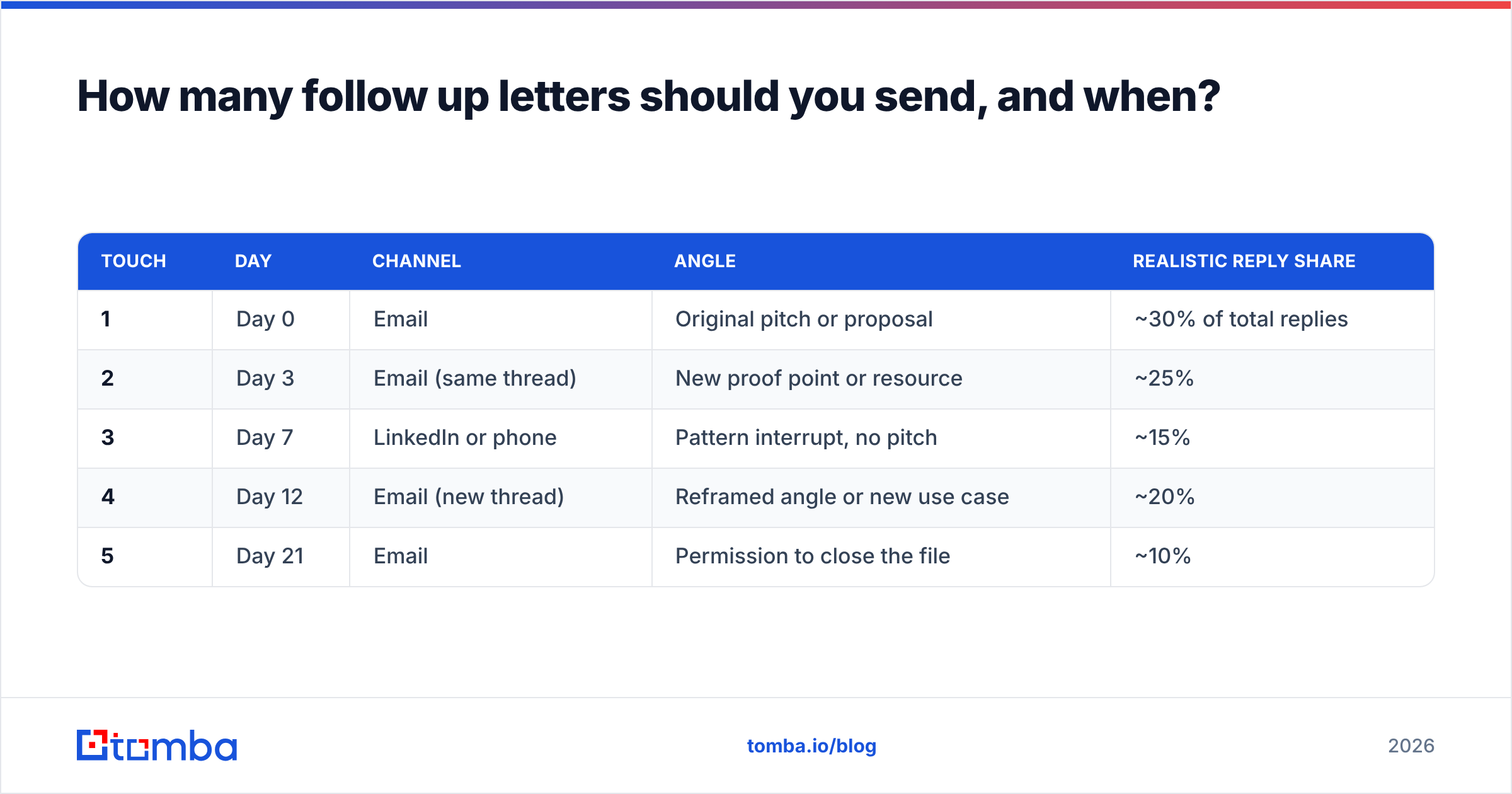
Here is a cadence that holds up across cold outbound, warm proposals, and stalled deals. Adjust the channel mix, keep the spacing.
| Touch | Day | Channel | Angle | Realistic reply share |
|---|---|---|---|---|
| 1 | Day 0 | Original pitch or proposal | ~30% of total replies | |
| 2 | Day 3 | Email (same thread) | New proof point or resource | ~25% |
| 3 | Day 7 | LinkedIn or phone | Pattern interrupt, no pitch | ~15% |
| 4 | Day 12 | Email (new thread) | Reframed angle or new use case | ~20% |
| 5 | Day 21 | Permission to close the file | ~10% |
Two things matter more than the exact days. First, spacing widens as the sequence goes on — day 3, then 4 days, then 5, then 9. Compressed follow-ups read as desperation. Second, touch 3 changes channel. If email is not landing, sending more email tests the same broken hypothesis. A LinkedIn note or a call at that point is a genuine new experiment, and it also tells you whether the problem was deliverability all along.
Past five touches you are into diminishing returns for cold prospects. For warm, in-flight deals where the person already said "send me a proposal," keep going — that silence is almost always internal chaos on their side, not disinterest.
What does a good follow up letter look like?#
Every follow-up that reliably works has the same skeleton. Five parts, in this order:
- A context anchor (one line). Remind them who you are without a paragraph of history. "Following up on the migration audit I sent Tuesday" is enough. Never open with "I know you're busy" — everyone is, and it signals apology.
- Something genuinely new. A customer result, a competitor move, a relevant article, a shortened scope, a lower-commitment option. If you cannot name the new thing in one sentence, you are not ready to send.
- A reason it matters to them specifically. Tie the new thing to their stack, their headcount, their funding round, their hiring page. Generic relevance reads as automation.
- One ask, with a binary answer. "Worth a look?" beats "let me know your thoughts." "Should I send the two-page version or drop it?" beats "when are you free?"
- An exit. One clean sentence that lets them say no without friction. This is the highest-ROI line in the whole letter and most people delete it out of fear.
Keep the whole thing under 90 words for touches 2 through 4. The final touch can be shorter still — three sentences is plenty.
Which follow up angle works best after no response?#
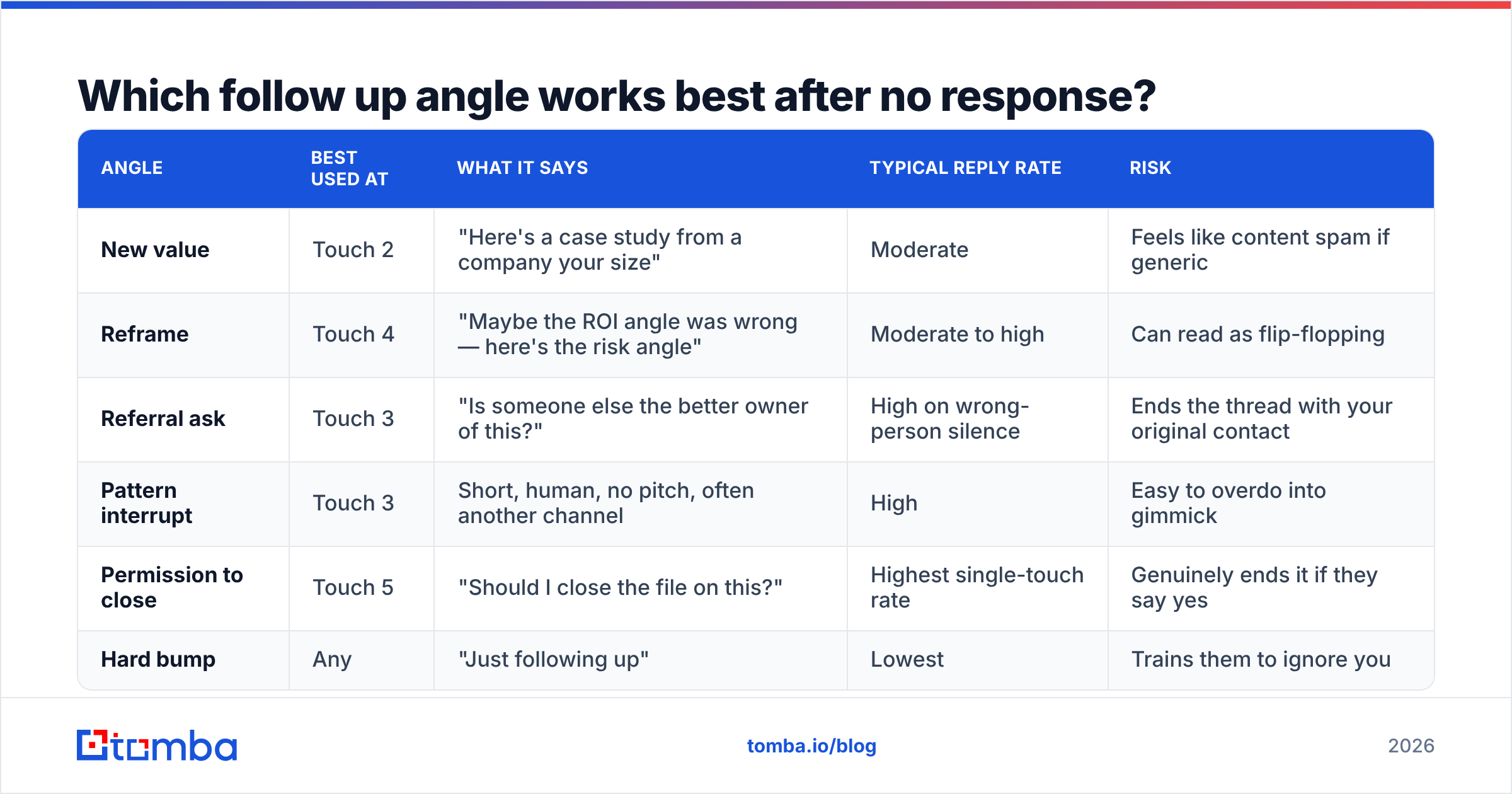
Not all follow-ups do the same job. Pick the angle that matches the silence you are dealing with.
| Angle | Best used at | What it says | Typical reply rate | Risk |
|---|---|---|---|---|
| New value | Touch 2 | "Here's a case study from a company your size" | Moderate | Feels like content spam if generic |
| Reframe | Touch 4 | "Maybe the ROI angle was wrong — here's the risk angle" | Moderate to high | Can read as flip-flopping |
| Referral ask | Touch 3 | "Is someone else the better owner of this?" | High on wrong-person silence | Ends the thread with your original contact |
| Pattern interrupt | Touch 3 | Short, human, no pitch, often another channel | High | Easy to overdo into gimmick |
| Permission to close | Touch 5 | "Should I close the file on this?" | Highest single-touch rate | Genuinely ends it if they say yes |
| Hard bump | Any | "Just following up" | Lowest | Trains them to ignore you |
The "permission to close" letter is the strange one. It regularly outperforms every other touch in a sequence, because it removes the social cost of saying no and triggers loss aversion at the same time. Use it once, mean it, and actually close the file when they take the exit.
What are the best follow up letter templates after no response?#
Nine templates, grouped by situation. Swap the brackets, keep the structure.
1. Cold prospect, touch 2 (new value)
Subject: re: [their company] + [your topic]
[Name] — sending one thing that's more useful than my last email: [Competitor/peer company] cut [metric] by [number] using the approach I mentioned. Two-page breakdown here if useful.
Worth a look, or wrong time?
2. Cold prospect, touch 3 (pattern interrupt)
Subject: quick one
[Name] — noticed you're hiring [role]. Usually means [inference about their priority]. If that's on your plate this quarter, my last email is relevant. If not, I'll stop.
3. Cold prospect, touch 5 (permission to close)
Subject: closing the loop
[Name] — I've sent a few notes about [topic] and haven't heard back, which usually means it isn't a priority. I'll close the file unless you tell me otherwise. No hard feelings either way.
4. Ghosted proposal
Subject: re: [project name] proposal
[Name] — checking whether the proposal is stuck on scope, budget, or timing. If it's scope, I can send a smaller phase-one version at [lower number]. If it's timing, tell me the month and I'll disappear until then.
5. Wrong person / referral ask
Subject: right person for [topic]?
[Name] — my last note may have landed in the wrong inbox. Who owns [specific function] at [company]? Happy to take it off your plate with one intro.
6. After a meeting that went quiet
Subject: re: [date] call
[Name] — on our call you flagged [specific concern]. I put together the answer here: [one line summary]. Does that unblock it, or is something else in the way?
7. Post-interview candidate follow-up
Subject: re: [role] interview — [your name]
[Hiring manager] — following up on our [day] conversation about [role]. Since then I [relevant new thing: shipped X, finished Y cert]. Still very interested. Is the timeline still [what they told you]?
8. Unpaid invoice
Subject: invoice [number] — [amount] outstanding
Hi [Name] — invoice [number] for [amount] was due [date] and I haven't seen payment or a bounce-back. Copy attached. If it's stuck in approvals, tell me who to chase and I'll handle it from here.
9. Long-dormant lead, reopened months later
Subject: [trigger event] made me think of you
[Name] — you passed on this last [season] because of [their stated reason]. [Trigger: funding, new hire, product launch, regulation] changed that assumption. Worth a second look, or still a no?
Notice that not one of these contains the words "just following up," "circling back," or "bumping this to the top of your inbox." Those phrases announce that the message contains nothing new. If you want a broader library to work from, our cold email templates collection covers the first-touch side of the same sequences.
Should you send an actual printed letter?#
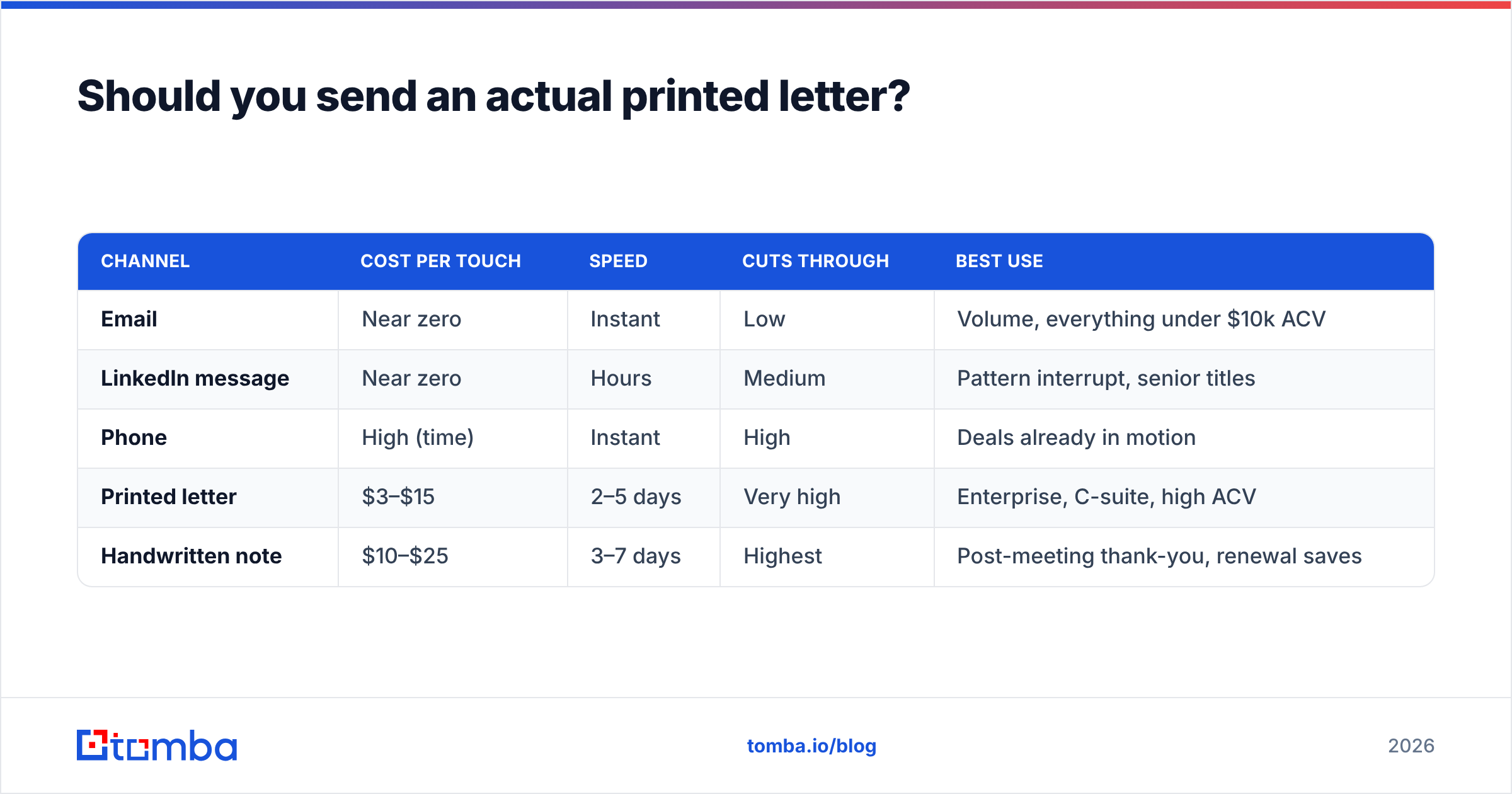
Sometimes — and it is more effective than most people assume, precisely because so few do it.
| Channel | Cost per touch | Speed | Cuts through | Best use |
|---|---|---|---|---|
| Near zero | Instant | Low | Volume, everything under $10k ACV | |
| LinkedIn message | Near zero | Hours | Medium | Pattern interrupt, senior titles |
| Phone | High (time) | Instant | High | Deals already in motion |
| Printed letter | $3–$15 | 2–5 days | Very high | Enterprise, C-suite, high ACV |
| Handwritten note | $10–$25 | 3–7 days | Highest | Post-meeting thank-you, renewal saves |
Physical mail makes sense when the deal size justifies it and the inbox is genuinely saturated — think VP and above at companies with more than 500 employees. Keep it to half a page, reference something specific and verifiable, and include one clear way to respond. Do not laminate anything. Do not send a gift with strings attached; procurement policies at large firms often prohibit it and it puts your contact in an awkward spot.
For everything else, email remains the correct default. It is measurable, it threads, and — critically — it is the only channel where you can verify whether the message was actually deliverable before you send it.
How do you know your follow up letter even arrived?#
This is where a lot of "my follow-ups don't work" problems actually live. Three checks, in order:
- Address validity. Confirm the mailbox exists before touch 1. Guessing patterns like first.last@ is fine as a hypothesis, but sending to an unverified guess burns your domain reputation with every bounce. A domain search surfaces the real address formats a company uses, which beats permutation guessing outright.
- Catch-all handling. Some domains accept every address at the gateway and drop the invalid ones silently. Those look like deliveries in your ESP and like silence in your inbox. Treat catch-all contacts as a separate, lower-confidence segment.
- Sender health. SPF, DKIM, DMARC, sending volume, and complaint rate all feed into whether your follow-up lands in the inbox or the promotions tab. Understanding your email deliverability baseline tells you whether a low response rate is a copy problem or an infrastructure problem.
One practical rule: if your reply rate is under 1% across hundreds of sends and your bounce rate is above 3%, stop rewriting copy. You have a data problem, not a writing problem. Fix the list, then A/B the letters.
Also worth knowing where the legal lines sit. In the US, the CAN-SPAM Act requires an accurate sender identity, a real physical address, and a working opt-out on commercial email — follow-ups included. GDPR adds a legitimate-interest test for EU contacts. Compliance is not optional and it costs you nothing in reply rate.
What mistakes kill follow up letters after no response?#
- Guilt-tripping. "I've reached out three times now" makes their silence the subject of the email. Never make the follow-up about you.
- Restating the original message. If they did not want it on Tuesday, they do not want the same words on Friday.
- Multiple asks. One question, one answer. Two questions gets zero.
- Sending at the same time every day. Vary send times across the sequence; a message that landed at 3am local time never had a chance.
- Breaking the thread when you should keep it, and keeping it when you should break it. Touches 2 and 3 belong in the original thread for context. Touch 4 — the reframe — deserves a fresh subject line, because the old thread now carries the memory of being ignored.
- Never stopping. If you say you will close the file, close the file. Reputation compounds, and the person who respected a no is the person who gets the meeting eighteen months later.
- Automating personalisation badly. "Hi {{FirstName}}" rendered literally, or a merge field pointing at the wrong company, ends the relationship faster than silence ever would. Compare tools on G2's sales engagement category before you trust one with your sequences.
How should you measure whether your follow ups are working?#
Track four numbers per sequence, not one:
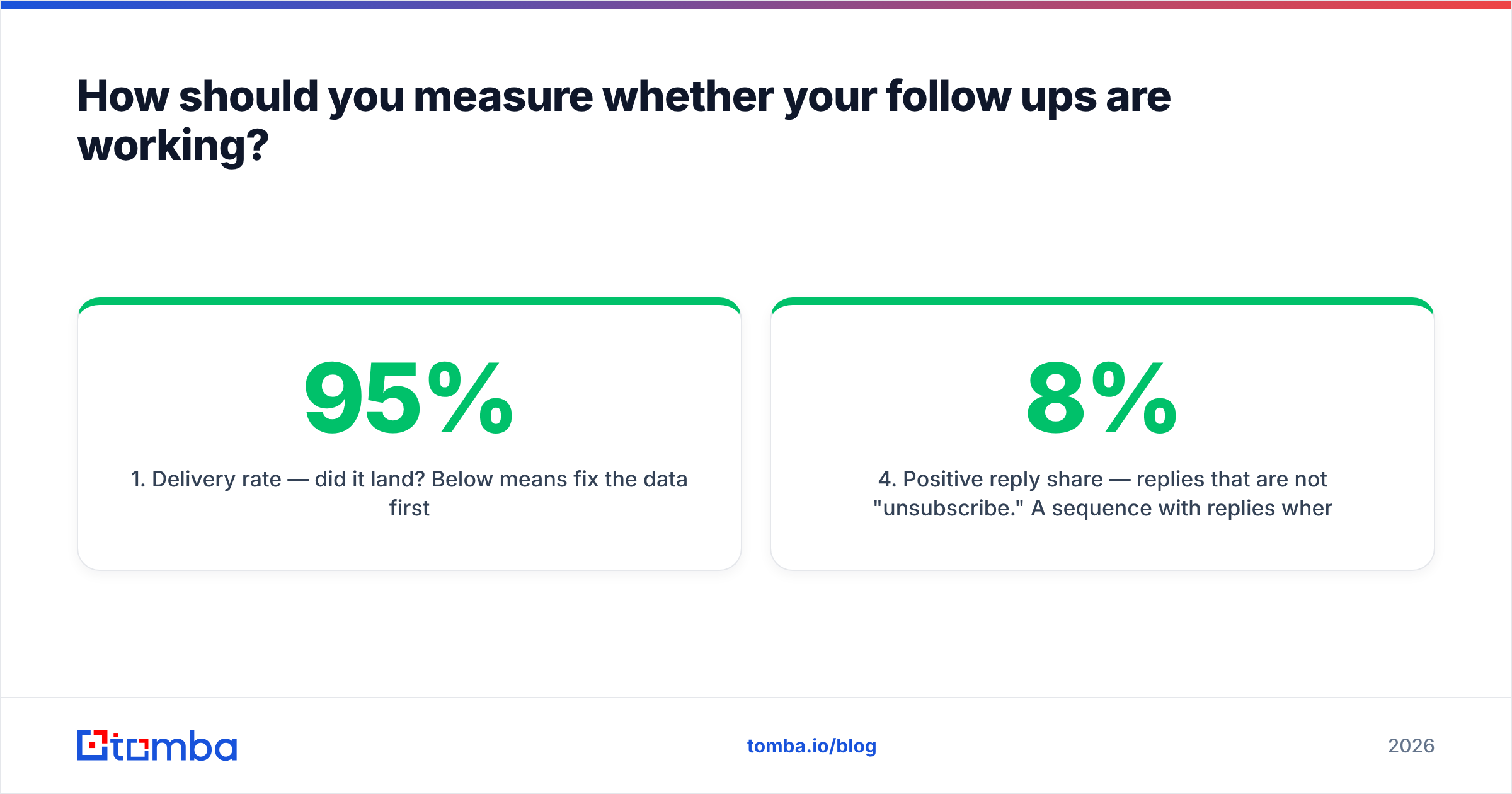
- Delivery rate — did it land? Below 95% means fix the data first.
- Open rate — flawed since Apple Mail Privacy Protection, but directional across a large sample.
- Reply rate by touch — this tells you which letter in the sequence is dead weight. If touch 3 pulls nothing across 200 sends, replace the angle, not the subject line.
- Positive reply share — replies that are not "unsubscribe." A sequence with 8% replies where six of those points are negative is worse than one with 4% replies that are all curious.
Run one variable at a time. Changing the subject line, the angle, and the send day simultaneously teaches you nothing.
Start with an address that actually exists#
The best follow up letter after no response is the one that reaches a real, verified inbox belonging to the person who owns the decision. Everything above — the cadence, the angles, the nine templates — assumes that part is already solved.
If you are not sure it is, start there. The Tomba Email Finder locates verified professional addresses by name, company, or domain, so your sequence starts with contacts that exist instead of pattern guesses that bounce. The free tier gives you 25 searches a month to test your list quality before committing; paid plans start at $49/mo. Check the full Tomba pricing if you are running volume.
Fix the data, then send the letter that adds something new. That combination is what turns silence into a calendar invite.
Related guides#
Ready to find emails that actually work?
Join 150,000+ professionals who stopped guessing and started sending. Free credits on signup — no credit card required.
Get the Tomba newsletter
Practical outbound tactics and product updates — once every two weeks.
About the author