Forager Reviews (2026): Data Accuracy, Pricing & Real Limits
An independent look at Forager.ai in 2026: how fresh the contact data really is, what the quote-based pricing hides, where it beats Apollo and RocketReach, and when a cheaper email finder does the same job.
TL;DR
- Forager.ai sells B2B contact data. It ships fresh profile data through an API, bulk files, and enrichment on your own records. It is a data feed, not a search box.
- The best reason to buy it is refresh speed on job changes. The worst part is the buying flow. Pricing is quote-led, so you cannot check cost per contact up front.
- Most Forager reviews come from data and RevOps buyers, not sales reps. That skews the scores toward API use. It says little about daily prospecting.
- Need work emails for a list of people? A self-serve email finder costs less. Tomba starts at $49/mo, free tier included.
- Verdict: a strong fit for data teams at volume. Too big and too costly for a 3-person sales team that needs 2,000 emails a month.
What is Forager and who is it actually for?#
Forager.ai (forager.ai) is a B2B data provider. It collects profile data on people and companies. That covers titles, job changes, and contact details. You can take it three ways: bulk files, an API, or enrichment on your own records.
That framing matters more than any feature list. Forager competes with data vendors, not with browser plugins for sales reps. Its pitch is refresh speed. The company re-crawls profiles often. So a contact who moved jobs last month gets flagged as changed. He does not sit stale in your CRM for three quarters.
Three buyer types show up again and again in Forager reviews:
- Data and RevOps teams that build an in-house enrichment layer. They want an API, a schema, and steady coverage. They do not want a UI.
- Recruiting and talent tools that need people data at scale. For them, contact info is one field among thirty.
- Sales teams that chase job-change triggers. Here, "this VP just moved" is the buy signal itself.
Are you none of those three? Then a comparison page likely put Forager next to tools you meant to check. That mix-up is common and costly. Sorting it out is the main job of this review.
What do Forager reviews say about data accuracy?#
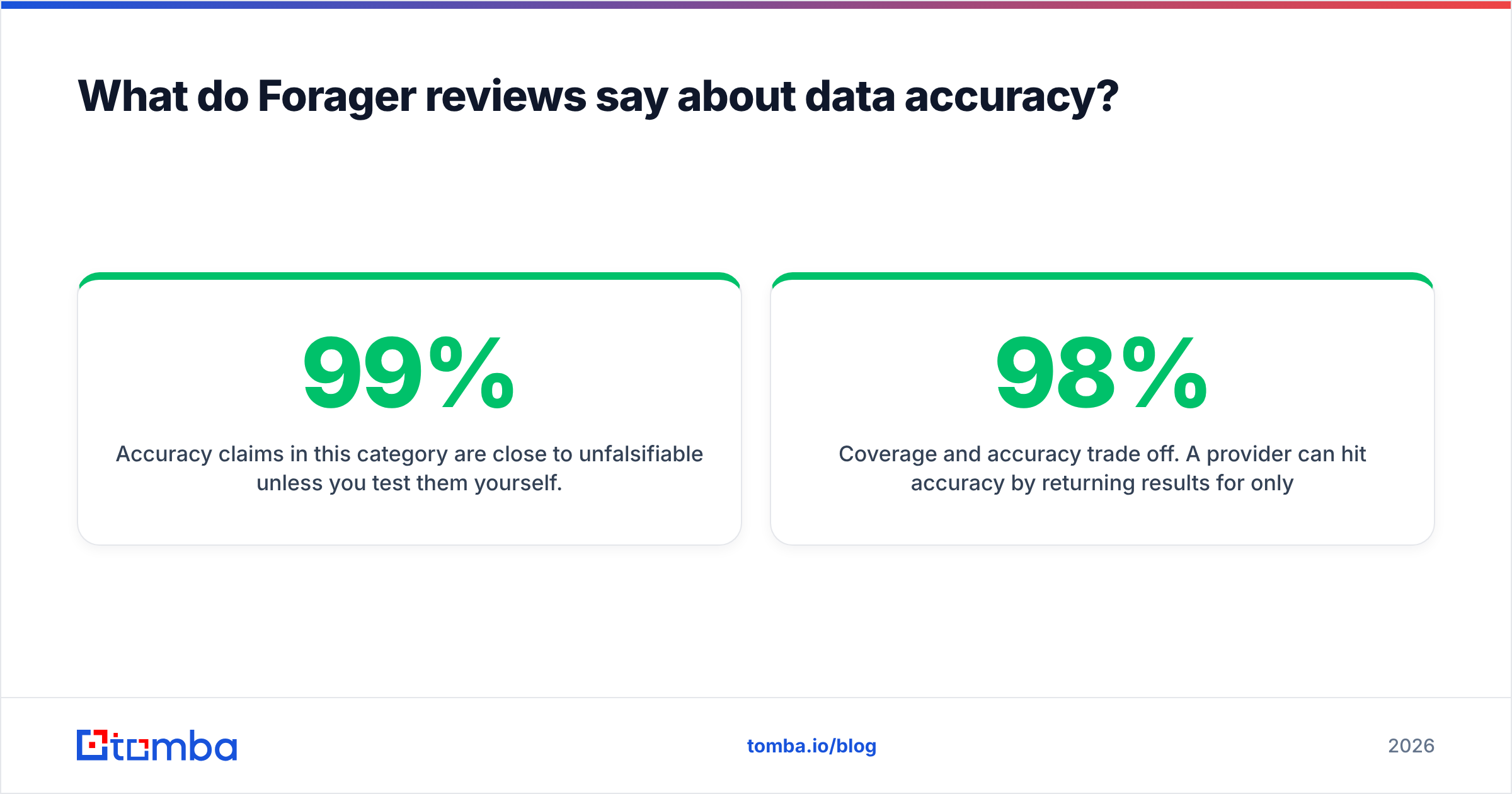
Accuracy claims here are hard to test unless you run the test yourself. Every vendor quotes a number between 95% and 99%. Every vendor also picks the yardstick. Forager is no different.
Its pitch leans on fresh data and repeat checks. Public reviews on G2 and Capterra back that up. The data does read as current. Dead records come up less than with older database vendors.
Reviewers agree far less on email accuracy. That is not the same thing as a fresh profile, and most Forager reviews never test it. A record can be right in every way. Right person, right firm, right title, updated last week. The email can still bounce. Maybe the firm changed its format. Maybe no one ever checked the mailbox.

Here is how to read any accuracy claim, Forager's included:
- "Verified" is a date, not a state. An email checked 90 days ago is not checked today. Ask when the last SMTP test ran.
- Catch-all domains lift every score. If a domain takes all mail, a basic tool marks it valid. About a fifth of large firms work this way. That is where bounces hide. A catch-all verifier is what tells "fine" from "will bounce."
- Coverage and accuracy trade off. A tool can hit 98% by answering only the easy 40% of your list. Track hit rate and bounce rate on the same file.
- Test on your own market. Vendor tests lean on US tech firms, where everyone looks good. Run 500 rows from your real segment. Regional, non-English, under 200 staff. The gaps get wide fast.
Run that test before you sign, not after. A vendor sure of its data will hand you a trial file. If the answer is "only after signature," that is your data point.
How much does Forager cost in 2026?#
This is where most Forager reviews go quiet. It is also the top gripe in them.
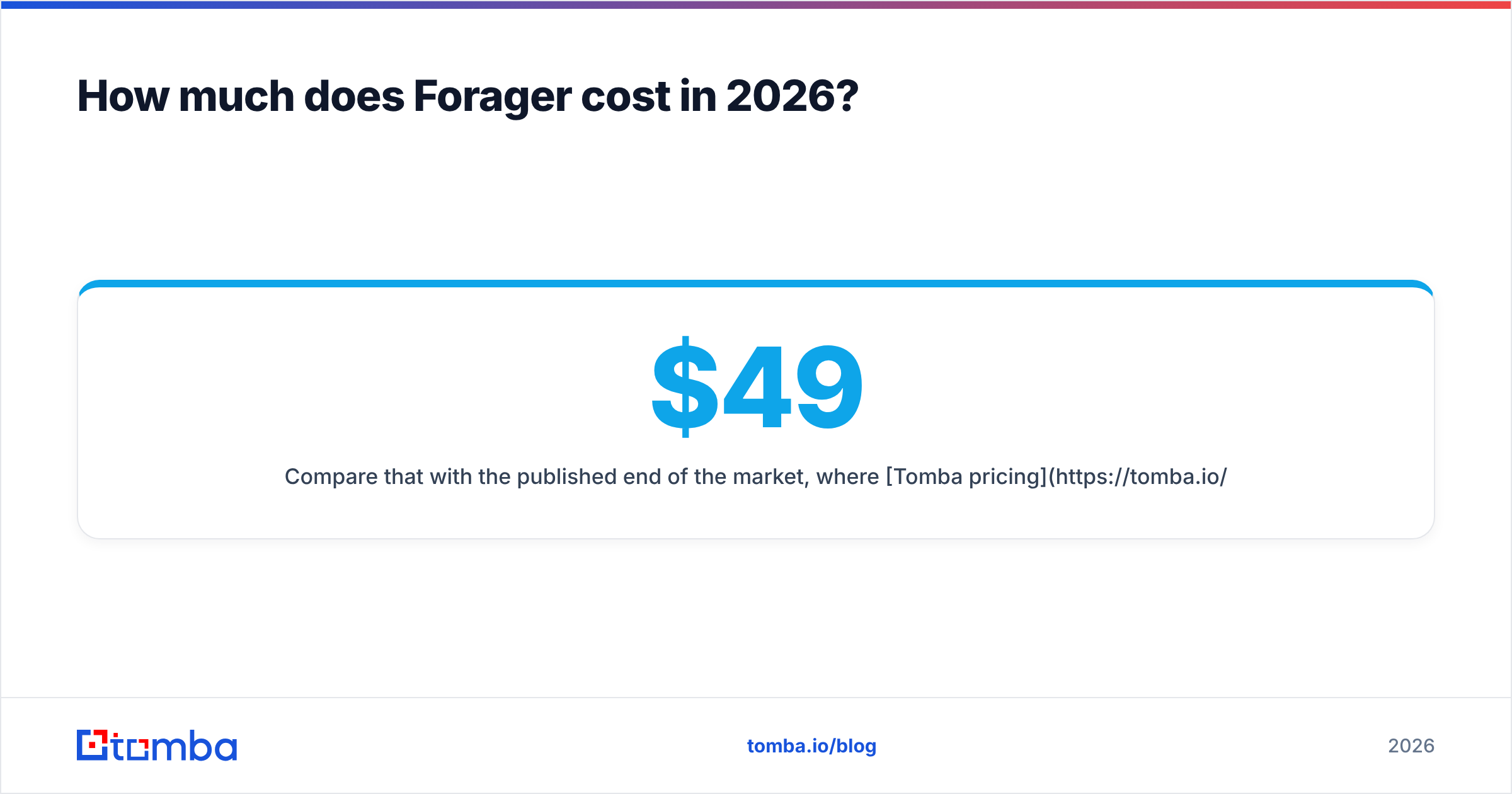
Forager does not post self-serve price tiers today. Email tools do. Forager quotes each deal instead. Price scales with record volume, delivery method, and refresh rate. Yearly terms are the norm for file access. Check current terms with the vendor. Quote-led pricing moves with no changelog.
Quote-led pricing is not bad by default. For a 500k-record feed, a yearly contract is the right shape. No credit-based page would model that well. But it costs a small buyer three things:
- You cannot buy on your own. Expect a discovery call, a scoping call, and a security review before you see a price.
- You cannot compare cost per verified contact against public rivals until you are deep in the funnel.
- You buy for a year. That is a poor fit if your volume swings, or if you are still testing a segment.
Now look at the open end of the market. Tomba pricing runs Free (25 searches/mo), Starter $49/mo, Growth $99/mo, Pro $249/mo, and Enterprise custom. You can model those in a sheet before you talk to anyone.
How does Forager compare to other contact data tools?#
The right question is not "which tool is best." It is "which layer am I buying." Forager sits at the data layer. Most Forager reviews line it up against tools from the sales layer instead.

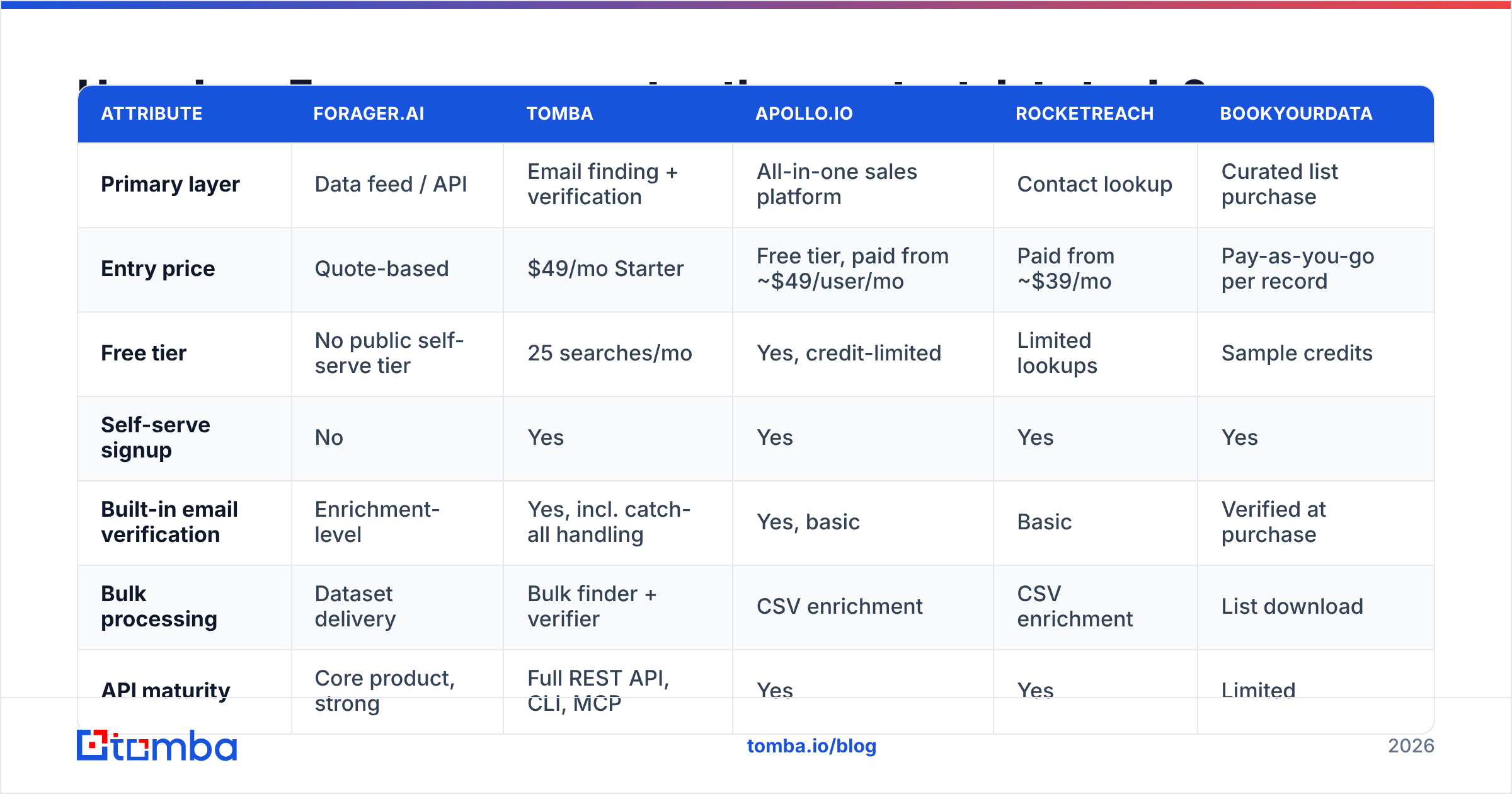
| Attribute | Forager.ai | Tomba | Apollo.io | RocketReach | BookYourData |
|---|---|---|---|---|---|
| Primary layer | Data feed / API | Email finding + verification | All-in-one sales platform | Contact lookup | Curated list purchase |
| Entry price | Quote-based | $49/mo Starter | Free tier, paid from ~$49/user/mo | Paid from ~$39/mo | Pay-as-you-go per record |
| Free tier | No public self-serve tier | 25 searches/mo | Yes, credit-limited | Limited lookups | Sample credits |
| Self-serve signup | No | Yes | Yes | Yes | Yes |
| Built-in email verification | Enrichment-level | Yes, incl. catch-all handling | Yes, basic | Basic | Verified at purchase |
| Bulk processing | Dataset delivery | Bulk finder + verifier | CSV enrichment | CSV enrichment | List download |
| API maturity | Core product, strong | Full REST API, CLI, MCP | Yes | Yes | Limited |
| Best for | Data teams, job-change triggers | Outbound teams needing verified emails cheaply | Teams wanting sequences + data in one seat | Ad-hoc individual lookups | Buying a defined segment outright |
| Contract | Typically annual | Monthly or annual | Monthly or annual | Monthly | Per purchase |
Read that table as a routing map, not a score. BookYourData wins when you know your segment and want to own the list. Apollo wins when you want data and sequences in one seat. You trade some data quality for that ease. Forager wins when contact data feeds a system you build. Tomba wins when the job is narrow and repeats: turn names and domains into emails that land, at a price you can predict.
What are the real limits reported in Forager reviews?#
Every honest review needs the part the sales page leaves out. Four themes repeat across public Forager reviews and buyer calls:
- Setup is a project, not a signup. Field mapping and match logic take dev hours. Plan for a sprint, not an evening.
- Coverage thins outside core markets. Profile data is richest in US and West European tech. It is thinner in small firms, trades, and non-English markets.
- Email still needs a second pass. Fresh profile data does not mean the mailbox takes mail today. Pipe records straight into a sequencer and bounces climb. Add an email verifier step first. Bounce rate is what hurts sender reputation, not data age.
- Price secrecy slows the buy. You need to compare three vendors this quarter. Two calls before a number is a handicap.
None of this rules Forager out. It is the normal cost of buying at the data layer. It does rule it out if you thought you were buying a sales tool.
Is Forager worth it for your team?#
Use these five checks. Public Forager reviews will not answer them for you. Three or more yes answers make Forager a real finalist. Fewer than three, and you are in the wrong aisle.
- Do you have dev time? Someone must own the setup, the schema, and the match logic. If the answer is "our sales lead will work it out," stop here.
- Is volume above 100k records a year? Below that, per-credit pricing usually wins on unit cost.
- Are job changes a real trigger for you? This is Forager's sharpest edge. If you do not act on those events, you pay for speed you never use.
- Do you need more than email? Titles, tenure, seniority, firm data. If email is 90% of the need, you are buying a warehouse for one box.
- Can you commit for a year? Quote-led vendors price around commitment. A quarterly budget will fight you.
Clear that bar and Forager is a solid pick with a real edge. For everyone else, and that is most sales teams, the boring path wins. Buy a focused email finder. Verify before you send. Spend the savings on more sending domains.
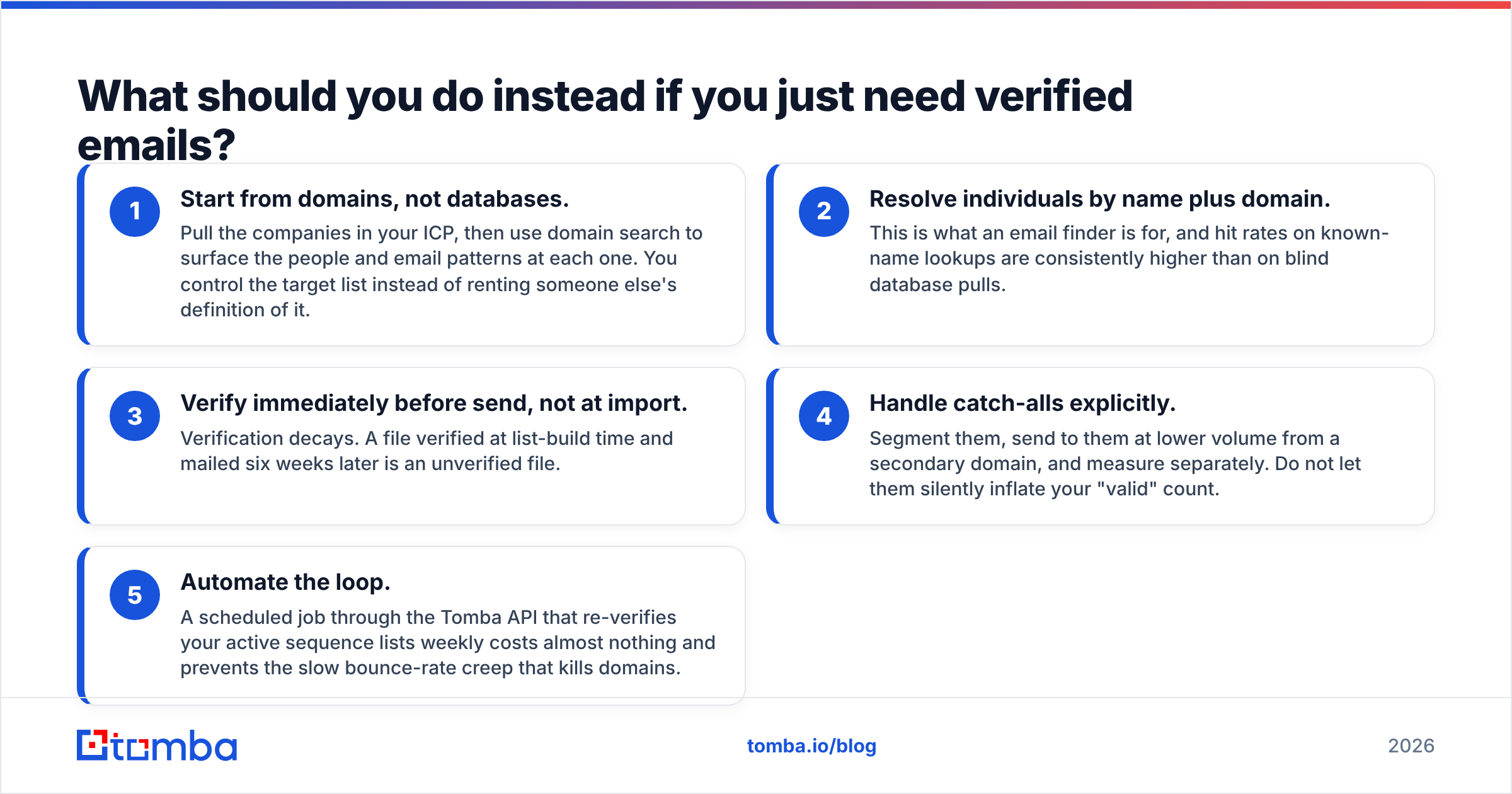
What should you do instead if you just need verified emails?#
Run the narrow workflow. It is cheaper and faster to prove out:
- Start from domains, not databases. List the firms in your market. Then use domain search to surface the people and email patterns at each one.
- Look up people by name and domain. That is what an email finder does best. Hit rates beat blind database pulls.
- Verify right before you send. Checks decay. A file checked at build time and mailed six weeks later is not a checked file.
- Handle catch-alls on purpose. Split them out. Send at low volume from a second domain. Measure them apart.
- Automate the loop. A weekly job on the Tomba API re-checks your live lists. It costs little and stops slow bounce creep.
That gets a two-person team to real volume in a week, for under $100 a month, with no purchase cycle. It will not build you a people-data warehouse. You were likely not trying to.
The verdict#
Forager.ai is a good product for a narrow buyer. Most people reading Forager reviews are not that buyer. Are you building an enrichment stack, tracking job moves at scale, with engineers to point at the setup? Then shortlist it. Ask for a trial file scored on your own market. Do you just need emails that land this month? The data layer is the wrong buy. You would pay for refresh speed you cannot use. You would wait weeks for a quote you could have skipped.
Start with the narrow tool. Widen only when it breaks.
Ready to test the simpler path? The Tomba Email Finder turns names and company domains into verified work emails. Pricing starts at $49/mo. A free tier lets you benchmark against your own list. Catch-all handling is built in. Run your next 500-row test file through it before you book a demo, and let the bounce rate decide.
Related guides#
Ready to find emails that actually work?
Join 150,000+ professionals who stopped guessing and started sending. Free credits on signup — no credit card required.
Get the Tomba newsletter
Practical outbound tactics and product updates — once every two weeks.
About the author