Forager vs Oceanio: Which B2B Data Tool Wins in 2026?
Forager sells fresh contact records. Ocean.io sells account targeting. They solve different halves of the same problem — and most teams only need one of them. Here is the honest breakdown, with pricing, coverage and a cheaper third option.
TL;DR
- Forager is a contact-data engine: it exists to hand you a person, an email, a phone number, and a job title — fresh, at query time, usually through an API or a bulk file.
- Ocean.io is an account-targeting engine: it exists to tell you which companies look like your best customers, then attach contacts to those companies.
- They are not really competitors. Picking between them is mostly a question of whether your bottleneck is "who do I target?" or "how do I reach them?"
- Both sit on annual, quote-driven contracts in most cases. If you just need verified work emails at a predictable monthly price, a dedicated email finder does that job for a fraction of either platform's cost.
- Our pick for the majority of small-to-mid outbound teams: buy targeting logic once (or build it yourself in a spreadsheet), and spend your budget on contact accuracy — that is where deliverability and reply rates actually break.
What is Forager, exactly?#
Forager positions itself as a real-time B2B data provider. The pitch is that instead of serving you a record from a database that was scraped nine months ago, it goes and resolves the person when you ask — pulling from professional profiles, company sites, and public sources — then returns an enriched record with email, phone, title, seniority and company firmographics.
That distinction matters more than it sounds. B2B contact data decays fast: people change jobs, titles get restructured, companies get acquired. A "150 million contacts" claim on a landing page tells you nothing about how many of those records were verified this quarter. Forager's whole marketing angle is freshness over raw volume.
Practically, Forager shows up in three shapes:
- API access — the primary interface. You send a LinkedIn URL, a name-plus-domain, or a company domain, and get back a structured record.
- Bulk enrichment — upload a list of leads with partial data, get back a filled-out file.
- Data feeds / licensing — larger deals where you're buying a slice of the dataset itself, often for a product you're building rather than for a sales team.
That third category is the tell. Forager reads as a data-infrastructure vendor more than a seat-based sales tool. If your buying committee includes an engineer, you're in the right neighbourhood.
What is Ocean.io, exactly?#
Ocean.io starts from the opposite end. It is a Copenhagen-built prospecting platform whose signature feature is lookalike company search: feed it a list of your best customers, and it returns companies that resemble them — not just by SIC code and headcount, but by what the companies actually say about themselves on their own websites.
That semantic angle is the differentiator. Traditional firmographic filters ("SaaS, 50–200 employees, US") return a mush of companies that share a checkbox but nothing else. Ocean.io's model reads website content to understand that a company sells warehouse robotics to mid-market 3PLs, which is a far tighter signal than "Industrials, 100 employees."
On top of that you get:
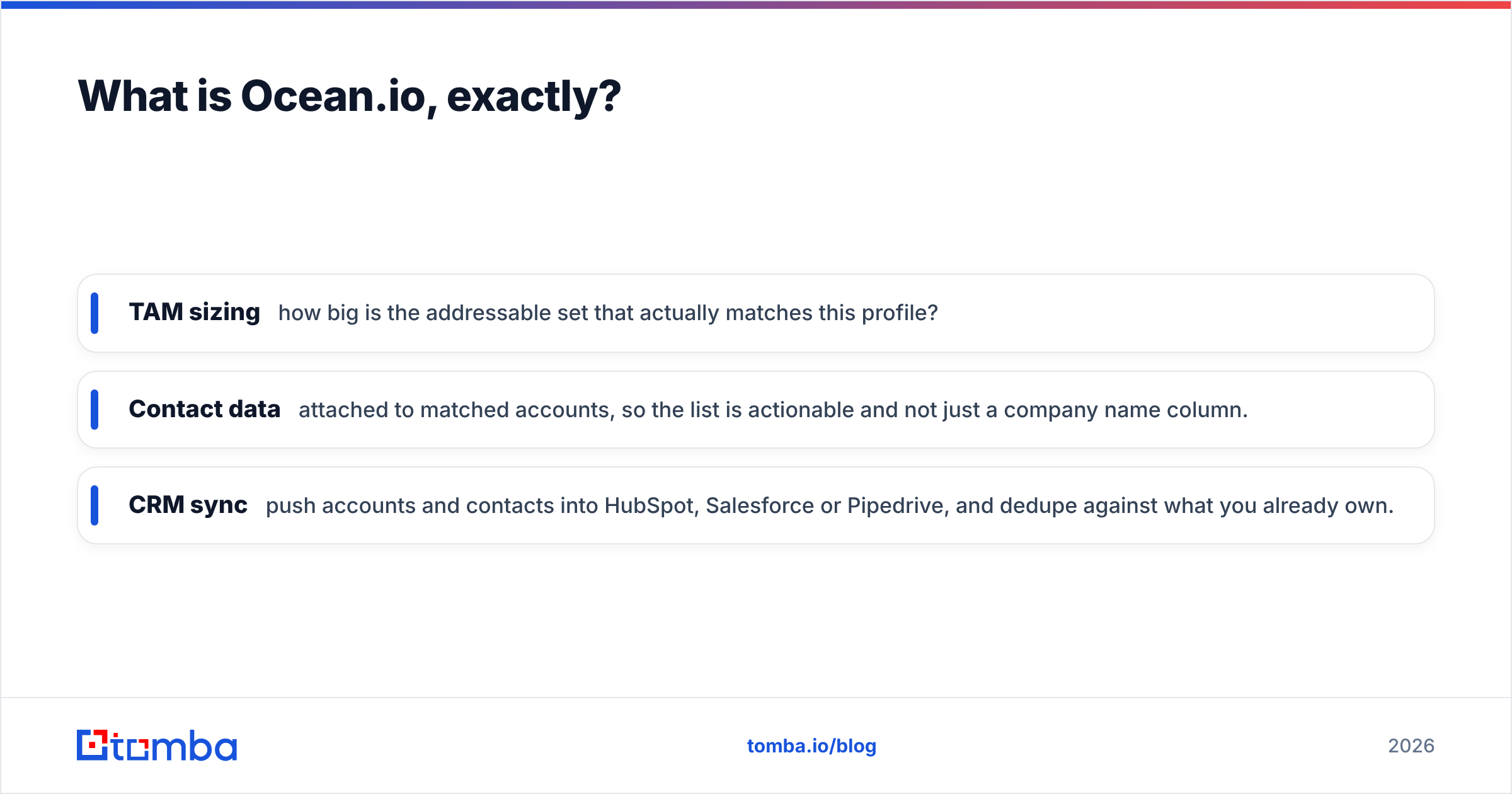
- TAM sizing — how big is the addressable set that actually matches this profile?
- Contact data attached to matched accounts, so the list is actionable and not just a company name column.
- CRM sync — push accounts and contacts into HubSpot, Salesforce or Pipedrive, and dedupe against what you already own.
So: Ocean.io answers who to go after. Forager answers how to reach them.

How do Forager and Ocean.io compare head-to-head?#
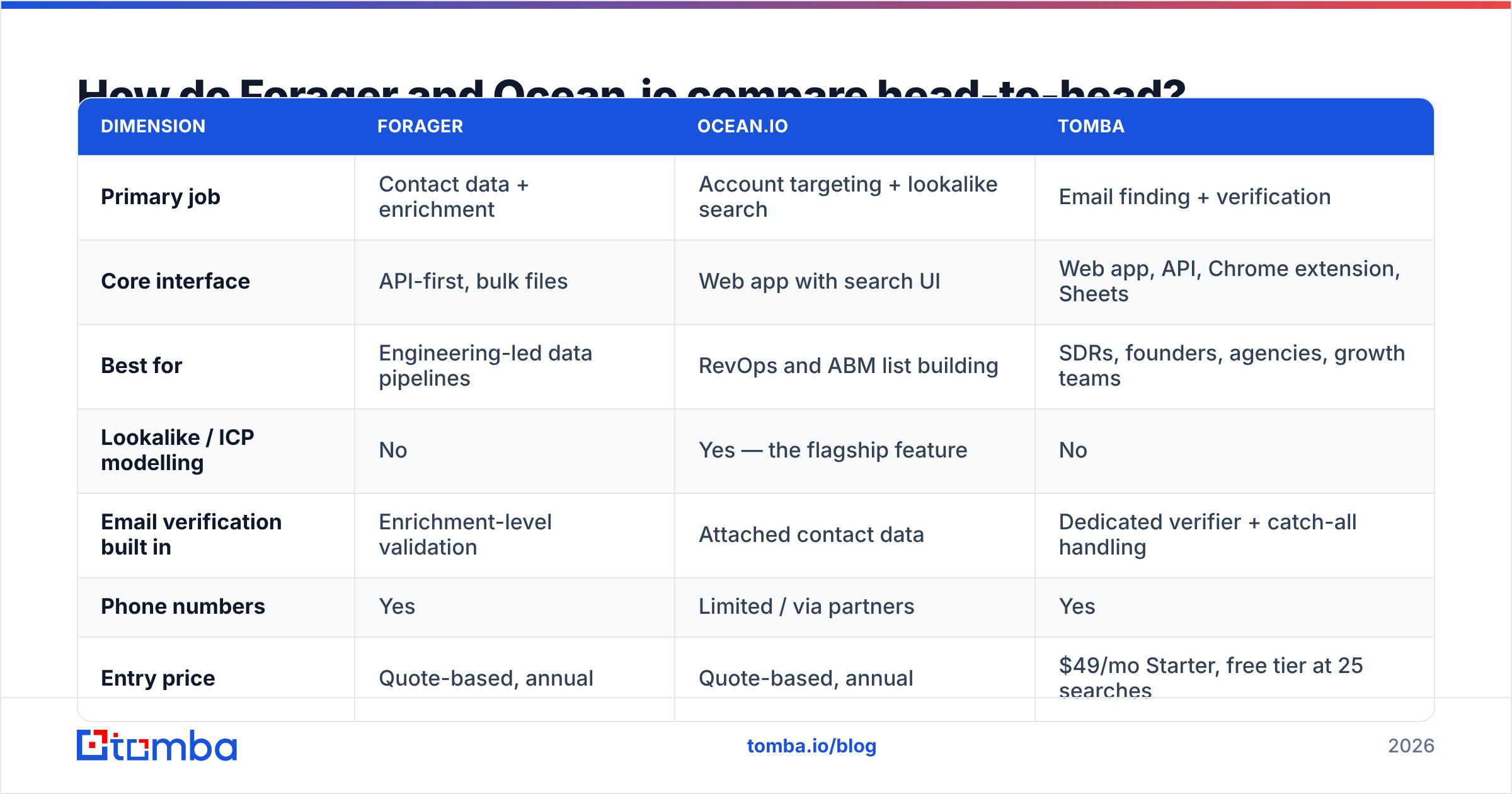
Here is the honest side-by-side. Note that both vendors run quote-based pricing for most tiers, so treat cost rows as directional and confirm current numbers with the vendor — published pricing pages change without notice.
| Dimension | Forager | Ocean.io | Tomba |
|---|---|---|---|
| Primary job | Contact data + enrichment | Account targeting + lookalike search | Email finding + verification |
| Core interface | API-first, bulk files | Web app with search UI | Web app, API, Chrome extension, Sheets |
| Best for | Engineering-led data pipelines | RevOps and ABM list building | SDRs, founders, agencies, growth teams |
| Lookalike / ICP modelling | No | Yes — the flagship feature | No |
| Email verification built in | Enrichment-level validation | Attached contact data | Dedicated verifier + catch-all handling |
| Phone numbers | Yes | Limited / via partners | Yes |
| Entry price | Quote-based, annual | Quote-based, annual | $49/mo Starter, free tier at 25 searches |
| Free tier | Trial / sample on request | Demo-gated | Yes — 25 searches per month |
| Contract friction | Medium to high | High (annual, sales-led) | Low — self-serve monthly |
| Where it breaks | No targeting logic; you bring the list | Contact depth thinner than pure data vendors | Not a targeting or intent platform |
The table makes the real decision obvious: these two tools overlap on maybe 20% of their surface area. The overlap is "attach a contact to a company." Everything else is different work.
Which one has better data coverage and accuracy?#
This is where most comparison posts hand-wave, so let's be specific about what accuracy even means.
There are three separate numbers vendors blur together:
- Match rate — of the 1,000 people you asked about, how many did the tool return anything for?
- Deliverability rate — of the emails returned, how many actually accept mail?
- Correctness — of the emails that accept mail, how many belong to the right human?
A vendor can post a spectacular match rate by guessing patterns (first.last@domain.com) and never SMTP-checking them. That inflates number one and destroys numbers two and three, and you find out three weeks later when your domain reputation is in the floor.
Forager competes on freshness, and in practice its match rate on senior, well-documented roles at tech companies is strong. Where any real-time resolver struggles is the long tail: small local businesses, non-English markets, and roles that leave no public footprint. If your ICP is "operations manager at a 40-person HVAC distributor in Ohio," expect a meaningful drop.
Ocean.io contacts are a feature of the account product, not the product itself. That's not a knock — it's a design choice. You'll get decision-maker contacts at matched accounts, but if you need every one of the 14 people in a buying committee with verified mobile numbers, you're asking the wrong tool.
The pragmatic move most teams land on: use one system to build the target account list, and a dedicated verification layer before anything hits a sending inbox. Running your final list through an email verifier catches the stale records regardless of which vendor sourced them, and it costs a rounding error compared to a burned sending domain.
One more accuracy trap worth naming: catch-all domains. A large share of enterprise domains accept mail to any address, which means a naive verifier marks everything "valid." If your list is heavy on enterprise targets, you need explicit catch-all handling or your "98% valid" list is fiction.
How does pricing actually work for each?#
Neither vendor makes this easy, which is itself a data point.
Forager prices on volume — records resolved or API calls made — with tiering that rewards commitment. Expect an annual agreement for anything beyond a pilot, and expect the conversation to start with "what's your monthly record volume?" If you can't answer that precisely, you will overbuy.
Ocean.io is sales-led and annual. It's priced like a platform, not like a utility, because that's what it is — you're buying the ICP model, the TAM view, and the CRM integration as a bundle. Teams that get value from it are usually running a genuine ABM motion with a marketing counterpart. Teams that buy it to "get some leads" tend to churn at renewal. Check current listings and verified reviews on G2 before you take any number in a blog post — including this one — as gospel.
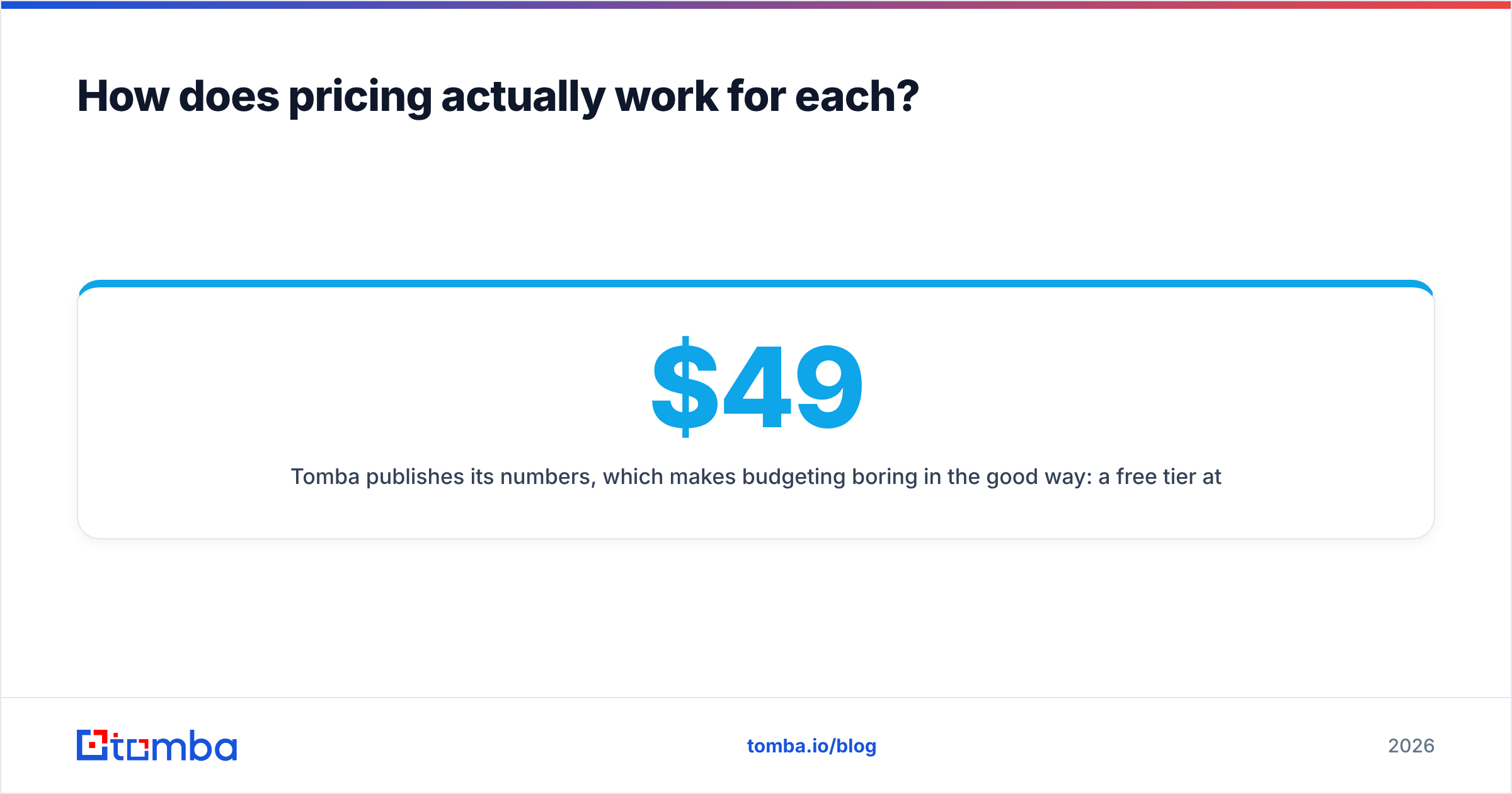
Tomba publishes its numbers, which makes budgeting boring in the good way: a free tier at 25 searches per month, Starter at $49/mo, Growth at $99/mo, Pro at $249/mo, and custom Enterprise. Full pricing details are public, month-to-month, and don't require a discovery call.
The uncomfortable math: a mid-size outbound team sending 2,000 cold emails a month needs roughly 2,500 verified contacts a month. On a self-serve email finder that's a two-figure monthly line item. On an annual data platform it's frequently four figures a month, and the delta is not buying you better emails — it's buying you targeting features, a UI, and an account manager. Sometimes that's worth it. Often it isn't.

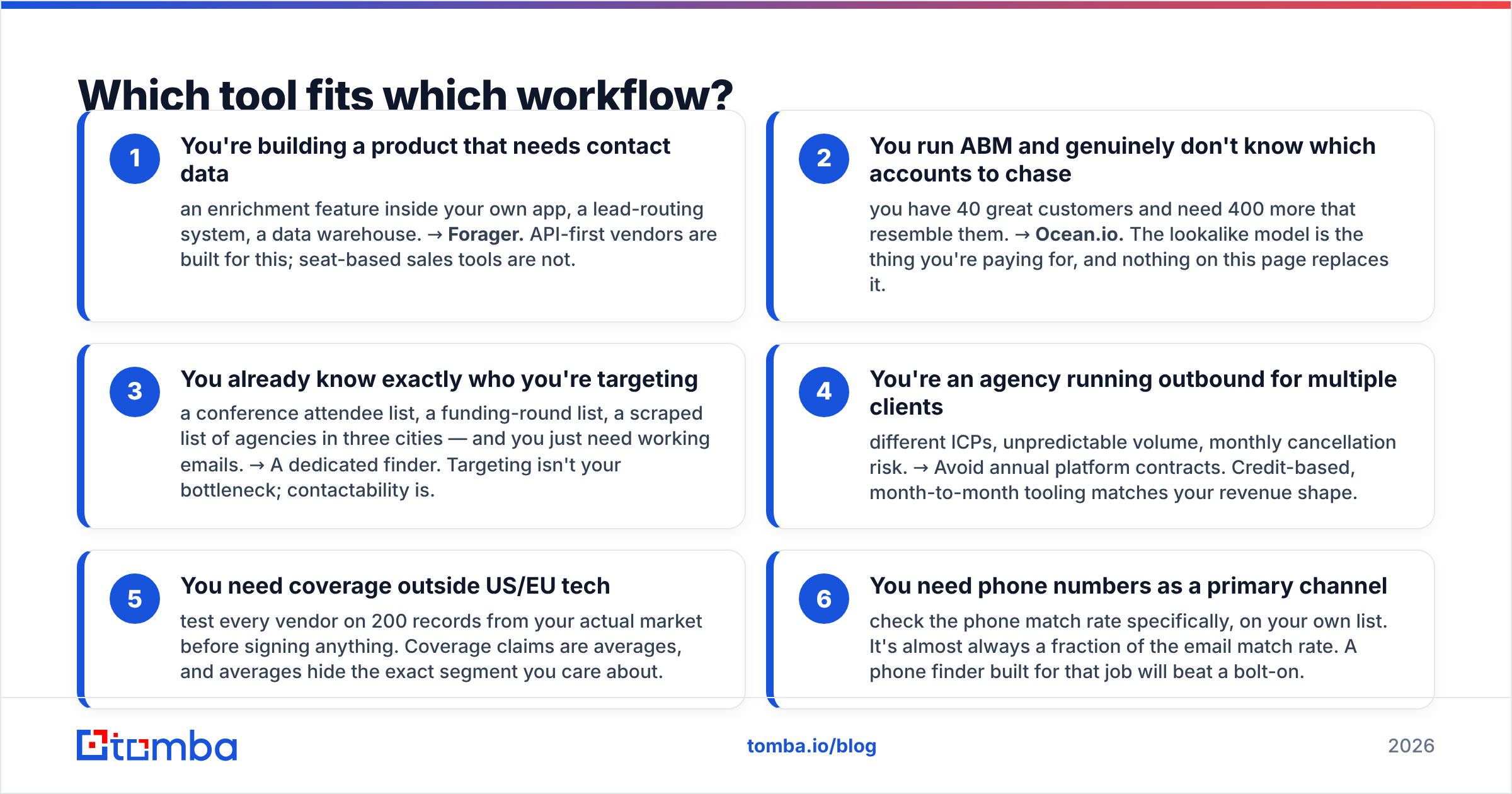
Which tool fits which workflow?#
Use this as the decision tree rather than reading feature lists:
- You're building a product that needs contact data — an enrichment feature inside your own app, a lead-routing system, a data warehouse. → Forager. API-first vendors are built for this; seat-based sales tools are not.
- You run ABM and genuinely don't know which accounts to chase — you have 40 great customers and need 400 more that resemble them. → Ocean.io. The lookalike model is the thing you're paying for, and nothing on this page replaces it.
- You already know exactly who you're targeting — a conference attendee list, a funding-round list, a scraped list of agencies in three cities — and you just need working emails. → A dedicated finder. Targeting isn't your bottleneck; contactability is.
- You're an agency running outbound for multiple clients — different ICPs, unpredictable volume, monthly cancellation risk. → Avoid annual platform contracts. Credit-based, month-to-month tooling matches your revenue shape.
- You need coverage outside US/EU tech — test every vendor on 200 records from your actual market before signing anything. Coverage claims are averages, and averages hide the exact segment you care about.
- You need phone numbers as a primary channel — check the phone match rate specifically, on your own list. It's almost always a fraction of the email match rate. A phone finder built for that job will beat a bolt-on.
What do both tools leave you to solve?#
Three gaps show up regardless of which you pick.
Verification before send. Neither platform is a deliverability guardian. Even a perfect record goes stale the week someone quits. A verification pass immediately before send — not at list-build time — is the only thing that reliably protects bounce rate.
Deduplication across sources. The moment you run two data sources, you get the same person twice with slightly different spellings. Solve it with a canonical key (usually company domain plus normalised name) before it becomes 30% list bloat.
Volume economics. Both platforms make bulk work possible but not cheap. If you routinely process 10,000+ rows, look at the per-record cost at your volume, not the headline tier. A bulk email finder with transparent per-credit pricing makes that number checkable in advance instead of after the invoice.
So which should you pick in 2026?#
Choose Ocean.io if the hardest question in your GTM is "which accounts?" and you have the budget and the team maturity to act on the answer. Lookalike modelling on semantic website data is real value, and it's the kind of thing that's genuinely painful to rebuild yourself.
Choose Forager if you're feeding a pipeline, not a person. API-first, freshness-focused, engineer-friendly. If your evaluation involves reading API docs before booking a demo, that's the right signal.
Choose neither — and this applies to more teams than vendors would like — if you already know your ICP and your actual constraint is getting verified addresses into a sequence this week. Buying an ABM platform to solve an email-finding problem is a $20,000 answer to a $600 question.
Whatever you land on, run the same test before you sign: take 200 real contacts from your genuine target segment, run them through every candidate, send a small verified batch, and measure bounce rate and reply rate. Vendor benchmarks are marketing. Your list is evidence.
Start with the contact layer. If your list is already defined and you need verified, deliverable work emails behind it, Tomba Email Finder finds addresses by name, domain, or company, verifies them before they reach your sequence, and starts free at 25 searches a month — no annual contract, no discovery call. Test it against whatever platform you're evaluating on the same 200 rows and let the bounce rate settle the argument.
Related guides#
Ready to find emails that actually work?
Join 150,000+ professionals who stopped guessing and started sending. Free credits on signup — no credit card required.
Get the Tomba newsletter
Practical outbound tactics and product updates — once every two weeks.
About the author