Forager vs Warpleads: Which B2B Lead Data Tool Wins in 2026?
Forager sells fresh, real-time contact data. Warpleads sells volume and unlimited exports. They solve different problems — and picking the wrong one quietly wrecks your bounce rate. Here's the honest breakdown.
Forager vs Warpleads comes down to one choice: fresh data, or a lot of data. Forager sells accuracy. Warpleads sells volume. Here is how each one works, what they really cost per usable contact, and the gap they both leave open.
TL;DR
- Forager is built for freshness — it looks up and enriches contacts in real time, and charges per verified record. Pick it when accuracy matters more than list size.
- Warpleads is built for volume — huge or unlimited export caps on B2B lead lists. Pick it when you need thousands of rows fast and plan to filter hard afterward.
- Neither one is simply "better." They sit at opposite ends of the same trade-off: cost per record versus trust per record.
- Both leave the same gap — neither one replaces a real verification step before you hit send. Raw exports at scale are how domains get burned.
- For most teams the Forager vs Warpleads answer is a hybrid: a cheap volume source to find accounts, then a verify-first email finder for the contacts you actually email.
Forager vs Warpleads: what are they?#
Two very different animals wearing similar marketing.
Forager calls itself a real-time B2B data platform. The pitch is recency. Most tools hand you a record that was scraped 14 months ago and cached ever since. Forager looks the record up again, close to the moment you ask for it. That matters, because B2B contact data goes stale fast. The figure most often cited is 25–30% decay a year, and it is worse in sales and marketing roles, where people move often. Forager's product leans toward enrichment and API work: you feed it identifiers, it returns matched people and company data.
Warpleads comes at it from the other side. It is an export-first lead tool built on a large B2B database with generous — sometimes unlimited — export caps. The pitch is throughput. Build a filter, export thousands of leads, drop them into your sequencer, go. Warpleads also bundles bulk email verification into the flow. That tells you something about how the raw exports perform on their own.
Put crudely: Forager is a scalpel priced like a scalpel. Warpleads is a firehose priced like a firehose.
Forager vs Warpleads: how do they compare head-to-head?#
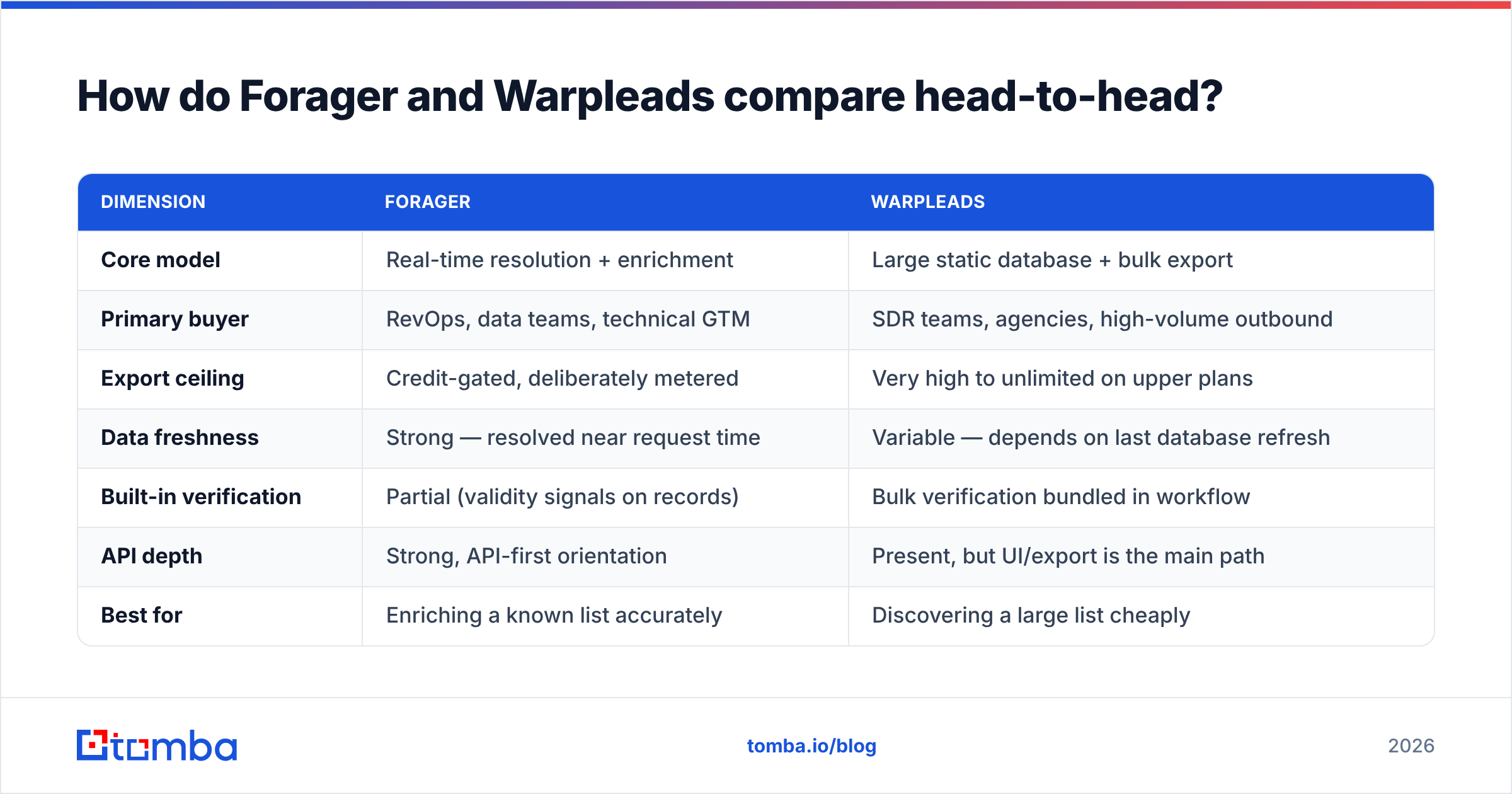
| Dimension | Forager | Warpleads |
|---|---|---|
| Core model | Real-time resolution + enrichment | Large static database + bulk export |
| Primary buyer | RevOps, data teams, technical GTM | SDR teams, agencies, high-volume outbound |
| Export ceiling | Credit-gated, deliberately metered | Very high to unlimited on upper plans |
| Data freshness | Strong — resolved near request time | Variable — depends on last database refresh |
| Built-in verification | Partial (validity signals on records) | Bulk verification bundled in workflow |
| API depth | Strong, API-first orientation | Present, but UI/export is the main path |
| Best for | Enriching a known list accurately | Discovering a large list cheaply |
| Weak spot | Cost per record at scale | Confidence per record |
The honest read: if you already know who you want, Forager fits, because you need the contact details to be right. If you do not know who you want yet, and you need to cast a wide net across an ICP, Warpleads fits. Teams that force one tool into the other's job either overpay to find leads or under-deliver to the inbox.

Which one has better data accuracy?#
Accuracy is not one number. It is three, and vendors love to blur them together.
- Match rate — of the contacts you asked for, how many came back with an email at all? Volume tools usually win here on paper. A loose matcher returns something for almost every row.
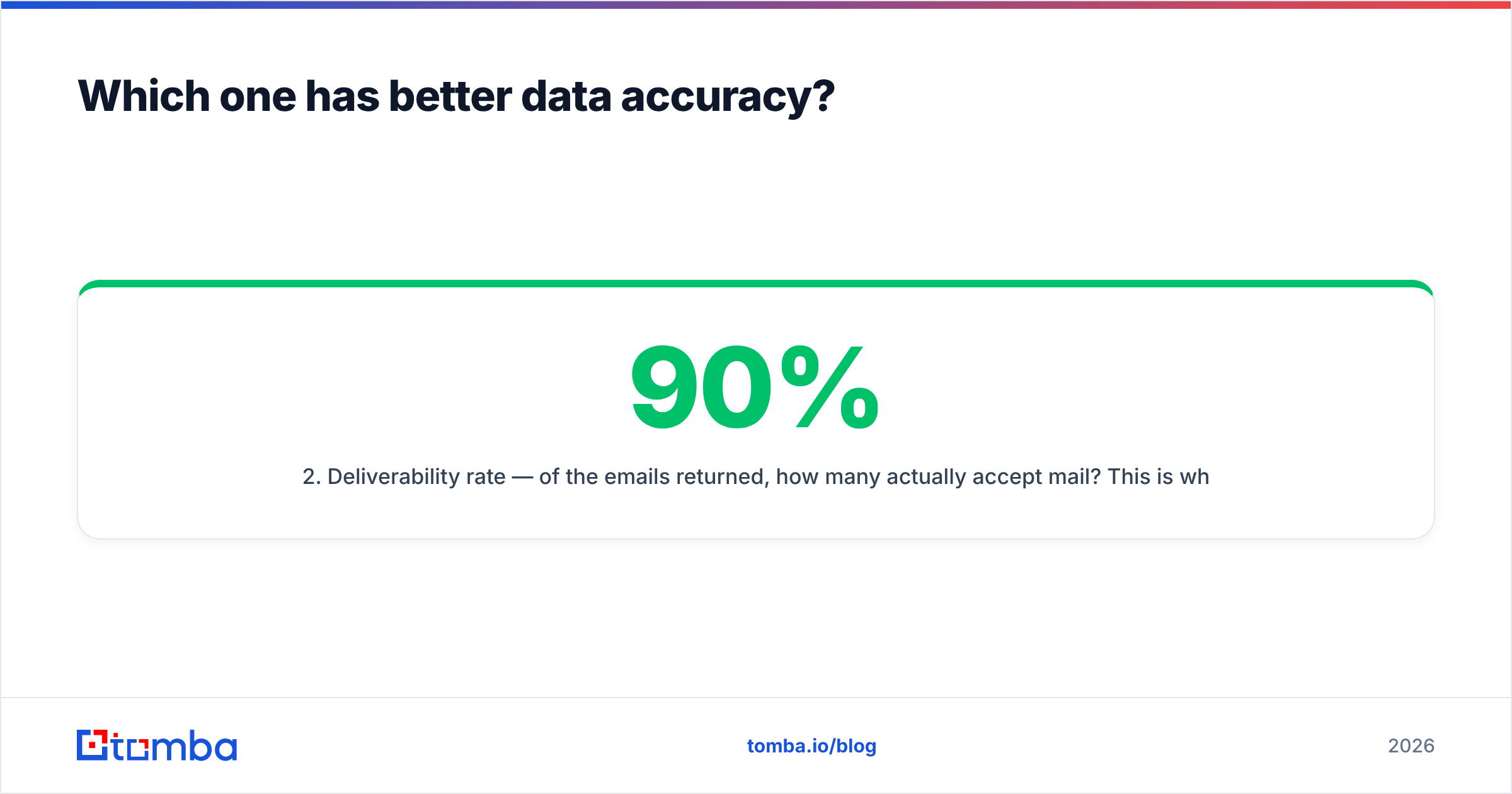
- Deliverability rate — of the emails returned, how many actually accept mail? This is where a high match rate gets punished. A 90% match rate at 70% deliverability hurts your domain more than a 60% match rate at 97%.
- Correctness — is
j.smith@acme.comthe right J. Smith? Pattern-guessing tools build addresses that look valid and land on a real person, just not your prospect. Nothing bounces. You get silence, and the odd spam complaint.
Forager's design targets #2 and #3. Warpleads targets #1, then hands you a verify step to clean up the rest. Both are fair choices. What is not fair to your domain is exporting 10,000 rows and loading them straight into a sequencer with no independent email verifier in between.
One practical test before you commit to either vendor: take 200 contacts you know are valid. Current customers, past demos, people who replied last quarter. Strip the emails, then ask each tool to find them again. That gives you a real accuracy score in an afternoon, and it costs you two free trials. Vendor accuracy claims are marketing. Your own test is data.
How does pricing actually work for each?#
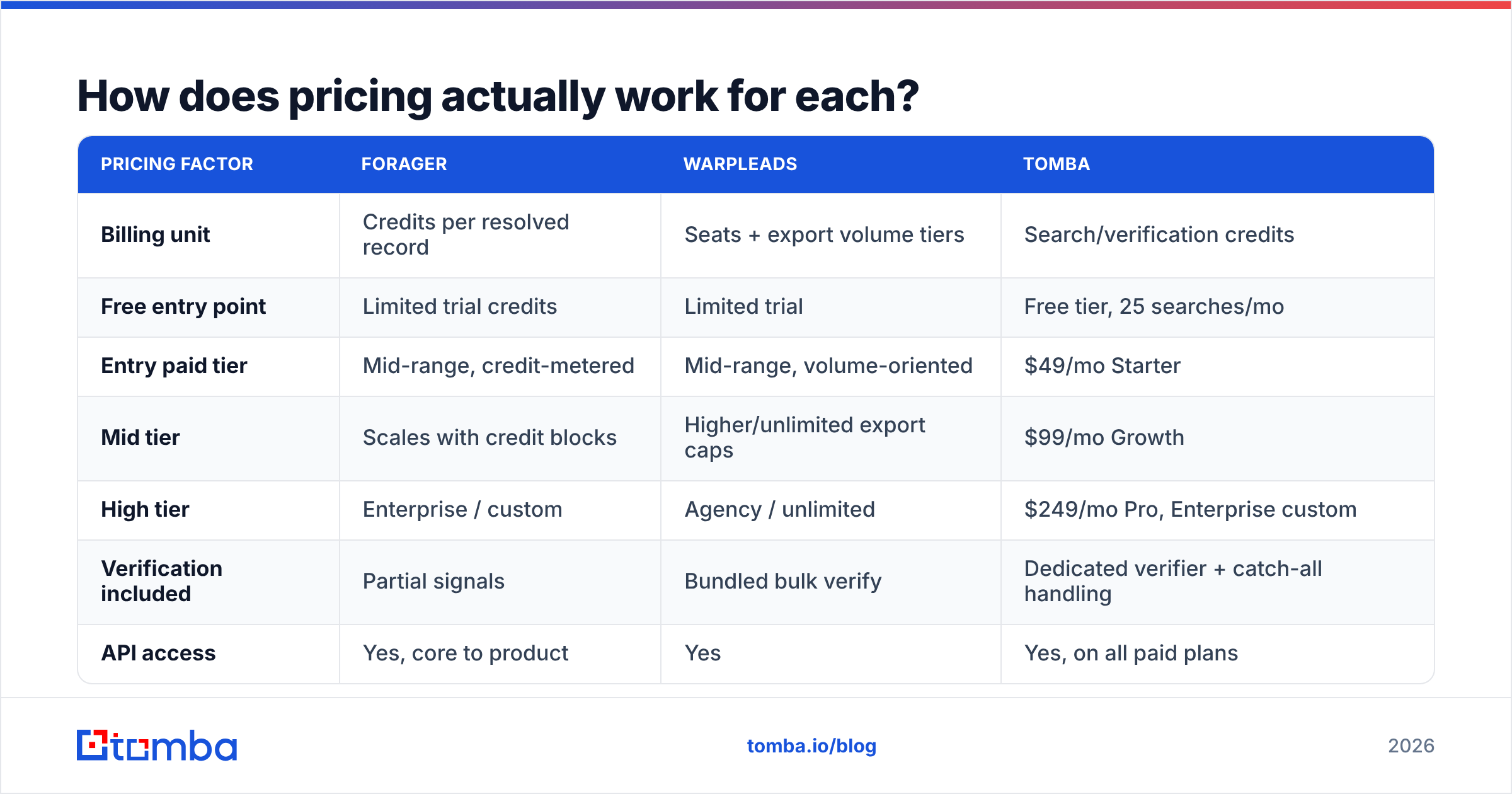
Both vendors change their plans often. Treat the table below as a shape, not a quote, and check the vendor pages before you buy.
| Pricing factor | Forager | Warpleads | Tomba |
|---|---|---|---|
| Billing unit | Credits per resolved record | Seats + export volume tiers | Search/verification credits |
| Free entry point | Limited trial credits | Limited trial | Free tier, 25 searches/mo |
| Entry paid tier | Mid-range, credit-metered | Mid-range, volume-oriented | $49/mo Starter |
| Mid tier | Scales with credit blocks | Higher/unlimited export caps | $99/mo Growth |
| High tier | Enterprise / custom | Agency / unlimited | $249/mo Pro, Enterprise custom |
| Verification included | Partial signals | Bundled bulk verify | Dedicated verifier + catch-all handling |
| API access | Yes, core to product | Yes | Yes, on all paid plans |
The number that matters is not the sticker price. It is cost per contact you can safely email. Run it like this:
- Step 1 — Export cost. Plan price divided by records pulled.
- Step 2 — Survival rate. Multiply by your verification pass rate. A $0.02 record that passes 55% of the time really costs $0.036.
- Step 3 — Fit. Drop records where the role, seniority, or company size is wrong. A bad-fit record costs you the same as a good one.
- Step 4 — Domain risk. Put a real price on bounces. A burned sending domain costs weeks of warmup, not dollars.
Do that math and "unlimited exports" often lands in the same real-cost band as metered, verified data. Sometimes higher. Compare it against transparent Tomba pricing and the picture usually gets clearer, because credit pricing makes step 1 easy to work out.
Forager vs Warpleads: who should choose which?#
Choose Forager if:
- You already have an account list. Enrichment against a known ICP is where real-time lookups earn their premium.
- You are API-first. Your data moves through a warehouse, a reverse-ETL job, or a CRM sync — not a CSV someone downloads on Tuesday.
- Your sending domain is a strategic asset. An old domain with years of good reputation should not be fed guesswork.
- Your deal size is big. When one closed deal is worth five figures, paying more per correct record is an easy call.
Choose Warpleads if:
- You are still in discovery. You do not know your ICP yet, and you need breadth to find the pockets that reply.
- You run agency volume. Many clients, many ICPs, constant list churn, and sending infrastructure to match.
- You already own a verification step. Bulk export is only safe when something strict sits between the export and the sequencer.
- Steady budgets beat per-record precision. Flat volume plans are easier to forecast than credit burn.
Peer tools sit nearby. BookYourData is a solid pick for teams that want pay-as-you-go B2B lists with a verification guarantee attached. It is worth a look next to both of these if you would rather not commit to a subscription at all.
What do both tools miss?#
The verification layer, the catch-all problem, and the long tail.
Catch-all domains are the quiet killer. About a fifth of B2B domains accept mail for any address at the SMTP level. A standard verifier returns "unknown," and you are left guessing. Guessing at scale turns a 3% bounce rate into a 9% one. That is its own technical problem, and it needs a dedicated catch-all verifier, not a generic validity flag.
Long-tail companies. Both databases lean toward well-indexed mid-market and enterprise accounts. If your ICP is 8-person agencies, regional manufacturers, or brand-new startups, coverage drops hard. A pattern-based domain search often beats a database lookup here: find the company's real email format, then apply it.
Workflow gravity. Warpleads pulls you toward CSV work. Forager pulls you toward engineering work. If your team's habits do not match the tool's pull, adoption dies inside a quarter, no matter how good the data is.

Worth saying plainly: most B2B databases draw on the same public sources. The difference between vendors is rarely a secret data vault. It is what they do after collection — match logic, refresh cadence, and how strictly they verify.
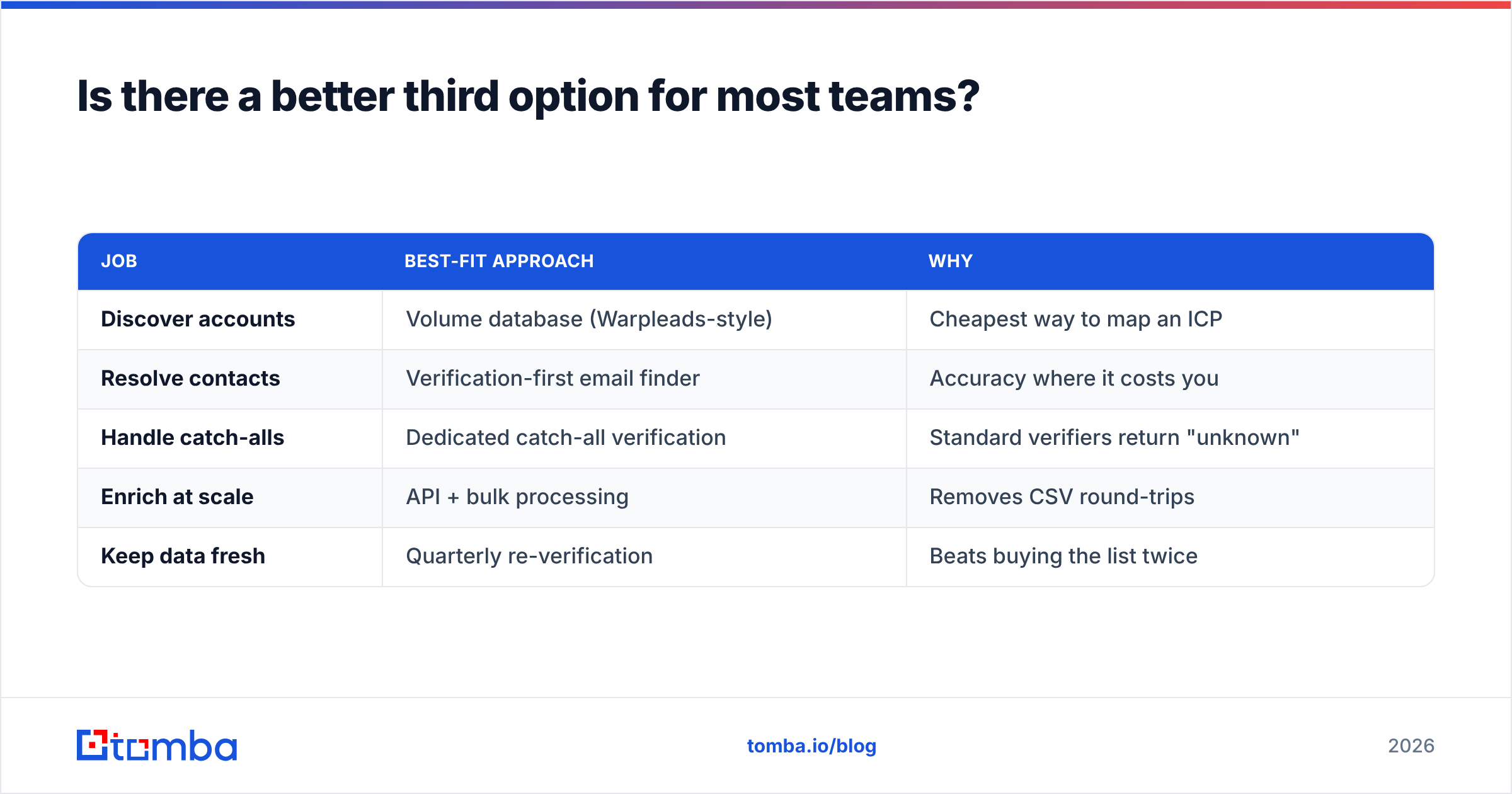
Is there a better third option for most teams?#
For teams under 50 SDRs, the answer is usually a hybrid rather than a single vendor.
| Job | Best-fit approach | Why |
|---|---|---|
| Discover accounts | Volume database (Warpleads-style) | Cheapest way to map an ICP |
| Resolve contacts | Verification-first email finder | Accuracy where it costs you |
| Handle catch-alls | Dedicated catch-all verification | Standard verifiers return "unknown" |
| Enrich at scale | API + bulk processing | Removes CSV round-trips |
| Keep data fresh | Quarterly re-verification | Beats buying the list twice |
That is where a tool like Tomba fits. Not as a replacement for large-scale discovery, but as the accuracy layer between finding a lead and sending to it. The bulk email finder works through exported lists in batches. Catch-all handling is a core feature, not a footnote. And the Tomba API means the whole thing can live inside an automated pipeline instead of a spreadsheet. The free tier gives you 25 searches a month, enough to run the holdout test above before you spend anything.
How do you actually decide this week?#
- Define the unit. Write down what one usable contact is worth to you. Everything after that is arithmetic against that number.
- Run the holdout test. 200 known-good contacts, both trials, and measure rediscovery and deliverability separately.
- Price the real cost. Plan cost ÷ (records × verification pass rate × ICP fit rate).
- Check the workflow fit. CSV team or API team? Pick the tool whose pull matches.
- Budget for verification either way. Whichever vendor wins, assume you still need your own verification pass. Every team that skipped this step learned the same lesson at the same price.
- Re-verify quarterly. Data decays whether or not you look at it.
The verdict#
Forager wins on confidence per record. Warpleads wins on records per dollar. If you are enriching a known list, feeding a warehouse, or protecting a mature sending domain, Forager is the right shape. If you are mapping a new ICP, running agency volume, or building lists faster than you can qualify them, Warpleads' export ceiling is hard to match at the price.
Neither one will promise that what you export is safe to send. That is a separate job, and it decides whether your campaign lands in the inbox or in the spam folder.
So the real Forager vs Warpleads answer is simple: test accuracy on contacts you can check yourself, then build the stack around whichever tool wins that test. If you want the find-and-verify half handled in one place — catch-all detection, bulk processing, and an API that fits the pipeline you already run — start with the Tomba Email Finder on the free tier. Twenty-five searches is enough to run the holdout test, and the result will tell you more than any comparison post, including this one.
Related guides#
Ready to find emails that actually work?
Join 150,000+ professionals who stopped guessing and started sending. Free credits on signup — no credit card required.
Get the Tomba newsletter
Practical outbound tactics and product updates — once every two weeks.
About the author