Free AI Tools for Lead Generation: 17 That Actually Work in 2026
Free AI tools can write your emails, score your leads, and research accounts. Almost none of them hand you a verified contact. Here's the 2026 stack that works, and the exact point where free stops paying off.
TL;DR
- Free AI tools are excellent at thinking work — research, segmentation, copy, scoring, summarising — and almost useless at data work. The contact record is where every free stack breaks.
- A realistic all-free pipeline gets you roughly 40–80 qualified, contactable leads per month. Past that, you are paying with your own hours.
- The highest-leverage paid upgrade is not a CRM or a sequencer. It is verified contact data, because bad emails destroy sender reputation faster than good copy can rescue it.
- Chain free tools by job (find → verify → enrich → write → send → track), not by brand. Most people over-buy on sending and under-buy on data.
- Budget check: an all-free stack costs about 12–15 hours of manual work a month. Tomba's free tier plus a $49/mo Starter plan removes most of that.
What counts as a "free AI tool for lead generation" in 2026?#
Three very different things get sold under the same label, and confusing them is why most free stacks stall.
- Genuinely free forever — a permanent zero-cost tier with a hard monthly cap. HubSpot's free CRM, Tomba's 25 searches a month, Google Sheets with a scripting layer. You can build a real process on these.
- Free trial dressed as a free tool — 7 or 14 days, then a paywall. Useful for a one-off list build, useless as infrastructure. Half the "free AI lead gen tools" listicles are secretly this.
- Free general-purpose AI — ChatGPT, Claude, Gemini, Perplexity. Unlimited-ish reasoning, zero proprietary B2B data. These are the engine, not the fuel.
The distinction matters because lead generation has two halves. The reasoning half — deciding who to target, what to say, which replies deserve a call — is now effectively free and very good. The data half — this person exists, works here today, and this mailbox accepts mail — is expensive because it requires crawling, verification infrastructure, and constant refresh. No AI model knows whether j.smith@acme.com bounces. It can only guess a pattern.
That is the whole story of free AI lead generation in 2026: free brains, paid eyes.

Which free AI tools actually generate leads?#
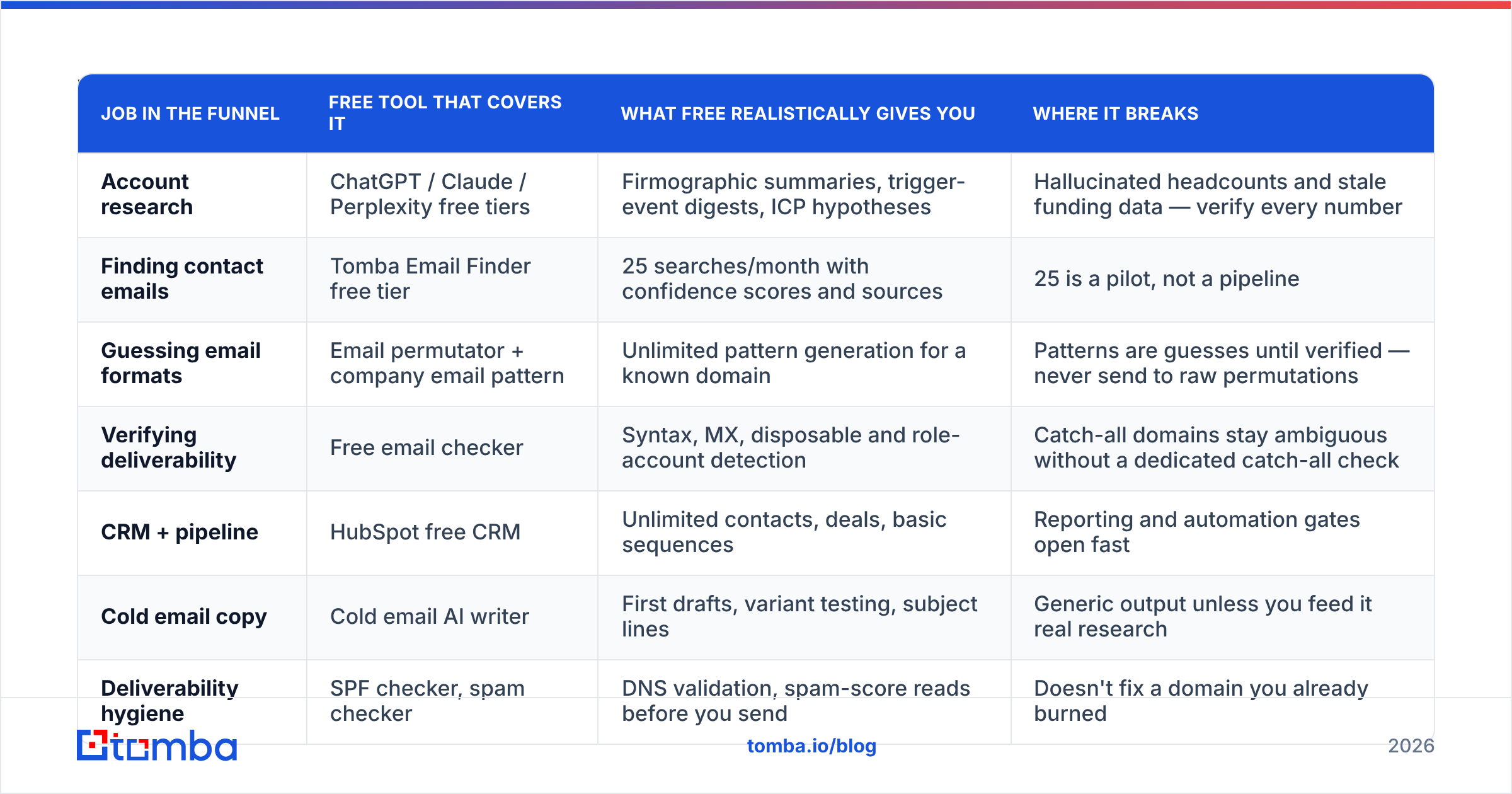
Here is the honest map, organised by job rather than by brand. Free tiers change constantly, so treat the middle column as "what you can expect", not a contract.
| Job in the funnel | Free tool that covers it | What free realistically gives you | Where it breaks |
|---|---|---|---|
| Account research | ChatGPT / Claude / Perplexity free tiers | Firmographic summaries, trigger-event digests, ICP hypotheses | Hallucinated headcounts and stale funding data — verify every number |
| Finding contact emails | Tomba Email Finder free tier | 25 searches/month with confidence scores and sources | 25 is a pilot, not a pipeline |
| Guessing email formats | Email permutator + company email pattern | Unlimited pattern generation for a known domain | Patterns are guesses until verified — never send to raw permutations |
| Verifying deliverability | Free email checker | Syntax, MX, disposable and role-account detection | Catch-all domains stay ambiguous without a dedicated catch-all check |
| CRM + pipeline | HubSpot free CRM | Unlimited contacts, deals, basic sequences | Reporting and automation gates open fast |
| Cold email copy | Cold email AI writer | First drafts, variant testing, subject lines | Generic output unless you feed it real research |
| Deliverability hygiene | SPF checker, spam checker | DNS validation, spam-score reads before you send | Doesn't fix a domain you already burned |
| Lead scoring | Any free LLM + a Sheets column | Surprisingly good ICP-fit scoring from firmographics | No intent or behavioural signal without paid data |
| Workflow glue | Zapier / Make free tiers | A few hundred tasks a month, single-step automations | Multi-step and volume are the paid wall |
Count them up with the sub-tools and you land around seventeen distinct free utilities that each own one step. That is the point. There is no free all-in-one, and every "AI lead gen platform" promising one is running a trial, not a free tier.
Where does every free tier actually break?#
Four failure points, in the order teams hit them.
- The credit wall. Free finders give you 25–50 lookups a month. A single well-targeted outbound campaign needs 300–600 contacts to produce a statistically meaningful reply rate. You hit the wall in week one, then start scraping manually, which costs more in hours than the plan costs in dollars.
- The verification gap. Free checkers confirm syntax and MX records. They cannot resolve catch-all domains, which are now a large share of mid-market and enterprise mailboxes. Sending to unverified catch-alls is the single fastest way to push bounce rate past 3% and trigger provider throttling. A catch-all verifier is the fix, and it is not free anywhere for a reason — it costs real SMTP infrastructure to run.
- The freshness problem. B2B contact data decays roughly 25–30% a year. A free export you built in January is meaningfully wrong by June. AI cannot refresh what it never had.
- The enrichment ceiling. LLMs will happily tell you a company's headcount, funding stage, and tech stack. They will also be confidently wrong about all three, because their training data has a cutoff and your prospect raised a Series B last month. Real-time data enrichment is an API problem, not a prompt problem.
Note what is not on that list: copy quality, targeting logic, personalisation depth, follow-up cadence. Free AI genuinely solved those. The bottleneck moved entirely downstream to data.
How do you chain free tools into a pipeline that works?#
Run it as six discrete stages. Each stage has a free option and a clear upgrade trigger.
Stage 1 — Define the ICP with a free LLM. Paste in your last 20 closed-won accounts and ask for the shared attributes, not the obvious ones. Industry and headcount you already know. Ask what the accounts had in common in timing — a hiring surge, a compliance deadline, a platform migration. That becomes your trigger list.
Stage 2 — Build the account list. Free LinkedIn search plus a free LLM to expand from seed companies ("list 40 European Shopify agencies with 20–100 employees") gets you a raw list. Cross-check every name against a real source before you spend a credit on it; models invent plausible companies.
Stage 3 — Find the people. This is the paid step, always. Use domain search to pull the contactable roles at each company, or a per-person email finder when you already have names from LinkedIn. Free tiers let you validate the workflow on 25 accounts before you commit.
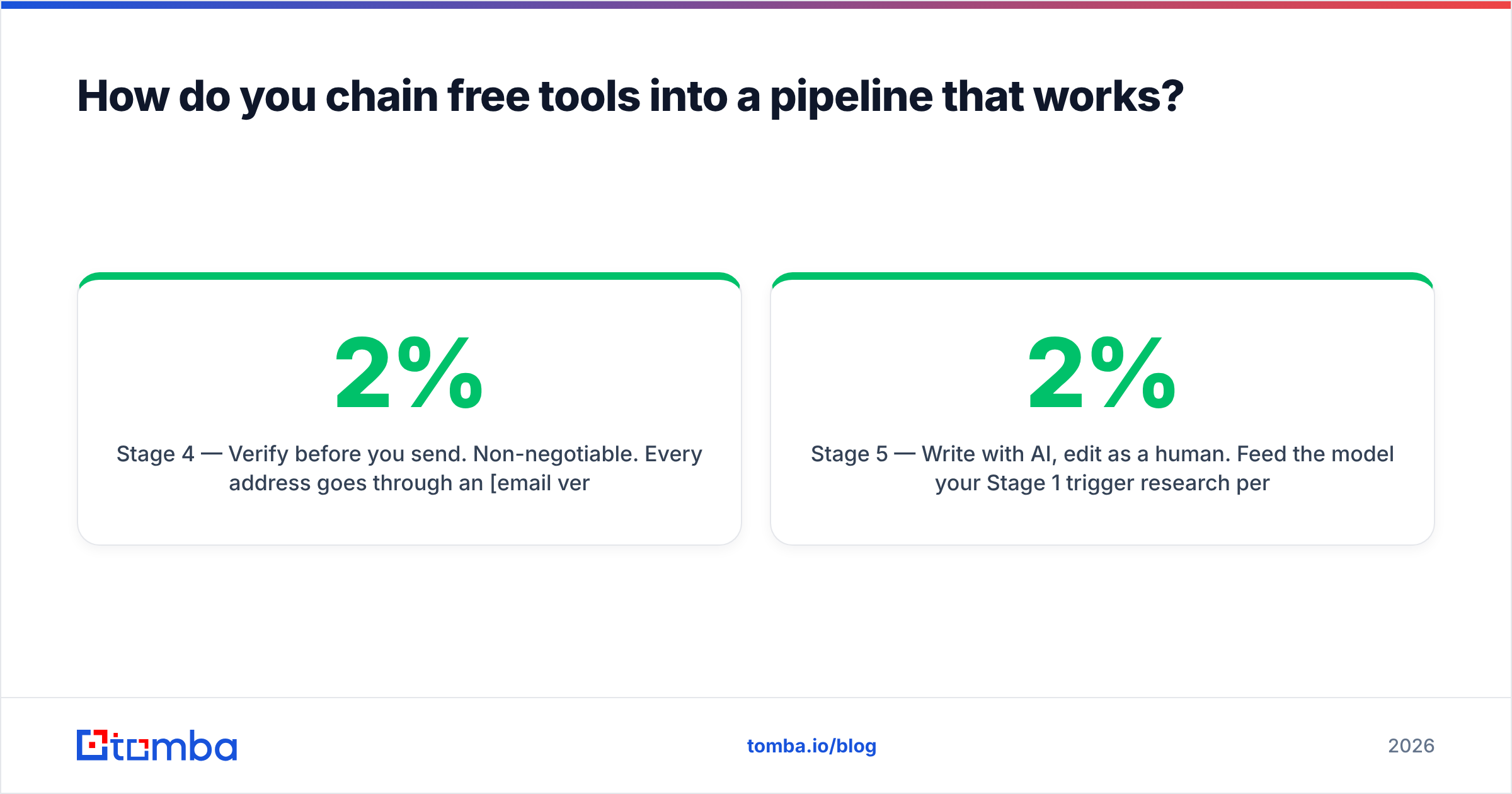
Stage 4 — Verify before you send. Non-negotiable. Every address goes through an email verifier and catch-alls go through a second pass. Keep bounce rate under 2% and your sender reputation survives. Skip this and nothing else in the stack matters.
Stage 5 — Write with AI, edit as a human. Feed the model your Stage 1 trigger research per account. The difference between a 2% and an 8% reply rate is whether the first line references something real. Free LLMs do this well if you give them facts; they write beige filler if you don't.
Stage 6 — Send, track, iterate. Free sequencer tiers cover 50–100 sends a day, which is roughly the safe ceiling for a single warmed domain anyway. Free is genuinely sufficient here for a solo founder or a two-person team.

Is an all-free stack cheaper than a paid one?#
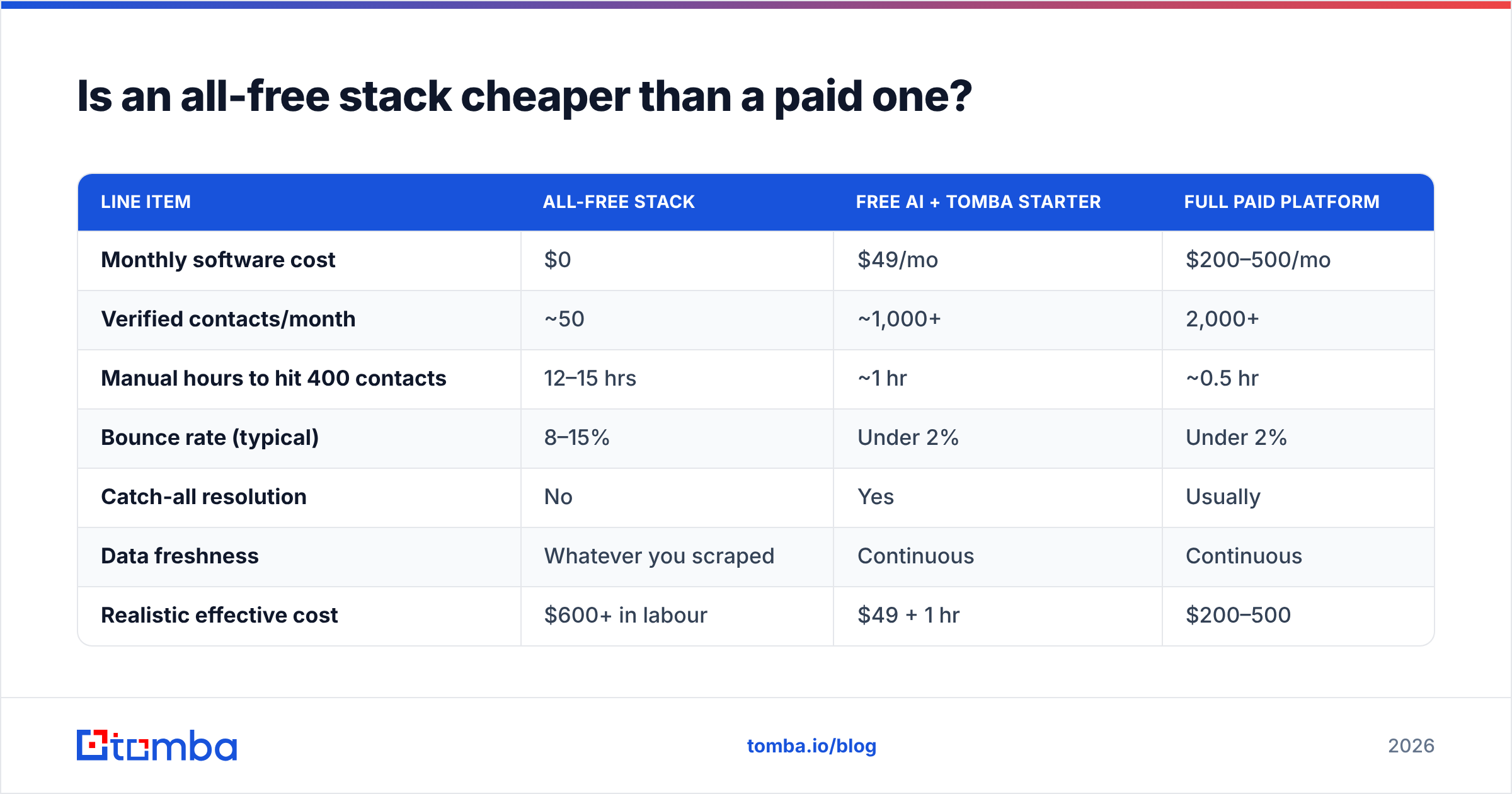
Only if your time is worth nothing. Here is the arithmetic for a realistic target of 400 verified contacts a month.
| Line item | All-free stack | Free AI + Tomba Starter | Full paid platform |
|---|---|---|---|
| Monthly software cost | $0 | $49/mo | $200–500/mo |
| Verified contacts/month | ~50 | ~1,000+ | 2,000+ |
| Manual hours to hit 400 contacts | 12–15 hrs | ~1 hr | ~0.5 hr |
| Bounce rate (typical) | 8–15% | Under 2% | Under 2% |
| Catch-all resolution | No | Yes | Usually |
| Data freshness | Whatever you scraped | Continuous | Continuous |
| Realistic effective cost | $600+ in labour | $49 + 1 hr | $200–500 |
At a $50/hour opportunity cost, the all-free path costs roughly $600–750 a month in hidden labour to produce a worse list. That is the actual case against free: not that it doesn't work, but that it stops scaling at exactly the volume where outbound starts to matter.
The upgrade trigger is measurable. When you spend more than two hours a month manually hunting emails, buy the data. Everything else — CRM, sequencer, copy tools, scoring — can stay free far longer than most teams assume. Check Tomba pricing against your own hourly rate and the answer is usually obvious within a minute.
For teams that want a static, pre-built list rather than on-demand lookups, a curated database like BookYourData is a reasonable alternative model — you buy verified records outright instead of running searches. Different shape, same underlying truth: someone has to pay for verification.
What should you never do with free AI lead gen tools?#
- Never send to permutated addresses. Generating
first.last@,flast@, andf.last@then blasting all three is the classic free-stack move. It is also a guaranteed spam-trap hit and a fast route to a blacklisted domain. Generate, then verify, then send to the one that resolves. - Never trust an LLM for a factual contact detail. Job titles, direct dials, and email addresses produced by a chat model are pattern-matched fiction. Use models for reasoning; use APIs for facts.
- Never paste your prospect list into a free consumer AI tier. Free tiers frequently train on inputs. If your list contains client data, that is a compliance problem, not a productivity hack. Check the terms, or use a workspace tier.
- Never scale sending before scaling verification. Doubling send volume on an unverified list doubles your bounces and halves your inbox placement. Data quality gates volume, not the other way round.
- Never confuse activity with pipeline. Free tools make it trivially easy to send 500 mediocre emails. Reviews on G2 are full of teams who automated their way into a burned domain.
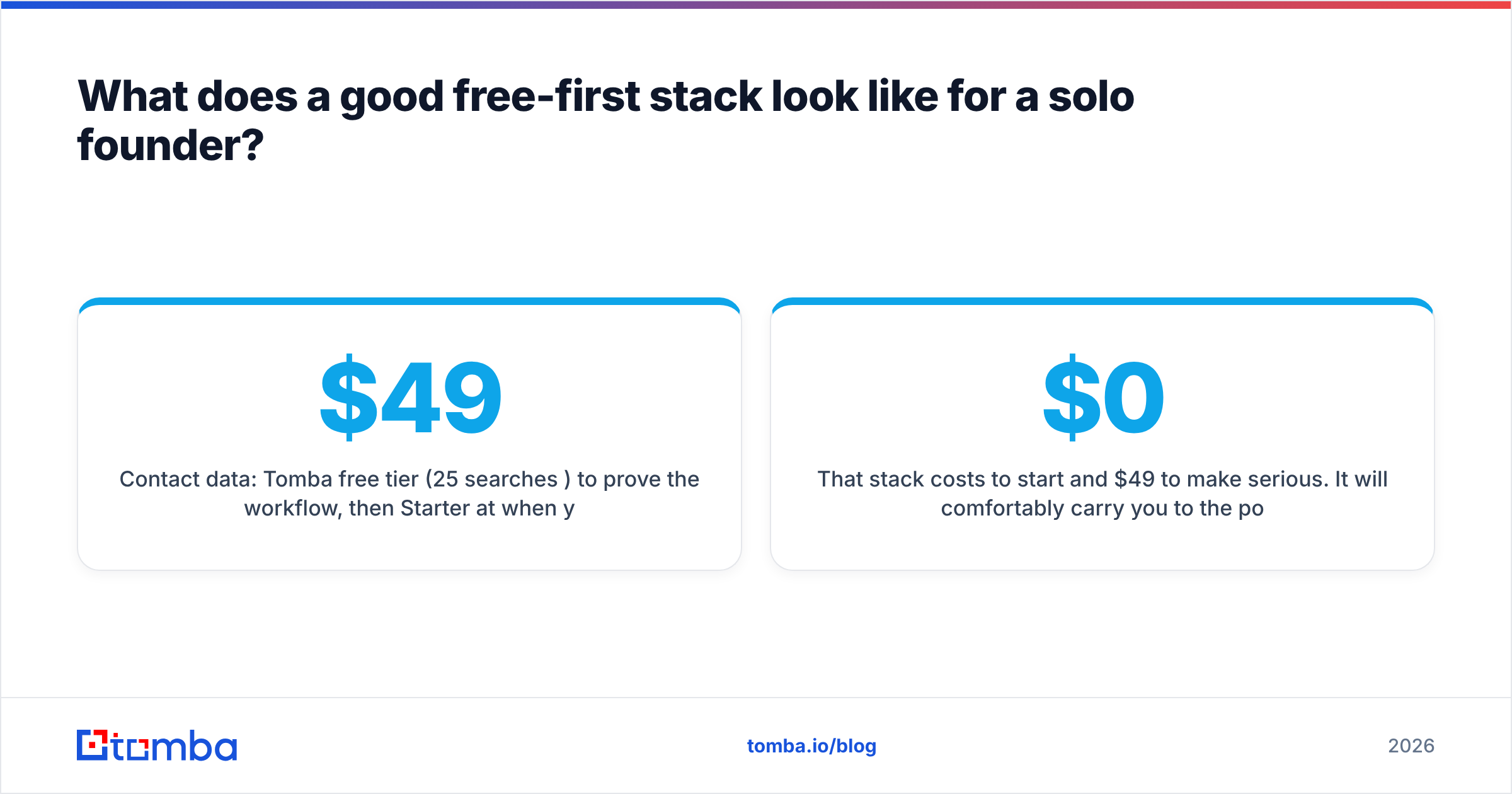
What does a good free-first stack look like for a solo founder?#
Concrete build, roughly 90 minutes to set up:
- Research and ICP: ChatGPT free tier, one saved prompt per segment.
- CRM: HubSpot free. Unlimited contacts, good enough forever at this stage.
- Contact data: Tomba free tier (25 searches/mo) to prove the workflow, then Starter at $49/mo when you outgrow it. The Chrome extension and Google Sheets add-on keep it inside tools you already use.
- Verification: Free email checker for spot checks, full verifier for anything you actually send.
- Deliverability setup: SPF record validation and a spam-score check before campaign one.
- Copy: Free LLM plus a subject-line tester, always with real research injected.
- Sending: Any free sequencer tier, capped at 50 sends/day per domain.
That stack costs $0 to start and $49 to make serious. It will comfortably carry you to the point where hiring an SDR makes more sense than adding software.
Ready to remove the one bottleneck free can't fix?#
Free AI has genuinely commoditised the thinking part of lead generation. Research, segmentation, scoring, and copy are no longer competitive advantages — everyone has them, at zero cost. What still separates a pipeline that produces meetings from one that produces bounces is whether the contact record is real, current, and deliverable.
Start with the Tomba Email Finder free tier: 25 searches a month, confidence scores, and source attribution on every result, so you can see exactly why an address was returned. Run your first 25 target accounts through it, measure the bounce rate against whatever you were doing before, and upgrade only when the arithmetic says to. That is how you keep a free-first stack honest.
Related guides#
Ready to find emails that actually work?
Join 150,000+ professionals who stopped guessing and started sending. Free credits on signup — no credit card required.
Get the Tomba newsletter
Practical outbound tactics and product updates — once every two weeks.
About the author