Free B2B Leads in 2026: 9 Sources That Actually Work
Free B2B leads exist, but most of them are stale, scraped, or unusable. Here are the nine sources worth your time in 2026, ranked by data quality, real cost, and legal risk.
TL;DR
- Free B2B leads are real, but "free" almost always means you pay in time, bounce rate, or legal exposure instead of dollars.
- The best free sources in 2026 are first-party (your own traffic, community, and content), not scraped lists downloaded from a random site.
- Free tiers on legitimate data tools — 25 to 50 credits a month — beat "10,000 free leads" torrent files every single time.
- Never send to an unverified free list. A 20% bounce rate on a cold domain can take months to recover from.
- The realistic ceiling for a free stack is roughly 100–300 verified contacts per month. Past that, paid data is cheaper than your own hours.
What counts as a free B2B lead?#
A free B2B lead is a business contact you acquire without paying a per-record fee. That's the only honest definition, and it hides three very different things.
Think of it like getting a "free" puppy. The puppy costs nothing. The vet bills, the chewed furniture, and the 6 a.m. walks cost plenty. Free leads work the same way: acquisition is free, but enrichment, verification, deduplication, and the deliverability damage from bad records are not.
There are three tiers of free, and confusing them is why most "free lead gen" experiments fail:
- Genuinely free and high quality — leads that come from assets you already own: website visitors, newsletter subscribers, webinar registrants, community members, inbound replies. Zero data cost, near-perfect accuracy, low volume.
- Free with a credit ceiling — free tiers on real data platforms. Small monthly allowances of verified contacts. Accuracy matches the paid product because it's the same database.
- Free and effectively worthless — downloadable "B2B lead lists," scraped directories, and 2019-vintage CSVs floating around Telegram. Unlimited volume, unknown provenance, 30–60% decay, and real regulatory risk.
Most people searching for free B2B leads are hoping for tier 3 to behave like tier 1. It never does.
Where can you actually get free B2B leads in 2026?#
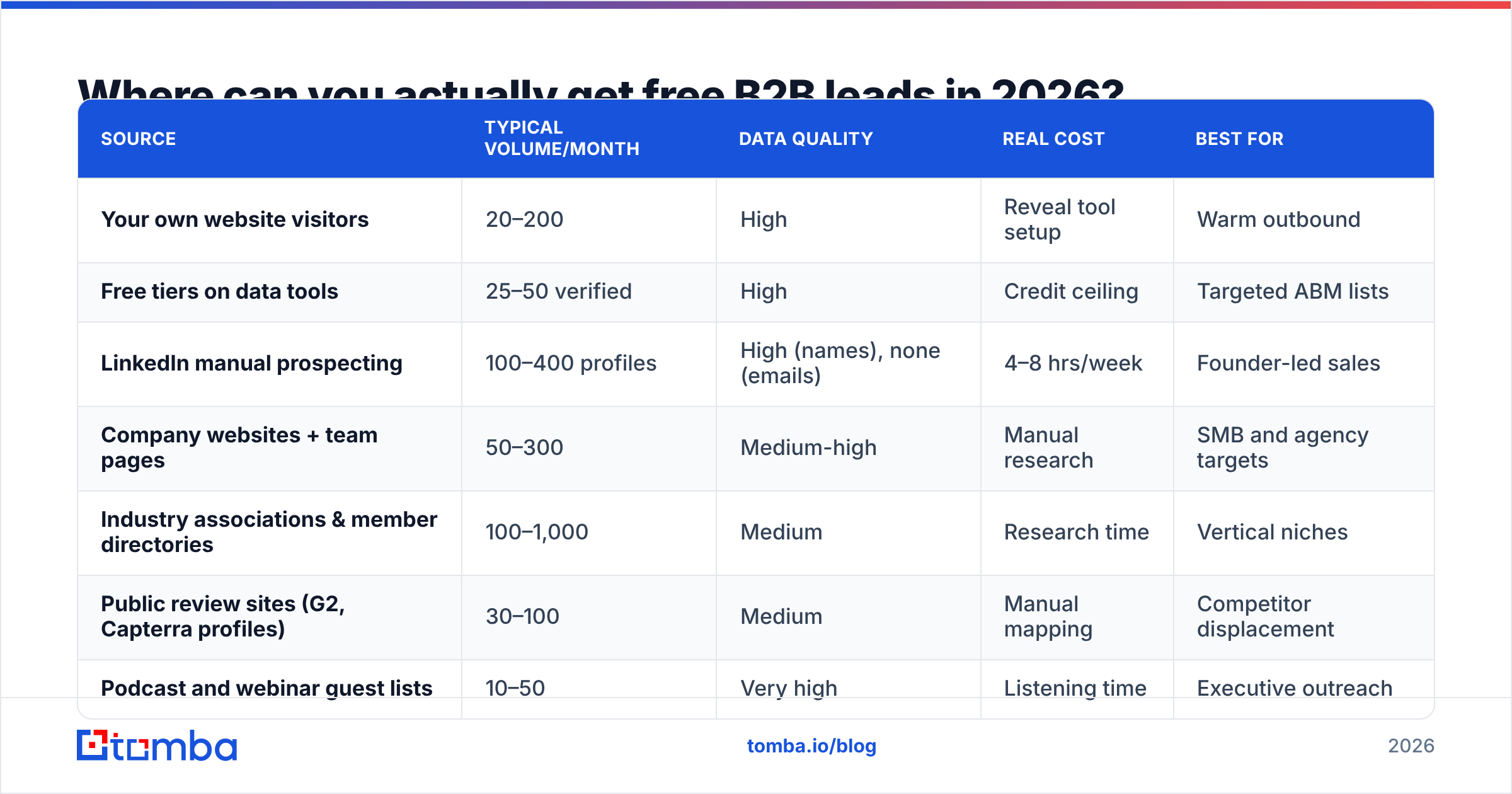
Here are the nine sources that still produce usable contacts, scored on what they actually cost you.
| Source | Typical volume/month | Data quality | Real cost | Best for |
|---|---|---|---|---|
| Your own website visitors | 20–200 | High | Reveal tool setup | Warm outbound |
| Free tiers on data tools | 25–50 verified | High | Credit ceiling | Targeted ABM lists |
| LinkedIn manual prospecting | 100–400 profiles | High (names), none (emails) | 4–8 hrs/week | Founder-led sales |
| Company websites + team pages | 50–300 | Medium-high | Manual research | SMB and agency targets |
| Industry associations & member directories | 100–1,000 | Medium | Research time | Vertical niches |
| Public review sites (G2, Capterra profiles) | 30–100 | Medium | Manual mapping | Competitor displacement |
| Podcast and webinar guest lists | 10–50 | Very high | Listening time | Executive outreach |
| Conference and event attendee pages | 50–500 | Medium | Seasonal | Regional plays |
| Downloadable "free lead list" files | Unlimited | Very low | Deliverability + legal | Nothing |
Two things jump out. First, every high-quality row costs time rather than money. Second, the only unlimited-volume source is also the only one whose quality is rated "very low." That trade is not a coincidence — it's the whole economics of B2B data.
The four free sources worth building a process around#
- Website visitor identification. Between 95% and 98% of B2B site traffic never fills in a form. Resolving even a slice of that to company level gives you an intent-ranked list nobody else has. Tools like website visitor reveal turn anonymous sessions into named accounts you can then research manually.
- Free tiers with real verification. Twenty-five verified contacts beat 25,000 unverified ones. Tomba's free tier gives you 25 searches a month; you can see how that scales on the Tomba pricing page. Apollo, Hunter, and others run similar allowances.
- Manual LinkedIn plus pattern inference. LinkedIn hands you names, titles, and companies free. It does not hand you email addresses. You bridge the gap with a company email pattern check, then verify before sending.
- Content and community capture. A useful calculator, template pack, or benchmark report collects opted-in contacts continuously. Slow to start, compounding forever, and legally clean by default.

Why do most free B2B lead lists fail?#
Because B2B data decays faster than almost anyone plans for. Job changes, layoffs, rebrands, domain migrations, and mailbox retirements churn contact records continuously. Industry estimates for annual B2B database decay cluster around 25–30%, and title-level accuracy decays faster than company-level accuracy.
Run that math on a free list. A CSV assembled in 2023 and passed around ever since is, conservatively, half wrong by now. Send to it cold and here's what happens:
- Hard bounces spike above 5%, which mailbox providers read as a spam signal.
- Spam traps — recycled addresses that once belonged to real people — sit inside abandoned records and silently blacklist your sending domain.
- Your reply rate collapses, so you can't even tell whether the message was the problem.
- Recovery takes 4–8 weeks of reduced volume and reputation rebuilding.
The list was free. The 6-week deliverability hangover was not. If you want the mechanics, Google's own guidance in Postmaster Tools is blunt about what bounce and complaint rates do to inbox placement.
The fix is boring and non-negotiable: verify everything before it touches a sequence. An email verifier run costs a fraction of a cent per record and removes the two failure modes that matter most — invalid syntax and dead mailboxes.
Are free B2B lead lists legal?#
Mostly yes in the US, mostly conditional in Europe, and always dependent on what you do with the data rather than how you got it.
Under CAN-SPAM, cold B2B email is legal in the United States provided you identify yourself, include a physical address, don't use deceptive headers, and honour opt-outs promptly. Purchased or scraped lists are not banned outright.
Under GDPR, the calculus changes. Business contact data is still personal data. You generally rely on legitimate interest, which requires the outreach to be genuinely relevant to the recipient's professional role, plus a documented balancing test, a clear opt-out, and — critically — the ability to say where the data came from. That last requirement is exactly what a random downloaded CSV cannot satisfy.
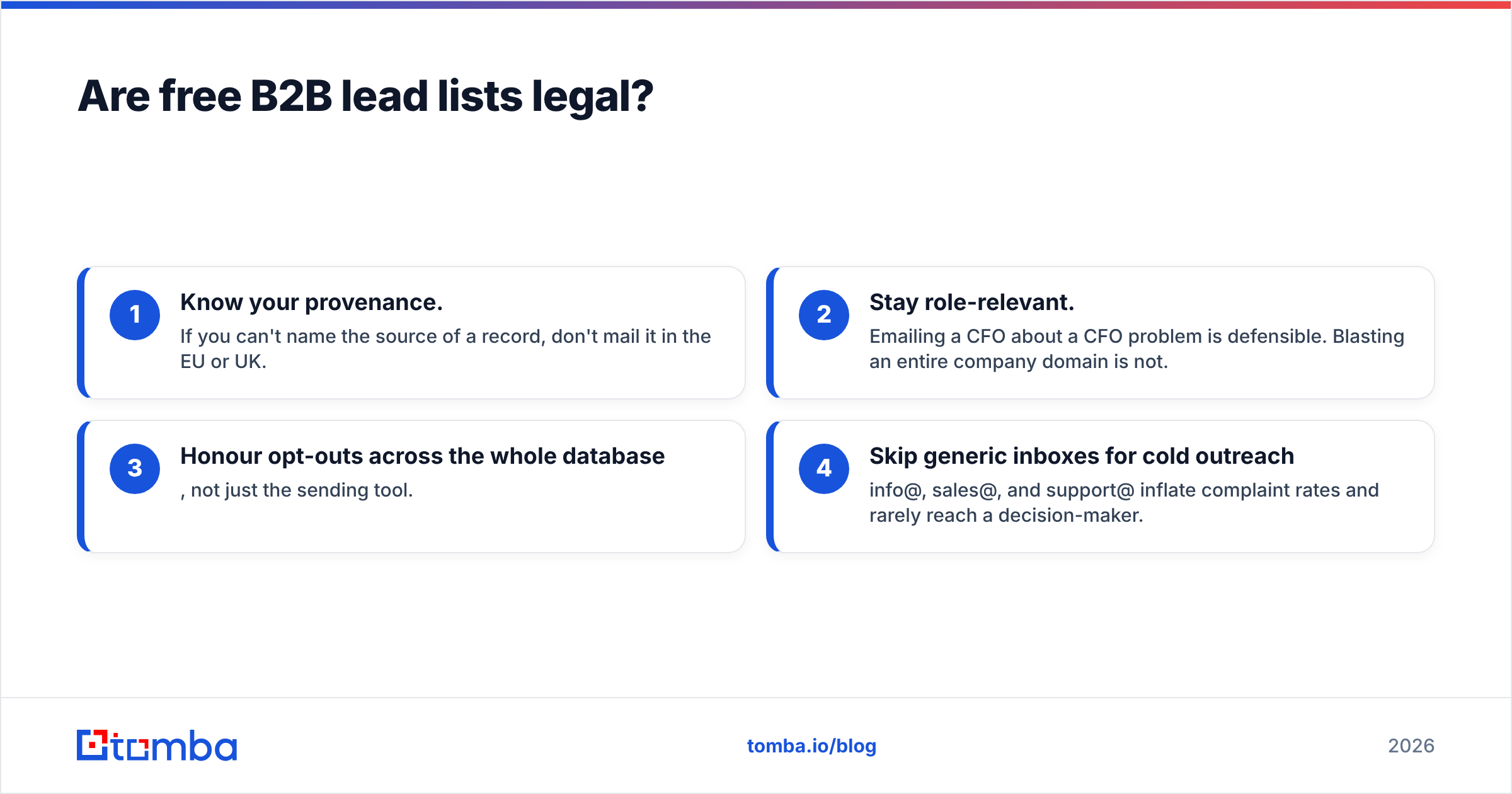
Practical rules that keep you out of trouble:
- Know your provenance. If you can't name the source of a record, don't mail it in the EU or UK.
- Stay role-relevant. Emailing a CFO about a CFO problem is defensible. Blasting an entire company domain is not.
- Honour opt-outs across the whole database, not just the sending tool.
- Skip generic inboxes for cold outreach — info@, sales@, and support@ inflate complaint rates and rarely reach a decision-maker.
How do you turn a free name into a verified email?#
This is the actual bottleneck. Names are abundant and free. Deliverable addresses are neither.
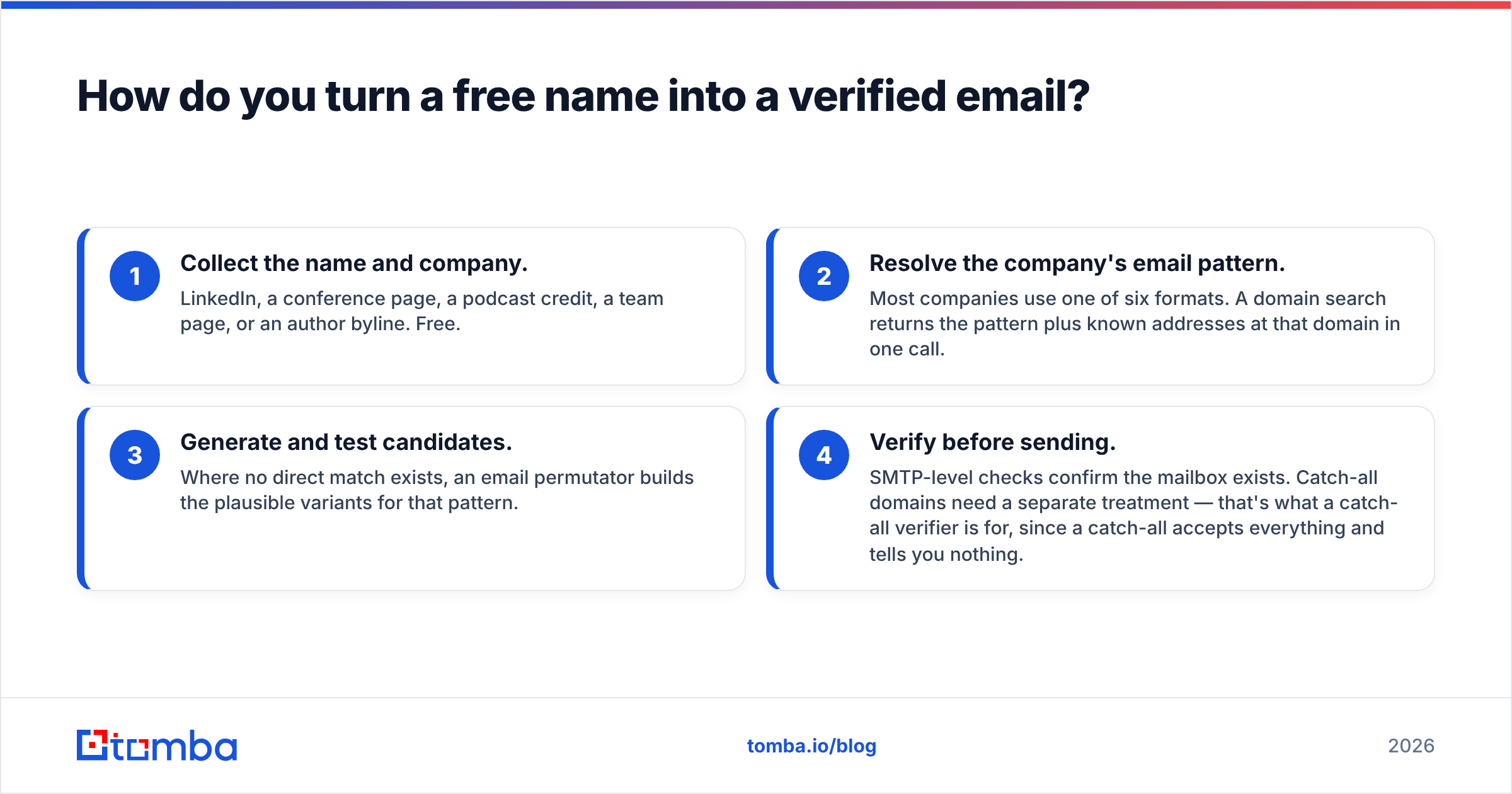
The workflow that works is four steps, and each one has a free or near-free option:
- Collect the name and company. LinkedIn, a conference page, a podcast credit, a team page, or an author byline. Free.
- Resolve the company's email pattern. Most companies use one of six formats. A domain search returns the pattern plus known addresses at that domain in one call.
- Generate and test candidates. Where no direct match exists, an email permutator builds the plausible variants for that pattern.
- Verify before sending. SMTP-level checks confirm the mailbox exists. Catch-all domains need a separate treatment — that's what a catch-all verifier is for, since a catch-all accepts everything and tells you nothing.
Skip step four and you've built a bounce machine. Do all four and a genuinely free list of 200 LinkedIn names converts into roughly 120–160 deliverable contacts, which is a perfectly respectable month of targeted outbound for a founder or a solo SDR.

Free tiers vs paid data: where's the break-even?#
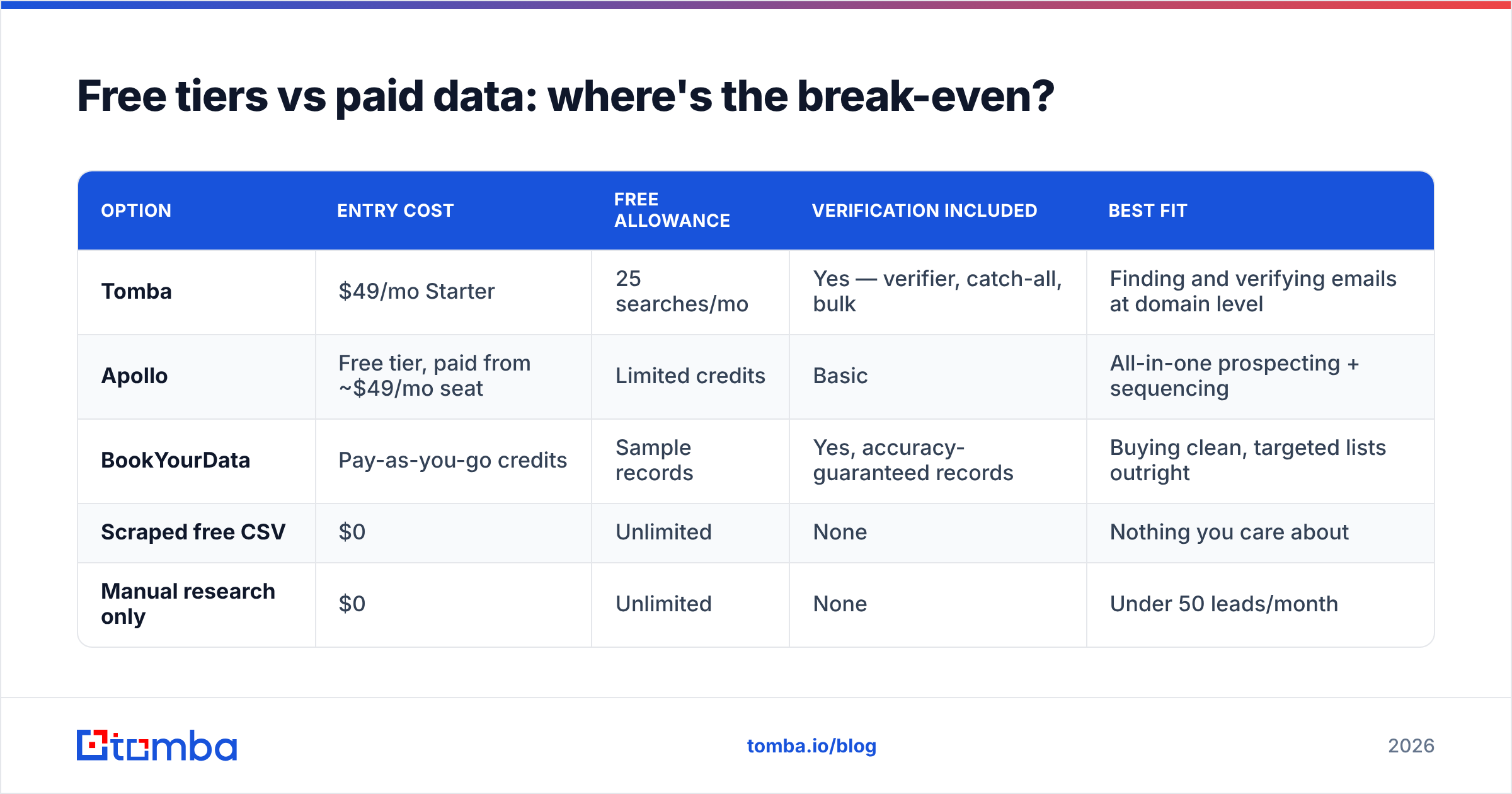
Here's the comparison that actually decides your stack. Prices reflect published 2026 entry tiers.
| Option | Entry cost | Free allowance | Verification included | Best fit |
|---|---|---|---|---|
| Tomba | $49/mo Starter | 25 searches/mo | Yes — verifier, catch-all, bulk | Finding and verifying emails at domain level |
| Apollo | Free tier, paid from ~$49/mo seat | Limited credits | Basic | All-in-one prospecting + sequencing |
| BookYourData | Pay-as-you-go credits | Sample records | Yes, accuracy-guaranteed records | Buying clean, targeted lists outright |
| Scraped free CSV | $0 | Unlimited | None | Nothing you care about |
| Manual research only | $0 | Unlimited | None | Under 50 leads/month |
Read the table as a time calculation, not a price calculation. Manual research runs roughly 4–6 minutes per fully qualified, verified contact. At 300 contacts a month, that's 20–30 hours. If your loaded hourly cost is $40, you just spent $800–$1,200 of labour to avoid a $49 subscription.
The break-even lands around 80–120 contacts per month. Below it, free tiers plus manual work genuinely win. Above it, paying for data is the cheaper option, and it isn't close. If you'd rather buy finished lists than build them, BookYourData sells verified records on a credit basis with an accuracy guarantee, which suits teams that want the list handed over rather than assembled.
For a broader view of who's in this category and how buyers rate them, the lead intelligence category on G2 is the least biased public scoreboard available.
What does a working free lead-gen stack look like?#
Assemble it in this order. Each layer feeds the next.
- Layer 1 — Capture. Visitor identification on your site, a gated asset that's actually worth gating, and a newsletter. This is your only compounding source.
- Layer 2 — Research. Manual LinkedIn and company-site prospecting against a tightly defined ICP. Narrow beats broad; 200 right-fit accounts outperform 2,000 random ones.
- Layer 3 — Resolution. Pattern detection plus an email finder to turn names into addresses. Free tier first, upgrade when you hit the ceiling.
- Layer 4 — Verification. Every record, every time. No exceptions, including records from paid providers.
- Layer 5 — Hygiene. Deduplicate, suppress existing customers and open opportunities, drop generic inboxes, and re-verify anything older than 90 days.
Teams that skip layers 4 and 5 report the same thing: great open rates for two weeks, then a cliff. The cliff is deliverability, and it's caused by the records you never checked.
What should you do this week?#
Pick one source and go deep instead of sampling all nine. For most teams the highest-yield move is: define 100 target accounts, find the two right people at each, resolve and verify their emails, and send a genuinely researched sequence to 200 contacts. That's a week of work and it will outperform 10,000 scraped rows every time — because the 10,000 rows will mostly bounce, and the ones that don't will be irrelevant.
Free B2B leads are a starting position, not a strategy. Use free tiers to prove your ICP and messaging with real replies. Once the motion works and you know what a qualified account looks like, the cost of data stops being the constraint and volume becomes the growth lever.
Start with the free tier of the Tomba Email Finder — 25 searches a month, verification included, no card required. Run your first 25 target accounts through it, verify every result, and measure your bounce rate against whatever list you were about to import. That single comparison tends to settle the free-versus-paid debate faster than any blog post can.
Related guides#
Ready to find emails that actually work?
Join 150,000+ professionals who stopped guessing and started sending. Free credits on signup — no credit card required.
Get the Tomba newsletter
Practical outbound tactics and product updates — once every two weeks.
About the author