Free Business Email Search: How to Find Work Emails in 2026
Free business email search sounds too good to be true — and sometimes it is. Here's what the free tiers actually give you in 2026, how accurate they are, and the exact point where free stops paying off.
TL;DR
- A free business email search gets you real work email addresses without a credit card — but every provider caps you somewhere between 10 and 50 lookups a month.
- Free tiers are for validating a tool, testing a niche, or finding 5-10 high-value contacts. They are not a prospecting engine.
- Accuracy varies more than volume does. A "free" tool that returns 60% bounce-prone guesses costs you more in domain reputation than a paid credit would have cost in cash.
- Tomba's free plan gives you 25 searches per month with the same data pipeline as paid plans, plus verification on every result.
- The switch point is usually around 40-60 verified contacts per month. Below that, stack free tiers. Above it, one $49/mo plan beats juggling six logins.
What is a free business email search?#
A free business email search is any method of finding a person's work email address — first.last@company.com — without paying for it. That covers three very different things, and mixing them up is where people waste time.
Method one: free tiers of commercial email finders. You create an account, get a monthly credit allowance (typically 10-50 lookups), and query by name + domain. The data comes from the same index paid customers use. You just get less of it.
Method two: free standalone web tools. Pattern generators, permutators, and single-address checkers that require no account. Useful, limited, and usually unverified.
Method three: manual OSINT. Digging through company sites, GitHub commit logs, press releases, WHOIS records, and conference speaker pages. Free in dollars, expensive in hours.
Most people asking about free business email search want method one and end up frustrated with method three. The rest of this guide covers what each is genuinely good for.
How does a business email finder actually work?#
Understanding the mechanics tells you why free tiers are capped the way they are — the expensive part isn't storing addresses, it's proving they exist.
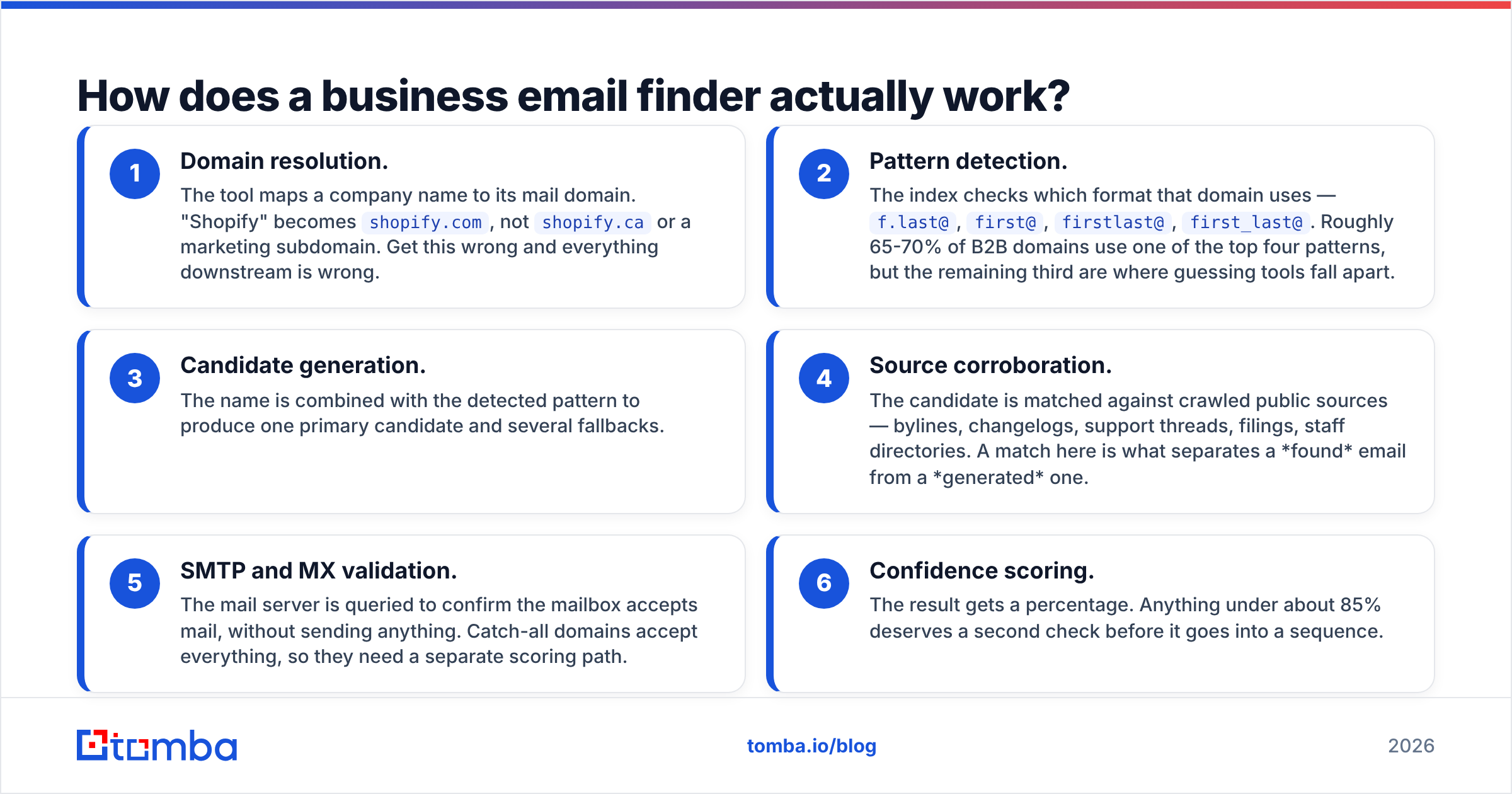
- Domain resolution. The tool maps a company name to its mail domain. "Shopify" becomes
shopify.com, notshopify.caor a marketing subdomain. Get this wrong and everything downstream is wrong. - Pattern detection. The index checks which format that domain uses —
f.last@,first@,firstlast@,first_last@. Roughly 65-70% of B2B domains use one of the top four patterns, but the remaining third are where guessing tools fall apart. - Candidate generation. The name is combined with the detected pattern to produce one primary candidate and several fallbacks.
- Source corroboration. The candidate is matched against crawled public sources — bylines, changelogs, support threads, filings, staff directories. A match here is what separates a found email from a generated one.
- SMTP and MX validation. The mail server is queried to confirm the mailbox accepts mail, without sending anything. Catch-all domains accept everything, so they need a separate scoring path.
- Confidence scoring. The result gets a percentage. Anything under about 85% deserves a second check before it goes into a sequence.
Free tools usually stop at step three. Paid tools — and the good free tiers that share the same backend — run all six. That difference is the entire accuracy story.

How accurate is a free business email search?#
Accuracy is where "free" splits into two camps, and the gap is wide.
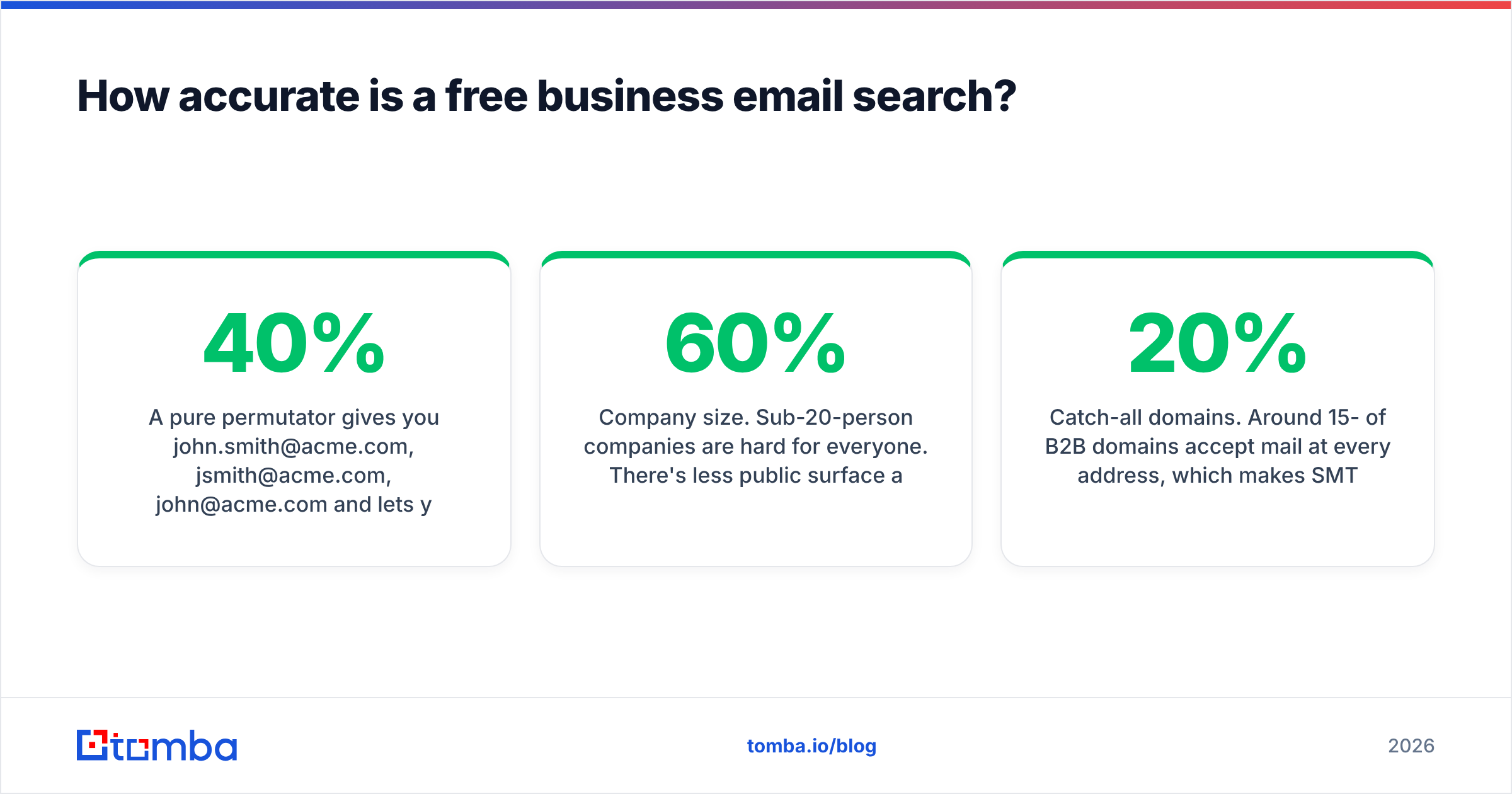
A pure permutator gives you john.smith@acme.com, jsmith@acme.com, john@acme.com and lets you sort it out. Send to all three and you've just generated two hard bounces on a domain where you wanted one conversation. Do that across 200 prospects and your bounce rate lands somewhere near 40% — well past the 2-3% threshold where Google and Microsoft start throttling you.
A free tier attached to a real index behaves differently. You get fewer lookups, but each one comes back with a source and a confidence score. That's the trade worth making.

Three things move accuracy more than the vendor's marketing page does:
- Company size. Sub-20-person companies are hard for everyone. There's less public surface area to crawl. Expect 40-60% hit rates on startups versus 85-95% on companies over 500 employees.
- Region. North American and Western European coverage is deep. APAC and LATAM coverage thins out fast, and free tiers rarely disclose this.
- Catch-all domains. Around 15-20% of B2B domains accept mail at every address, which makes SMTP validation useless. You need a scoring model, not a ping. If your tool returns "valid" for
asdfgh@theirdomain.com, it's a catch-all and the result means nothing. A dedicated catch-all verifier is the only honest way to handle these.
Run a control test before you trust any tool: pick 20 contacts you already have confirmed emails for, run them through the free tier, and measure. Twenty lookups is within almost every free allowance, and it tells you more than any review site.
Which free business email search tools are worth using in 2026?#
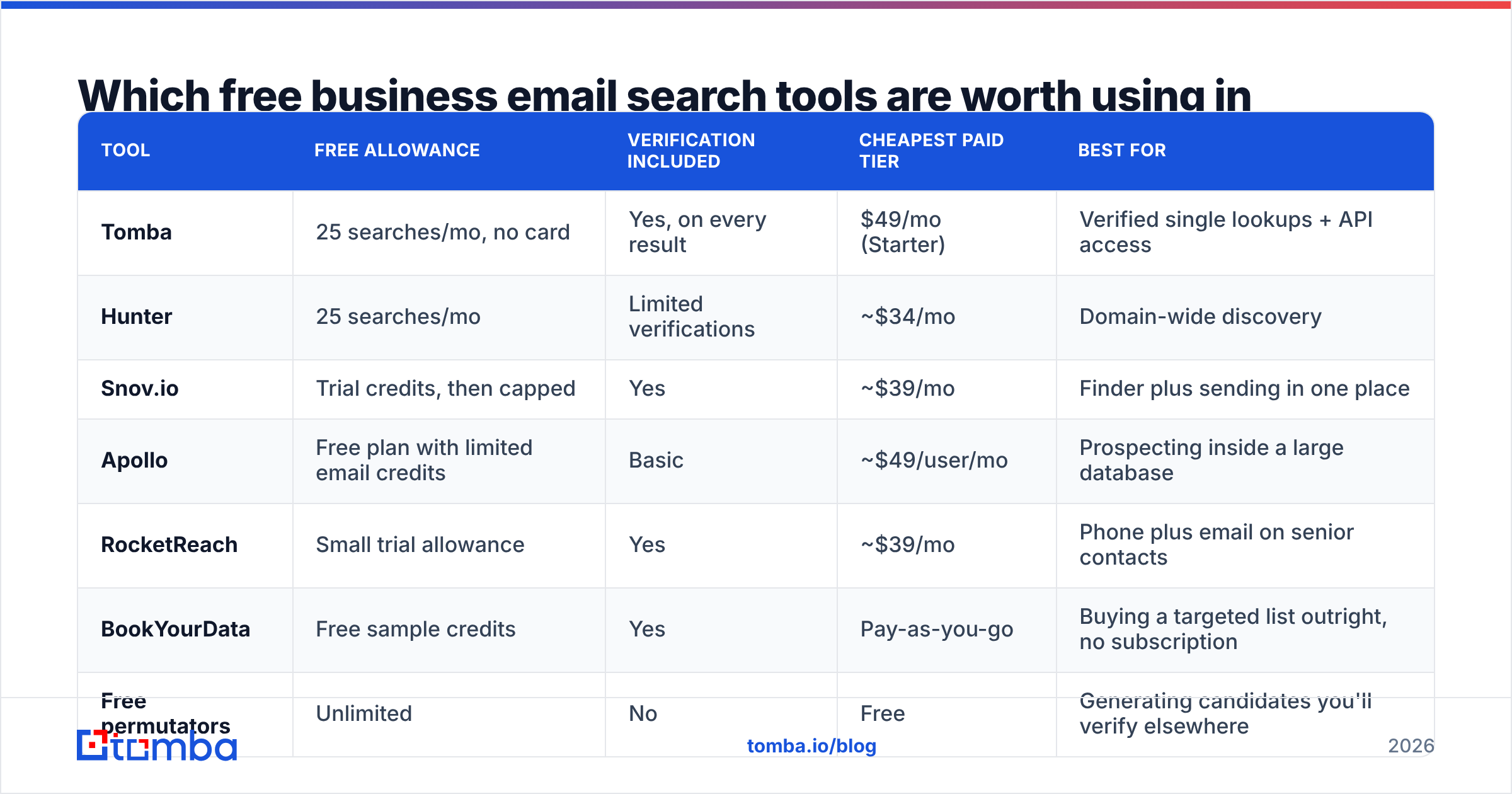
Free allowances change constantly — vendors adjust them quarterly. Treat the table below as a starting point and confirm on each provider's pricing page before you commit.

| Tool | Free allowance | Verification included | Cheapest paid tier | Best for |
|---|---|---|---|---|
| Tomba | 25 searches/mo, no card | Yes, on every result | $49/mo (Starter) | Verified single lookups + API access |
| Hunter | 25 searches/mo | Limited verifications | ~$34/mo | Domain-wide discovery |
| Snov.io | Trial credits, then capped | Yes | ~$39/mo | Finder plus sending in one place |
| Apollo | Free plan with limited email credits | Basic | ~$49/user/mo | Prospecting inside a large database |
| RocketReach | Small trial allowance | Yes | ~$39/mo | Phone plus email on senior contacts |
| BookYourData | Free sample credits | Yes | Pay-as-you-go | Buying a targeted list outright, no subscription |
| Free permutators | Unlimited | No | Free | Generating candidates you'll verify elsewhere |
A few notes the table can't carry.
Pay-as-you-go is underrated. If you need 300 contacts once a quarter rather than 50 every week, a credit-based provider like BookYourData often works out cheaper than any monthly seat, and there's nothing to cancel. Subscription tools win on recurring, steady volume; PAYG wins on bursty demand.
"Free forever" versus "free trial" matters more than the number. A 50-credit trial that expires in 7 days is a demo. A 25-search monthly reset is a tool you can build a small workflow around. Tomba's pricing keeps the free tier recurring at 25 searches per month, which is enough to keep a low-volume niche running indefinitely.
Seat pricing hides the real cost. Tools priced per user look cheap at one seat and stop being cheap at four. Credit-based pricing scales with usage instead of headcount.

How do you run a free business email search step by step?#
Here's the workflow that squeezes the most out of a capped allowance. The core principle: never spend a paid credit on something a free step can answer.
Step 1 — Confirm the domain first. Use the company's actual site, not a guess. Corporate mail domains often differ from marketing domains. This costs nothing and prevents wasted lookups.
Step 2 — Detect the pattern for free. Run one lookup on any known employee at that company — a founder, a support lead, someone with a public byline. Once you know the domain uses f.last@, you can generate the rest of your list without burning a lookup each. A company email pattern check does this in one query.
Step 3 — Generate candidates in bulk. Feed names and the confirmed pattern into an email permutator. This is free and unlimited. You now have a candidate list, not a verified one.
Step 4 — Verify, don't guess. This is the step people skip and then blame the tool. Run candidates through an email verifier before anything enters a sequence. Verification is cheaper than finding, and a bounce costs more than both.
Step 5 — Handle catch-alls separately. Anything flagged catch-all goes into its own bucket. Either score it, find a second confirming source, or exclude it. Don't send blind.
Step 6 — Log what worked. Track hit rate by company size and region. After 100 lookups you'll know exactly which segments your free tier handles well, and you'll stop wasting credits on the ones it doesn't.
For a whole-company view rather than one person, a domain search returns every public address on a domain at once, which is usually a better use of a limited allowance than five individual lookups.
What's the catch with free email search tools?#
Every free tier is a lead magnet. That's fine — you just need to know which lever the vendor pulled.
- Volume caps. The obvious one. 25/month is roughly one contact per working day.
- Feature gating. Free plans commonly exclude bulk upload, CSV export, API access, and CRM integrations. You can find the email but not move it anywhere efficiently.
- Verification stripped out. Some tools give generous free finding but charge for verification, which is exactly backwards from a deliverability standpoint. Unverified volume is a liability.
- Data freshness tiers. A few providers serve older index snapshots on free plans. With B2B job changes running around 20-25% annually, a stale record is a wrong record.
- Rate limits and queues. Free requests get deprioritized. Fine for 25 lookups, painful at scale.
- Support. Email-only, multi-day response. Expected, but plan around it.
None of these are dishonest. They become a problem only when you build a process on a free tier and then discover the export button is locked the week before a campaign launch.
Is free business email search legal?#
Short answer: finding a publicly available business email address is generally legal in most jurisdictions, but how you use it is regulated.
Under GDPR, business contact data is still personal data. The usual basis for cold outreach in B2B is legitimate interest, which requires that your message be relevant to the recipient's professional role, that you identify yourself clearly, and that you honor opt-outs immediately. The ICO's guidance on direct marketing is the practical reference here.
In the US, CAN-SPAM permits cold commercial email but requires accurate headers, a real physical address, and a working unsubscribe mechanism processed within 10 business days.
Two rules that keep you out of trouble regardless of jurisdiction:
- Only contact people whose job makes your message relevant. Blasting a whole domain is where legitimate interest collapses.
- Suppress on first request, permanently, across every tool you use.
Reputable providers document where their data comes from. Tomba publishes its data sources — if a vendor won't tell you where the records originate, that's your answer.
When should you stop using free and start paying?#
Run the math instead of the vibe check.
Say you need 60 verified contacts a month. On a 25-search free tier you cover 25, then you're stacking a second and third free account to reach 60 — three logins, three exports, three formats, manual dedupe. That's easily two hours a month of admin. At any reasonable hourly rate, you've spent more than $49 to save $49.
The switching signals are consistent:
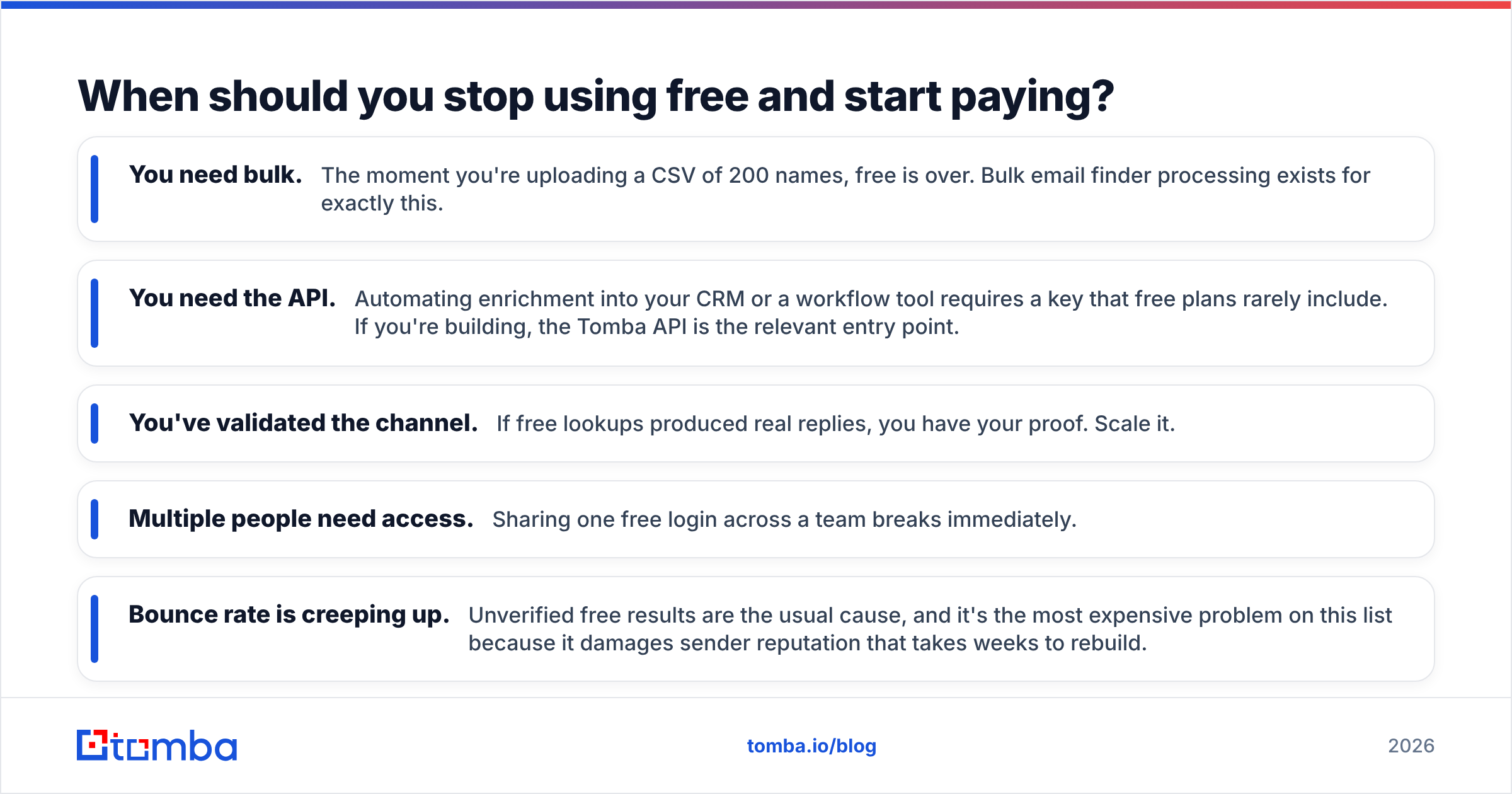
- You need bulk. The moment you're uploading a CSV of 200 names, free is over. Bulk email finder processing exists for exactly this.
- You need the API. Automating enrichment into your CRM or a workflow tool requires a key that free plans rarely include. If you're building, the Tomba API is the relevant entry point.
- You've validated the channel. If free lookups produced real replies, you have your proof. Scale it.
- Multiple people need access. Sharing one free login across a team breaks immediately.
- Bounce rate is creeping up. Unverified free results are the usual cause, and it's the most expensive problem on this list because it damages sender reputation that takes weeks to rebuild.
If you're comparing options at that point, G2's email-finder category and vendor pricing pages like Hunter's give you current, non-marketing numbers to check against.
What's the honest verdict on free business email search?#
Free business email search is real, useful, and genuinely sufficient for a defined set of jobs: testing a tool before you commit, researching a handful of high-value accounts, checking data quality against contacts you already know, and running low-volume outreach in a narrow niche.
It is not sufficient for building a pipeline. The caps exist because verified B2B contact data is expensive to maintain, and any vendor giving it away without limit is either serving stale records or subsidizing you with something worse.
The right move is to use free tiers deliberately — pattern detection first, permutation second, verification always — and to upgrade the moment admin time exceeds subscription cost. That crossover happens sooner than most people expect.
Ready to test it against your own list? Start with the Tomba Email Finder free plan — 25 searches a month, no card required, every result verified against the same pipeline paid customers use. Run your 20-contact control test, measure the hit rate on your actual target segment, and let the numbers decide whether you ever need to upgrade.
Related guides#
Ready to find emails that actually work?
Join 150,000+ professionals who stopped guessing and started sending. Free credits on signup — no credit card required.
Get the Tomba newsletter
Practical outbound tactics and product updates — once every two weeks.
About the author