Free Cold Calling Software in 2026: 9 Tools and Their Limits
Every "free" dialer hides a ceiling somewhere: minutes, seats, numbers, or recordings. Here's what nine free cold calling tools actually give you, and the exact point where each one stops being free.
TL;DR
- Genuinely free cold calling software exists, but it is free in one of three ways: a free softphone with no minutes, a free CRM with a tiny minute allowance, or a self-hosted open-source PBX you run yourself.
- The cheapest honest setup for a solo rep in 2026 is a free softphone (Zoiper, Linphone, MicroSIP) plus pay-as-you-go SIP trunking at roughly $0.008–$0.015 per US minute. That is often under $15/month for 1,000 minutes.
- Free plans almost never include the three things that actually raise connect rates: local presence dialing, parallel dialing, and branded caller ID.
- The real bottleneck is rarely the dialer. It is phone number accuracy. A free dialer calling a 40% stale list burns more money in rep time than any paid tool costs.
- Pay for software once you exceed ~500 dials/month, need call recording for coaching, or need calls logged into a CRM automatically.
What counts as "free cold calling software"?#
Free cold calling software is any tool that lets you place outbound business calls without a recurring license fee. That definition splits into four categories, and confusing them is why most "free dialer" lists are useless.
- Free softphones. Desktop or mobile apps that place calls over SIP. The app is free forever. The calling minutes are not — you bring your own VoIP carrier. Examples: Zoiper, Linphone, MicroSIP.
- Free tiers of commercial platforms. A real product with a permanently free plan, capped by seats, minutes, or features. Examples: HubSpot's free CRM with calling, Bitrix24's free plan, Zadarma's free cloud PBX.
- Open-source, self-hosted systems. No license cost, real infrastructure cost. FreePBX/Asterisk, VICIdial, FusionPBX. Free like a puppy is free.
- Free trials dressed as free plans. 7–14 days of a paid dialer. Useful for evaluation, useless as a standing setup. Aircall, Kixie, Dialpad, CloudTalk, JustCall all live here.
Only categories 1–3 are actually free. Category 4 belongs in your evaluation calendar, not your stack.
Which free cold calling tools are worth your time in 2026?#
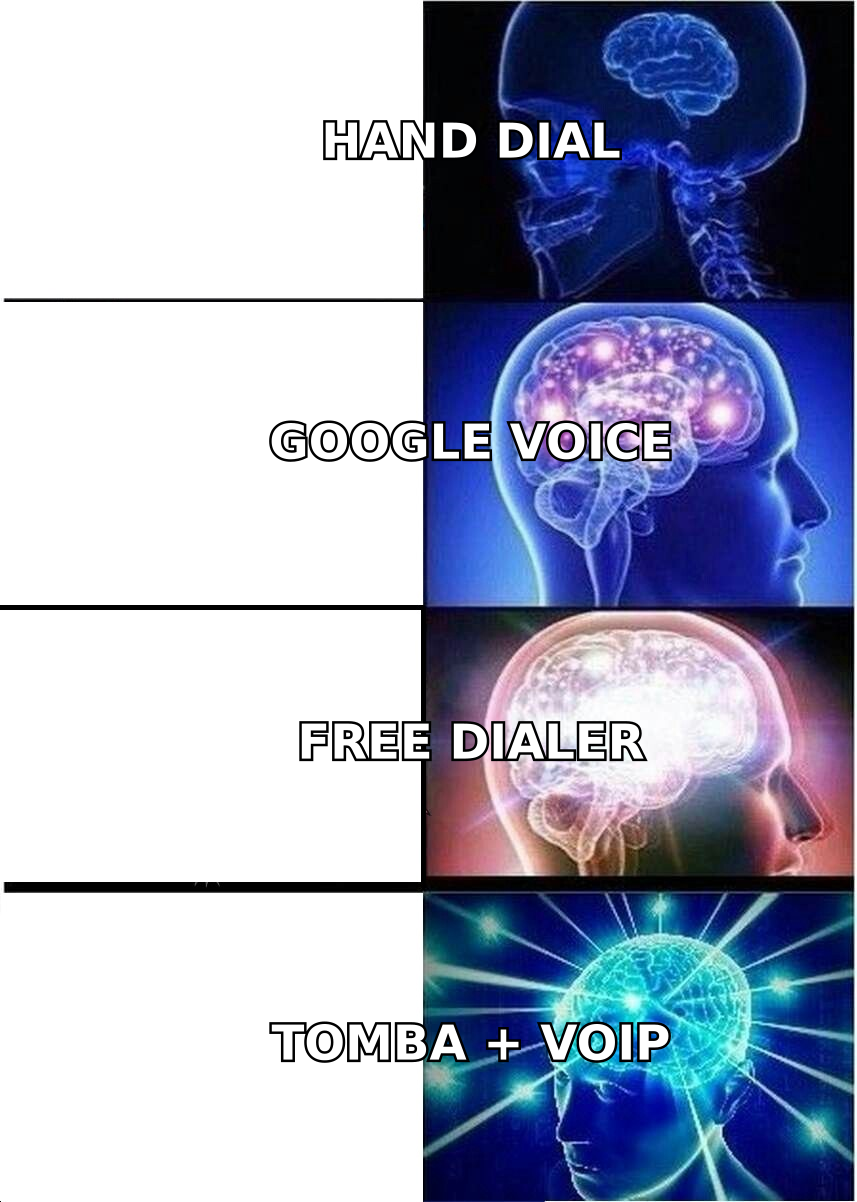
Here is the honest breakdown. Verify current limits on each vendor's own page before you commit — free tiers change quarterly and several of these were repriced in the last 18 months.
| Tool | What's free | Hard limit | Best for | Where it breaks |
|---|---|---|---|---|
| Zoiper (softphone) | App on desktop + mobile, unlimited SIP calls | No minutes included; premium codecs paid | Solo rep with a SIP trunk | No CRM logging, no analytics |
| MicroSIP / Linphone | Fully open-source SIP client | Windows-only (MicroSIP); bare UI | Technical users, cheap per-minute calling | Zero pipeline features |
| HubSpot free CRM | CRM, contact records, in-app calling | Small monthly calling-minute allowance per user | Reps who need calls logged to records | Minutes run out inside a week of real dialing |
| Bitrix24 free | CRM + telephony framework, unlimited users | Numbers and minutes are rented separately | Small teams wanting one shared workspace | Interface complexity; telephony isn't free |
| Zadarma | Free cloud PBX, free internal calls | Outbound minutes and DIDs cost extra | International teams needing cheap DIDs | Support depth on the free plan |
| Google Voice (personal) | One US number, US/Canada calls | Personal use only; no bulk outbound | Testing a script, low-volume follow-up | ToS risk for sustained cold outreach |
| FreePBX / Asterisk | Full PBX software, unlimited extensions | You supply server, trunking, and admin time | Teams with an ops person | Setup measured in days, not minutes |
| VICIdial | Open-source predictive dialer | Self-hosted; steep learning curve | High-volume call centers on a budget | Compliance config is entirely on you |
| Paid-tool free trials | Full feature set | 7–14 days | Head-to-head evaluation | Ends exactly when you build momentum |
The pattern is consistent: you can get free software or free minutes, never both at scale. Anyone advertising both is either running a trial or funding it with your data.
Is a free dialer actually enough for cold calling?#
For under roughly 500 dials a month, yes. Past that, the math flips.
Run the numbers. A rep making 60 manual dials a day spends about 15 seconds per dial on lookup, copy, paste, and typo correction. That is 15 minutes a day, 5.5 hours a month, gone. At a loaded rep cost of $45/hour, you burned $247 to avoid a $50 software bill.
That is the entire case for paid dialers, and it only holds when your list is good. If 35% of your numbers are wrong, a power dialer just helps you reach voicemail faster. Fix data quality first, tooling second.
Three capabilities separate free from paid, and each maps to a measurable metric:
- Click-to-call with CRM logging — kills the 15-second tax per dial and makes activity data trustworthy.
- Local presence / branded caller ID — moves answer rates from the low single digits into the 8–12% range for most B2B lists. Free tools essentially never offer it.
- Parallel or power dialing — 3–4x the dial volume per hour. Also 3–4x the compliance exposure if configured carelessly.
If none of those three moves your number this quarter, stay free.
How do you build a free cold calling stack that actually works?#
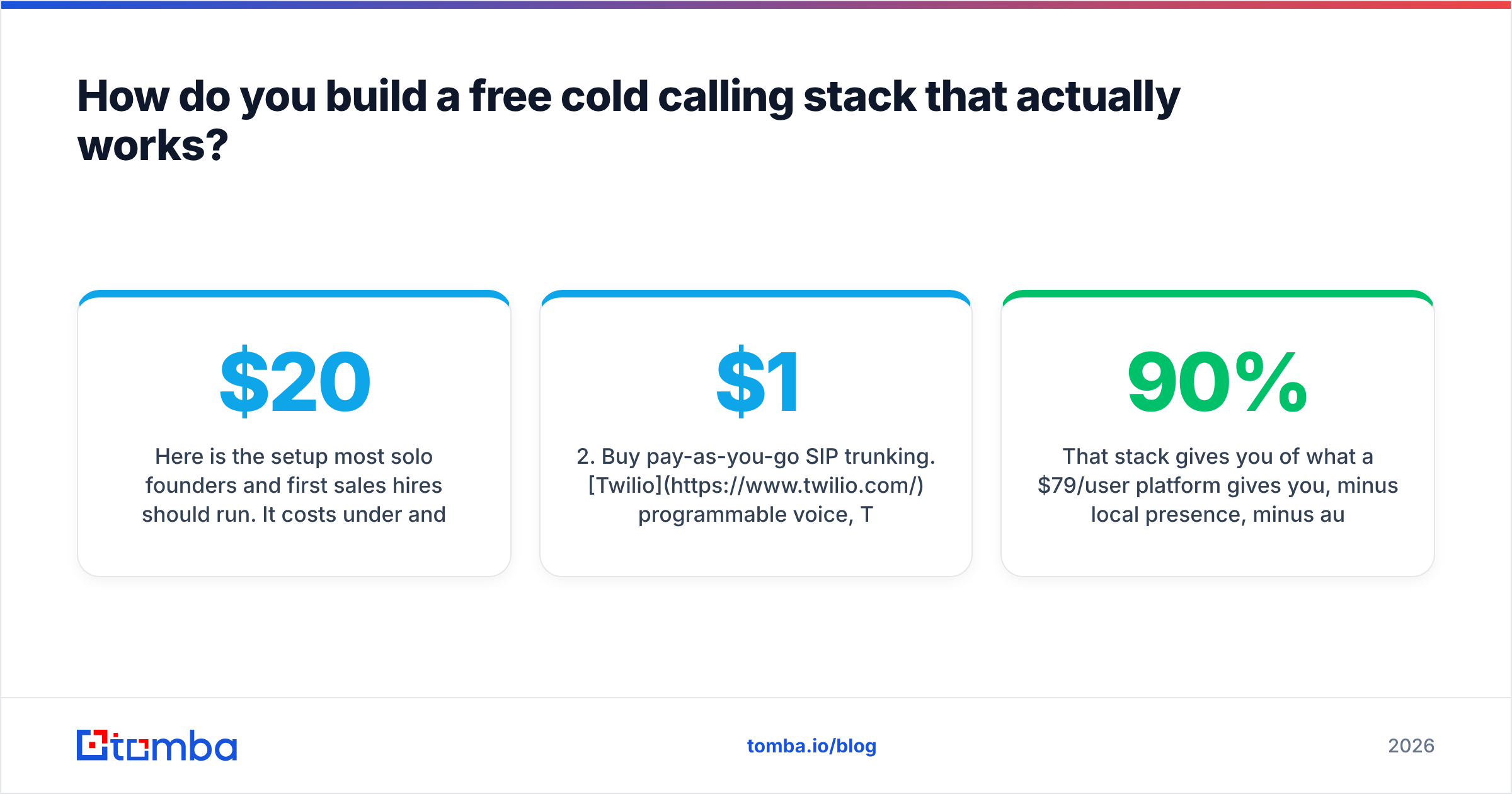
Here is the setup most solo founders and first sales hires should run. It costs under $20/month and covers everything except local presence.
- Pick a free softphone. Zoiper on Mac/Windows/mobile, MicroSIP if you're on Windows and want the lightest possible client. Both register to any SIP provider in about five minutes.
- Buy pay-as-you-go SIP trunking. Twilio programmable voice, Telnyx, or Zadarma. Expect roughly $1/month per number plus fractions of a cent per minute. There is no subscription to cancel.
- Use a free CRM as the system of record. HubSpot's free tier handles contacts, call notes, and tasks without a card. Log outcomes manually if you must; the discipline matters more than the automation.
- Verify numbers before you dial. Run your list through a phone validator so you're not paying per-minute charges to reach disconnected lines. This single step usually recovers more time than the dialer does.
- Keep a written disposition scheme. Six outcomes maximum: connected, voicemail, gatekeeper, wrong number, callback booked, not interested. Anything more granular gets logged inconsistently.
- Record your own calls locally where legally permitted. Free platforms rarely include recording, and you cannot coach what you cannot replay.
That stack gives you 90% of what a $79/user/month platform gives you, minus local presence, minus automatic call logging, minus a manager dashboard.
What does free cold calling software cost you in hidden ways?#
Four costs show up on the invoice you never see.
Compliance exposure. Paid platforms ship with DNC scrubbing, calling-hour enforcement, and consent tracking. Self-hosted and softphone setups ship with none of it. In the US, the FCC's telemarketing rules and state-level equivalents apply to B2B outreach more often than reps assume, and 2024–2025 brought tighter consent standards. Build your own scrubbing step, or accept the risk knowingly.
Data quality drift. B2B contact data decays roughly 2–3% per month as people change roles. A free stack has no enrichment loop, so your list quietly rots. This is where a phone finder or scheduled re-enrichment run earns its keep — not glamorous, but it is the difference between a 12% connect rate and a 4% one.
Admin time. FreePBX and VICIdial are legitimately powerful and legitimately expensive in hours. Budget 8–20 hours for initial setup and a few hours monthly for patching. If nobody on the team enjoys that work, it will not get done, and an unpatched PBX is a security problem, not just an ops one.
Coaching blind spots. No recording, no talk-time ratios, no objection tagging. For a solo operator that's survivable. For a team of three or more, you're managing on vibes.
How do free plans compare to entry-level paid dialers?#
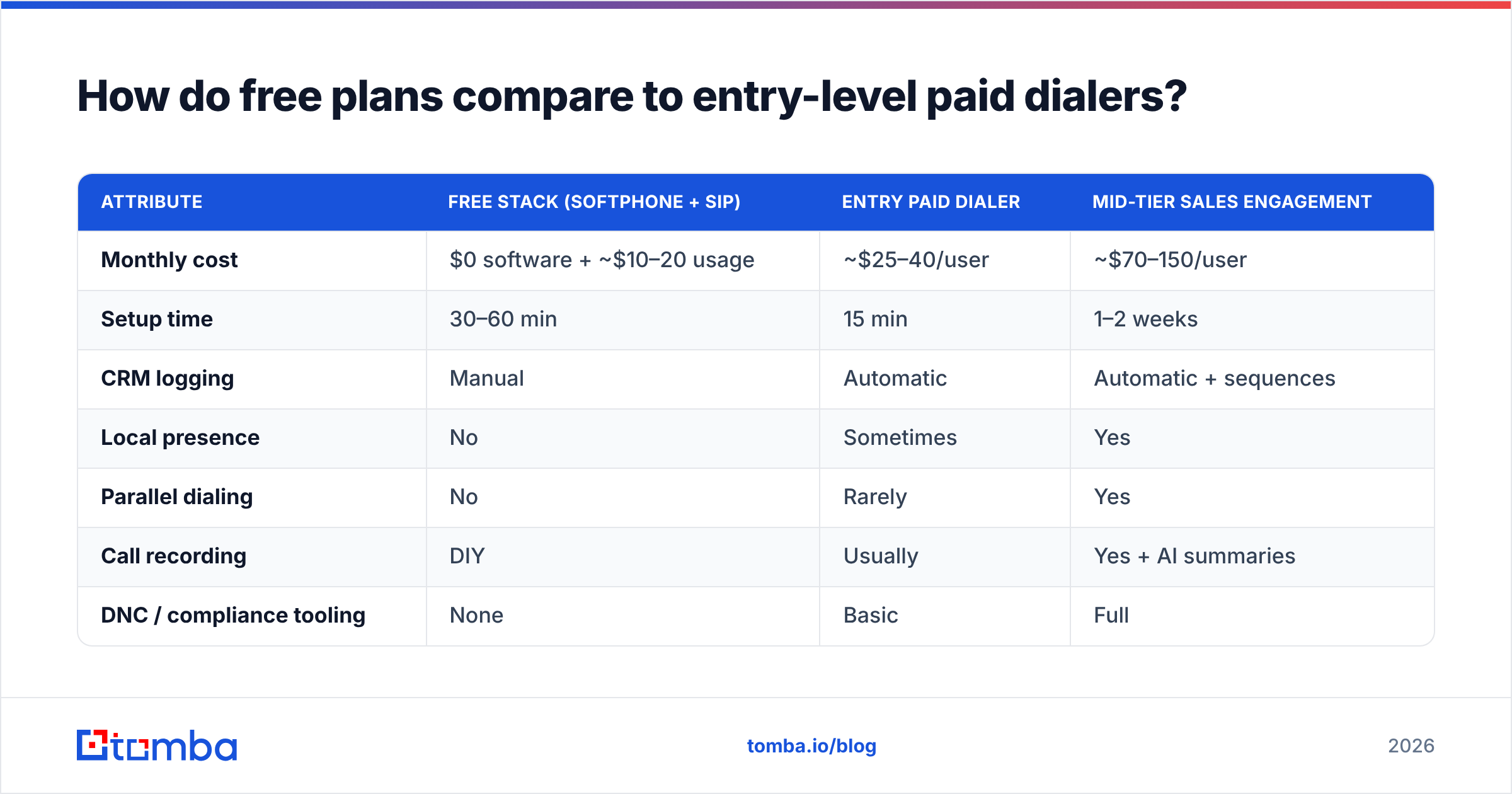
Once you decide to pay, the entry tier is remarkably consistent across vendors. Here's the shape of the market at the low end.
| Attribute | Free stack (softphone + SIP) | Entry paid dialer | Mid-tier sales engagement |
|---|---|---|---|
| Monthly cost | $0 software + ~$10–20 usage | ~$25–40/user | ~$70–150/user |
| Setup time | 30–60 min | 15 min | 1–2 weeks |
| CRM logging | Manual | Automatic | Automatic + sequences |
| Local presence | No | Sometimes | Yes |
| Parallel dialing | No | Rarely | Yes |
| Call recording | DIY | Usually | Yes + AI summaries |
| DNC / compliance tooling | None | Basic | Full |
| Realistic dial ceiling | ~40–60/day | ~80–120/day | ~200–300/day |
The jump from free to entry paid buys you time. The jump from entry to mid-tier buys you volume and management visibility. Neither buys you a better list.
Read vendor claims on G2 with the usual skepticism — review volume correlates with marketing spend more than product quality — but the category pages are useful for spotting which tools have real teams behind them versus which are wrappers on someone else's carrier.
When should you stop using free cold calling software?#
Four triggers. Any one of them is enough.
You crossed 500 dials a month. The manual-dial time tax now exceeds a paid license. Do the arithmetic with your actual loaded rep cost, not a guess.
You hired a second caller. The moment you need to compare two reps' activity, you need automatic logging. Self-reported dial counts are fiction, kindly or otherwise.
Your connect rate sits below 4%. That's usually a data problem, not a dialer problem — but it's also the point where local presence and branded caller ID start paying for themselves. Fix data first, then buy presence.
You need call recordings for onboarding. Ramping a new rep on recorded calls cuts time-to-first-meeting substantially. No free tool does this cleanly.
If none of those apply, spend the money on data instead. Contact accuracy compounds; dialer features don't.
How do you keep your calling list from going stale?#
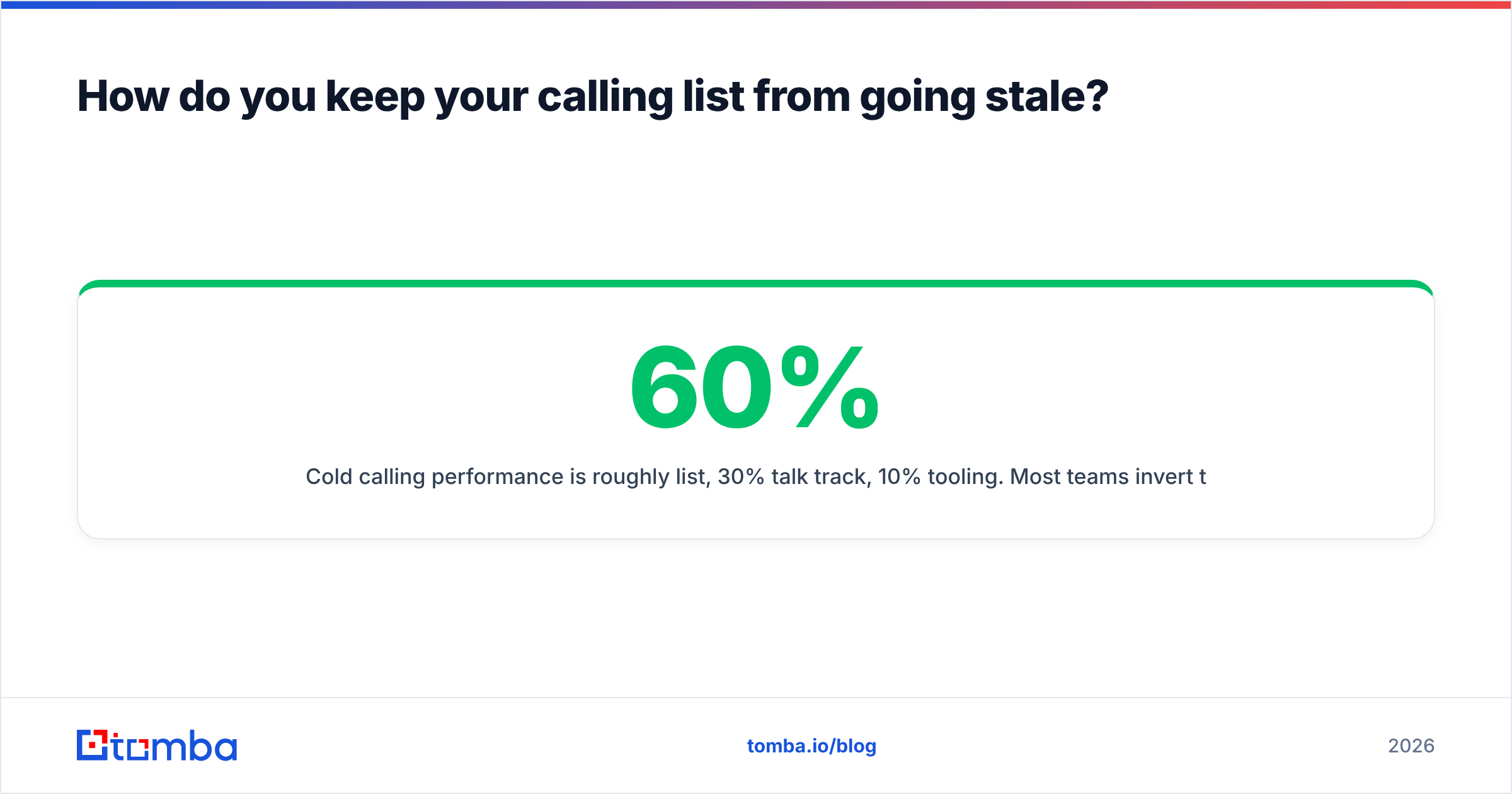
Cold calling performance is roughly 60% list, 30% talk track, 10% tooling. Most teams invert that.
A workable maintenance loop:
- Monthly: re-verify the numbers you plan to dial next month. Drop disconnected lines before they cost you minutes.
- Quarterly: re-enrich job titles. Half your "wrong number" outcomes are actually "right number, person left."
- Continuously: capture direct dials from every connected call. Reps who ask "is this the best number to reach you?" build a better database than any vendor sells.
- Before every campaign: dedupe. Calling the same prospect twice in a week from two lists is the fastest way to get a company-wide block.
If your calling list comes from the same source as your email list, keep both current together. Pairing a bulk email finder run with a phone-number refresh means one enrichment pass keeps both channels alive, and multichannel sequences stop breaking halfway through. For teams that already run outreach programmatically, the same data is available through the Tomba API, so the refresh becomes a scheduled job rather than a monthly chore someone forgets.
Also worth knowing: several established B2B data vendors, including BookYourData, sell verified contact lists outright rather than by subscription. If your motion is a handful of large campaigns per year rather than continuous prospecting, a one-time verified list can be more economical than a monthly seat.
What's the verdict on free cold calling software?#
Free cold calling software is a legitimate starting point, not a permanent home. A softphone plus pay-as-you-go SIP will carry a solo rep through their first several thousand dials at a cost that rounds to nothing. Open-source PBX systems will carry a scrappy team further, if someone genuinely wants to own the infrastructure.
What free tools cannot do is make a bad list good. Every dialer in this article — free, paid, self-hosted, or otherwise — is a delivery mechanism. The variable that actually decides whether cold calling works for you is whether the number on the screen belongs to a person who currently holds the job you think they hold.
So spend nothing on the dialer until volume forces your hand, and spend deliberately on data from day one. That ordering is what separates teams whose cold calling program survives quarter three from the ones quietly shelving it.
Start with the list, not the dialer. Tomba's Email Finder gives you verified professional contacts by name or domain, and the free tier includes 25 searches a month so you can test list quality before spending a cent. Paid plans start at $49/month (Starter), with Growth at $99/month — see full Tomba pricing for credit volumes. Build the list, verify the numbers, then pick whichever dialer your volume justifies.
Related guides#
Ready to find emails that actually work?
Join 150,000+ professionals who stopped guessing and started sending. Free credits on signup — no credit card required.
Get the Tomba newsletter
Practical outbound tactics and product updates — once every two weeks.
About the author