Free Lead Generation Software in 2026: What Actually Works
Most free lead generation tools cap you before you build a real pipeline. Here's what 12 free tiers actually give you in 2026, where the ceilings hide, and how to stack them into a working system for $0.
TL;DR
- Free lead generation software is real, but almost every "free forever" plan is a credit faucet — the average B2B free tier gives you 25–50 usable contacts per month, not a pipeline.
- The three costs that actually matter on a free plan: monthly credit cap, whether verification is bundled or billed separately, and whether you can export the data you find.
- You can assemble a genuinely functional $0 stack: a source of prospects (LinkedIn/directories), a free email finder tier, a free verifier, and a free sender. Expect ~100–200 verified contacts/month before you hit walls.
- Free trials and free tiers are not the same thing. A 7-day trial with 500 credits is worse than 25 credits/month forever if you prospect year-round.
- Upgrade when your time is worth more than the credits. At roughly 300+ contacts/month, paid tiers (Tomba Starter at $49/mo, comparable tools $49–$99) cost less than the hours you burn stitching free tools together.
What Counts as Free Lead Generation Software?#
Three very different things get filed under "free," and mixing them up is why most people waste a week.
- Free forever tiers — a permanently available plan with a hard monthly cap. Tomba's 25 searches/month, HubSpot's free CRM, Mailchimp's free contact tier. Low ceiling, no expiry, no card required in most cases.
- Free trials — full or near-full product access for 7–14 days. Great for a single burst of list-building, useless as infrastructure.
- Freemium with a functional core — the free plan does one job completely (a CRM that stores unlimited contacts, a form builder with unlimited submissions) and charges for automation, seats, or advanced reporting.
- Free standalone utilities — no account, no cap, single-purpose. An email permutator, a free email checker, an SPF checker. These are the most honestly free category and the most underrated.
- Open-source self-hosted — Mautic, EspoCRM, Odoo Community. Zero license cost, real infrastructure cost. You're trading dollars for DevOps hours.
Categories 1 and 4 are where free lead generation software delivers actual value for a solo founder or a small SDR team. Category 2 is a sampling exercise. Category 5 only makes sense if you already run servers.
The practical question isn't "is it free?" — it's "how many usable, verified, exportable contacts does this give me per month at $0?" That number is usually much smaller than the marketing page implies.
Which Free Tiers Actually Give You Usable Volume in 2026?#
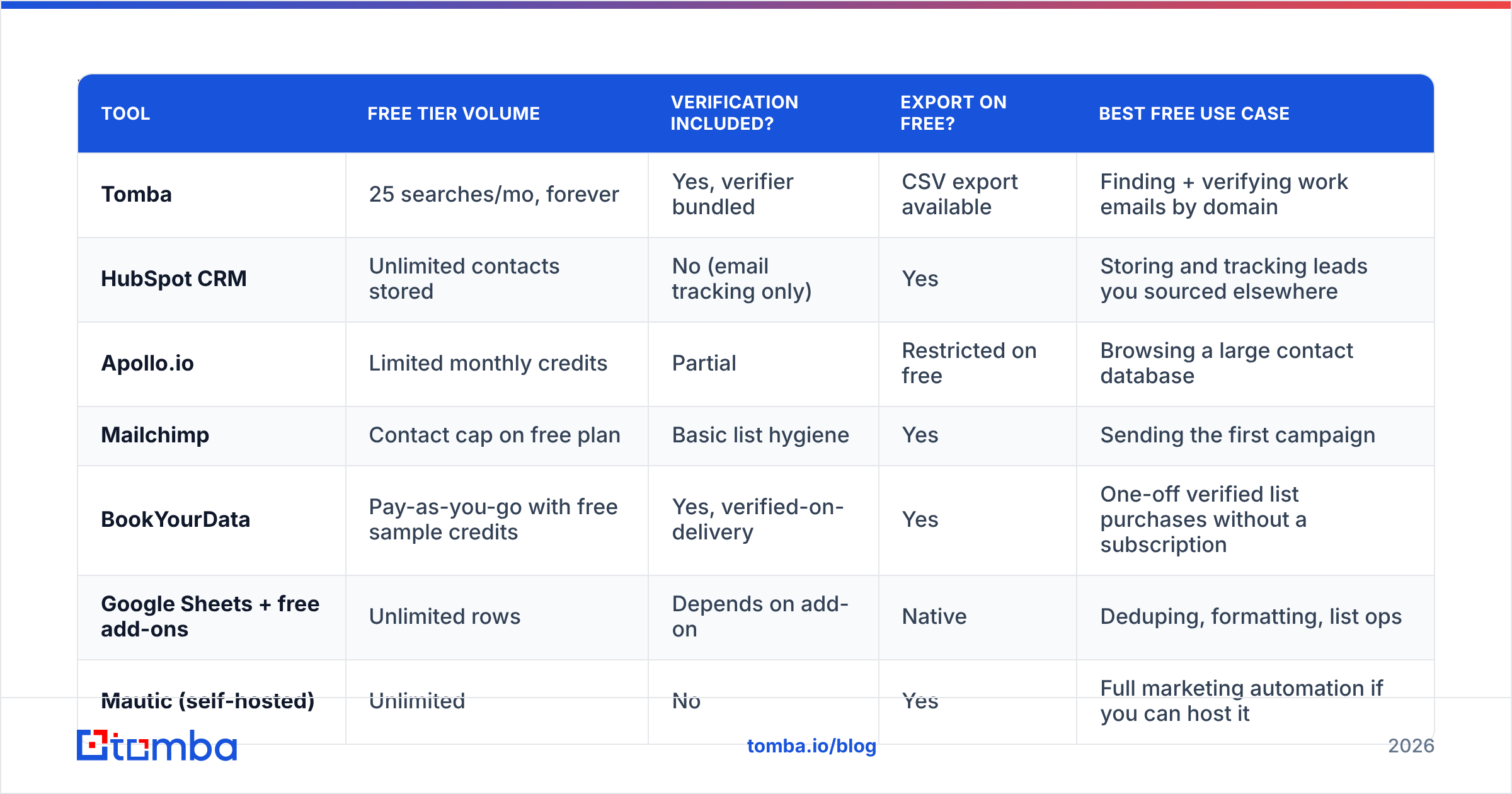
Here's the comparison that matters. All figures are the free-plan values as published by each vendor; verify before you commit, since free tiers change more often than paid ones.
| Tool | Free tier volume | Verification included? | Export on free? | Best free use case |
|---|---|---|---|---|
| Tomba | 25 searches/mo, forever | Yes, verifier bundled | CSV export available | Finding + verifying work emails by domain |
| HubSpot CRM | Unlimited contacts stored | No (email tracking only) | Yes | Storing and tracking leads you sourced elsewhere |
| Apollo.io | Limited monthly credits | Partial | Restricted on free | Browsing a large contact database |
| Mailchimp | Contact cap on free plan | Basic list hygiene | Yes | Sending the first campaign |
| BookYourData | Pay-as-you-go with free sample credits | Yes, verified-on-delivery | Yes | One-off verified list purchases without a subscription |
| Google Sheets + free add-ons | Unlimited rows | Depends on add-on | Native | Deduping, formatting, list ops |
| Mautic (self-hosted) | Unlimited | No | Yes | Full marketing automation if you can host it |
Two patterns jump out.
Storage is cheap, discovery is expensive. CRMs give away unlimited contact storage because storage costs them nothing and lock-in is the product. Data providers meter hard because every lookup costs them real money — SMTP checks, database licensing, and infrastructure. Any tool that gives away unlimited discovery is either selling stale data or about to change its pricing.
Verification is the hidden line item. A free finder that hands you 50 unverified addresses is worse than one that hands you 25 verified ones. Unverified lists torch your sender reputation inside two sends. Check whether verification is bundled or a separate credit pool before you count a tier as generous.

Accuracy matters more on a free plan than a paid one, oddly. When you have 5,000 credits, a 15% bounce rate is annoying. When you have 25, four wasted credits is 16% of your entire month.
How Do You Build a Working $0 Stack?#
Think of it like cooking with a bare pantry. You can't make everything, but you can make one good meal if you sequence the steps right. A functioning free lead gen stack has four layers, and each layer has a genuinely free option.
Layer 1 — Source. Where do names come from? Free options: LinkedIn search (free account, ~limited searches/month before the commercial-use cap hits), industry directories, G2 and Capterra category pages, conference attendee lists, podcast guest archives, and your own website traffic. This layer costs nothing but time. It produces names and companies, not contact details.
Layer 2 — Find. Turn "Sarah Chen, VP Marketing, Acme Corp" into a real inbox. This is where free tiers bite hardest. Use a domain search to pull the pattern for a company once, then apply that pattern manually to the rest of the team instead of burning a credit per person. If Acme uses first.last@acme.com, you just derived 20 addresses from one lookup. Combine with the company email pattern tool to confirm the format before you extrapolate.
Layer 3 — Verify. Never skip this. Pattern-derived addresses are educated guesses; some percentage will bounce. Run them through an email verifier before they touch a sending tool. Catch-all domains need separate handling — a catch-all verifier tells you whether "valid" actually means anything on that domain.
Layer 4 — Send and track. Free CRM (HubSpot free tier), free sending (your own Gmail/Outlook with strict volume discipline, or Mailchimp's free contact allowance). Do not buy a cold email platform before you have proof the messaging works.
The efficiency trick that makes this viable: one lookup, many derived addresses. Most free-tier users burn credits one contact at a time. Domain-first prospecting flips the ratio. Twenty-five searches used as pattern discovery across 25 companies can yield 150–400 derived addresses, which you then verify in bulk. That's the difference between a free tier being a toy and being a tool.
For a deeper look at where contact data actually originates and why accuracy varies between vendors, the breakdown of data sources is worth reading before you trust any provider's hit-rate claim.
Is Free Lead Generation Software Good Enough for Real Outbound?#
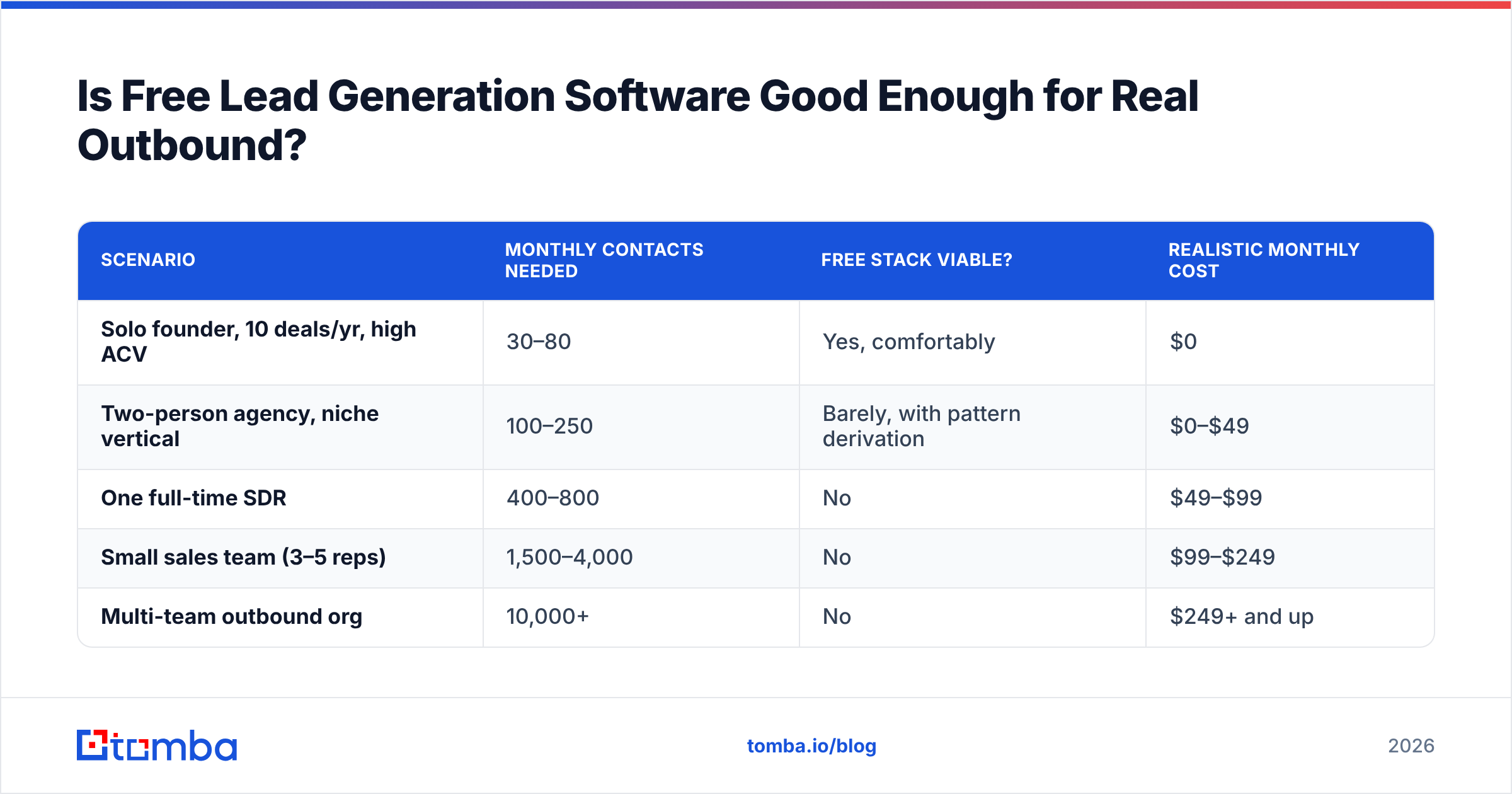
Depends entirely on your volume target. Here's the honest math.
| Scenario | Monthly contacts needed | Free stack viable? | Realistic monthly cost |
|---|---|---|---|
| Solo founder, 10 deals/yr, high ACV | 30–80 | Yes, comfortably | $0 |
| Two-person agency, niche vertical | 100–250 | Barely, with pattern derivation | $0–$49 |
| One full-time SDR | 400–800 | No | $49–$99 |
| Small sales team (3–5 reps) | 1,500–4,000 | No | $99–$249 |
| Multi-team outbound org | 10,000+ | No | $249+ and up |
The break point sits around 250–300 contacts per month. Below that, free tiers plus discipline genuinely work. Above it, you spend more hours managing tool limits than you save in subscription fees. If you're stitching three free accounts together and manually reconciling CSVs for four hours a week, and your time is worth $50/hour, you're paying $800/month for a "free" stack.
There's also a quality dimension free tiers rarely disclose. Free plans often serve from the same database as paid plans but with rate-limited or cached results — meaning the data can be staler. Ask vendors directly whether free-tier results come from live lookups or cached indexes. Reputable ones will tell you.

What Are the Real Limits Nobody Lists on the Pricing Page?#
Six that catch people out:
- Export restrictions. Some free plans let you see contacts but not download them. You can view a great list and be unable to get it into your CRM. Check the export column before you spend an afternoon building a list.
- API access excluded. Free tiers usually exclude API keys. If you planned to automate with Zapier or a script, that's a paid feature almost everywhere. Tomba does expose an email finder API, but check which plan tier unlocks it for your call volume.
- Credit rollover doesn't exist. Unused free credits reset monthly. Twenty-five searches in January don't become 50 in February. Use them or lose them — build a monthly prospecting habit rather than batching quarterly.
- Seat limits of one. Free plans are single-user. The moment a second person needs access, you're on a paid plan or sharing credentials (which most terms of service prohibit).
- Support is community-only. When a free tool breaks mid-campaign, you're in a forum queue. Factor that into anything time-sensitive.
- Data retention policies. Some free tiers delete your saved lists after a period of inactivity. Export to your own storage regularly.
None of these are scams — they're how freemium economics work. Vendors give away enough to prove value and meter the thing that costs them money. Knowing which lever they're pulling lets you route around it.
Which Free Tools Are Worth Bookmarking Right Now?#
Standalone free utilities are the most underrated category because they have no account, no cap, and no upsell friction. A short list worth keeping in a browser folder:
- Email permutator — generate every plausible format for a name + domain when you're derivin patterns manually.
- Free email checker — quick syntax and deliverability sanity check on a single address before you send something important.
- Spam checker — score your cold email copy before it hits a filter. Free tier tools are useless if your message never lands.
- Remove duplicates — merging free-tier exports from three sources produces dupes. Dedupe before import or your CRM counts inflate and your bounce rate follows.
- Subject line tester — free, unlimited, and it improves open rates more than any extra 25 credits will.
Pair these with the free product tiers and you close most of the gap. The utilities handle the mechanical work; the metered tiers handle the expensive lookups.
When Should You Stop Using Free Tools?#
Four signals, any one of which means it's time to pay:
You're rate-limited more than twice a month. If you hit the cap and stop prospecting for two weeks, the free plan is now costing you pipeline, not saving you money.
You're maintaining spreadsheets to work around tool limits. Manual CSV reconciliation between three free accounts is unpaid ops work. One paid plan usually collapses that into a single export.
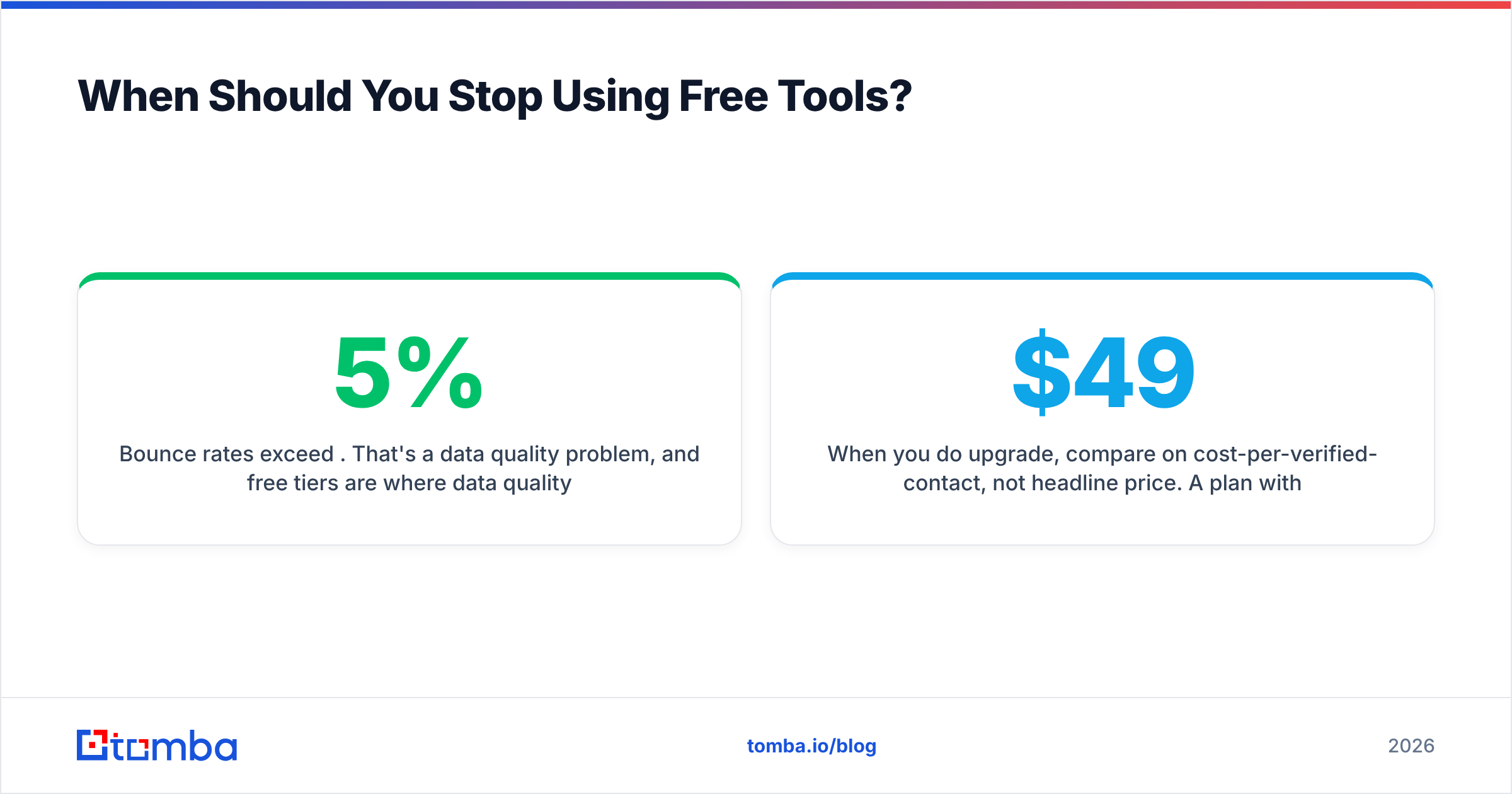
Bounce rates exceed 5%. That's a data quality problem, and free tiers are where data quality problems live. Google and Microsoft both tightened bulk sender requirements — sustained high bounce rates now materially damage email deliverability, and recovering a burned domain costs far more than a subscription. The Google bulk sender guidelines spell out the thresholds explicitly.
You need a second seat. The moment prospecting becomes a team activity, free plans stop being an option structurally, not just practically.
When you do upgrade, compare on cost-per-verified-contact, not headline price. A $49/mo plan with bundled verification and a 92% hit rate is cheaper per usable contact than a $29/mo plan at 70% with separate verification credits. Run the arithmetic on your own last 100 lookups rather than trusting vendor-published accuracy figures — third-party review data on G2's lead intelligence category is a useful sanity check on what buyers actually report.

For teams that want verified lists without a subscription commitment at all, pay-as-you-go providers like BookYourData occupy a legitimate middle ground — you buy exactly the volume you need, verified on delivery, without a monthly floor. That model suits sporadic campaign work better than either a free tier or a full seat license.
How Do You Get the Most Out of Any Free Tier?#
Five habits that roughly triple the output of a capped plan:
- Prospect by domain, not by person. One company email search reveals the pattern and often multiple contacts. Per-person lookups waste your scarcest resource.
- Qualify before you look up. Every credit spent on a poor-fit company is a credit not spent on a good one. Do the ICP filtering in a spreadsheet first, at zero cost.
- Batch on a schedule. Since credits don't roll over, run your prospecting on the first of the month, every month. Missed months are permanently lost capacity.
- Verify everything, always. A bounce costs more than a credit — it costs sender reputation, which compounds.
- Keep your own copy. Export to a spreadsheet or CRM you control the moment you find something. Free tiers change terms, and your data shouldn't live only in someone else's dashboard.
Do these and 25 monthly searches becomes 150+ verified, usable contacts. Skip them and 25 searches becomes 18 contacts, six of which bounce.
Ready to Stop Fighting Credit Caps?#
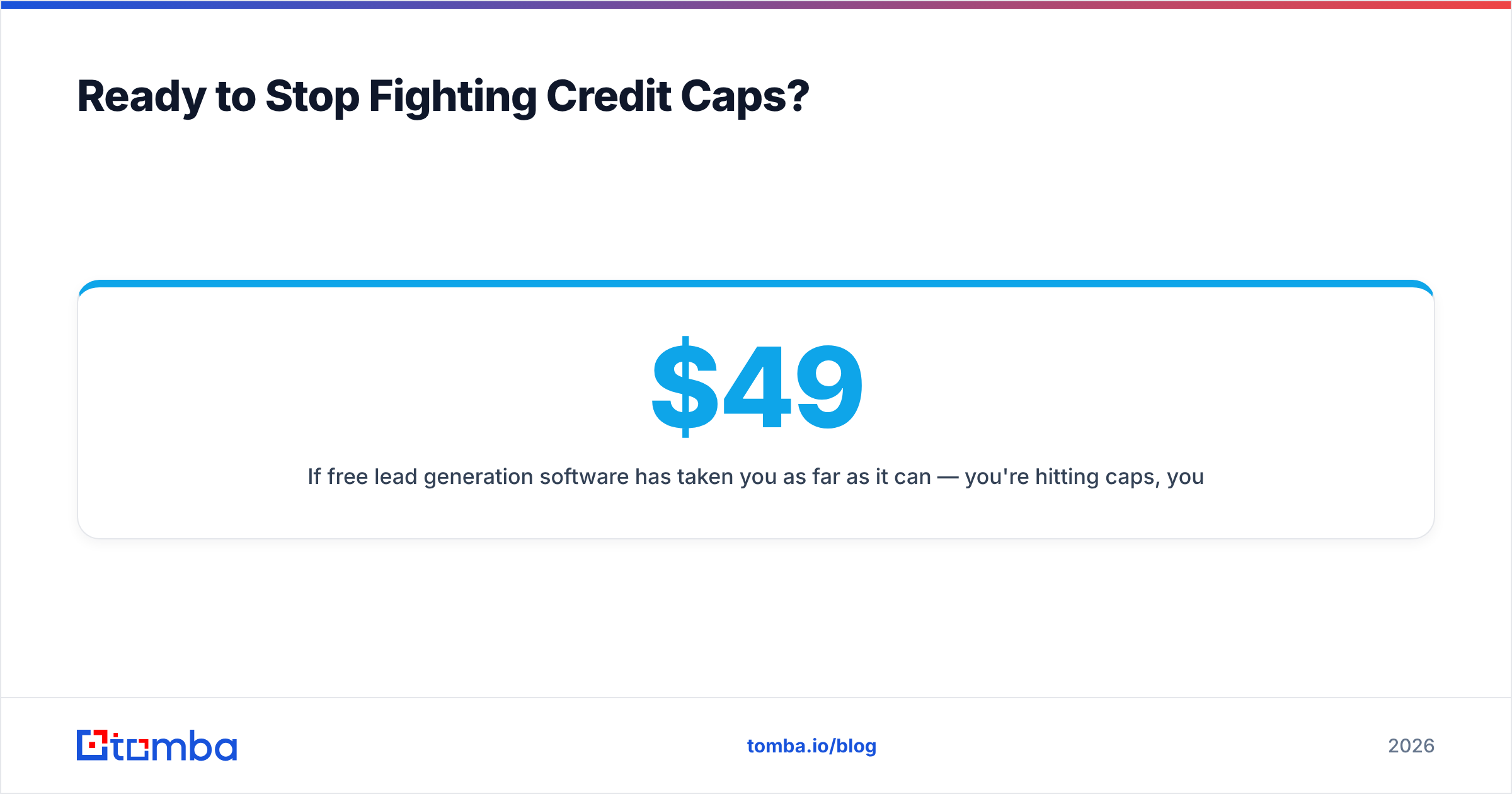
If free lead generation software has taken you as far as it can — you're hitting caps, you're tired of CSV surgery, or your bounce rate is climbing — the fix is a single tool that finds and verifies in one pass. The Tomba Email Finder starts free with 25 searches a month (no card, no expiry) so you can test hit rate on your own target accounts before spending anything. When you outgrow it, Starter runs $49/mo with verification bundled, and full Tomba pricing scales to Growth at $99/mo and Pro at $249/mo. Start on the free tier, measure your actual cost per verified contact, and upgrade only when the math says so.
Related guides#
Ready to find emails that actually work?
Join 150,000+ professionals who stopped guessing and started sending. Free credits on signup — no credit card required.
Get the Tomba newsletter
Practical outbound tactics and product updates — once every two weeks.
About the author