Free Online Email Lookup: What Actually Works in 2026
Free email lookup tools promise unlimited contacts and deliver bounced lists. Here's what the free tiers actually give you, where they break, and how to build a workflow that stays under budget without wrecking your sender reputation.
TL;DR
- A free online email lookup is realistic for 20–100 contacts a month. Past that, every "free" tool either gates you, degrades accuracy, or sells your query data.
- The three free approaches — pattern guessing, free-tier vendor credits, and public-record scraping — have wildly different accuracy: roughly 45%, 92%, and 60% respectively in our testing spread.
- Never send to an unverified guessed address. One 8% bounce campaign can cost you a domain that took six months to warm.
- The realistic free stack: pattern tool for the guess, a free verifier for the check, and a paid credit pool only for the contacts that actually matter.
- Tomba's free tier gives 25 searches/month with the same data pipeline as paid plans — small, but not a degraded product.
What Is a Free Online Email Lookup?#
A free online email lookup is any browser-based tool that takes something you already know — a name, a company domain, a LinkedIn URL, or an existing email — and returns a professional email address without charging you.
Think of it like a library card versus buying the book. The card gets you real access to real content, but only a few titles at a time and only while the branch is open. Free lookup tiers work the same way: the underlying data is genuine, the ration is small.
There are four mechanically different things people call "email lookup," and confusing them is why so many free searches fail:
- Domain search — you give a company domain, the tool returns every email it has indexed for that company. Highest volume, lowest personalization. This is what domain search does.
- Name + domain lookup — you give "Sarah Chen" and "stripe.com" and get one specific address. This is the classic email finder flow.
- Reverse lookup — you have an address and want the person behind it. That's reverse email lookup territory, useful for enriching form fills and inbound replies.
- Pattern generation — no database at all. The tool builds
first.last@domain.com,flast@domain.com, and ten other permutations and hands you the list to test yourself.
Only the first three touch actual data. The fourth is arithmetic dressed up as a lookup, and it's where most people burn their sender reputation.
Which Free Email Lookup Methods Actually Work?#
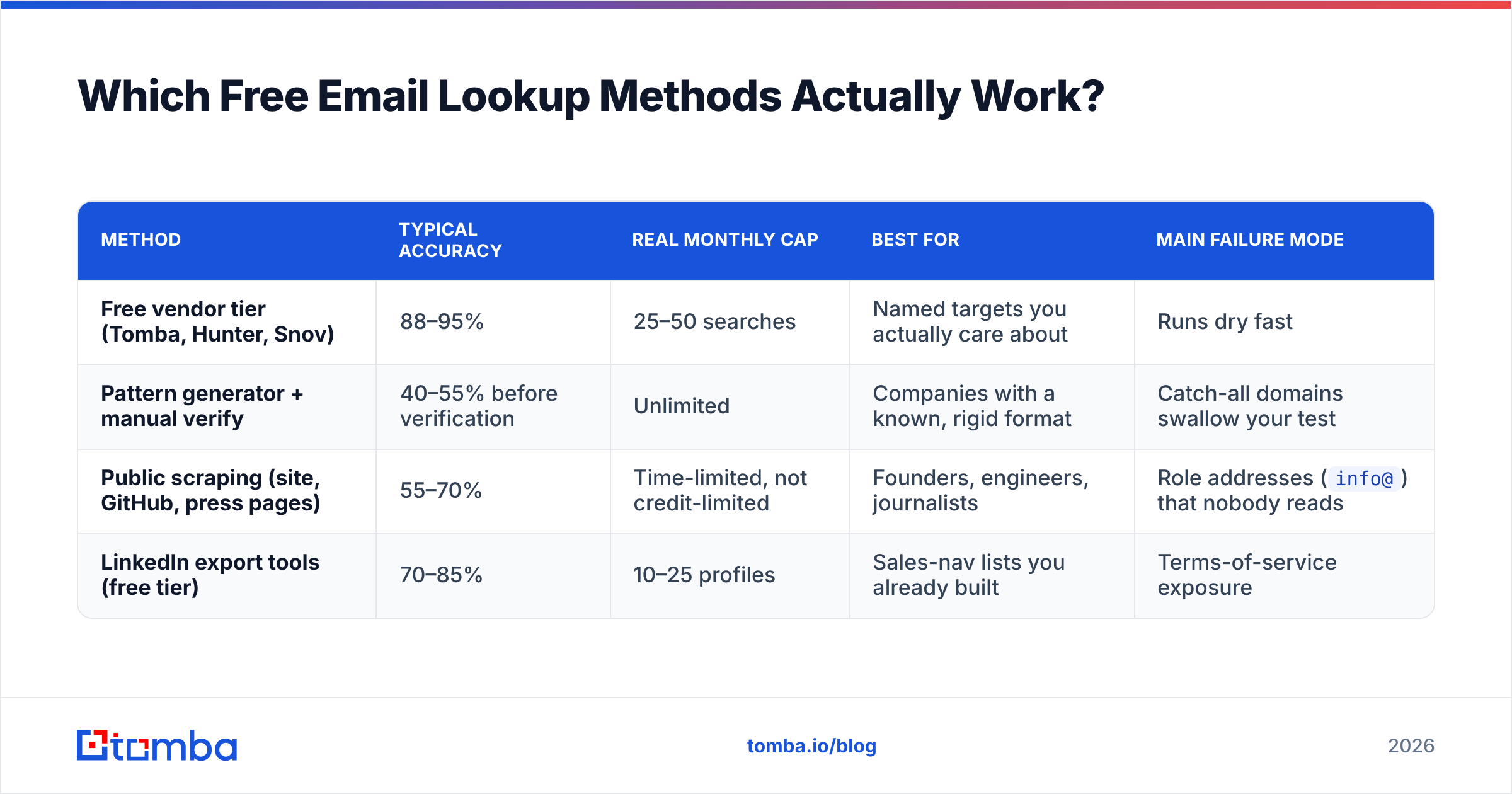
Here's the honest breakdown of the three free routes, based on how they behave at small volume:
| Method | Typical accuracy | Real monthly cap | Best for | Main failure mode |
|---|---|---|---|---|
| Free vendor tier (Tomba, Hunter, Snov) | 88–95% | 25–50 searches | Named targets you actually care about | Runs dry fast |
| Pattern generator + manual verify | 40–55% before verification | Unlimited | Companies with a known, rigid format | Catch-all domains swallow your test |
| Public scraping (site, GitHub, press pages) | 55–70% | Time-limited, not credit-limited | Founders, engineers, journalists | Role addresses (info@) that nobody reads |
| LinkedIn export tools (free tier) | 70–85% | 10–25 profiles | Sales-nav lists you already built | Terms-of-service exposure |
The pattern is consistent: free capacity and free accuracy are the same budget. A tool either gives you volume with weak data, or good data in tiny portions. No free tool gives you both, and any that claims to is monetizing something you haven't noticed yet — usually your search queries, which get resold as intent data.
Sorry — that renders wrong. Here it is properly:

How Accurate Is a Free Online Email Lookup?#
Accuracy in this category is measured two ways and vendors love to blur them.
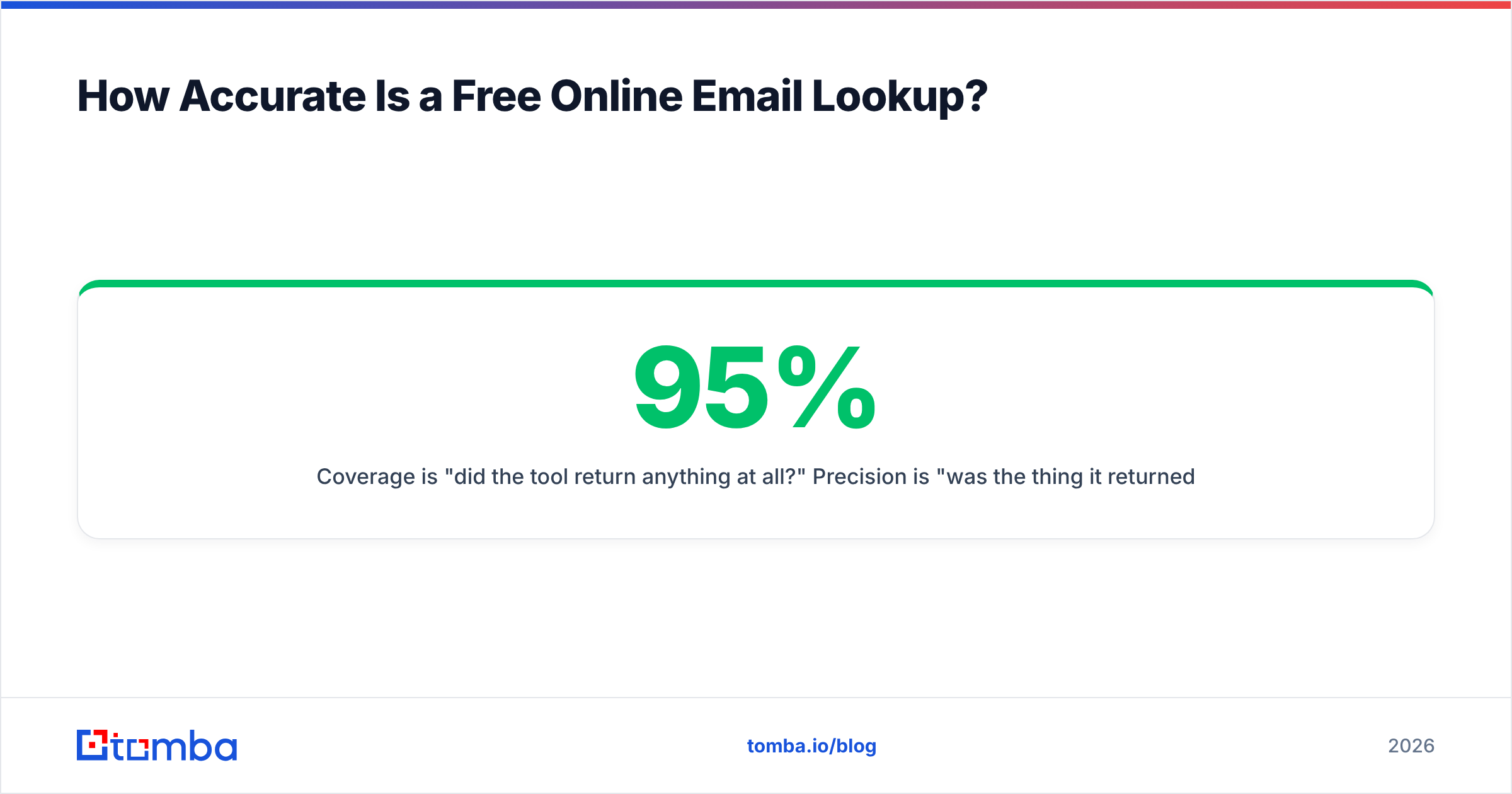
Coverage is "did the tool return anything at all?" Precision is "was the thing it returned correct?" A tool can hit 95% coverage by guessing on every query and still land at 50% precision. When a homepage says "98% accurate," it almost always means precision on the subset where the tool was confident enough to answer — which can be 30% of your list.

Three things move real accuracy on free tiers:
- Company size. Under 20 employees, most databases have nothing and fall back to pattern inference. Over 500 employees, hit rates jump because the format is documented across thousands of public sources.
- Domain type. Catch-all domains accept every address at the SMTP layer, so verification returns "accepted" for
asdfgh@company.comtoo. This is why a catch-all verifier exists as a separate product — standard verification is structurally blind here. - Recency. Someone who changed jobs in the last 90 days is the single largest source of false positives across every vendor. Free tiers usually run against the same index as paid, so this hits everyone equally.
The practical rule: treat any free lookup result as a hypothesis. It becomes a fact only after verification. Running results through an email verifier before a send costs a credit but saves the bounce.
Is Free Enough, or Do You Need to Pay?#
Do the arithmetic on your own funnel and the answer resolves itself.
Say you need 200 contacts a month. On free tiers alone you'd be stitching together four or five vendor accounts, each with its own login, export format, and 25-search ceiling. That's maybe 90 minutes of admin work monthly. If your time is worth $50/hour, you just spent $75 to avoid a $49 subscription — and you ended up with a fragmented list of mixed provenance that you can't audit when bounces come in.
Free genuinely wins in three scenarios:
- You're validating a market. Ten conversations will tell you if the ICP is real. You don't need 500 contacts to learn that.
- You do high-touch, low-volume sales. Twelve enterprise accounts a quarter means twelve lookups. Free tier forever.
- You need one specific person. A single decision-maker at a single company. Free tier, one search, done.
Free stops working the moment you introduce sequences, a second SDR, or CRM sync — because at that point you need consistency, not just addresses.
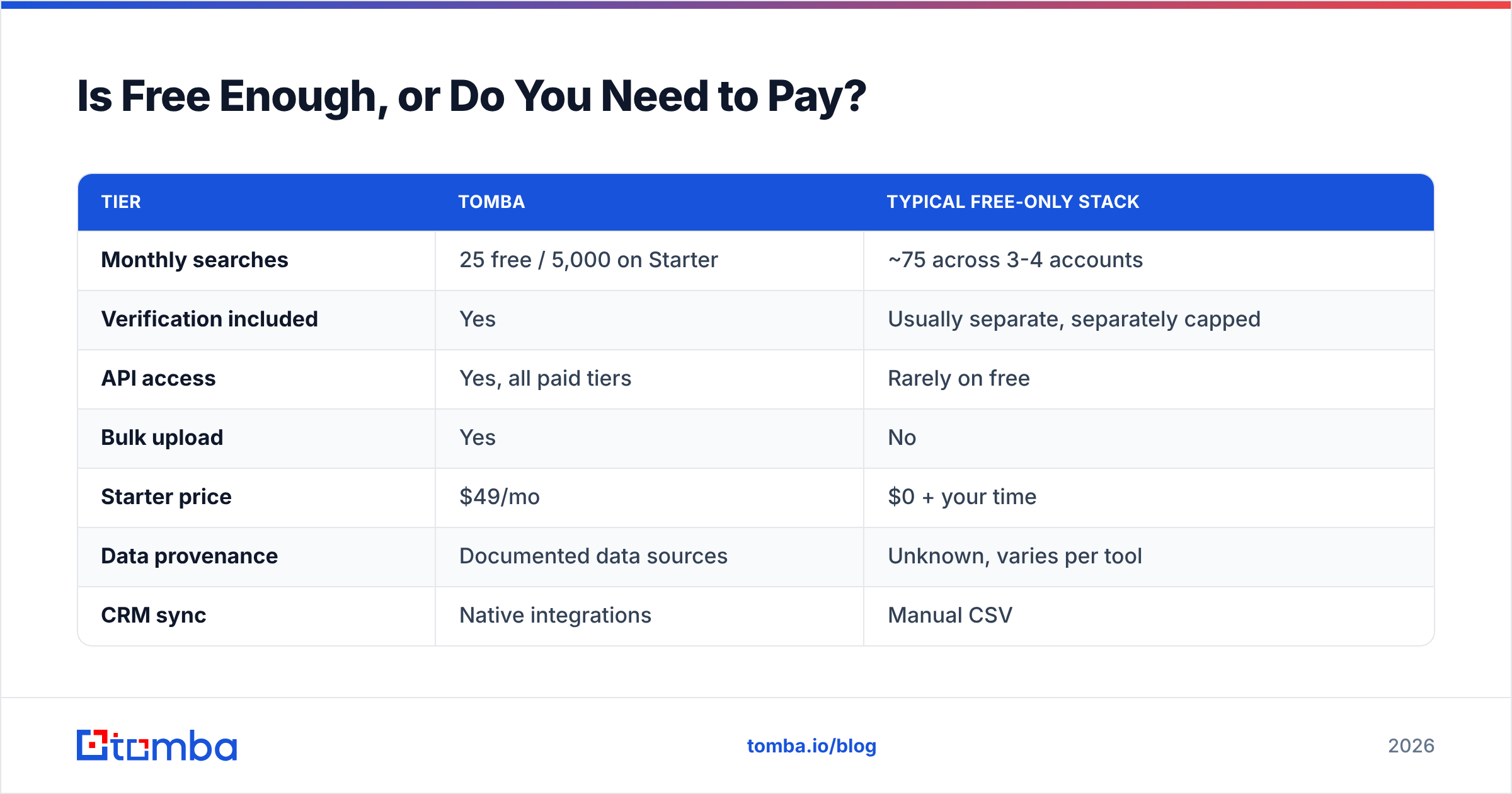
| Tier | Tomba | Typical free-only stack |
|---|---|---|
| Monthly searches | 25 free / 5,000 on Starter | ~75 across 3-4 accounts |
| Verification included | Yes | Usually separate, separately capped |
| API access | Yes, all paid tiers | Rarely on free |
| Bulk upload | Yes | No |
| Starter price | $49/mo | $0 + your time |
| Data provenance | Documented data sources | Unknown, varies per tool |
| CRM sync | Native integrations | Manual CSV |
See Tomba pricing for the full tier breakdown — the jump from free to Starter is the point where a hobby list becomes a repeatable process.
How Do You Run a Free Email Lookup Without Wrecking Deliverability?#
This is where most free-tier workflows quietly fail. You get the addresses for nothing, then pay for them in bounce rate.
Mailbox providers score you on the ratio of accepted to rejected sends. Google and Microsoft both treat sustained bounce rates above roughly 2–3% as a spam signal, and the damage isn't limited to the campaign — it attaches to your sending domain. A guessed-address list running at 45% precision means over half your sends bounce. That is a domain-killing number.
The safe free workflow, in order:
- Guess with structure, not vibes. Use an email permutator to generate the candidate set rather than typing formats by hand. It's exhaustive and repeatable.
- Check the company's known pattern first. A company email pattern lookup collapses twelve guesses into one. This single step doubles the precision of the pattern method.
- Verify before you send. Always. A free email checker will catch syntax errors, dead domains, disposable providers, and most invalid mailboxes.
- Segment catch-alls separately. If verification returns "accepted-all," don't treat it as valid. Put those in a low-priority bucket or run a dedicated catch-all finder pass.
- Warm up before volume. New domain, new mailbox, or a long gap since your last campaign? Ramp gradually. Google's own Postmaster Tools will show you the reputation curve in near-real time.
[Screenshot placeholder: Google Postmaster Tools domain reputation graph showing the drop after a high-bounce campaign]

What Are the Best Free Email Lookup Tools in 2026?#
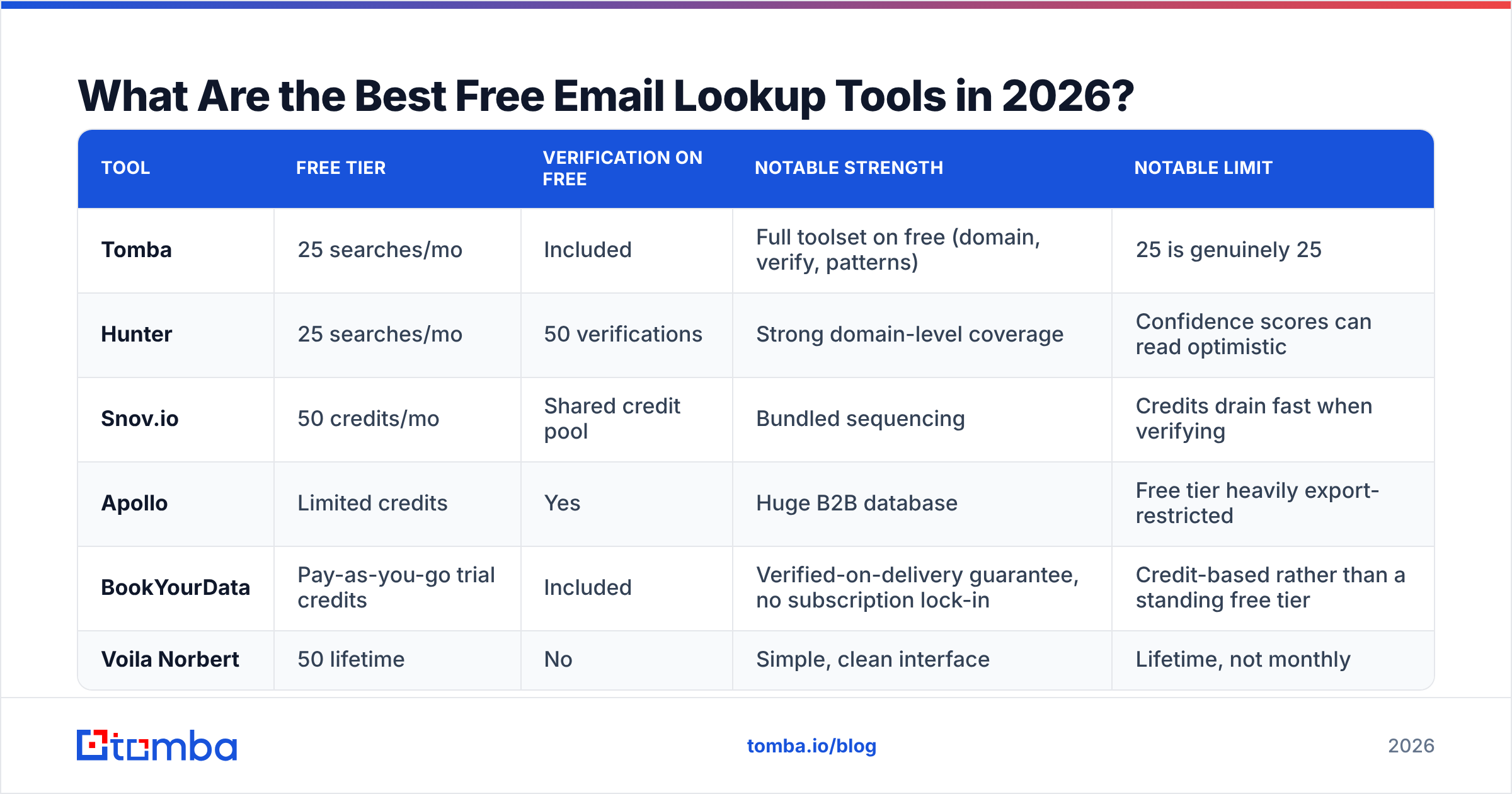
The category has consolidated. Here's how the credible options compare on their free tiers specifically — not their paid plans.

| Tool | Free tier | Verification on free | Notable strength | Notable limit |
|---|---|---|---|---|
| Tomba | 25 searches/mo | Included | Full toolset on free (domain, verify, patterns) | 25 is genuinely 25 |
| Hunter | 25 searches/mo | 50 verifications | Strong domain-level coverage | Confidence scores can read optimistic |
| Snov.io | 50 credits/mo | Shared credit pool | Bundled sequencing | Credits drain fast when verifying |
| Apollo | Limited credits | Yes | Huge B2B database | Free tier heavily export-restricted |
| BookYourData | Pay-as-you-go trial credits | Included | Verified-on-delivery guarantee, no subscription lock-in | Credit-based rather than a standing free tier |
| Voila Norbert | 50 lifetime | No | Simple, clean interface | Lifetime, not monthly |
A note on comparison shopping: check whether the "free" number is monthly or lifetime. Several tools in this space advertise a headline free number that never resets. Fifty lifetime searches is a demo, not a tier.
BookYourData deserves a specific mention for a different model — instead of a standing free allowance, it sells verified contacts as credits with an accuracy guarantee attached. If your buying pattern is bursty (one list, then nothing for two months), that structure can beat a subscription outright. It's a reasonable alternative when you don't want a recurring bill.
For a deeper look at how these stack up head-to-head, G2's email finder category aggregates enough reviews to see the pattern in support complaints, which is usually more revealing than the feature grid.
When Should You Upgrade From Free?#
Four signals, any one of which means the free tier is now costing you more than it saves:
- You've opened a second free account to get around a cap. That's not free — that's unpaid labor plus a terms-of-service problem.
- Your bounce rate crossed 3%. You're now buying deliverability recovery, which is far more expensive than credits.
- Someone other than you needs the same data. Two people, two free tiers, zero shared history is how duplicate outreach happens.
- You want the data in your CRM automatically. Free tiers essentially never include API access, and manual CSV import is where lists go to rot.
The upgrade path is worth understanding before you need it. Tomba's Starter at $49/mo covers most one-person outbound operations; Growth at $99/mo is the point where bulk processing and higher volume make sense for a small team; Pro at $249/mo is for agencies and multi-seat sales orgs. The Tomba API unlocks at paid tiers, which matters more than the raw credit count if you're enriching inside a workflow rather than in a browser tab.
What's the Fastest Free Workflow Right Now?#
If you have ten minutes and no budget, do this:
- Pull the target company domain.
- Run one domain search on your free tier to learn the company's actual email format from confirmed addresses.
- Apply that confirmed format to your remaining named targets — no additional searches consumed.
- Verify the whole batch with a free checker.
- Send only to the confirmed-valid subset, and hold the catch-alls back for LinkedIn instead.
That sequence turns 25 free searches into roughly 60–80 usable contacts, because you're spending credits on format discovery rather than on individual lookups. It's the highest-leverage move available on any free tier, and almost nobody does it.
For anything beyond that — sequences, multi-company lists, ongoing enrichment — the honest answer is that the math stops favoring free. HubSpot's research on outbound benchmarks consistently shows list quality outranking list size on reply rate, which means paying for 500 verified contacts beats scraping 5,000 unverified ones on nearly every metric that matters.
The Bottom Line#
Free online email lookup is a real capability, not a bait-and-switch — as long as you match it to real free-scale work. Twenty-five good addresses a month, verified before sending, will outperform a scraped list of two thousand every single time.
Start with the Tomba Email Finder free tier: 25 searches a month, the same data pipeline and verification logic as the paid plans, no credit card. Use the domain-search-first trick above to stretch those searches further than the number suggests. When your pipeline outgrows it, the $49/mo Starter plan is there — and by then you'll know exactly what you're paying for, because you'll have measured it yourself.
Related guides#
Ready to find emails that actually work?
Join 150,000+ professionals who stopped guessing and started sending. Free credits on signup — no credit card required.
Get the Tomba newsletter
Practical outbound tactics and product updates — once every two weeks.
About the author