Free Sales Courses Online: 14 Programs Worth Your Time in 2026
Most free sales courses are lead magnets with a certificate attached. Here are the 14 that actually teach something, ranked by what they cover, how long they take, and who should skip them.
TL;DR
- The best free sales courses online are HubSpot Academy's Inbound Sales, Salesforce Trailhead's sales paths, and the free tiers from Sandler and RAIN Group — everything else is either a lead magnet or a rehash of a 2014 book.
- Free courses teach frameworks. They do not teach you to make calls. Budget 20% of your time to coursework and 80% to live reps.
- Certificates matter for exactly two audiences: SDRs applying for their first role, and consultants who need a credential wall. Everyone else should skip the badge and take the modules.
- The most common failure isn't a bad course — it's finishing a course and having no list to practice on. Fix your data before you fix your pitch.
- Expect to spend 8–15 hours total across two or three courses, not 60. Diminishing returns hit fast.
What Counts as a "Free Sales Course" in 2026?#
The term covers four very different things, and confusing them wastes weeks.
- Vendor academies. HubSpot Academy, Salesforce Trailhead, and Pipedrive Academy publish structured, video-based curricula for free. The product bias is real but usually declared, and the underlying methodology (inbound, consultative, MEDDIC-adjacent) is transferable.
- Methodology teasers. Sandler, RAIN Group, Challenger, and Winning by Design publish free modules that cover the first 10% of a paid program. Genuinely useful, deliberately incomplete.
- University MOOCs. Northwestern, Michigan, and HEC Paris run sales and negotiation courses on Coursera and edX. Free to audit, paid for the certificate. Academically rigorous, commercially dated.
- Creator content. YouTube channels, newsletters, and Skool communities from practicing reps. Highest signal-to-fluff ratio when the creator is currently selling; worst when they stopped in 2019 and now sell courses about selling.
The practical difference: vendor academies teach process, methodology teasers teach a specific sale-stage skill, MOOCs teach theory, and creator content teaches tactics that expire in about 18 months.
Which Free Sales Courses Online Are Actually Worth Finishing?#
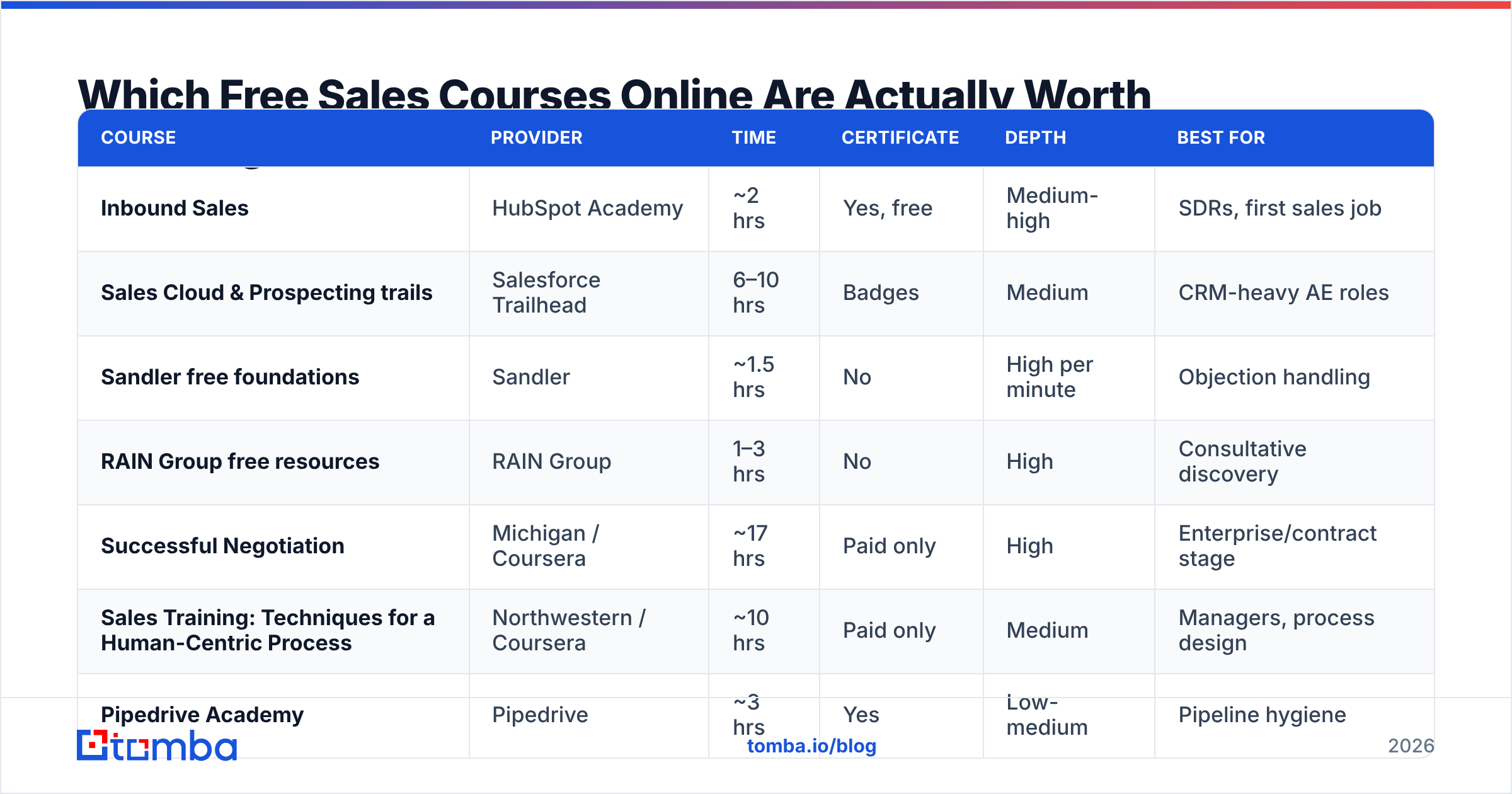
Here's the shortlist. "Depth" is subjective but grounded in how much of the module is instruction versus product demo.
| Course | Provider | Time | Certificate | Depth | Best for |
|---|---|---|---|---|---|
| Inbound Sales | HubSpot Academy | ~2 hrs | Yes, free | Medium-high | SDRs, first sales job |
| Sales Cloud & Prospecting trails | Salesforce Trailhead | 6–10 hrs | Badges | Medium | CRM-heavy AE roles |
| Sandler free foundations | Sandler | ~1.5 hrs | No | High per minute | Objection handling |
| RAIN Group free resources | RAIN Group | 1–3 hrs | No | High | Consultative discovery |
| Successful Negotiation | Michigan / Coursera | ~17 hrs | Paid only | High | Enterprise/contract stage |
| Sales Training: Techniques for a Human-Centric Process | Northwestern / Coursera | ~10 hrs | Paid only | Medium | Managers, process design |
| Pipedrive Academy | Pipedrive | ~3 hrs | Yes | Low-medium | Pipeline hygiene |
| Close.com free courses | Close | ~2 hrs | No | Medium | SMB cold calling |
Two things stand out when you lay them side by side. First, the vendor courses are shorter and more practical; the university courses are longer and more theoretical. Second, nothing on this list teaches you prospect research or list building in any depth — that gap is nearly universal, and it's the one that costs beginners the most.
What Do Free Sales Courses Consistently Skip?#
Every curriculum above covers roughly the same middle of the funnel: discovery, qualification, objection handling, closing. The skipped parts are the ones that determine whether you have anyone to talk to at all.
- Data sourcing. Almost no free course explains how to build a targeted list of 500 accounts and find verified contacts inside them. Courses assume the list exists.
- Deliverability mechanics. SPF, DKIM, DMARC, warmup, and bounce thresholds get one slide at most. Yet a 6% bounce rate will kill a sequence faster than any weak subject line. Learn email deliverability separately.
- Tooling economics. Which parts of the stack are worth paying for at 1 rep versus 10. Vendor courses have an obvious conflict of interest here.
- Territory math. How many accounts you need at your ACV and win rate to hit quota. This is arithmetic, not art, and it's oddly absent.
- Multi-threading. Free courses teach you to sell to a champion. They rarely teach you to build consensus across five stakeholders, which is where mid-market deals actually die.
If you finish three courses and still don't know how to build a list, you've learned to cook without knowing how to shop.
How Do You Turn a Free Course Into Actual Pipeline?#
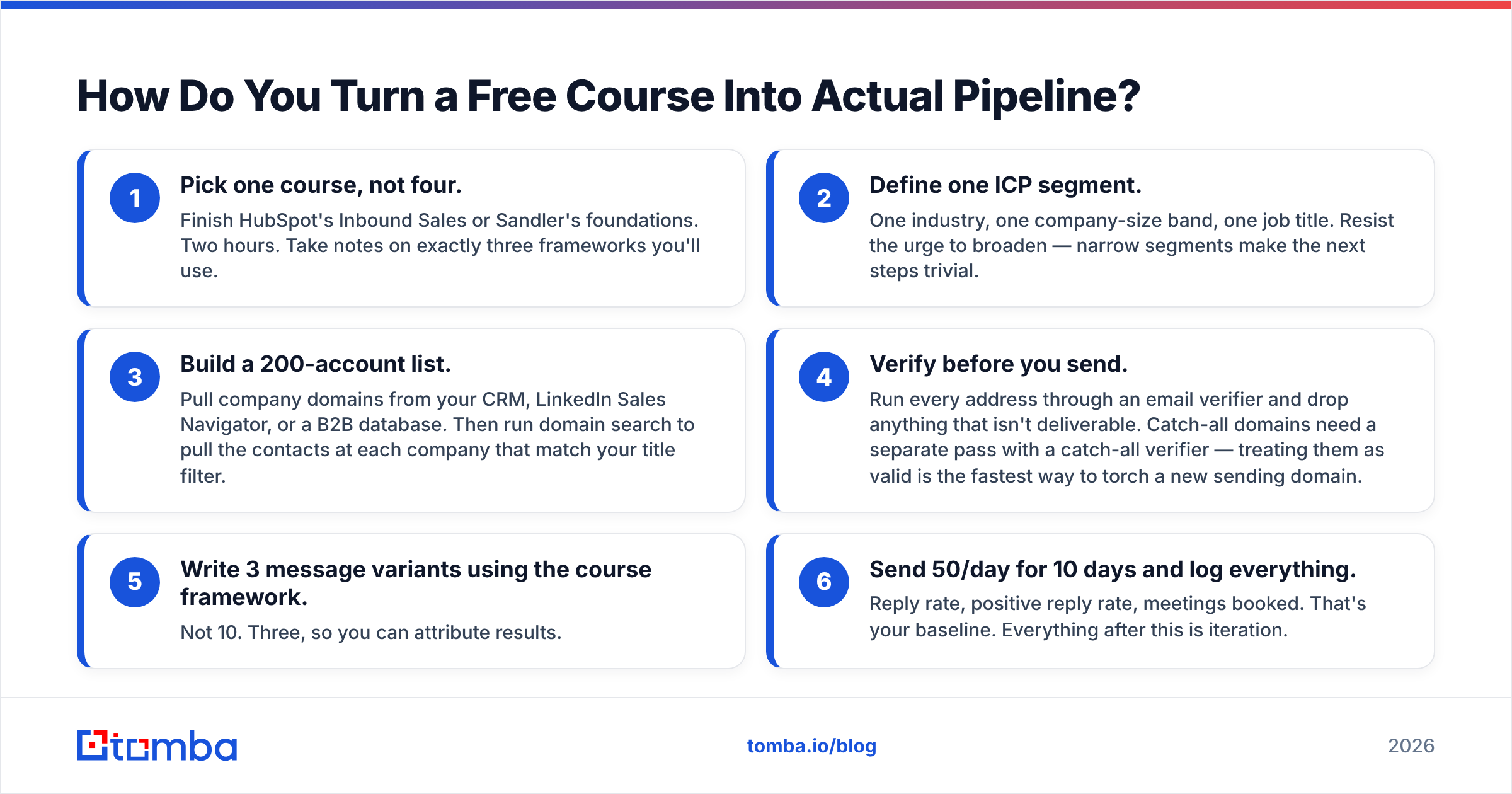
The gap between "completed a course" and "booked a meeting" is a workflow problem, not a knowledge problem. Here's a sequence that closes it in about two weeks.
- Pick one course, not four. Finish HubSpot's Inbound Sales or Sandler's foundations. Two hours. Take notes on exactly three frameworks you'll use.
- Define one ICP segment. One industry, one company-size band, one job title. Resist the urge to broaden — narrow segments make the next steps trivial.
- Build a 200-account list. Pull company domains from your CRM, LinkedIn Sales Navigator, or a B2B database. Then run domain search to pull the contacts at each company that match your title filter.
- Verify before you send. Run every address through an email verifier and drop anything that isn't deliverable. Catch-all domains need a separate pass with a catch-all verifier — treating them as valid is the fastest way to torch a new sending domain.
- Write 3 message variants using the course framework. Not 10. Three, so you can attribute results.
- Send 50/day for 10 days and log everything. Reply rate, positive reply rate, meetings booked. That's your baseline. Everything after this is iteration.
The whole point is that step 1 is the cheap part. Steps 3 and 4 are where most self-taught reps stall, because no free course covers them and the tools have a learning curve.
Are Paid Sales Courses Worth It Over the Free Ones?#
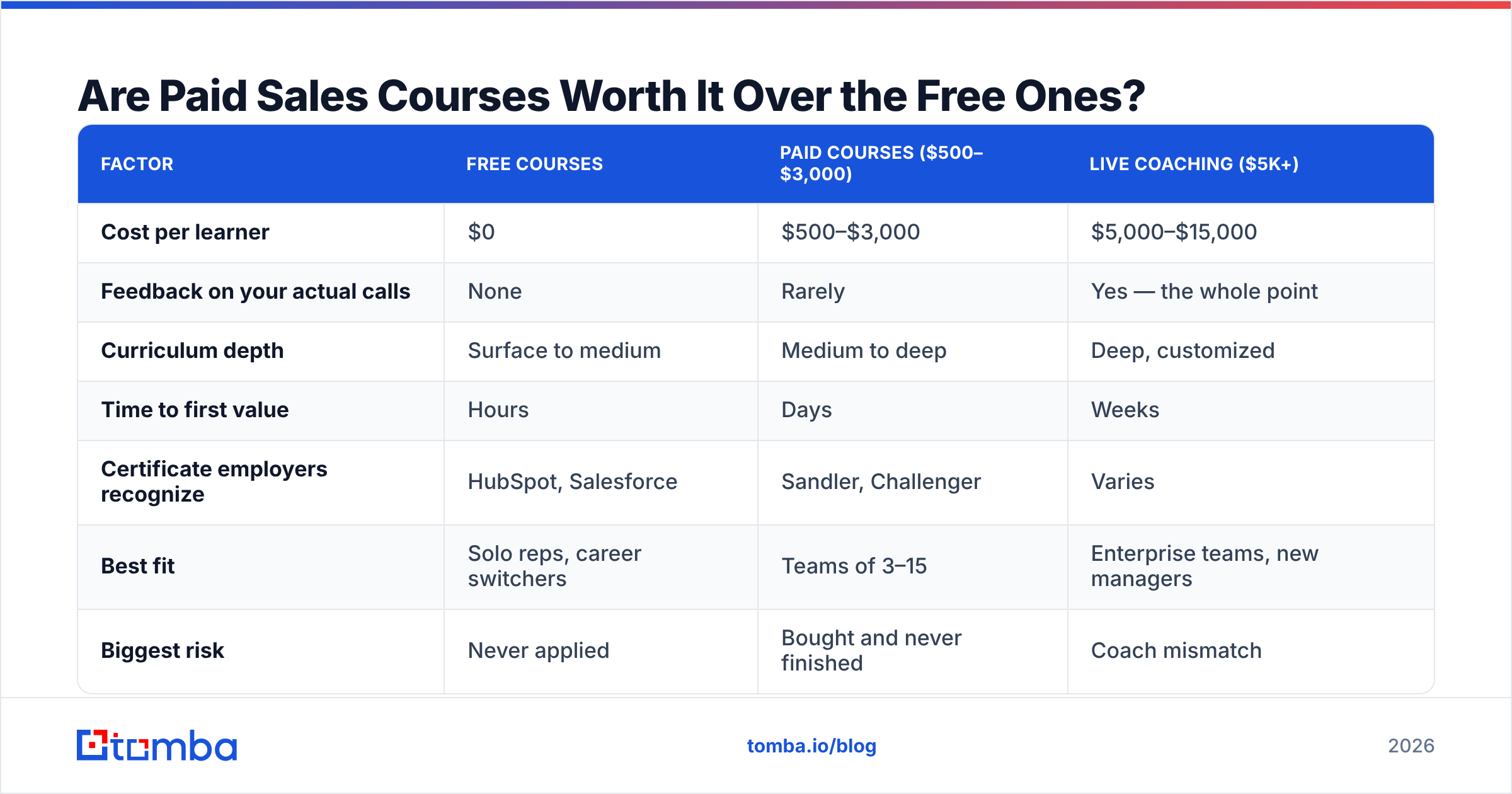
Usually not for individual contributors, usually yes for teams. The math is straightforward.
| Factor | Free courses | Paid courses ($500–$3,000) | Live coaching ($5k+) |
|---|---|---|---|
| Cost per learner | $0 | $500–$3,000 | $5,000–$15,000 |
| Feedback on your actual calls | None | Rarely | Yes — the whole point |
| Curriculum depth | Surface to medium | Medium to deep | Deep, customized |
| Time to first value | Hours | Days | Weeks |
| Certificate employers recognize | HubSpot, Salesforce | Sandler, Challenger | Varies |
| Best fit | Solo reps, career switchers | Teams of 3–15 | Enterprise teams, new managers |
| Biggest risk | Never applied | Bought and never finished | Coach mismatch |
The variable that actually predicts improvement is call review, not curriculum. A free course plus a manager who listens to two of your calls a week beats a $3,000 program with no feedback loop. If your organization has no call review process, spend the training budget on that first.
Independent review sites like G2 and Capterra carry buyer reviews for the vendor academies' parent products, which is a decent proxy for whether the platform-specific training will transfer to your stack.
Which Free Course Should You Take for Your Role?#
Match the course to the stage of the funnel you actually own.
- SDR / BDR (0–12 months). HubSpot Inbound Sales for the framework, then Close.com's cold calling material for scripts. Skip negotiation content entirely — you don't negotiate yet. Spend the saved time on sales prospecting volume.
- AE (mid-market). RAIN Group's discovery material plus Michigan's Successful Negotiation on audit. Discovery quality is the single biggest lever on win rate at this level.
- Founder selling. Sandler foundations for objection handling, then stop. Founders over-consume sales education and under-practice. Ten conversations with real buyers teach more than any curriculum.
- Sales manager. Northwestern's human-centric process course, because it's built around designing a repeatable process rather than personal technique. Pair it with a coaching cadence you actually hold.
- RevOps / enablement. Salesforce Trailhead's admin and sales trails, since your job is the system, not the pitch. Add reading on revenue operations fundamentals.
One note on certificates: HubSpot and Salesforce credentials show up in ATS keyword filters, which is a real if unglamorous benefit for entry-level applicants. Beyond the first role, nobody asks.
How Do You Spot a Free Sales Course That's Just a Lead Magnet?#
Four signals, in order of reliability.
- Email gate before any content. Real academies let you browse the syllabus. Lead magnets gate the table of contents.
- No named instructor with a verifiable track record. If you can't find who taught it and what they sold, the content is likely repackaged.
- Every module ends with the same product. A vendor course that mentions its own product is fine. A "course" where each lesson's takeaway is "and this is why you need our platform" is a demo with chapters.
- Length inflation. "40-hour masterclass, free" almost always means 40 hours of screen recordings padded to justify a price anchor for the paid version.
The honest tell: good free courses tell you what they don't cover. HubSpot's inbound track says plainly that it assumes an inbound motion. Sandler's free material says openly it's a slice of the paid system. Vagueness about scope is the warning sign.
For general reference on sales methodologies before you pick a lane, Wikipedia's sales process entry is a surprisingly clean overview of where these frameworks came from and how they differ.
What Should Your First 30 Days Look Like?#
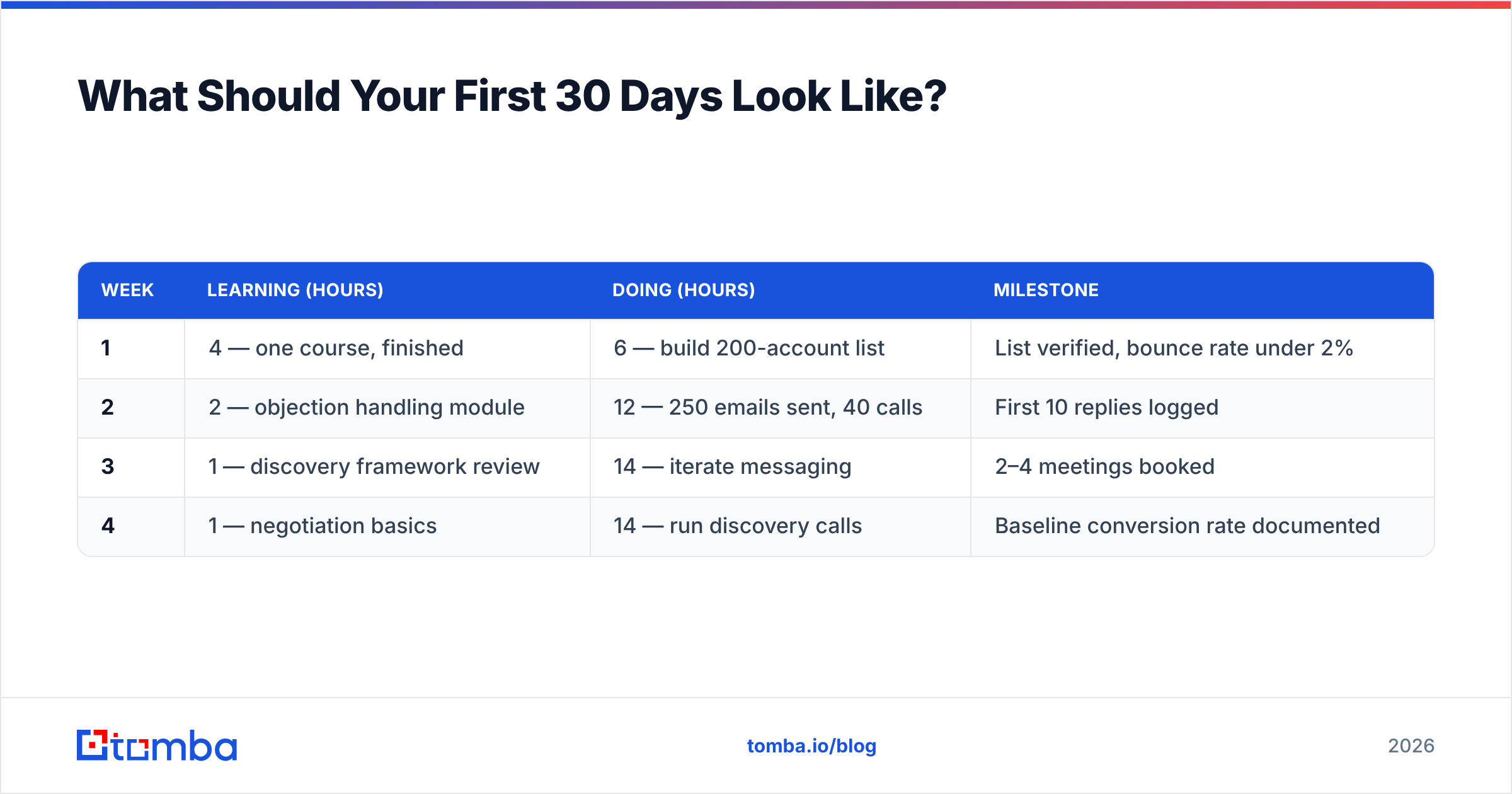
A realistic schedule that respects the 80/20 split between learning and doing.
| Week | Learning (hours) | Doing (hours) | Milestone |
|---|---|---|---|
| 1 | 4 — one course, finished | 6 — build 200-account list | List verified, bounce rate under 2% |
| 2 | 2 — objection handling module | 12 — 250 emails sent, 40 calls | First 10 replies logged |
| 3 | 1 — discovery framework review | 14 — iterate messaging | 2–4 meetings booked |
| 4 | 1 — negotiation basics | 14 — run discovery calls | Baseline conversion rate documented |
Notice the learning column shrinks every week. That's intentional. Sales skill compounds through reps and feedback, not through additional curriculum. If you're in week four and still watching modules, you're procrastinating with productive-looking activity.
Track two numbers throughout: bounce rate and positive reply rate. Bounce rate tells you whether your data is real. Positive response rate tells you whether your message is. Confusing the two — blaming your copy when the real problem is a stale list — is the most common misdiagnosis in early-stage outbound.
Frequently Asked Questions#
Do free sales courses come with certificates? HubSpot Academy and Salesforce Trailhead issue free, verifiable credentials. Coursera and edX courses are free to audit but charge $49–$99 for the certificate. Methodology vendors like Sandler and RAIN Group generally don't certify their free material.
How long does it take to get decent at sales? Framework knowledge takes about 10 hours. Competence takes roughly 200 live conversations. There's no course that compresses the second number.
Are YouTube sales channels a legitimate substitute? For tactics, yes — especially channels run by people currently carrying a quota. For structure, no. YouTube gives you a hundred tips with no sequence. Use a course for the spine and YouTube for the specifics.
What's the best free course for cold email specifically? None of the major academies cover it well. The strongest free material sits in vendor blogs and deliverability documentation rather than structured courses. Pair a general course with hands-on work on list quality and sending infrastructure.
Start With Data, Not Another Course#
The uncomfortable truth about free sales courses online: the marginal value of your fourth course is near zero, while the marginal value of a clean, verified prospect list is enormous. Reps who plateau almost never plateau from lack of framework knowledge. They plateau because they're sending 40 emails a week to addresses that half-bounce, drawing conclusions from a sample too small and too dirty to mean anything.
Finish one course this week. Then build the list. Tomba Email Finder locates verified professional addresses by name, company, or domain, with a free tier of 25 searches a month to test the workflow before you commit. Paid plans start at $49/mo (Starter) and $99/mo (Growth) — see Tomba pricing for the full breakdown. Get 200 real contacts in front of your new framework, and you'll learn more in two weeks of live conversations than in another forty hours of video.
Related guides#
Ready to find emails that actually work?
Join 150,000+ professionals who stopped guessing and started sending. Free credits on signup — no credit card required.
Get the Tomba newsletter
Practical outbound tactics and product updates — once every two weeks.
About the author