Free Sales Tools in 2026: 21 Picks That Are Actually Free
Most "free" sales software is a 14-day trial in disguise. Here are the free sales tools with real permanent free tiers in 2026, what each one caps, and how to assemble a $0 outbound stack that still books meetings.
TL;DR
- Roughly 70% of software marketed as "free sales tools" is a time-boxed trial. A real free tier renews every month and never asks for a card to keep working.
- A functional $0 outbound stack in 2026 needs five pieces: a CRM, a contact-data source, an email verifier, a scheduler, and a sequencer. All five exist with permanent free plans.
- Free plans cap the thing that costs the vendor money — usually credits, sending volume, or seats. Read the cap, not the price.
- The realistic ceiling of a free stack is about 25-60 verified contacts and 200-400 emails per month. That's enough to validate an ICP, not enough to scale one.
- Best upgrade order when you outgrow free: data first, sending second, CRM last.
What counts as a "free sales tool" in 2026?#
Three different things get called "free," and only one of them is.
Free forever (real free tier). The plan renews monthly, forever, with a hard usage cap. No card required. HubSpot's CRM and Tomba's 25 searches/month are examples. This is the only category worth building a stack on.
Freemium-with-a-catch. Free until you hit a feature wall that makes the tool useless for its primary job — export disabled, results blurred, "upgrade to reveal." You can use it, but not for the workflow you actually need.
Free trial. 7 to 14 days of the paid product, card usually required, auto-converts. Fine for evaluation. Useless as infrastructure, because in two weeks your pipeline breaks.
The practical test: can this tool still do its core job on day 45 without a payment method on file? If no, it isn't free, and you should not build a process around it.
Which free sales tools actually matter?#
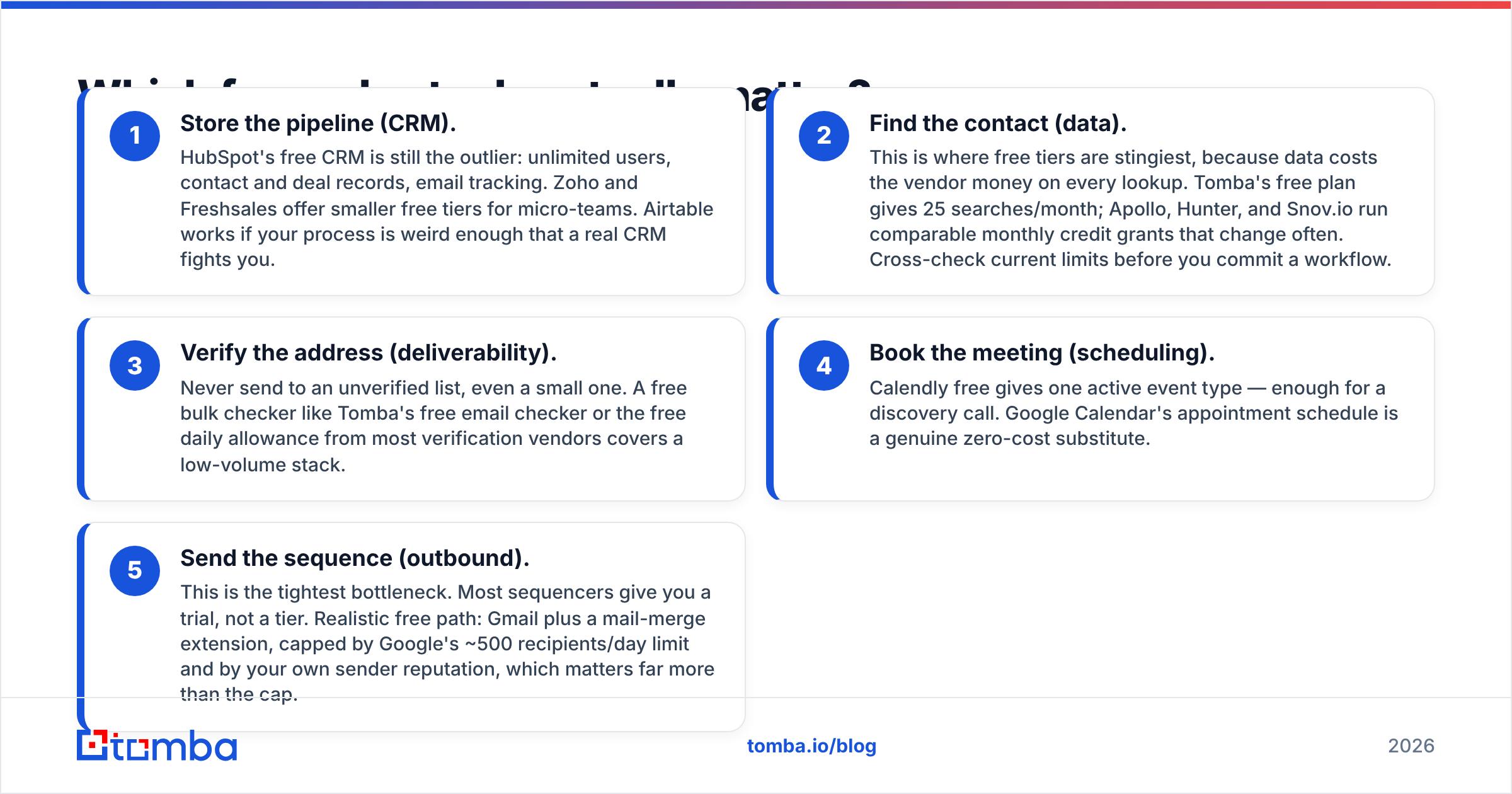
Skip the "150 free tools" listicles. Sales work reduces to five jobs, and each one has a credible free option.
Store the pipeline (CRM). HubSpot's free CRM is still the outlier: unlimited users, contact and deal records, email tracking. Zoho and Freshsales offer smaller free tiers for micro-teams. Airtable works if your process is weird enough that a real CRM fights you.
Find the contact (data). This is where free tiers are stingiest, because data costs the vendor money on every lookup. Tomba's free plan gives 25 searches/month; Apollo, Hunter, and Snov.io run comparable monthly credit grants that change often. Cross-check current limits before you commit a workflow.
Verify the address (deliverability). Never send to an unverified list, even a small one. A free bulk checker like Tomba's free email checker or the free daily allowance from most verification vendors covers a low-volume stack.
Book the meeting (scheduling). Calendly free gives one active event type — enough for a discovery call. Google Calendar's appointment schedule is a genuine zero-cost substitute.
Send the sequence (outbound). This is the tightest bottleneck. Most sequencers give you a trial, not a tier. Realistic free path: Gmail plus a mail-merge extension, capped by Google's ~500 recipients/day limit and by your own sender reputation, which matters far more than the cap.
Everything else — call recorders, intent data, dialers, forecasting — is a nice-to-have you can add after revenue exists.
How do the free tiers compare head to head?#
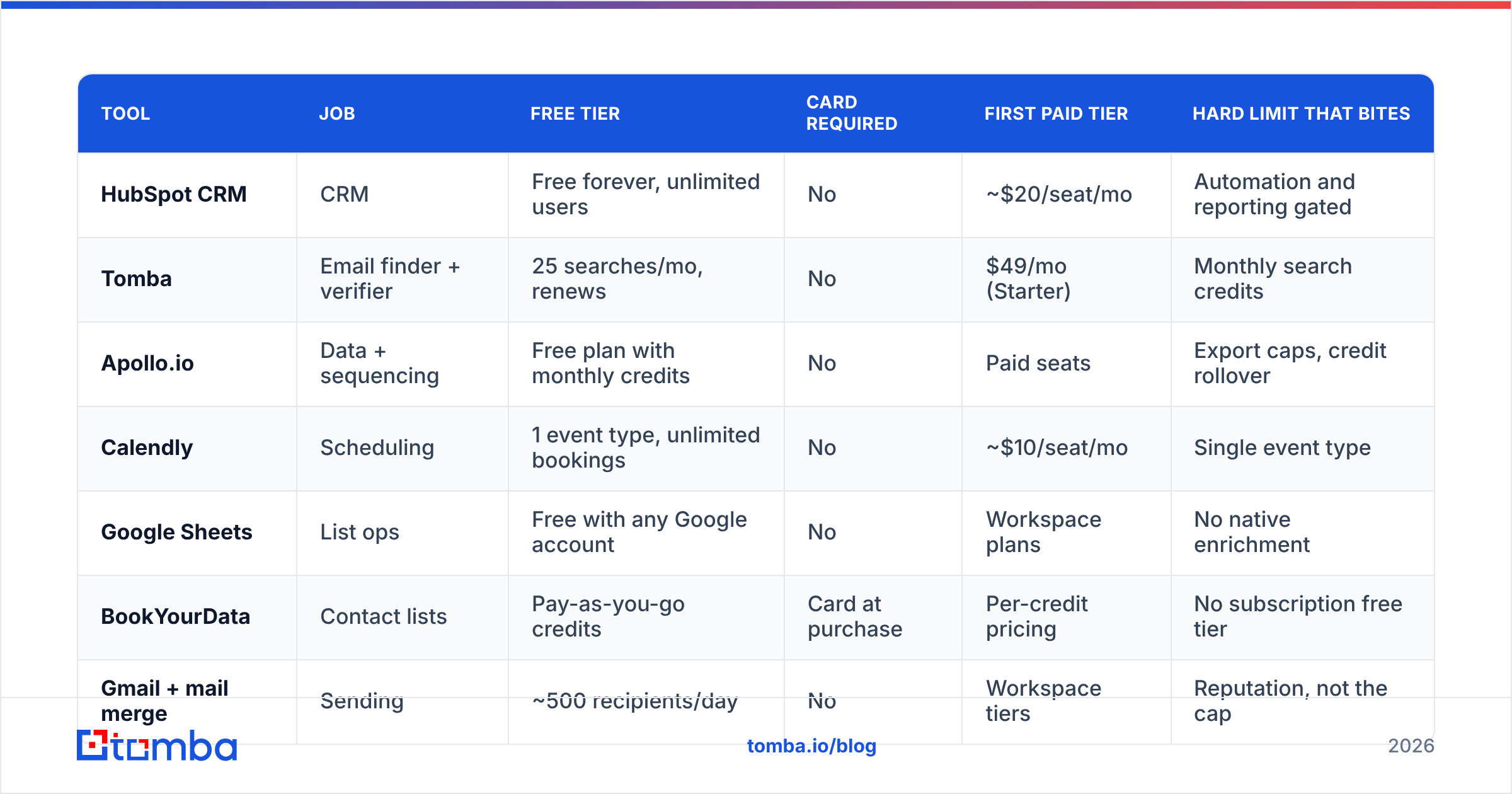
Limits move. Treat this as the shape of the market in early 2026, and verify on the vendor's own pricing page before you build against it.
| Tool | Job | Free tier | Card required | First paid tier | Hard limit that bites |
|---|---|---|---|---|---|
| HubSpot CRM | CRM | Free forever, unlimited users | No | ~$20/seat/mo | Automation and reporting gated |
| Tomba | Email finder + verifier | 25 searches/mo, renews | No | $49/mo (Starter) | Monthly search credits |
| Apollo.io | Data + sequencing | Free plan with monthly credits | No | Paid seats | Export caps, credit rollover |
| Calendly | Scheduling | 1 event type, unlimited bookings | No | ~$10/seat/mo | Single event type |
| Google Sheets | List ops | Free with any Google account | No | Workspace plans | No native enrichment |
| BookYourData | Contact lists | Pay-as-you-go credits | Card at purchase | Per-credit pricing | No subscription free tier |
| Gmail + mail merge | Sending | ~500 recipients/day | No | Workspace tiers | Reputation, not the cap |
Two things stand out. First, the CRM layer is genuinely solved for free — HubSpot's free tier is more capable than most 2018 paid CRMs. Second, data is where free ends fastest. Every vendor in the category prices the same underlying cost: verification infrastructure, SMTP checks, and refresh cycles on a decaying database.
That last point explains the pricing spread. Tomba's pricing starts at $49/mo for Starter, $99/mo for Growth, and $249/mo for Pro, and the free 25 searches exist to let you test accuracy on your own ICP before paying. BookYourData takes a different and equally reasonable route — pay-as-you-go credits with no subscription, which suits teams that buy one list a quarter rather than prospecting continuously. Neither model is wrong; they solve different buying patterns.
What does a genuinely $0 sales stack look like?#
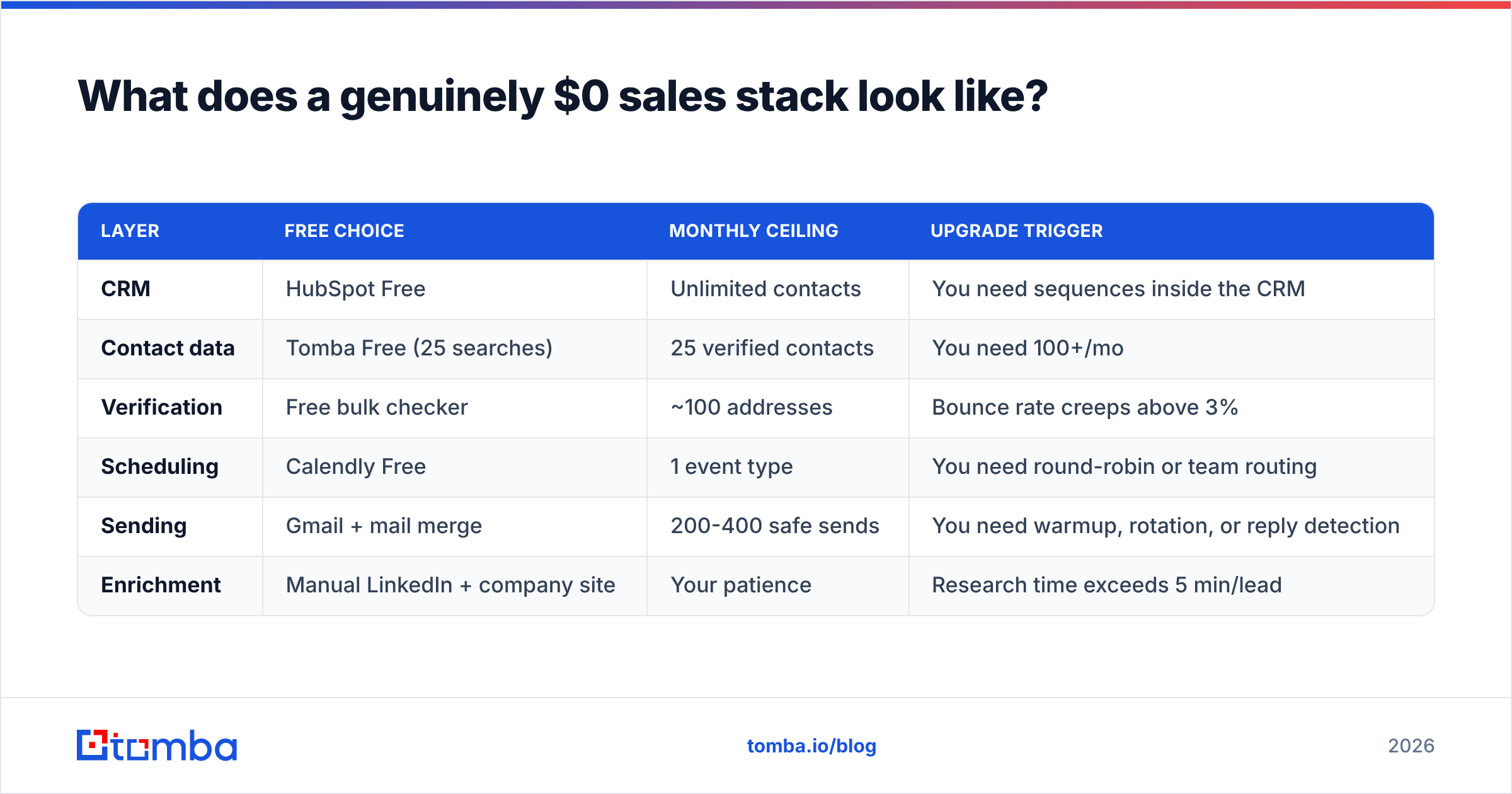
Here's a stack that costs nothing and still produces meetings, assembled in the order you should build it:
| Layer | Free choice | Monthly ceiling | Upgrade trigger |
|---|---|---|---|
| CRM | HubSpot Free | Unlimited contacts | You need sequences inside the CRM |
| Contact data | Tomba Free (25 searches) | 25 verified contacts | You need 100+/mo |
| Verification | Free bulk checker | ~100 addresses | Bounce rate creeps above 3% |
| Scheduling | Calendly Free | 1 event type | You need round-robin or team routing |
| Sending | Gmail + mail merge | 200-400 safe sends | You need warmup, rotation, or reply detection |
| Enrichment | Manual LinkedIn + company site | Your patience | Research time exceeds 5 min/lead |
Total: $0. Realistic output: 25-40 well-researched contacts, 3-4 touches each, roughly 8-12% reply rate if your targeting and copy are good. At a normal 20-25% meeting rate on replies, that's one to three meetings a month.
That is not a joke number for a solo founder validating a segment. It is a joke number for a funded team with a quota. Know which one you are.
Where do free sales tools actually break down?#
Four failure modes, in the order teams hit them.
1. The credit wall arrives mid-campaign. You build a 200-account list, burn 25 lookups, and stall on day three. Fix: batch your prospecting monthly instead of continuously, and spend credits only on accounts that already passed a qualification filter. Free credits are for confirmed targets, never for exploration.
2. Export is disabled. Several freemium data tools let you see a contact but not export it, which forces manual copy-paste and quietly destroys your hourly rate. Check export permissions before you build a list, not after.
3. Deliverability collapses. This is the expensive one. Free sending paths skip warmup, SPF/DKIM alignment checks, and reply-rate monitoring. A cold domain sending 300 emails a week with unverified addresses lands in spam by week two, and domain reputation is much harder to rebuild than it is to protect. Run an SPF checker before your first send and verify every address, even the 25 free ones.
4. Data decay. B2B contact data degrades roughly 22-30% a year through job changes alone, per repeated G2 category research and vendor benchmarks. A free list scraped in January is measurably worse in June. Free tiers rarely include re-verification, so your CRM slowly fills with dead records that inflate your bounce rate.

Is free better than a cheap paid plan?#
Depends entirely on which layer you're asking about.
Keep free forever: CRM, scheduling, list hygiene utilities, subject line testers, signature generators. The paid versions add team features you don't need under 5 reps.
Upgrade first: contact data. It's the only layer where the free version is a sample rather than a product. Twenty-five searches proves accuracy; it doesn't fill a pipeline. When you're spending more than 45 minutes a week hunting for addresses manually, a $49/mo plan pays for itself against any reasonable hourly rate.
Upgrade second: sending infrastructure. Once you're above ~300 emails/month across more than one domain, you need warmup, inbox rotation, and reply detection. Gmail plus a merge extension stops being safe there.
Upgrade last: everything else. Call recording, intent signals, and forecasting tools are all excellent and all premature before you have consistent volume to analyze.
A useful heuristic borrowed from RevOps practice: spend on the layer that's currently costing you the most hours, not the layer with the most impressive demo. For most teams under 10 people that's contact data, every time.
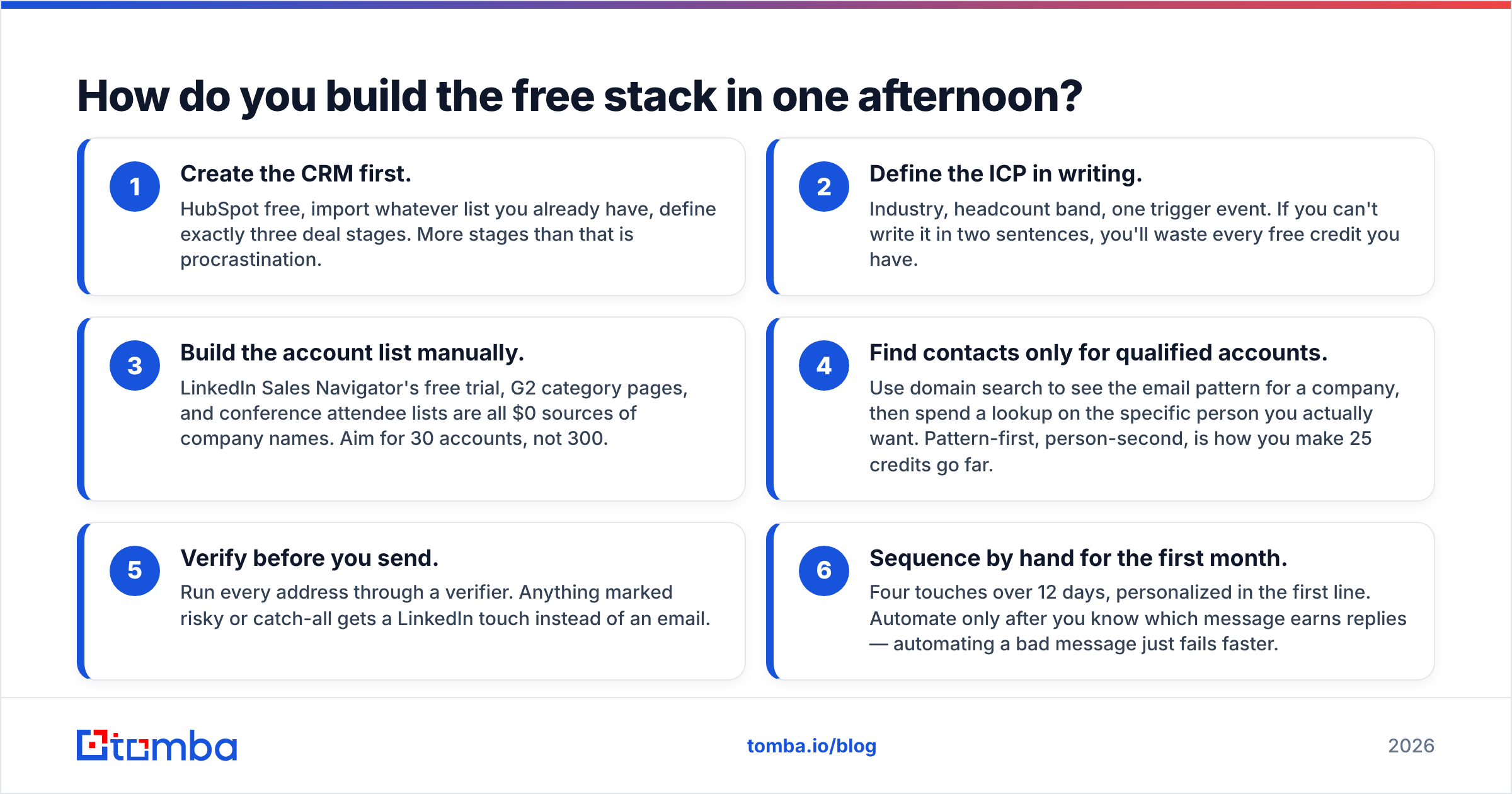
How do you build the free stack in one afternoon?#
- Create the CRM first. HubSpot free, import whatever list you already have, define exactly three deal stages. More stages than that is procrastination.
- Define the ICP in writing. Industry, headcount band, one trigger event. If you can't write it in two sentences, you'll waste every free credit you have.
- Build the account list manually. LinkedIn Sales Navigator's free trial, G2 category pages, and conference attendee lists are all $0 sources of company names. Aim for 30 accounts, not 300.
- Find contacts only for qualified accounts. Use domain search to see the email pattern for a company, then spend a lookup on the specific person you actually want. Pattern-first, person-second, is how you make 25 credits go far.
- Verify before you send. Run every address through a verifier. Anything marked risky or catch-all gets a LinkedIn touch instead of an email.
- Sequence by hand for the first month. Four touches over 12 days, personalized in the first line. Automate only after you know which message earns replies — automating a bad message just fails faster.
What about free AI sales tools?#
The 2026 wrinkle: most AI writing assistance is now free or bundled, which changes the calculus. Free tiers of general-purpose assistants will draft your sequences, rewrite subject lines, summarize a prospect's 10-K, and cluster your objections — no sales-specific tool required.
What AI does not solve for free is the data underneath. A model can write an excellent email to an address that bounces. Treat AI as a copy multiplier on top of verified contact data, never as a replacement for it. The teams that struggle are the ones who upgraded their writing tool and left the list unverified.
FAQ#
Are free sales tools safe for GDPR/CCPA compliance? The tool's price has nothing to do with compliance — your legal basis and opt-out handling do. Check the vendor's data sourcing documentation regardless of tier, and honor unsubscribes on every send, including manual ones.
Can I stack multiple free tiers to get more credits? Technically yes, and plenty of teams rotate three or four free data tools. Practically, you'll spend more time managing dedup and CSV merges than the credits are worth once you pass ~100 contacts a month.
Which single free tool should I start with? The CRM, always. Data without a place to put it becomes an untracked spreadsheet, and untracked spreadsheets are where pipeline goes to die.
Do free tiers give worse data quality than paid? On reputable vendors, no — the free tier queries the same database and the same verification pipeline. You get fewer lookups, not worse ones. Vendors that do degrade free results are worth avoiding entirely.
Start with the free tier that proves accuracy#
Every free sales tool on this list is testable in an afternoon, but only one layer deserves your scrutiny: the data. Run your own ten hardest accounts through Tomba's Email Finder on the free plan — 25 searches a month, no card — and check the results against people you can actually verify. If the hit rate holds on your ICP, you'll know exactly what you're buying before you spend $49. If it doesn't, you've lost nothing but ten minutes, which is precisely what a free tier is for.
Related guides#
Ready to find emails that actually work?
Join 150,000+ professionals who stopped guessing and started sending. Free credits on signup — no credit card required.
Get the Tomba newsletter
Practical outbound tactics and product updates — once every two weeks.
About the author