Free Tools for Lead Generation: 18 Picks That Actually Work
Most "free" lead gen tools are trial funnels in disguise. Here are the free tiers that still hand you usable contacts in 2026, what each one caps, and how to chain them into one working pipeline.
TL;DR
- "Free" splits into three types: permanent free tiers (renew monthly), freemium-with-a-wall (usable but capped), and free trials dressed up as free tools. Only the first two belong in a repeatable process.
- A free stack can realistically produce 150-400 verified contacts per month if you combine a finder, a verifier, a data source, and a CRM. Past that, you're paying — either in money or in your own hours.
- The bottleneck is almost never finding names. It's verification. Unverified lists at scale are what get sending domains burned.
- The highest-leverage free tools in 2026 are the ones with an API or a spreadsheet add-on, because they let you script the boring parts instead of copy-pasting.
- Free is a proving ground, not a destination. Use it to validate your ICP and messaging, then upgrade the single tool that's actually constraining you.
What counts as a free tool for lead generation?#
Start by being ruthless about the word "free," because vendors are not.
There are three categories, and they behave very differently once you depend on them:
- Permanent free tier — a real monthly allowance that resets. You get 25, 50, or 100 credits, forever, with no card. This is the only kind you can build a repeatable weekly routine around.
- Freemium with a functional wall — the product works, but a core action (export, bulk, integrations) is gated. Useful for research, painful for volume.
- Free trial in disguise — 14 days, full features, then nothing. Fine for a one-off list build. Do not architect a process around it.
- Genuinely free utilities — single-purpose web tools with no account: permutators, SPF checkers, extractors, subject-line testers. Unlimited in practice, narrow in scope.
Most "50 best free tools for lead generation" roundups quietly mix category 3 into the list to pad the count. When you audit a list yourself, the test is simple: can you still use this tool on day 45 without entering a card? If not, it's a trial.
The second thing to get straight is what part of the funnel each tool touches. Lead generation is not one job. It's at least five: sourcing accounts, finding contacts at those accounts, verifying that the contacts are real, enriching them with context, and storing them somewhere you can act on. A free tool that's excellent at one of these is worthless if you have nothing covering the other four.

Which free tools for lead generation are actually worth using?#
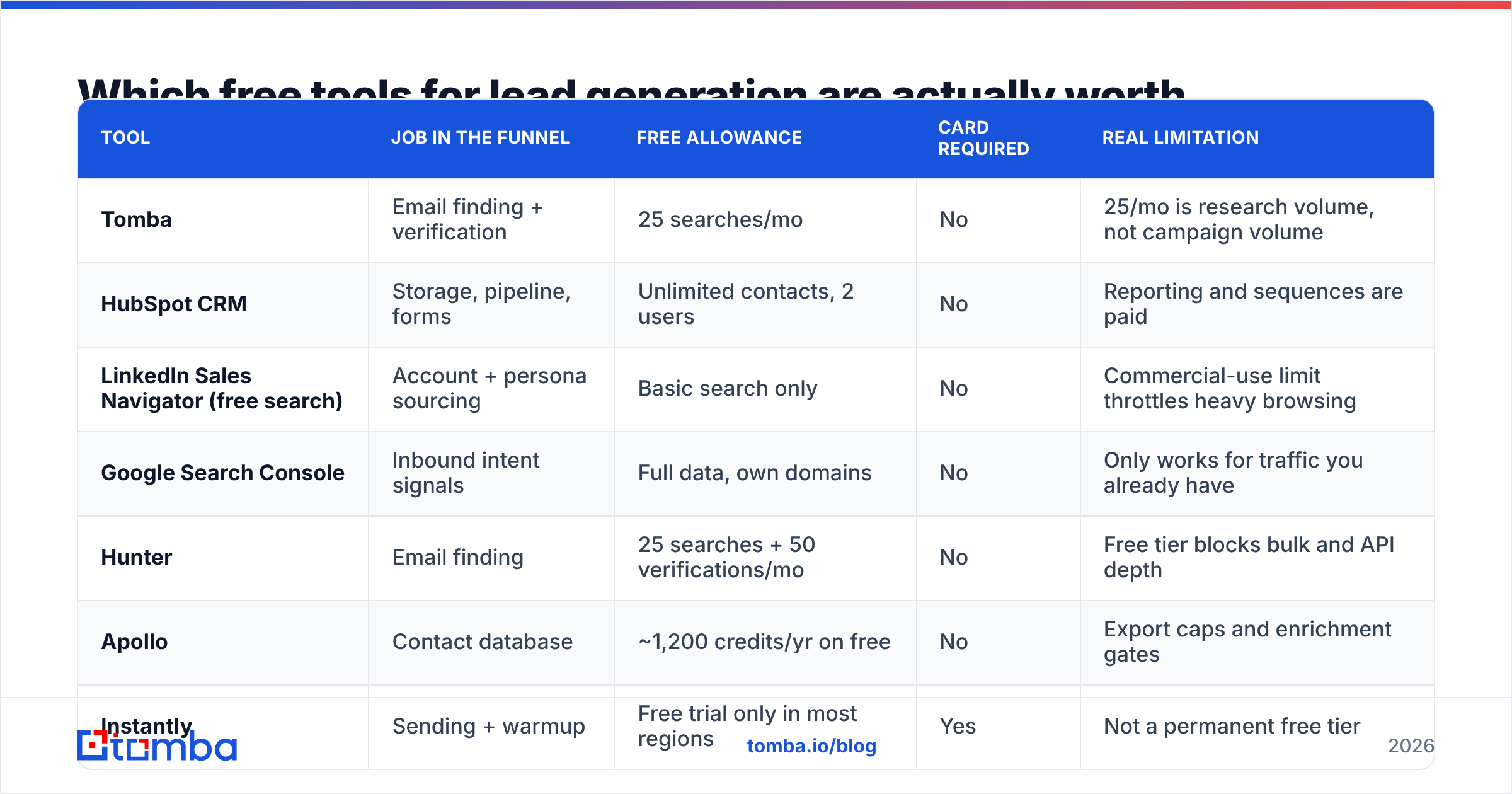
Here's the honest comparison. Limits reflect publicly advertised free tiers as of 2026; vendors adjust these, so confirm before you build a process on top.
| Tool | Job in the funnel | Free allowance | Card required | Real limitation |
|---|---|---|---|---|
| Tomba | Email finding + verification | 25 searches/mo | No | 25/mo is research volume, not campaign volume |
| HubSpot CRM | Storage, pipeline, forms | Unlimited contacts, 2 users | No | Reporting and sequences are paid |
| LinkedIn Sales Navigator (free search) | Account + persona sourcing | Basic search only | No | Commercial-use limit throttles heavy browsing |
| Google Search Console | Inbound intent signals | Full data, own domains | No | Only works for traffic you already have |
| Hunter | Email finding | 25 searches + 50 verifications/mo | No | Free tier blocks bulk and API depth |
| Apollo | Contact database | ~1,200 credits/yr on free | No | Export caps and enrichment gates |
| Instantly | Sending + warmup | Free trial only in most regions | Yes | Not a permanent free tier |
| Clay | Enrichment workflows | 100 credits/mo | No | Credits burn fast on multi-step tables |
| Google Sheets | Workspace + dedupe | Unlimited | No | You build the logic yourself |
A few things jump out of that table.
First, the free CRMs are the most generous category by a wide margin. HubSpot's free CRM will hold a million contacts without charging you. Vendors are happy to store your data for free because storage is the hook — the moment you want to act on it at scale, you pay.
Second, the contact-discovery tools are the stingiest. That's not accidental. Verified B2B contact data has a real marginal cost: it has to be sourced, validated against live mail servers, and refreshed as people change jobs. Nobody gives away 5,000 verified emails a month, and any tool claiming to should make you nervous about where the data came from.
Third, the utilities cost nothing because they're pure compute. An email permutator or an SPF checker doesn't touch a paid database, so there's no reason to meter it.
How do free email finder tiers compare on the numbers?#
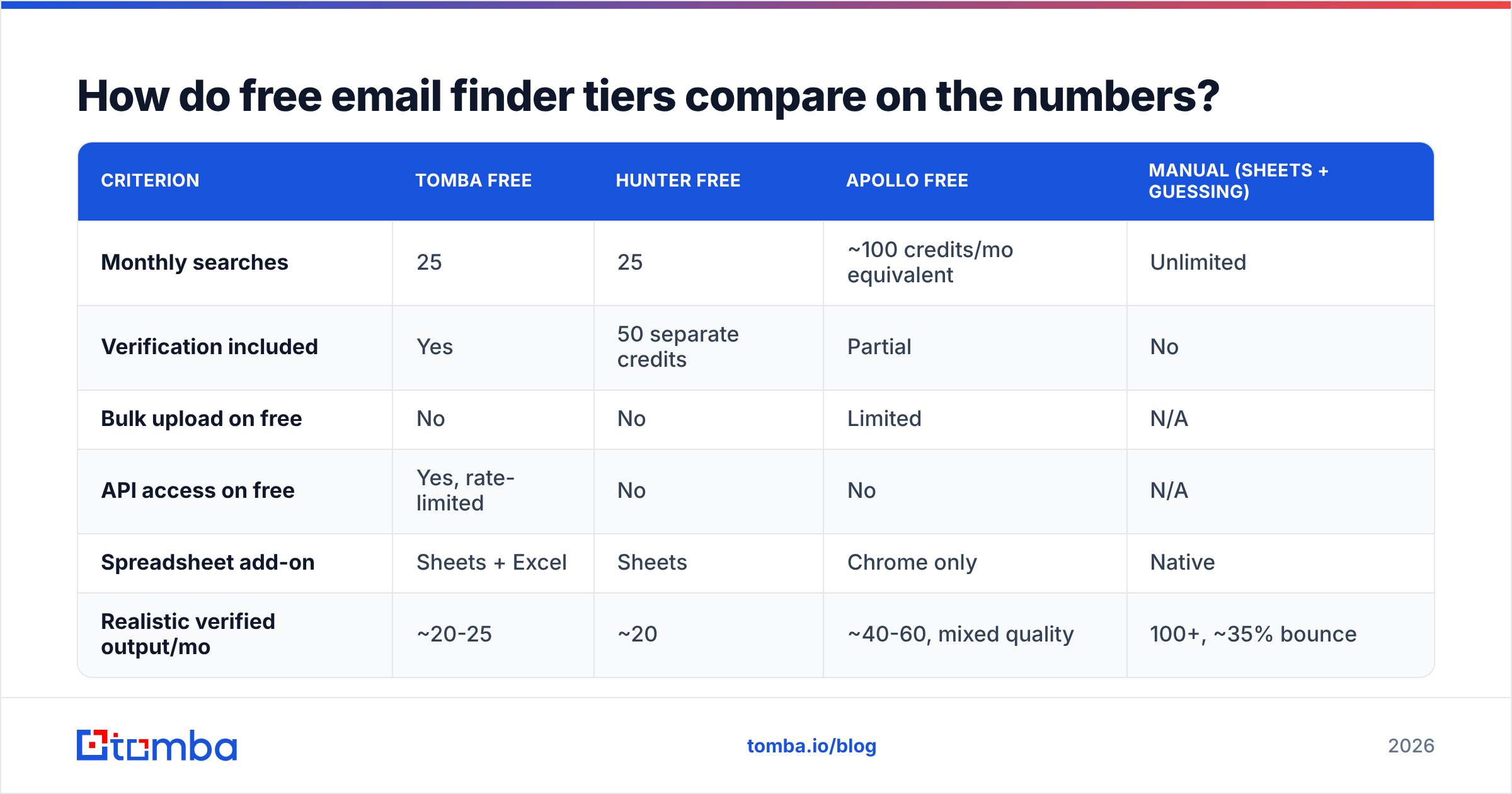
This is the part of the stack where "free" varies the most, so it deserves its own breakdown. Assume you're doing the same job in each tool: you have 100 company domains and a target job title, and you want deliverable inboxes.
| Criterion | Tomba free | Hunter free | Apollo free | Manual (Sheets + guessing) |
|---|---|---|---|---|
| Monthly searches | 25 | 25 | ~100 credits/mo equivalent | Unlimited |
| Verification included | Yes | 50 separate credits | Partial | No |
| Bulk upload on free | No | No | Limited | N/A |
| API access on free | Yes, rate-limited | No | No | N/A |
| Spreadsheet add-on | Sheets + Excel | Sheets | Chrome only | Native |
| Realistic verified output/mo | ~20-25 | ~20 | ~40-60, mixed quality | 100+, ~35% bounce |
The last row is the one that matters, and it's the row nobody publishes. Raw credit counts are marketing. What you care about is verified contacts that survive a send.
That's why the manual column is a trap. You can permutate first.last@domain.com for a thousand companies in an afternoon for free. You'll be right maybe 60-65% of the time on common patterns and far worse on companies using initials, nicknames, or acquired-brand domains. Then you send to the list, bounce at 35%, and your domain reputation takes a hit that costs you more than any subscription would have. Run any guessed list through a free email checker before it touches your sequencer — that step is non-negotiable.
If you want the pattern first, company email pattern lookup is a cheaper move than burning finder credits: identify the format once per domain, generate the rest, then verify. That single reordering can triple the effective output of a 25-credit free tier.
What does a working free lead gen stack look like?#
Five layers, each with a free option, chained so nothing gets done twice:
- Source accounts — LinkedIn basic search, G2 category pages, job boards, and funding announcements. You're building a list of companies, not people. Target 50-100 per week; anything more and you'll starve the next layer.
- Find contacts — use a domain search to pull who's publicly listed at each company, then spend your finder credits only on the roles that match your ICP. Never spend a credit on a title you wouldn't email.
- Verify before storing — every address gets checked before it enters the CRM. Catch-all domains are their own problem; treat them as a separate bucket rather than pretending they're valid.
- Enrich with one useful field — not twelve. Pick the single data point your opener actually uses (hiring for the role, recent funding, tech stack, headcount jump). Free enrichment credits are scarce, so spend them on the field that changes the email.
- Store and sequence — free CRM for storage, and either a free sending tier or your own mailbox for the first 30-40 sends a day. Do not buy a sequencer before you have proof the messaging works.
- Measure one metric — reply rate per 100 sends. Open rates have been unreliable since privacy protection started prefetching pixels; bounce rate tells you about data quality, and reply rate tells you about everything else.
The discipline here is the point. Free tiers punish sloppiness. If you burn 25 credits on unqualified accounts, you've lost the month. Teams that run free stacks successfully are usually more rigorous about ICP than teams with unlimited credits, because every credit has a visible cost.
Where do free tools for lead generation break down?#
Four predictable failure points.
Volume ceilings hit fast. 25-100 contacts a month supports maybe one campaign for one persona. If your model needs 500 touches a month to produce a meeting, free arithmetic doesn't work no matter how you stack it.
No bulk means no leverage. Almost every free tier disables bulk upload, which is precisely the feature that saves hours. One-at-a-time lookups at 20 seconds each is 8+ hours per thousand contacts. Your time is not free; if you're billing anything above $15/hour, a bulk email finder on a paid plan pays for itself before lunch on day two.
Data staleness is invisible. Around 25-30% of B2B contact records decay per year through job changes. Free tiers rarely include re-verification, so a list you built in January is measurably worse by June and you have no signal telling you so.
Integrations are the standard paywall. You can find contacts free and store them free, but pushing them from A to B automatically is almost always paid. That's the gap Zapier's free tier partially fills — and where a Google Sheets add-on quietly outperforms fancier automation, since a spreadsheet with a lookup formula is both free and scriptable.

When should you stop using free tools?#
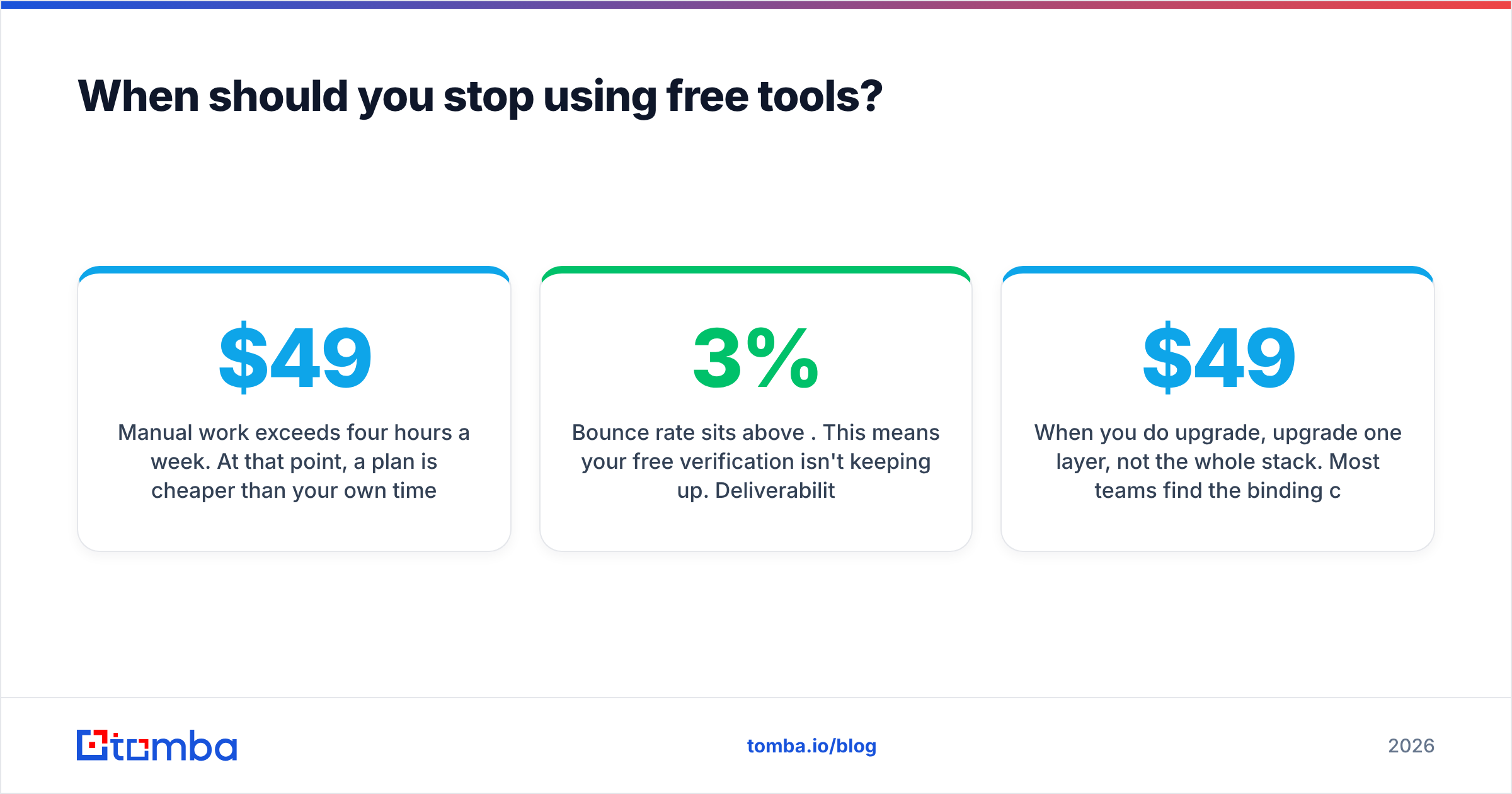
Do the math instead of guessing. Three signals mean it's time:
- You're rationing credits. If you're deciding which good-fit prospect to look up because you only have four searches left, the tool is now shaping your strategy. That's backwards.
- Manual work exceeds four hours a week. At that point, a $49/mo plan is cheaper than your own time by a factor of five or more.
- Bounce rate sits above 3%. This means your free verification isn't keeping up. Deliverability damage compounds — it's the one problem you can't fix retroactively by upgrading later.
When you do upgrade, upgrade one layer, not the whole stack. Most teams find the binding constraint is contact discovery and verification, not the CRM or sequencer. Tomba's plans start at $49/mo for Starter, $99/mo for Growth, and $249/mo for Pro, with a free tier at 25 searches per month that stays free — so you can validate the workflow before spending anything.
There's also a legitimate middle path worth naming: buying a targeted, pre-verified list from a reputable data provider like BookYourData for a specific campaign, rather than subscribing to a platform you'll only use twice a year. If your outbound is project-based rather than continuous, a one-time verified dataset can be more economical than a monthly seat. Match the purchase model to how you actually work.
How do you verify a free tool is worth adding?#
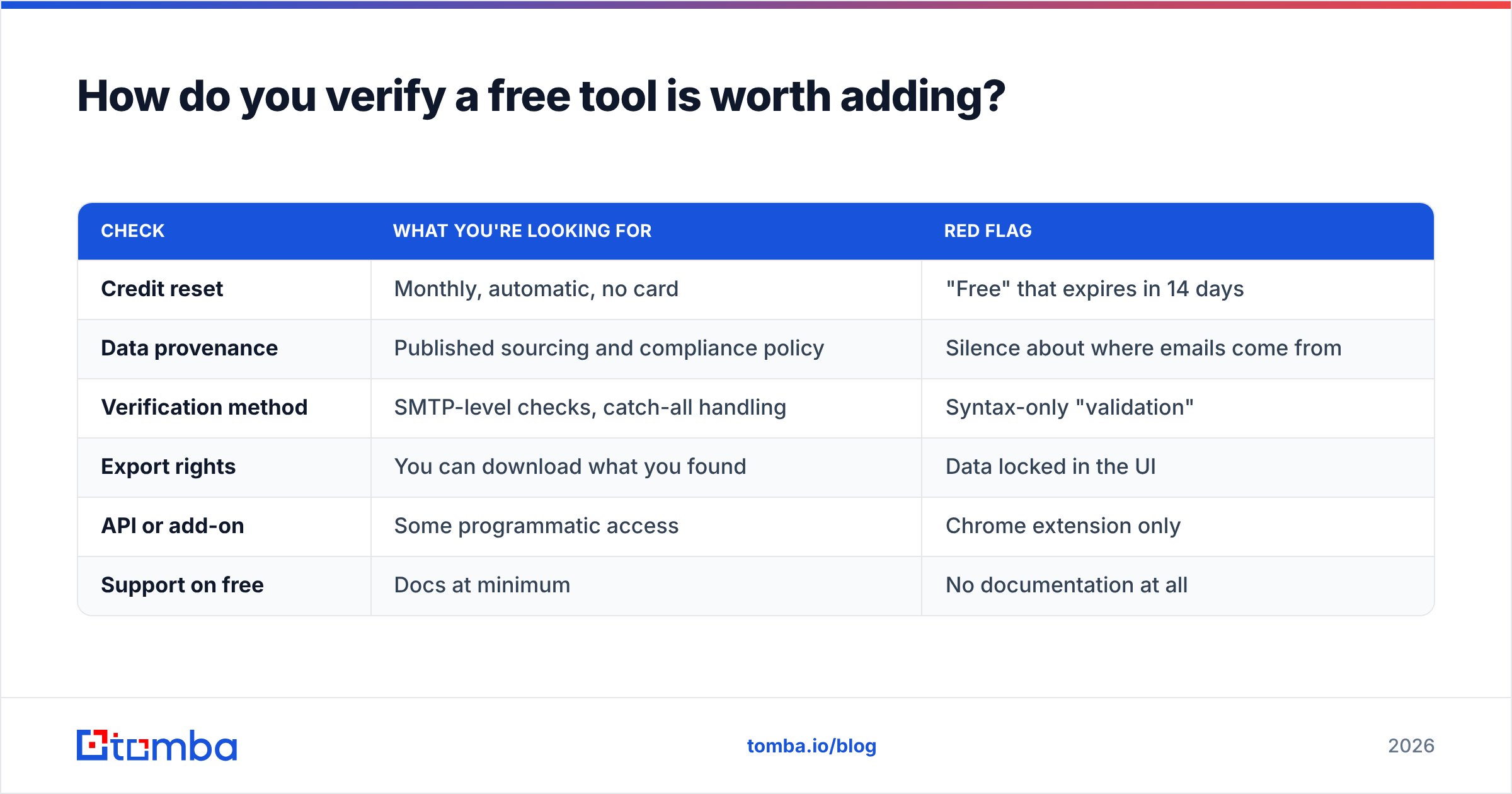
Run this five-minute audit before any tool enters your stack:
| Check | What you're looking for | Red flag |
|---|---|---|
| Credit reset | Monthly, automatic, no card | "Free" that expires in 14 days |
| Data provenance | Published sourcing and compliance policy | Silence about where emails come from |
| Verification method | SMTP-level checks, catch-all handling | Syntax-only "validation" |
| Export rights | You can download what you found | Data locked in the UI |
| API or add-on | Some programmatic access | Chrome extension only |
| Support on free | Docs at minimum | No documentation at all |
The provenance check matters more every year. Under GDPR and CCPA-style regimes, "I got it from a free tool" is not a lawful basis. Providers that publish their data sources and honor deletion requests are the ones that won't create a compliance problem eighteen months from now.
Also check whether the tool respects catch-all domains honestly. A catch-all server accepts every address, so a lazy verifier marks them all valid and your bounce rate looks great right up until it doesn't. A catch-all verifier that flags these separately is telling you the truth; a tool that returns "valid" for everything on a catch-all domain is not.
What's the fastest free workflow to run this week?#
Concrete, start-to-finish, no budget:
- Pick one ICP segment. One industry, one company size band, one job title. Resist expanding.
- Build a list of 40 companies from LinkedIn search, a G2 category, or a recent funding roundup. Domain column only.
- Run domain search on the 15 companies that fit best, pulling public contacts and the email pattern.
- Use the pattern to generate addresses for the remaining 25, then verify every one before it goes anywhere near a sequencer.
- Load survivors into a free CRM. Write one email, three variants of the first line.
- Send 30/day from a warmed mailbox. Track replies, not opens.
- After 100 sends, you'll know whether the problem is the list, the offer, or the copy — and that's what tells you which tool to actually pay for.
That loop costs nothing but a week. It's also the only reliable way to know whether a paid plan will return anything, because a paid tool applied to an unvalidated ICP just produces expensive silence faster.
The bottom line#
Free tools for lead generation are genuinely good in 2026 — good enough to validate an ICP, prove a message, and book your first meetings without a purchase order. They are not good enough to scale, and the vendors who built them know exactly where the ceiling sits.
Use free to learn. Upgrade the one layer that's constraining you, and keep everything else free until it stops working.
Start with the Tomba Email Finder — 25 searches a month on the free tier, no card, with verification built in rather than sold separately. Find the pattern, verify what you generate, and see whether your ICP actually replies before you spend a dollar on the rest of the stack.
Related guides#
Ready to find emails that actually work?
Join 150,000+ professionals who stopped guessing and started sending. Free credits on signup — no credit card required.
Get the Tomba newsletter
Practical outbound tactics and product updates — once every two weeks.
About the author